Tag Archives: Albert Bierstadt

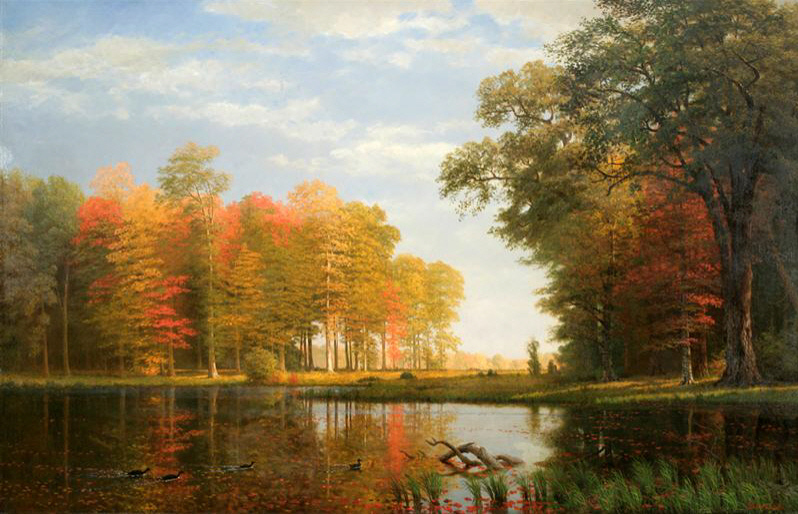
#FineArtFriday: Autumn Woods by Albert Bierstadt 1886

Artist: Albert Bierstadt (1830–1902)

Title: Autumn Woods, Oneida County, State of New York

Date: 1886

Medium: Oil on linen

Dimensions: Overall (linen): 54 x 84 in. (137.2 x 213.4 cm) Framed: 64 3/4 in. × 7 ft. 10 3/4 in. × 3 1/4 in. (164.5 × 240.7 × 8.3 cm)

Collection: New York Historical  (Gift of Mrs. Albert Bierstadt)

What I love about this painting:

Albert Bierstadt gives us a beautiful day in Glorious Autumn (with capitol letters), the kind of day rare here in my part of the Pacific Northwest. In October, rainy weather usually rolls in, accompanied by a blustery wind that strips the trees of leaves and takes the joy out of sightseeing.

Bierstadt’s trees are luminous, red and gold the way they are far away in the mystical lands on the other side of the continent from me. His sky is lovely, but he has kept our focus on the theme, so it doesn’t dominate the scene. The reflections of the trees on the quiet, still waters of the pond ensure they are the stars of this painting.

I especially like the realism of the branches of a downed tree rising out of the water in the foreground. This is a romantic depiction of what Autumn should be, as opposed to the sodden mess that it often is here in my town.

I would love to go walking along the shore of this pond.

About the Artist, via Wikipedia:

Albert Bierstadt (January 7, 1830 – February 18, 1902) was a German American painter best known for his lavish, sweeping landscapes of the American West. He joined several journeys of the westward expansion to paint the scenes. He was not the first artist to record the sites, but he was the foremost painter of them for the remainder of the 19th century.

Bierstadt was born in Prussia, but his family moved to the United States when he was one year old. He returned to study painting for several years in Düsseldorf. He became part of the second generation of the Hudson River School in New York, an informal group of like-minded painters who started painting along the Hudson River. Their style was based on carefully detailed paintings with romantic, almost glowing lighting, sometimes called luminism. Bierstadt was an important interpreter of the western landscape, and he is also grouped with the Rocky Mountain School. [1]

To read more about this artist, go to  Albert Bierstadt – Wikipedia.


Credits and Attributions:

IMAGE: Wikimedia Commons contributors, “File:Autumn Woods, Oneida County, State of New York 1910 11.jpeg,” Wikimedia Commons, https://commons.wikimedia.org/w/index.php?title=File:Autumn_Woods,_Oneida_County,_State_of_New_York_1910_11.jpeg&oldid=1069889157 (accessed October 16, 2025).

[1] Wikipedia contributors, “Albert Bierstadt,” Wikipedia, The Free Encyclopedia, https://en.wikipedia.org/w/index.php?title=Albert_Bierstadt&oldid=1308977510 (accessed October 16, 2025).

5 Comments

Filed under #FineArtFriday

#FineArtFriday: Indian Sunset – Deer by a Lake by Albert Bierstadt ca. 1880 – 90

Artist: Albert Bierstadt (1830–1902)

Title: Indian Sunset – Deer by a Lake

Date: circa 1880-1890

Medium: oil on canvas

Dimensions: height: 77.2 cm (30.3 in); width: 113.1 cm (44.5 in)

Collection: Yale University Art Gallery

What I love about this painting:

I love the way the setting sun glows through the rising mist, shining across the still waters of the lake. I love the shadowy woods, the deepening sense that twilight is near and night will soon enshroud the scene.

Deer graze in the lush meadow at the shore. Perhaps they will bed down in the shelter of the trees at the edge of the wood.

Albert Bierstadt’s landscapes made even the most ordinary scene feel majestic. One of his greatest skills was his ability to show the haze of twilight and the stillness of a pond or lake at that singular time of the late September evening, that moment when the warm breeze cools, slows, and fades to calm.

By placing wild deer in his scene, Bierstadt gives us a little story and a reason to care. It is autumn, and hunting season. Will this brief moment of peace be the buck’s last? We’ll never know, but I like to think Bambi and his family will live to see the advent of spring.

About the Author, via Wikipedia:

Albert Bierstadt (January 7, 1830 – February 18, 1902) was a German American painter best known for his lavish, sweeping landscapes of the American West. He joined several journeys of the westward expansion to paint the scenes. He was not the first artist to record the sites, but he was the foremost painter of them for the remainder of the 19th century.

Bierstadt was born in Prussia, but his family moved to the United States when he was one year old. He returned to study painting for several years in Düsseldorf. He became part of the second generation of the Hudson River School in New York, an informal group of like-minded painters who started painting along the Hudson River. Their style was based on carefully detailed paintings with romantic, almost glowing lighting, sometimes called luminism. Bierstadt was an important interpreter of the western landscape, and he is also grouped with the Rocky Mountain School. [1]

To read more about this artist, go to  Albert Bierstadt – Wikipedia.


Credits and Attributions:

IMAGE: Wikimedia Commons contributors, “File:Indian Sunset Deer by a Lake by Albert Bierstadt.jpeg,” Wikimedia Commons, https://commons.wikimedia.org/w/index.php?title=File:Indian_Sunset_Deer_by_a_Lake_by_Albert_Bierstadt.jpeg&oldid=828692957 (accessed September 18, 2025).

[1] Wikipedia contributors, “Albert Bierstadt,” Wikipedia, The Free Encyclopedia, https://en.wikipedia.org/w/index.php?title=Albert_Bierstadt&oldid=1308977510 (accessed September 18, 2025).


4 Comments

Filed under #FineArtFriday

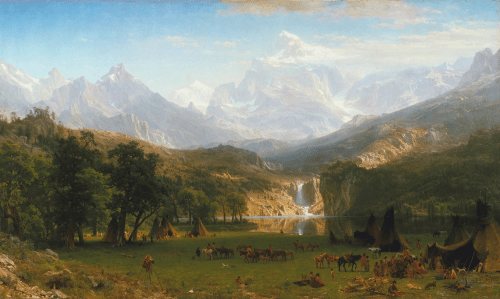
#FineArtFriday: Albert Bierstadt, The Rocky Mountains, Landers Peak 1860, revisited

When I sit down to write, my work is usually fiction. Even so, I want my work to have authenticity, although I might never have experienced what I am writing about. Whether a piece is set in an alternate world, or in this one, or if it is in the past, present, or future, a source of visual information you can use to fire your imagination exists on the internet–Wikimedia Commons.

For example, today’s image is a landscape painting by Albert Bierstadt, an American painter best known for his lavish, sweeping landscapes of the American West.  This painting shows what tribal life after a successful hunt might be like, and if you are writing about any group of people who hunt or gather food, this particular painting contain a wealth of historically accurate visual information. He painted what he saw. In all of Bierstadt’s work, you will find a world that existed 150 years ago, complete with children playing and dogs barking.

Wikipedia has this to say about the painter:

Born in Germany, Bierstadt was brought to the United States at the age of one by his parents. He later returned to study painting for several years in Düsseldorf. He became part of the Hudson River School in New York, an informal group of like-minded painters who started painting along the Hudson River. Their style was based on carefully detailed paintings with romantic, almost glowing lighting, sometimes called luminism. An important interpreter of the western landscape, Bierstadt, along with Thomas Moran, is also grouped with the Rocky Mountain School.

The life of the American West of the 19th century can be directly translated into a science fiction novel, or a fantasy novel–because the elements of hunting and gathering remain the same no matter what world you set it in. A great many people were involved in taking down a few animals–two antelope, one mountain sheep, and one bear. Hunts of this nature, even with modern weapons, are difficult and fraught with danger. For this reason, the take from this hunt will supply the entire camp of perhaps 100 people for one or two weeks., so foraging for roots, berries, and greens was an important task, as was fishing.

In this painting, you see how the tribe’s homes were constructed, and how the camp was laid out–the butchering party is well away from the rest of the camp, which is on the banks of a river. Everything that was important to the lives of these people is laid out in detail, exactly how it was the day the artist set up his easel in the wilderness and began painting.

Go to history for your world building, and go to art for your history. Don’t be afraid to ‘waste time’ looking at paintings and examining them for minute details, because your imagination will run with it, and your work will have a sense of realism.


Wikipedia contributors, “Albert Bierstadt,” Wikipedia, The Free Encyclopedia, https://en.wikipedia.org/w/index.php?title=Albert_Bierstadt&oldid=793302910 (accessed August 11, 2017).

The Rocky Mountains, Landers Peak; Albert Bierstadt 1863 [Public domain], via Wikimedia Commons, https://commons.wikimedia.org/wiki/File%3AAlbert_Bierstadt_-_The_Rocky_Mountains%2C_Lander’s_Peak.jpg, accessed August-11-2017.

3 Comments

Filed under #FineArtFriday, writing

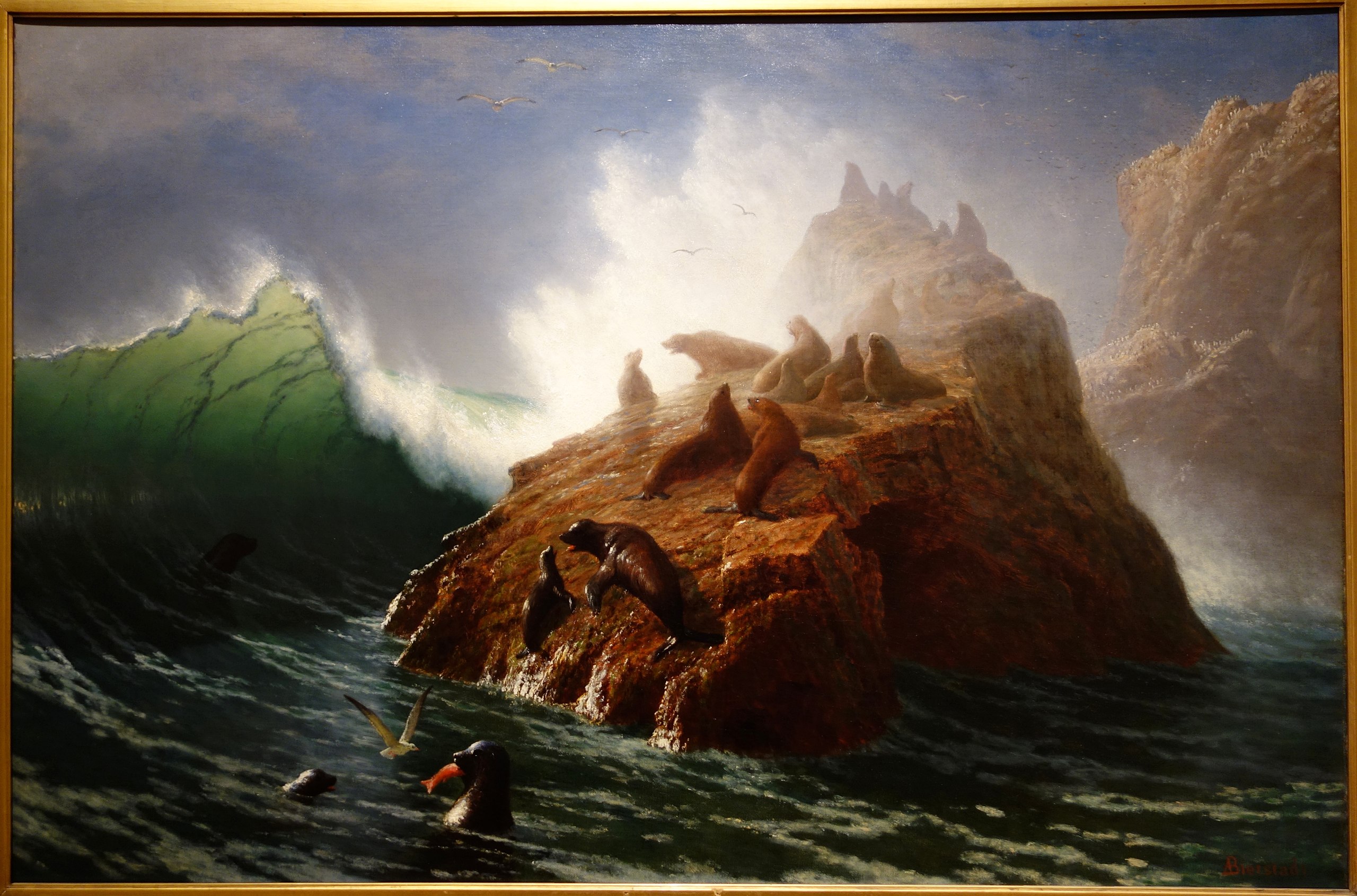
#FineArtFriday: Seal Rock by Albert Bierstadt

Artist: Albert Bierstadt (1830–1902)

Title: Seal Rock

Genre: marine art

Date: 1880s

Medium: oil on canvas

Dimensions:   height: 105 cm (41.3 in)

What I love about this painting:

It is a blustery day on the cold, wild sea. The sun briefly shines through, illuminating the rocks, glowing through a cresting wave. This is a masterful depiction of the scene, painted later in his life. It is dynamic and dramatic, conveying the power of the waves and the emotion of the scene.

Despite the efforts of the sea to wash them away, the rocks stand strong, offering a safe place for the seals.

As an avid watcher of nature shows, I love this painting.  Bierstadt captures these seals doing all the things seals do. They are fishing, lounging, and several pairs are apparently arguing.

Not unlike my family when we go out to lounge on a rock beside the sea.


About the Artist, via Wikipedia:

Albert Bierstadt (January 7, 1830 – February 18, 1902) was a German American painter best known for his lavish, sweeping landscapes of the American West. He joined several journeys of the Westward Expansion to paint the scenes. He was not the first artist to record the sites, but he was the foremost painter of them for the remainder of the 19th century.

Bierstadt was born in Prussia, but his family moved to the United States when he was one year old. He returned to study painting for several years in Düsseldorf. He became part of the second generation of the Hudson River School in New York, an informal group of like-minded painters who started painting along the Hudson River. Their style was based on carefully detailed paintings with romantic, almost glowing lighting, sometimes called luminism. Bierstadt was an important interpreter of the western landscape, and he is also grouped with the Rocky Mountain School. [1]


Credits and Attributions:

IMAGE: Seal Rock by Albert Bierstadt, Wikimedia Commons contributors, “File:Seal Rock by Albert Bierstadt, c. 1872-1887, oil on canvas – New Britain Museum of American Art – DSC09221.JPG,” Wikimedia Commons, https://commons.wikimedia.org/w/index.php?title=File:Seal_Rock_by_Albert_Bierstadt,_c._1872-1887,_oil_on_canvas_-_New_Britain_Museum_of_American_Art_-_DSC09221.JPG&oldid=975772252 (accessed March 27, 2025).

[1] Wikipedia contributors, “Albert Bierstadt,” Wikipedia, The Free Encyclopedia, https://en.wikipedia.org/w/index.php?title=Albert_Bierstadt&oldid=1277160716 (accessed March 27, 2025).

2 Comments

Filed under #FineArtFriday

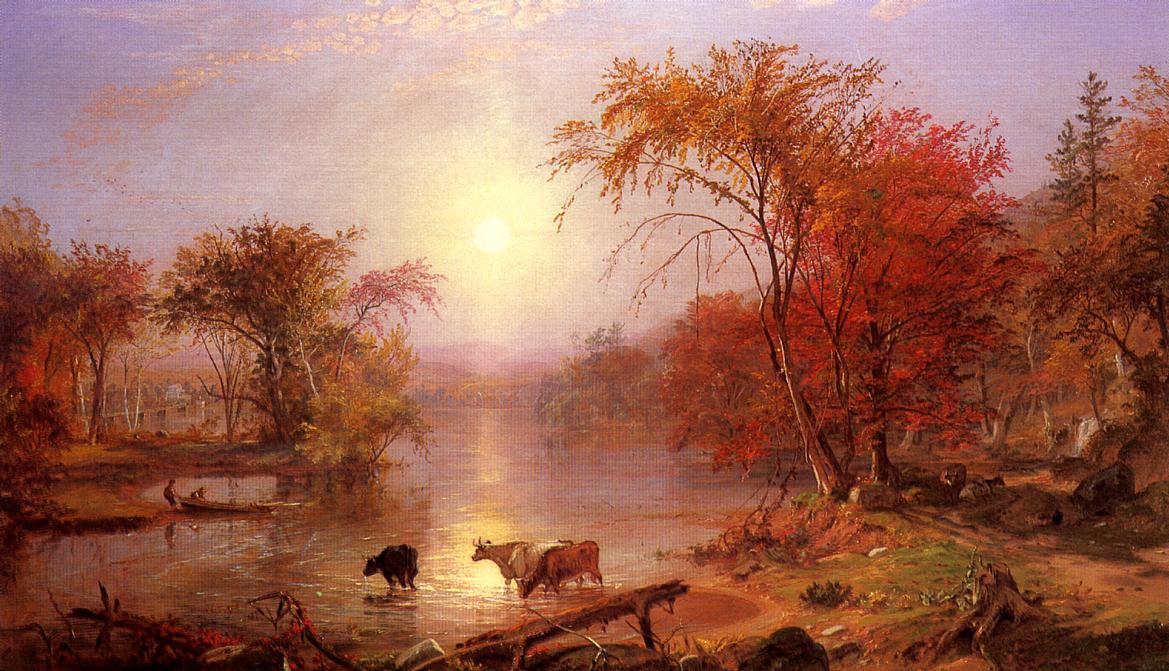
#FineArtFriday: Indian Summer on the Hudson River by Albert Bierstadt 1861

Bierstadt_Albert_Indian_Summer_Hudson_RiverArtist: Albert Bierstadt  (1830–1902)

Title: “Indian Summer on the Hudson River”

Genre: landscape painting

Date: 1861

Medium: oil on canvas

Dimensions: height: 60.9 cm (24 in); width: 104.1 cm (41 in)

What I love about this painting:

This is the quintessential autumn afternoon in New England on the Hudson River one-hundred and sixty-three years ago. The woods along the banks were old, ancient in some places. Deciduous trees like sugar maples, hornbeams, and sycamores grew along the riverbank.

In this scene, cattle are being watered while a pair of fishers pull their boat ashore, hopefully with a good catch in that basket.

One can almost hear soft splash of the occasional fish snatching waterbugs from the surface of the waters. The evening songs of the woodland birds as they settle down for the night drift across the waters. Tomorrow, the birds will take flight, heading south, while winter birds from further north will arrive and take their place.

About the artist, via Wikipedia:

Albert Bierstadt (January 7, 1830 – February 18, 1902) was a German American painter best known for his lavish, sweeping landscapes of the American West. He joined several journeys of the Westward Expansion to paint the scenes. He was not the first artist to record the sites, but he was the foremost painter of them for the remainder of the 19th century.

Bierstadt was born in Prussia, but his family moved to the United States when he was one year old. He returned to study painting for several years in Düsseldorf. He became part of the second generation of the Hudson River School in New York, an informal group of like-minded painters who started painting along the Hudson River. Their style was based on carefully detailed paintings with romantic, almost glowing lighting, sometimes called luminism. Bierstadt was an important interpreter of the western landscape, and he is also grouped with the Rocky Mountain School. [1]

Credits and Attributions:

Image: Wikimedia Commons contributors, “File:Bierstadt Albert Indian Summer Hudson River.jpg,” Wikimedia Commons, https://commons.wikimedia.org/w/index.php?title=File:Bierstadt_Albert_Indian_Summer_Hudson_River.jpg&oldid=837006005 (accessed October 11, 2024).

[1] Wikipedia contributors, “Albert Bierstadt,” Wikipedia, The Free Encyclopedia, https://en.wikipedia.org/w/index.php?title=Albert_Bierstadt&oldid=1137881139 (accessed October 10,  2024).

4 Comments

Filed under #FineArtFriday

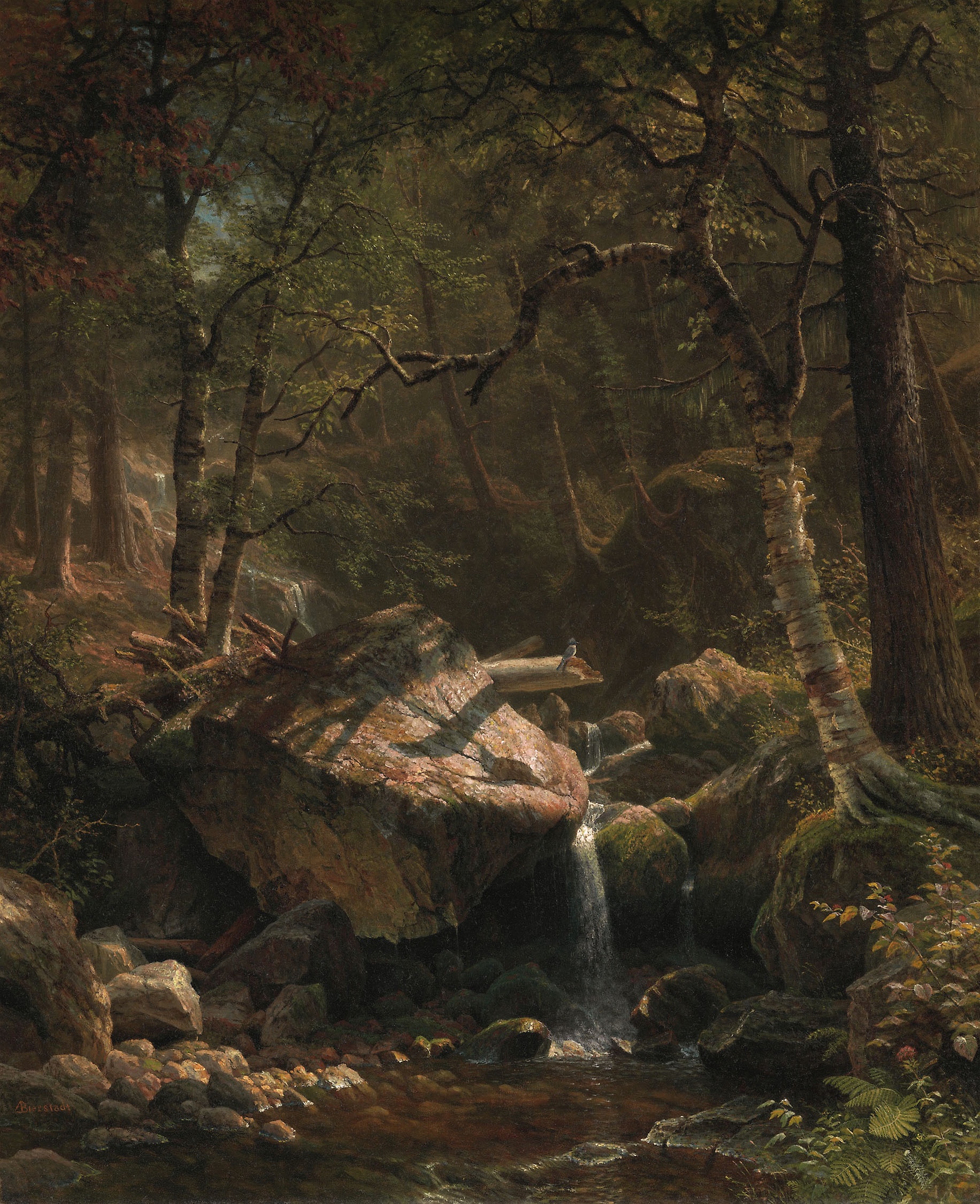
#FineArtFriday – the Mountain Brook by Albert Bierstadt 1863

Mountain_Brook_oil_1863_Albert_BierstadtArtist: Albert Bierstadt  (1830–1902)

Title: Mountain Brook

Genre: landscape painting

Date: 1863

Medium: oil on canvas

Dimensions: height: 111.8 cm (44 in); width: 91.4 cm (35.9 in)

Collection: Art Institute of Chicago

What I love about this painting:

This is an unusual subject for Albert Bierstadt. There is no immensity of sky watching over all who walk below. Instead, he gives us the immensity of a quiet wood and the solitude of a small mountain stream.

I love this peaceful glade, with the sun filtering through the forest canopy. I could sit there happily, writing the day away.

About the artist, via Wikipedia:

Albert Bierstadt (January 7, 1830 – February 18, 1902) was a German American painter best known for his lavish, sweeping landscapes of the American West. He joined several journeys of the Westward Expansion to paint the scenes. He was not the first artist to record the sites, but he was the foremost painter of them for the remainder of the 19th century.

Bierstadt was born in Prussia, but his family moved to the United States when he was one year old. He returned to study painting for several years in Düsseldorf. He became part of the second generation of the Hudson River School in New York, an informal group of like-minded painters who started painting along the Hudson River. Their style was based on carefully detailed paintings with romantic, almost glowing lighting, sometimes called luminism. Bierstadt was an important interpreter of the western landscape, and he is also grouped with the Rocky Mountain School.

In 1851, Bierstadt began to paint in oils. He returned to Germany in 1853 and studied painting for several years in Düsseldorf with members of its informal school of painting. After returning to New Bedford in 1857, he taught drawing and painting briefly before devoting himself full-time to painting.

Bierstadt’s popularity in the U.S. remained strong during his European tour. The publicity generated by his Yosemite Valley paintings in 1868 led a number of explorers to request his presence as part of their westward expeditions. The Atchison, Topeka, and Santa Fe Railroad also commissioned him to visit and paint the Grand Canyon and surrounding region.

Despite his popular success, Bierstadt was criticized by some contemporaries for the romanticism evident in his choice of subjects and for his use of light, which they found excessive.

Some critics objected to Bierstadt’s paintings of Native Americans based on their belief that including Indigenous Americans “marred” the “impression of solitary grandeur.” [1]


Credits and Attributions:

IMAGE: Wikimedia Commons contributors, Mountain Brook by Albert Bierstadt, Public domain, via Wikimedia Commons Commons, https://commons.wikimedia.org/w/index.php?title=File:Bierstadt_Albert_Bavarian_Landscape.jpg&oldid=823443562 (accessed July 25, 2024).

[1] Quote: Wikipedia contributors, “Albert Bierstadt,” Wikipedia, The Free Encyclopedia, https://en.wikipedia.org/w/index.php?title=Albert_Bierstadt&oldid=1210445403 (accessed July 25, 2024).

3 Comments

Filed under #FineArtFriday

#FineArtFriday: Bavarian Landscape by Albert Bierstadt

Bierstadt_Albert_Bavarian_LandscapeArtist: Albert Bierstadt  (1830–1902)

Title: Bavarian Landscape

Genre: landscape art

Date: possibly between 1853 and 1857

What I love about this painting:

Albert Bierstadt is one of my favorite artists. He loved the power of nature. His colors are strong, and he employs contrast to good effect. In this painting of cattle in a field, he manages to make even the simplest scene feel epic.

This is one of his earlier works, but the sky is pure Bierstadt—immense, powerful, the vaults of heaven reigning over the world below.

We see a lush, fertile farm with healthy cattle in the foreground. The dark clouds in the distance tell us a summer storm looms, but for us, the sun still shines overhead.

About the artist, via Wikipedia:

Albert Bierstadt (January 7, 1830 – February 18, 1902) was a German American painter best known for his lavish, sweeping landscapes of the American West. He joined several journeys of the Westward Expansion to paint the scenes. He was not the first artist to record the sites, but he was the foremost painter of them for the remainder of the 19th century.

Bierstadt was born in Prussia, but his family moved to the United States when he was one year old. He returned to study painting for several years in Düsseldorf. He became part of the second generation of the Hudson River School in New York, an informal group of like-minded painters who started painting along the Hudson River. Their style was based on carefully detailed paintings with romantic, almost glowing lighting, sometimes called luminism. Bierstadt was an important interpreter of the western landscape, and he is also grouped with the Rocky Mountain School.

In 1851, Bierstadt began to paint in oils. He returned to Germany in 1853 and studied painting for several years in Düsseldorf with members of its informal school of painting. After returning to New Bedford in 1857, he taught drawing and painting briefly before devoting himself full-time to painting.

Bierstadt’s popularity in the U.S. remained strong during his European tour. The publicity generated by his Yosemite Valley paintings in 1868 led a number of explorers to request his presence as part of their westward expeditions. The Atchison, Topeka, and Santa Fe Railroad also commissioned him to visit and paint the Grand Canyon and surrounding region.

Despite his popular success, Bierstadt was criticized by some contemporaries for the romanticism evident in his choice of subjects and for his use of light, which they found excessive.

Some critics objected to Bierstadt’s paintings of Native Americans based on their belief that including Indigenous Americans “marred” the “impression of solitary grandeur.”


Credits and Attributions:

IMAGE: Wikimedia Commons contributors, “File:Bierstadt Albert Bavarian Landscape.jpg,” Wikimedia Commons, https://commons.wikimedia.org/w/index.php?title=File:Bierstadt_Albert_Bavarian_Landscape.jpg&oldid=823443562 (accessed May 2, 2024).

Comments Off on #FineArtFriday: Bavarian Landscape by Albert Bierstadt

Filed under #FineArtFriday

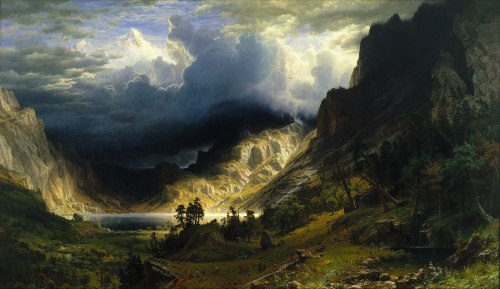
#FineArtFriday: A Storm in the Rocky Mountains – Mt. Rosalie by Albert Bierstadt 1866

Albert_Bierstadt_-_A_Storm_in_the_Rocky_Mountains,_Mt._Rosalie_-_Google_Art_ProjectArtist: Albert Bierstadt  (1830–1902)

Title: A Storm in the Rocky Mountains, Mt. Rosalie

Genre: landscape art

Date: 1866

Medium: oil on canvas

Dimensions: height: 210.8 cm (82.9 in); width: 361.3 cm (11.8 ft)

Collection: Brooklyn Museum: American Identities: A New Look, American Landscape, 5th Floor

What I love about this painting:

Albert Bierstadt painted his idea of what the American West of his time should be, grand, pristine, and wild. He painted what he saw, slightly fictionalized, so the viewer would see what he felt. He gave us entire stories on his canvas, epic explorations of the power and beauty of nature.

Bierstadt’s skies were imbued with high drama contrasted with peaceful vistas below. He took the places he had visited and made them bigger, grander, made the viewer feel the emotions he experienced when he first laid eyes on them.

About this painting via Wikipedia:

A Storm in the Rocky Mountains, Mt. Rosalie is an 1866 landscape oil painting by German-American painter Albert Bierstadt (1830-1902) which was inspired by sketches created on an 1863 expedition.

Bierstadt traveled to the Colorado Rocky Mountains where he was taken up to the Chicago Lakes beneath Mount Evans. The painting is named after Bierstadt’s mistress and, at the time, his friend’s wife, Rosalie Osborne Ludlow. The painting, measuring at 210.8 × 361.3 cm (83.0 × 142.2 in), is exhibited at the Brooklyn Museum, which acquired it in 1976.

The painting depicts Native American hunter/gatherers hunting deer in the foreground. A Native American encampment resides by a stream in the distance. The mountains are thrown into either sunlight or the darkness of a thunderstorm. In order to increase its dramatic value, Bierstadt exaggerated the scale of the Rocky Mountains.

Peering through a break in the clouds in the far distance is a snow-capped Mt. Rosalie, named after Bierstadt’s wife.

Upon its completion, the painting toured the United States for a year. On 7 February 1866, A Storm in the Rocky Mountains, Mount Rosalie exhibited for one day and evening at the Somerville Art Gallery in New York City as a benefit for the “Nursery and Child’s Hospital.” [1]

Quote from Wikimedia Commons: Albert Bierstadt enjoyed great success in the years surrounding the Civil War, producing finely detailed vistas of nature’s splendor in majestic canvases that were similarly invested with significance beyond their surface appearance.

The first technically advanced artist to portray the American West, Bierstadt offered to a rapidly transforming nation pictures whose spectacular size and fresh, dramatic subject matter supplied a visual correlative to notions of American exceptionalism, while also contributing to the developing concept of Manifest Destiny.

Trained in the highly finished manner of the Düsseldorf Academy, Bierstadt’s precise style imbued his works with a reassuring sense of veracity despite their sublime subjects and occasional liberties with geographic reality. [2]

About the Artist, via Wikipedia:

Albert Bierstadt (January 7, 1830 – February 18, 1902) was a German American painter best known for his lavish, sweeping landscapes of the American West. He joined several journeys of the Westward Expansion to paint the scenes. He was not the first artist to record the sites, but he was the foremost painter of them for the remainder of the 19th century.

Bierstadt was born in Prussia, but his family moved to the United States when he was one year old. He returned to study painting for several years in Düsseldorf. He became part of the second generation of the Hudson River School in New York, an informal group of like-minded painters who started painting along the Hudson River. Their style was based on carefully detailed paintings with romantic, almost glowing lighting, sometimes called luminism. Bierstadt was an important interpreter of the western landscape, and he is also grouped with the Rocky Mountain School.


Credits and Attributions:

Image: Wikimedia Commons contributors, ‘File:Albert Bierstadt – A Storm in the Rocky Mountains, Mt. Rosalie – Google Art Project.jpg’, Wikimedia Commons, 29 July 2023, 05:50 UTC, <https://commons.wikimedia.org/w/index.php?title=File:Albert_Bierstadt_-_A_Storm_in_the_Rocky_Mountains,_Mt._Rosalie_-_Google_Art_Project.jpg&oldid=787844562> [accessed 1 September 2023]

[1] Wikipedia contributors, “A Storm in the Rocky Mountains, Mt. Rosalie,” Wikipedia, The Free Encyclopedia, https://en.wikipedia.org/w/index.php?title=A_Storm_in_the_Rocky_Mountains,_Mt._Rosalie&oldid=1160866547 (accessed September 1, 2023).

[2] Wikimedia Commons contributors, “File:1875, Bierstadt, Albert, Mount Adams, Washington.jpg,” Wikimedia Commons, the free media repository, https://commons.wikimedia.org/w/index.php?title=File:1875,_Bierstadt,_Albert,_Mount_Adams,_Washington.jpg&oldid=272380899 (accessed March 9, 2018).

2 Comments

Filed under #FineArtFriday

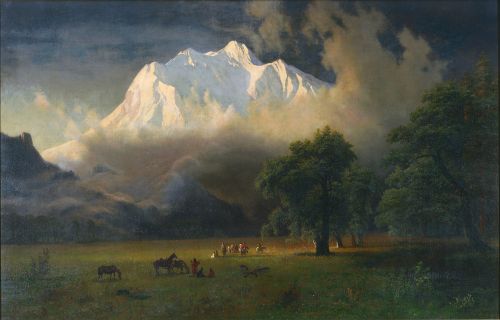
#FineArtFriday: Mount Adams by Albert Bierstadt (revisited)


I live just north of Mount Adams. When you drive down past Mt. St. Helens, you often catch glimpses of this majestic volcano, but it is not usually on the tourist routes. Several of our native tribes call this mountain Klickitat, and some call it Pahto. Although Adams has not erupted in more than 1,000 years, it is not considered extinct.

I find it interesting that while it is the second-highest mountain in Washington State, after Mount Rainier, it is the least well-known to me. As a child, we stayed at Spirit Lake Resort (long before the 1980 eruption of Mt. St. Helens) and often camped at places near Goat Rocks. Sometimes I saw it from afar and wondered but never visited.

My father was an amputee, and 1940s prosthetics were rudimentary at best. He was unable to wear his prosthetic leg and walked on crutches. He adored fishing, but couldn’t hike for any distance, so we trailer-camped in places where he could fish from a boat. While there were camp sites in the Mt. Adams area, one often had to hike into them. But despite Dad’s disability, we traveled every summer and saw as much of our beautiful state as we could.

I don’t know if Bierstadt actually visited Mt. Adams, or painted this from what he was told–he was famous for painting scenery he had never seen and doing it with some accuracy.

Quote from Wikimedia Commons: Albert Bierstadt enjoyed great success in the years surrounding the Civil War, producing finely detailed vistas of nature’s splendor in majestic canvases that were similarly invested with significance beyond their surface appearance.

The first technically advanced artist to portray the American West, Bierstadt offered to a rapidly transforming nation pictures whose spectacular size and fresh, dramatic subject matter supplied a visual correlative to notions of American exceptionalism, while also contributing to the developing concept of Manifest Destiny.

Trained in the highly finished manner of the Düsseldorf Academy, Bierstadt’s precise style imbued his works with a reassuring sense of veracity despite their sublime subjects and occasional liberties with geographic reality. In Mount Adams, Washington, he characteristically combined an impressively scaled natural background with a foreground view of American Indian life, which serves to heighten the picture’s putative realism even as it enhances its exotic appeal.

The implied movement of the clouds and the sunlit figures on horseback similarly off to the right seems to open up the depicted space for the viewer to inhabit, providing an apt pictorial metaphor for the actual occupation and exploitation of the West by the eastern interests that constituted the artist’s clientele.


Credits and Attributions:

Mount Adams by Albert Bierstadt [Public domain], via Wikimedia Commons

Wikimedia Commons contributors, “File:1875, Bierstadt, Albert, Mount Adams, Washington.jpg,” Wikimedia Commons, the free media repository, https://commons.wikimedia.org/w/index.php?title=File:1875,_Bierstadt,_Albert,_Mount_Adams,_Washington.jpg&oldid=272380899 (accessed March 9, 2018).

4 Comments

Filed under #FineArtFriday

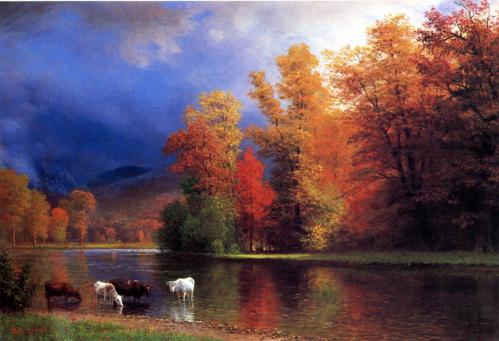
#FineArtFriday: On the Saco by Albert Bierstadt (revisited)

Bierstadt_Albert_On_the_SacoArtist: Albert Bierstadt (1830–1902)

Title: “On the Saco”

Genre: landscape art

Description: Of the Saco River, Maine.

Date: Unknown date (19th century)

Medium: oil painting.

What I love about this image:

Bierstadt understood and respected the power of nature. The way he rendered the sky is wonderful. He captured that brilliant darkness of a distant storm against the bright sunshine of an autumn afternoon. I love contrasts in this painting, the bright foliage in every shade of red and yellow, the serenity of the cattle drinking in the shallows.

The heavy darkness of the storm in the hills seems to be pushed back by the serene glow of fall’s sunlight on the river. Will it rain itself out before it passes over the herd? Possibly.

About the Artist, via Wikipedia:

Albert Bierstadt (January 7, 1830 – February 18, 1902) was a German-American painter best known for his lavish, sweeping landscapes of the American West. He joined several journeys of the Westward Expansion to paint the scenes. He was not the first artist to record the sites, but he was the foremost painter of them for the remainder of the 19th century.

Bierstadt was born in Prussia, but his family moved to the United States when he was one year old. He returned to study painting for several years in Düsseldorf. He became part of the second generation of the Hudson River School in New York, an informal group of like-minded painters who started painting along the Hudson River. Their style was based on carefully detailed paintings with romantic, almost glowing lighting, sometimes called luminism. Bierstadt was an important interpreter of the western landscape, and he is also grouped with the Rocky Mountain School. [1]


Credits and Attributions:

Image: On the Saco by Albert Bierstadt, Wikimedia Commons contributors, “File:Bierstadt Albert On the Saco.jpg,” Wikimedia Commons, the free media repository, https://commons.wikimedia.org/w/index.php?title=File:Bierstadt_Albert_On_the_Saco.jpg&oldid=618723154 (accessed September 16, 2022).

[1] Wikipedia contributors, “Albert Bierstadt,” Wikipedia, The Free Encyclopedia, https://en.wikipedia.org/w/index.php?title=Albert_Bierstadt&oldid=1107140650 (accessed September 16, 2022).

Comments Off on #FineArtFriday: On the Saco by Albert Bierstadt (revisited)

Filed under #FineArtFriday