Tag Archives: #amwriting

World Building – creating political structures #amwriting

Every society, fantasy, sci-fi, or real-world, must have an overarching political structure—a government of some sort. Humans are tribal – like all primates we are comfortable when we have a hierarchy of decision-makers to guide the tribe.

A simple society might consist of an elder and several trusted advisors.

A more complex society might have a monarch leading a society composed of multiple layers:

Monarch/Royalty

→Nobility

→→Lesser Nobility

→→→Upper Middle Class

→→→→Middle Class

→→→→→Lower Middle Class

→→→→→→Lower Class

→→→→→→→Poorest Class

Every human society, large or small, is divided into layers and classes, whether we want to admit it or not. Change the word “Monarch” to “Mayor,” Governor,” “President,” “Pope,” or “Prime Minister,” and the society they lead falls into the same layers.

This is because someone is always more important, richer, has more power, makes the rules.

The politics of a society are an invisible construct that affects every aspect of a story, even if it isn’t directly addressed. Our characters have a place within that structure. When you know what that place is, you write their story accordingly. If you know your characters’ social caste, you know if they are rich or poor; hungry or well-fed. This will shape them throughout the story:

  • Hunger drives conflict
  • Well-fed could mean a complacent society

Every society has laws, inviolable rules. Breaking these laws has consequences.

Some small tribal societies have unwritten codes of ethics, but they are as firmly enforced as any written laws. When a character goes against the commonly accepted rules, they must face the consequences.

That flouting of civil laws is an opportunity for conflict.

Sometimes I run short of words on a new project but I can’t set it aside. At that point I go deep into the backstory and examine the hidden underpinnings of their society. Little, if any, of this backstory will enter into the finished product. But I have found that when my characters are sure of what their station in society is, I can write their journey with confidence and authority.

I need to know who they are, how they see themselves and their future, and how they fit organically into their world.

One aspect that is a hidden support structure of every fantasy society is the government.  Even if it doesn’t come into the story, take a few moments to examine the political power structure of your world. It’s a good idea to write down a page or so of information detailing the political and monetary structure of the world your characters inhabit.

As I create the political power-structure, I find that the opportunities for creating tension within the story also grow. I keep a list of those ideas so that when I run short on creativity, I have a bit in the bank, so to speak.

However, in order to convey that information logically and without contradictions, you must have an idea of how things work. Does the government/legal system affect your characters? If not, this exercise is a waste of time, sorry.
  • Who has the power and privilege in that society, and who is the underclass?
  • How is your society divided? Who has the wealth?
  • Who has the power? Men, women—or is it a society based on mutual respect? Is one race more entitled than another?
  • Monarchy, Elected officials, Warlords, Shamans, or what?
  • How do they get that power? Hereditary, elected, military coup?
  • What laws affect your characters or hinder them?
  • How are the governing people perceived? Foolish or wise? Honest or Corrupt?
  • What place does religion have in this society? We examined religion last week in the post Creating Power Structures and Religions.
  • What passes for morality? You only need to worry about the moral dilemmas that come into your story.
  • If a character goes against society’s unwritten or moral laws, what are the consequences?

One critical aspect of society that governments have control of is money. If you have a fantasy society, design a simple monetary system. Keep it simple, so you don’t contradict yourself over the course of the story.

I use the same system in all three of my fantasy worlds. A Gold is comprised of 10 Silvers. A Silver is comprised of 10 Coppers.

In a sci-fi world, you can get away with using a blanket term like credits. These are easy concepts for a reader to imagine without your having to go into detail. Examples might be:

  • Innkeeper: “A mug of ale is three coppers. No coppers, no ale.”
  • Spaceport pawnbroker: “It’s unregistered. A weapon like this is worth five hundred credits, don’t you agree?”

If you’re writing in a speculative fiction world and you absolutely must use created names for money and positions, make those words simple to read and pronounce, and once you have established them, don’t deviate from them.

Good world building takes the familiar and shapes it into unfamiliar ways. It’s only my opinion, but I suggest you keep to familiar terms for leaders. King/queen, president, mayor, admiral, captain—these are terms that convey an image with no effort on your part. Anything the reader doesn’t have to research is good. If you are too enthusiastic in creating an entire language in order to convey a sense of foreignness, you have gone to a great deal of trouble only to lose the majority of readers.

When you are building a world that only exists on paper, you must be sparing with the space you devote to conveying the social, religious, and political climate of your story.  This is atmosphere. This is knowledge the characters have, but the reader does not.

There is no need to have an introductory chapter describing the laws and moral codes of the religious order of St Anthony, or the political climate of East Berlin in 1962. The way you convey this is to show how these larger societal influences affect your character and his/her ability to resolve their situation.

You show this in small ways, with casual mentions in conversation ONLY when it becomes pertinent, and not through info dumps.

Familiar words convey familiar images. Use them wisely in showing an entire fantasy world. Consider the politics in a medieval setting:

Setting:

  1. the village of Imaginary Junction, in the Barony of Blackthorn.

General atmosphere:

  1. the weather is unseasonably cold

Introduce the protagonist and show him in his situation:

  1. In an alley, a bard, Sebastian, is  hiding.

Introduce the antagonist(s):

  1. Soldiers of Baron Blackthorn, whom Sebastian has inadvisably humiliated in a song are searching for him.

Introduce the way politics and power affect the protagonist:

  1. the soldiers surround and capture Sebastian
  2. he is hauled before the angry baron and
  3. thrown into prisonsentenced to hang at dawn.

The bolded words above offer a reader powerful images of both the physical and political world Sebastian lives in. These words are familiar to every reader of fantasy. They convey emotions and a feudal atmosphere without you having to resort to an info dump of the history of Imaginary Junction.

Show the coldness of the alley, show the irate nobleman’s anger, show the wretchedness of the protagonist in prison, show the arrogance of the soldiers. Use familiar terms to convey entire packets of images wherever possible, and they will be unobtrusive, allowing the reader to live the story, to fear the coming dawn as much as Sebastian does.


Image Credits and Attributions:

Henry VIII by Hans Holbein 1540 / Wikimedia Commons contributors, “File:Enrique VIII de Inglaterra, por Hans Holbein el Joven.jpg,” Wikimedia Commons, the free media repository, https://commons.wikimedia.org/w/index.php?title=File:Enrique_VIII_de_Inglaterra,_por_Hans_Holbein_el_Joven.jpg&oldid=344005488 (accessed June 2, 2019

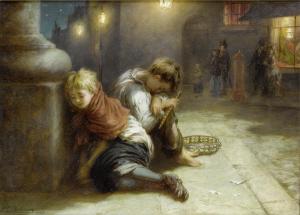
Wikimedia Commons contributors, “File:Augustus Edwin Mulready Fatigued Minstrels 1883.jpg,” Wikimedia Commons, the free media repository, https://commons.wikimedia.org/w/index.php?title=File:Augustus_Edwin_Mulready_Fatigued_Minstrels_1883.jpg&oldid=335802594 (accessed June 2, 2019).

Wikimedia Commons contributors, “File:Ernst Meyer – A Roman Alley – KMS2097 – Statens Museum for Kunst.jpg,” Wikimedia Commons, the free media repository, https://commons.wikimedia.org/w/index.php?title=File:Ernst_Meyer_-_A_Roman_Alley_-_KMS2097_-_Statens_Museum_for_Kunst.jpg&oldid=330745323 (accessed June 2, 2019).
7 Comments

Filed under writing

World Building: Creating Power Structures and Religions #amwriting

ALL societies have an overarching power structure of some sort because someone has to be the leader. Similarly, all smaller segments within societies, from families to business, to churches, to governments have organized leadership structures, even if they aren’t formally described as such.

Power structure: the hierarchy that encompasses the most powerful people in an organization. An overall system of influence between individuals within any selected group of people.

Leader

→Assistant Leader(s)

→ →Assistant(s) to the Assistant Leader(s)

→ → → Middle-Level Clawing-their-way-to-Assistant Assistants

→ → → →Lower-Level-Hoping-to Survive-to-Retirement Assistants

→ → → → →Peons-Who-Do-the-Actual-Work-But-Don’t-Get-to-be-Called-Assistants

Religion rarely is a component of sci-fi but often figures prominently in fantasy work.

This is because a common way to train magic-gifted people is by apprenticeships, religious orders, or a school of some sort.

If you are taking the religious route, how important is the actual worship of the deity(s) in your tale?

Is there one god/goddess or many?

Benevolent or malevolent?

In many historical societies in this world, the Church/Temple was the governing power. The head of the religion was the ruler, and the higher one rose within the religious organization, the more power one had.

SO, in your world, how important is religion to your characters’ journey?

To convey that information logically and without contradictions, you must have an idea of how things work in the cities and towns, the segments of society outside the church.  Merchants, priests, teachers, healers, thieves—each occupation has a place in the hierarchy.

  • Is religion central to the governance of the society, or is it a peripheral, perhaps nonexistent thing?
  • What segment of society outside the church has the power and privilege, and who is the underclass?
  • How does the underclass live, and what is the role of religion in keeping them in their place?
  • How is your society divided? Who has the wealth?
  • Who has the power? Men, women—or is it a society based on mutual respect? Is one race more entitled than another?
  • What passes for morality? Is sex before marriage taboo? What constitutes murder, and how is it viewed? You only need to worry about the moral dilemmas that come into your story.
  • If a character goes against society’s unwritten or moral laws, what are the consequences?

If the worship of a deity is a key part of your tale, you must design the entire theology. You must know the rituals and know how their deity holds their hearts. You must know how that deity considers his/her worshipers.

  1. What sort of political power does the priestly class wield?
  2. What is the internal hierarchy of the priesthood?
  3. Who has the power?
  4. Is this religion a benevolent entity or all-powerful, demanding, harsh?
  5. How does the priesthood interact with the community?
  6. Who can join the priesthood?
  7. Do people want to join the priesthood, or do they fear it? How is the priesthood trained?

In the Tower of Bones series, the overarching government in Neveyah is the Temple of Aeos, which is really a large commune run by mages. Mage-gifted children must be trained, and a school exists for that purpose. Aeos is the Goddess of Hearth and Home, so her style is a gentler, community based kind of religion.

Tauron is the Bull God, who rules the world of Serende, but who wants to be the only god in the universe. Hoping to force Aeos to become his wife, Tauron has attacked and imprisoned Aeos’s husband, the Mountain God Ariend, and has taken half of Ariend’s world. In Tauron’s world, only the strongest are worthy of survival.

Aeos managed to find her husband’s prison and reclaimed half his world, but she can’t undo another god’s work. Thus, her husband’s prison remains a prize in the ongoing war of the gods.

These actions of the deities brought civilization to its knees on the three worlds. At the time of the Tower of Bones series, the worlds have mostly recovered.

When I created the religious power-structure in the Tower of Bones series, the opportunities for creating tension within the story grew exponentially.

As I said, the underlying premise of the story is that the gods are at war. But the imprisonment of Ariend caused the Universe to bar the deities from acting directly against each other ever again.

Thus, their battles are fought through their people, their clergy who are gifted with the ability to use magic.

When one god makes a move that affects the balance of the worlds, the others make a change to counter it and their people are the playing pieces in their great game.

That meant I had two radically different religions to create, that of Aeos, and that of Tauron. Highly structured religion is central to my characters’ worlds of Neveyah and Serende. Their places in their respective societies revolves around their positions within those hierarchies.

But what if your work has no religious element?

On Monday, we will explore creating political power structures.


Credits and Attributions:

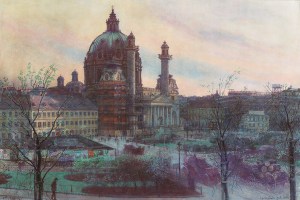
Wikimedia Commons contributors, “File:Carl Pippich Karlskirche Wien.jpg,” Wikimedia Commons, the free media repository, https://commons.wikimedia.org/w/index.php?title=File:Carl_Pippich_Karlskirche_Wien.jpg&oldid=234767606 (accessed May 29, 2019).

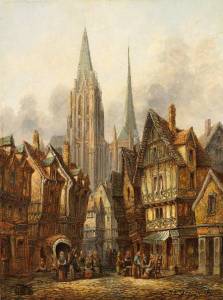
Wikimedia Commons contributors, “File:Dommersen Gothic cathedral in a medieval city.jpg,” Wikimedia Commons, the free media repository, https://commons.wikimedia.org/w/index.php?title=File:Dommersen_Gothic_cathedral_in_a_medieval_city.jpg&oldid=319795786 (accessed May 29, 2019).

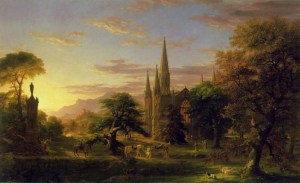
Wikimedia Commons contributors, “File:Cole Thomas The Return 1837.jpg,” Wikimedia Commons, the free media repository, https://commons.wikimedia.org/w/index.php?title=File:Cole_Thomas_The_Return_1837.jpg&oldid=301862305 (accessed May 29, 2019).

6 Comments

Filed under writing

World Building – Where Magic and Science Converge #amwriting

Today we are examining the close relationship of two facets of world building in speculative fiction, science, and magic. Both are tools our characters employ.

Science is not magic. It is logical, rooted in the realm of real theoretical physics. The writer of true science fiction must know the difference, and never “let the streams cross.”

Egon: Don’t cross the streams.

Peter: Why?

Egon: It would be bad.

Peter: I’m fuzzy on the whole good/bad thing. What do you mean “bad”?

Egon: Try to imagine all life as you know it stopping instantaneously and every molecule in your body exploding at the speed of light.

~ Ghostbusters, Screenwriters: Dan Aykroyd and Harold Ramis, for Columbia Pictures, ©1984

Magic is not an accepted trope of hard science fiction so don’t even try to justify it. If you are writing a sci-fi fantasy mix, don’t try to pass it off as hard sci-fi. It is science-fantasy at that point, a subgenre of spec-fic.

Mushy science is just as offensive to fans of hard sci-fi as magic is, maybe more. Mushy science means the author didn’t research the possibilities thoroughly. When science fails the truth test, hard sci-fi fans will voice their opinions in bad reviews.

Those of us who are physics-geeks know what the cutting edge of propulsion technology is.  We read publications that tell us the new advances in laser tech. We know what is being discovered about exoplanets, how nothing truly earthlike has been discovered as of this writing.

We know all the ways currently being discussed regarding terraforming Mars. This planet is in our backyard and is within humanity’s grasp if we can work together and keep the greedy hotheads running our many different countries from screwing it up for the rest of us. So many possibilities, so many stories to imagine and write.

But what of Interstellar Propulsion? After all, we want to get to these newly found exoplanets and see if we can either adapt to them or make them fit us. My current favorite way to bring humans to another world is through the use of generation ships. Entire colonies living for generations on a moon-sized ship, traveling through the cosmos offers so many opportunities for drama. For some good research-reading and a plethora of ideas to investigate further, check out Futurism: Here is the Future of Interstellar Spacecraft.

When writing science fiction, the science is fundamental to the world:

Communications – This is the Future of Communication Thanks to Technology

Transportation – What’s the Future of Transportation?

Agriculture – High-rise Urban Farming

Waste management – The future of waste: five things to look for by 2025

Resource management – Resources for the Future: website  https://www.rff.org/

The environment of any spacefaring society must be created of technology, or they would not be able to leave the safety of this world. Earth is the only world known to harbor life as we know it.

Writers of science fiction must become futurists. They must take what is theoretically possible and think ahead. Your task is to take what science says is conceivable and make it feel true and solid.

Know the limits of whatever theoretical tech you are exploring in your work, write stories that stretch them, but don’t ignore them “for the sake of the story.” Limits are what keeps science from feeling like magic.

So, now we agree that science should never feel like magic. But shouldn’t magic feel like magic? Yes, but just like science, magic shouldn’t confer absolute power.

In both science and magic, forcing our characters to work around the limits is the key to good stories.

For me, as a reader, magic should only be possible if certain conditions have been met. This means the author has created a system that regulates what is possible. Magic works

  • if the number of people who can use it is limited.
  • if the ways in which it can be used are limited.
  • if the majority of mages are limited to one or two kinds of magic and only certain mages can use every kind of magic.
  • if there are strict, inviolable rules regarding what each kind of magic can do and the conditions under which it will work.
  • if there are some conditions under which the magic will not work.
  • if the damage it can do as a weapon or the healing it can perform is limited.
  • if the mage or healer pays a physical/emotional price for the use.
  • if the mage or healer pays a hefty price for abusing it.
  • if the learning curve is steep and sometimes lethal.

These conditions set the stage for you to create the Science of Magic, an underlying, invisible layer of the world you have built, one that possibly won’t get mentioned. But if you create this “science” and follow the arbitrary rules you have designed, your story won’t contradict itself.

For example, if in chapter three you declare that lightning mages cannot sense their magic in the rain, then it stands to reason they cannot sense it if immersed in a river in chapter twenty-three.

What challenges does your character have to overcome when learning to wield magic?

  • Are they unable to fully use their abilities?
  • If that is so, what is the block?
  • How does that inability affect their companions, and how do they feel about it?
  • Are the companions hampered in any way themselves?
  • What has to happen before your hero can fully realize their abilities?

Even if this aspect does not come into the story, for your own information, you should decide who is in charge of teaching the magic, how that wisdom is dispensed, and who will be allowed to gain that knowledge.

  • is the prospective mage born with the ability to use magic or
  • is it spell-based and any reasonably intelligent person can learn it if they can find a teacher?

This is where science and magic converge. Magic and the ability to wield it confers power. Good technology does the same.

Merlin, by Douglas Baulch, Via Wikimedia Commons

That means the enemy must have access to equal or better Science/Magic. So, if the protagonist and their enemy are not from the same “school,” you now have two systems to design for that story. You must create the ‘rules of magic’ or ‘the limits of science’ for both the protagonist and antagonist. Take the time to write it out and be sure the logic has no hidden flaws.

In creating science technologies and magic systems, you are creating a hidden framework that will support and advance your plot. Within either system, there can be an occasional exception to a rule, but there must be a good reason for it, and it must be clear to the reader why that exception is acceptable.

An important thing to consider whether using magic or technology: the only time the reader needs to know these systems exist is when it affects the characters and their actions. Dole information out in conversations or in other subtle ways and it will become a natural part of the environment rather than an info dump.

Science and magic are two sides of the personal-power coin we who write the two radically divergent sides of speculative fiction give our characters. In either sub-genre, these fundamental tropes offer your characters opportunities for success, but those opportunities must not be free and unlimited.

In both sci-fi and fantasy, the struggle is the story. How the characters overcome the limitations takes a person out of their comfortable environment. Roadblocks to success forces ordinary people to become more than they believe they are.

They become heroes.


Credits and Attributions:

Quote from the movie, Ghostbusters, Screenwriters: Dan Aykroyd and Harold Ramis, for Columbia Pictures, ©1984, Fair Use.

Ghostbusters theatrical release poster, Columbia Pictures ©1984, Fair Use.

Merlin, by Douglas Baulch, Via Wikimedia Commons


10 Comments

Filed under writing

World building Part 2 – the Commonalities of Need #amwriting

Need shapes the environment and forms an obvious but unobtrusive layer of the world our characters inhabit.

What our characters do for a living, the tools they use, what they must acquire – these things form a layer that grows out of need. This layer shows the reader the level of technology, the society they inhabit, and their standing within that culture. This layer is easy to construct in many ways but can be a stumbling block to the logic of your plot.

First, no matter what genre you are writing in, you must establish the level of technology and stick to it. Do the research and then create your technology.

The Romans had running water, central heating, and toilets in their homes. So did the Minoans. However, all their great architectural creations required human hands to do the physical work. They walked, rode horses, donkeys, or oxen, and were limited to wagons drawn by those same domestic beasts.

In the ordinary environment, cups will be cups, bowls will be bowls. The materials they are made of might be different, but those items will always be the same. Furniture will be similar—people need somewhere to sit or sleep. They need a place to cook and somewhere to store preserved food.

Clothing styles are up to you, but I suggest you keep it simple and don’t wax poetic about it.

Some aspects of a story require planning if you are to keep to the logic of your established world setting.

Characters remain the same, no matter what genre you are writing. Beneath the obvious tropes of a particular genre is a human being. Consider the soldier:

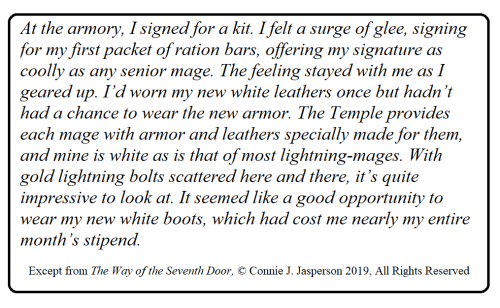
I write fantasy, so the following is an excerpt from a short story written this last year, The Way of the Seventh Door.

Worlds are like clothes. I could drop Jared into any world, and he would still be who he is—a young, hapless schmuck with potential. Genre defines the visuals, but the characters are paper dolls we dress to fit the society we have placed them in. The clothes and world of Soldier Barbie fits Corporate Barbie… and Malibu Barbie… and Star Wars Barbie.

We will take one protagonist and place them in one of three kinds of settings: fantasy, sci fi, or contemporary. As we go, write your own version of this scene.

  • A soldier, your choice of gender, gears up for an impending battle. It will take place on foreign soil and could involve personal, face-to-face combat.
  1. First, we must consider what garments they might wear.
  2. Next, we armor them.
  3. Then we give them weaponry.
  4. Finally, we equip them with some sort of rations and water, as sustenance becomes an issue if a battle stretches for several days.
  5. We do it in one paragraph.

Now let’s put Jared, my luckless protagonist from the previous example into this scenario. Fortunately for the safety of everyone in Neveyah, he isn’t preparing for war, but he does have a mission, and it requires dressing appropriately, and ensuring he has what he might need to complete it:

In any setting, there are certain commonalities with only minor literary differences for soldiers: they all need garments, weapons, armor, and sustenance, and you can use those things to

  1. offer more clues about your character’s personality and
  2. set your protagonist up for a meeting with destiny by inserting clues: white armor, new boots – what could go wrong?

Whether the weapon is a rifle, a sword, or a phaser is dependent on the level of technology you have established.

Logic determines how each need is met. In the case of weapons, within each category there are many varieties of each. Which kind of hand-held weapon your protagonist will use is dependent on their skill level and physical strength as well as what is stocked in the armory.

When it comes to weaponry, if you are writing about them, you need to research them to know what is logically possible. Within each of the three world settings, strength and skill are determining factors—a cutlass is an efficient blade and is much lighter than a claymore. A one-handed blade allows the wielder to carry a shield. A shotgun is much lighter than a machine-gun but is less effective, so be true to the logic and research what might be most useful to your characters and don’t introduce an element that doesn’t fit.

Sci-fi writers—I suggest that for advanced weaponry, you should do the research into theoretical applications of lasers, sonic, and other theoretically possible weapons. Sci fi readers know their science, so if you don’t consider the realities of physics, your work won’t appeal to the people who read in that genre.

For soldiers of any technology level, from Roman to medieval, to contemporary, to futuristic—armor will always consist of the same elements: breast and back plate, shin-guards, vambraces, a helmet of some sort, and maybe a shield. These elements won’t vary much, although the materials they’re made of will differ widely from technology to technology. For the sake of expediency and logic, garments must be close-fitting as they will go under the armor.

Expediency affects logic which affects need. The same is true for any occupation–bookkeeper, lawyer, home-maker–the setting changes from genre to genre, but the fundamental needs for each occupation remain the same.

In every aspect of a world, expediency decides what must be mentioned and how important it is. At times, you must go back to an earlier place and make changes that allow for a certain necessary turn of events.

For instance, in a battle situation, food must be extremely compact, lightweight, and must provide nutrients the soldier needs. Nutrition bars, jerky—battle rations and how the soldier carries them must be considered. How do you fit that into the world building? Casually, with one sentence, a few words.

What basic things do you need in your real-world? You need food, water, clothing, and shelter, and a means of providing those things. Place the character in a room and call it a kitchen, and the reader will immediately imagine a kitchen. Mention the coffeemaker, and the reader’s mind will furnish the cups.

Need manifests in other, more subtle ways.

Do you require a way to communicate with others quickly? Messengers, letters, telephones, social media, or telepathy? Choose a method for long distance communication that fits your technology and stick to it.

If you are writing a sci fi tale, what sort of personal power does that technology confer on the characters? What powers it? What are the limits of that technology, and how do those limits hamper the protagonist? What do they need to acquire to overcome those limitations?

If magic is a part of your world, you must design the way it is used, what powers it, and set rigid limits. Limits create opportunities for both failure and creative thinking.

In all levels of technology, some of what the characters need should be denied to them.

Obstruction offers the opportunity for heroism.

No matter the genre, need and human failure makes the story more real.

Next week, we will explore the commonalities of science and magic and how they are applied to world building.


Credits and Attributions:

Excepts from The Way of the Seventh Door, © Connie J. Jasperson 2019, All Rights Reserved.

Gladys Parker [Public domain] “Mopsy Modes” paper doll published in TV Teens, Vol. 2, No. 9 Wikimedia Commons contributors, “File:Mopsy Modes – TV Teens, Vol. 2, No. 9.jpg,” Wikimedia Commons, the free media repository, https://commons.wikimedia.org/w/index.php?title=File:Mopsy_Modes_-_TV_Teens,_Vol._2,_No._9.jpg&oldid=344503399 (accessed May 21, 2019).

Metropolitan Museum of Art [CC0] Japanese Paper Doll, ca. 1897-1898 Wikimedia Commons contributors, “File:MET DP147723.jpg,” Wikimedia Commons, the free media repository, https://commons.wikimedia.org/w/index.php?title=File:MET_DP147723.jpg&oldid=305535412 (accessed May 21, 2019).

9 Comments

Filed under writing

Fantasy Food #amwriting

As many of you know, I have been vegan since 2012. However, I write books set in fantasy environments. An important part of world building is including the appropriate food for your level of technology.

I recently read a fantasy book where the author went to a great deal of trouble to give each kind of fruit, bird, or herd beast a different (and in some cases, an unpronounceable) name in “their” language.  This ruined what could have been a great book for me. Every time the protagonists halted on their journey, they pulled some random fruit with a gobbledygook name out of the bag and waxed poetic about it.

For me, Tolkien had it right. When I am reading, I don’t want to have to learn a new language. Fantasy food should be kept to the familiar. Bacon should be bacon, apples should be apples. Food is part of the world building, so it needs to something a reader is familiar with.

During the 1980s, much of the meat I served my family, we raised ourselves. Our chickens were cage free and had good lives, and our sheep were raised using simple, old-style farming methods. I grew up fishing with my father, and I have a first-person understanding of what it takes to put meat, fish, or fowl on the table when a supermarket is not an option. Take my word for this: getting a chicken from the coop to the table is time-consuming, messy, and smelly.

SO – in a medieval setting meat won’t be served every day, and not just because it is a real job to slaughter it. Other, more subtle factors come into play, things that affect the logic of your plot.

In the middle ages, the wool a sheep could produce in its lifetime was of far more value than the meat you might get by slaughtering it. For that reason, lamb was rarely served. The only sheep that made it to the table were usually rams that were being culled from the herd. And chickens were no different because once a chicken is dead, you lose the many meals her eggs would have provided. Cattle were also more valuable alive: cows as milk producers and bulls as oxen, draft animals.

In medieval times, on many estates, it was a felony for commoners in Britain to hunt for game. However, most people were allowed to fish as long as they didn’t take salmon, so fish was on the menu more often than fowl, sheep, or cattle.

Therefore, eels, eggs, grains, and vegetables were easy and figured most prominently on the menu. Pies of all sorts were the fast food of the era.

Wheat was rare and expensive. For that reason, the grains most often found in a peasant’s home were barley, oats, and rye.

Common vegetables in medieval European gardens were leeks, garlic, onions, turnips, rutabagas, cabbages, carrots, peas, beans, cauliflower, squashes, gourds, melons, parsnips, aubergines (eggplants)—the list goes on and on. And fruits? Wikipedia says:

Fruit was popular and could be served fresh, dried, or preserved, and was a common ingredient in many cooked dishes. Since sugar and honey were both expensive, it was common to include many types of fruit in dishes that called for sweeteners of some sort. The fruits of choice in the south were lemons, citrons, bitter oranges (the sweet type was not introduced until several hundred years later), pomegranates, quinces, and grapes. Farther north, apples, pears, plums, and wild strawberries were more common. Figs and dates were eaten all over Europe but remained rather expensive imports in the north.

Even a century ago, the average person didn’t eat meat every day because it was difficult to acquire. To buy it from the butcher, you paid them for their time and labor as well as for the cut of meat. It was not cheap.

For the most part, my characters eat a medieval/agrarian diet. In medieval times, peasants ate more vegetables, grains, fruits, and nuts than the nobility did. The main source of protein would be eggs and cheese. Herbal teas, ale, ciders, and mead were also staples of the commoner’s diet because drinking fresh, unboiled water was unhealthy. Medieval brews were more of a meal than today’s beers.

So, in Huw the Bard and Billy Ninefingers, when food is mentioned, it’s likely to be oat porridge, soup or stew, ale or cider, or bread and cheese.

Billy is captain of a mercenary company and an innkeeper, and for most of his story he does the cooking. I keep the food simple and don’t make too big a deal out of it. The conversations that happen while he is trying to feed the Rowdies are more important than the food. The food is the backdrop.

For Huw (pronounced Hugh), starvation is his most urgent problem, so food and the difficulties of obtaining it are an integral part of his story at the outset.

Knowing what to feed your people keeps you from introducing jarring components into your narrative. In the world of Neveyah (Tower of Bones), my people have a New World diet. It isn’t really mentioned, but maize and potatoes are important staples as are beans and wild greens.

When it comes to writing about meals, I feel it’s best to concentrate on the conversations. The food should be part of the scenery, a subtle part of world building. The conversations that occur around food are the places where new information can be exchanged, things we need to know to move the story forward,


Credits and Attributions:

Wikipedia contributors, “Medieval cuisine,” Wikipedia, The Free Encyclopedia, https://en.wikipedia.org/w/index.php?title=Medieval_cuisine&oldid=896980025 (accessed May 14, 2019).

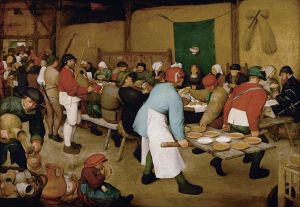
Pieter Bruegel the Elder – Peasant Wedding (1526/1530–1569) PD|100 via Wikimedia Commons

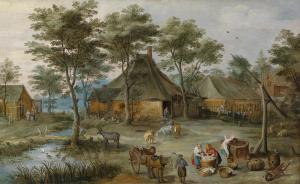
Village Scene with Well,  Josse de Momper and Jan Brueghel II PD|100 via Wikimedia Commons

14 Comments

Filed under writing

The eight forms of “be” #amwriting

It can take me several years to get a novel out of my head and into print. I write, rewrite, consider it done, and rewrite it again. Why does it take so long to write even a short story? How is it that I can write a short story in a day or two but work on it for years, trying to get it just right?

Prose.

I always begin with an excess of prose—don’t ask me why. It just is.

When I begin a project the words fall out of me in the form of “writers’ shorthand.”

I “tell” myself the story.  Then, after it has sat for a while, I have to take each instance of hokey clichés, lurid description, and nonessential background information and rewrite. All of that bad writing is, for me, a framework to hang the real story on.

I make radical, surgical changes. Sometimes it takes three or four completely new versions of a story before the one that really works emerges.

A few substantive things that might change in the revision process:

  • Character names.
  • Place names.
  • Which character the protagonist actually is.

These changes happen because of logic—if the plot isn’t logical, the story fails.

But also, the prose will undergo major surgery.

I mentioned that a first draft is a “telling” draft. The prose in that draft has to be reshaped so it is a “showing” draft. The big bugaboo my writing group helps me most with is my tendency to not see the passive phrasing in my own work. The area I am working on improving right now is my reliance on the forms of “be.”

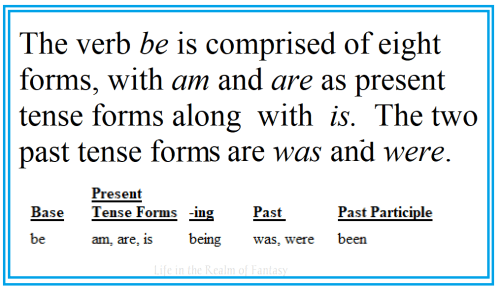
Did you know there are eight forms of the word be? I use all of them too regularly, which creates passive phrasing that is seriously difficult for me to detect. Finding and rewriting passive prose is why all my work takes so long to get into its final form. Fortunately, I have a writing group to help me down that path.

These verb forms are insidious because they are necessary. We can’t write without them. However, they are easy to rely on. We can overuse them to tell ourselves the story. In doing so, we  create prose that holds the reader slightly away from the story, making them an observer rather than a participant.

Some literary fiction is written to intentionally make the reader an observer of the human condition. This is work that requires the reader to think about the ideas and events, perhaps even to learn something. Readers deliberately seek out this kind of literature because it is challenging to read.

However, genre work is intended to be an immersive adventure, with active prose that draws the reader into that world. The reader must see the world and the events as if they are the protagonist. Through active prose, the reader becomes a participant. They may learn some things about the human condition, but they won’t consciously realize it and didn’t seek it out.

So, now you know what I am working on improving in my writing journey. The ability to write active prose in a first draft is one some of my favorite authors were born with. Others, like me, must develop it and sometimes it takes me four or five drafts before it’s done right.

8 Comments

Filed under writing

Formatting and Submission Guidelines #amwriting

Writing can be a solitary occupation, but as we gain confidence, we join writing groups and larger professional organizations. We become involved in the writing community because writers need to be able to talk about writing with people who understand. Through that network of professional acquaintances, we make connections with more experienced authors, people who are happy to mentor us. The knowledge I have gained about the craft of writing from those generous mentors has been invaluable.

Mentors have much to offer us about the mechanics of writing, such as grammar and industry practices. Also, they will often know of open opportunities our work might be suitable for, publications and anthologies with open calls. It takes courage to submit our work to any kind of contest or publication the first few times, but that is part of the process. We learn by doing.

New and beginning authors sometimes do the craziest things with their manuscripts. If you are serious about writing and submitting short stories, you must follow publisher and contest guidelines in formatting your manuscript before you submit it. No matter how pretty you make that manuscript for your own pleasure, if it doesn’t follow the submission guidelines for the place you are submitting it, you have wasted your time.

Perhaps you feel that the rules shouldn’t apply to you –  it’s your manuscript and by golly, you like the way it looks. It took you forever to make it look that good. Why should you have to take the time to completely reformat your perfectly fine manuscript to fit some stupid set of arbitrary rules no one cares about?

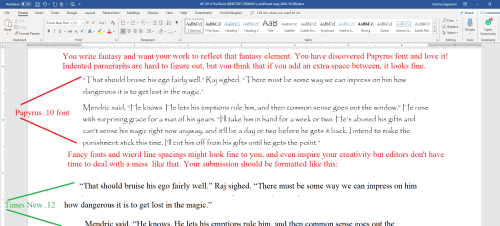
Maybe you don’t care about those rules, but editors and publishers do, and they are the people you want to please. They don’t have time to deal with a manuscript that is justified, single spaced, has block paragraphs, has an extra space between each paragraph, and is in Papyrus font .10.

When the editor of a contest, publication, or anthology opens the call for submissions, they will get hundreds of entries, perhaps thousands. When a call for submissions goes out, their editors will have no time to deal with badly formatted manuscripts.

Publication dates are set well in advance and must be adhered to. Time is always of the essence in the publishing world.

Editors are only one person, and they want to read each and every submission. Unfortunately, out of all those entries some will be great stories that won’t even be read because the author couldn’t be bothered to format the manuscript in the way that the submission rules stated.

Publishers have specific, standardized formatting they want you to use, and these guidelines are clearly posted on their websites. If the first page shows the manuscript is not formatted to industry standards, expediency kicks in. The editor must reject it and move on to the next submission.

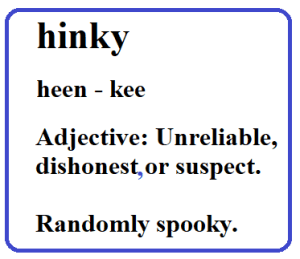
Word processing programs are inherently hinky because they are built out of new versions layered over the old versions, and the bugs in the old versions are often still there. This is why some really large formatting issues are nearly impossible to iron out.

And then there is the issue of reasonable effort. It’s time-consuming and difficult enough for a publisher to make a final manuscript of thirty short stories by thirty different authors look good when each submission was formatted correctly. If you have thirty short stories, each formatted differently with random fonts, different paragraph spacing, and different font sizes – you have a nightmare to edit. Even after editing it can take days to make a final compilation manuscript fit for publication.

For the most part, the requirements are basically the same from company to company with minor differences. To make sure your work conforms to the intended recipient’s requirements go to the publication’s website and read the standards they have laid out.

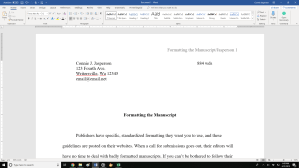
Publications will want your contact information on the upper left of the first page, and your approximate word count on the right. The title should be centered, and the first paragraphs should begin at the halfway point down the first page.

To get your paragraphs and line spacing right, you need to know a few simple tricks for using your word processing program. These tools come with the software and are there to make your documents look as professional as is possible. I have covered how to do that in my post of January 15, 2018, Formatting Short Stories for Submission.

These rules are not only for short stories. Every contest and publication wants the submissions in the same professional format whether it is a printout or an electronic submission.

Too many extra spaces in an electronic document cause the formatting to fail when converted to electronic publishing formats (mobi, epub, etc.) so keep extra spaces to a minimum. Most publishers require manuscripts to be submitted electronically so you will have to go in and remove these tabs. You can do it by following the instructions in my post of March 27, 2019, Formatting Your Paragraphs. If you are not using MS Word or you don’t have a ten key on your keyboard, you may have to do it by hand. It’s a tedious job but do it now, if you have been using the tab key.

You should make sure the font is Times New Roman or Courier .12 font and the body of the manuscript is aligned left.

  1. 1 in. margins
  2. Double-spaced
  3. 1 space after each sentence (NOT 2 as we dinosaurs were taught in typing class)
  4. Each page is numbered in the upper right hand corner
  5. Has formatted indented paragraphs
  6. The header contains the title and author name
  7. The first page contains the author’s mailing address and contact information in the upper left hand corner

Please, if you consider yourself a professional, format your submissions properly. You want to stand out but getting fancy with your final manuscript is not the way to do that—you will be rejected out of hand if you don’t make this effort.

Again, the posts (with screenshots) detailing how to make your manuscript submission ready can be found at these links:

Formatting Your Paragraphs

Formatting Short Stories for Submission

4 Comments

Filed under writing

The transition scene #amwriting

A well-paced narrative has a kind of rhythm. Instructors commonly refer to this as “push, glide, push, glide,” as if skating. What that means is that while the characters might be in the midst of chaos, there is order in the layout and pacing of the narrative.

  • action,
  • processing the action,
  • action again,
  • another connecting/regrouping scene

These “processing” scenes are transitions, moving the plot forward while allowing the reader to process what just happened.

We can’t have non-stop action, as that is exhausting to write and more exhausting to read. The character arc is often at the forefront during these transitional scenes as that period of relative calm is when you allow your characters’ internal growth to emerge.

We justify what just happened, making it believable. It is also where you ratchet up the tension.

When it comes to writing transitions between scenes, we have several paths to choose from.

Introspection:

  • Introspection offers an opportunity for new information important to the story to emerge.
  • It opens a window for the reader to see who the characters are, how they react and illuminates their fears and strengths. It shows that they are self-aware.

Keep the scenes of introspection brief, and go easy on them if you are given to using italics to set them off. A wall of italics is hard to read, so don’t “think” too much if you are using those.

  • Characters’ thoughts must serve to illuminate their motives at a particular moment in time.
  • In a conversation between two characters, introspection must offer information not previously discussed.
  • Internal monologues should not make our characters too wise. Humanize them, show them as a bit clueless about their flaws, strengths, or even their deepest fears and goals.

Conversations:

  • Conversations should not become clumsy info-dumps. “As you know….”
  • Each character must speak uniquely, sounding like themselves. Don’t dump conversations into a blender and pour out a string of commentary that makes them all sound alike.

Don’t get fancy with speech tags/attributions. It’s best for me as a reader when the author avoids words that take me out of the narrative. Some words are eye-stoppers. I recommend you stick with said, replied, answered—common and ordinary  tags that don’t leap out at the reader like ejaculated, disgorged, spewed, and so on. Occasionally, you can get away with more forceful tags, but keep them to a minimum. Make the characters’ actions and words show the force of their words. In my opinion, you can do away with speech tags for some brief exchanges if the scene contains only two characters.

Fade-to-black and hard scene breaks:

I’m in two minds about using fade-to-black scene breaks as transitions. Why not just start a new chapter?

One of my favorite authors, L.E. Modesitt Jr. sometimes has chapters of only five or six-hundred words, which keeps each character thread truly separate and flows well.

In a short story, a hard scene break is sometimes required, as you don’t have the option to do chapters. Use an asterisk or hashtag between scenes. * #

New chapter:

Each of the major players has a point of view. Some authors use the aftermath of an action scene as an opportunity to advance the antagonist’s story line. That is a good strategy, as we do need to show why the enemy is the enemy.

The key is to avoid “head-hopping,” and I feel like the best way to do that is to give a new chapter to the point-of-view character. Head-hopping occurs when an author switches point-of-view characters within a single scene. It happens most frequently when using a third-person omniscient narrative because the thoughts of every character are open to the reader.

My favorite authors will employ all the above listed transitions as they move their characters through the story arc. Each transition will lead us into a new scene, and when they are done right, we the readers won’t even notice that they are transitional.

The transition is the most difficult part of the narrative for me to formulate in the first draft. I get stuck, trying to decide what information needs to come out, and what should be held back.

Sometimes, a transition just will not work no matter what. This happens when a flaw in the logic exists in the scene preceding it. Usually, I can’t see it at that point, but my writing group will show me what the problem is.

This struggle to connect my action scenes into a seamless arc is why writing isn’t the easiest occupation I could have chosen. But when everything comes together, it is the most satisfying job.


Credits and Attributions:

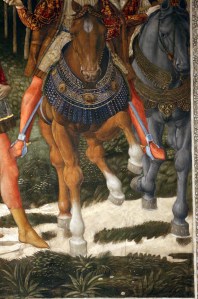
Detail from: Journey of the Magi (East Wall) by Benozzo Gozzoli 1459Magi Chapel of Palazzo Medici-RiccardiFlorence, 1459–1461. Wikimedia Commons contributors, “File:Benozzo gozzoli, corteo dei magi, 1 inizio, 1459, 51.JPG,” Wikimedia Commons, the free media repository, https://commons.wikimedia.org/w/index.php?title=File:Benozzo_gozzoli,_corteo_dei_magi,_1_inizio,_1459,_51.JPG&oldid=179731811 (accessed April 24, 2019).

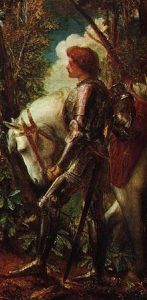
Wikimedia Commons contributors, “File:Sir Galahad (Watts).jpg,” Wikimedia Commons, the free media repository, https://commons.wikimedia.org/w/index.php?title=File:Sir_Galahad_(Watts).jpg&oldid=277887181 (accessed April 24, 2019).

9 Comments

Filed under writing

Update on Works in Progress #amwriting

I hope you had a happy Easter weekend, celebrating the advent of spring your way. We share five children, and they all have children, so warm weather and the addition of extended family made for a great family party on Saturday. Unfortunately, our poor abused vacuum cleaner died the final death before we were finished preparing for the party and there was no time to get a new one.

Near the front door, beneath the growing pile of cast off shoes, bags, and backpacks, lay an expanse of unvacuumed carpet. Strangely, no one seemed to notice.

By three in the afternoon, my kitchen was loaded with every kind of food imaginable, and the party was in full swing. While the younger children involuntarily were held captive indoors behind closed drapes, the teenagers hid well over a hundred plastic eggs. Each was filled with cash, toys, and candy.

Somehow, in the process, the rod holding up my front drapes was pulled loose from the wall. It still hangs there, like everyone’s drunken uncle…precariously positioned and slightly askew.

Thunder shook my suburban neighborhood when we released the captives and the front door burst open. Tender shoots of green lawn met a grisly fate as the mob of crazed grandchildren descended on our yard.

High drama unfolded as toddlers fell and scraped their knees and older children took advantage of their distraction. Oh, the carnage!

At around seven PM, the last car left the driveway. We geared up in hazmat suits and began the cleanup—sans vacuum cleaner.

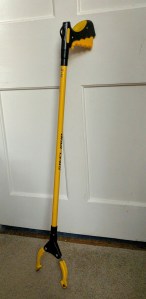
However, I’m a pro. My husband and I are both suffering from back injuries, so in the aftermath, we were forced to be creative. Who needs a stinkin’ vacuum cleaner? My broom works on the carpet, and I have developed mad skills with my new tool of choice—the reach extender.

It’s amazing the things you can do with long-handled grabbers. They make excellent tools to extricate candy wrappers from the shrubbery and retrieve the few eggs that were overlooked in the stampede. Being able to grab the toy cars and plastic farm animals out from under the porch is a real plus.

Inside the house, wide-spread devastation made negotiating the hallway to the bathroom difficult for travelers in a hurry. Muffled cursing was heard as sock-footed old people stepped on abandoned Legos.

I’m talented—I can pick up the merest fragment of potato chip from under a bed with my long handled grabber, without crushing it. This tool, properly wielded, works on every kind of debris—lint, broken crayons, Legos, Polly Pocket purses, Barbie shoes, and half-eaten Cadbury eggs.

You can lean on it when you need propping up.

We dug a path and cleaned the kitchen before going to bed. But by noon on Sunday, the cleanup had been completed, and the toy room was once again a place of moderate order.

Speaking of order, I have ordered a new, sturdier vacuum cleaner, and peace reigns once again here at Casa del Jasperson.

Now that the madness of the family Easter rumble is over, I will continue working on my three projects. I have just finished a large editing job for a client but now will get back to work on several smaller editing jobs.

I am still working on the final revisions for Julian Lackland and intend to have him ready for publication by mid-July. This book is both the final installment in the Billy’s Revenge series and was the original book that the series grew out of. It has been unpublished for seven years and during that time, it has been re-written, expanded, and edited properly. It is about to go to the beta readers.

I am also nearing completion of the first draft of a new book set in Neveyah, the Tower of Bones world. For me, in the first draft of any work, long or short, writing the transition scenes between events are difficult to imagine.

I think of them as “just” moments: adjust and justify. That sort of thinking takes a bit of mind-wandering, so while I ponder ways to move my characters gracefully from disaster to disaster, I work on other projects.

Writing keeps me busy, but the grandchildren are a never-ending source of entertainment for me.


Credits and Attributions:

Shmuser at English Wikipedia [CC BY-SA 4.0 (https://creativecommons.org/licenses/by-sa/4.0)]

Wikimedia Commons contributors, “File:36 inch reach extender.jpg,” Wikimedia Commons, the free media repository, https://commons.wikimedia.org/w/index.php?title=File:36_inch_reach_extender.jpg&oldid=307417600  (accessed April 21, 2019).


3 Comments

Filed under writing

The author’s blog #amwriting

Today I want to encourage authors to make use of their websites, by blogging occasionally.

For an author, the goal of a website is not to gain “fans” – it is to gain readers. Your website is a resource that offers readers a place to meet you and see what you are interested in. It is also your storefront, a place where readers can find and buy your books.

Writing three times a week for this blog has helped me grow more confident as a writer. I can write using the “stream of consciousness” method, or I can write it several days in advance. Usually, I put together a quick outline and do the research on whatever aspect of writing has been on my mind, and soon I have written 700 or more words.

I have made many friends through blogging, people all over the world whom I may never meet in person, but who I am fond of, nevertheless. Readers love to talk about what they are reading, and authors want to talk about what they’re writing. Both subjects are obsessions for me.

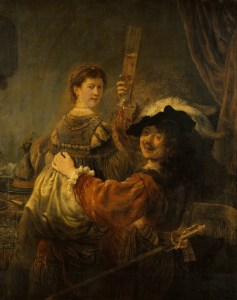
And I can’t tell you how much I enjoy discussing my little passion for 16th and 17th century Netherlandish art. When I write about a particular artist or picture, I find some new bit of creativity to admire, things that make me almost feel the artist is someone I might know.

I think the best bloggers are those who are passionate about something and who have the courage to write about it. Here are only some blogs I follow:

Lee French – Finding Family in Strange Places

Sue Vincent’s Daily Echo

Aaron Volner

Stephen Swartz’s Deconstruction of the Sekuatean Empire

Chris the Story Reading Ape’s Blog

These are the just the blogs I can think of off the top of my head – in reality I follow many, many more. In fact, if you are already a regular blogger, I am probably following you and reading your posts!

Real life can be a rolling disaster, as everyone knows. This is why I occasionally write about the difficulties of traveling and how hard it is for a vegan to find food on a long road trip. At times, I write about the challenges of having two adult children with epilepsy.

I’ve sometimes written about the dysfunctionality of growing up with a father suffering from battle-related PTSD.

I have also talked about growing up in a family of word-nerds, and the shock of discovering we weren’t “normal.”

Whatever I am thinking about, I post a short piece on it.

If I can do it, so can you.

If you are an author, having a blog on your website and updating it at least twice a month is a good way to connect with your readers on a human level. Readers will enjoy hearing what your writing goals are.  They want to know where you will be signing books, or if you will be at a convention near them. Also, they love to know what you are reading.

I do recommend publishing short pieces occasionally. Bits of flash fiction are fun to write and readers enjoy them. These pieces can find their way into your larger work, as they are a great way to brainstorm ideas.

At the bottom of each flash-fiction piece, I post a disclaimer that it is copyrighted:

  • Bleakbourne on Heath, by Connie J. Jasperson, © 2016 All Rights Reserved

I suppose I am a compulsive blogger. I sometimes think about slowing down, but then I suddenly have an idea that I need to write about. In no time flat, I will have written 500 words. In fact, this post is around 600- 700 words long.

Not a bad length and not too long to write.


Image Credits:

Wikimedia Commons contributors, “File:Rembrandt – Rembrandt and Saskia in the Scene of the Prodigal Son – Google Art Project.jpg,” Wikimedia Commons, the free media repository, https://commons.wikimedia.org/w/index.php?title=File:Rembrandt_-_Rembrandt_and_Saskia_in_the_Scene_of_the_Prodigal_Son_-_Google_Art_Project.jpg&oldid=340120613 (accessed April 17, 2019).

7 Comments

Filed under writing