Tag Archives: #amwriting

The Proofreader #amwriting

I see the process of getting a manuscript ready for publication as a four-part process.

  1. Writing the first draft.
  2. Beta Reading and revising the manuscript to your satisfaction.
  3. Sending it to the editor and making suggested revisions.
  4. Having the edited manuscript proofread.
Proofreading is done after the final revisions have been made. Even though an editor has combed your manuscript and you have made thousands of corrections, both large and small, there will be places where the reader’s eye will stop.

It is best if this task is done by someone who has not seen the manuscript before. That way, they will see it through new eyes, and the small things hiding in your otherwise-perfect manuscript will stand out.

Some things your proofreader must understand:

  • The proofreader should not try to hijack the process and derail an author’s launch date by nitpicking his/her genrestyle, and phrasing.
  • The proofreader must understand that the author has been through the process with a professional line editor. At this point, they are satisfied that the story arc is what they envisioned, and the characters are believable with unique personalities. The author worked with an editor to ensure the overall tone, voice, and mood of the piece is what the author envisioned.

You will note that I have used the word envisioned twice in the above list. If a proofreader can’t restrain their unasked-for editorial comments, you should find a different reader.

The edited manuscript is the author’s creation, a product of his/her vision, and by the time we arrive at the proofing stage, it is intentional in the form it is in.

This is why a professional proofreader is a good investment. The proofreader must realize that the author and his/her editor have considered the age level of the intended audience. A proofreader does not go through a manuscript with a red pen and mark it up with editorial comments. They do not critique the author’s voice or content because that is not their job.

A proofreader does highlight places where typos and other proofing errors exist and ruin the narrative.

A proofreader understands that every typo and error is different. These little landmines are insidious and may not leap out at first glance, which is why they aren’t always caught during the editorial process. Any number of small, hard-to-detect things can occur during the process of making even minor revisions.

In case you didn’t see it when I mentioned it above, I will say it again: proofreading is not editingEditing is a process that I have discussed at length elsewhere.

At the outset, the proofreader must understand that no matter how tempting it may be, they have not been invited to edit the manuscript for content. If they cannot refrain from asking for large revisions regarding your style and content, find another proofreader.

The proofreader should look for misspelled words, and homophones (words that sound the same but are spelled differently). Spell-checker may or may not catch these words, so a human eye is critical for this.

  • Wrong:  Cissy wint out the door, slamming the screen.
  • Right:  Cissy went out the door, slamming the screen.
  • Wrong: There dog escaped, and he had to chase it
  • Right: Their dog escaped, and he had to chase it.

The proofreader must also look for repeated words and cut-and-paste errors. These are the kind of error frequently introduced into a manuscript when a tired author is making revisions. When we are pushing ourselves, even the most meticulous of authors unknowingly introduce errors when cutting and moving entire sections, rearranging portions of the narrative for a more logical flow.

You must rememberthe editor won’t see any errors you introduce when you implement their editorial suggestions. Once an editor has made their recommendations and returned your manuscript to you, they are done and won’t see the book again until it is published. You will have to make those revisions, and that is where many typos and errors occur.

Cut and paste errors are insidious and difficult to spot, and spell-checker won’t always find them. But a proofreader will notice them because the prose will contain unusually garbled sentences, and sometimes, two periods (full stops) at the end of a sentence.

  • Wrong: It is is accepted practice to italicize thoughts.
  • Wrong: Itis accepted practice to thoughts.
  • Wrong: First of all, it is accepted to ot thoughts..
  • Right: It is accepted practice to italicize thoughts.

Dialogue that is missing quotes can be a problem for many authors. When they are in a hurry, they sometimes don’t hit the quote key at the end of a sentence. Also, for US authors, they must be closed (double) quotes rather than single quotes.

  • Wrong: “Doctor Mendel, you’re new to the area,’ said Officer Shultz. “What do you know about the dead man?
  • Right: “Doctor Mendel, you’re new to the area,” said Officer Shultz. “What do you know about the dead man?”

Numbers that are digits are acceptable to use when writing notes and emails. They can also be used if you are writing a blogpost, but ask any bookkeeper – digits are as easy to accidentally mess up as words.

  • Wrong: There will be 3000 guests at the reception.
  • Wrong: There will be 003 guests at the reception.
  • Right: There will be 300 guests at the reception.
  • Right: There will be three hundred guests at the reception. (In literature, we write it out.)

Dropped and missing words will make the prose seem garbled and hard to follow.

  • Wrong: Officer Shultz sat at my table, me gently.
  • Right: Officer Shultz sat at my table, grilling me gently.

Something you must be aware of if you have paid for someone to proofread for you—each time you tweak the phrasing or create a new passage in your edited manuscript, you run the risk of creating another undetected error. Never make revisions when you are tired or not fully on your toes.
If you are happy with the way your manuscript was edited, I suggest you do not ask a different editor to proofread your manuscript, as they may be unable to resist suggesting larger changes. Each editor sees things differently and editing is their nature and their job.

The problem is that this can go on forever, and you run the risk of ironing the life out of your manuscript and losing the feeling of spontaneity, making it feel contrived. You also risk publishing a manuscript that looks unedited because of the flaws that were introduced in the proofing process.

Before you publish your book, do yourself a favor and have it proofread by an intelligent reader. Find someone who understands what you are asking them to do and who is willing to do only that. If you are a member of a writing group, you have a good resource of readers there.
13 Comments

Filed under writing

What we can learn from midlist books #amwriting

As part of my ongoing quest to improve my writing skills, I have been reading a series of novels written by a midlist author (whom I am not going to name), trying to decipher what it that I like about her work and what I don’t like.

Midlist is a term used by the traditional publishing industry referring to books that aren’t bestsellers, but which sell enough to justify their publication. If these authors can build a consistent sales record, the big publishers will probably want future books from that author.

Most books published today are midlist titles. Bestsellers earn the largest portion of overall royalties, but midlist novels are steady earners over a long period, and many of these authors have devoted fans.

So, I have been binge-reading this series of mystery novels, trying to decide why she sells enough to keep her publisher buying her books, and in the process,  I have figured out why she’s not a bestseller. I have come up with a list of strengths and shortcomings, things I can look for in my own work.

The positives:

  • Her plots tend to be intriguing. She is creative with her murders and doesn’t rely on cliché situations.
  • She knows how to sink a hook. The details of how and why each of the murders are discovered is interesting, and at the beginning, logical, so you keep reading.
  • She has good skills in world building. The ethnicity of the immigrant Armenian neighborhood feels solid, as if you know it well.
  • The main characters reveal themselves slowly. They have an air of mystery around them. You never feel like you know all there is to know about them.

The negatives:

  • Her books tend to follow a formula that is recognizably hers, which is why she can put out four novels a year. In that regard, they are like romance novels. Once you’ve read the first three in the series, you know the basic story line.
  • They’re not memorable in any way. The one thing that keeps you reading is curiosity to discover who out of the many possibilities actually did it.
  • Toward the middle and the second half, the story arc becomes jerky, at times almost flatlining. The eye wants to skip pages.
  • Then suddenly, it’s so chaotic it’s impossible to follow what just happened, and no matter how many times you go back and re-read it, you can’t understand what is going on.
  • References to habits, such as obsessive chain smoking, start out doing the intended job, conveying a personality. But these references soon become repetitive, over-used, inadvertent crutches.
  • Her political and technological references place these books firmly in a certain period – a double-edged sword. The political references are the biggest Achilles heel. She began writing the series in in the early nineties. Publishing schedules being as slow as they are, these references immediately made the books feel slightly out of date, rather than set in an era.
  • By book three, the Main Character hasn’t grown or evolved. They’re still locked firmly in their own time-warp.
  • Her publisher misses a lot of proofing errors. This is every indie’s nightmare, so it’s annoying to find so many flaws in a book by a reputable publisher.

In retrospect, I like this author’s work, but certain of her writing habits annoy me as a reader. So, why have I subjected myself to reading so many of her books if I’m so ambivalent about them?

Education.

We all know what we love when we see it. But unless we out-and-out hate something, being able to identify what we don’t love is sometimes difficult.

And this concept is especially true about our own work. Those of us whose vocation is writing fiction must work to ensure our voice and writing style is current and fresh. It is a quest that can take a lifetime and involves more than just reading “How to Write This or That Aspect of a Novel” manuals. Books on craft are important, but they only offer up a part of the picture.

You must read widely, and outside your favorite genre. This is why I study how books in all genres, both good and bad, are constructed.

When you come across authors whose work shocks, rocks, and shakes you, study them. What did you love? What did they do right and how can you incorporate those techniques into your work?

When you don’t like a novel, ask yourself why it failed to move you. What did the author do wrong and how could you write it better?

Read widely, dissect what you read, and then apply what you’ve learned to your own work.

5 Comments

Filed under writing

Update and Resolutions for 2019 #amwriting

Here in the Pacific Northwest, the year of 2018 is enjoying its last hurrah. People are getting ready for parties and counting both their successes and failures. It has been an eventful year for both my family and my writing life, so I am looking forward to what 2019 will bring.

My quest to complete the three-book literary fantasy series, Billy’s Revenge, will finally come to an end. Julian Lackland is on the home stretch and will go to the editor on February 1st. Depending on how quickly that goes, he will be published in June. Julian began life as my first NaNoWriMo Novel in 2010 and was picked up by a small press. Unfortunately, that didn’t go well.

It has taken me eight years to undo the damage they did and get this manuscript into proper shape. Julian Lackland is why I have been on this quest to educate myself about the craft of writing. I wanted to give Julian the kind of book he deserves, and judging by my beta readers’ comments, the effort has been worth it.

I am also closing in on finishing the first draft of a new duology set in Neveyah, the Tower of Bones world. One of the things I learned when I was trying to finish Valley of Sorrows, is that readers who begin a series want the next book in a timely fashion. They might wait a year, but after that, they will forget about it. It takes me four years to get a book from concept to publication, which can be a problem.

What I am doing differently with Alf’s story is this: I’m writing the first draft of the entire story arc before I begin revisions on the first book. So, this means I am writing a 250,000 word manuscript. Only when the entire first draft is finished will I begin the editing process. The manuscript will be broken in half and published as a duology, hopefully six months apart, assuming that editing goes smoothly when we get to that stage.

I am also finishing the stand-alone book that was begun as a serial in 2015, Bleakbourne on Heath. I have approximately 20,000 words left to write before it goes to the editor. Leryn’s story was so much fun to write. I had never done a serial, and unfortunately, I soon discovered I couldn’t keep up the daunting schedule I had set for getting my installments published. It was like “live television.” Whenever I sat down to write a chapter, I had no idea what was going to happen next.

One day I realized I had reached a creative plateau and had no idea how to finish the damned thing. Some people consider that writer’s block, but not me. When I can’t think of a way to advance a particular story, it’s time to rein it in and put it aside for a while to work on something else. So, I wrote a wedding scene, and ended the serial on a happy note, winding up most of the threads, but with the main quest still unfinished.

Last year was a good year for short stories, some of which found good homes in forthcoming anthologies. Also, two of my poems were selected for publication in the I Hear Olympia Singing poetry anthology and were chosen as the opening verses. I survived my first live poetry reading and met some amazing people in the process. Yay for that!

Despite cutting back on my professional editing schedule, I was privileged to edit several wonderful books for my clients—what a joy that aspect of my life is. I can’t completely drop out of that part of this business, as I love working with my clients, helping them to realize the vision they originally had for their book.

My resolutions for 2019 are to publish at least one novel, have a second one either published by the end of the year or ready to go in 2020, finish the first draft of my duology, and continue to write short stories and poetry, and continue to edit for my private clients.

I will keep writing new words every day, and I will remain involved in the local writing community. That connection with other writers feeds my creativity, offers me a sounding board, and keeps me working with good people who will read for me and show me what needs to be rewritten.

Thank you for being a part of my writing life. May the new year bring you good fortune, good food, and good friends. May the new year bring us all inspiration and determination—the two most important gifts a writer could have.


Credits and Attributions

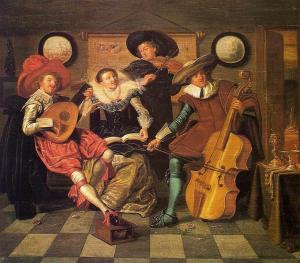
Wikimedia Commons contributors, “File:Dirck Hals – Musicians – WGA11043.jpg,” Wikimedia Commons, the free media repository, https://commons.wikimedia.org/w/index.php?title=File:Dirck_Hals_-_Musicians_-_WGA11043.jpg&oldid=253948561 (accessed December 31, 2018).

6 Comments

Filed under writing

I’ll do it Mañana #amslacking #amwriting (a little)

For those of us who regularly participate in NaNoWriMo, the month of December can be a comparatively unproductive time. I average 500 – 1000 new words each day, mostly in the form of re-writing and tweaking existing prose.

I find myself cooking a lot and doing some housework. I’m not a great housekeeper but I do like to keep things dug out, so some sort of chore is always on the list. Whatever can be done in one hour gets done. Everything else can be done mañana (tomorrow).

It’s the end of the year and a good time to look back, and see your accomplishments for the year. One of my personal goals this year was to clean out the garage.

Oops.

Maybe next year. I’m sure it will happen in 2019.

The weather has been dark and dreary here in the Pacific Northwest, and I’ve been reading old Agatha Christie novels. When I’m not reading or writing, I like to bake bread at this time of the year. Few things are homier than the aroma of freshly baked bread wafting through the house.

And, when I have a little urge to write, I find myself in the Room of Shame, taking a look at existing work with a fresh eye and checking for:

  • Spelling—misspelled words, auto-correct errors, and homophones (words that sound the same but are spelled differently). These words are insidious because they are real words and don’t immediately stand out as being out of place.
  • Repeated words and cut-and-paste errors. These are sneaky and dreadfully difficult to spot. Spell-checker won’t always find them. To you the author, they make sense because you see what you intended to see. For the reader, they appear as unusually garbled sentences.
  • Missing punctuation and closed quotes. These things happen to the best of us.
  • Digits/Numbers: Miskeyed numbers are difficult to spot when they are wrong unless they are spelled out.
  • Dropped and missing words.

These are things that always find their way into my work during the mad rush of NaNoWriMo. In my writing hours, I’m working on things to submit and don’t want to send out work that looks unprofessional.

I plan on taking it easy for the rest of the month, cooking a little, cleaning a little, and making revisions, but mostly I’m going to spend the dark time of December curled up on the sofa with Agatha Christie, lost in as many Miss Marple mysteries as I can stuff into my Kindle.

4 Comments

Filed under writing

World building, ensuring consistency #amwriting

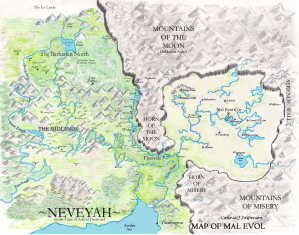
The key to making both fiction and nonfiction real for the reader is subtle but crucial: world building. Maps, no matter how rudimentary, are the foundation of world building in my writing process.

The first map of what eventually became my world of Neveyah series emerged from a conversation with a game designer and was scribbled on a piece of note paper in a Starbucks. I transferred the scribble to graph paper, and over time, that map grew, evolving into a full color relief map of the world as it exists in my mind.

I love maps. Since that early scribble, my maps all start out in a rudimentary form, just a way to keep my work straight. I use pencil and graph paper at this stage, because as the manuscript evolves, sometimes towns must be renamed. They may have to be moved to more logical places. Whole mountain ranges may have to be moved or reshaped so that forests and savannas will appear where they are supposed to be in the story.

And that tendency for embellishment and evolution in the story teller’s mind is what has led to my most embarrassing moment of the week.

I went back to the original manuscript of Mountains of the Moon, Wynn Farmer’s story, just to check on how I had described the terrain of the high country of the Escarpment, as I am writing a short story set there. While I was searching for the passage I wanted, I noticed that I had described Widge as the northernmost navigable port on the River Fleet.

Which means that Dervy can’t be the northernmost port, and the novel I am not working on for the duration of NaNoWriMo has a large plot-hole that won’t be fixed until December.

Fortunately, it is set five hundred years before Wynn’s time, so I’m not going to scrap that portion.

Instead, I made a series of notes for when I get back to writing that novel after NaNoWriMo is over. I will show how at that time, Dervy had some commerce via flat-bottomed barges owned by daring traders. The courses of rivers are changeable, like the Mississippi or the Nile. Where a harbor was possible three hundred years ago, it may not be possible now. (see How The Nile Has Changed Course Over The Past 5,000 Years.)

So, I just had a sharp reminder to check my work for inconsistencies while I still have the chance to either make them possible or remove them.

Perhaps you think you don’t need a map. You aren’t writing fantasy, so the real world is your setting. If your characters are traveling and you are writing about their travels, you want to be accurate. Google earth and a good map will help, as will timetables for trains and airlines.

In my books, people are going hither and yon with great abandon, and if I am not really on top of it, the names of towns will evolve throughout the novel.

The basic pencil-drawn map, in conjunction with my style-sheet, is my indispensable tool for keeping the story straight. I just have to keep referring back to them, rather than trying to keep it all in my head.

What is a style-sheet? When a manuscript comes across their desk, editors and publishers create a list of names, places, created words, and other things that may be repeated and that pertain only to that manuscript. This is called a style-sheet.

The style-sheet can take several forms. It’s a visual guide to print out or keep minimized until it’s needed. I copy and paste every new word or name onto my list, doing this the first time they appear in the manuscript. If I am conscientious about this, I’ll be less likely to inadvertently contradict myself later on in the tale. I also do this for my clients when I edit a manuscript.

Some people use Scrivener. I prefer to keep it simple, so I just use Excel for this because I like keeping my maps and the glossary in the same workbook. Google Docs works just as well, and it’s free, or you can just keep a list on a document or notepad.

Regardless of how you create your style-sheet, I suggest you include these elements:

  • The cast of characters and how their names are spelled
  • Their home town
  • The places they go
  • Every made-up word or name
  • The page on which it first appears
  • What it means

What should go on a map? When your characters are traveling great distances, certain differences in the terrain will impede your characters. If they are pertinent to the story, you will want to note:

  • Rivers
  • swamps
  • mountains
  • hills
  • towns
  • forests
  • oceans

What if your setting is indoors, such as an office, a mansion, or a hotel? You want to make sure the rooms and corridors that get mentioned in the narrative aren’t described in a contradictory way. If a room is next to the kitchen in the opening scene, it should still be there at the end of the story, barring a tornado.

Billy Ninefingers is set in a wayside inn. I made a drawing of the floor plan for my purposes because the inn is the world in which the story takes place. If you are writing a space opera, map out your ship or station, just for yourself.

Know your world.

As a side note, if you are writing fantasy, I suggest you keep the actual distances mushy because some readers will nitpick the details, no matter how accurate you are.

From Wikipedia, the fount of all knowledge: “A league is a unit of length (or, in various regions, area). It was long common in Europe and Latin America, but it is no longer an official unit in any nation. The word originally meant the distance a person could walk in an hour.[1] Since the Middle Ages, many values have been specified in several countries.”

Therefore, a league is what you say it is, within some loose parameters. I go with the distance you can walk in an hour, which means you must take the terrain into consideration. In my current work, I don’t even mention distance by measure. Instead, I use time—they travel for an hour, or day, or two days.

Not everyone is an artist. Perhaps your work is set in a fantasy world, but you feel your hand-drawn map isn’t good enough to include in the finished product.

One option is to go to a game designer’s map generating site, play around with it until you find a map you like, then write the story to that map. Another option indie authors might consider is hiring an artist to make a map from their notes.

I’m fortunate to have some skill as an artist, so my pencil-drawn map always evolves into artwork for the book.


Credits and Attributions:

Wikipedia contributors, “League (unit),” Wikipedia, The Free Encyclopedia, https://en.wikipedia.org/w/index.php?title=League_(unit)&oldid=865343305(accessed November 4, 2018).

Map of Neveyah ©2015 Connie J. Jasperson, All Rights Reserved.

9 Comments

Filed under writing

Ideas to jump-start #NaNoWriMo2018 #amwriting

I have been a Municipal Liaison for NaNoWriMo since 2012. I started participating in this annual writing rumble in 2010. I  found myself taking the lead as the unofficial ML for my region in 2011 when our previous ML didn’t return, and we didn’t have one that year. Organizing write-ins, cheering on my fellow writers–I didn’t really know a lot about how it all worked, but it was a lot of fun and I met so many wonderful people.

Over the years I have learned a lot of little tricks to help people get a jump on their NaNoWriMo project.

Some people continue writing the first draft of an unfinished work-in-progress but on November first, they write all the new work in a separate manuscript that is only for NaNoWriMo validation purposes.

Most will start an entirely new project, which is what I do. Actually,  since 2012, I have started a bunch of new projects, an attempt to amass a collection of short stories to submit to magazines and contests.

Many times, I don’t know exactly what I’m going to do until 12:01 a.m. on November 1st.

But that lack of a finite plan doesn’t mean I have no ideas. I am always prepared to write something new.

One of my favorite tools is the prepared list of one-liners that I keep on hand, little ideas to open a story with.

You must write every day, even when you are only writing for yourself. When you write every day, you keep your “writing mind” in top condition–you are training yourself the way an athlete trains for a big event.

For this reason, I have a document saved to my desktop that I use to write down ideas as they hit my brain.

Everyday I pick a prompt out of my list and start writing. I write new words on that idea for fifteen minutes.

Often, I end up with a good drabble to show for my fifteen minutes. Other times, what I produce is not worth much, but the act of writing new words is important.

On November first I will pick one that will be the first short story I write, giving me a jumping off point to riff on.

1 – Leonard always said there was no place for pansies in this war. His preferred weapon was a dahlia.

2 – Dogs and little children hated Eldon. The rest of us merely despised him.

3 – Death is the one thing you can take with you, and Harvey Milton was packed up and ready to go.

4 – No dogs or cats for Mrs. G—she had pygmy goats.

5 – The body in the trunk of Edna’s car had become a real inconvenience.

6  – “Technically, it’s not my cow. It’s my stepdad’s cow. Anyway, we aren’t going to harm her. She’s just going to school for a day.”

And what about essays, those wonderful commentaries and literary pieces for various magazines? I’m stricken every day with ideas that would make such good essays, and November is my month to write them.

  • Impressions of a spring day at the Olympia Farmer’s Market (one of the largest on the west coast).
  • The story of a mentally ill homeless woman whom I met on a rainy day.
  • A road trip down Washington State Route 105 from Westport to Raymond, and the ghostly, nearly abandoned coastal towns of rural Washington State.

So many random ideas and so little time to write those stories! That is why November has become so precious to me—it is my time to make use of my flashes of inspiration.

Another trick to both jump-starting and finishing a NaNo Novel is to write the last chapter first and set it aside in a separate document from the NaNo Manuscript.

Yes–its true. I wrote my first complete novel by writing the last chapter first and then wondering how the characters had gotten to that point, that place.

Once I knew how the book ended, I was easily able to write 60,000 to 70,000 words to connect up to that final denouement.

The original premise: An old man returns to a town that was the scene of his most treasured memories.

The book opens when he is a young man of barely twenty and takes him through grand love affairs and miserable failures, a Don Quixote-like story of madness and bravery. My brain was on fire with that book.

I still love that book and one day I will republish it.

Maybe.

That wasn’t my first novel, but it was the first one I had completed—and if you don’t complete your projects, you can’t really lay claim to being an author.

We all have false starts—it’s part of writing. My first novel was begun in 1994 on an old Macintosh Performa. The original manuscript was lost when I switched to a PC in 1998, but I rewrote it. Over the next ten years, that version evolved to over 250,000 rambling words, ten different story lines, and it was still nowhere near the finish line.

I promise you, that is one book that will never see the light of day.

NaNoWriMo has shown me that writing prompts are a wonderful tool that we can use to jump-start our imaginations. The Writer’s Digest website has an excellent post dedicated to writing prompts:

Creative Writing Prompts

If you want to practice writing something but can’t think of what, take a look and see if something interests you.  No two people are alike, so don’t be afraid to use a prompt from a popular site like Writer’s Digest. The way you go with it will be as unique and individual as you are.

In the meantime, start keeping a list of ideas, prompts that you think would make great stories. Save it to your desktop so it is always available with just a click. Great novels all begin with a random idea, a “what if.” Don’t let your ideas slip into oblivion–write them down and use them.

4 Comments

Filed under writing

World building: what was, what is, and what may be #amwriting

All novels are set in one of three time periods: the past, the present, or the future.

Readers are much smarter than we are, so knowing what you write about is critical no matter what the level of technology. Even when setting a novel in the present day, the actual technology available is an unknown quantity to most of us.

However, targeted research can shed some light on what was once possible, what is possible, and what will one day be possible. Here are some of my go-to sources of information:

The Past:

My best source of information on low-tech agrarian life and culture comes from a book I found at a second-hand book store in Olympia in the mid- to late-1980s. Lost Country Life by Dorothy Hartley is still available as a second-hand book and can be found on Amazon. This book was meticulously researched and illustrated by a historian who knew the people she was writing about.

What I find absolutely charming is the way the author used excerpts from medieval rhymes and literature to put their lives into context, forming a picture of how we really lived before the industrial revolution. In fact, many rural communities were still living this kind of life in the early twentieth century. The author knew and interviewed farmers whose lives had been spent working the fields and raising animals the old way.

Best of all, even though the book makes no apologies for being a textbook, Hartley’s prose is so enjoyable I found myself reading it with the sort of enjoyment one gets from a novel.

I also get a lot of information on how people lived from Wikimedia Commons.  There, under the heading  Category: Painters from the Northern Netherlands (before 1830) you will find the brilliant works of the Dutch Masters, artists living in what is now The Netherlands. In the course of their work these painters created accurate records of the everyday life of the common people, how they dressed, and what was important to them.

The Present:

You can Google just about anything. Fads, fashion, phone tech, current robotics tech, automobile tech—it’s all out there. If you need to know how many bodies you can fit into the trunk of a Mini Cooper, don’t guess. Look it up and write with authority. (The answer is NONE—Mini Coopers have no trunk.)

Available on the internet today:

TED Talks are a wonderful resource for information on current and cutting edge technology.

ZDNet Innovation is an excellent source of current tech and future tech that may become current in 25 years.

Tech Times is also a great source of ideas.

If you want to know what interests the people in the many different layers of our society, go to the magazine rack at your grocery store or the local Barnes & Noble and look at the many publications that are available to the reading public. You can find everything from culinary to survivalist, to organic gardening—if people are interested in it, there is a magazine for it.

Know what your community is interested in, and your setting will have depth.

The Future:

We can only extrapolate how societies will look in the future by taking what we know is possible today and mixing it with a heavy dose of what we wish were possible.

But many business people and scientists have incredible imaginations, and their life’s work is making the future knowable, and a reality.

SPACEX

NASA

Digital Trends

If you write sci fi, you must read sci fi as that is where the ideas are. Much of what was considered highly futuristic in the classic science fiction is now current tech—ion drive, space stations—these are our reality but were only a dream when science fiction was in its infancy. Think about it: your Star Trek communicator is never far from your side.

Do the right research, target it to your needs, and don’t allow yourself to be sidetracked by the amazing bunny trails that lead you away from actually writing.

Above all, enjoy the act of creating a world that a reader will want to live in, whether it is set in the past, the present, or the future.


Credits and Attributions:

Lost Country Life, by Dorothy Hartley, © 1981 by Pantheon, cover illustrated by Beatrice Fassell, fair use.

3 Comments

Filed under writing

Thoughts on the Advent of Autumn #amwriting

I’ve mentioned before that I love the changing of the seasons. Here in the Pacific Northwest, the colors of our native big-leaf maples and alders are beginning to paint the landscape in shades of yellow and gold, dotted with pops of red sumac and scarlet vine-maples.

In the higher hills of the lowlands and up in the Cascades, the gold of our native larches is astonishing to those who’ve never seen a deciduous conifer. It can seem like an entire forest has died. But they’re only getting ready to sleep through the winter, the way bears, maples, and cottonwoods do.

I’ve always been awed by the majesty of the autumn forest here in my part of the world.

The sky is also changing. The days are growing shorter and the rains of the monsoon months approach. The long dry spell has ended, and rain has returned to us.

In November, the gray overcast skies linger unending, eternal. My friends and I wonder if the sun will ever shine again. But just as I am feeling desperately sorry for myself, the clouds will part to reveal a patch of blue so beautiful my eyes hurt. I have to dig out my sunglasses to shield my weak, Northwesterner’s eyes from the radiance of the great yellow orb.

We who have grown up in the long dark winters have little tolerance for such brilliance. But we’re always ready to discuss our never-ending quest for cheap sunglasses. We adore those accessories that are so much more than a fashion statement.

As my previous posts have said, these are the writing weeks, the mad dash to finish the first draft of my work in progress, and my preparations for NaNoWriMo. Stockpiling staple groceries, perusing my recipe file for crock-pot meals—comfort food is on my mind at this time of year.

After all, food was love in the family I grew up in, and our favorite comfort foods make the winter seem warmer. The time we spend at the table sharing the evening meal is inviolable—no TV, just quiet music and conversation. This is our time to reconnect, to rebuild the ties of love and family that bind us.

Autumn’s glory will linger for a brief few weeks. The rainy season will come, turning unraked leaves to sodden, moldy messes waiting for the winds of November to send them flying from yard to yard. I will watch from my front room window and admire the leafy ballet.

Once the leaves are gone, evening and morning will still bring color, but it will be the sky that has the dominant role. At that time of year, the sun, low on the southern horizon, reflects on the clouds, turning them every shade of pink, gold, red, purple, and even a gray so dark it’s black.

Sporadically juxtaposed against that riot of cloud-color will be patches of poignant blue. It’s a color that makes my heart ache for spring, makes me yearn for sunshine and warmth.

I have prepared the back porch for winter, abandoned my favorite thinking place. The cushions are put away and the chairs are pulled to the center where they will stay dry except in the heaviest wind-driven rains.

Since spring is a full six months away, and the weather is fairly nice today, I will uncover a chair and sit on the back porch and write about a world where the sun is shining, and birds are singing.


Credits and Attributions:

Wikimedia Commons contributors, “File:Thomas Worthington Whittredge – Woods of Ashokan.jpg,” Wikimedia Commons, the free media repository, https://commons.wikimedia.org/w/index.php?title=File:Thomas_Worthington_Whittredge_-_Woods_of_Ashokan.jpg&oldid=296638658 (accessed September 13, 2018).

8 Comments

Filed under writing

The derailed plot #amwriting

You’re a pantser, not a plotter–you like to wing it when you write, just let the ideas flow freely. This can be liberating, but sometimes in the course of writing the first draft, we realize our manuscript has gone way off track and is no longer fun to write.

At this point, we must go back and find the point where the story stops working. We cut everything back to there and make an outline to build some structure into the manuscript.

Let’s say we are working on a manuscript titled “Dog Days of Summer.” We wrote most of it during November and are sixty thousand words in, but we aren’t even a third of the way to the finish. When we look back, the first twenty thousand words are exactly what we wanted the story to be. But at that point we became a little desperate to get our daily word count, and now we don’t know what to do or how to bring the story to its intended conclusion.

When this happens to me, I stop floundering and (literally) cut my losses. It needs to be cut back to the place where it dissolved into chaos. This is good – it’s called rewriting. Nearly every published novel has entire sections that had to be rewritten at least once before it got to the editing stage.

Much of what you cut out can be recycled, reshaped, and reused, so never just delete weeks of work.

  1. Save everything you cut to a new document, labeled, and dated: “OutTakes_DDoS_rewrite1_09-19-2018.” (Out Takes, Dog Days of Summer, rewrite 1, 09-19-2018)

Now, you must consider what will be the most logical way to get the plot back on track.

Sit down with a notebook (or in my case a spreadsheet) and make a list of what events must happen between the place where the plot was derailed and the end—a list of chapters with each the keywords for each scene noted:

15 Aeddie sick – Mendric can’t repair his heart-take him to Hemsteck 
16 Three days into the journey Elgar and Raj battle Thunder lizard
17 Star stone falls outside Waterston
18 Aeddie sick, nearly dies, Mendric nearly burns out gift keeping him alive
19 South of Kyran, water wraith
20 North of Kyran, mob attack
21 Nola – inn
22 Maldon, highwaymen, and William

You can go even farther and color code your scenes to show who the POV characters are, as was noted in my previous post, Author Simon Wood on Plotting.

What is the core conflict? Make a large note to remind yourself of what the central conflict is so that you won’t go off track again.

Pay close attention to the story arc. Make a “blueprint” of the intended story arc, an outline.

  1. Where does the inciting incident occur?
  2. Where does the first pinch point occur?
  3. What is happening at the midpoint? Are the events of the middle section fraught with uncertainty but still moving the protagonist toward their goal? If not, cut them and insert events that propel the story forward.
  4. Where does the third plot point occur?

What does each character desire? List each character and make a note of what they want at the beginning, what stands in their way at the middle, and what they get at the end.

  1. At the outset, what do the characters want?
  2. What are they willing to sacrifice to get it?
  3. How are their attempts to achieve it frustrated?
  4. Do they get it in the end, or do their desires evolve away from that goal as the story progresses?

Everything you write from the point of the inciting incident to the last page will detail that quest for the unobtainable something. At the outset, your protagonist must desire nothing more than to achieve that objective. Use whatever you can of the material you cut, and write new prose where you must.

By the end of the book, the internal growth of the characters may have caused them to change their personal goals, but something big and important must be achieved in the final chapters.

Where are they going? If they are traveling in a created world, draw a simple map for your own reference. Otherwise, use an atlas or Google Earth to keep your story on track.

Don’t be afraid to rewrite what isn’t working. Save everything you cut, because I guarantee you will want to reuse some of that prose later, at a place where it makes more sense. Not having to reinvent those useful sections will greatly speed things up, which is why I urge you to save them with a file name that clearly labels them.

Finally, don’t feel that, just because you wrote a wonderful section, it has to stay in the manuscript. If the story is stronger without that great scene, cut it. Use it as fodder for a short story or novella set in that world.

5 Comments

Filed under writing

Titling that book, or wringing blood from a stone #amwriting

A great book title can sell a book or short story to the reader:

We all start out with a working title—after all, we have to label our files somehow. But how do we come up with a catchy title for that finished product? It’s an issue we all face.

First of all, write the book and don’t obsess about the title until you are at the stage where something must be put in place on the cover. During the writing of the book the perfect title might come to you, so don’t sweat it.

What is the book’s genre? Go to the bookstore (or online to Amazon) and look at books in that genre to see how other authors are naming them. This will also give you an idea of how the cover should look if you are an indie. You will know what to ask of your cover designer.

Your friends and your writing group are good resources for brainstorming titles, so get them involved. Your writing group will know what the book is about, so their ideas will be valuable. If they haven’t been able to help and you are in the editing stage, ask your editor for some ideas.

I have two books titled after the main character’s name, Huw the Bard and Billy Ninefingers. This works because their names are unique. Other authors have done this too:

Are there any scenes that depict watershed moments in the protagonist’s life, places that are turning points? Settings that represent the theme can be great titles.

What is the central plot point?

If your story is dark, you might want to emphasize that theme by going the mysterious route.

Giving your work an official title is sometimes difficult, and it’s hard to find good titles that aren’t already famous. In the US, book titles aren’t copyrighted so there may be multiple books out there with the title you want to use—take my advice and research your prospective title thoroughly.

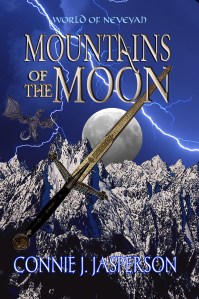
I once was at a book signing event with my epic fantasy book, Mountains of the Moon (World of Neveyah), seated opposite an author selling a travel book, Mountains of the Moon, detailing his journeys in Africa. We laughed and helped sell each other’s books—because he was a good sport, the identical names worked to our advantage at that show, and we sold more books than we would have. But knowing what I do now, I would definitely give my book a different name–I had no idea such a place existed here in this world.

The right title is a subliminal lure enticing the reader into opening the book or clicking on the “look inside” option.

In 1989, I bought a book by Tad Williams: The Dragonbone Chair. That title hooked me, and the book itself lived up to its promise so well that I patiently waited two years between books for Mr. Williams to finish each installment in the series.

In my case, good titles are as much of a hook as an intriguing cover design.

Comments Off on Titling that book, or wringing blood from a stone #amwriting

Filed under writing