
 Modern fiction often employs the motif of redemption–the notion that a person can counter a lifetime of misdeeds, but to do so, one must commit selfless acts of heroism.
Within the story arc, a fall from grace can make a protagonist more compelling, more multidimensional. A main-character who is not perfect is far more intriguing than a person with no flaws, because they are unpredictable. Nothing is worse than a predictable novel.
I see characters in books as if they were real people living through the events life hands them. When a character in a book experiences confusion, it’s an opportunity for them to learn new things. If they are frustrated, they must devise a way around that frustration, and if they are tested to the limits of their endurance, they will become stronger. Keep this in mind when you are writing. Don’t make things so easy for your beloved characters–their struggle is the story.
No tension equals boredom which equals no readers.
For today’s’ post I’m using a famous work of epic fantasy as my example, but everything that I am saying pertains to every kind and genre of book you will write, assuming it is a work of fiction and involves fictional people. (Does not pertain to technical manuals.) (Insert ‘lol’ here).
Tales that describe the hero’s journey have certain tropes: they all involve a person who goes on an adventure and, in a decisive crisis, wins a victory. He/she then comes home changed or transformed. This is a theme that most epic fantasy novels are built around, as is my medieval fantasy, Huw the Bard, and also my epic fantasy World of Neveyah books. However, every novel about people involves a journey of the human spirit, in one way or another.
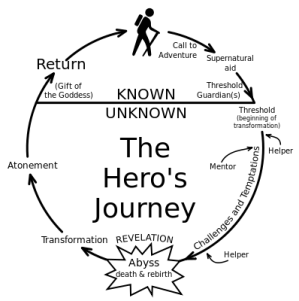
Hero’s journey by Christopher Vogler
So how does redemption fit into the hero’s journey? The events the protagonist experiences change his view of the world and his place in it.
Redemption can be portrayed many ways. A person who commits a terrible crime can do a heroic act, thus counter-balancing his prior sin.
Or there is the charming rogue: at the beginning,his life is focused solely on his own survival. Over the course of the story he gradually begins to care for his companions, and about the cause.
Then, there is the main character who begins the journey as a young and naive person. The first half of the book may show his fall from grace–he becomes disillusioned and callous. At the midpoint of the story arc he is once more transformed. This time events forge him into a hero.
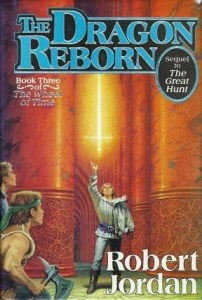
Let’s look at Rand al’Thor, Robert Jordan’s protagonist in the (15 volume) Wheel of Time series. The Wheel of Time has great villains–a LOT of them– which is what drives the highly convoluted story line. There are times when Rand is as villainous as those he battles.
When we first meet Rand he is a naive young man from a rural village, who is pledged to be married to Egwene al’Vere, his childhood sweetheart. Many things occur to change him over the course of the following two years–15 volumes worth of terrible changes, both physical and emotional. In just the first three books:
- Rand is forced to leave home in the dark of night for his own safety.
- He learns he can channel the male half of saidin (magic/the ‘one power’) which means he will go mad, and should be killed for everyone’s safety.
- He is branded on both palms by his blade during an epic battle
- He hears the voice of a long dead madman in his head, and is told he is the reincarnation of that man.
- He is at war with himself and his hated abilities as much as he is with the evil Forsaken.
- He falls in love with three women, who eventually become his three wives, none of whom are Egwene, his fiance. This love-quadrangle challenges his strict sense of morality, increasing his stress.
- He discovers the parents he was raised by were not his birth parents, and that he is the center of a prophecy.
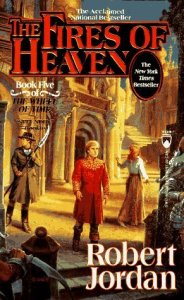 These things are just the tip of the iceberg that is the multitude of burdens carried by Rand al’Thor. As his story arc progresses, Rand starts out with well-meaning intentions, wanting to use his powers for good. As he gains power both politically and in the use of saidin, he becomes a tyrant in his own right. But he is still a good man despite his desire to feel nothing, and once again, though his own folly, he is completely broken down to his component parts. It is during the aftermath of his final breakdown that he is made a truly strong, competent leader.
Rand’s ultimate acceptance of who he is, the reincarnation of Lews Therin Telamon, is the key to his redemption. Only then does he have the chance of winning the prophesied battle against the Forsaken at Tarmon Gai’don.
When I read a book whose protagonists and villains challenge me I return to it later and analyze what it is about those characters that inspired such an emotional reaction in me. It always comes back to their many layers of good and bad traits.
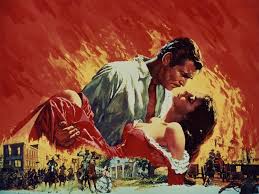 Consider Margaret Mitchell’s classic, Gone With the Wind: Rhett Butler is a man with many faults, but who is, underneath it all, a decent, likable person.
Characters that are multi-layered are intriguing, and will keep the reader turning the pages, to see what they will do next.
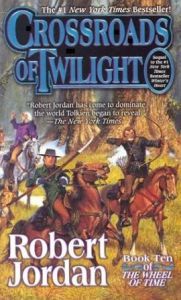 It is a rare person who is completely consumed by evil, and so when we see the softer side of the devil we grudgingly like him. Because of that idea, I’ve spent a lot of time looking at how Robert Jordan portrayed the Forsaken.
Lanfear and Asmodean were frequently pleasant, engaging people and one could feel a certain sympathy for them despite the knowledge that they had pledged their souls to serve evil. Even Demandred had a certain cachet that one could relate to. Each one had the potential and the latent desire for redemption–and each chose to grasp for greater power instead.
What kept Robert Jordan’s die-hard fans waiting patiently for him to finish the series was his compelling characters–and that was also Jordan’s weakness as an author. He fell in love with the minor players and soon the side characters became as important in his mind as Rand al’Thor.
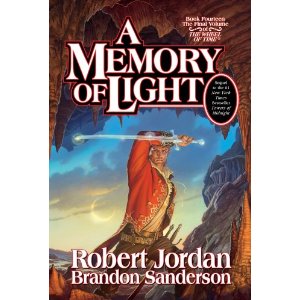 This chasing after so many character’s threads derailed the series for several books, because although they were entertaining books, they did not advance the story. Many readers lost interest by book six, and Brandon Sanderson had to really exercise restraint when, after Jordan’s death, he was tapped to finish writing the series (from Jordan’s copious notes).
Some characters in my own work also have story lines that feature elements of the hero’s journey, some experience a fall from grace, and find redemption. Character development within the core group and reining in my enthusiasm for the side characters is my current task, as I embark on the final draft of Valley of Sorrows.
Tempting though a “fifteen book trilogy” is, I vow that Edwin Farmer’s story will be completed within this last of the three books in the Tower of Bones series.
If the literary muses are willing, the side characters can have their own books, later.


 Life in the Realm of Fantasy