Tag Archives: character development

#amwriting: Midpoint in the Character Driven Novel

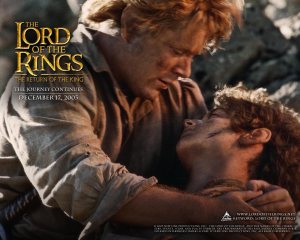
LOTR advance poster 2Some novels are character-driven, others are event-driven.

ALL novels follow an arc.  For my personal reading pleasure, I prefer literary fantasy, which has a character-driven plot. Events happen, often in a fantasy setting, but the growth of the characters is the central theme, and the events are just the means to enable that growth.

You may have built a great world, created a plausible magic system or, conversely, you may have created an alien world with plausible technologies based on advanced scientific concepts. You may have all sorts of adventures and hiccups for your protagonist to deal with. All that detail may be perfect, but without great, compelling characters, setting and action is not reason enough for a reader to stick with your story.

Despite your amazing setting and the originality of your plot, if you skimp on character development, readers won’t care about your protagonist. You must give them a reason to stick with it.

In a character driven novel, the midpoint is the place where the already-high emotions really intensify, and the action does too. From this point on, the forces driving the plot are a train on a downhill run, picking up speed. There is no  turning back now. The characters continue to be put to the test, and the subplots kick into gear.

Of course, plotting and pacing of your entire story arc is critical, but it is especially so from midpoint to the third plot point.

As you approach midpoint of the story arc, the personal growth for the protagonist and his/her friends begins to drive the plot. These are the events that tear the hero down, break him emotionally and physically so that in the final fourth of the book he can be rebuilt, stronger, and ready to face the villain on equal terms.

How does the protagonist react to the events? What emotions drive him/her to continue toward the goal?

In a character -driven novel, this is the place where the protagonists suffer a loss of faith or have a crisis of conscience. It may be a time when the main character believes they have done something unfair or morally wrong, and they have to learn to live with it.

What personal revelations come out about the protagonist, or conversely what does he discover about himself?

This part of the novel is often difficult to write because the protagonist has been put through a personal death of sorts–his world has been destroyed or shaken to the foundations. You as the author are emotionally invested in the tale and are being put through the wringer as you lay it down on the paper.

What has happened? Remember, the protagonist has suffered a terrible personal loss or setback. Perhaps she no longer has faith in herself or the people she once looked up to.

  • How is she emotionally destroyed by the events?
  • How was her own personal weakness responsible for this turn of events?
  • How does this cause the protagonist to question everything she ever believed in?
  • What makes her pull herself together and just keep on going?
  • How is she different after this personal death and rebirth event
LOTR advance posterThe truth underlying the conflict now emerges. Also, the villain’s weaknesses become apparent. The hero must somehow overcome her own personal crisis and exploit her opponent’s flaws. It’s your task to convey the hard decisions she must make, and show that she truly does have the courage to do the job. The villain has had his/her day in the sun, and they could possibly win.

This low point is a crucial part of the hero’s journey, the place during which she is taken down to her component parts emotionally, and rebuilds herself to be more than she ever believed she could be.

At this point in the novel, if you have done it right, your reader will be sweating bullets, praying that Frodo and Sam can just hold it together long enough to make it to Mt. Doom.
2 Comments

Filed under writing

#amwriting: Redemption and the Hero’s Journey

WoT03_TheDragonRebornModern fiction often employs the motif of redemption–the notion that a person can counter a lifetime of misdeeds, but to do so, one must commit selfless acts of heroism.

Within the story arc, a fall from grace can make a protagonist more compelling, more multidimensional. A main-character who is not perfect is far more intriguing than a person with no flaws, because they are unpredictable. Nothing is worse than a predictable novel.

I see characters in books as if they were real people living through the events life hands them. When a character in a book experiences confusion, it’s an opportunity for them to learn new things. If they are frustrated, they must devise a way around that frustration, and if they are tested to the limits of their endurance, they will become stronger. Keep this in mind when you are writing. Don’t make things so easy for  your beloved characters–their struggle is the story.

No tension equals boredom which equals no readers.

For today’s’ post I’m using a famous work of epic fantasy as my example, but everything that I am saying pertains to every kind and genre of book you will write, assuming it is a work of fiction and involves fictional people. (Does not pertain to technical manuals.) (Insert ‘lol’ here).

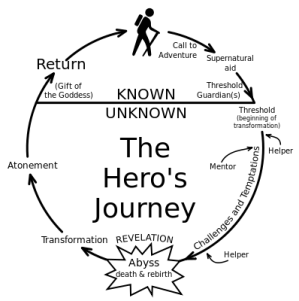
Tales that describe the hero’s journey have certain tropes: they all involve a person who goes on an adventure and, in a decisive crisis, wins a victory. He/she then comes home changed or transformed.  This is a theme that most epic fantasy novels are built around, as is my medieval fantasy, Huw the Bard, and also my epic fantasy World of Neveyah books. However, every novel about people involves a journey of the human spirit, in one way or another.

398px-Heroes journey by Christopher Vogler

Hero’s journey by Christopher Vogler

So how does redemption fit into the hero’s journey? The events the protagonist experiences change his view of the world and his place in it.

Redemption can be portrayed many ways. A person who commits a terrible crime can do a heroic act, thus counter-balancing his prior sin.

Or there is the charming rogue: at the beginning,his life is focused solely on his own survival. Over the course of the story he gradually begins to care for his companions, and about the cause.

Then, there is the main character who begins the journey as a young and naive person. The first half of the book may show his fall from grace–he becomes disillusioned and callous. At the midpoint of the story arc he is once more transformed. This time events forge him into a hero.

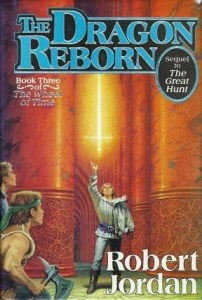
Let’s look at Rand al’Thor, Robert Jordan’s protagonist in the (15 volume) Wheel of Time series. The Wheel of Time has great villains–a LOT of them– which is what drives the highly convoluted story line. There are times when Rand is as villainous as those he battles.

When we first meet Rand he is a naive young man from a rural village, who is pledged to be married to Egwene al’Vere, his childhood sweetheart. Many things occur to change him over the course of the following two years–15 volumes worth of terrible changes, both physical and emotional. In just the first three books:

  1. Rand is forced to leave home in the dark of night for his own safety.
  2. He learns he can channel the male half of saidin (magic/the ‘one power’) which means he will go mad, and should be killed for everyone’s safety.
  3. He is branded on both palms by his blade during an epic battle
  4. He hears the voice of a long dead madman in his head, and is told he is the reincarnation of that man.
  5. He is at war with himself and his hated abilities as much as he is with the evil Forsaken.
  6. He falls in love with three women, who eventually become his three wives, none of whom are Egwene, his fiance. This love-quadrangle challenges his strict sense of morality, increasing his stress.
  7.  He discovers the parents he was raised by were not his birth parents, and that he is the center of a prophecy.

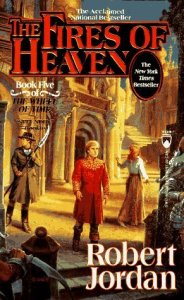
WoT05_TheFiresOfHeavenThese things are just the tip of the iceberg that is the multitude of burdens carried by Rand al’Thor. As his story arc progresses, Rand starts out with well-meaning intentions, wanting to use his powers for good. As he gains power both politically and in the use of saidin, he becomes a tyrant in his own right. But he is still a good man despite his desire to feel nothing, and once again, though his own folly, he is completely broken down to his component parts. It is during the aftermath of his final breakdown that he is made a truly strong, competent leader.

Rand’s ultimate acceptance of who he is, the reincarnation of Lews Therin Telamon, is the key to his redemption. Only then does he have the chance of winning the prophesied battle against the Forsaken at Tarmon Gai’don.

When I read a book whose protagonists and villains challenge me I return to it later and analyze what it is about those characters that inspired such an emotional reaction in me. It always comes back to their many layers of good and bad traits.

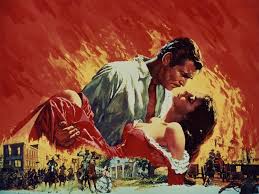
gone with the windConsider Margaret Mitchell’s classic, Gone With the Wind: Rhett Butler is a man with many faults, but who is, underneath it all, a decent, likable person.

Characters that are multi-layered are intriguing, and will keep the reader turning the pages, to see what they will do next.

WoT10_CrossroadsOfTwilightIt is a rare person who is completely consumed by evil, and so when we see the softer side of the devil we grudgingly like him. Because of that idea, I’ve spent a lot of time looking at how Robert Jordan portrayed the Forsaken.

Lanfear and Asmodean were frequently pleasant, engaging people and one could feel a certain sympathy for them despite the knowledge that they had pledged their souls to serve evil.  Even Demandred had a certain cachet that one could relate to. Each one had the potential and the latent desire for redemption–and each chose to grasp for greater power instead.

What kept Robert Jordan’s die-hard fans waiting patiently for him to finish the series was his compelling characters–and that was also Jordan’s weakness as an author. He fell in love with the minor players and soon the side characters became as important in his mind as Rand al’Thor.

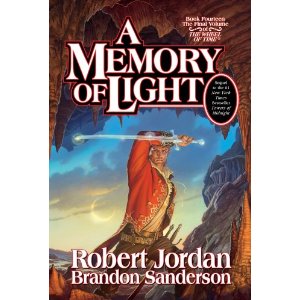
A_Memory_of_Light_cover (1)This chasing after so many character’s threads derailed the series for several books, because although they were entertaining books, they did not advance the story. Many readers lost interest by book six, and Brandon Sanderson had to really exercise restraint when, after Jordan’s death, he was tapped to finish writing the series (from Jordan’s copious notes).

Some characters in my own work also have story lines that feature elements of the hero’s journey, some experience a fall from grace, and find redemption. Character development within the core group and reining in my enthusiasm for the side characters is my current task, as I embark on the final draft of Valley of Sorrows.

Tempting though a “fifteen book trilogy” is, I vow that Edwin Farmer’s story will be completed within this last of the three books in the Tower of Bones series.

If the literary muses are willing, the side characters can have their own books, later.

4 Comments

Filed under Books, Fantasy, Literature, writing

What I’ve learned from Agatha Chistie

The_Body_in_the_Library_US_First_Edition_Cover_1942I don’t know about you, but I loved Agatha Christie’s novels as much for the great characters as for the mysteries. She had a way of putting the reader right into the society of the time. Take, for instance, Miss Marple.

She’s elderly and has no visible means of support, yet she is not poor. We think she must be living on inherited wealth, but while she is not poor, she also is not conspicuously rich. She is an elderly spinster who was once engaged, is obviously from a good family, and is godmother to a number of young men and women who sometimes get into trouble and need her sharp eyes to sort out mysteries.

She has a nephew, Raymond West, who must be a sister’s child as the name is different, yet no mention is ever made of Jane’s family beyond him. Did she raise him? She is quite close to him.

The_Moving_Finger_First_Edition_Cover_1942She is well-traveled, and can afford to go to Egypt, and to the Caribbean. Miss Marple has close friends in high society. She knows people with hyphenated names and large estates. She doesn’t let wealth or social standing blind her to the true frailties of human nature–she knows that greed and sex are the root cause of nearly every crime.

She owns her own cottage in St. Mary Mead, and it’s not small or mean in any way–she has the ability to hire a young lady to come in and help with the heavy cleaning, although it is difficult to find one who respects the china.

A_Caribbean_Mystery_First_Edition_Cover_1964Miss Marple takes great interest in the life of her village, and it is through her knowledge of that life that she is able to solve complicated, well planned murders. Her ability to work out the motives for each suspect is directly related to how their actions remind her of certain people she has known over the years in her village. Be careful what you say around her, because she will know what you did by connecting the dots between what you said and what happened.

All this information about Miss Jane Marple comes out in her conversations with other characters, delivered over the course of an entire book, and yet one feels as if one knows her right away.

The_Murder_at_the_Vicarage_First_Edition_Cover_1930In the first full book in which she appears, The Murder at the Vicarage, she isn’t really as likable as she is in later books–she seems a bit of a gossip, and rather mean-spirited at that, always expecting the worst of people.

But over the course of 12 books she evolves, and so does our knowledge of her–or does it?

She is genteel, slightly nosy, very comforting and she is on to you–so don’t even think about doing it.

What I have learned from Agatha Christie is that memorable characters grow on you over the course of the book–they are not delivered fully formed on the first page. They are intriguing and we don’t always know what they will do next. There is a hint of mystery about them, and at the end of the book we want to know more.

A_Murder_is_Announced_First_Edition_Cover_1950This sense of intrigue is what we want to instill in all our characters, whether we write sci-fi, romance, fantasy, pot-boilers, or cozy mysteries. If you think about your own experience in life, once it is apparent that you know everything there is to know about a person, they cease to intrigue you. It is the complexities of your friends that keep them interesting, the little things you never knew that amaze you when they are revealed.

Developing a character, deploying just enough information at the right moments to pique the reader’s curiosity is a balancing act, and I’ve come to believe that not everyone can do it with finesse.

Revealing the character over the course of time, and allowing them grow is crucial to keeping the reader’s interest. I think this can only happen if the author has a true understanding of who their character is. This person must be fully formed in the author’s mind so that when they emerge on to the paper they have a sense of realism, as if they are someone the reader would want to know.

nemesis agatha christieMiss Jane Marple was modeled on Agatha Christie’s step grandmother, and on her Aunt (Margaret West), and her friends. Observing these sharp old ladies taught Agatha how a little life-experience can cut through the smoke and mirrors to the truth of people’s’ motivations rather quickly, and that they were often correct in their sometimes mean-spirited assumptions.

I find that doing a small biography of my characters for my own records helps me to understand my people, and while I generally write in the genre of fantasy, people are who they are regardless of the setting you place them in. Characters will react and behave a certain way depending on their history and values. Some are brave, some are lucky, some are stupid beyond belief, but the ones who keep you reading are the ones who still have more to reveal about themselves when the last page has been turned.


Comments Off on What I’ve learned from Agatha Chistie

Filed under Adventure, blogging, Books, Fantasy, Literature, Publishing, Romance, Self Publishing, Uncategorized, writer, writing