Tag Archives: characters

Fantasy and the cold hard truth

Saint_Alban_(cropped)In a good novel, there is a moment where the interactions between certain characters can become highly charged, fraught with anger and other intense emotions. That is the case with what I am writing now:  three of my characters spent a long time fighting alongside each other, brothers and sisters in arms, completely dependent on each other.

They have a long history. Several terrible incidents occurred during the war they once fought that they don’t understand, and which created a rift between them. Some of their close companions were killed under bad circumstances (are there ever any good ones?) and each of my characters suffers a little survivor’s guilt.

After the war, they went their separate ways and for the last 25 years, have rarely seen each other or spoken. They all bear a burden of responsibility for things they can’t change, and their lives are affected by this, although they don’t know why. For each of them, their anger and remorse are expressed in different ways.

Two of them can’t be in the same room for long without trying to kill each other.

One character in particular suffers disturbing recurring flashbacks, avoidance or numbing of memories of the event, and what we call ‘fight or flight syndrome,’ the uncontrollable urge to either fight or flee. These characters all three demonstrate varying degrees of avoidance,  withdrawal, aggressive defense, or in one case, complete frozen immobility. Certain memories trigger these behaviors, and now all three are being forced to face their demons.

My challenge is to bring these people back together with sensitivity and realism, in order to advance my story, and use only 1/3 of the allotted word-count for this book.

Does this sound like Post Traumatic Stress Disorder (PTSD)? You’re right. For more information on PTSD, see an article  on the website, Military Pathways, and this news article aired by CBS on their show, 60Minutes.

Because it’s a new term, I can’t refer to this ‘injury of the spirit’ as PTSD in my manuscript. But I can give it another name and air both the symptoms and the sometimes life-long problems untreated PTSD causes.

GeorgeSPatton - WikipediaMy father, and my uncles all suffered from this long after World War II ended. In many ways it has shaped our post WWII society. Our fathers were told to just shut up and  get on with their lives–something that is not always an easy thing. Alcoholism and domestic abuse lay just under the surface of many families in our community, hidden but there.

Prior to World War I, the U.S. Army considered the symptoms of battle fatigue to be cowardice or attempts to avoid combat duty. While the causes, symptoms, and effects of the condition were familiar to physicians, it was generally less understood in military circles. General George Patton garnered substantial controversy after he slapped two United States Army soldiers under his command during the Sicily Campaign of World War II.

It was common for soldiers who reported these symptoms to receive harsh treatment. At the time of the slapping incidents, the two soldiers Patton assaulted were suffering from “battle fatigue,” otherwise known as “shell shock” or “battle stress.” Today, this condition is characterized as a form of PTSD, which can result from prolonged severe exposure to death and destruction, among many other traumatic events.
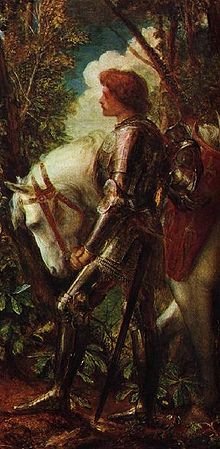
220px-Sir_Galahad_(Watts)

Even though I write fantasy, the reactions of my characters to certain situations has to be realistic, and that is where a good grasp of what really happens to our vets comes in handy. Post Traumatic Stress Disorder (PTSD) is real and affects our returning veterans. More must be done to help ease our military wounded back into society, but generally speaking we pay more lip-service to that problem than we do tax dollars.

We write about incredible personal challenges, because they make great stories. But what about the people who live through those moments? How do they quietly go back to the farm once the war is over, and pretend it never happened? This is what I am writing about now, and it has been an emotional journey for me as as an author and a human being. Everyday, our paths are crossed by men and women living with PTSD caused by a variety of terrible circumstances,  They are just ordinary people trying to keep their lives together, not understanding why they sometimes do the things they do, and wondering why things just keep going to hell all around them.


2 Comments

Filed under Adventure, Battles, Blogger, blogging, Books, Fantasy, knights, Literature, Publishing, Self Publishing, WordPress, writer, writing

Knights Running Bare

200px-Saint_George_-_Carlo_CrivelliOne thing we don’t really think about when we first sit down to tell a tale is the attire our characters will be sporting. (Or not sporting, as the case may be.) But it does eventually come up, and how we get that across to our readers without boring them to tears is important.

Much of the time, my characters wear armor, the men and the women both. I’m an equal opportunity author–I think women deserve to be encased in gleaming tin as often as men, so there you go.

When I am reading a historically based novel, I want to be able to picture the characters in the right style of clothing, but unless I am reading the curtain scene in Gone With The Wind, I don’t want exact details. In most cases, a sentence or two giving us a general description is all that is really necessary.

Some of you may say, “But clothes are an essential aspect of the culture I am trying to describe!” I agree – every culture is rich in the way their clothing is decorated, and in what is considered appropriate for each gender. But again, a sentence or two here and there will do the trick. If you give the reader  the general idea they will fill in the blanks with their imagination. Too much detail may cause the reader to lose the momentum of the tale.

As a reader,  unless we are talking armor, I want to know what they are wearing, but don’t waste my time giving me more than a few sentences.

However, if we are talking armor, while I, as the reader, don’t need too many details, you as the AUTHOR, do need to keep some details in mind when you are writing the story. Your knights are not running bare–they are fully clothed in steel. That affects HOW they move.

First of all, it’s important to note that ‘fully armored’ means the characters are wearing:

  1. Helmet:  a form of protective gear worn to protect the head from injuries
  2. Gorget:  a single piece of plate armor hanging from the neck and covering the throat and chest.
  3. Pauldrons (or spaulders):  a single large dome-shaped piece to cover the shoulder
  4. Besagews:  circular defenses designed to protect the armpits
  5. Couters: the defense for the elbow in a piece of plate armor. Initially just a curved piece of metal, as plate armor progressed the couter became an articulated joint.
  6. Vambraces: forearm guards, defenses for covering the forearm
  7. Gauntlets: several different styles of glove, particularly those with an extended cuff covering part of the forearm
  8. Cuirass: back and breastplate
  9. Fauld: bands of metal surrounding both legs, potentially surrounding the entire hips in a form similar to a skirt.
  10. Tassets:a piece of plate armor designed to protect the upper legs
  11. Culet:   a piece of plate armor consisting of small, horizontal ribs that protect the small of the back or the buttocks
  12. Cuisses: to protect the thigh.The word is the plural of the French word cuisse meaning ‘thigh’. While the tassets of a cuirass could protect the upper legs from above, a thrust from below could avoid these defenses. Thus, cuisses were worn on the thighs to protect from such blows.
  13. Poleyns: armor that protected the knee
  14. Greaves: shin armor
  15. Sabatons: covering for the foot. Fourteenth and fifteenth century sabatons typically end in a tapered point well past the actual toes of the wearer’s foot, following fashionable shoe shapes of the fourteenth century. Sabatons of the first half of sixteenth century end at the tip of the toe and may be wider than the actual foot. They were the first piece of armor to be put on.

Charles_Ernest_Butler_-_King_Arthur - via Wikimedia CommonsThat’s a hell of a lot of steel and it took some time to put on. The very fullest sets,  could be configured for a range of different uses, for fighting on foot or on horse. They were complicated and took a while to get on correctly, and a man needed help with some of the more involved things, like lacing them on.

The reader doesn’t need to know this, and they don’t care. But what the AUTHOR needs to know is how this sort of attire affects what your character can actually do!

Realistically, most medieval soldiers did not wear full sets of armor as their daily attire. In general they wore the minimum amount of metal they could get away with unless they were going into a situation that could result in a battle. When your characters are out riding around, if you have them only partially armored, they will be more able to move around in a logical manner, than if you have encased them in a gleaming sardine can.

arthur-knights-table-1Some readers (like me) are quite savvy–they will know you haven’t thought it out well if your fully armored knight is suddenly indulging in a moment of passion with fully dressed Lady Gwen.

Think about the many layers of what your characters are actually wearing–it can’t be done! For that you must undress them, and it is a bit involved, so they must plan ahead for their romantic trysts and leave the armor at home.

When writing historical fiction it is important to remember that people are not really that much different nowadays than they ever were. They get cold, so they wear clothes, in many layers. The warmer the weather, the fewer the layers. Inside a warm building, they may be lightly clad. Keep that  in mind as you are writing, and convey the idea of their attire with a minimum of words, and your reader will get more enjoyment from the tale.

736px-Dante_Gabriel_Rossetti_The_Tune_of_Seven_Towers

2 Comments

Filed under Battles, Books, Fantasy, Humor, knights, Literature, Uncategorized, writer, writing