Tag Archives: crutch words

Making Effective Revisions part 2: crutch words, style, and voice #writing

Our stories are an unconscious reflection of what we wish our favorite authors would write. But what is it that attracts us to their writing?

We love their style, their voice.
Some authors are forceful in their style and throw you into the action. They have an in-your-face, hard-hitting approach that comes on strong and doesn’t let up until the end.

Others are more leisurely, casually inserting small hooks that keep you reading.

What are voice and style?

  1. The habitual choice of words shapes the tone of our writing.
  2. The chronic use and misuse of grammar and punctuation shapes the pacing of our sentences.
  3. Our deeply held beliefs and attitudes emerge and shape character arcs and plot arcs.

We develop our own voice and style when we write every day or at least as often as possible. We subconsciously incorporate our speech patterns, values, and fears into our work, and those elements of our personality form the voice that is ours and no one else’s.

The words we habitually choose are a part of our fingerprint. First drafts are rife with crutch words. This is because, in the rush of laying down the story, we tend to fall back on certain words and ignore their synonyms. A good online thesaurus is a necessary resource.

I prefer to keep my research in hardcopy form, rather than digital. I have mentioned this before, but The Oxford Dictionary of Synonyms and Antonyms is a handy tool when I am stuck for alternate ways to say something.

And it makes the perfect place to rest my teacup.

We all have words that we choose above others because they say precisely what we mean. I think of my fallback words as a code. At this point in my career, I know what those words are and when I am making revisions, I make a global search for them and insert alternatives that show my idea more vividly.

Looking at each example of a code word and their synonyms gives me a different understanding of what I am trying to say. It gives me the opportunity to change them to a more powerful form, which conveys a stronger image and improves the narrative. (I hope.)

Saying more with fewer words forces us to think on an abstract level. In poetry we have to choose our words based on the emotions they evoke, and the way they portray the environment around us. This is why I gravitate to narratives written by authors who are also poets—the creative use of words elevates what could be mundane to a higher level of expression, and when it’s done well, the reader doesn’t consciously notice the prose, but they are moved by it.

What are some words that convey powerful imagery, some that heighten tension when included in the prose?

  • Lunatic
  • Lurking
  • Massacre
  • Meltdown
  • Menacing
  • Mired
  • Mistake
  • Murder
  • Nightmare
  • Painful
  • Pale
  • Panic
  • Peril
  • Slaughter
  • Slave
  • Strangle
  • Stupid
  • Suicide
  • Tailspin
  • Tank
  • Targeted
  • Teetering

And those are just the beginning.

Our word choices are a good indication of how advanced we are in the craft of writing. For instance, in online writing forums, we are told to limit the number of modifiers (adjectives and adverbs) we might habitually use.
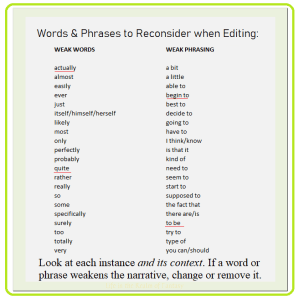
We are like everyone else. Our work is as dear to us as a child, and we can be just as touchy as a proud parent when it is criticized. We should respect the opinions of others, but we have the choice to ignore those suggestions if they don’t work for us.

Our voice comes across when we write from the heart. We gain knowledge and skill when we study self-help books, but we must write what we are passionate about. So, the rule should be to use modifiers, descriptors, or quantifiers when they’re needed.

How we use them is part of our style. Modifiers change, clarify, qualify, or sometimes limit a particular word in a sentence to add emphasis, explanation, or detail. We also use them as conjunctions to connect thoughts: “otherwise,” “then,” and “besides.”

Descriptors are adverbs and adjectives that often end in “ly.” They are helper nouns or verbs, words that help describe other words. Some descriptors are necessary but they are easy to overuse.

Do a global search for the letters “ly.” A list will pop up in the left margin and the manuscript will become a mass of yellow highlighted words.

I admit it takes time and patience to look at each instance to see how they fit into that context. If, after looking at the thesaurus, I discover that the problem descriptor is the only word that works, I will have to make a choice: rewrite the passage, delete it, or leave it.

Quantifiers are abstract nouns or noun phrases that can weaken prose. They convey a vague impression or a nebulous quantity, such as: very, a great deal ofa good deal ofa lot, many, much, and rather. Quantifiers have a bad reputation because they can quickly become habitual, such as the word very.

We don’t want our narrative to feel vague, nebulous, or abstract.

  • In some instances, we might want to move the reader’s view of a scene or situation out, a “zoom out” so to speak. The brief use of passive phrasing will do that. I saw the gazelles leaping and running ahead of the grassfire, hoping to outrun it. They failed.

I saw is a telling phrase, slightly removing the speaker from the trauma.

Limiting descriptors and quantifiers to conversations makes a stronger narrative. We use these phrases and words in real life, so our characters’ conversations will sound natural. The fact we use them in our conversation is why they fall into our first drafts.
Our narrative voice comes across in our choice of hard or soft words and where we habitually position verbs in a sentence. It is a recognizable fingerprint.

Many times, I read something, and despite how well it is constructed and written, it doesn’t ring my bells. This is because I’m not attracted to the author’s style or voice.

That doesn’t mean the work is awful. It only means I wasn’t the reader it was written for.
3 Comments

Filed under writing

The Second Draft: Decoding My Mental Shorthand #writing

Before we set the first words on a blank page, our minds have formed images of scenes we want to describe. Steven Pinker is a professor of psychology at Harvard University who specializes in visual cognition and developmental linguistics. He reminds us that we are not born with language, so we are NOT engineered to think in words alone. We also think in images.

depthPart1revisionsLIRF05252021It follows that certain words become a kind of mental shorthand, small packets of letters that contain a world of images and meaning for us. Code words are the author’s multi-tool—a compact tool that combines several individual functions in a single unit. One word, one packet of letters will serve many purposes and convey a myriad of mental images.
These words are sometimes used too often in the first draft as they are efficient. We write as fast as we can when we have the inspiration. Code words convey a wide range of information concisely, and because we use them, we can write the first draft of a story from beginning to end before we lose the fire for it.

In my current writing, I hope to portray my protagonists as I see them without bashing my readers with how I see their appearance. The big temptation is to go into detail about each person’s specific characteristics.

This is not necessary. We think in images, and so do our readers, who will fill in the details in a way that is pleasing to them. I want to convey their characteristics naturally and without beating the reader over the head.

A few years ago, I read a novel featuring a caterer who solves mysteries. She is continuously described as Junoesque, ample, vast, chubby, size eighteen, fat, large … and on and on. In every chapter, at least once and usually twice, we were given a visual description of her, along with indications of how she aroused the males around her.

Those constant descriptions were meant to emphasize the author’s perception of her protagonist as plump but irresistible to the males. However, as the book wore on, it became jarring and unnecessary. I skipped to the end and then set it aside, never to be read again.

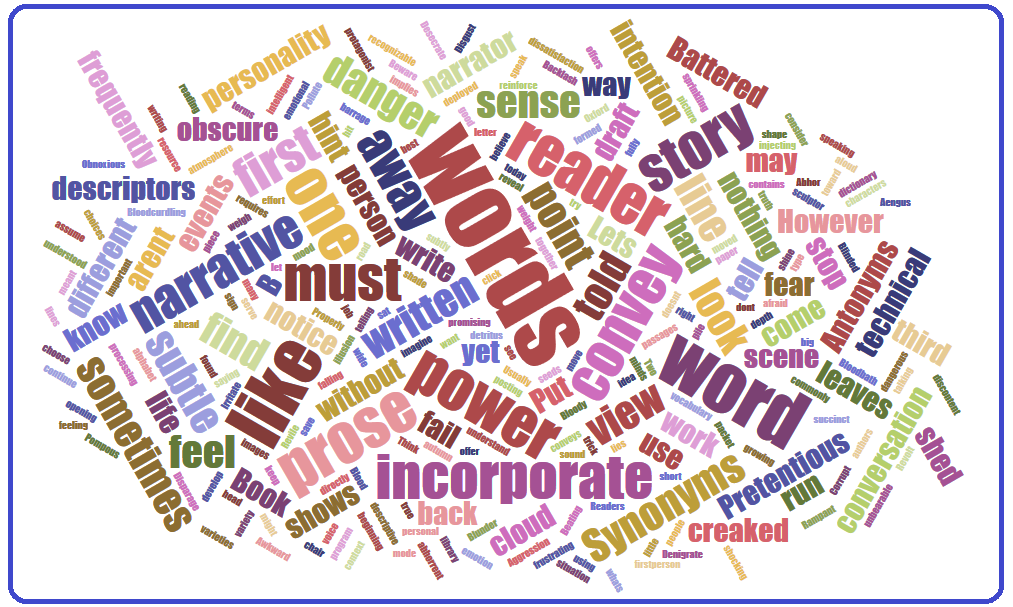
powerwordsWordCloudLIRF06192021I want to avoid that sin in my work, but what are my code words? What words are being inadvertently overused as descriptors? A good way to discover this is to make a word cloud. The words that see the most screen time will be the largest. Free online word cloud generator and tag cloud creator – WordClouds.com.

A word frequency search is also a good tool. Word Frequency Counter – Counts frequency of words in text, free online tool (charactercounter.com)

In my current work, a prominent side character is an important mentor. He is tall with dark skin and dark eyes. His hair is a wiry halo shot with white and trimmed close to his head. This is a mixed-race society, a world where “race” means “species.” One is a human born in the world of Neveyah, a large minotaur from the Bull God’s world, or a small person with rat-like features from the Mountain God’s world. Those are the only racial differences people notice.

So, when showing my people, I use general descriptors, and thanks to my use of word frequency search, the code words are now used only a few times. My hope is that a reader will make appropriate visualizations as needed.

Every author thinks a little differently, so your code words will be different from mine. Another way to find your secret code words is to have the Read Aloud tool read each section. I find many inadvertent crutch words that way.

One of the code words I subconsciously overuse is “felt.” My thesaurus says I could exchange felt for:

  • ozford-american-writers-thesaurusendured
  • experienced
  • knew
  • saw
  • suffered
  • tasted
  • underwent,
  • witnessed

The thesaurus offers some other words related to felt:

  • regarded
  • viewed
  • accepted
  • depended
  • trusted
  • assumed
  • presumed
  • presupposed
  • surmised

It’s natural to overuse certain words without realizing it, but that is where revisions come in.

As you go along, you’ll discover that some words have very few synonyms that work.

Consider the word “smile.” It’s a common code word, a five-letter packet of visualization. Synonyms for “smile” are few and don’t show what I mean:

  • beam
  • grin
  • leer
  • smirk

Each occurrence of the word “smile” in my work must be considered individually. Sometimes, this requires a complete re-visualization of the scene. It hurts my heart to murder my darlings, but I look for a different way to convey my intention.

We don’t have to drag the reader through a long list of ever-moving facial expressions, such as lips turning up, down, drawing to one side, etc.

When done sparingly and combined with a conversation, this kind of visual display can work.

By sparingly, I mean no more than one facial change per interaction, please.

oxford_synonym_antonymSometimes, the only thing that works is the brief image of a smile. Nothing is more boring than reading a story where a person’s facial expressions take center stage. As a reader, I want to know what is happening inside our characters and can be put off by an exaggerated outward display.
Once you become aware of your first draft code words, go to the thesaurus, find all the synonyms you can, and list them in a document for easy access. If it is a word such as smile or shrug, you have your work cut out, but it will speed things up if you make a small list of visuals that you can use and change up as needed.

A list of mood indicators can keep you from losing your momentum and will readily give you the words you need to convey all the vivid imagery you see in your mind. I saved my list to my desktop, so I don’t have to waste time searching for it.

Here are some instances of body language an observer would see if a character was wary.

  • Crossed arms.
  • A stiff posture.
  • Narrowed eyes.

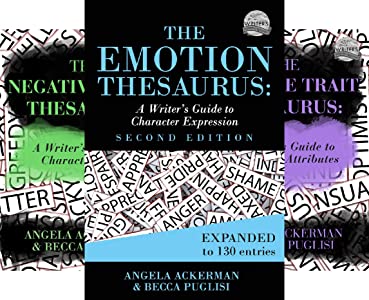
emotion-thesaurus-et-alIf you don’t have it already, a book you might want to invest in is The Emotion Thesaurus by Angela Ackerman and Becca Puglisi. Some of the visuals they list aren’t my cup of tea, but they understand how to use words that show what people are thinking.

This aspect of the revision process is sometimes the most difficult. It takes time to examine each instance of our code words. They don’t always need changing—sometimes, a smile is a smile, and that is okay.

6 Comments

Filed under writing

Modifiers, descriptors, and crutch words #writing

Note to self: write dynamic prose and avoid crutch words.

MyWritingLife2021BOne thing I notice when listening to an audiobook is crutch words. One of my favorite authors uses the descriptor “wry” in all its forms, just a shade too frequently. As a result, I have scrubbed it from my own manuscript, except for one instance.
Wry is a modifier. It means using or expressing dry, especially mocking, humor: “a wry smile.”

“Sardonic,” a word he also uses a bit too frequently, is a relative of the word “wry” and means grimly mocking or cynical.

Both are good words, but they are easily overused when we are trying to show a character’s mood in a bleak situation.

Grin and smile are also first draft crutch words we use to show a mood. I do a global search and then tear my hair out trying to show my protagonist’s mood without getting hokey.

The way we use modifiers and descriptors (and their frequency) plays a significant role in how our work is received by a reader.

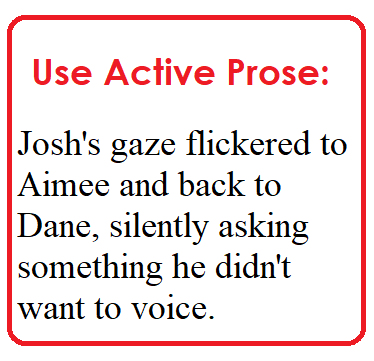
Use Active ProseThe words authors choose add depth and shape their prose in a recognizable way—their voice. They “paint” a scene showing what the point-of-view character sees or experiences.

And yes, in order to do that, they must use modifiers and descriptors, also known as adjectives and adverbs.

Modifiers are like any other medicine: a small dose can cure illnesses. A large dose will kill the patient. The best use of them is to find words that convey the most information with the most force.

What do we mean when we refer to modifiers?

A modifier is any word that modifies (alters, changes, transforms) the meaning and intent of another word. These words change, clarify, qualify, or limit a particular word in a sentence to add emphasis, explanation, or detail.

Some of these words are useful as conjunctions, words to connect thoughts: “otherwise,” “then,” and “besides.”

poetry-in-prose-word-cloud-4209005What are descriptors? Adverbs and adjectives, known as descriptors, are helper nouns or verbs—words that help describe other words.
What is a quantifierThey are nouns (or noun phrases) meant to convey a vague number or an abstract impression, such as very, a great deal ofa good deal ofa lot, many, much. The important word there is abstract. It is a thought or idea describing something without physical or concrete existence.

Modifiers, descriptors, and quantifiers are easily overused, so these words are often reviled by authors armed with a little dangerous knowledge.

One of the cautions those of us new to the craft frequently hear are criticisms about the number of “ly” words we habitually use. The forms we use can weaken our narrative.

First, examine the context. Have you used the word “actually” in a conversation? You may want to keep it, as dialogue must sound natural, and many people use that word when speaking.

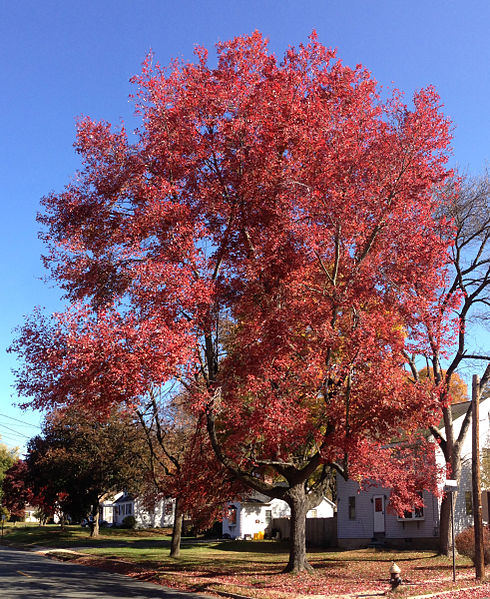
490px-2014-10-30_11_09_40_Red_Maple_during_autumn_on_Lower_Ferry_Road_in_Ewing,_New_JerseyHowever, if you have used “actually” to describe an object, take a second look to see if it is necessary.

  • The tree was actually covered in red leaves.

Would the sentence be stronger without it?

  • Red leaves covered the tree.

Some descriptors are easy to spot, especially those ending in “ly.” When I begin revising a first draft, I do a global search for the letters “ly.” A list will pop up in my lefthand margin. My manuscript will become a mass of yellow highlighted words.

This is where I look at each instance because “ly” words are code words the subconscious mind uses in the first draft. They are a kind of mental shorthand that tells us what we need to expand on to fully explore the scene we envisioned.

Or they tell me something needs to be cut.

Context is everything. Please take the time to look at each example of the offending words and change them individually. I’ve said this many times, but I like to nag: You have already spent months writing that novel. Why not take a few days to do the job well?

Sentence structure mattersThe placement of an adjective in relation to the noun it describes affects a reader’s perception. Modifiers often work best when showing us what the point-of-view characters see, hear, smell, touch, and taste.

Sunlight glared over the ice, a cold fire that cast no warmth but burned the eyes.

In the above sentence, the essential parts are structured this way: noun – verb (sunlight glared), adjective – noun (cold fire), verb – adjective – noun (cast no warmth), and finally, verb – article – noun (burned the eyes).

So, we try to lead with the action or noun, followed by a strong modifier (one without the “ly” ending). The sentence conveys what is intended. It has modifiers but isn’t weakened by them.

ok to write garbage quote c j cherryhThe scene I detailed above could be shown in many ways. I took a paragraph’s worth of world-building and pared it down to 19 words, three of which are action words.
So, now you know what occupies most of my attention during revisions.

As writers, we all want to be accepted and have others like our work, which means we must meet our reader’s expectations.

Writers must write from the heart, or there is no joy in writing.

That means using modifiers, descriptors, or quantifiers when they are needed. It’s a balancing act. We must be mindful of the form and the context of how a modifier fits into our phrasing.

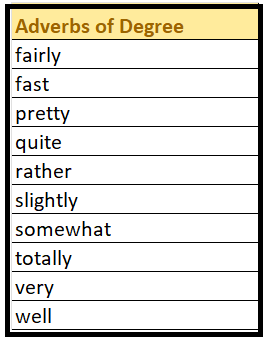
Below are two images. They are lists of code words I seek out and re-examine when I begin revising a first draft. Some words are quantifiers. They are adverbs of degree, words that describe how much of something, such as “I’m dreadfully unhappy.” Quantifiers (also known as adverbs of degree) have their place but can weaken a sentence. So, they are code words for you to look closely at when you get to the revision stage.  

Adverbs_of_degree

“Adverbs of manner” are qualifiers, words that “qualify the manner of what we are talking about.” They can intensify or decrease the degree of something, such as “I rarely go out.”

Adverbs_of_Manner

It seems like an overwhelming task, but it isn’t. I look at each instance of a modifier and see how it fits into that context. If a word or phrase weakens the narrative, I rewrite the sentence. I either change it to a more straightforward form or remove it. For example, bare is an adjective, as is barely. Both can be used to form a strong image, depending on the words we surround them with.

I have found that participating in a critique group has been crucial to my growth as an author. Most writing groups are made up of people who love reading and want your work to succeed. They won’t micromanage your manuscript because they are aware that too much input can remove the author’s unique voice from a piece.


Credits and Attributions:

IIMAGE: Wikimedia Commons contributors, “File:2014-10-30 11 09 40 Red Maple during autumn on Lower Ferry Road in Ewing, New Jersey.JPG,” Wikimedia Commons, https://commons.wikimedia.org/w/index.php?title=File:2014-10-30_11_09_40_Red_Maple_during_autumn_on_Lower_Ferry_Road_in_Ewing,_New_Jersey.JPG&oldid=751843290 (accessed April 28, 2024).

4 Comments

Filed under writing

Revisions part 1: Spotting the Code Words and Mental Shorthand #amwriting

When we set the first words on a  blank page, our minds begin forming images, scenes we want to describe. In his book, The Language Instinct, Steven Pinker notes that we are not born with language, so we are NOT engineered to think in words alone—we also think in images.

It follows that certain words become a kind of mental shorthand, small packets of letters that contain a world of images and meaning for us. These words will be used with frequency in the first draft as they are efficient. We write as fast as we can when we are in the mood, and these words are a speedy way to convey a wide range of information.

Because we use them, we can get the first draft of a story written from beginning to end before we lose the fire for it.

One code word that slips into my first draft prose is the word “got.”

It is a word that serves numerous purposes and conveys so many images. “Got” is on my global search list of “telling words.” The words in the list are signals to me, indications that a scene needs to be reworded to make it a “showing” scene.

Got:”  He got the message = comprehension. He understood.

Some other instances where we use “got” as a code word for our second draft:

  • He got the dog into the car.
  • He got the mail.
  • He got

Code words are the author’s multi-tool—a compact tool that combines several individual functions in a single unit. One word, one packet of letters serves many purposes and conveys a myriad of mental images.

Every author thinks a little differently, so your code words will be different from mine. One way to find your secret code words is to have the Read Aloud tool read each section. I find most of my inadvertent crutch words that way.

Another code word on my personal list is “felt.” Let’s go to Merriam-Webster’s Online Thesaurus:

Synonyms:

  • endured
  • experienced
  • knew
  • saw
  • suffered
  • tasted
  • underwent,
  • witnessed

Words Related to felt:

  • regarded
  • viewed
  • accepted
  • depended
  • trusted
  • assumed
  • presumed
  • presupposed
  • surmised

It’s natural to overuse certain words without realizing it, but that is where revisions come in. Anytime I’m working on showing interactions between characters, certain words will be hauled into play over and over.

As you go along, you’ll discover that some words have very few synonyms that work.

Consider the word “smile.” It’s a common code word, a five-letter packet of visualization. Synonyms for “smile” are few and usually don’t show what I mean:

  • Grin
  • Smirk
  • Leer
  • Beam

When I come across the word “smile” in my work, it sometimes requires a complete re-visualization of the scene. I look for a different way to convey my intention, which can be a frustrating job.

Our characters’ facial expressions display happiness, anger, spite, and all the other emotions. Their eyebrows raise or draw together; foreheads crease and eyes twinkle; shoulders slump, and hands tremble.

I refuse to drag the reader through a long list of ever-moving facial expressions, lips turning up, down, drawing to one side, etc., but sometimes the brief image of a smile is what you need.

When done sparingly and combined with a conversation, this can work.

But… by sparingly, I mean no more than one facial change per interaction, please. Nothing is more boring than reading a story where a person’s facial expressions take center stage. We must be more concerned with what is happening inside our characters than about the melodramatic outward display.

When you discover one of your first draft code words, go to the thesaurus and find all the synonyms you can and list them in a document for easy access. If it is a word like smile or shrug, you have your work cut out, but consider making a small list of visuals.

Think about the expressions and body language an onlooker would see if a character were angry.

  • Crossed arms.
  • A stiff posture.
  • Narrowed eyes.

A little list of those mood indicators can keep you from losing your momentum and will readily give you the words you need to convey all the vivid imagery you see in your mind.

Literary agent Donald Maas has good advice in his book, the Emotional Craft of Fiction.

If you don’t have it already, another book you might want to invest in is The Emotion Thesaurus by Angela Ackerman and Becca Puglisi. Some of the visuals they list aren’t my cup of tea, but they do have a grip on how to show what people are thinking.

This aspect of the revision process is sometimes the most difficult.  It takes time when we look at each instance of our code words. They don’t always need changing—sometimes, a smile is a smile and that is okay.


Credits and Attributions:

Wikimedia Commons contributors, “File:Victorinox Multitool.jpg,” Wikimedia Commons, the free media repository, https://commons.wikimedia.org/w/index.php?title=File:Victorinox_Multitool.jpg&oldid=484117422 (accessed February 14, 2021).

6 Comments

Filed under writing