Tag Archives: dragons

Sell me that book in 100 words or less!

Aquarell_gemalt_von_August_Menken-1875 By Creator - August Menken [Public domain] via Wikimedia CommonsI’ve been participating in a month-long exercise where you get a prompt and you write the story. I have set the bar a bit high, as I am giving myself only 100 words to tell that story.  It’s a bit difficult, but I have a reason for this, beyond my usual insanity.

The back of a book has something we writers call blurbs (I know. I shouldn’t use author-speak in company, it’s not polite.)  Technically it is called “the pitch” because you are pitching your product to prospective buyers.  This little thing is critical.  Your cover must make them pick up the book or click on the icon and your pitch must sell it. But hello – you have only about 30 seconds to capture the prospective buyer’s interest enough for them to crack it open, or use the look inside feature for eBooks.

I’m not real good at writing pitches. Neither are the Big Six Publishers, oddly enough!  Even the big companies have found ways of avoiding pitching a novel simply by putting glowing reviews of other works by that author on the back cover.
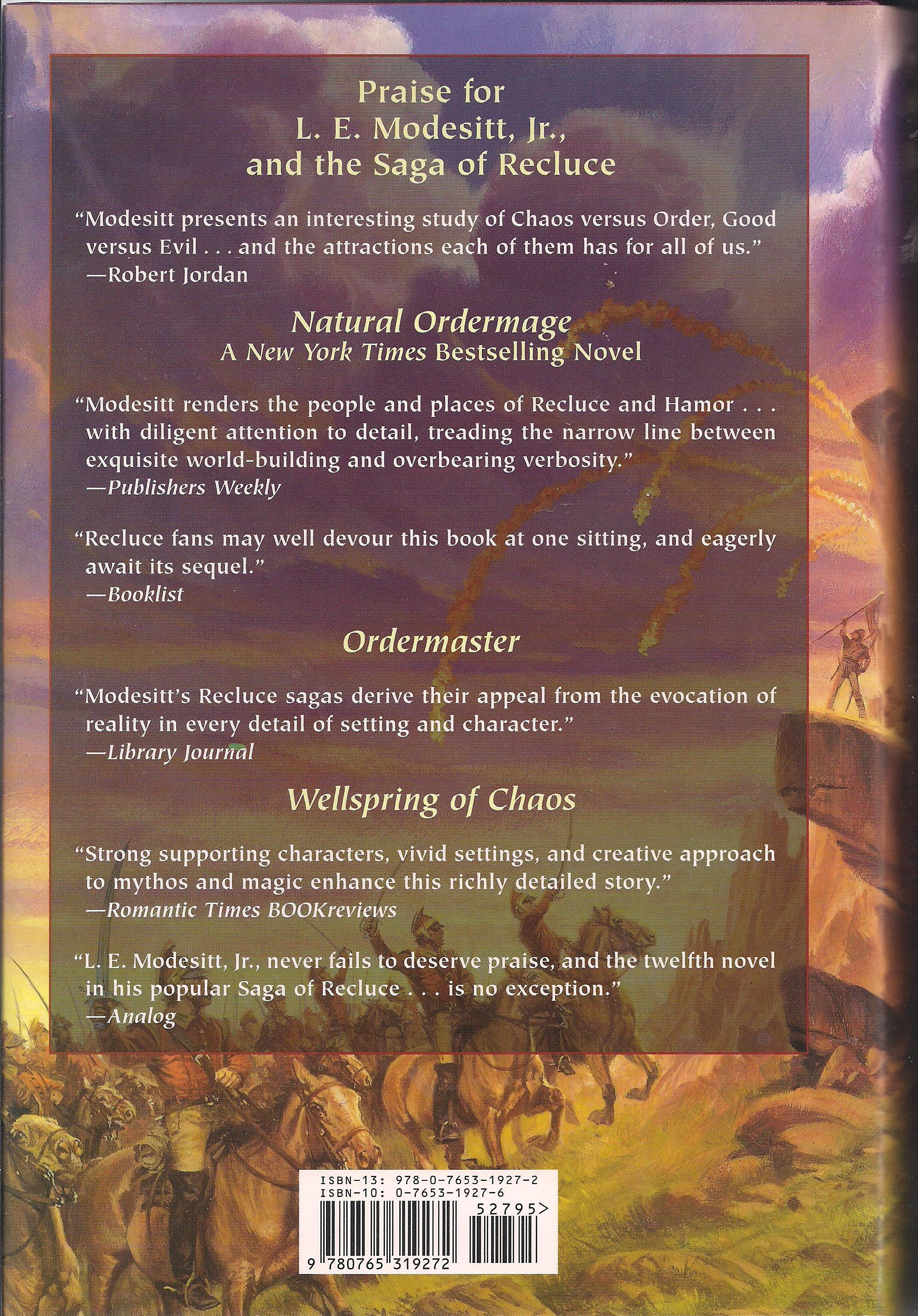
Back Cover of Mage-Guard of Hamor by L. E. Modesitt Jr.

Back Cover of Mage-Guard of Hamor by L. E. Modesitt Jr.

Bleah.  That doesn’t sell me a book, Tor-Forge, publishing giant that you are. As you can see, on the back cover of this book there is no blurb, only glowing comments about the author’s other series of books.  This may work for a well-known author like L.E.Modesitt Jr., or Brandon Sanderson, but it doesn’t work for me as a reader.

I have observed many indies taking the same route, and skipping the blurbs entirely.

Indie authors take note: I (and millions like me) don’t buy books without blurbs of some sort, somewhere, unless I am already familiar with that author’s work. I want to know what I am buying, so even a bad blurb will interest me more than a quote from a glowing review by one of your Beta Readers.

Just sayin’!

So here I am, suffering the curse of the indie author, trying to not only be my own publicist, but also my own advertising agency.

Thus, I am going to learn how to write a blurb, if it kills me. Writing a 100 word piece of flash-fiction is called a “drabble”.  I figure if I can get this down to a fine art, I can write a decent blurb.

The original prompt went as follows:

Write A 100 Word Story (“Drabble”) . . . although a 100 word story will probably take longer than expected, it’s still going to take a manageable amount of time.

To make a drabble work,
-Choose one or two characters
-Take one single moment/action/choice and show us how it unfolds
-Give us one or two vibrant details in as few words as possible
-Show us (hint) how this moment/action/choice is more significant than the characters probably realize in the moment

I decided to use these parameters for the entire month of flash fiction.  Here is my first one, written May 1st.

Ted  (5-1-2013)

Edna stirred her coffee and looked out the window toward the shed.

“Did you feed the chickens?” Marion always asked, though she knew Edna had.

Edna looked away from the shed. “Of course I did.” Her eyes turned back to the shed. “We won’t be able to keep him in there much longer. He’s growing too big. We should have a barn built for him.”

“Ted was always a greedy boy.” Marion stirred her coffee. “I warned him he behaved like a beast.”

A rumbling bellow shook the shed. A long green tail snaked out of the shed door.

I will keep practicing until I get the hang of creating something interesting in 100 words. Blurbs  don’t have to tell the whole story, that is what the inside of the book is for! All they have to do is sell the book–be that tantalizing bit of interest that hooks the reader into buying your book. 

Yesterday’s drabble went like this:

Quaglio_KipfenbergDrake – 5-3-2013

He stood on the parapet, silhouetted against the starry sky, his wings wrapped tightly about him against the chill wind. The sounds of the darkened world below drifted up to him. The nightbird’s song. The servants in the castle below. The lowing of cattle in the distance.

Hunger, intense and overwhelming clouded his vision.

Spreading his wings Drake fell forward, the wind catching and lifting him; soaring. A scent on the wind alerted him to his quarry.

On a corner she stood, ripe and full lipped—the tamale vendor.

Silently, he dropped beside her, whispering seductively, “Two tamales, please Senora.”

I’ve had a lot of fun with this, and I may have some ideas for longer short stories here, so it’s certainly not a waste of time, even if I never get the hang of selling my own work!

11 Comments

Filed under Books, Dragon Age, Fantasy, Humor, Literature, Uncategorized, writing

It’s all Greek to me

Blender3D_Dragonfight_03 Sascha Kozacenko, with kind permission for GFDL.Dragons.

Two tons (or more) of muscle, scales and, frequently, fire.

What’s not to love?

They are rumored to be as devious and crafty as your mother-in-law.

Don’t bandy words with a dragon or you may lose more than the argument.

Again, not unlike your mother-in-law.

St._George_and_the_Dragon_-_Briton_Riviere Briton Rivière [Public domain], via Wikimedia CommonsMy dragons are not really the kind who bandy words about, however some do breathe fire. That heats things up a bit!

Heh heh.  Oops.

Darn it. Now we need a new hero.

I hate that when that happens.

In English, the word dragon is directly derived from Old French – dragon, which in turn comes from Latin draconem (or draco) meaning “huge serpent, dragon,” AND also from the Greek word drakon meaning “serpent, or giant sea fish”.  Both the Greek and Latin term referred to any great serpent, not necessarily mythological, and this usage was also current in English up to the 18th century. So in that sense, dragons REALLY did exist.

Which came first Latin or Greek? Greek – it’s a living language and has been spoken for over 3000 years.  Many Greek words found their way into Latin, and other proto European languages. Thus English has some roots in Ancient Greek.

Tiepolo,_Giambattista_-_Die_Unbefleckte_Empfängnis_-_1767_-_1768_-_Drachen Giovanni Battista Tiepolo [Public domain], via Wikimedia CommonsNow as far as dragons go, in my two worlds they are quite different from each other.  In Waldeyn, (Billy’s Revenge) there are two kinds. The smaller wingless variety often has a second breath that allows them to breathe fire–quite an effective weapon, as Huw the Bard will discover. The bigger ones fly and prefer to eat people, so they are considered a nuisance.

No, my dragons are NOT vegans. But that would be an interesting twist….

In Neveyah, (Tower of Bones) they tend to be immense creatures of both magic and the element water. This puts the mage at a disadvantage, as the element that heals the beast is the element of water and you must never use it against them. Water is also their best magic weapon, and they are relentless. They have high reserves of chi and strong magic at their disposal, along with excellent shielding ability, so using any magic at all against them is a no-no.

Good luck, boys.

There are ways to fight them, and all my heroes will find ways to do so with varying degrees of success.  Writing those scenes is a real adventure, as I get to put myself in the battle, and choreograph it so that it flows, is believable, exciting, and hopefully no one crucial to the story dies.

St._George_and_the_Dragon John Ruskin [Public domain], via Wikimedia Commons

1 Comment

Filed under Adventure, Battles, Books, Dragons, Humor, mythology, Vegan, writer, writing

Transporting Dead Dinosaurs

The Joy of Childhood  © Leah Reindl 2012

The Joy of Childhood
© Leah Reindl 2012

So I went on an outing with one of my grandsons and his Kindergarten class. You may remember this child–The Boy whose antics keep Grandma hopping.

I honestly thought he was going to be the difficult child on the trip, but it turns out that he has an image to maintain (already) and his little mates believe he is the soul of reason. His teachers adore him.

(See Grandma’s look of shocked disbelief.)

However, I did have the pleasure of riding on the school bus in the seat directly in front of the ‘interesting child’ in the class, a little firecracker we’ll call Mercy. Her voice was beyond piercing–my ears are still ringing.

MH900001542First though, you have to picture the school bus packed with 6-year olds, each one in varying stages of that mania only a 6 year old child can bring to such an event. The adult volunteers were given groups of 3 children each to monitor. We lined up outside the school at the curb, and got on the bus, keeping our groups in order. My daughter and I shared our group, which worked out well.

MH900422812The first thing I noticed was the amazing lack of leg-room in Grandma’s seat. That and the fact that nowadays Grandma seems to take up more than half of the bench.

Oops.

Still, two of ‘my’ children were able to sit on the bench with me, and despite the fact that my knees were firmly pressed into the back of the seat in front of me, we rode fairly comfortably.

Directly behind me was the girl who we’ll call Mercy. She was imaginative, boisterous, and full of ‘it’.  She wore her emotions for everyone to clearly see, and every thought that entered her mind was immediately expressed, loudly, twice for emphasis. She was needy, loud, inappropriate and hysterically funny.

Mercy was the poster-child for ADHD.

As the large yellow sardine can I was trapped in hurtled down I-5, Mercy’s commentary dominated the din. “Look at that dude! He’s smoking a cigar. I’ll bet he’s a gangsta. He’s gonna do a deal. I saw it on TV.”

“Mercy, that’s inappropriate. We don’t talk like that, remember?” The lady who was Mercy’s wrangler was awesome. She was an older lady who volunteered at the school and who was also the school crossing guard. I suspect she was a retired teacher, as she had opted to wrangle the three toughest discipline cases in the class.

The other two were boys and they were…interesting…, but Mercy was the real loose-cannon in the bunch. She was the ringleader, the one the other two looked up to.

Just around the time I noticed I had lost the feeling in my legs, the school bus pulled alongside of a long semi, an open-top box trailer that was covered with a canvas tarp.  A corner of the tarp had come loose, and flapped in the wind as the truck rolled down the highway, giving a tantalizing peek at the contents of the load. (It was sawdust.)

Mercy said, “Look that truck is broken. I wonder what’s in it? It’s probably going to crash, cuz its broken.”

Her seatmate, a boy we’ll call Dewayne, said, “It won’t crash. That’s just the tarp. I wonder what’s under it?”

Dinosaur_comic_left by Luuva wikimedia commonsMercy said, “It’s broken, so it’s gonna fly off and kill someone and there’ll be blood everywhere. We’ll probably be on the news when it happens. And it’s a dinosaur, under the tarp.  A dead one.”

Dewayne said, “How do you know its a dead dinosaur? It could be any sort of dead body.”

“Human bodies aren’t that big. It has to be a dinosaur.” Mercy’s tone implied that she held the trump card. “I wonder where they’re going to bury it.”

All I could think of was that the seat behind me was occupied by two future authors of fantasy crime fiction, and the girl could possibly be a future Quentin Tarantino. This little girl was hysterically funny, obsessed with the macabre, totally off the wall and sharper than a tack.

I was SO grateful she was not in our group, as she was fast as lightning, didn’t hear any instructions, and made her own rules as she went.

It was a fun trip.

Grandma needed a nap when we got home.

7 Comments

Filed under Adventure, Books, Dragons, Fantasy, Humor, Literature, Uncategorized, Vegan, writer, writing

Gurus, St. George and Uncle Orson

200px-Saint_George_-_Carlo_CrivelliI write stories.  I tell people what may have happened had St George not slain the last dragon and taken the fun out of life.  Obviously I am telling the tale from the position of a storyteller.

This works well in the first draft, where I can “he did” “they went” to my heart’s content, but during the second draft I must take these “telling” places and expand on them, making them more active.

Many people ask me what I think about ‘critique’ groups.

I don’t.

I don’t think about critique groups at all, as critiquing is only a small sliver of what an author needs to hear in order to get his or her work ready for submission. Any wannabe can trash another person’s work.

I have found that for every serious author, there are five posers who think they are Jane Austen and that gives them the right to “just tell the truth.”

My ears are bloody with the sounds of unpublished and unpublishable authors piously ranting about the rules and quoting self-help writing gurus as they shred a fellow author’s work in the guise of critiquing it. This is why I don’t go to the groups whose main focus is destroying the dreams of others.

I have found a group of writers who share an understanding of all the phases that a manuscript goes through before it reaches the final draft.  Comments, when solicited, are encouraging. Flaws are noted, yes, but more importantly the places where the story shines are also noted. The writer is a fragile creature–it takes very little abuse to make them bleed.

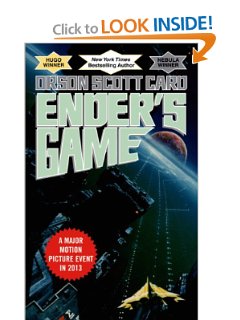
enders game orson scott cardThe award-winning author of science fiction and fantasy, Orson Scott Card is one of the guru’s whose books on writing have shaped my approach to not only my own work, but how I look at the works of others.  Uncle Orson, as he refers to himself, has a fabulous website with many links to writing seminars, Hatrack River. Orson puts himself out there with his political and religious views, but that doesn’t detract from the fact that he KNOWS about writing and how to write a good, readable book.

Orson’s wife is his first-reader. He has a list of questions that he asks his wife to answer in regard to his work, and the way those questions are phrased is interesting. I now use those same questions and so do my two writing groups when we are PRIVILEGED to be first readers of an author’s cherished manuscript.  This is the list as I have it in my own files, tailored to my own work:

Five Questions for The Wise Reader who is evaluating my tale:

1. Were you ever bored? Please tell me where it became slow and hard to stay with it.

2. What did you think of the main character _______________________? Of ____________________? Of _________________________?

3. Was there anything you didn’t understand? Is there any section you had to read twice? Is there any section you became confused?

4. Was there anything you did not believe? Any time you said ‘Oh come on!”

5. What do you think will happen to the characters now I am done telling their tale. What are you still wondering about? 

My goal is to eliminate any areas of boredom, implausibility and cliché and I need your help to do so!

I think that writers grow when another eye is on their work. Of course it is an uncomfortable thing to have a whole section pointed out as being repetitive and possibly irrelevant, but it’s better to hear it from trusted friends before you publish than to never know why you keep getting rejections. Agents and editors rarely have time to tell hopeful authors why their work isn’t acceptable. This is why they use the dreaded form-letter-of-rejection.

outhouse at lake bernardHaving received enough of these to wallpaper an outhouse, I can tell you honestly that we aspiring authors are left to struggle on our own and learn the craft of writing as well as we can. This means we take courses if we can afford them or we avail ourselves of the very good education we can receive via the internet.

It also means we must ask others to look at our work. Local writing groups are the best places to meet people you can trust. Perhaps you’re not a member of a writing group and you want to become involved in one, but you are afraid of having your work torn to shreds. This is a real possibility, but there are MANY groups in every community, and quite a few will have the same rules as my group does. Attend several meetings as an observer before you commit to bringing any of your work. Once you see how they treat each other’s work you will know what you can expect from them.

Treat others the way you want to be treated, regardless. Don’t let the occasional bully stop you from growing and achieving your dream.

And this brings me back to where I started–trying to take an idea as it was laid down in the first draft, tell the story and yet show the action without going off the rails in either direction–showing OR telling.  As a reader I cut my teeth on Louisa May Alcott and J.R.R.Tolkien. They were authors who knew how to TELL a story and I lived it as they told it. Nowadays it takes a special sort of reader to enjoy classics as they were originally written, because they were rife with telling and not showing.

The second draft is much easier when it comes to laying out the action.  In the first draft I know what is supposed to happen at a given point, but I don’t always know how to show it, so I have a conversation that tells what happened. In the second draft I take those conversations out and replace them with the event.

Now I must have my characters go forth with their swords and kill me a dragon. We’re done talking about it boys! Show mama what ya got!

7 Comments

Filed under Adventure, Battles, Dragons, Humor, Uncategorized, Vegan, writer, writing

The ‘e’ word

MP900049975Letting go is never easy.

You are grown up now, you’re a big boy.  You make your decisions, right or wrong.

You’re thirty-five years old.

You have a seizure disorder.  It’s okay to call it epilepsy. It’s okay to say the ‘e’ word. It’s not like we are naming Voldemort. Nothing caused it. Nothing will cure it. It will come and go, and yes it’s a bastard to deal with, but we deal with it. When you take your medicine, the symptoms are controlled.  When you don’t, they are not.

You have this epilepsy thing and you have trouble accepting it, but I believe in you. Nothing has changed, except you have this problem sometimes.

Don’t choose to live your life looking at what you don’t have–so caught up in where things went wrong that you can’t see where they went right.

Life is so beautiful.

Your life is out there, waiting for you to claim it, waiting for you to wrap your arms around it and embrace it.

Life is good.  Don’t become a small, angry person just because things aren’t perfect. Don’t build walls around the you that I love so much. Don’t hide behind stubborn anger, because life doesn’t care if you’re mad or not. Life goes on, and the only way to live, REALLY live is to grab it, and learn to love the life that exists despite the ugly bits.

It’s the contrast of the good and the bad that makes the good in life so beautiful.

Embrace every minute and see the beauty around you. Live in the moment, because you only get one moment, ever–and that moment is now.

Don’t let the ‘e’ word steal your “now.”

8 Comments

Filed under Battles, Literature, writing

Great Collaborations

Rainbow_-_Ritchie_Blackmore's_Rainbow_(1975)_front_coverThis album, Ritchie Blackmore’s Rainbow was a watershed moment for me, musically.  I discovered Rainbow when my first husband and I moved to Bellingham Washington to go to college. We had one child, our daughter Leah.  We were pretty broke, and couldn’t go to many concerts, but we did invest in new music as often as we could.

I was the one who was the Rainbow and Led Zeppelin freak. I liked Deep Purple, but something about Rainbow really grabbed me. Darryl was into The Who and Argent.  We were also crazy about Procol Harum,  Focus and Genesis. Heart also figured largely in the noise that erupted from our small apartment.

The thing about great bands that inspires me is the chemistry between the members that lead to great collaborations.  Some of the most powerful music of my generation was created during the 1970’s.  The collaboration that still reigns supreme in my heart is the Ronnie James Dio and Ritchie Blackmore collaboration in the band Rainbow.  Separately, they were brilliant, unmatched in their skill and talent. Together they were pure magic, creating thunderous, powerful, bone-shaking music like The Gates of Babylon and the beautiful, lyrical Catch the Rainbow. Alas, Dio passed on in 2010 but his legacy lives on.

In books, there are great collaborations that produce incredible tales that change the face of the fantasy genre.  MythAdventures by Robert Lynn Aspirin and Jody Lynn Nye were the game changers for me as far as my reading material went. They brought the fun to the party!

The Darkover Series that was begun by  Marion Zimmer Bradley and which included collaborations with various authors such as Mercedes Lackey and Deborah J. Ross was wildly popular among my friends. The Dragonlance series, which came out of TSR’s Dungeons and Dragons game empire was another series that introduced the fantasy genre to a wide audience of young people. This collaboration between Tracy Hickman and Margaret Weiss hooked my son Daniel as a teenager, and turned him into a rabid fan of speculative fiction.

Currently I’ve been reading The Adventures of Don Valiente and the Apache Canyon Kid. It  a book that is a collaboration between John A. Aragon and Mary W. Walters, and it’s one that is not only NOT a fantasy (it’s a WESTERN) it’s an actual physical book as opposed to a Kindle book.  This awesome book details the adventures of Roz, a young lesbian cowgirl and her mentor, caballero Don Valiente. I’ve never been a fan of westerns, but THIS book is a game changer for me.

I love books and music that expand my boundaries.  Every time I hear something new and powerful, like Apocalyptica, Rammstein or Evanescence or read a book in an unfamiliar genre I am inspired to create on my own and my work benefits.  Music, art and books are like yoga for my soul!

7 Comments

Filed under Adventure, Battles, Books, Heavy Metal, Humor, Music, writing

Book launch: Forbidden Road by Connie J Jasperson

Book launch: Forbidden Road by Connie J Jasperson.

I was priveleged to be interviewed on Carlie M.A. Cullen’s fine blog, and we talked about the launch of my book, Forbidden Road. Stop on by and check it out!

Comments Off on Book launch: Forbidden Road by Connie J Jasperson

Filed under Adventure, Battles, Books, Dragons, Fantasy, writing

Forbidden Road

Pageflex Persona [document: PRS0000032_00050]On friday, February 1, 2013 the kindle version of Forbidden Road, Book II in the Tower of Bones series will launch, followed closely by the print version.  The print version may be delayed if there are any formatting issues, but it should be through the process by February 15th at the latest.

In print form these books are the size of good doorstops, but not quite as big as most of the Wheel of Time series by Robert Jordan and Brandon Sanderson.

Someone asked me how I could write a book a year, and that made me laugh.  I suppose it LOOKS like that’s what I have done, but in actuality I began writing Tower of Bones in March of 2009. I have two manuscripts going at all times so they do seem to roll out at the rate of one per year, but I was actually two or more years in the writing process for each book before they went to publication.

Tower of Bones began its life as the walk-through for an old-school style RPG along the lines of Final Fantasy Mystic Quest. My nephew Ryan and I thought would be fun to build something we could play and perhaps market as there is a large community of player who enjoy the old games. The game fell through but I liked the storyline and made it into a novel. But, by 2010 I realized it was never going to fly in the form I had originally created it.

In its first incarnation, Tower of Bones read in the “He is; he does; he goes” style of a Brady walk-through.  Not real 51S0EMXZRAL__SL500_AA300_easy to get into as a reader! Present tense: The events of the plot are depicted as occurring now—at the current moment—in real-time. (e.g. “They drive happily. They have found their way and are now preparing to celebrate.”) In English this tense, known as the “historical present”, is more common in spontaneous conversational narratives than in written literature. A recent example of this is the Hunger Games trilogy by Suzanne Collins.

You don’t even want to know the agony that I went through in changing the viewpoint of the entire 150,000 word ms from that awkward present tense point of view to the standard  third person point of view.  Not only that, I had begun Forbidden Road in the same style!  Oh, my goodness–2010 was the year in which Grandma could frequently be heard exclaiming things like, “Sassafras!  And Dirty Words!”

Alison DeLuca and my sister Sherrie DeGraw pored over that ms trying to help me clean it up, and finally by the end of 2011 it was done.

Now, three years after I began Forbidden Road it is in the grinder at Amazon, and the launch day approaches. It just looks like I am chugging them out  one a year.  I have already been working on Huw the Bard for 15 months, and Mountains of the Moon has been in the works for 18 months (and is still not finished.)  Valley of Sorrows (book 3 in Tower of Bones series) has been in the works since November and NaNoWriMo

2010 was also the year I began The Last Good Knight as a NaNoWriMo project. I allowed myself to rush into publishing it when it was not ready.  It is now readable, largely to the assistance of both Rachel Tsoumbakos and Carlie Cullen.  I admit that my view of my own work is skewed by my growing as an author and gaining experience as an editor.  It may be that I see my work in a worse light than the casual reader would, but in my opinion there were enough speed bumps in Billy’s Revenge 1 – TLGK to gag the dog.

One thing I have been working on is dealing with (if I may descend into technical terms) is Hinky Formatting Issues and VooDoo Readability.  Anyone who has ever read an e-book knows what I am talking about, although they may not realize what has caused the strange  appearance of  random question marks where apostrophes should be.  Strange formatting issues are also responsible for the way paragraphs will randomly lose their indentations, making a page look like a wall of words.

Unfortunately several wordprocessing programs are rife with hidden formatting, so if your ms began life in Open Office, you will need to strip all the formatting out of your work and reformat it, saving it as a .RTF.  It gets even more complicated if you switched to using Word halfway through.  As a rule, I strip all the formatting and completely reformat all my manuscripts before I upload them now, it saves time and curse words later.  Rich Text Format files (signified by the extension .rtf) can also be argued to be safer than Word documents, (or .doc and .docx.) This is also, again, because .rtf uses text-based encoding. In simple terms, it’s pretty much impossible for Word to mess up .rtf files, because they are text-based: if there is a mistake while opening the file, the worst that will happen is that Word will open it as a text file, which will look like this:

 \par A question that may often come to the mind of people who watch Mexican soap
operas is, \ldblquote Who the heck invented this ridiculous plot that consists
of the love af
fair between a rich guy and a poor girl who end up getting
married in the end despite all the adversity??\rdblquote This idea,
overexploited and completely clich\’e9

If there is a failure in .rtf you can at least read it.  BUT the optimal goal is to have NO Formatting Failures so never rush to publish.  If you are an indie you can simply move your launch date back until you have straightened out your issues.  Use the option to review it in the handy reader KDP provides when you publish with them.  B&N for Nook also has this option.  Order proofs from your print-publisher and make sure your book looks the way you want it by going over every page of the proof copies line by line before you hear back from your friends that your book is a mess.

In the end I am responsible for what my work looks like so I have to do the footwork and make sure my formatting issues are all solved before the launch date.  This requires both a calendar and the will to use it. Plan for a week of playing with your uploads to Kindle and CreateSpace before your projected launch date, and hopefully your work will go smoothly enough that you won’t need the extra time. Authors are notorious for leaving everything to the last-minute but I do suggest you don’t procrastinate in this endeavor.  Random things go sideways and need to be redone. You’ll be much happier if you do the responsible thing and leave yourself plenty of wiggle-room during the crazy week leading up to your launch.

Comments Off on Forbidden Road

Filed under Adventure, Books, Dragons, Fantasy, Final Fantasy, Humor, knights, writing

Imago Chronicles, Lorna Suzuki

Imago Chronicles Book One  Lorna Suzuki Just like every other obsessed, fanatic reader of High Fantasy, I am always on the lookout for that one special book that presages the advent of a new classic series in the genre. In my opinion, Lorna T. Suzuki has written that book in Imago Chronicles Book One: A Warrior’s Tale.

 As many of you know, I review my favorite fantasy books on a blog called Best in Fantasy, and that is where I first reviewed Suzuki’s work in 2011.  I was blown away by her ability to draw you into her world and keep you there, mesmerized.

Since I began blogging on what I consider to be the best fantasy reads that come across my Kindle, I have read, on average, 4 to 6 fairly good books for every one really good book that made the blog; but ‘fairly good’ is not good enough for me to call a book ‘Best In Fantasy’. Hence, my frequent excursions back to my library of classics. In order for a book to be featured on that blog, I have to LOVE it! In ‘A Warrior’s Tale’, Suzuki has written a book that stands beside the works of my beloved heroes of modern fantasy Jean Auel, Mercedes Lackey, and David Eddings. Imago now ranks as one of my all-time favorite epic fantasy series. And now, joy of all joys! Books 1,2 and 3 have been optioned for a major motion picture trilogy!

And now the story:

In an intriguing twist, A Warrior’s Tale begins with the end. Taking shelter from a freak blizzard, Nayla Treeborn, half elf, half human and not fully either, huddles next to the corpse of a dead soldier; using his body and the now un-needed cloaks of other dead soldiers to shelter her from the killing weather. As she shelters there, she finds herself thinking about her life to that point; going back to a day when she had been a child the mental and physical equivalent of a mortal 12 year old, but was in reality 37 years of age.

Nayla’s father, a high Elf and the Steward of Nagana, Dahlon Treeborn, despises her for reasons which are not made clear in this book. He has punished her for publicly disagreeing with him; nearly beating her to death. Joval Stonecroft discovers her, dreadfully mutilated and bloody and is horrified. Healing her as well as he can, he spirits her out of the elven city of Nagana to the human city of Anshen, home of the legendary Kagai Warriors. Taking the name of Takaro, the young girl embarks upon a lifetime of training, eventually becoming the only female Kagai Warrior ever accepted into the brotherhood. When at long last she reaches womanhood, not only is Takaro fully trained in the manly arts of the warrior, but she is also a woman fully trained in the womanly arts as a spy, a courtesan and an assassin.

In book 1 of the series the main antagonist is Eldred Firestaff, a sorcerer who combines the nicer qualities of Lord Voldemort (Harry Potter) with the personal charm of Ctuchik (The Belgariad), and who is an immortal tool of evil, resurfacing every generation or so. Each time he comes back, he uses the armies of the weak Emperor of East Orien as his power-base in his eternal quest to conquer the world of Imago. However, in this first book of the series, although the battles with this slippery and long-lived villain are colorful and intense, they are almost secondary to Nayla’s personal battle for acceptance and with her own inner demons. This book is concerned with fleshing out Nayla and really whets your appetite for the rest of the tale!

As a half-caste, Takaro/Nayla ages much more slowly than humans, and much more quickly than elves. During the course of the story she outlives three of her Kagai Masters, all of whom live to be very old men. She also outlives their grandsons and their grandson’s grandchildren, yet at the end of the book she appears to be a woman of about twenty-five years of age. Her wisdom and abilities are that of a warrior at the prime of life, and she becomes the most respected of the fierce Kagai Warriors. When her father is maneuvered into asking for the finest Kagai Warrior to train his own warriors, Nayla finds herself back in Nagana, and her father is forced to suffer her presence there; a situation that is bad at best.

The world of Imago is clearly drawn, and is every bit as compelling as that of Tolkien’s Middle Earth. Here we have two distinct cultures living side-by-side in peace and harmony for generations; coming to each other’s aid whenever the other is threatened. Loyalty, honor, hard-work, love and family are the central facets of the human society that Nayla/Takaro finds herself adopted into as an abused child, and these values are echoed in the society of the Elves. Within each society, the political and social divisions are clear and the differences between Elves and Men are well drawn and consistently portrayed throughout the drama that unfolds.

Suzuki is herself a master of the martial arts, being a practitioner and instructor of Bujinkan Budo Taijutsu; a system that incorporates 6 traditional Samurai schools and 3 schools of Ninjutsu. As one who was once a mere grasshopper in the obscure art of Shou Shu, I fully appreciate the wisdom and experience that the master crafts into the fabric of this tale. Every element of this story evokes both the martial and the spiritual aspects of the culture of Imago; every element is vivid and believable to the reader.

With each book in this series, I was drawn deeper into this amazing and very real world of Imago. In book 2 of the series, Tales From the West we discover more about the true evil that threatens Imago, and discover who or what is behind the sorcerer Eldred Firestaff.

What I’ve learned from reading the works of indie author Lorna Suzuki is that to really craft a world and build believability you must know what you are writing about. She understands the warrior culture from the point of view of a female warrior becasue she IS a female and a warrior.

Know thy craft! Write what you want to read, know what you are writing about and readers like me will flock to read it!

Comments Off on Imago Chronicles, Lorna Suzuki

Filed under Adventure, Battles, Books, Dragons, knights, mythology, ninjutsu, Uncategorized, writing

David Eddings – Setting the Scene

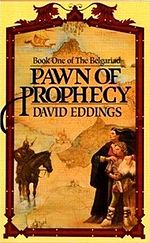
Pawn_of_Prophecy_coverIn 1982 I picked up Pawn of Prophecy by the late David Eddings. This was an amazing, eye-opening book for me, as both a reader and an author.  Eddings had the ability to convey a sense of place in a few well-chosen words.  The book opens in the kitchen of a farmhouse with Garion’s memories of playing under the table in a kitchen as small child.

This is the first book in the 5 volume series, the Belgariad and chronicles the childhood of an orphaned boy, Garion, who is being raised by his Aunt Pol who works as the cook on a prosperous farm in a place called Sendaria. Garion has friends, and as time progresses he even has a wistful almost-romance with one of the girls there. But all is not as it appears, and Garion knows nothing of the reality of his family or the world he lives in.

He has other friends; Durnik the smith who is in love with Garion’s Aunt Pol, and a strange old traveling storyteller, Mr. Wolf whom his aunt seems to know well and whom she grudgingly tolerates despite his strange attire and love of ale.

What David Eddings does in the first chapters of this book is truly magical.  He immediately drew me in and within two paragraphs I was immersed in this world–I could smell the smell scents of the kitchen and visualize the people who worked there so companionably in the generous employ of Farmer Faldor. I felt I knew them, and I felt I knew that farm.

I am not a boy, but Eddings put me inside a boy’s mind and I understood that boy on a personal level. Garion’s confusion and dismay as everything he takes for granted begins to crumble around him is real and I felt his anger, his hurt and confusion. I understood his need to stand on his own and I knew fear when he did.

Eddings managed to draw me into that world with an economy of prose. He gives the reader just enough detail to fire the imagination, and the reader’s own mind does the rest, unencumbered by too much of the author’s personal vision of the scene. He does this by describing what the boy remembers of the kitchen, and more emphasis is placed on the emotions evoked by scents and memories of conversations, supported by the merest framework of the scene. Edding’s world is filtered through the eyes of the people who live in it.

Garion’s earliest memories are of being a toddler–the sound of knives deftly dicing vegetable, his aunt keeping him corralled and happy under the table while she works, the sparkle of the gleaming pots and kettles high on the wall lulling him to nap.

“And sometimes in the late afternoon when he grew tired, he would lie in a corner and stare into one of the flickering fires that gleamed and reflected back from the hundred polished pots and knives and long-handled spoons that hung from pegs along the whitewashed walls and, all bemused, he would drift off to sleep in perfect peace and harmony with all the world around him.”

In that passage we see the entire kitchen, and we have a visual image of it. The child’s sense of contentment and safety that the kitchen represented is conveyed by the impressions of the kitchen instead of the image of it. The detail supports the story rather than impeding it.

Many times I see authors try to force an exact, detailed picture of their world on the reader, and it ruins the story for me.  An author doesn’t have to beat me over the head with minute detail; that sort of thing bores me.

What reading the work of David Eddings has taught me is that economy of detail and simple lines often make a more powerful picture than a detailed drawing that looks like a search and find game. Some indie authors set a scene with so much detail it reads like an episode of Hoarders. I understand that, as I too wrestle with the tendency.

In the editing process I have had some of my most cherished passages detailing certain places or people thrown out with the simple phase “This is hokey”, and while it hurts to see those words in the comments, it is true and so it is time to throw out a beloved passage and opt for a lean description.

Sometime I opt for too lean a description and when the comment  “What were they feeling? Howthe belgariad did they show it?” appears in the right hand column  I sometimes wonder why they can’t see it when it is as plain as day.  But upon examination I realize that maybe a line or two more might help explain the emotion of a scene.

Still, it is important to remember that my reader has an idea of what true beauty is, and they may not think a girl with sun-yellow hair in perfect ringlets framing a heart-shaped face with fine, arching eyebrows over corn-flower-blue eyes peering through dark curling lashes is as beautiful as I may think she is. It may be better for me to refer to her as fair-haired and astonishingly pretty, and leave it at that.

If I could ask for any skill, it would be create a world with the precision and fine craftsmanship David Eddings brought to his work. To this end, I read the works of the great masters of fantasy hoping to absorb some of their techniques and wizardry. I also read the works of newly published indie authors hoping to find that one kernel of genius that will strike a chord in my soul and transport me to a world not of my own making.

The next installment in this series will be focusing on just that–indies of great talent whose works are as yet unknown but which have had an impact on me as a reader.

5 Comments

Filed under Adventure, Battles, Books, Dragons, Fantasy, Humor, mythology, writing