Tag Archives: Fine Art Friday

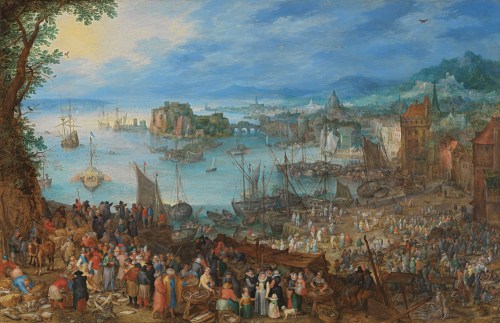
#FineArtFriday: The Great Fish Market by Jan Brueghel the Elder 1603 (revisited)

Title: Great Fish Market

Artist: Jan Brueghel the Elder  (1568–1625)

Date: 1603

Medium: oil on canvas

Dimensions:  Height: 59 cm (23.2 in); Width: 92 cm (36.2 in)

Collection: Alte Pinakothek  Current location: room 19

Inscriptions: Signature and date, bottom left: BRVEGHEL 1603

What I love about this painting:

This is one of my all-time favorite paintings. Here we see a composite of all the places Jan Brueghel the Elder had visited. The scene is a fusion of his Flemish homeland and impressions of places he’d sketched on his travels.

In the middle of the picture is the Neapolitan Castel dell’ Ovo, on the right, in the distance, is St. Peter’s Basilica in Rome. We have a little of Italy thrown in with the Flemish, his effort to create the feeling of a busy, prosperous market. He shows his imaginary city from a high perspective, the god-like view.

In writing, this would be the omniscient point of view.

The elements presented in this painting, the harborscape, the ruins, and even the sections that are simply landscapes are all features that later became genres in their own right.

The scene contains many elements of Mannerist landscape painting. According to the Tate website, mannerist is a sixteenth-century style of art and design characterized by artificiality, elegance, and an aesthetic portrayal of the human figure.

In other words, they painted fantasy. And why not?

Flemish genre painting is strongly tied to the traditions of Pieter Bruegel the Elder. It was a style that continued directly into the 17th century through copies and new compositions made by his sons Pieter Brueghel the Younger and Jan Brueghel the Elder.

In this painting, the story opens with a view across a downward-sloping foreground. It teems with life, hundreds of figures of many races, grouped around the stalls and booths of a fish market. The group at the center of the foreground is thought to be a self-portrait of the artist and his family. It was common for artists to insert self-portraits in their works, and Jan often included his family.

One of Jan Brueghel’s most significant contributions to the craft of painting landscapes was how he depicted perspective. The eye is drawn towards the harbor in the background. We look out across the bay, along the coastline, and see entire towns, with ruins, wharves, and castles. Beyond that, we see distant mountains, painted with a blue that merges with the blue of the sea.

This blending of shape and color into the distance is how a landscape appears in real life.

These painters, and the Brueghel family in particular, were the generation who paved the way for artists like Rembrandt. Their works were the foundation upon which the masterpieces of the middle-to-late 17th century were built.

About the Artist, via Wikipedia:

Jan Brueghel was the son of the eminent Flemish Renaissance painter Pieter Brueghel the Elder.  A close friend and frequent collaborator with Peter Paul Rubens, the two artists were the leading Flemish painters in the first three decades of the 17th century.

He was born in Brussels as the son of Pieter Brueghel the Elder and Maria Coecke van Aelst. His mother was the daughter of the prominent Flemish Renaissance artists Pieter Coecke van Aelst and Mayken Verhulst. His father died about a year after Jan’s birth in 1569. It is believed that after the death of his mother in 1578, Jan, together with his brother Pieter Brueghel the Younger and sister Marie, went to live with their grandmother Mayken Verhulst, who was by then widowed. Mayken Verhulst was an artist in her own right. The early Flemish biographer Karel van Mander wrote in his Schilder-boeck published in 1604 that Mayken was the first art teacher of her two grandsons. She taught them drawing and watercolor painting of miniatures. Jan and his brother may also have trained with local artists in Brussels who were active as tapestry designers.

Jan Brueghel the Elder is regarded as an important innovator of landscape art. By introducing greater naturalism in his Alpine mountain settings, his father had expanded on the world landscape tradition that had been founded mainly by Joachim Patinir. Some of Pieter the Elder’s works also foreshadowed the forest landscape that would start to dominate landscape painting around the turn of the 16th century. Pieter the Elder also developed the village and rural landscape, placing Flemish hamlets and farms in exotic prospects of mountains and river valleys.

Jan developed on the formula he learned from his father of arranging country figures traveling a road, which recedes into the distance. He emphasized the recession into space by carefully diminishing the scale of figures in the foreground, middle-ground, and far distance. To further the sense of atmospheric perspective, he used varying tones of brown, green, and blue progressively to characterize the recession of space. His landscapes with their vast depth are balanced through his attention to the peasant figures and their humble activities in the foreground.

Like his father, Jan Brueghel also painted various village landscapes. He used the surrounding landscapes as the stage for the crowds of anecdotal, colorfully dressed peasants who engage in various activities in the market, the country roads and during the rowdy kermesses. Jan Brueghel’s landscape paintings with their strong narrative elements and attention to detail had a significant influence on Flemish and Dutch landscape artists in the second decade of the 17th century. His river views were certainly known to painters working in Haarlem, including Esaias van de Velde and Willem Buytewech, whom Brueghel may have met there when he accompanied Peter Paul Rubens on a diplomatic mission to the Dutch Republic in 1613.

Jan Brueghel was, along with artists such as Gillis van Coninxloo one of the prime developers of the dense forest landscape in the 17th century. Jan Breughel in fact experimented with such works before Coninxloo’s first dated wooded landscape of 1598. In his forest landscapes Brueghel depicted heavily wooded glades in which he captured the verdant density, and even mystery, of the forest. Although on occasion inhabited by humans and animals, these forest scenes contain dark recesses, virtually no open sky and no outlet for the eye to penetrate beyond the thick trees.


Credits and Attributions:

Wikimedia Commons contributors, “File:Jan Brueghel the Elder-Great Fish market.jpg,” Wikimedia Commons, the free media repository, https://commons.wikimedia.org/w/index.php?title=File:Jan_Brueghel_the_Elder-Great_Fish_market.jpg&oldid=406069557 (accessed July 9, 2020).

Wikipedia contributors, “Jan Brueghel the Elder,” Wikipedia, The Free Encyclopedia, https://en.wikipedia.org/w/index.php?title=Jan_Brueghel_the_Elder&oldid=963723468 (accessed July 9, 2020).
Comments Off on #FineArtFriday: The Great Fish Market by Jan Brueghel the Elder 1603 (revisited)

Filed under #FineArtFriday

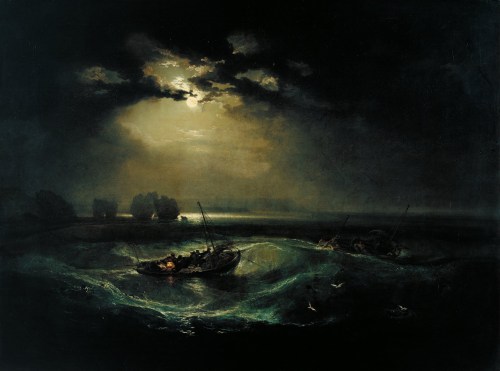
#FineArtFriday: Fishermen at Sea by J. M. W. Turner 1796

Joseph_Mallord_William_Turner_-_Fishermen_at_Sea_-_Google_Art_ProjectArtist: J. M. W. Turner (1775–1851)

Title: Fishermen at Sea

Genre: marine art

Depicted place: The Needles, off the Isle of Wight

Date: 1796

Medium: oil on canvas

Dimensions: Height: 914 mm (35.98 in); Width: 1,222 mm (48.11 in)

What I love about this painting:

I love seascapes, in all their many forms. This particular painting is dark in many ways beyond the obvious. It is a night scene, and it tells us a story of the dangers that fishermen face. Fish don’t care about the weather and some fish can only be caught at night.

If you must go out in the stormy dark, sometimes the catch is death.

We see an event unfolding by moonlight, observed by three seagulls sailing on the wind. Two boats, one a small vessel and the other a larger boat, tossing upon the rough sea, both with their sails furled. This tells us they fear being driven onto the rocks known as the Needles.

A line has been cast toward the larger boat, but no one is tending it. Nearly all the art scholars say it is a fishing line, but it seems rather stout for a fishing line, and there is only one line in the water although two ships are braving the storm. Waves threaten to wash everything overboard on both boats.

I’m a storyteller; to my imagination this scene looks less like a fishing expedition and more like a rescue, as if the rope has been cast toward the other vessel to bring it close.

This is the beauty of great art. It inspires the imagination to think beyond the obvious, to look outside the accepted view and to find new ways of looking at things.

The warm glow of lantern in the stern of the smaller boat casts little light and is the only warmth in this scene. The moon has emerged from behind the clouds and illuminates the action.

Whether this is merely a rough night of fishing or a rescue at sea, this a powerful moment of fear and bravery.

About this painting via Wikipedia:

Fishermen at Sea, sometimes known as the Cholmeley Sea Piece, is an early oil painting by English artist J. M. W. Turner. It was exhibited at the Royal Academy in 1796 and has been owned by the Tate Gallery since 1972. The painting measures 36 by 48.125 inches (91.44 cm × 122.24 cm). It was the first painting by Turner to be exhibited at the Royal Academy. It was praised by contemporary critics and founded Turner’s reputation, as both an oil painter and a painter of maritime scenes. Art historian Andrew Wilton has commented that the image: “Is a summary of all that had been said about the sea by the artists of the 18th century.”

The painting depicts a moonlit view of fishermen on rough seas near the Needles, of the Isle of Wight. It juxtaposes the fragility of human life, represented by the small boat with its flickering lamp, and the sublime power of nature, represented by the dark clouded sky, the wide sea, and the threatening rocks in the background. The cold light of the Moon at night contrasts with the warmer glow of the fishermen’s lantern. [1]

About the Artist, via Wikipedia:

Joseph Mallord William Turner RA (23 April 1775 – 19 December 1851), known in his time as William Turner,[a] was an English Romantic painter, printmaker and watercolourist. He is known for his expressive colourisations, imaginative landscapes and turbulent, often violent marine paintings. He left behind more than 550 oil paintings, 2,000 watercolours, and 30,000 works on paper. He was championed by the leading English art critic John Ruskin from 1840, and is today regarded as having elevated landscape painting to an eminence rivalling history painting.

Turner was born in Maiden Lane, Covent Garden, London, to a modest lower-middle-class family. He lived in London all his life, retaining his Cockney accent and assiduously avoiding the trappings of success and fame. A child prodigy, Turner studied at the Royal Academy of Arts from 1789, enrolling when he was 14, and exhibited his first work there at 15. During this period, he also served as an architectural draftsman. He earned a steady income from commissions and sales, which due to his troubled, contrary nature, were often begrudgingly accepted. He opened his own gallery in 1804 and became professor of perspective at the academy in 1807, where he lectured until 1828. He travelled to Europe from 1802, typically returning with voluminous sketchbooks.

Intensely private, eccentric and reclusive, Turner was a controversial figure throughout his career. He did not marry, but fathered two daughters, Eveline (1801–1874) and Georgiana (1811–1843), by his housekeeper Sarah Danby. He became more pessimistic and morose as he got older, especially after the death of his father, after which his outlook deteriorated, his gallery fell into disrepair and neglect, and his art intensified. In 1841, Turner rowed a boat into the Thames so he could not be counted as present at any property in that year’s census. He lived in squalor and poor health from 1845, and died in London in 1851 aged 76. Turner is buried in Saint Paul’s Cathedral, London. [2]


Credits and Attributions:

Fishermen at Sea, J. M. W. Turner, Public domain, via Wikimedia Commons

[1] Wikipedia contributors, “Fishermen at Sea,” Wikipedia, The Free Encyclopedia, https://en.wikipedia.org/w/index.php?title=Fishermen_at_Sea&oldid=1000617338 (accessed January 21, 2022).

[2] Wikipedia contributors, “J. M. W. Turner,” Wikipedia, The Free Encyclopedia, https://en.wikipedia.org/w/index.php?title=J._M._W._Turner&oldid=1062349164 (accessed January 21, 2022).

2 Comments

Filed under #FineArtFriday, writing

#FineArtFriday: Red hollyhocks in the garden of the Ancher family at Markvej in Skagen by Anna Ancher ca. 1916

Anna_Ancher_-_Røde_stokroser_i_haven_ved_Ancher-familiens_hus_på_Markvej_i_SkagenArtist: Anna Ancher  (1859–1935)

Title: English: Red hollyhocks in the garden of the Ancher family at Markvej in Skagen.

Date: circa 1916

Medium: oil on canvas

Dimensions: Height: 63 cm (24.8 in); Width: 47 cm (18.5 in)

Collection: Unknown

Inscriptions: Signature bottom right: A. Ancher

What I love about this painting:

January tends to be dark and rainy here in the Pacific Northwest. We were snowed and iced in for two weeks, and then four inches of rain fell in one day and the floods came—boy, do I need a summer day! So, I found us this one—a perfect day in Skagen a century ago.

She is mostly known for her interiors, but Anna Ancher captured the essence of summer in this painting. Along with foxgloves, hollyhocks are my favorite summer flowers. Hers are beautiful, juxtaposed against the blue sky. Her eye for color was amazing. The yellow and red flowers perfectly complement the color of the building behind the garden.

I feel so much better for having had this glorious day in Anna’s serene garden.

About the Artist via Wikimedia: Anna Ancher preferred to paint interiors and simple themes from the everyday lives of the Skagen people, especially fishermen, women, and children. She was intensely preoccupied with exploring light and color, as in Interior with Clematis (1913). She also created more complex compositions such as A Funeral (1891). Anna Ancher’s works often represented Danish art abroad. Ancher has been known for portraying similar civilians from the Skagen art colony in her works, including an old blind woman.

While she studied drawing for three years at the Vilhelm Kyhn College of Painting in Copenhagen, she developed her own style and was a pioneer in observing the interplay of different colors in natural light. She also studied drawing in Paris at the atelier of Pierre Puvis de Chavannes along with Marie Triepcke, who would marry Peder Severin Krøyer, another Skagen painter.

In 1880 she married fellow painter Michael Ancher, whom she met in Skagen. They had one child, daughter Helga Ancher. Despite pressure from society that married women should devote themselves to household duties, she continued painting after marriage. [1]


Credits and Attributions:

Anna Ancher, Public domain, via Wikimedia Commons. Wikimedia Commons contributors, “File:Anna Ancher – Røde stokroser i haven ved Ancher-familiens hus på Markvej i Skagen.jpg,” Wikimedia Commons, the free media repository, https://commons.wikimedia.org/w/index.php?title=File:Anna_Ancher_-_R%C3%B8de_stokroser_i_haven_ved_Ancher-familiens_hus_p%C3%A5_Markvej_i_Skagen.jpg&oldid=616771666 (accessed January 14, 2022).

[1] Wikipedia contributors, “Anna Ancher,” Wikipedia, The Free Encyclopedia, https://en.wikipedia.org/w/index.php?title=Anna_Ancher&oldid=1041257716 (accessed January 14, 2022).

Comments Off on #FineArtFriday: Red hollyhocks in the garden of the Ancher family at Markvej in Skagen by Anna Ancher ca. 1916

Filed under #FineArtFriday, writing

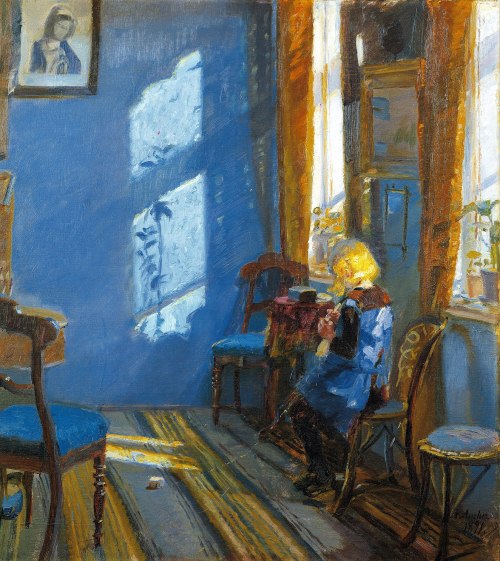
#FineArtFriday: Sunshine in the Blue Room. Helga Ancher Knitting in Grandmother’s Parlour by Anna Ancher 1891

Anna_Ancher_-_Sunlight_in_the_blue_room_-_Google_Art_ProjectArtist: Anna Ancher:

Title: Sunshine in the Blue Room. Helga Ancher Knitting in Grandmother’s Parlour

Alternate TitleSunlight in the Blue Room

Date: 1891

Medium: oil on canvas

Dimensions: w58.8 x h65.2 cm (Without frame)

Collection: Skagens Museum

Inscriptions: A. Ancher 1891

What I love about this painting:

It is a painting that must be viewed from a distance, as only then does it come into focus. I love the way the light falls on the wall, the shadow of a plant silhouetted there. Helga’s golden hair stands out in contrast to the blue of the walls and matching blue of her dress. Who is the woman in the image on the wall? Is it a picture of grandmother?

This is definitely a blue room, a shade of blue with a kind of depth and boldness to it. It must have been a colorful home.

I love all of Anna Ancher’s work. She painted the humanity in the small everyday things, such a daughter sitting near a window, crocheting. She melded art with homemaking, proving that even in an era of oppression women could be artists to be reckoned with.

About this painting, via Wikipedia:

As indicated by its full title: Sunshine in the Blue Room. Helga Ancher Knitting in Grandmother’s Parlour (Solskin i den blå stue. Helga Ancher ved strikketøjet i bedstemoders stue), the painting depicts Anna’s daughter Helga knitting in her grandmother’s room. With her back to the observer, the child is busy crocheting. Despite its everyday subject, the painting is one of Anna Ancher’s most captivating masterpieces with its many shades of blue and the sense of tranquility it conveys. Devoid of action, the theme is essentially the play of light in the room. The only indication of the outside world is the light streaming through the window. Mette Bøgh Jensen, curator of Skagens Museum, explains that Anna Ancher’s interior paintings are “more about the colour and light than anything else”. The artist’s main interest is “not in replicating the reality of the room or wall, or even the light, but rather what is left when these things are stripped away and all that remains are colour and form”. Bøgh Jensen continues, “Anna Ancher’s art is unlike that of anyone else. In its essence it is tied to the special world of motifs in Skagen: the fishermen’s families, the harvesters, the heathers, the special colours, and the brilliant summer light.”

In her Concise Dictionary of Women Artists, Delia Gaze assesses Anna Ancher’s achievements as remarkable “in the modernity of her idiom, with its reduced, abstracting forms and bold expressive colours, singling her out as one of the most innovative painters of her generation, exceeding most of her male colleagues, including her husband” [1]

About the artist, via Wikipedia:

Anna Ancher (18 August 1859 – 15 April 1935) was a Danish artist associated with the Skagen Painters, an artist colony on the northern point of Jylland, Denmark. She is considered to be one of Denmark’s greatest visual artists.

Anna Kirstine Brøndum was born in Skagen, Denmark, the daughter of Ane Hedvig Møller (1826–1916) and Erik Andersen Brøndum (1820–1890). She was the only one of the Skagen Painters who was born and grew up in Skagen, where her father owned the Brøndums Hotel. The artistic talent of Anna Ancher became obvious at an early age and she became acquainted with pictorial art via the many artists who settled to paint in Skagen, in the north of Jylland.

While she studied drawing for three years at the Vilhelm Kyhn College of Painting in Copenhagen, she developed her own style and was a pioneer in observing the interplay of different colors in natural light. She also studied drawing in Paris at the atelier of Pierre Puvis de Chavannes along with Marie Triepcke, who would marry Peder Severin Krøyer, another Skagen painter.

In 1880 she married fellow painter Michael Ancher, whom she met in Skagen. They had one child, daughter Helga Ancher. Despite pressure from society that married women should devote themselves to household duties, she continued painting after marriage. [2]


Credits and Attributions:

Image: Sunlight in the Blue Room by Anna Ancher, Public domain, via Wikimedia Commons

[1] Wikipedia contributors, “Sunlight in the Blue Room,” Wikipedia, The Free Encyclopedia, https://en.wikipedia.org/w/index.php?title=Sunlight_in_the_Blue_Room&oldid=1047381792 (accessed January 6, 2022).

[2] Wikipedia contributors, “Anna Ancher,” Wikipedia, The Free Encyclopedia, https://en.wikipedia.org/w/index.php?title=Anna_Ancher&oldid=1041257716 (accessed January 6, 2022).

Comments Off on #FineArtFriday: Sunshine in the Blue Room. Helga Ancher Knitting in Grandmother’s Parlour by Anna Ancher 1891

Filed under #FineArtFriday, writing

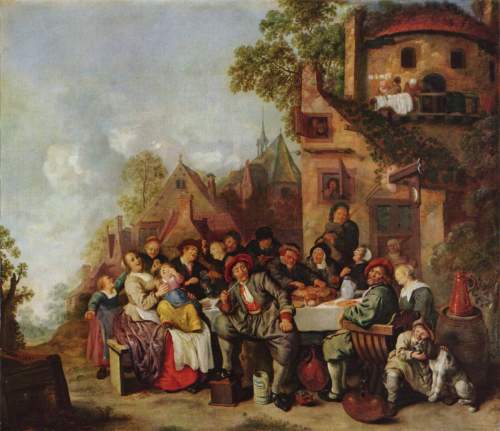
#FineArtFriday: Tavern of the Crescent Moon by Jan Miense Molenaer (revisited)

Artist: Jan Miense Molenaer (1609/1610–1668)

Title: Tavern of the Crescent Moon

Genre: genre art

Date: mid-17th century

Medium: oil on canvas

Dimensions: 87.8 × 102 cm (34.5 × 40.1 in)

Collection: Budapest Museum of Fine Arts

The sign hanging in front of the Tavern of the Crescent Moon shows it was a wayside inn catering to the traveling public and some locals.  Molenaer’s inn seems to have been a friendly place where the food was most important. A piper is playing, and people are singing. Others are hanging out the windows and watching from a balcony, enjoying the music.

The patrons are a mixed group but look like happy middle-class people, who seem fairly prosperous. What I love about this painting is the fact that the patrons are sitting outdoors. The inside of most taverns and wayside inns were dark, smoky places. Patrons must have moved outdoors as soon as the weather allowed. The day this painting was composed, weather was fine, although one well-dressed man (perhaps a merchant?) has his foot resting on a foot-warmer, which was a luxury item in that time period.

Whole families are there, out for an evening of music and enjoyment. They are breaking and sharing fresh-baked bread. Other than the man whose best friend is the dog, no one has overindulged in drink—over all, the happy group looks as if they came to the tavern solely for the company and the music.

About the Artist: From the National Gallery Website:

Jan Miense Molenaer was born in Haarlem and lived there or in nearby Heemstede. In 1634 he was listed as member of the Guild of St. Luke in Haarlem. In 1636 he married the painter Judith Leyster. Both Molenaer and Leyster may have been pupils of Frans Hals and were certainly influenced by both his style and subject matter. Dirck Hals’ influence was also very important for him, for it inspired Molenaer to paint merry company scenes.

Jan Miense Molenaer was a more prolific artist than his wife, Judith Leyster, who worked on similar subjects. Motherhood and running a household most likely cut into Judith’s time for artistic endeavors.  Molenaer  and Leyster had five children, only two of whom survived to adulthood.


Sources and Attributions:

Quote from biography of Jan Miense Molenaer, The National Gallery Website, https://www.nationalgallery.org.uk/artists/jan-miense-molenaer The National Gallery, Trafalgar Square, London, WC2N 5DN (accessed November 9, 2018)

Wikimedia Commons contributors, “File:Jan Miense Molenaer 003.jpg,” Wikimedia Commons, the free media repository, https://commons.wikimedia.org/w/index.php?title=File:Jan_Miense_Molenaer_003.jpg&oldid=302686494 (accessed November 9, 2018).

Wikipedia contributors, “Judith Leyster,” Wikipedia, The Free Encyclopedia, https://en.wikipedia.org/w/index.php?title=Judith_Leyster&oldid=820769951 (accessed November 9, 2018).

Comments Off on #FineArtFriday: Tavern of the Crescent Moon by Jan Miense Molenaer (revisited)

Filed under writing

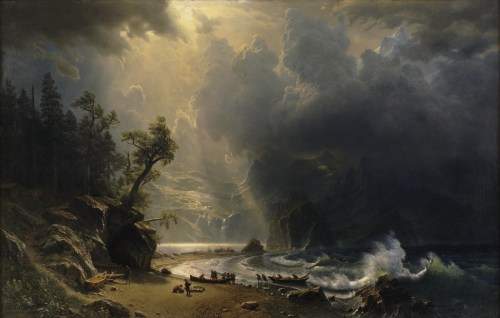
#FineArtFriday: Puget Sound on the Pacific Coast by Albert Bierstadt 1870 (reprise)

What I love about this painting:

I live on Puget Sound, and while the exact beach this image depicts likely does not exist, the cliffs are pretty accurate. I have seen many, many places here like it. The waters of the sound can get quite rough during storms, as this video shot three years ago by a storm chaser during a December storm shows: Wild Ferry Ride Across Puget Sound Dec. 16 2018.

Anyone who lives here will tell you, the view of the Olympic Mountains from over the sound is unparalleled.

At certain times of the year, rain sweeps in like a dark beast. I have often seen the sky as black and heavy as it is depicted in this painting. Shafts of sun between heavy rain squalls are frequent companions here. When the sun shines through the heavy clouds, the light looks very much the way he shows it.

A sky that looks like the one in this painting heralds a serious storm. If you are driving anywhere during this kind of weather, you are in for a slow, miserable trip.

Quote from http://www.SeattleArtMuseum.org, regarding Puget Sound on the Pacific Coast, 1870, which is now in their possession.

 “Bierstadt had likely not yet traveled to the Washington Territory in 1870. The painting was possibly a commission from a New York shipping magnate who had made his enormous fortune on the Pacific coast. Enterprising artist that he was, Bierstadt did not shy away from the challenge of painting a place he had not yet seen.”

I love that Bierstadt was a story teller as much as an entrepreneur in regard to his art. All the great artists were.

It has been suggested he put this picture together by piecing together places he had visited on the Lower Columbia River. Indeed, the trees and landscape there is much like that of Puget Sound, so it is possible. However, it would have been easy for him to have traveled north to the sound if he was on the  Lower Columbia—a matter of only eighty miles, so a week of travel for him by horse.

He was a man who traveled all over the west and painted what he felt as much as what he saw.

Wikipedia has this to say about Albert Bierstadt:

In 1867, Bierstadt traveled to London, where he exhibited two landscape paintings in a private reception with Queen Victoria. He traveled through Europe for two years, cultivating social and business contacts to sustain the market for his work overseas. His exhibition pieces were brilliant images, which glorified the American West as a land of promise and “fueled European emigration.” He painted Among the Sierra Nevada, California in his Rome studio, for example, showed it in Berlin and London before shipping it to the U.S. As a result of the publicity generated by his Yosemite Valley paintings in 1868, Bierstadt’s presence was requested by every explorer considering a westward expedition, and he was commissioned by the Atchison, Topeka, and Santa Fe Railroad to visit the Grand Canyon for further subject matter.

Bierstadt’s choice of grandiose subjects was matched by his entrepreneurial flair. His exhibitions of individual works were accompanied by promotion, ticket sales, and, in the words of one critic, a “vast machinery of advertisement and puffery.”

Bierstadt was highly successful in his day, which the more refined critics despised. Everything the critics mocked about his work are the aspects I love. The high contrasts of light and shadow, sweeping epic themes, and overblown romanticism—those are what I love about all his work.

In all his works, Bierstadt created an emotional landscape as much as a physical one.

Puget Sound on the Pacific Coast by Albert Bierstadt

  • Genre: landscape art
  • Date: 1870
  • Medium: oil on canvas
  • Dimensions: Height: 52.5 ″ (133.3 cm); Width: 82 ″ (208.2 cm)
  • Collection: Seattle Art Museum
  • Current location: Seattle Art Museum Downtown, Gallery Level 3, American Art

Credits and Attributions:

Puget Sound on the Pacific Coast, by Albert Bierstadt, signed and dated 1870 [Public domain]

Wikimedia Commons contributors, “File:Albert Bierstadt – Puget Sound on the Pacific Coast (1870).jpg,” Wikimedia Commons, the free media repository, https://commons.wikimedia.org/w/index.php?title=File:Albert_Bierstadt_-_Puget_Sound_on_the_Pacific_Coast_(1870).jpg&oldid=344396079 (accessed April 26, 2019).

Quote from the article: Puget Sound on the Pacific Coast, Seattle Art Museum website contributors, (accessed April 25, 2019).

5 Comments

Filed under #FineArtFriday

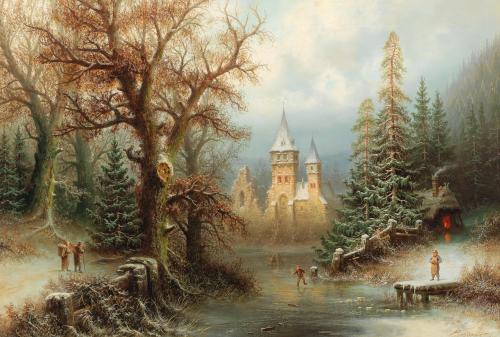
#FineArtFriday: Romantic Winter Landscape with Ice Skaters by a Castle, by Albert Bredow (reprise)

I love the dreamscape quality of this painting – it’s practically a Christmas card. Peasants, ordinary people living in the shadow of the ruined castle, freely enjoying the day. To look at this picture is to see a fairy tale that wants to be told. Who are these people and why do they live there? What is their connection to the ruined castle? And what is their connection to each other?

The trees, the ice, the snow–the detail is all there, even the warmth of the peasant’s hut. It’s a comforting picture, a moment of contentment.

About the Artist:

Little is known of Albert Bredow’s life. Born Apr 23, 1828 in Germany, and died May 5, 1899 in Moscow, he was well known as a landscape painter, lithographer and stage designer.

From this painting, which is dated near the end of his life, we know he was a romantic, fond of fantasy and fairy tales.

His birthplace in Germany and where he first studied art and set design are unknown. Records do show that he lived and worked in Riga as a stage designer from around 1852 and then in Tallinn. In 1856 he went to Moscow at the invitation of the Directorate of the Imperial Theater. He worked from 1856 to 1862 as a set designer for the Moscow Theater and from 1862 to 1871 the Petersburg Theater.

He is known for his ethereal landscape paintings, which may have been a hobby he pursued more intently later in life since he was actively employed in the theater during his working years. His style of landscape painting must have produced some amazing backdrops for the sets he designed.

In 1863, illustrations of his stage sets for Glinka’s opera “A Life for the Tsar” were considered worthy enough to be published as an album. In 1868 he began his studies at the Petersburg Imperial Art Academy. At the Academy’s art exhibitions, he exhibited his landscapes from Germany and Russia.

The designs of Albert Bredow’s stage sets are in the collection of the Moscow Bachruschin Theater Museum.


Credits and Attributions

Wikimedia Commons contributors, “File:Albert Bredow – Romantic Winter Landscape with Ice Skaters by a Castle.jpg,” Wikimedia Commons, the free media repository, https://commons.wikimedia.org/w/index.php?title=File:Albert_Bredow_-_Romantic_Winter_Landscape_with_Ice_Skaters_by_a_Castle.jpg&oldid=282656583 (accessed December 7, 2018).

Comments Off on #FineArtFriday: Romantic Winter Landscape with Ice Skaters by a Castle, by Albert Bredow (reprise)

Filed under #FineArtFriday

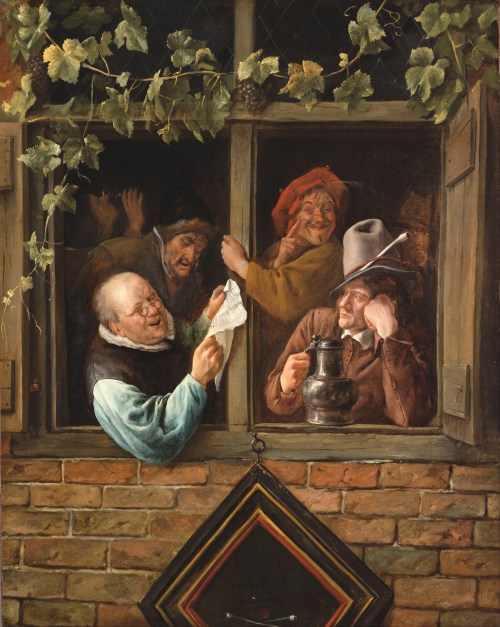
#FineArtFriday: Rhetoricians at a Window by Jan Steen ca. 1666 (reprise)

Artist: Jan Steen  (1625/1626–1679)

Title: Rhetoricians at a Window

Genre: genre art

Date: c. 1661-66

Medium: oil on canvas

English: Oil on canvas

Dimensions: Height: 759.46 mm (29.90 in); Width: 586.23 mm (23.07 in)

Collection: Philadelphia Museum of Art

What I love about this painting:

This is one of my all time favorite paintings. It has inspired some the characters who pass through my stories, people my protagonists meet along the way. These jolly rogues have such vivid personalities that the viewer immediately feels a kinship to them.

The reading of a poem or play was clearly the opportunity for the performers to have a good time. From the drinker in the shadows of the background, to the grapevines growing around the window, Steen tells us that wine and rhetoric are clearly entwined.

I love the inclusion of both “the critic” who leans his head on his hand and listens analytically, and the man behind him, who is clearly “a little over the limit,” and supports himself by grasping the window frame and heartily agreeing with some point.

The reader is clearly enjoying himself, as are the others.

About the Artist (Via Wikipedia):

Jan Havickszoon Steen (c. 1626 – buried 3 February 1679) was a Dutch Golden Age painter, one of the leading genre painters of the 17th century. His works are known for their psychological insight, sense of humour and abundance of colour.

Daily life was Jan Steen’s main pictorial theme. Many of the genre scenes he portrayed, as in The Feast of Saint Nicholas, are lively to the point of chaos and lustfulness, even so much that “a Jan Steen household”, meaning a messy scene, became a Dutch proverb (een huishouden van Jan Steen). Subtle hints in his paintings seem to suggest that Steen meant to warn the viewer rather than invite him to copy this behaviour. Many of Steen’s paintings bear references to old Dutch proverbs or literature. He often used members of his family as models, and painted quite a few self-portraits in which he showed no tendency of vanity.

Steen did not shy from other themes: he painted historical, mythological and religious scenes, portraits, still lifes and natural scenes. His portraits of children are famous. He is also well known for his mastery of light and attention to detail, most notably in Persian rugs and other textiles.

Steen was prolific, producing about 800 paintings, of which roughly 350 survive. His work was valued much by contemporaries and as a result he was reasonably well paid for his work. He did not have many students—only Richard Brakenburgh is recorded—but his work proved a source of inspiration for many painters. [2]

About this painting, Via Wikipedia:

Chambers of rhetoric (Dutch: rederijkerskamers) were dramatic societies in the Low Countries. Their members were called Rederijkers (singular Rederijker), from the French word ‘rhétoricien’, and during the 15th and 16th centuries were mainly interested in dramas and lyrics. These societies were closely connected with local civic leaders and their public plays were a form of early public relations for the city. [1]

In 1945, Sturla Gudlaugsson, a specialist in Dutch seventeenth-century painting and iconography and Director of the Netherlands Institute for Art History and the Mauritshuis in The Hague, wrote The Comedians in the work of Jan Steen and his Contemporaries, which revealed that a major influence on Jan Steen’s work was the guild of the Rhetoricians or Rederijkers and their theatrical endeavors.

It is often suggested that Jan Steen’s paintings are a realistic portrayal of Dutch 17th-century life. However, not everything he did was a purely realistic representation of his day-to-day environment. Many of his scenes contain idyllic and bucolic fantasies and a declamatory emphasis redolent of theater.

Jan Steen’s connection to theater is easily verifiable through his connection to the Rederijkers. There are two kinds of evidence for this connection. First, Jan Steen Steen’s uncle belonged to the Rhetoricians in Leiden, where Steen was born and lived a substantial part of his life. Second, Jan Steen portrayed many scenes from the lives of the Rederijkers, an example being the painting Rhetoricians at a Window of 1658–65. The piece is currently held in the Philadelphia Museum of Art which was established in February 1876. The humanity, humor and optimism of the figures suggest that Jan Steen knew these men well and wanted to portray them positively.

With his lavish and moralising style, it is logical that Steen would employ the stratagems from theater for his purposes. There is conclusive evidence that the characters in Steen’s paintings are predominantly theatrical characters and not ones from reality. [2]


Credits and Attributions:

This post first appeared here on Life in the Realm of Fantasy  in September of 2020.

[1] Wikipedia contributors, “Jan Steen,” Wikipedia, The Free Encyclopedia, https://en.wikipedia.org/w/index.php?title=Jan_Steen&oldid=950709901 (accessed September 10, 2020).

[2] Wikipedia contributors, “Chamber of rhetoric,” Wikipedia, The Free Encyclopedia, https://en.wikipedia.org/w/index.php?title=Chamber_of_rhetoric&oldid=975283829 (accessed September 10, 2020).

Wikimedia Commons contributors, “File:Jan Steen, Dutch (active Leiden, Haarlem, and The Hague) – Rhetoricians at a Window – Google Art Project.jpg,” Wikimedia Commons, the free media repository, https://commons.wikimedia.org/w/index.php?title=File:Jan_Steen,_Dutch_(active_Leiden,_Haarlem,_and_The_Hague)_-_Rhetoricians_at_a_Window_-_Google_Art_Project.jpg&oldid=355150081 (accessed September 10, 2020).

2 Comments

Filed under #FineArtFriday

#FineArtFriday: Harvesters by Anna Ancher, 1905

Anna_Ancher_-_Harvesters_-_Google_Art_ProjectArtist: Anna Ancher  (1859–1935)

Title: Harvesters

Date: 1905

Medium: oil on canvas

Dimensions: w56.2 x h43.4 cm (Without frame)

Collection: Skagens Museum

What I love about this painting:

While she normally painted interiors, Anna Ancher captured a perfect late summer morning beneath blue skies in this painting. One can almost hear the rustling of ripe grain moving with the breeze.

I like the placement of the three figures, two women and a man. Are they husband, wife, and daughter? There is a sense of movement in this painting. They enter the scene from the right, and you feel sure they will exit to the left, where the field that is to be cut that day is.

The man will scythe, the woman who follows third will rake, and the woman in the middle will stack the sheaves.

These are not poor people. These farmers are dressed modestly in clean work clothes that aren’t tattered and patched. They are doing well; the grain is high, and life is good in these years of plenty before the outbreak of WWI.

About the Artist, via Wikipedia:

Anna Ancher (18 August 1859 – 15 April 1935), born Anna Kirstine Brøndum, was born in Skagen, Denmark, was the only one of the Skagen Painters who was born and grew up in Skagen, where her father owned the Brøndums Hotel. The artistic talent of Anna Ancher became obvious at an early age and she became acquainted with pictorial art via the many artists who settled to paint in Skagen, in the north of Jylland.

While she studied drawing for three years at the Vilhelm Kyhn College of Painting in Copenhagen, she developed her own style and was a pioneer in observing the interplay of different colors in natural light. She also studied drawing in Paris at the atelier of Pierre Puvis de Chavannes along with Marie Triepcke, who would marry Peder Severin Krøyer, another Skagen painter.

In 1880 she married fellow painter Michael Ancher, whom she met in Skagen. They had one child, daughter Helga Ancher. Despite pressure from society that married women should devote themselves to household duties, she continued painting after marriage.

Anna Ancher was considered to be one of the great Danish pictorial artists by virtue of her abilities as a character painter and colorist. Her art found its expression in Nordic art’s modern breakthrough toward a more truthful depiction of reality, e.g. in Blue Ane (1882) and The Girl in the Kitchen (1883–1886).

Ancher preferred to paint interiors and simple themes from the everyday lives of the Skagen people, especially fishermen, women, and children. She was intensely preoccupied with exploring light and color, as in Interior with Clematis (1913). She also created more complex compositions such as A Funeral (1891). Anna Ancher’s works often represented Danish art abroad. Ancher has been known for portraying similar civilians from the Skagen art colony in her works, including an old blind woman.


Credits and Attributions:

Harvesters, Anna Ancher, Public domain, via Wikimedia CommonsWikimedia Commons contributors, “File:Anna Ancher – Harvesters – Google Art Project.jpg,” Wikimedia Commons, the free media repository, https://commons.wikimedia.org/w/index.php?title=File:Anna_Ancher_-_Harvesters_-_Google_Art_Project.jpg&oldid=371900766 (accessed October 14, 2021).

Wikipedia contributors, “Harvesters (Ancher),” Wikipedia, The Free Encyclopedia, https://en.wikipedia.org/w/index.php?title=Harvesters_(Ancher)&oldid=1047378795 (accessed October 14, 2021).

3 Comments

Filed under #FineArtFriday

#FineArtFriday: The Ghost of Vermeer of Delft Which Can Be Used As a Table by Salvador Dalí, 1934 (revisited)

About the painting, from Wikipedia:

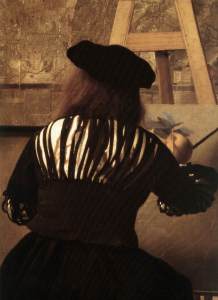
The Ghost of Vermeer of Delft Which Can Be Used As a Table is a small Surrealist oil painting by Salvador Dalí. Its full title is The Ghost of Vermeer of Delft Which Can Be Used as a Table (Phenomenologic Theory of Furniture-Nutrition). It makes reference to The Art of Painting by Johannes Vermeer, a famous seventeenth-century work in which a painter, thought to be a self-portrait of Vermeer, is depicted with his back to us, in distinctive costume. It is one of a number of paintings expressive of Dalí’s enormous admiration for Vermeer.

Vermeer is represented as a dark spindly figure in a kneeling position. The figure’s outstretched leg serves as a table top surface, on which sits a bottle and a small glass. This leg tapers to a baluster-like stub; there is a shoe nearby. The walls and the distant views of the mountains are based on real views near Dalí’s home in Port Lligat. In Vermeer’s painting the artist leans on a maulstick, and his hand is painted with an unusual blurriness, perhaps to indicate movement. In Dalí’s painting Vermeer rests the same arm on a crutch.

What I love about this painting:

I love the composition, the detail Dali puts into Vermeer’s hair and doublet–the attention Vermeer applied to his own work. This speaks to me of the desert, the way the sky looks in the afternoon just as the hottest part of the day slides into a cooler evening. Vermeer, the Master of Light, is enjoying the view. He is shown in a small courtyard, enclosed. Vermeer rarely left his rooms in Delft.

It is unsigned and undated but known to have been completed c.1934. It is currently on display at the Salvador Dalí Museum in St. Petersburg, Florida, on loan from the E. and A. Reynolds Morse collection.


Credits and Attributions:

Wikipedia contributors, “The Ghost of Vermeer of Delft Which Can Be Used As a Table,” Wikipedia, The Free Encyclopedia,https://en.wikipedia.org/w/index.php?title=The_Ghost_of_Vermeer_of_Delft_Which_Can_Be_Used_As_a_Table&oldid=861917029 (accessed March 1, 2019).

Wikimedia Commons contributors, “File:Johannes Vermeer – The Art of Painting (detail) – WGA24677.jpg,” Wikimedia Commons, the free media repository, https://commons.wikimedia.org/w/index.php?title=File:Johannes_Vermeer_-_The_Art_of_Painting_(detail)_-_WGA24677.jpg&oldid=268076769 (accessed March 1, 2019).

6 Comments

Filed under writing