Tag Archives: Fine Art Friday

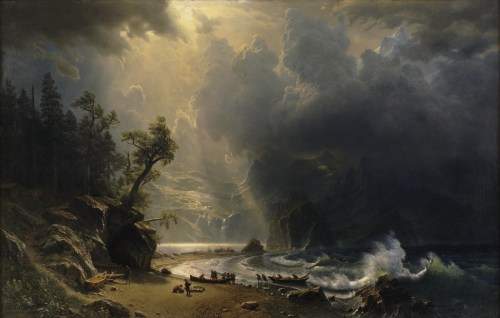
#FineArtFriday: Accident at the Old Pier, by Andreas Achenbach 1863

OLYMPUS DIGITAL CAMERA

Artist: Andreas Achenbach  (1815–1910)

Title: Accident at the Old Pier, by Andreas Achenbach 1863

Genre: landscape art

Date: 1863

Medium: oil on panel

Dimensions: Height: 92.5 cm (36.4 in) Width: 70.8 cm (27.8 in)

Collection: Kunsthalle Bremen 

Object history: 1865: purchased by Kunsthalle Bremen

Inscriptions: Signature and date bottom left: A. Achenbach 1863

What I love about this painting:

The scene depicted here is both historical, and current. It is a scene that plays out in our modern world in the same way as it did in 1863.

No matter what part of the world you live, anyone who lives near the sea will recognize the style of the rickety, weathered pier. Storms and saltwater wreak their will on both the wooden docks and the hubris of those who think to conquer the waves. Wood is no match for the storm; we fish and travel the waters at the mercy of the weather, and if the wind is wrong, approaching the dock can be dicey.

Along the pier, men work to keep the boat from crashing. A ship of that size would take out at least a section of the dock, if not the whole dock.

To this day, there is only one way to fend a boat away from a bad docking if they are at the mercy of the storm, and that is what we see here. Dockworkers push the vessel with poles to hold it off, hoping to reduce its momentum. A timber floats in the waves, as the boat has struck the pier at least once with the full force of the gale winds.

For the crew, disembarking will be a challenge. Should these sailors remain on board or try to jump onto the pier, risking being crushed between the rolling, lurching ship and the waves?

About the Artist, via Wikipedia:

Andreas Achenbach (29 September 1815, Kassel – 1 April 1910, Düsseldorf) was a German landscape and seascape painter in the Romantic style. He is considered to be one of the founders of the Düsseldorf School. His brother, Oswald, was also a well known landscape painter. Together, based on their initials, they were known as the “Alpha and Omega” of landscape painters. [1]


Credits and Attributions:

Wikimedia Commons contributors, “File:Achenbach Havarie am alten Pier@Albert König Museum20160904.jpg,” Wikimedia Commons, the free media repository, https://commons.wikimedia.org/w/index.php?title=File:Achenbach_Havarie_am_alten_Pier@Albert_K%C3%B6nig_Museum20160904.jpg&oldid=526736266 (accessed August 19, 2021).

[1] Wikipedia contributors, “Andreas Achenbach,” Wikipedia, The Free Encyclopedia, https://en.wikipedia.org/w/index.php?title=Andreas_Achenbach&oldid=1037476363 (accessed August 19, 2021).

1 Comment

Filed under #FineArtFriday, writing

#FineArtFriday: Autumn by František Michl 1949

1949-Autumn

Artist: František Michl

Title:  Autumn, 1949.

Medium: oil on canavas (private collection)


What I love about this painting:

This is a powerful, moody piece. It conveys the chill and dampness of a day in late autumn, contrasted against the brilliant blue of the skies between rain squalls. Some trees cling to their leaves, defying the cold breeze while others are bare, mingled among the tall evergreens. The grass is brown, and a solitary hiker takes advantage of the sunshine, making their way over the ridge in solitary peace.

One feels that soon this hillside will be covered with snow.

About the Artist, via Wikipedia:

[1] František Michl (20 November 1901, – 4 June 1977), Czech academic painter, graphic artist, and original designer of the Škoda Works emblem, the “Winged Arrow”. He was imprisoned in Pankrac Prison, and the concentration camps Terezin and Flossenbürg after his arrest by Nazis for an anti-fascist demonstration at Domažlice. After the war he was arrested in the Czechoslovak Socialist Republic for listening to the anticommunist Radio Liberty.

Michl, being a free-minded and anticommunist spirit, was imprisoned in Plzeň Prison in 1961. The trial was based on the accusation that Michl listened to Radio Liberty, which was considered by the totalitarian regime as treason. His name was blacklisted and his family persecuted.

The diminished political pressure in 1967 opened new prospects for Michl’s art in Czechoslovakia and abroad. In March 1968 his paintings were exhibited in Montreal. The Rullos Gallery in New York bought 165 paintings in November 1968. Unfortunately, preparation of Michl’s exhibition in the London National Gallery was interrupted by the Soviet invasion in August 1968.

The time of normalization brought back the ban on Michl’s name. Michl was not allowed to publicly display his art (though several illegal exhibitions, organized by his friends, took place, camouflaged under fake titles, for example “Successes of building socialism”). After his first brain stroke in 1972, which left half of his body paralyzed, Michl kept painting. It was only after his sixth stroke that Michl remained permanently bedridden until his death on June 4, 1977.

In 1991, František Michl’s name was fully politically rehabilitated, and his contribution to the anti-fascist and anticommunist resistance was recognized. Michl’s work, however, is still awaiting public recognition. [1]


Credits and Attributions:

Wikimedia Commons contributors, “File:1949-stromy.jpg,” Wikimedia Commons, the free media repository, https://commons.wikimedia.org/w/index.php?title=File:1949-stromy.jpg&oldid=423191687 (accessed August 13, 2021).

[1] Wikipedia contributors, “František Michl,” Wikipedia, The Free Encyclopedia, https://en.wikipedia.org/w/index.php?title=Franti%C5%A1ek_Michl&oldid=1002262176 (accessed August 13, 2021).

2 Comments

Filed under #FineArtFriday

#FineArtFriday: Passion Flowers and Hummingbirds by Martin Johnson Heade

MJ_Heade_Passion_Flowers_and_HummingbirdsArtist: Martin Johnson Heade (1819–1904)

Title: Passion Flowers and Hummingbirds

Genre:  floral painting

Date: circa 1870–83

Medium: oil on canvas

Dimensions: Height: 39.3 cm (15.5 in); Width: 54.9 cm (21.6 in)


About this painting, via Wikimedia Commons:

[1] In Passion Flowers and Hummingbirds, Heade depicted two snowcap hummingbirds, small black-and-white birds found in Panama, and the most brilliantly colored species of passionflower, Passiflora racemosa, in a steamy, lush jungle setting.

The passionflower is so named because missionaries saw correspondences between the parts of the flower and the Passion (or sufferings) of Christ. For example, the ten petals represent the ten apostles present at the crucifixion, the corona filaments resemble the crown of thorns, and the three stigmas relate to the nails.

In this work, Heade successfully combined his scientific interests and his aesthetic sensitivity. He rendered the birds and the passionflowers accurately in a close-up view but also gracefully composed the winding stems across the surface of the picture and contrasted the cool greens and grays with the dazzling red of the flowers.

Although Heade was one of the first to reflect Darwin’s theories in his paintings of flowers in their natural habitats, other artists were subsequently affected by Darwin’s view of the vitality of plants and the interaction of plants with their environment. [1]

About the Artist, via Wikipedia:

[2] Martin Johnson Heade (August 11, 1819 – September 4, 1904) was an American painter known for his salt marsh landscapes, seascapes, and depictions of tropical birds (such as hummingbirds), as well as lotus blossoms and other still lifes. His painting style and subject matter, while derived from the romanticism of the time, are regarded by art historians as a significant departure from those of his peers.

Heade was born in Lumberville, Pennsylvania, the son of a storekeeper. He studied with Edward Hicks, and possibly with Thomas Hicks. His earliest works were produced during the 1840s and were chiefly portraits. He travelled to Europe several times as a young man, became an itinerant artist on American shores, and exhibited in Philadelphia in 1841 and New York in 1843. Friendships with artists of the Hudson River School led to an interest in landscape art. In 1863, he planned to publish a volume of Brazilian hummingbirds and tropical flowers, but the project was eventually abandoned.

He travelled to the tropics several times thereafter, and continued to paint birds and flowers. Heade married in 1883 and moved to St. Augustine, Florida. His chief works from this period were Floridian landscapes and flowers, particularly magnolias laid upon velvet cloth. He died in 1904. His best known works are depictions of light and shadow upon the salt marshes of New England.

Heade was not a widely known artist during his lifetime, but his work attracted the notice of scholars, art historians, and collectors during the 1940s. He quickly became recognized as a major American artist. Although often considered a Hudson River School artist, some critics and scholars take exception to this categorization. Heade’s works are now in major museums and collections. His paintings are occasionally discovered in unlikely places such as garage sales and flea markets. [2]


Credits and Attributions:

[1] Wikimedia Commons contributors, “File:MJ Heade Passion Flowers and Hummingbirds.jpg,” Wikimedia Commons, the free media repository, https://commons.wikimedia.org/w/index.php?title=File:MJ_Heade_Passion_Flowers_and_Hummingbirds.jpg&oldid=577409420 (accessed July 29, 2021).

[2] Wikipedia contributors, “Martin Johnson Heade,” Wikipedia, The Free Encyclopedia, https://en.wikipedia.org/w/index.php?title=Martin_Johnson_Heade&oldid=1013422150 (accessed July 29, 2021).

Comments Off on #FineArtFriday: Passion Flowers and Hummingbirds by Martin Johnson Heade

Filed under #FineArtFriday, writing

#FineArtFriday: Winter Scene by Jan Steen 1650

Inv.nr: 10032

Artist: Jan Steen (1625/1626–1679)

Title: Winter Scene

Date: circa 1650

Medium: oil on canvas

Dimensions: Height: 660 mm (25.98 in); Width: 960 mm (37.79 in)

About this painting, Via Wikimedia Commons:

[1] Winter Scene is one of the earliest known paintings by Steen. With its diagonal composition and silhouetted figures on the ice one can clearly see his early inspirations from paintings such as Isaac van Ostade’s Winter from 1645. Here, as often seen in other works by Steen and his contemporaries, the activities are being watched by a well-dressed couple who occupies a central position in the composition. [1]

About the Artist, via Wikipedia:

[2] Jan Havickszoon Steen (c. 1626 – buried 3 February 1679) was a Dutch Golden Age painter, one of the leading genre painters of the 17th century. His works are known for their psychological insight, sense of humour and abundance of colour.

Daily life was Jan Steen’s main pictorial theme. Many of the genre scenes he portrayed, as in The Feast of Saint Nicholas, are lively to the point of chaos and lustfulness, even so much that “a Jan Steen household,” meaning a messy scene, became a Dutch proverb (een huishouden van Jan Steen). Subtle hints in his paintings seem to suggest that Steen meant to warn the viewer rather than invite him to copy this behaviour. Many of Steen’s paintings bear references to old Dutch proverbs or literature. He often used members of his family as models, and painted quite a few self-portraits in which he showed no tendency of vanity.

Steen did not shy from other themes: he painted historical, mythological and religious scenes, portraits, still lifes and natural scenes. His portraits of children are famous. He is also well known for his mastery of light and attention to detail, most notably in Persian rugs and other textiles.

Steen was prolific, producing about 800 paintings, of which roughly 350 survive. His work was valued much by contemporaries and as a result he was reasonably well paid for his work. He did not have many students—only Richard Brakenburgh is recorded—but his work proved a source of inspiration for many painters. [2]


Credits and Attributions:

Wikimedia Commons contributors, “File:Måleri, landskapsbild, vinterlandskap. Jan Steen – Skoklosters slott – 88965.tif,” Wikimedia Commons, the free media repository, https://commons.wikimedia.org/w/index.php?title=File:M%C3%A5leri,_landskapsbild,_vinterlandskap._Jan_Steen_-_Skoklosters_slott_-_88965.tif&oldid=428348165 (accessed July 22, 2021). Photographer:  Jens Mohr.

Wikipedia contributors, “Jan Steen,” Wikipedia, The Free Encyclopedia, https://en.wikipedia.org/w/index.php?title=Jan_Steen&oldid=1022958604 (accessed July 22, 2021).

Comments Off on #FineArtFriday: Winter Scene by Jan Steen 1650

Filed under #FineArtFriday

#FineArtFriday: Dogs by Jan Stobbaerts

Jan_Stobbaerts_-_DogsTitle: Dogs

Artist: Jan Stobbaerts  (1839–1914)

Date: between 1858 and 1914

Medium: oil on canvas

Dimensions: Height: 36.5 cm (14.3 in); Width: 45.5 cm (17.9 in)

What I like about this painting:

These dogs have the run of the house. They’re not too well groomed and probably spend a certain amount of time roaming the neighborhood. Both dogs have personality, and both are unrepentant ruffians.

This is a pair of canine hooligans bent on having a good time.

About the Artist, via Wikipedia [1]:

Jan Stobbaerts or Jan-Baptist Stobbaerts (18 March 1838 – 25 November 1914) was a Belgian painter and printmaker. He is known for his scenes with animals, landscapes, genre scenes and portraits or artists. With his dark-brown studio tones and forceful depiction of trivial subjects, Stobbaerts was a pioneer of Realism and ‘autochthonous’ Impressionism in Belgium.

While in his early works he painted scenes with pets in kitchen interiors in which the genre and anecdotal elements prevailed, from 1880 onwards stables and barns became a dominant theme in his work.[5] The compositions in this period were painted with an almost photographic realism.[8] His sober monochrome palette developed to a more balanced color scheme and he gave more attention to the effect of light.

Around 1890, Stobbaerts’ style underwent a considerable change likely under the influence of his discovery of Impressionism and his personal search for resolving the problem of light. Stobbaerts abandoned the detailed realism in favour of a very personal sfumato of light. His style became velvety, his brushwork looser and the paint more fluid. His paintings of the 1890s depicting scenes around the river Woluwe were made with an opaque, somewhat transparent paste. The artist concentrated on the effect of light and the forms, while they remained recognizable, became less clear as if seen through a soft-focus lens. The subject matter itself became less important. [1]


Credits and Attributions:

Wikimedia Commons contributors, “File:Jan Stobbaerts – Dogs.jpg,” Wikimedia Commons, the free media repository, https://commons.wikimedia.org/w/index.php?title=File:Jan_Stobbaerts_-_Dogs.jpg&oldid=354839586 (accessed July 9, 2021).

[1] Wikipedia contributors, “Jan Stobbaerts,” Wikipedia, The Free Encyclopedia, https://en.wikipedia.org/w/index.php?title=Jan_Stobbaerts&oldid=1025124429 (accessed July 9, 2021).

2 Comments

Filed under #FineArtFriday, writing

#FineArtFriday: Dawn In The Hills by Julian Onderdonk 1922

  • Julian_Onderdonk_(1882-1922)_-_Dawn_In_The_Hills_(1922)
  • Artist: Julian Onderdonk  (1882–1922)
  • Title: Dawn In The Hills
  • Date    1922
  • Medium: oil on canvas
  • Dimensions: Height: 76.2 cm (30″); Width: 101.6 cm (40″)
  • Collection: Private collection

What I love about this painting:

Onderdonk captured the surreal essence of early morning near San Antonio, Texas. The mists are rising in the hills, slowly revealing the riotous splendor of deep blue wildflowers. It is a rolling sea of bluebonnets, with the occasional white of the blackfoot or fleabane daisy mingled in.

The artist perfectly conveyed the mystical quality of that singular moment of the morning when the air is still and golden, and the day ahead is full of possibilities.

I could spend hours in this place.

About this painting:

Art historian Jeffrey Morseburg writes, “In the fall of 1922, as he was just entering his prime, Onderdonk was rushed to the hospital with an intestinal blockage. He failed to recover from the emergency surgery and died on October 27, 1922. His sudden death created an outpouring of emotion for the man who had become “The Dean of Texas Painters.” Just before he died, Onderdonk had finished a beautiful early morning view of a Texas hillside carpeted with Bluebonnets titled ‘Dawn in the Hills’ and another work, a bold fall scene titled ‘Autumn Tapestry.’” [1]

About the Artist, Via Wikipedia:

Julian Onderdonk was born in San Antonio, Texas, to Robert Jenkins Onderdonk, a painter, and Emily Gould Onderdonk. He was raised in South Texas and was an enthusiastic sketcher and painter. As a teenager Onderdonk was influenced and received some training from the prominent Texas artist Verner Moore White who also lived in San Antonio at the time. He attended the West Texas Military Academy, now the Episcopal School of Texas, graduating in 1900. His grandfather Henry Onderdonk was the Headmaster of Saint James School in Maryland, from which Julian’s father Robert graduated.

At 19, with the help of a generous neighbor, Julian left Texas in order to study with the renowned American Impressionist William Merritt Chase. Julian’s father, Robert, had also once studied with Chase. Julian spent the summer of 1901 on Long Island at Chase’s Shinnecock Hills Summer School of Art. He studied with Chase for a couple of years and then moved to New York City to attempt to make a living as an en plein air artist. While in New York he met and married Gertrude Shipman and they soon had a son.

Onderdonk returned to San Antonio in 1909, where he produced his best work. His most popular subjects were bluebonnet landscapes. Onderdonk died on October 27, 1922 in San Antonio.

President George W. Bush decorated the Oval Office with three of Onderdonk’s paintings. The Dallas Museum of Art has several rooms dedicated exclusively to Onderdonk’s work.

His art studio currently resides on the grounds of the Witte Museum.


Credits and Attributions:

[1] Julian Onderdonk, An Illustrated Biography by Jeffrey Morseburg, © 2011 https://julianonderdonk.wordpress.com/tag/julian-onderdonk-biography/  (accessed March 4, 2020).

Wikimedia Commons contributors, “File:Julian Onderdonk (1882-1922) – Dawn In The Hills (1922).jpg,” Wikimedia Commons, the free media repository, https://commons.wikimedia.org/w/index.php?title=File:Julian_Onderdonk_(1882-1922)_-_Dawn_In_The_Hills_(1922).jpg&oldid=278966540 (accessed March 4, 2020).

Wikipedia contributors, “Julian Onderdonk,” Wikipedia, The Free Encyclopedia, https://en.wikipedia.org/w/index.php?title=Julian_Onderdonk&oldid=882101452 (accessed March 4, 2020).

Comments Off on #FineArtFriday: Dawn In The Hills by Julian Onderdonk 1922

Filed under #FineArtFriday

#FineArtFriday: Saint George and the Dragon by Paolo Uccello

paolo_uccello_stgeorge_and_dragonArtist:  Paolo Uccello (1397–1475)

Title: Saint George and the Dragon

Medium: oil on canvas

Dimensions: Height: 57 cm (22.4 in); Width: 73 cm (28.7 in)

The above painting by Paolo Uccello, from around 1470, is a surreal, stylized retelling of the legend of Saint George and the Dragon. The legend tells of the knight slaying a dragon that demanded human sacrifices. With the slaying of the dragon, the hero has saved the princess who was chosen to be the next offering.

Nothing looks real except the dragon which is nightmare come to life. I love the hyper-heroic way Uccello portrayed horses. The people are pallid, with no personality to their features. The dragon and the horse are alive, as if the scene is about them only. All the passion of the moment converges in the dragon and the horse.

Done in oil on canvas, the painting was one of the last of Uccello’s creations.

According to Wikipedia, the Fount of All Knowledge: The narrative (of Saint George) has pre-Christian origins (Jason and MedeaPerseus and AndromedaTyphon, etc.), and is recorded in various saints’ lives prior to its attribution to St George specifically. It was particularly attributed to Saint Theodore Tiro in the 9th and 10th centuries, and was first transferred to Saint George in the 11th century. The earliest narrative record of Saint George slaying a dragon is found in a Georgian text of the 11th century. [1]

About the Artist (via Wikipedia)

Born Paolo di Dono, his nickname, Uccello (of the birds), came from his fondness for painting birds. He worked in the Late Gothic tradition, emphasizing colour and pageantry rather than the classical realism that other artists were pioneering. His style is best described as idiosyncratic (eccentric or unique), and he left no school of followers.

With his precise and analytical mind, Paolo Uccello tried to apply a scientific method to depict objects in three-dimensional space. In particular, some of his studies of the perspective foreshortening of the torus are preserved, and one standard display of drawing skill was his depiction of the mazzocchio.

In the words of G. C. Argan: “Paolo’s rigour is similar to the rigour of Cubists in the early 20th century, whose images were more true when they were less true to life. Paolo constructs space through perspective, and historic event through the structure of space; if the resulting image is unnatural and unrealistic, so much the worse for nature and history.”

The perspective in his paintings has influenced many famous painters, such as Piero della FrancescaAlbrecht Dürer and Leonardo da Vinci, to name a few. [2]


Credits and Attributions:

Wikimedia Commons contributors, “File:Paolo Uccello 047.jpg,” Wikimedia Commons, the free media repository, https://commons.wikimedia.org/w/index.php?title=File:Paolo_Uccello_047.jpg&oldid=308602797  (accessed January 18, 2019).

Wikipedia contributors, “Saint George,” Wikipedia, The Free Encyclopedia, https://en.wikipedia.org/w/index.php?title=Saint_George&oldid=1029544183 (accessed June 23, 2021). [1]

Wikipedia contributors, “Paolo Uccello,” Wikipedia, The Free Encyclopedia, https://en.wikipedia.org/w/index.php?title=Paolo_Uccello&oldid=873078862  (accessed January 18, 2019). [2]

Comments Off on #FineArtFriday: Saint George and the Dragon by Paolo Uccello

Filed under #FineArtFriday, writing

#FineArtFriday: The Spirit of War by Jasper Francis Cropsey 1851

The spirit of war

Title: The Spirit of War by Jasper Francis Cropsey  (1823–1900)

Genre: landscape

Date: 1851

Medium: painting

Dimensions: Height: 110.8 cm (43.6 in); Width: 171.6 cm (67.5 in)

Collection: National Gallery of Art

Place of creation: United States of America [1]

What I love about this painting:

The Spirit of War by Jasper Francis Cropsey is one of a two-part fantasy that Cropsey painted in 1851; the other is the Spirit of Peace. During Cropsey’s lifetime, these two paintings were his most celebrated, but now he is known more for his ethereal paintings depicting autumn scenes, several of which I have featured here.

This painting was inspired both by the aftermath of the Mexican-American War and the looming threat of the American Civil War. It shows the young artist’s love of Arthurian tales and demonstrates his ability to deliver a story. His signature luminism is still in its infancy here, yet one can see the seeds of what would become a mastery of light and illumination.

Cropsey contrasts light and shadow as if they were good and evil. He paints godlike mountains that reign over deep valleys and strongholds. In the foreground, a strong fortress represents prosperity, her richly attired knights riding out to do battle. In the distance, a citadel burns, the smoke of raging fires billowing toward the darkening sky.

This is a powerful painting, one that tells a story and shows an entire novel.

About the Artist, via Wikipedia:

Jasper Francis Cropsey (February 18, 1823 – June 22, 1900) was an important American landscape artist of the Hudson River School.

Trained as an architect, he set up his own office in 1843. Cropsey studied watercolor and life drawing at the National Academy of Design under the instruction of Edward Maury and first exhibited there in 1844. A year later he was elected an associate member and turned exclusively to landscape painting; shortly after he was featured in an exhibition entitled “Italian Compositions”.

Cropsy traveled in Europe from 1847–1849, visiting England, France, Switzerland, and Italy. He was elected a full member of the Academy in 1851. Cropsey was a personal friend of Henry Tappan, the president of the University of Michigan from 1852 to 1863. At Tappan’s invitation, he traveled to Ann Arbor in 1855 and produced two paintings, one of the Detroit Observatory, and a landscape of the campus. He went abroad again in 1856, and resided seven years in London, sending his pictures to the Royal Academy and to the International exhibition of 1862.

Returning home, he opened a studio in New York and specialized in autumnal landscape paintings of the northeastern United States, often idealized and with vivid colors. Cropsey co-founded, with ten fellow artists, the American Society of Painters in Water Colors in 1866.

Cropsey’s interest in architecture continued throughout his life and was a strong influence in his painting, most evident in his precise arrangement and outline of forms. But Cropsey was best known for his lavish use of color and, as a first-generation member from the Hudson River School, painted autumn landscapes that startled viewers with their boldness and brilliance. As an artist, he believed landscapes were the highest art form and that nature was a direct manifestation of God. He also felt a patriotic affiliation with nature and saw his paintings as depicting the rugged and unspoiled qualities of America. [2]


Credits and Attributions:

[1] Wikimedia Commons contributors, “File:The-spirit-of-war.jpg,” Wikimedia Commons, the free media repository, https://commons.wikimedia.org/w/index.php?title=File:The-spirit-of-war.jpg&oldid=565046310 (accessed June 17, 2021).

[2] Wikipedia contributors, “Jasper Francis Cropsey,” Wikipedia, The Free Encyclopedia, https://en.wikipedia.org/w/index.php?title=Jasper_Francis_Cropsey&oldid=1018920537 (accessed June 17, 2021).

3 Comments

Filed under #FineArtFriday, writing

#FineArtFriday: Boulevard de la Madeleine in Paris by Frits Thaulow ca 1897

Frits_Thaulow_-_Boulevard_de_la_Madeleine_à_Paris_(1890s)Title: Boulevard de la Madeleine in Paris by Frits Thaulow

Date: circa 1896-1897

Medium: oil on canvas

Dimensions: Height: 88.2 cm (34.7 in); Width: 66.3 cm (26.1 in)

Collection: Pushkin Museum of Fine Arts

Inscriptions: Signature and date bottom right: Frits Thaulow (date is unclear)

What I like about this painting:

This is a street scene viewed from an angle we rarely see in paintings. The people and vehicles are small, insignificant in comparison with the size and grandeur of the buildings.

While Thaulow didn’t enjoy painting cityscapes, I think Boulevard de la Madeleine in Paris is one of the best of that era.

The soot from the chimneys in the distance, the wet street, the muted, watery colors of a rainy spring day, and the God’s-eye view of the busy street—it all comes together to present a powerful statement.

About the Artist, Via Wikipedia:

Thaulow was one of the earliest artists to paint in Skagen in the north of Jutland, soon to become famous for its Skagen Painters. He arrived there in 1879 with his friend Christian Krohg, who persuaded him to spend the summer and autumn there. They arrived from Norway in Thaulow’s little boat. Thaulow, who had specialized in marine painting, turned to Skagen’s favourite subjects, the fishermen and the boats on the shore.

Thaulow moved to France in 1892, living there until his death in 1906. He soon discovered that the cityscapes of Paris did not suit him. His best paintings were made in small towns such as Montreuil-sur-Mer (1892–94), Dieppe and surrounding villages (1894–98), Quimperle in Brittany (1901) and Beaulieu-sur-Dordogne in the Corrèze département (1903). One of his most famous works once he moved to france was A village street in France. In Dieppe Thaulow and his wife Alexandra made themselves popular: they were friends with artist Charles Conder, and they met Aubrey Beardsley. [1]


Credits and Attributions:

[1] Wikipedia contributors, “Frits Thaulow,” Wikipedia, The Free Encyclopedia, https://en.wikipedia.org/w/index.php?title=Frits_Thaulow&oldid=1026282924 (accessed June 10, 2021).

Boulevard de la Madeleine in Paris, ca 1896-97 by  Frits Thaulow, Public domain, via Wikimedia Commons. Wikimedia Commons contributors, “File:Frits Thaulow – Boulevard de la Madeleine à Paris (1890s).jpg,” Wikimedia Commons, the free media repository, https://commons.wikimedia.org/w/index.php?title=File:Frits_Thaulow_-_Boulevard_de_la_Madeleine_%C3%A0_Paris_(1890s).jpg&oldid=566337323 (accessed June 10, 2021).

2 Comments

Filed under #FineArtFriday

#FineArtFriday: A London Garden by Edith Corbet 1911

Edith_Corbet_A_London_gardenTitle: A London Garden

Artist: Edith Corbet (1846-1920)

Description: oil on canvas; 62 x 45 cm

Date: 1911

Signed and dated ‘Edith Corbet/1911’ (lower left).

What I love about this painting:

I love the serenity of older, slightly overgrown gardens. This garden is peaceful, with irises blooming, and beyond the gate, a path winds toward a pool ringed by hyacinths. Further beyond, steps lead to a home. Whoever lives here is lucky to have such a garden out their front door.

Birds find mature shrubbery attractive and make their homes there. Several birds are enjoying the birdbath, secure and safe from predators.

About the artist, via Wikipedia:

Edith Corbet née Edenborough (28 December 1846 – 1920) was a Victorian landscape painter, having close associations with the Macchiaioli group (also known as the Tuscans or Etruscans), who, in a break with tradition, painted outdoors in order to capture natural light effects and favoured a panoramic format for their paintings

She married the Victorian painter and illustrator Arthur Murch and moved to Rome, where she painted with Giovanni Costa, leader of the Macchiaioli group. In 1876 they both stayed in Venice. Olivia Rossetti Agresti wrote: Costa had a very high opinion of this artist’s gifts and used to remember with pleasure how on that occasion they used to go out together to paint from nature at Fusino (Agresti, 1904).

She frequently exhibited from 1880 to 1890 at the Grosvenor Gallery and the New Gallery. In 1891, after the death of her first husband, she married Matthew Ridley Corbet, one of the Macchiaioli group’s leading members, after which she exhibited mainly at the Royal Academy, visiting Italy and living in London for the remainder of her life. Corbet exhibited her work at the Palace of Fine Arts at the 1893 World’s Columbian Exposition in Chicago, Illinois. She died in Hampstead, north London, in 1920. [1]


Credits and Attributions:

Wikimedia Commons contributors, “File:Edith Corbet A London garden.jpg,” Wikimedia Commons, the free media repository, https://commons.wikimedia.org/w/index.php?title=File:Edith_Corbet_A_London_garden.jpg&oldid=555317886 (accessed June 3, 2021).

[1] Wikipedia contributors, “Edith Corbet,” Wikipedia, The Free Encyclopedia, https://en.wikipedia.org/w/index.php?title=Edith_Corbet&oldid=936468065 (accessed June 3, 2021).

Comments Off on #FineArtFriday: A London Garden by Edith Corbet 1911

Filed under #FineArtFriday