Tag Archives: Fine Art Friday

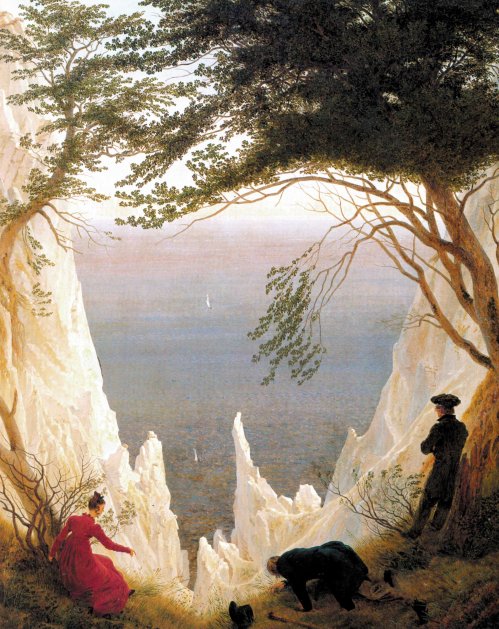
#FineArtFriday: Chalk Cliffs on Rügen, by Caspar David Friedrich, 1818

Chalk Cliffs on Rügen, by Caspar David Friedrich circa 1818

What I love about this image:

Friedrich’s precision is spectacular. He pays as much attention to the leaves on the overhanging trees as he does to the cliffs and red dress his wife wears. His color choices are also wonderful—the vividness of Caroline’s red dress against the white cliffs is stunning.

The movement, the power of the cliffs above the sea, the small boats below–one feels humbled by the sheer power of nature.

I can never pass up an allegory, and this picture is packed with them. For more on that, we will turn to the Fount of All knowledge, Wikipedia:

The painting depicts the view from the chalk cliffs of the Stubbenkammer, at that time one of the most famous lookout points on the island. It is frequently but incorrectly believed that the Wissower Klinken outcrops in particular were a model for the painting; however, these did not exist at the time of the painting’s creation, but appeared later because of erosion. Friedrich often composed his landscapes from carefully chosen elements of different sketches, so that a specific location is not necessarily discernible.

Two trees, whose leaves cover the upper third of the painting, frame the scenery. Two men and a woman in town clothes gaze in wonder at the view. The thin figure in the middle is usually interpreted as Caspar David Friedrich himself.  His hat lies beside him as a sign of humility. He seeks for a foothold in the grass as a symbol of the transience of life and looks into the abyss opening before him—the abyss of death. On the right, the man with crossed arms leans against the trunk of a dying tree and looks far out to the sea. The two tiny sailboats stand as symbols for the soul which opens to eternal life and correspond to the figures of the two men.  On the left, the woman in a red dress (who is usually identified as Friedrich’s wife Caroline) sits beside an almost dried-up shrub: only the twigs around her face are leafing out. With her right hand she points either at the abyss or at the flowers bordering it. In contrast to the men, who gaze either at the abyss or into the distance, she communicates with the other figures—whether she feels threatened by the abyss or compelled by the natural beauty is unclear.

The colors of the figure’s clothes are also symbolic. The middle figure is blue, the color of faith; the left figure is red, that of love; and the right figure is green, that of hope. Thus they can be interpreted as embodiments of the three Christian theological virtues: faith, hope and love. The art historian Helmut Börsch-Supan sees in the picture a representation of Friedrich’s relation to death, and the threat to life by death: “clear […] as almost never before, but at the same time also in an unusually serene mood.”


Credits and Attributions:

Wikimedia Commons contributors, “File:Caspar David Friedrich’s Chalk Cliffs on Rügen.jpg,” Wikimedia Commons, the free media repository, https://commons.wikimedia.org/w/index.php?title=File:Caspar_David_Friedrich%27s_Chalk_Cliffs_on_R%C3%BCgen.jpg&oldid=311800403 (accessed April 12, 2019).

Wikipedia contributors, “Chalk Cliffs on Rügen,” Wikipedia, The Free Encyclopedia, https://en.wikipedia.org/w/index.php?title=Chalk_Cliffs_on_R%C3%BCgen&oldid=878315164 (accessed April 12, 2019).
Comments Off on #FineArtFriday: Chalk Cliffs on Rügen, by Caspar David Friedrich, 1818

Filed under writing

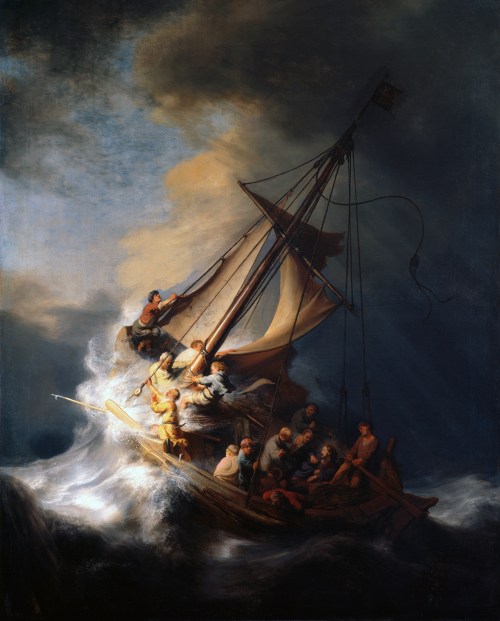
#FineArtFriday: Christ in the Storm on the Sea of Galilee by Rembrandt van Rijn, 1633

Today’s image is of a picture that was stolen in 1990 and has never been recovered.

Christ in the Storm on the Sea of Galilee was painted during one of the happiest years of Rembrandt van Rijn’s turbulent life and depicts the miracle of Jesus calming the storm on the Sea of Galilee. A devout Christian, Rembrandt painted it from the description of the event as reported by the Apostle Mark, in the fourth chapter of his Gospel. As far as is known, it is the only seascape Rembrandt ever painted.

Constantijn Huygens, the father of Dutch mathematician and physicist Christiaan Huygens, had seen Rembrandt’s talent and helped him gain important commissions from the Court of The Hague. Many of his best religious paintings date from the years during which he had the favor of both Huygens and Prince Frederick Hendrick.

At the end of 1631, Rembrandt had moved to Amsterdam. The city was becoming the new business capital of the Netherlands, so there was great opportunity there for artists. In Amsterdam, Rembrandt had begun to paint portraits for the first time, and by 1633, his work was in high demand. His religious paintings and history paintings were also receiving the highest praise.

At first, he lived with an art dealer, Hendrick van Uylenburgh, which was where he met Hendrick’s cousin, Saskia van Uylenburgh. During 1633, the year in which Christ on the Sea of Galilee was painted, he was courting Saskia, hoping to marry her. He was earning a good income as a portraitist, and a bright future loomed. He must have felt in many ways as if he had the world by the tail.

What I love about this painting:

Rembrandt’s colors are vivid, standing out against the darkness of the storm. An entire story is captured in this image. The sea is terrifying, monstrous waves battering the ship, men panicking, trying to gain control. The terror of the event is clearly shown, and you feel fear for the men too. In the midst of chaos, Jesus awakes, calm despite the panic around him. Each face has a different expression, and one, a man holding a rope in one hand and pressing his cap to his head with the other, looks directly at us—Rembrandt himself.

The Gospel of Mark records the incident:

He woke up and rebuked the wind, and said to the sea, “Peace! Be still!” Then the wind ceased, and there was a dead calm. He said to them, “Why are you afraid? Have you still no faith?” And they were filled with great awe and said to one another, “Who then is this, that even the wind and the sea obey him?

Rembrandt, a frail man but a devout believer, lived the story as he painted it, as do all good storytellers.

About the theft, via Wikipedia:

On March 18, 1990, 13 works of art valued at a combined total of $500 million were stolen from the Isabella Stewart Gardner Museum in Boston. In the early hours, guards admitted two men posing as police officers responding to a disturbance call. Once inside, the thieves tied up the guards and over the next hour committed the largest-value recorded theft of private property in history. Despite efforts by the Federal Bureau of Investigation (FBI) and multiple probes around the world, no arrests have been made, and no works have been recovered.

The stolen works had originally been purchased by art collector Isabella Stewart Gardner (1840–1924) and intended to be left on permanent display at the museum with the rest of her collection. Since the collection and its layout are permanent, empty frames remain hanging both in homage to the missing works and as placeholders for their potential return. Experts are puzzled by the choice of paintings that were stolen, especially since more valuable artwork was left untouched. Among the stolen works was The Concert, one of only 34 known works by Vermeer and thought to be the most valuable unrecovered painting, valued at over $200 million.[when?] Also missing is The Storm on the Sea of GalileeRembrandt‘s only known seascape. Other works by Rembrandt, DegasManet, and Flinck were also stolen.

Christ in the Storm on the Sea of Galilee by Rembrandt van Rijn

  • Artist:   Rembrandt  (1606–1669)
  • Genre: religious art
  • Date: 1633
  • Medium: oil on canvas
  • Dimensions: Height: 160 cm (62.9 ″); Width: 128 cm (50.3 ″)
  • Current Location: Unknown

Sources and Attributions:

Wikimedia Commons contributors, “File:Rembrandt Christ in the Storm on the Lake of Galilee.jpg,” Wikimedia Commons, the free media repository, https://commons.wikimedia.org/w/index.php?title=File:Rembrandt_Christ_in_the_Storm_on_the_Lake_of_Galilee.jpg&oldid=341966464 (accessed April 4, 2019).

Wikipedia contributors, “Calming the storm,” Wikipedia, The Free Encyclopedia, https://en.wikipedia.org/w/index.php?title=Calming_the_storm&oldid=882782126 (accessed April 4, 2019).

The Isobel Stewart Gardner Museum, CHRIST IN THE STORM ON THE SEA OF GALILEE, 1633, https://www.gardnermuseum.org/experience/collection/10953 (accessed April 4, 2019).

2 Comments

Filed under #FineArtFriday

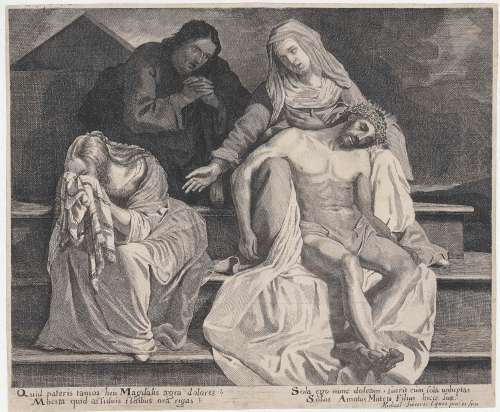
#FineArtFriday: The Lamentation by Michiel Sweerts  

Michiel Sweerts:  The Lamentation

Date:   between 1643 and 1661

Medium:          Etching and engraving on paper

Dimensions:    Height: 28.7 cm (11.2 ″); Width: 34.6 cm (13.6 ″)

About the technique of Etching (From Wikipedia):

Etching is traditionally the process of using strong acid or mordant to cut into the unprotected parts of a metal surface to create a design in intaglio (incised) in the metal. As a method of printmaking, it is, along with engraving, the most important technique for old master prints, and remains in wide use today.

In traditional pure etching, a metal (usually copper, zinc or steel) plate is covered with a waxy ground which is resistant to acid. The artist then scratches off the ground with a pointed etching needle where he or she wants a line to appear in the finished piece, so exposing the bare metal. The échoppe, a tool with a slanted oval section, is also used for “swelling” lines. The plate is then dipped in a bath of acid, technically called the mordant (French for “biting”) or etchant, or has acid washed over it. The acid “bites” into the metal (it dissolves part of the metal) where it is exposed, leaving behind lines sunk into the plate. The remaining ground is then cleaned off the plate. The plate is inked all over, and then the ink wiped off the surface, leaving only the ink in the etched lines.

Etchings were, in the 17th century, the way an artist could ensure his work was seen by the growing middle-class who would otherwise be unable to afford art for their homes. Once an artist mastered the technique, it was the most reliable way to earn money from his work.

About the artist, via Wikipedia:

Michiel Sweerts was born in Brussels where he was baptized on 29 September 1618 in the St. Nicholas Church as the son of David Sweerts, a linen merchant, and Martina Ballu.  Little is known about the artist’s early life and nothing about his training.

The surviving works by Sweerts mostly date to the period of his residence in Rome. Due to the difficulty of attributing works to the artist who rarely signed his works the number of canvases given to the artist vary from 40 to 100. Some of Sweerts’ works were so popular in his time that contemporary copies were made, some by Sweerts himself, others by pupils or followers. It is not always easy to determine the level of Sweerts’ involvement (if any) in the making of these copies. For instance, there exist at least four early copies, of varying quality, of his Artist’s studio with a woman sewing (one copy at the Collection RAU – Fondation Unicef, Cologne). None of his paintings produced after he left Europe is known to survive.

The majority of his output falls into two categories: ‘genre scenes” of low-life subjects of country and street life and portraits or tronies. A third category are allegorical works, which are regarded as enigmatic and are the subject of ongoing interpretation by art historians. Sweerts reportedly painted compositions of Biblical subjects, several of which are mentioned in contemporary inventories. However, none of these are known to have survived. One of his religious paintings, a Lamentation is known from the print, which Sweerts himself made after his own painting. The composition is unusual for the Virgin’s comforting gesture towards the inconsolable Mary Magdalene.

Sweerts is an enigmatic and difficult artist to categorise, since he absorbed a variety of influences to create an eclectic style that adapted Netherlandish genre painting to early tenebrist styles as well as blended Baroque and classicist tendencies.

By December 1661 Sweerts had arrived in Marseilles from where his ship left for Palestine in January 1662.  Sweerts sailed for Alexandretta with bishop François Pallu, 7 priests and another lay brother. In Syria he is said to have produced some paintings. On the overland portion of the trip in Syria he became mentally unstable and was dismissed from the company somewhere between Isfahan and Tabriz in Persia. He then traveled on to the Portuguese Jesuits in Goa where he is reported to have died at the age of 46.


Credits and Attributions:

Wikipedia contributors, “Etching,” Wikipedia, The Free Encyclopedia, https://en.wikipedia.org/w/index.php?title=Etching&oldid=887368691 (accessed March 29, 2019).

Wikipedia contributors, “Michiel Sweerts,” Wikipedia, The Free Encyclopedia, https://en.wikipedia.org/w/index.php?title=Michiel_Sweerts&oldid=850063690  (accessed March 29, 2019).

Wikimedia contributors, “Michiel Sweerts,”  https://en.wikipedia.org/wiki/File:Michiel_Sweerts_-_The_lamentation.jpg (accessed March 29, 2019)


Comments Off on #FineArtFriday: The Lamentation by Michiel Sweerts  

Filed under #FineArtFriday

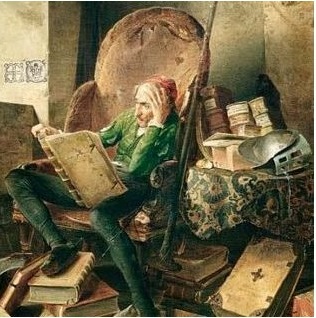
#FineArtFriday: Don Quixote in the Library by Adolf Schrödter, revisited

Today we are revisiting area of art which has often been a primary reason why I buy books, the illustrations. This post was first published here on August 3, 2018. The above image is one I love, a scene from  one of my favorite books. Don Quixote is a character that is near to my heart.

The artwork that went into many books in the 19th and early 20th centuries was sometimes exquisite. Yet, these illustrators remained unknown for the most part and unsung. Today’s image is from Wikimedia Commons and is by a German artist, Adolf Schrödter.

Little is known about Schrödter other than he was born on June 28, 1805, and died Dec. 9, 1875, and was a genre painter of the Düsseldorf school of painting. According to Wikipedia, the Fount of All Knowledge:

The Düsseldorf School had a significant influence on the Hudson River School in the United States, and many prominent Americans trained at the Düsseldorf Academy and show the influence of the Düsseldorf School, including George Caleb BinghamDavid Edward CroninEastman JohnsonWorthington WhittredgeRichard Caton WoodvilleWilliam Stanley HaseltineJames McDougal HartHelen Searle, and William Morris Hunt, as well as German émigré Emanuel LeutzeAlbert Bierstadt applied but was not accepted. His American friend Worthington Whittredge became his teacher while attending Düsseldorf.

However, some of Schrödter’s art survives in the form of illustrations and a few prints have been sold at auctions.

In today’s image what impresses me is the level of detail. Here we see Alonso Quixano reading, lounging in a room that is clearly a book lover’s sanctuary. He is a descendant of the family of “Gutierre Quijada” by direct lineage and is proud to be part of a long and noble tradition of knights. In the first part of the book, Alonso, later Don Quixote de la Mancha, is a dreamer, preferring to imagine himself as a superhero, living out a knightly story.

Books are strewn everywhere, beautiful, heavy leather-bound tomes. Schrödter shows him in a relaxed pose, deep into a book. The light of the room comes from a large window. He is a very human, ordinary middle-aged man, relaxing in the most cherished place in his universe: his library.

Alonso Quixano, the protagonist of the novel (though he is not named until much later in the book), is a retired country gentleman nearing fifty years of age, living in La Mancha with his niece and housekeeper. Although he is mostly a rational man, his excessive reading of books of chivalry has produced a skewed view of reality and what we might consider dementia. In keeping with the theories of the time, not sleeping adequately—because he was reading—has caused his brain to dry.

I love that notion.

As a result, Alonso is easily given to anger and believes every word of these fictional books of chivalry to be true. Don Quixote’s niece commits, what is to me, the most heinous crime–she and the Parrish curate burn his library, and lie to him, telling him it was the work of an evil magician.

He descends completely into his fantasy world and decides to become a knight-errant in search of adventure. Schrödter has captured the essence of the making of Don Quixote in this painting—the man who loves books is in his element, the one place where he fits. When that is taken from him, the story begins.


Credits and Attributions:

Don Quixote in the Library, by Adolf Schrödter, 1834 PD|100, via Wikimedia Commons.

Wikipedia contributors, “Düsseldorf school of painting,” Wikipedia, The Free Encyclopedia, https://en.wikipedia.org/w/index.php?title=D%C3%BCsseldorf_school_of_painting&oldid=822264175 (accessed August 3, 2018).

Comments Off on #FineArtFriday: Don Quixote in the Library by Adolf Schrödter, revisited

Filed under writing

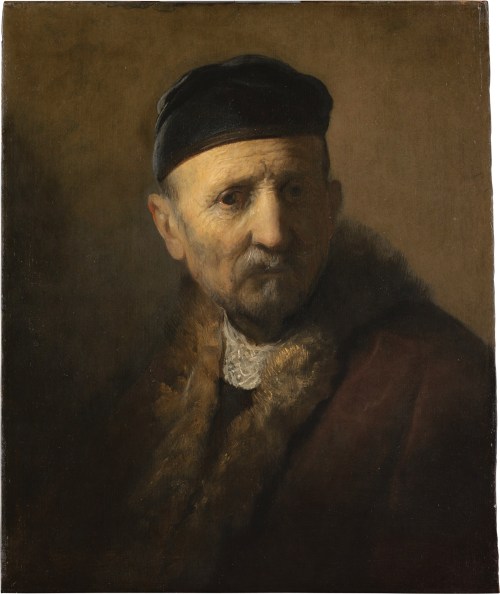
#FineArtFriday: Tronie of an Old Man by Rembrandt van Rijn

Tronie of an Old Man by Rembrandt van Rijn is a portrait of Rembrandt’s father, Harmen Gerritszoon van Rijn.  Harmen was a miller in Leiden.

About the word “tronie” from Wikipedia: A tronie (16/17th-century Dutch for “face”) is a common type, or group of types, of works common in Dutch Golden Age painting and Flemish Baroque painting that shows an exaggerated facial expression or a stock character in costume. It is related to the French word “tronche” which is slang for “mug” or head.

Rembrandt’s family was quite well-to-do and as such, young Rembrandt was educated in the best schools, which his father paid for.  Rembrandt’s father encouraged his son’s talent.

To my opinionated eyes, this painting shows Rembrandt’s affection for his father.

Rembrandt resembled  his father, if this portrait was accurate, and I think we can assume it was. As an artist, Rembrandt was unflinchingly honest in the portrayal of his subjects, while always managing to show their humanity.


Credits and Attributions

Tronie of and Old Man by Rembrandt van Rijn

Wikipedia contributors, “Tronie,” Wikipedia, The Free Encyclopedia,https://en.wikipedia.org/w/index.php?title=Tronie&oldid=872242306 (accessed March 15, 2019).

Rembrandt and workshop [Public domain]

Comments Off on #FineArtFriday: Tronie of an Old Man by Rembrandt van Rijn

Filed under #FineArtFriday, writing

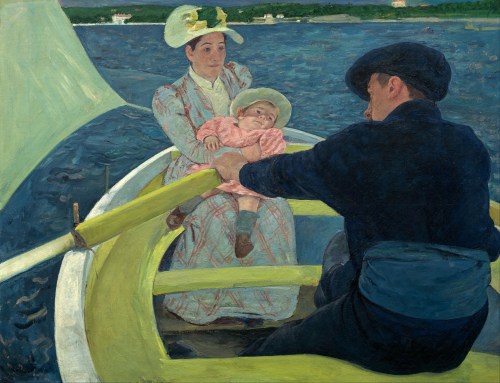
#FineArtFriday: The Boating Party, by Mary Cassatt

What I love about The Boating Party by American artist, Mary Cassatt, is impression of movement, of the life of the water. It has a feeling of contentment, of peace. There is a serenity about this painting that evokes wonderful memories of boating and water sports, of the time when my family still lived on a lake. It reminds me of the sheer joy and freedom of being on the water with no purpose other than to enjoy one’s self.

About this painting, from Wikipedia:

Art historian and museum administrator Frederick A. Sweet calls it “One of the most ambitious paintings she (Cassatt) ever attempted.” His 1966 analysis focuses on the balance of the “powerful dark silhouette of the boatman”, the angle between the oar and the arm that “thrusts powerfully into the center of the composition towards the mother and child” and “delicate, feminine ones.”

Cassatt placed the horizon at the top of the frame in Japanese fashion.

  • In 1890 Cassatt visited the great Japanese Print exhibition at the ecole de Beaux-arts in Paris.
  • Mary Cassatt owned Japanese prints by Kitagawa Utamaro (1753–1806).
  • The exhibition at Durand-Ruel of Japanese art proved the most important influence on Cassatt.

(Influence of) Manet

Frederick A. Sweet suggests that Cassatt may have been inspired by Édouard Manet‘s Boating from 1874.

I hadn’t considered that position of the horizon as being a traditional Japanese style until I read that paragraph. Then I realized that most Western artists place it lower on the canvas. In Western art, the sky (an allegory for God) traditionally dominates the work.

This painting has made me aware of  how greatly the ability to travel the world via ocean liners and contact with other cultures changed the way we produce art. Impressionism was new and daring in its time. The eye of the artist was freed from traditional confines of the various schools (Hudson Valley, etc.) by exposure to the simplicity and elegance of the previously unknown tradition of Japanese art.

Every new painting I come across leads me to another, which often leads me to another country and another tradition of style and form.

My life as an admirer of art is one of constantly finding something new about history and the world around me.

About the artist, Via Wikipedia:

Mary Stevenson Cassatt (May 22, 1844 – June 14, 1926) was an American painter and print-maker. She was born in Allegheny City, Pennsylvania (now part of Pittsburgh’s North Side), but lived much of her adult life in France, where she first befriended Edgar Degas and later exhibited among the Impressionists. Cassatt often created images of the social and private lives of women, with particular emphasis on the intimate bonds between mothers and children.

She was described by Gustave Geffroy in 1894 as one of “les trois grandes dames” (the three great ladies) of Impressionism alongside Marie Bracquemond and Berthe Morisot.


Credits and Attributions:

The Boating Party by Mary Cassatt, 1893–94

Wikipedia contributors. “The Boating Party.” Wikipedia, The Free Encyclopedia. Wikipedia, The Free Encyclopedia, 9 Dec. 2018. Web. 8 Mar. 2019.

Comments Off on #FineArtFriday: The Boating Party, by Mary Cassatt

Filed under writing

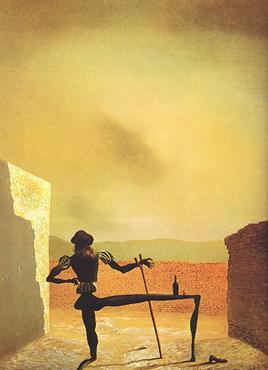
#FineArtFriday: The Ghost of Vermeer of Delft Which Can Be Used As a Table by Salvador Dalí, 1934

About the painting, from Wikipedia:

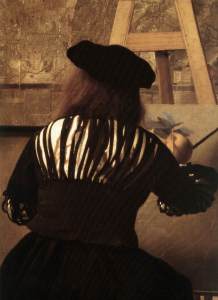
The Ghost of Vermeer of Delft Which Can Be Used As a Table is a small Surrealist oil painting by Salvador Dalí. Its full title is The Ghost of Vermeer of Delft Which Can Be Used as a Table (Phenomenologic Theory of Furniture-Nutrition). It makes reference to The Art of Painting by Johannes Vermeer, a famous seventeenth-century work in which a painter, thought to be a self-portrait of Vermeer, is depicted with his back to us, in distinctive costume. It is one of a number of paintings expressive of Dalí’s enormous admiration for Vermeer.

Vermeer is represented as a dark spindly figure in a kneeling position. The figure’s outstretched leg serves as a table top surface, on which sits a bottle and a small glass. This leg tapers to a baluster-like stub; there is a shoe nearby. The walls and the distant views of the mountains are based on real views near Dalí’s home in Port Lligat. In Vermeer’s painting the artist leans on a maulstick, and his hand is painted with an unusual blurriness, perhaps to indicate movement. In Dalí’s painting Vermeer rests the same arm on a crutch.

What I love about this painting:

I love the composition, the detail Dali puts into Vermeer’s hair and doublet–the attention Vermeer applied to his own work. This speaks to me of the desert, the way the sky looks in the afternoon just as the hottest part of the day slides into a cooler evening. Vermeer, the Master of Light, is enjoying the view. He is shown in a small courtyard, enclosed. Vermeer rarely left his rooms in Delft.


It is unsigned and undated but known to have been completed c.1934. It is currently on display at the Salvador Dalí Museum in St. Petersburg, Florida, on loan from the E. and A. Reynolds Morse collection.


Credits and Attributions:

Wikipedia contributors, “The Ghost of Vermeer of Delft Which Can Be Used As a Table,” Wikipedia, The Free Encyclopedia,https://en.wikipedia.org/w/index.php?title=The_Ghost_of_Vermeer_of_Delft_Which_Can_Be_Used_As_a_Table&oldid=861917029 (accessed March 1, 2019).

Wikimedia Commons contributors, “File:Johannes Vermeer – The Art of Painting (detail) – WGA24677.jpg,” Wikimedia Commons, the free media repository, https://commons.wikimedia.org/w/index.php?title=File:Johannes_Vermeer_-_The_Art_of_Painting_(detail)_-_WGA24677.jpg&oldid=268076769 (accessed March 1, 2019).

5 Comments

Filed under writing

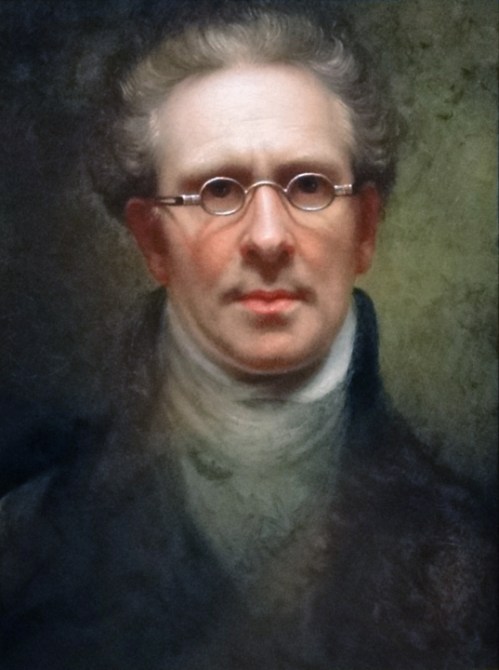
#FineArtFriday: Rembrandt Peale, self-portrait

About the artist via Wikipedia:

Rembrandt Peale (February 22, 1778 – October 3, 1860) was an American artist and museum keeper. A prolific portrait painter, he was especially acclaimed for his likenesses of presidents George Washington and Thomas Jefferson. Peale’s style was influenced by French Neoclassicism after a stay in Paris in his early thirties.

Rembrandt Peale was born the third of six surviving children (11 had died) to his mother, Rachel Brewer, and father, Charles Willson Peale in Bucks County, Pennsylvania, on February 22, 1778. The father, Charles, also a notable artist, named him after the noted 17th-century Dutch painter and engraver Rembrandt Harmenszoon van Rijn. His father also taught all of his children, including Raphaelle PealeRubens Peale and Titian Peale, to paint scenery and portraiture, and tutored Rembrandt in the arts and sciences. Rembrandt began drawing at the age of 8. A year after his mother’s death and the remarriage of his father, Peale left the school of the arts, and completed his first self-portrait at the age of 13. The canvas displays the young artist’s early mastery. The clothes, however, give the notion that Peale exaggerated what a 13-year-old would look like, and Peale’s hair curls like the hair of a Renaissance angel. Later in his life, Peale “often showed this painting to young beginners, to encourage them to go from ‘bad’ to better…”[1]

In July 1787, Charles Willson Peale introduced his son Rembrandt to George Washington, and the young aspirant artist watched his father paint the future president. In 1795, at the age of 17, Rembrandt painted an aging Washington (with whom he shared a birthday), making him appear far more aged than in reality. The portrait was well received, and Rembrandt had made his debut.


Credits and Attributions

Wikimedia Commons contributors, “File:Rembrandt Peale self-portrait.jpg,” Wikimedia Commons, the free media repository, https://commons.wikimedia.org/w/index.php?title=File:Rembrandt_Peale_self-portrait.jpg&oldid=336752881 (accessed February 22, 2019).

Wikipedia contributors, “Rembrandt Peale,” Wikipedia, The Free Encyclopedia, https://en.wikipedia.org/w/index.php?title=Rembrandt_Peale&oldid=879098650 (accessed February 22, 2019).

Comments Off on #FineArtFriday: Rembrandt Peale, self-portrait

Filed under writing

#FineArtFriday: Portrait of Christian Krohg by Oda Krohg

Today’s image is a portrait of Norwegian artist, Christian Krohg as painted by his wife, Oda Krohg.

What I love about this painting:

We see Christian in his bohemian glory. His lush beard is combed just so; his shoes are shined, and he looks every inch a gentleman of the town, yet he doesn’t look like a dandy. A parade with a brass band is happening in the background, a fanfare for the man himself.

The background details are there in impressionistic strokes, but Christian himself stands out sharply, a man who could never fade into the background. He is good-humored, passionate, a warrior for the underclass–Christian Krohg commands attention.

About the artist, via Wikipedia:

Oda Krohgnée Othilia Pauline Christine Lasson (11 June 1860 – 19 October 1935) was a Norwegian painter, and the wife of her teacher and colleague Christian Krohg. She was the second daughter of public attorney Christian Lasson and Alexandra von Munthe af Morgenstierne. Her maternal grandmother was a Russian princess. She grew up in a liberal-conservative household, along with eight sisters and two brothers. Her brother Per Lasson became a noted composer and her sister Caroline Bokken Lasson a singer and writer.

In 1881 she married the businessman Jørgen Engelhardt (1852–1921), with whom she had two children. She split from Engelhardt in 1883, and divorced him in 1888. In 1885 she became a student of Erik Werenskiold and Christian Krohg, the latter she would marry in October 1888. In 1885, their daughter Nana was born, and in 1889, their son Per, who also would be a notable painter.

Oda was noted for both her talent and her passion for life. She was a champion of social justice and devout bohemian. Her life with Christian was filled with drama, with both having many affairs, but they always returned to each other. The two were reunited in 1909 and remained together until his death in 1925.


Credits and Attributions:

Wikimedia Commons contributors, “File:Christian Krohg av Oda Lasson Krohg OB.01508.jpg,” Wikimedia Commons, the free media repository, https://commons.wikimedia.org/w/index.php?title=File:Christian_Krohg_av_Oda_Lasson_Krohg_OB.01508.jpg&oldid=336341196 (accessed February 15, 2019).

Wikipedia contributors, “Oda Krohg,” Wikipedia, The Free Encyclopedia, https://en.wikipedia.org/w/index.php?title=Oda_Krohg&oldid=871328815(accessed February 15, 2019).

2 Comments

Filed under #FineArtFriday, writing

#FineArtFriday: Rallé: Madonna Without a Child (revisited)

Madonna Without a Child; oil on board by Ralle CC-3.0-SSA

Madonna Without a Child; oil on board by Ralle CC-3.0-SSA

Today I am going back to my first #FineArtFriday post, Madonna Without a Child by Rallé. It was with this original post that I first realized that I could study art and art history, even though I am a middle-aged housewife living in a small town two hours away from the nearest art museum. I can go to the internet and through the wonders of Wikimedia Commons, I have thousands of images of the greatest masterpieces at my viewing pleasure.

I can zoom in to examine the smallest details. I can look up information about the picture itself from both Wikipedia and the worlds finest art museums. If anything is known about the artist I can find that information too.

How fortunate I am to live in a time when a thirst for knowledge can be satisfied so easily.

To all the art historians of the world whose research is out there on the internet, I say thank you. I was unable to study this subject in college, but I am neck deep in it now because of your efforts.

And now, my original post.


(Via Wikipedia) Rallé, also known as Master of the Town of Consuls (MTC), is an American artist whose work has most recently been shown in the Meisel Gallery[1][2] and the Bruce R. Lewin Fine Art[3] in New York City. His paintings have accompanied several articles in the magazine Omni, and appeared as covers of several books. Rallé’s work has also been featured in Time Life Books,[4]Esquire, Penthouse, Gulf-Commentator, Toronto Life, Graphics Annual and American Illustration 3.[5]He published an autobiography in 2003, which won the 2004 Sappi European Printer of the Year gold award.

Viewing art inspires my personal creativity as much as listening to music or reading does. The eye of the artist sees things from a different angle, is inspired by things we might at first see as mundane or inconsequential. This is also true about literature, and music.

For me as an author and would-be poet, the world is comprised of myriad different genres, styles, and interpretations of the diverse forms of art. I think this is because all art, whether created of words, paint, images, or sound is filtered through the mind of the artist, photographer, composer, or author and is interpreted by the mind of the beholder.

Inspired by what I behold, I become a creator.

The late Surrealist Artist, René Magritte, said, “The searching intelligence sharpens when it Sees the meaning in poetic images. This meaning goes with the moral certainty that we  belong to the World. And so, this actual belonging becomes a right to belong. The changing content of these poetic images tallies with the richness of our moral certainty. It does not happen at will, it does not obey any system, whether logical or illogical, rigid or fanciful.”


Quote from Literary Hub:  Poetry is a Pipe: Selected Writings of René Magritte ©  René Magritte September 29, 2016

Selected Writings of René Magritte,  Copyright © 2016 by Kathleen Rooney and Eric Plattner, University of Minnesota Press

Quote from Rallé (Artist) Author: Wikipedia contributors / Publisher: Wikipedia, The Free Encyclopedia.

3 Comments

Filed under #FineArtFriday