Tag Archives: Fine Art Friday

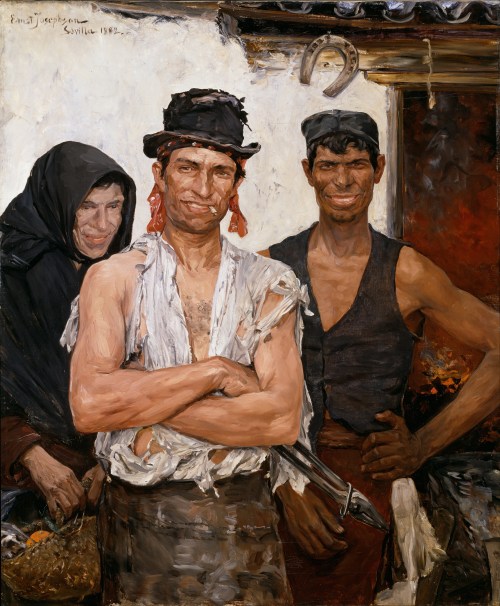
#FineArtFriday: a closer look at ‘Spanish Blacksmiths’ by Ernst Josephson 1882

Spanish Blacksmiths, by Ernst Josephson

  • Date: 1882
  • Medium: oil on canvas
  • Dimensions: width: 107 x height: 128.5 cm

What I love about this image:

This powerful painting is one of my all-time favorites–I have featured it here before. Josephson captures the boundless self-confidence and personalities of these young men. He has managed to portray their cock-of-the-walk swagger, and he has shown us the truth of their craft: that sparks fly and ruin their clothes; that the work is hard and their muscles strong. These men are full of life.

I can imagine them arriving at the tavern for supper, cleaned up and wearing their best shirts, eyeing the ladies and flirting with the serving girls.

The influence of Josephson’s having studied Rembrandt’s works closely can be seen here in the style with which he has painted their features. He has painted the men with truth—they are not classically handsome, but they are in the prime of life and have immense charisma. They wear their burned and ragged hats with pride. These men are good at what they do, and they know it. Their eyes dance and flirt outrageously with you across the years—they are full to bursting with machismo, daring you to just try to walk past and not notice them.

About the Artist, Via Wikipedia

(Ernst Josephson) was born to a middle-class family of merchants of Jewish ancestry. His uncle, Ludvig O. Josephson (1832-1899) was a dramatist and his uncle Jacob Axel Josephson (1818-1880) was a composer. When he was ten, his father Ferdinand Semy Ferdinand Josephson (1814-1861) left home and he was raised by his mother, Gustafva Jacobsson (1819-1881) and three older sisters.

At the age of sixteen, he decided to became an artist and, with his family’s support, enrolled at the Royal Swedish Academy of Fine Arts. His primary instructors there were Johan Christoffer Boklund and August Malmström. He was there until 1876, when he received a Royal Medal for painting.

After leaving the Academy, he and his friend and fellow artist Severin Nilsson (1846-1918) visited Italy, Germany and the Netherlands, where they copied the Old Masters. His breakthrough came in Paris, where he was able to study with Jean-Léon Gérôme at the École des Beaux-Arts. He soon began concentrating on portraits, including many of his friends and fellow Swedes in France. For a time, he shared a studio with Hugo Birger (1854–1887). His personal style developed further during a trip to Seville with his friend, Anders Zorn, from 1881 to 1882.

His private life did not go well, however. By his late twenties, he was afflicted with syphilis. His romantic life suffered as a consequence, as he was forced to break off a promising relationship with a young model named Ketty Rindskopf.

Josephson was deeply affected by his mother’s death in 1881, though had found respite when, in 1883, he had obtained the patronage of Pontus Furstenberg (1827–1902), a wealthy merchant and art collector. In 1885, he became a supporter of the “Opponenterna“, a group that was protesting the outmoded teaching methods at the Swedish Academy, but his interest in the group diminished when he failed to win election to their governing board.

By the summer of 1888, he was beginning to suffer delusions and hallucinations, brought on by the progression of his illness. Residing on the Île-de-Bréhat in Brittany, where he had spent the previous summer with painter and engraver Allan Österlind (1855–1938) and his family, he became involved in spiritism, possibly inspired by Österlind’s interest in occult phenomena. While in his visionary states, he wrote poems and created paintings that he signed with the names of dead artists. Some of his best known and most influential works were created during this period. [1]


Credits and Attributions:

Spanish Blacksmiths by Ernst Josephson 1882 PD|100, First published on Life in the Realm of Fantasy on August 16, 2019.

Wikimedia Commons contributors, “File:Ernst Josephson – Spanish Blacksmiths – Google Art Project.jpg,” Wikimedia Commons, the free media repository, https://commons.wikimedia.org/w/index.php?title=File:Ernst_Josephson_-_Spanish_Blacksmiths_-_Google_Art_Project.jpg&oldid=354761584 (accessed August 16, 2019).

[1] Wikipedia contributors, “Ernst Josephson,” Wikipedia, The Free Encyclopedia, https://en.wikipedia.org/w/index.php?title=Ernst_Josephson&oldid=1256604655 (accessed January 30, 2025).

2 Comments

Filed under #FineArtFriday

#FineArtFriday: Three Fisher Girls, Tynemouth by Winslow Homer

Artist: Winslow Homer  (1836–1910)

Title: Three Fisher Girls, Tynemouth

Date: 1881

Medium: watercolor over graphite pencil on wove paper

Dimensions: height: 19.8 cm (7.8 in); width: 48.9 cm (19.2 in)

Collection: National Gallery of Art

The above image is one of my favorite watercolors by Winslow Homer. In Three Fisher Girls, Tynemouth,  Winslow Homer captures the personalities and the youth of the girls who comb the cold beach for shellfish. The viewer wonders, are they good friends, or perhaps sisters? Rain has darkened the day and scarves protect their ears from the wind, yet they’ve rolled their sleeves up and fish in their ordinary work dresses. These hardy young women feed their family, and perhaps they gather enough extra to sell.

About this Image, Via Wikipedia:

Homer spent two years (1881–1882) in the English coastal village of Cullercoats, Tyne and Wear. Many of the paintings at Cullercoats took as their subjects working men and women and their daily heroism, imbued with a solidity and sobriety which was new to Homer’s art, presaging the direction of his future work. He wrote, “The women are the working bees. Stout hardy creatures.” His works from this period are almost exclusively watercolors. His palette became constrained and sober; his paintings larger, more ambitious, and more deliberately conceived and executed. His subjects more universal and less nationalistic, more heroic by virtue of his unsentimental rendering. Although he moved away from the spontaneity and bright innocence of the American paintings of the 1860s and 1870s, Homer found a new style and vision which carried his talent into new realms.

About the Artist, via Wikipedia

Winslow Homer never taught in a school or privately, as did Thomas Eakins, but his works strongly influenced succeeding generations of American painters for their direct and energetic interpretation of man’s stoic relationship to an often neutral and sometimes harsh wilderness. Robert Henri called Homer’s work an “integrity of nature”.American illustrator and teacher Howard Pyle revered Homer and encouraged his students to study him. His student and fellow illustrator, N. C. Wyeth (and through him Andrew Wyeth and Jamie Wyeth), shared the influence and appreciation, even following Homer to Maine for inspiration.  The elder Wyeth’s respect for his antecedent was “intense and absolute” and can be observed in his early work Mowing (1907). Perhaps Homer’s austere individualism is best captured in his admonition to artists: “Look at nature, work independently, and solve your own problems.” [1]


Credits and Attributions:

Image: Three Fisher Girls, Tynemouth, by Winslow Homer 1881 [Public domain] watercolor over graphite on wove paper, via Wikimedia Commons (accessed January 16, 2025).

[1] Wikipedia contributors, “Winslow Homer,” Wikipedia, The Free Encyclopedia, https://en.wikipedia.org/w/index.php?title=Winslow_Homer&oldid=1253319847 (accessed January 17, 2025).

9 Comments

Filed under #FineArtFriday

#FineArtFriday: Revisiting “The Way you Hear it is the Way you Sing It” by Jan Steen ca. 1665

Artist: Jan Steen  (1625/1626–1679)

Jan Steen: ‘As the Old Sing, So Pipe the Young’

Title: ‘The way you hear it, is the way you sing it’

Genre: genre art

Date: circa 1665

Medium: oil on canvas

Dimensions: Height: 134 cm (52.7 in); Width: 163 cm (64.1 in)

I always post a Jan Steen painting at New Years, because I love how raucous and down to earth his characters are. It’s a New Year and we’re having a party. No Puritans allowed, as we’ll have no feigning a dignified demeanor here–we’re drunk, and we don’t care. The people who posed for this painting are featured in many of Steen’s genre works, sometimes wearing the same costumes as we see here. I suspect we are seeing Steen’s family members or close friends acting out the story Jan wishes to show us.

About this painting:

Jan Steen’s work The Way you Hear it is the Way you Sing It depicts a Dutch Proverb, As the Old Sing, So Twitter the Young. It shows us a family carousing and overindulging in rich foods. Luxurious fabrics, a foot warmer, and rare birds show off this family’s wealth, which they are spending lavishly as fast as they can.

A young piper, who closely resembles a young Jan Steen (possibly one of his sons?), entertains them. He looks directly at us as if to ask what he’s gotten himself into.

Mother and Father, dressed as the King and Queen, are sumptuously attired, being served wine in an overlarge crystal goblet by the family’s servant. Both are indifferent to the chaos, too sated and drunk to care.

To the right of Father (his left, our right), a younger woman, perhaps an unmarried sister or eldest daughter, is holding the baby but has nodded off, having indulged too freely.

The wasting of money on so much luxury that one can’t consume it all is clearly represented here. Mother raises her glass high to have it refilled, as if it is the most important thing–indeed, the wine cascading down into the crystal goblet is the focal point of the picture.

A bottle of clear liquor (distilled?) and a beaker of ale are set on the windowsill behind Father, and a covered pitcher stands on the floor beside Mother. The table is laden with grapes and oysters, expensive luxuries.

Grandmother is singing from sheet music, leading the song that the family sings. This is the direct allegory for the proverb, as the old sing, so twitter the young.

A youngish man, either the eldest son or the Drunk Uncle (every family has one), finds it hilarious to teach the children to smoke.

Neither the dog nor the piper is impressed with the carrying on, and the servant has no comment, merely serving the wine as required.

In essence, Steen tells us that children learn what they live, so if you want sober, morally upstanding children, you must be a sober, morally upright parent.

About the Artist, via Wikipedia:

Jan Havickszoon Steen (c. 1626 – buried 3 February 1679) was a Dutch Golden Age painter, one of the leading genre painters of the 17th century. His works are known for their psychological insight, sense of humour and abundance of colour.

In 1648 Jan Steen and Gabriël Metsu founded the painters’ Guild of Saint Luke at Leiden. Soon after he became an assistant to the renowned landscape painter Jan van Goyen (1596–1656), and moved into his house on the Bierkade in The Hague. On Oct 3, 1649 he married van Goyen’s daughter Margriet, with whom he would have eight children. Steen worked with his father-in-law until 1654, when he moved to Delft, where he ran the brewery De Slang (“The Snake”) for three years without much success. After the explosion in Delft in 1654 the art market was depressed, but Steen painted A Burgomaster of Delft and his daughter. It does not seem to be clear if this painting should be called a portrait or a genre work.

Steen lived in Warmond, just north of Leiden, from 1656 till 1660 and in Haarlem from 1660 till 1670 and in both periods he was especially productive. In 1670, after the death of his wife in 1669 and his father in 1670, Steen moved back to Leiden, where he stayed the rest of his life. When the art market collapsed in 1672, called the Year of Disaster, Steen opened a tavern. In April 1673 he married Maria van Egmont, who gave him another child. In 1674 he became president of the Saint Lucas Guild. Frans van Mieris (1635- 1681) became one of his drinking companions. He died in Leiden in 1679 and was interred in a family grave in the Pieterskerk.

Daily life was Jan Steen’s main pictorial theme. Many of the genre scenes he portrayed, as in The Feast of Saint Nicholas, are lively to the point of chaos and lustfulness, even so much that “a Jan Steen household”, meaning a messy scene, became a Dutch proverb (een huishouden van Jan Steen). Subtle hints in his paintings seem to suggest that Steen meant to warn the viewer rather than invite him to copy this behaviour. Many of Steen’s paintings bear references to old Dutch proverbs or literature. He often used members of his family as models, and painted quite a few self-portraits in which he showed no tendency of vanity.

Steen did not shy from other themes: he painted historical, mythological and religious scenes, portraits, still lifes and natural scenes. His portraits of children are famous. He is also well known for his mastery of light and attention to detail, most notably in Persian rugs and other textiles.

Steen was prolific, producing about 800 paintings, of which roughly 350 survive. His work was valued much by contemporaries and as a result he was reasonably well paid for his work. He did not have many students—only Richard Brakenburgh is recorded—but his work proved a source of inspiration for many painters. [1]


Credits and Attributions:

IMAGE: The Way you Hear it is the Way you Sing It, Jan Steen, Public domain, via Wikimedia Commons

Wikimedia Commons contributors, “File:The way you hear it.jpg,” Wikimedia Commons, https://commons.wikimedia.org/w/index.php?title=File:The_way_you_hear_it.jpg&oldid=428340634 (accessed January 2, 2025).

[1] Wikipedia contributors, “Jan Steen,” Wikipedia, The Free Encyclopedia, https://en.wikipedia.org/w/index.php?title=Jan_Steen&oldid=1249713624 (accessed January 2, 2025).

4 Comments

Filed under #FineArtFriday

#FineArtFriday: revisiting ‘The Wonderful Tree – Children’s costumes for Christmas’ by Charles Martin ca. 1913

About the Artist, via Wikipedia

Charles Martin (1884–1934) was a French artist and illustrator.

His illustrated books include Les Modes en 1912, a hat collection; the erotic Mascarades et Amusettes and Sports et divertissements (published 1923), a collaboration with composer Erik Satie. [1]

(That is ALL I was able to find about this wonderful artist.)

What I love about this image:

I love the  sense of the grotesque embodied in this image. This cartoon was published at the time Europe was poised on the edge of World War I. In this image, I can see the beginnings of an evolution in art style, one that illustrated the passion for modernity in the first four decades of the 20th century.

The slightly macabre style of Charles Martin’s illustrations may have influenced the work of American cartoonist, Charles Addams. At least, in my untutored opinion, his iconic Addams Family, first published in The New Yorker in 1938, seems reminiscent in style and theme to that of this illustration.

This image was published in the French magazine, La Gazette du Bon Ton, issue no. 1, Christmas 1913—January 1914.


Credits and Attributions:

[1] Wikipedia contributors, “Charles Martin (artist),” Wikipedia, The Free Encyclopedia, https://en.wikipedia.org/w/index.php?title=Charles_Martin_(artist)&oldid=1082966917 (accessed December 26, 2024).

IMAGE: Wikimedia Commons contributors, “File:Vintage Christmas illustration digitally enhanced by rawpixel-com-25.jpg,” Wikimedia Commons, https://commons.wikimedia.org/w/index.php?title=File:Vintage_Christmas_illustration_digitally_enhanced_by_rawpixel-com-25.jpg&oldid=350923612 (accessed December 26, 2024).

3 Comments

Filed under writing

#FineArtFriday: Selling Christmas Trees by David Jacobsen 1853

Selling Christmas Trees by David Jacobsen 1853Title: Selling Christmas Trees

Artist: David Jacobsen

Date: 2 January 1853

Medium: oils on canvas

What I love about this painting:

This painting was done early in Jacobsen’s career when he was still painting in the traditional style that he was taught at the Royal Danish Academy of Fine Arts. This scene shows us a time of year when woodcutters can count on a few extra coins to carry them through the winter. In addition to their regular work of cutting firewood, their families are bringing fresh-cut evergreens to the market, and they are quickly selling out.

There are many stories in this painting. The town square is decorated for the season with wreaths and a prominently displayed Nativity Scene. The market is busy, noisy, and filled with traders and shoppers. Some shoppers rest beside the frozen fountain, while others bargain for the best deals.

Who has the coins for a fine Christmas dinner, and who will go home empty-handed, unable to afford a family feast?

A pair of children, brother and sister, haul a small tree home, accompanied by the family dog. They will decorate it, and if they are fortunate, the dog will respect the tree and go out of its way to avoid knocking it over.

About the Artist:

David Jacob Jacobsen was a Danish 19th-century painter who was born in 1821 and died in 1871.[1] Jacobsen was the son of Jewish parents, Juda Jacobsen and Frederikke Jacobson. [2]

He was accepted into the Royal Danish Academy of Fine Arts in 1834 and began his education as a sculptor, studying under Herman Wilhelm Bissen. He switched to painting, preferring outdoor scenes.

His friendship with French artists like Camille Pissarro, with whom he shared a studio for a while, influenced Jacobsen’s art. Jacobsen was like many other Danish artists who traveled abroad. His choice of subject was not confined solely to the scenes of Danish life and landscape promoted by Danish critics such as NL Høyen. Despite Jacobsen’s efforts and his close friendships with the impressionists, he was unable to make a name for himself abroad.

Jacobsen’s work was exhibited at the Charlottenborg Spring Exhibition from 1849 until his death. He suffered from deep depression, exacerbated by the fact his work didn’t sell as well as he hoped.  He died by suicide in 1871 during a stay in Florence and was buried there. [1]


Credits and Attributions:

IMAGE: Wikimedia Commons contributors, “File:David Jacobsen – Selling Christmas Trees (1853).jpg,” Wikimedia Commons, https://commons.wikimedia.org/w/index.php?title=File:David_Jacobsen_-_Selling_Christmas_Trees_(1853).jpg&oldid=886774504 (accessed December 12, 2024).

[1] David Jacobsen – Artvee Artvee.com  © Artvee 2024 All Rights Reserved
[2] David Jacob Jacobsen | Biography © 2024 MutualArt Services, Inc.

3 Comments

Filed under #FineArtFriday

#FineArtFriday: Glade Jul (Joyful Christmas) Viggo Johansen 1891 #christmas

Artist: Viggo Johansen  (1851–1935)

Title : Joyful Christmas (Danish: Glade jul)

Date: 1891

Medium: canvas and oil

Dimensions Height: 127.2 cm (50 in); Width: 158.5 cm (62.4 in)

December is here and the season of Christmas decorating has begun. I’ve made a trip to the storage unit for a few decorations but will have to go again. Our apartment is small, but the tiny tree and lights make the whole place feel festive during the darkest month of winter.

There is so much wonderful Christmas art out there. I wanted to take a second look at a painting that reflects a historical view of how the holiday was celebrated before it became a commercial windfall for the large department stores and big-box warehouse stores.

This painting first appeared here in December of 2020.

What I love about this painting:

This is an atmospheric depiction of the artist’s family, singing carols on Christmas Eve, 1891. The only light in the room is provided by the many candles on the tree. This is a homey, nostalgic piece showing not just a moment in time, but the warm feeling of tradition in an era when the giving and receiving of lavish presents was not the primary focus of the holiday. Instead, families celebrated with a small feast, and songs and games.  Some families would have a tree such as the one in this painting, and many people would decorate doors and windows with holly and other evergreens.

Whether a family was deeply religious or not, the day was time to give thanks for their blessings and pray for a bountiful new year ahead.

Both of my grandmothers were born during the time this painting was made. Fire was a real hazard in those days, and neither of my grandparents’ families had candles on their trees. Instead, foil decorations, cut-paper snowflakes, and chains of popcorn and cranberries made their trees bright.

My maternal grandmother was one of fifteen children. They were a close-knit family, and not rich in any sense of the word. Christmas was always her favorite holiday, and she always went out of her way to make special treats for the big day. Grandma Ethel shaped my view of the world in many ways. I always make her special date nut bread and jam tarts, a Christmas tradition that connects our family through the generations and across time.

About this painting. Via Wikipedia:

From 1885, he (Viggo Johansen) exhibited in Paris; there he was inspired by Claude Monet, particularly in his use of colour as can be seen in his painting Christian Bindslev er syg (Christian Bindslev is ill, 1890), which also shows the influence of Christian Krohg, one of the other Skagen painters. After his return from Paris, his paintings took on lighter tones; he had noted the absence of black in the works of the French artists and considered his own earlier works too dark by comparison. Nevertheless, Johansen is remembered particularly for the subdued lighting effects of his interiors — many of which were painted after his visit to Paris — as in his Glade jul (Merry Christmas, 1891) According to Gauguin visited Skagen while Johansen was painting Merry Christmas and tried to encourage him to make the tree brighter, even going as far as to produce a pastel drawing to convey the idea, but Johansen “did not think there was much sense in what he sketched.”

About the Artist, via Wikipedia

Viggo Johansen (3 January 1851 – 18 December 1935) was a Danish painter and active member of the group of Skagen Painters who met every summer in the north of Jutland. He was one of Denmark’s most prominent painters in the 1890s. He also painted landscapes (at Skagen, at Tisvilde, and at his childhood home, the fishing port of Dragør outside Copenhagen), still lifes and portraits.


Credits and Attributions:

Wikipedia contributors, “Viggo Johansen,” Wikipedia, The Free Encyclopedia, https://en.wikipedia.org/w/index.php?title=Viggo_Johansen&oldid=938475993 (accessed December 20, 2020).

6 Comments

Filed under writing

#FineArtFriday: Fruit Piece by Jan van Huysum 1722 #Thanksgiving

Fruit Piece by Jan van Huysum (Dutch, 1682 – 1749)– artist (Dutch)

Genre: still-life

Date: 1722

Medium: oil on panel

Dimensions: Height: 800 mm (31.49 in); Width: 610 mm (24.01 in)

What I love about this painting:

This painting first appeared here the day after Thanksgiving in 2020, the year of lockdown and virtual family gatherings via Zoom and Discord. Despite quarantine and lockdown, we gave thanks that year for the good things and for each other.

And this year, we did the same, with turkey, and all the family’s favorite side dishes. I made everything except the turkey using plant-based recipes that I have developed over the years of being vegan. My husband and son are not vegan, so I do go out of my way to accommodate their wishes while still keeping all the side-dishes plant-based.

I love the romance of today’s painting. The scene depicts the very essence of abundance and comfort. Every piece of fruit in this image is perfect, begging to be eaten, every flower wishes to be admired. Carnations, grapes, plums, figs, apples, a melon, raspberries, and numerous other fruits occupy the center of the image. Butterflies have found the flowers.

In the background, slightly out of focus as if the centerpiece is seen through a camera lens, we have a lush garden, a fantasy of earthly paradise. Far to the rear of the scene, painted as if they just happened to stray into it, two figures on a low bridge carry on a quiet conversation beneath a graceful statue.

More than any other artist of his time, van Huysum understood how to show the “life” aspect of still-life by combining fantasy with the faithful reproduction of perfect, ripe fruit.

Yesterday, we hosted our son and granddaughter and her husband, giving thanks for the abundance in our lives, the multitude of blessings for which we are truly grateful. While life has thrown us some hurdles in the last year, we have good food, safe shelter, and most importantly, we have each other.

This painting celebrates food in plentiful, mouthwatering profusion, a true blessing for which we should all be thankful.

About the Artist: The website at the National Gallery says:

Jan van Huysum (1682 – 1749)  was the last of the distinguished still life painters active in the Northern Netherlands in the 17th and early 18th centuries, and an internationally celebrated artist in his lifetime. Although he specialised in flower still lifes, van Huysum also painted a few landscapes.

His early works are more concentrated in design than his elaborate later paintings, like the Gallery’s Flowers in a Terracotta Vase, with its lighter background and superabundance of detail.

Van Huysum was a native of Amsterdam and was trained, according to Arnold Houbraken, by his father, who was also a still life painter. His first dated work is of 1706.

Van Huysum often travelled to horticultural centres like Haarlem so he could make sketches of rare and unusual flowers. During his lifetime, his flower paintings were sold for as much as 2,000 guilders, and he had famous patrons including the Duc d’Orléans, William VIII, Landgrave of Hesse-Kassel, and Sir Robert Walpole.


Credits and Attributions:

Wikimedia Commons contributors, “File:Jan van Huysum (Dutch – Fruit Piece – Google Art Project.jpg,” Wikimedia Commons, the free media repository, https://commons.wikimedia.org/w/index.php?title=File:Jan_van_Huysum_(Dutch_-_Fruit_Piece_-_Google_Art_Project.jpg&oldid=507579017 (accessed November 25, 2020).

National Gallery Contributors, Biography of Jan van Huysum (1682 – 1749) | National Gallery, London ©2020 National Gallery, London  https://www.nationalgallery.org.uk/artists/jan-van-huysum (accessed November 25, 2020).

4 Comments

Filed under #FineArtFriday

#FineArtFriday: Barge Haulers on the Volga by Ilya Repin, 1870 #writing #prompt

Barge Haulers on the Volga by Ilya Repin  (1844–1930)

  • Date: 1870
  • Medium: oil on canvas
  • Dimensions: Height: 131.5 cm (51.7 ″); Width: 281 cm (110.6 ″)
  • Current location: Ж-4056 (Russian Museum)
  • Inscriptions: Signature and date: И. Репин / 1870-73

To see this image best, right click on it and have it open in a new tab. or visit the Wikimedia page (which will open in a new tab).

What I love about this painting:

A burlak was a person who hauled barges and other vessels upstream from the 17th to 20th centuries in the Russian Empire. Most burlaks were landless or poor peasants.

These men are shown working, painted with brutal truth. They are beyond exhausted. Their skin is darkened and weathered from years of work in the unremitting sun, except for the young man in the middle. One day he will be like the older men, hardened to the misery and enduring his lot in life.

Each face is filled with emotion, with a story of their own. Who knows what tragedies brought them to agree to this terrible existence, this seasonal slavery of physically towing boats upriver?

For the women and men who towed the barges, winter was even worse, because once the river froze over these burlaki were unemployed. Their life was a constant circle of starvation and hellish labor under the harshest conditions.

This post first appeared in November of 2019. Each time I view this painting, I am moved by the unwritten stories, the tragedies that led these people to the life of a burlak, and the hardship shown so clearly here.

What stories are inspired by this image? Which burlak most inspires your creative mind?

About this Painting (via Wikipedia)

Barge Haulers on the Volga or Burlaki (Russian: Burlaki na Volge, Бурлаки на Волге) is an 1870–73 oil-on-canvas painting by artist Ilya Repin. It depicts 11 men physically dragging a barge on the banks of the Volga River. They are at the point of collapse from exhaustion, oppressed by heavy, hot weather.[1][2]

The work is a condemnation of profit from inhumane labor.[3] Although they are presented as stoical and accepting, the men are defeated; only one stands out: in the center of both the row and canvas, a brightly colored youth fights against his leather binds and takes on a heroic pose.

Repin conceived the painting during his travels through Russia as a young man and depicts actual characters he encountered. It drew international praise for its realistic portrayal of the hardships of working men, and launched his career.[4] Soon after its completion, the painting was purchased by Grand Duke Vladimir Alexandrovich and exhibited widely throughout Europe as a landmark of Russian realist painting. Barge Haulers on the Volga has been described as “perhaps the most famous painting of the Peredvizhniki movement [for]….its unflinching portrayal of backbreaking labor”.[5]

The characters are based on actual people Repin came to know while preparing for the work. He had had difficulty finding subjects to pose for him, even for a fee, because of a folklorish belief that a subject’s soul would leave his possession once his image was put down on paper.[8] The subjects include a former soldier, a former priest, and a painter.[9] Although he depicted eleven men, women also performed the work and there were normally many more people in a barge-hauling gang; Repin selected these figures as representative of a broad swathe of the working classes of Russian society. That some had once held relatively high social positions dismayed the young artist, who had initially planned to produce a far more superficial work contrasting exuberant day-trippers (which he himself had been) with the careworn burlaks. Repin found a particular empathy with Kanin, the defrocked priest, who is portrayed as the lead hauler and looks outwards towards the viewer.[10] The artist wrote,

“There was something eastern about it, the face of a Scyth…and what eyes! What depth of vision!…And his brow, so large and wise…He seemed to me a colossal mystery, and for that reason I loved him. Kanin, with a rag around his head, his head in patches made by himself and then worn out, appeared none the less as a man of dignity; he was like a saint.”[11]


Credits and Attributions:

Wikipedia contributors, “Barge Haulers on the Volga,” Wikipedia, The Free Encyclopedia, https://en.wikipedia.org/w/index.php?title=Barge_Haulers_on_the_Volga&oldid=918607811 (accessed November 1, 2019).

3 Comments

Filed under #FineArtFriday

#FineArtFriday: Upon Sunny Waves, by Hans Dahl #prompt #NovemberWriter


Artist: Hans Dahl  (1849–1937)

Title: Upon Sunny Waves

Date: before 1937

Medium: oil painting

Hans Dahl was a Norwegian painter trained in Germany and is associated with the Düsseldorf school of painting, which was characterized by finely detailed imaginary landscapes. In his later years, he endured mean-spirited criticism from other artists and art critics, because he chose to remain true to his idealized fantasy art, resisting the movement from Romanticism to Modernism.

What I love about this painting:

I first featured this painting in 2019 and think it’s a good image for a writing prompt. I love the way Dahl shares with us the bold freedom of sailing on a sunny summer day. He captures the feeling of flying on the water that makes sailing a small boat so much fun.

We aren’t on a leisurely fishing expedition here—this is boating for the sake of adventure. We’re running with wind and enjoying every minute of it. The wind is brisk, and the waters are choppy. There’s a hint of danger, the glee of knowing we’re pushing the boundaries. We’d best be strong swimmers because if we capsize, the waters are cold, and someone might not survive.

Who are these people? What is their relationship to each other? What dramas are they seeking a temporary escape from on this glorious day on the waves?

Hans Dahl has given us a painting with great story potential.

About the Artist, via Wikipedia:

In the 1890s a new school of art arose, and artists like Dahl were not very popular in the leading circles in the capital. He was particularly criticized by the art historian Jens Thiis. He was severely criticized by fellow artists especially by Christian Krohg, who was one of the leading figures in the transition from romanticism to naturalism which characterized Norwegian art in this period. Throughout his life, he increasingly narrowed his range of topics. Dahl often described the scenery of the western part of Norway in brilliant sunshine with smiling people in national costumes. His vibrant colors and charming portrayals of young Norwegian girls in their national costume have always been very popular. [1]


Credits and Attributions:

[1] Wikipedia contributors, “Hans Dahl,” Wikipedia, The Free Encyclopedia, https://en.wikipedia.org/w/index.php?title=Hans_Dahl&oldid=827399492 (accessed November 7, 2024).

IMAGE: Upon Sunny Waves, by Hans Dahl PD|70 [Public domain]

Wikimedia Commons contributors, “File:Hans Dahl – Upon sunny waves.jpg,” Wikimedia Commons, the free media repository, https://commons.wikimedia.org/w/index.php?title=File:Hans_Dahl_-_Upon_sunny_waves.jpg&oldid=140877929 (accessed November 7, 2024).

Comments Off on #FineArtFriday: Upon Sunny Waves, by Hans Dahl #prompt #NovemberWriter

Filed under #FineArtFriday

#FineArtFriday: ‘Falling Leaves,’ by Olga Wisinger-Florian, my favorite image of autumn

Falling Leaves, by Olga Wisinger-Florian, circa 1899, first appeared here in October of 2018 and again in autumn of 2022.  When I think of autumn, this painting always springs to mind. It captures the mood and atmosphere of a quiet day when the leaves are falling and the forest is settling in for a winter’s nap.

It is one of my favorite depictions of autumn. The scene could be happening here in my lovely Pacific Northwestern forests. The colors of the leaves, the dirt road–this is very like where I grew up.

The painting depicts a woman and her dog enjoying a quiet walk in the serenity of an autumn day. Using light and shadow, the artist employs an impressionistic style to convey the forest. Nothing is drawn with precision, yet everything is shown in its entirety. The feeling of this piece is a little dreamlike–she carries an umbrella, so she’s prepared for rain. She is dressed all in black except for her yellow hat. Leaves in all the many shades of green, gold, and red cling to their trees; the damp, aging rails of the wooden fence offers a flimsy barrier to the carriages and motor vehicles that may travel the roadside. Leaves cover the dirt road, and more are falling down, and the dog trots happily along beside her mistress—the story is there for us to see.

About the Artist via Wikipedia:

 Olga Wisinger-Florian’s early paintings can be assigned to what is known as Austrian Mood Impressionism. In her landscape paintings she adopted Schindler’s sublime approach to nature. The motifs she employed, such as views of tree-lined avenues, gardens and fields, were strongly reminiscent of her teacher’s work. After breaking with Schindler in 1884, however, the artist went her own way. Her conception of landscapes became more realistic. Her late work is notable for a lurid palette, with discernible overtones of Expressionism. With landscape and flower pictures that were already Expressionist in palette by the 1890s, she was years ahead of her time.


Credits and Attributions:

Falling Leaves, by Olga Wisinger-Florian, ca 1899 [Public domain], via Wikimedia Commons

Wikipedia contributors, “Olga Wisinger-Florian,” Wikipedia, The Free Encyclopedia, https://en.wikipedia.org/w/index.php?title=Olga_Wisinger-Florian&oldid=852607929 (accessed October 11, 2018).

Wikimedia Commons contributors, “File:Olga Wisinger-Florian – Falling Leaves.JPG,” Wikimedia Commons, the free media repository, https://commons.wikimedia.org/w/index.php?title=File:Olga_Wisinger-Florian_-_Falling_Leaves.JPG&oldid=273565541 (accessed October 11, 2018).

Comments Off on #FineArtFriday: ‘Falling Leaves,’ by Olga Wisinger-Florian, my favorite image of autumn

Filed under #FineArtFriday