Tag Archives: Fine Art Friday

#FineArtFriday: Street Scene in Montmartre Vincent van Gogh 1887 (a second look)

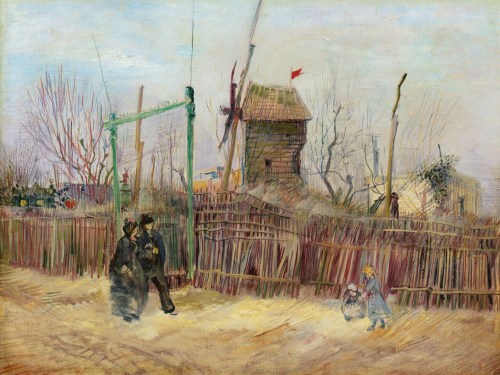
Scène_de_Rue_à_MontmartreArtist: Vincent van Gogh (1853–1890)

Title: Street Scene in Montmartre

Genre: landscape art

Date: 1887

Medium: oil on canvas

Dimensions: height: 46.1 cm (18.1 in); width: 61.3 cm (24.1 in)

Collection: Private collection

What I love about this painting:

Street Scene in Montmartre is a relatively unknown painting by Vincent van Gogh, unknown because it has been held in private collections and not exhibited to the public. It was auctioned by Sotheby’s in 2021, and the image was posted to Wikimedia Commons courtesy of that auction.

The scene feels like an afternoon scene in winter, with a man and woman walking, and two children playing.

I wanted to take a second look at this painting because I’ve been reading a great deal about Vincent’s life. His art was an attempt to show the beauty he saw everywhere, especially in the most ordinary of things.

He paid particular attention to the visual construction and texture of the fence, and also to the tangle of garden behind. This is the smaller of two windmills featured in several more well-known paintings in the subset of paintings from Van Gogh’s Montmartre series.

While there are people walking down the dirt lane in this scene, they aren’t the focus. Instead, our eye is directed to the way the windmill rises over the ramshackle fence, neglected garden, and above it all, the flag bravely flying.

The dirt lane, the fence, the winter-barren garden, and the windmill falling to ruin beneath the cold sky offer us a glimpse into Vincent’s mood. He finds beauty in the textures of life, both visual and metaphysical – in the cycle of life, of youth growing old and aging to ruin. The flag flying in the breeze and the children playing offer us the hope of brighter days and new possibilities.

About this painting, via Wikipedia:

The Montmartre paintings are a group of works that Vincent van Gogh created in 1886 and 1887 of the Paris district of Montmartre while living there, at 54 Rue Lepic, with his brother Theo. Rather than capture urban settings in Paris, van Gogh preferred pastoral scenes, such as Montmartre and Asnières in the northwest suburbs. Of the two years in Paris, the work from 1886 often has the dark, somber tones of his early works from the Netherlands and Brussels. By the spring of 1887, van Gogh embraced use of color and light and created his own brushstroke techniques based upon Impressionism and Pointillism. The works in the series provide examples of his work during that period of time and the progression he made as an artist.

In van Gogh’s first year in Paris he painted rural areas around Montmartre, such as the butte and its windmills. The colors are somber and evoke a sense of his anxiety and loneliness.

The landscape and windmills around Montmartre were the source of inspiration for a number of van Gogh’s paintings. The Moulin de la Galette, still standing, is located near the apartment he shared with his brother. Built in 1622, it was originally called Blute-Fin and belonged to the Debray family in the 19th century. Van Gogh met artists such as Toulouse-Lautrec, Paul Signac and Paul Gauguin who inspired him to incorporate Impressionism into his artwork resulting in lighter, more colorful paintings.

Windmills also featured in some of van Gogh’s landscape paintings of Montmartre.

Montmartre, sitting on a butte overlooking Paris, was known for its bars, cafes, and dance-hall. It was also located on the edge of countryside that afforded Van Gogh the opportunity to work on paintings of rural settings while living in Paris.

When Van Gogh painted he intended not just to capture the subject, but to express a message or meaning. It was through his paintings of nature that he was most successful at accomplishing his goal. It also created a great challenge: how to portray the subject and create a work that would resonate with the audience. [1]

About the Artist, via Wikipedia:

Vincent Willem van Gogh, 30 March 1853 – 29 July 1890) was a Dutch Post-Impressionist painter who posthumously became one of the most famous and influential figures in Western art history. In a decade, he created about 2,100 artworks, including around 860 oil paintings, most of which date from the last two years of his life. They include landscapes, still lifes, portraits, and self-portraits, and are characterised by bold colours and dramatic, impulsive and expressive brushwork that contributed to the foundations of modern art. He was not commercially successful, struggled with severe depression and poverty, and committed suicide at the age of 37.

Van Gogh was born into an upper-middle-class family, While a child he drew and was serious, quiet and thoughtful. As a young man he worked as an art dealer, often traveling, but became depressed after he was transferred to London. He turned to religion and spent time as a Protestant missionary in southern Belgium. He drifted in ill health and solitude before taking up painting in 1881, having moved back home with his parents. His younger brother Theo supported him financially; the two kept a long correspondence by letter. His early works, mostly still lifes and depictions of peasant labourers, contain few signs of the vivid colour that distinguished his later work. In 1886, he moved to Paris, where he met members of the avant-garde, including Émile Bernard and Paul Gauguin, who were reacting against the Impressionist sensibility. As his work developed he created a new approach to still lifes and local landscapes. His paintings grew brighter as he developed a style that became fully realised during his stay in Arles in the South of France in 1888. During this period he broadened his subject matter to include series of olive trees, wheat fields and sunflowers.

Van Gogh suffered from psychotic episodes and delusions, and though he worried about his mental stability, he often neglected his physical health, did not eat properly and drank heavily. His friendship with Gauguin ended after a confrontation between the two when, in a rage, Van Gogh severed a part of his own left ear with a razor. He spent time in psychiatric hospitals, including a period at Saint-Rémy. After he discharged himself and moved to the Auberge Ravoux in Auvers-sur-Oise near Paris, he came under the care of the homeopathic doctor Paul Gachet. His depression persisted, and on 27 July 1890, Van Gogh is believed to have shot himself in the chest with a revolver, dying from his injuries two days later. [2]


Credits and Attributions:

Image: Scène de Rue à Montmartre, Vincent van Gogh PD|100, Wikimedia Commons contributors, “File:Scène de Rue à Montmartre.jpg,” Wikimedia Commons, the free media repository, https://commons.wikimedia.org/w/index.php?title=File:Sc%C3%A8ne_de_Rue_%C3%A0_Montmartre.jpg&oldid=617922499 (accessed May 19, 2022).

[1] Wikipedia contributors, “Montmartre (Van Gogh series),” Wikipedia, The Free Encyclopedia, https://en.wikipedia.org/w/index.php?title=Montmartre_(Van_Gogh_series)&oldid=1086671125 (accessed May 19, 2022).

[2] Wikipedia contributors, “Vincent van Gogh,” Wikipedia, The Free Encyclopedia, https://en.wikipedia.org/w/index.php?title=Vincent_van_Gogh&oldid=1087073450 (accessed May 19, 2022).
3 Comments

Filed under #FineArtFriday, writing

#FineArtFriday: The Louvre, Morning, Spring by Camille Pissarro 1902

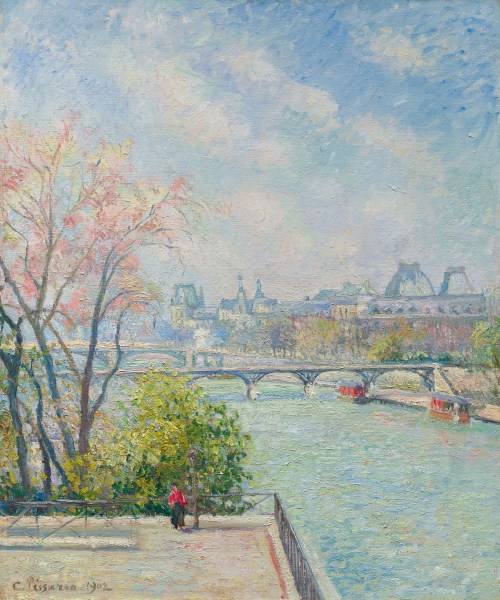
1902_Camille_Pissarro_Le_Louvre,_matin,_printempsArtist: Camille Pissarro  (1830–1903)

Title: French: Le Louvre, Matin, Printemps (English: the Louvre, morning, spring)

Date:1902

Medium: oil on canvas

Dimensions: height: 54 cm (21.2 in), width: 64.8 cm (25.5 in)

References: https://www.sothebys.com/en/buy/auction/2023/modern-evening-auction-5/le-louvre-matin-printemps

What I love about this picture:

This is the way spring begins, tentative and holding back as if gauging the audience before leaping to center stage. The style of brushwork lends itself to the misty quality of the pastels of March and early April.

This was one of Pissarro’s final works. It is a pretty picture, a simple scene not unlike one I might see here in the Pacific Northwest this weekend. We are supposed to see a sunny stretch tomorrow through Tuesday, a few days of warmth without rain. The flowering plum trees in my town are poised to burst forth, and we will take a long drive, soaking up the sunlight while we can.

As I said above, this is a pretty picture, not profound or revolutionary, not highbrow in any way. But sometimes, what the soul needs is a pretty picture featuring the beauty and serenity of a sunny day.

About the artist, via Wikipedia:

Jacob Abraham Camille Pissarro (10 July 1830 – 13 November 1903) was a Danish-French Impressionist and Neo-Impressionist painter born on the island of St Thomas (now in the US Virgin Islands, but then in the Danish West Indies). His importance resides in his contributions to both Impressionism and Post-Impressionism. Pissarro studied from great forerunners, including Gustave Courbet and Jean-Baptiste-Camille Corot. He later studied and worked alongside Georges Seurat and Paul Signac when he took on the Neo-Impressionist style at the age of 54.

In 1873 he helped establish a collective society of fifteen aspiring artists, becoming the “pivotal” figure in holding the group together and encouraging the other members. Art historian John Rewald called Pissarro the “dean of the Impressionist painters”, not only because he was the oldest of the group, but also “by virtue of his wisdom and his balanced, kind, and warmhearted personality”. Paul Cézanne said “he was a father for me. A man to consult and a little like the good Lord”, and he was also one of Paul Gauguin‘s masters. Pierre-Auguste Renoir referred to his work as “revolutionary”, through his artistic portrayals of the “common man”, as Pissarro insisted on painting individuals in natural settings without “artifice or grandeur”.

Pissarro is the only artist to have shown his work at all eight Paris Impressionist exhibitions, from 1874 to 1886. He “acted as a father figure not only to the Impressionists” but to all four of the major Post-Impressionists, Cézanne, Seurat, Gauguin, and van Gogh.

Founder of a Dynasty:

Camille’s son Lucien was an Impressionist and Neo-impressionist painter as were his second and third sons Georges Henri Manzana Pissarro and Félix Pissarro. Lucien’s daughter Orovida Pissarro was also a painter. Camille’s great-grandson, Joachim Pissarro, became Head Curator of Drawing and Painting at the Museum of Modern Art in New York City and a professor in Hunter College’s Art Department. Camille’s great-granddaughter, Lélia Pissarro, has had her work exhibited alongside her great-grandfather. Another great-granddaughter, Julia Pissarro, a Barnard College graduate, is also active in the art scene. From the only daughter of Camille, Jeanne Pissarro, other painters include Henri Bonin-Pissarro (1918–2003) and Claude Bonin-Pissarro (born 1921), who is the father of the Abstract artist Frédéric Bonin-Pissarro (born 1964).

The grandson of Camille Pissarro, Hugues Claude Pissarro (dit Pomié), was born in 1935 in the western section of Paris, Neuilly-sur-Seine, and began to draw and paint as a young child under his father’s tutelage. During his adolescence and early twenties he studied the works of the great masters at the Louvre. His work has been featured in exhibitions in Europe and the United States, and he was commissioned by the White House in 1959 to paint a portrait of U.S. President Dwight Eisenhower. He now lives and paints in Donegal, Ireland, with his wife Corinne also an accomplished artist and their children. [1]


Credits and Attributions:

IMAGE: Wikimedia Commons contributors. File:1902 Camille Pissarro Le Louvre, matin, printemps.jpeg [Internet]. Wikimedia Commons; 2024 Feb 20, 05:48 UTC [cited 2024 Mar 13]. Available from: https://commons.wikimedia.org/w/index.php?title=File:1902_Camille_Pissarro_Le_Louvre,_matin,_printemps.jpeg&oldid=853770801.

[1] Wikipedia contributors. Camille Pissarro [Internet]. Wikipedia, The Free Encyclopedia; 2024 Feb 12, 07:32 UTC [cited 2024 Mar 13]. Available from: https://en.wikipedia.org/w/index.php?title=Camille_Pissarro&oldid=1206477040.

2 Comments

Filed under #FineArtFriday

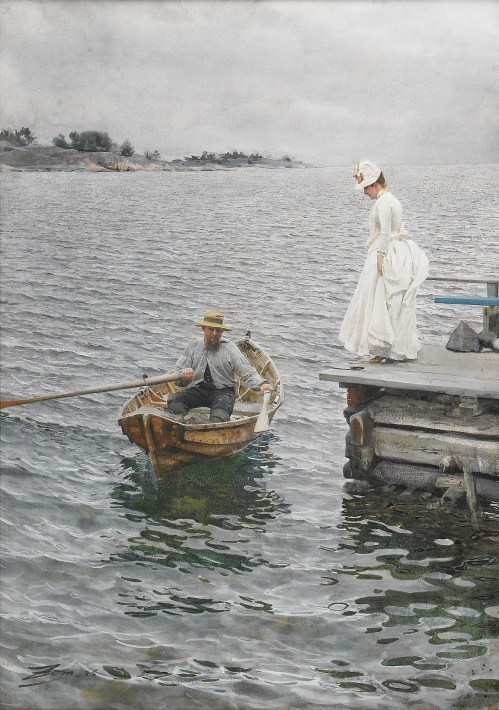
#FineArtFriday: Sommarnöje (Summer Fun) by Anders Zorn 1886

Sommarnöje_(1886),_akvarell_av_Anders_ZornArtist: Anders Zorn  (1860–1920)

Title: (Swedish: Sommarnöje)  (English: Summer Fun)

Genre: marine art

Date: 1886

Medium: watercolor paint on paper

Dimensions: height: 76 cm (29.9 in)

Collection: Private collection

Place of creation: Dalarö, Sweden

Inscriptions: Signature and date bottom left: Zorn -86

What I love about this painting:

This image, the way the lake is shown, took me back to my childhood. I grew up in a house that faced directly onto a large lake, with a wide beach for swimming, a wooden dock, and few neighbors. The southern Puget Sound area experiences more overcast days in June than most people like. Many days, the waters and the sky looked exactly as Anders Zorn has depicted them here.

Zorn’s brushwork is so meticulous, it is nearly photographic. He captures the feeling of the day, of the breeze, slightly sharp but not too cold, and the anticipation of going out on the water.

About this painting, via Wikipedia:

Zorn painted Sommarnöje in Dalarö in the early summer of 1886, after the couple had returned from honeymoon but before they settled in Mora. He made a smaller sketch first, which measures 30.2 by 18.8 centimeters (11.9 in × 7.4 in), now held by the Zorn Museum in Mora.

The completed watercolor captures a fleeting moment and shows influence from the works of the French Impressionists that Zorn had seen while in Paris, but with a distinctively austere Scandinavian palette.

The painting depicts the artist’s wife Emma Zorn standing in a white dress and hat, waiting on the edge of a wooden pier beside the water, as their friend Carl Gustav Dahlström approaches in a rowing boat.

The reflective glassy surface of the water is rippling in a breeze, under cloudy grey skies. The figures, pier, boat and sea are finely rendered, almost as if the work was made in oil paint, showing Zorn’s skill as a watercolorist. Less attention is paid to the other side of the lake, sketched roughly in the background. It is signed and dated in the lower left corner, “Zorn 86”.

It was acquired by Edvard Levisson of Gothenburg, and then descended through the Schollin-Borg family. The painting was sold at the Stockholms Auktionsverk in June 2010 for SEK 26 million, setting a record for a Swedish painting.

About the Artist, via Wikipedia:

Zorn was born in Mora, Sweden, between the lakes of Siljan and Orsasjön. He studied at the Royal Swedish Academy of Arts in Stockholm from 1875 to 1880, and then spent time travelling in Europe, painting watercolours and society portraits in London, Paris and Madrid.

He returned to Sweden in 1885, and on 16 October, he married Emma Zorn (née Lamm) (1860 – 1942). After spending their honeymoon abroad, in eastern Europe and Turkey, they returned to Sweden in 1886, spending time with Emma’s family at Dalarö, before settling near Mora, where their house, which is now the home of the Zorn Collections, is located.


Credits and Attributions:

IMAGE: Wikimedia Commons contributors, “File:Sommarnöje (1886), akvarell av Anders Zorn.jpg,” Wikimedia Commons, https://commons.wikimedia.org/w/index.php?title=File:Sommarn%C3%B6je_(1886),_akvarell_av_Anders_Zorn.jpg&oldid=842907051 (accessed February 29, 2024).

[1] Wikipedia contributors, “Sommarnöje,” Wikipedia, The Free Encyclopedia, https://en.wikipedia.org/w/index.php?title=Sommarn%C3%B6je&oldid=1149795747 (accessed February 29, 2024).

5 Comments

Filed under writing

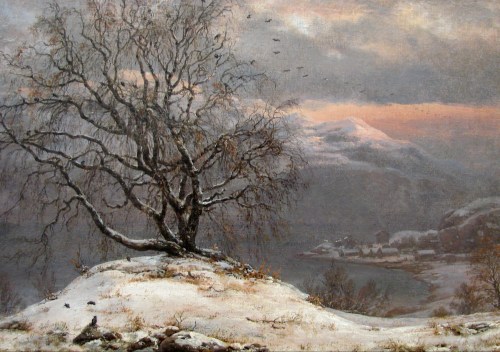
#FineArtFriday: revisiting ‘Slindebirken Vinter’ by J. C. Dahl 1838

I first posted this image in December of 2018. As I considered what painting to look at for today’s post, it seemed to me that the brief bout of snowy weather here in the Pacific Northwest called for a snowy picture, and what could be snowier than Norway in the winter? I love paintings that depict historical places–they fuel my inner author.

Slindebjørka or Slindebirken was a birch tree that stood at Inner Slinde in Sogn, Norway, until it was blown down in a storm in 1874. The tree was beloved, considered a Norwegian national treasure. People came from all over Western Norway to see the tree and picnic beneath its branches.

What I love about this painting is the personality embodied in the birch tree itself as Dahl depicts it. The tree stands proudly, offering a place for birds to rest. It seems to represent the Norwegian spirit of independence, taking what nature throws at it with humor and stoicism.

Dahl’s portrayal is powerful, showing the bent and bowed branches held high despite the barrenness of winter. The image shows a tree that intends to be there when spring comes, as do the people of the village it overlooks.

About the Artist (from Wikipedia)

Johan Christian Claussen Dahl (24 February 1788 – 14 October 1857), often known as J. C. Dahl or I. C. Dahl, was a Norwegian artist who is considered the first great romantic painter in Norway, the founder of the “golden age” of Norwegian painting, and one of the greatest European artists of all time.[1] He is often described as “the father of Norwegian landscape painting”[2] and is regarded as the first Norwegian Painter ever to reach a level of artistic accomplishment comparable to that attained by the greatest European artists of his day. He was also the first to acquire genuine fame and cultural renown abroad.[3] As one critic has put it, “J.C. Dahl occupies a central position in Norwegian artistic life of the first half of the 19th century.[4]

As a boy, Dahl was educated by a sympathetic mentor at the Bergen Cathedral who at first thought that this bright student would make a good priest, but then, recognizing his remarkably precocious artistic ability, arranged for him to be trained as an artist. From 1803 to 1809 Dahl studied with the painter Johan Georg Müller [no], whose workshop was the most important one in Bergen at the time. Still, Dahl looked back on his teacher as having kept him in ignorance in order to exploit him, putting him to work painting theatrical sets, portraits, and views of Bergen and its surroundings. Another mentor, Lyder Sagen, showed the aspiring artist books about art and awakened his interest in historical and patriotic subjects. It was also Sagen who took up a collection that made it possible for Dahl to go to Copenhagen in 1811 to complete his education at the academy there.

As important as Dahl’s studies at the academy in Copenhagen were his experiences in the surrounding countryside and in the city’s art collections. In 1812 he wrote to Sagen that the landscape artists he most wished to emulate were Ruisdahl and Everdingen, and for that reason he was studying “nature above all,” Dahl’s artistic program was, then, already in place: he would become a part of the great landscape tradition, but he would also be as faithful as possible to nature itself.


Credits and Attributions:

Slindebirken, Vinter by Johan Christian Dahl 1838 [Public domain] via Wikimedia Commons

Wikipedia contributors, “Johan Christian Dahl,” Wikipedia, The Free Encyclopedia, https://en.wikipedia.org/w/index.php?title=Johan_Christian_Dahl&oldid=866337453 (accessed December 14, 2018).

Comments Off on #FineArtFriday: revisiting ‘Slindebirken Vinter’ by J. C. Dahl 1838

Filed under #FineArtFriday

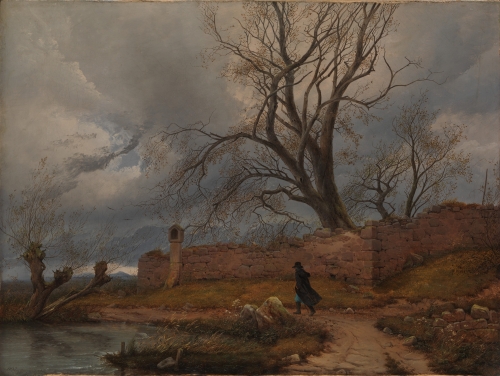
#FineArtFriday: Wanderer in the Storm by Carl Julius von Leypold 1835 (a second look)

Karl_Julius_von_Leypold_-_Wanderer_im_SturmArtist: Carl Julius von Leypold  (1806–1874)
Title: Wanderer in the Storm

Date: 1835

Medium: oil on canvas

Dimensions: height: 42.5 cm (16.7 in); width: 56.5 cm (22.2 in)

Collection: Metropolitan Museum of Art

What I love about this painting:

This painting completely describes typical January weather in the cold, dark, and stormy Pacific Northwest—wind and rain and rain and wind. Winter is in full swing, a few degrees warmer this week than last, but dark, cold, and wet. Hopefully, we will avoid having more snow and ice, but it’s only January. Anything can be lurking around the corner.

I love the dark and moody sky that von Leypold paints for us. It has movement, a sense of life, of wind and rain gathering momentum, a small pause while it builds toward a tantrum of the wintery kind. It feels heavy and oppressive.

One can almost hear the water lapping at the shore. Beyond the muddy lane, the trees are like me, old but strong, holding their barren branches defiant before the storm. They seem to shout, “We will bend but never break!” and by bending with the winds, those trees will survive to see yet another blossoming of spring.

The ancient stone wall stands firm, still doing its duty despite being long neglected and left to ruin. It refuses to abandon its purpose, although it no longer remembers what that might be.

The man trudges purposefully, despite the wind that whips at his long coat. Does he feel the cold, or is he walking quickly enough that he is warm? And where is he going? Who is he so intent upon seeing that he would brave the storm on foot?

More importantly, does danger lurk around the corner? Will he be safe?

There is a story in this painting.

About the Artist, via Wikipedia:

Carl Julius von Leypold (1806–1874) was a German Romantic landscape painter known for his painting, “Wanderer in the Storm.”

Von Leypold studied landscape painting with Johan Christian Dahl at the Dresden Academy of Fine Arts between 1820 and 1829. From 1826 onwards, Caspar David Friedrich influenced his choice of subjects and painting style. His landscapes are characterized by “a painterly, but at the same time sharp-brushed style, in which high painting culture is combined with Biedermeier objectivity.”

On March 5, 1857, he became an honorary member of the Dresden Art Academy. [1]


Credits and Attributions:

Image: Wanderer in the Storm by Carl Julius von Leypold PD|100. Wikimedia Commons contributors, “File:Karl Julius von Leypold – Wanderer im Sturm.jpg,” Wikimedia Commons, the free media repository, https://commons.wikimedia.org/w/index.php?title=File:Karl_Julius_von_Leypold_-_Wanderer_im_Sturm.jpg&oldid=675091985 (accessed January 5, 2023).

[1] Wikipedia contributors, “Carl Julius von Leypold,” Wikipedia, The Free Encyclopedia, https://en.wikipedia.org/w/index.php?title=Carl_Julius_von_Leypold&oldid=1095364695 (accessed January 5, 2023).

Comments Off on #FineArtFriday: Wanderer in the Storm by Carl Julius von Leypold 1835 (a second look)

Filed under #FineArtFriday, writing

#FineArtFriday: An Out-of-Doors Study by John Singer Sargent (revisited)

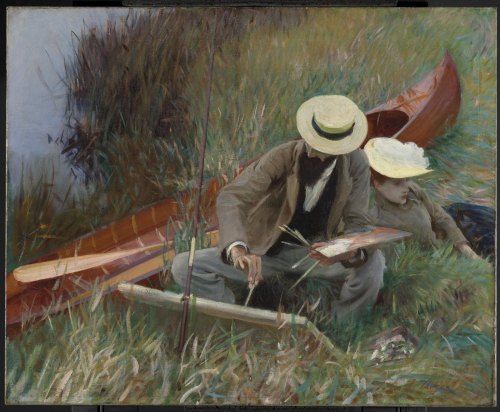
Artist: John Singer Sargent  (1856–1925)

Title: An Out-of-Doors Study

Description: English: Paul César Helleu Sketching with his wife Alice

Signature bottom right: John S. Sargent

Date: 1889

Medium: oil on canvas

Dimensions: Height: 65.9 cm (25.9 ″); Width: 80.7 cm (31.7 ″)

The weather has been dark and dreary here in the Pacific Northwest. I need sunny day, and I remembered this image. An Out-of-Doors Study, 1889, is by expatriate American artist, John Singer Sargent. It depicts fellow artist and great friend, Paul César Helleu sketching with his wife Alice Guérin. What a lovely day it was, for them to be sitting on the grass, enjoying a carefree moment in life.

What I love about this painting:

This painting depicts a day in the life of two great artists. The grass looks very like that which grows beside streams in my part of the world. The colors are that mix of green and brown that long grass has when summer is just beginning. The blue sky is reflected in the water. They had taken advantage of a fine day in late May or June perhaps, fortunate to have an outing before high summer turns the meadow grass crisp and brown.

The quality of light that day was perfect for a picnic beside the water. One can imagine the two artists working on their individual projects and chatting, having a relaxing lunch, and then taking a quiet walk. We can even wonder if, later, they might have taken the canoe out.

January has been overcast and rainy with little chance of seeing sunshine. I could use a day like this, a picnic beneath blue skies, and a gathering of friends beside a quiet pond.

About the artist, via Wikipedia:

Sargent’s early enthusiasm was for landscapes, not portraiture, as evidenced by his voluminous sketches full of mountains, seascapes, and buildings. Carolus-Duran’s expertise in portraiture finally influenced Sargent in that direction. Commissions for history paintings were still considered more prestigious, but were much harder to get. Portrait painting, on the other hand, was the best way of promoting an art career, getting exhibited in the Salon, and gaining commissions to earn a livelihood.

In a time when the art world focused, in turn, on ImpressionismFauvism, and Cubism, Sargent practiced his own form of Realism, which made brilliant references to VelázquezVan Dyck, and Gainsborough.


Credits and Attributions:

Wikimedia Commons contributors, “File:Sargent – Paul Helleu Sketching with his Wife.jpg,” Wikimedia Commons, the free media repository, https://commons.wikimedia.org/w/index.php?title=File:Sargent_-_Paul_Helleu_Sketching_with_his_Wife.jpg&oldid=273586527 (accessed December 5, 2019).

Wikipedia contributors, “John Singer Sargent,” Wikipedia, The Free Encyclopedia, https://en.wikipedia.org/w/index.php?title=John_Singer_Sargent&oldid=927728162 (accessed December 5, 2019).

2 Comments

Filed under #FineArtFriday

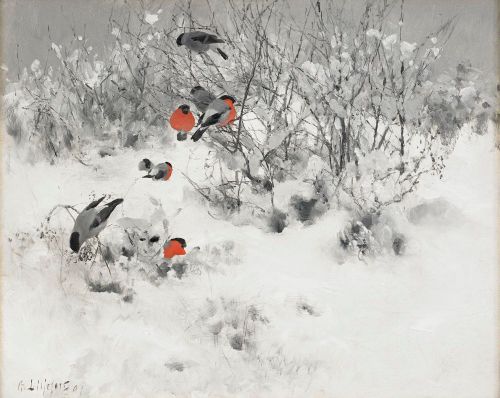
#FineArtFriday: Winter landscape with bullfinches by Bruno Liljefors 1891

Bruno_Liljefors_-_Winter_landscape_with_bullfinches_1891Artist: Bruno Liljefors  (1860–1939)

Title: English: Winter landscape with bullfinches

Date: 1891

Medium: oil on canvas

Dimensions: height: 40 cm (15.7 in); width: 50 cm (19.6 in)

What I love about this painting:

This is a Christmas card kind of scene, and I’m sure I have seen it featured on many cards over the years. However, the birds are what attracted me to this painting. Birds of all varieties enthrall me, and these birds are gorgeous.

I love the colors of these bullfinches, love the natural way they are shown roosting in the shrubbery. These birds are European and are different from the bright yellow goldfinches I know here in the Pacific Northwest.

My childhood home had begun its life as a one room hunting cabin that had been converted to a mid-century rambler and turned into a family home in the 1950s. It was situated on a large stretch of beach on the southeastern shore of Black Lake near Olympia, Washington. Our property was centered in a thick forest of Douglas fir, western red cedars, and hemlock trees.

My parents were avid gardeners, and besides the large veggie garden and flower beds, we had many ornamental shrubs. Native Oregon Grape, salmon berries, and salal bordered the edges of our property.

One of my earliest memories is that of watching the winter birds. First, they perched in shrubs, then they flew off, and then they were back again.

Dark-eyed juncos, sparrows, and chickadees gathered in the shrubs. Larger birds, such as crows, owls, and ospreys roosted in the trees. On the lake, ducks, Canada geese, and grebes swam along with the occasional swan or loon.

Birdwatching provided endless entertainment during a time when our television antenna only picked up the signals from two stations. While we did see shows like Star Trek, Batman, Get Smart, and the Addams Family in the evenings, TV overall was a wash, as storms had cut the power to our home many times. Some winters were worse than others, and sometimes, we were without power for several weeks, waiting for the linemen to hook us back up.

To this day, birdwatching is one of my family’s favorite things to do.

About the Artist, via Wikipedia:

Bruno Andreas Liljefors, 14 May 1860 – 18 December 1939) was a Swedish artist. He is perhaps best known for his nature and animal motifs, especially with dramatic situations. He was the most important and probably most influential Swedish wildlife painter of the late nineteenth and early twentieth century. He also drew some sequential picture stories, making him one of the early Swedish comic creators. [1]

To read more about the artist, go to Bruno Liljefors – Wikipedia.


Credits and Attributions:

IMAGE: Wikimedia Commons contributors, “File:Bruno Liljefors – Winter landscape with bullfinches 1891.jpg,” Wikimedia Commons, https://commons.wikimedia.org/w/index.php?title=File:Bruno_Liljefors_-_Winter_landscape_with_bullfinches_1891.jpg&oldid=812150991 (accessed December 14, 2023).

[1] Wikipedia contributors, “Bruno Liljefors,” Wikipedia, The Free Encyclopedia, https://en.wikipedia.org/w/index.php?title=Bruno_Liljefors&oldid=1170413866 (accessed December 14, 2023).

Comments Off on #FineArtFriday: Winter landscape with bullfinches by Bruno Liljefors 1891

Filed under #FineArtFriday

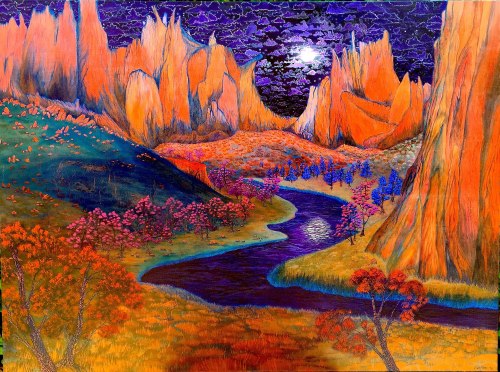
#FineArtFriday: African Violet Skies by Clark Thomas Carlton

African_Violet_Skies_by_Clark_Thomas_CarltonTITLE: African Violet Skies

BY: Clark Thomas Carlton

MEDIUM: Acrylics on canvas

DATE: ca. 2016

What I love about this painting:

Today we’re dipping into 21st century fantasy landscape art. African Violet Skies by Clark Thomas Carlton is an explosion of color and form. The colors are so intense, I feel as if I could taste them.

I love how delicate the trees and foliage are as compared to the fierce thrust of the landscape. The mountains seem to burst through the earth at high speed, reaching for the incredible night sky, as if they would touch the moon.

This is true mastery of storytelling in an image as well as form and color. He gives us drama, and romance, and violence, and above it all, the moon softly gliding behind the delicate clouds, reflected on the serene stream below.

This painting is exactly what I need after four days of thick fog that refused to lift, followed by eternal rain.

About the Artist, via Wikipedia, the free encyclopedia

Clark Thomas Carlton is a novelist, playwright, and a screen and television writer living in Los Angeles. He has also worked as a producer of reality television. Carlton is best known for his science fiction/fantasy novel Prophets of the Ghost Ants published by HarperCollins Voyager in 2016.

Carlton is the author of Prophets of the Ghost Ants, Book 1 of the Antasy Series published by HarperCollins Voyage on December 13, 2016.  The indie version of the book was named a Best of 2011 by Kirkus Reviews.

In 1997, Carlton was awarded the Drama-Logue Critics Award for his play Self Help or the Tower of Psychobabble along with playwrights Neil Simon and Henry Ong. The play, a satire of the psychotherapy industry, was performed in Santa Monica, Palm Springs, Los Angeles and West Hollywood and directed by Michael Kearns and was also produced in Chicago.

Carlton is a painter who embraces the description of his work as “Grandma Moses on acid”. His work has been displayed through the Palm Springs Art Museum Annex through the Palm Springs Arts Council.

In December 1999, Carlton released an album of songs titled Salt Water through CD baby where he accompanied himself on acoustic guitar.  At present he is at work on Gardens of Babylon, a synth pop opera about the building of the Hanging Gardens of Babylon. The opera was written with his partner, Mike Dobson, an Emmy award winning music supervisor and composer on the daytime drama, the Young and the Restless. [1]


Credits and Attributions:

IMAGE: African Violet Skies by Clark Thomas Carlton. Wikimedia Commons contributors, “File:African Violet Skies by Clark Thomas Carlton.jpg,” Wikimedia Commons, https://commons.wikimedia.org/w/index.php?title=File:African_Violet_Skies_by_Clark_Thomas_Carlton.jpg&oldid=785979611 (accessed November 30, 2023).

[1] Wikipedia contributors, “Clark Thomas Carlton,” Wikipedia, The Free Encyclopedia, https://en.wikipedia.org/w/index.php?title=Clark_Thomas_Carlton&oldid=1171925222 (accessed November 30, 2023).

1 Comment

Filed under #FineArtFriday

#FineArtFriday: Peasant Wedding, David Teniers II (revisited)

Today is the day after Thanksgiving here in the US. Many people are out doing their Christmas shopping or looking for Black Friday bargains.

But not my husband and me. We will rest up, enjoy leftovers, and visit the storage unit to pick up our bin full of Christmas decorations. Maybe we’ll decorate the balcony, offer a little cheer to the neighbors across the way.

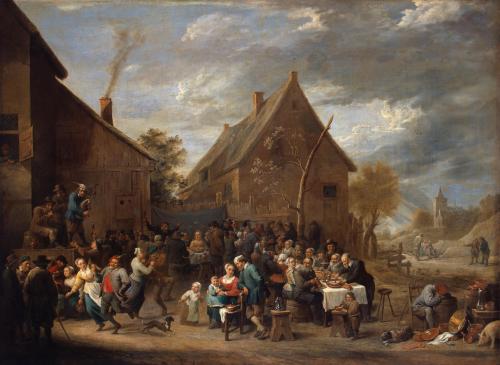
I love today’s painting, and yesterday’s family gathering made me think of revisiting it. The Peasant Wedding by the Flemish painter, print maker, David Teniers the Younger, is full of movement and life, and shows real people having a great party, not unlike we do in our modern world.

The musicians are playing, some people are singing, some are talking, and some are dancing. Most are eating and just enjoying themselves. A few of the men are becoming a little familiar with the ladies, who are not really having any of that, thank you. A few people have indulged a little too much.

Even the dog is having a good time.

Teniers was a prolific and skilled artist, a man remembered today as much for his lofty social ambitions as he is for the quantity and excellence of his work. He wanted to be a nobleman; indeed he once falsely laid claim to being descended from a noble line. Several times he nearly succeeded in this ambition, but nobility was one accolade he never achieved.

This world can be a hard place for some people to live. I am fortunate to be safe and well-fed, luxuries I thank God for every day. Wherever you are in this big world, I hope you have plenty to give thanks for.

About David Teniers II, from Wikipedia:

Teniers married into the famous Brueghel artist family when Anna Brueghel, daughter of Jan Brueghel the Elder, became his wife on 22 July 1637. Rubens, who had been the guardian of Anna Brueghel after her father’s death, was a witness at the wedding.

Through his marriage Teniers was able to cement a close relationship with Rubens who had been a good friend and frequent collaborator with his wife’s father. This is borne out by the fact that at the baptism of the first of the couple’s seven children David Teniers III, Rubens’ second wife, Hélène Fourment was the godmother.

Teniers’ wife died on 11 May 1656. On 21 October of the same year the artist remarried. His second wife was Isabella de Fren, the 32-year-old daughter of Andries de Fren, secretary of the Council of Brabant. It has been suggested that Teniers’ main motive for marrying the ‘spinster’ was her rather elevated position in society. His second wife also brought him a large dowry. The couple had four children, two sons and two daughters. His second wife’s attitude to Teniers’ children from his first marriage would later divide the family in legal battles.

At the behest of his Antwerp colleagues of the Guild of Saint Luke, Teniers became the driving force behind the foundation of the Academy in Antwerp, only the second of such type of institution in Europe after the one in Paris. The artist used his connections and sent his son David to Madrid to assist in the negotiation to successfully obtain the required licence from the Spanish King. There were great celebrations in Antwerp when, on 26 January 1663, Teniers came from Brussels with the royal charter creating the Antwerp Royal Academy of Fine Arts, the existence of which was due entirely to his persistence.

Teniers petitioned the king of Spain to be admitted to the aristocracy but gave up when the condition imposed was that he should give up painting for money.

He was an innovator in a wide range of genres such as history, genre, landscapeportrait and still life. He is now best remembered as the leading Flemish genre painter of his day


Credits and Attributions:

Wikimedia Commons contributors, “File:David Teniers de Jonge – Peasant Wedding (1650).jpg,” Wikimedia Commons, the free media repository, https://commons.wikimedia.org/w/index.php?title=File:David_Teniers_de_Jonge_-_Peasant_Wedding_(1650).jpg&oldid=225700063 (accessed November 2, 2018).

Wikipedia contributors, “David Teniers the Younger,” Wikipedia, The Free Encyclopedia, https://en.wikipedia.org/w/index.php?title=David_Teniers_the_Younger&oldid=858638339 (accessed November 2, 2018).

1 Comment

Filed under #FineArtFriday

#FineArtFriday: Two Watermills and an Open Sluice by Jacob van Ruisdael 1653

Jacob_Isaacksz._van_Ruisdael_-_Two_Watermills_and_an_Open_Sluice_-_WGA20479Artist: Jacob van Ruisdael  (1628/1629–1682)

Title: Two Watermills and an Open Sluice

Genre: landscape art

Date: 1653

Medium: oil on canvas

Dimensions: height: 664 mm (26.1 in)

Collection: Getty Center

What I Love about this painting:

This painting is the perfect writing prompt. Peaceful and serene, the scene shows us two watermills opposite each other on the stream, sharing the power of the water. These mills were examples of the highest technology of that time, and the families who owned them were prosperous middle-class people. Very likely they were literate, well-respected members of the local community.

Were these mills owned by the same family?

Or were they owned by rivals, competing to grind the grain produced by the local farmers? Is one a grist mill and the other a lumber mill? Or a weaver’s mill housing looms?

Was there a love story behind their being so close to each other, perhaps a Romeo and Juliet-style romance? (Tragedy averted, of course, or it wouldn’t be a romance.)

This is a wonderful painting, a window into the past.

About the artist, via Wikipedia, the free encyclopedia:

Jacob Isaackszoon van Ruisdael (Dutch pronunciation: [ˈjaːkɔp fɑn ˈrœyzˌdaːl] ; c. 1629 – 10 March 1682) was a Dutch painter, draughtsman, and etcher. He is generally considered the pre-eminent landscape painter of the Dutch Golden Age, a period of great wealth and cultural achievement when Dutch painting became highly popular.

Prolific and versatile, Ruisdael depicted a wide variety of landscape subjects. From 1646 he painted Dutch countryside scenes of remarkable quality for a young man. After a trip to Germany in 1650, his landscapes took on a more heroic character. In his late work, conducted when he lived and worked in Amsterdam, he added city panoramas and seascapes to his regular repertoire. In these, the sky often took up two-thirds of the canvas. In total he produced more than 150 Scandinavian views featuring waterfalls.

Ruisdael’s only registered pupil was Meindert Hobbema, one of several artists who painted figures in his landscapes. Hobbema’s work has at times been confused with Ruisdael’s. Ruisdael always spelt his name thus: Ruisdael, not Ruysdael.

Ruisdael’s work was in demand in the Dutch Republic during his lifetime. Today it is spread across private and institutional collections around the world; the National Gallery in London, the Rijksmuseum in Amsterdam, and the Hermitage Museum in St. Petersburg hold the largest collections. Ruisdael shaped landscape painting traditions worldwide, from the English Romantics to the Barbizon school in France, and the Hudson River School in the US, and influenced generations of Dutch landscape artists. [1]

To read more about this artist, go to Jacob van Ruisdael – Wikipedia

About this painting via Wikipedia, the free encyclopedia:

Two Water Mills with an Open Sluice, also known as Two Watermills and an Open SluiceTwo Undershot Water Mills with an Open Sluice is a 1653 painting by the Dutch Golden Age painter Jacob van Ruisdael. It is in the collection of the Getty Museum in Los Angeles.

The painting shows two working undershot water mills, with the major one being half-timbered with a cob-facade construction, tie beams, and vertical plank gable. This is characteristic of the water mills in the Bentheim area in Germany, to where Ruisdael had travelled in the early 1650s. This painting is one of six known variations on this theme and the only one that is dated.

Although other Western artists had depicted water mills before, Ruisdael was the first to make it the focal subject in a painting. Meindert Hobbema, Ruisdael’s pupil, started working on the water mills subject in the 1660s. Today Hobbema is more strongly associated with water mills than his teacher.

The painting is known by various names. The painting is called Two Water Mills with an Open Sluice in Seymour Slive‘s 2001 catalogue raisonné of Ruisdael, catalogue number 119. In his 2011 book on Ruisdael’s mills and water mills Slive calls it Two Undershot Water Mills with an Open Sluice. The Getty Museum calls it Two Watermills and an Open Sluice on their website, object number 82.PA.18. [2]


Credits and Attributions:

Wikipedia contributors, “Two Water Mills with an Open Sluice,” Wikipedia, The Free Encyclopedia, https://en.wikipedia.org/w/index.php?title=Two_Water_Mills_with_an_Open_Sluice&oldid=1160869306 (accessed November 16, 2023).

[2] Wikipedia contributors, “Jacob van Ruisdael,” Wikipedia, The Free Encyclopedia, https://en.wikipedia.org/w/index.php?title=Jacob_van_Ruisdael&oldid=1181677660 (accessed November 16, 2023).

2 Comments

Filed under #FineArtFriday