Tag Archives: Fine Art Friday

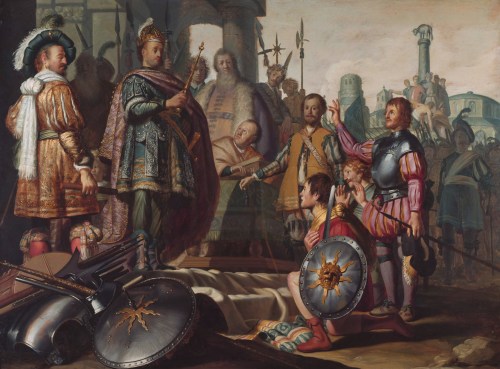
#FineArtFriday: History Painting, Titus (with self portrait) by Rembrandt Harmenszoon van Rijn 1626 (revisited)

History Painting, Titus (with self portrait of Rembrandt) by Rembrandt Harmenszoon van Rijn 1626

  • Artist: Rembrandt  (1606–1669) Rembrandt Harmenszoon van Rijn
  • Title: Historical Scene.
  • Inscriptions: Monogram and date bottom right: RH 16[2]6
  • Object type: painting
  • Genre: history painting
  • Depicted people: Titus
  • Date: 1626
  • Medium: oil on oak panel
  • Dimensions: Height: 89.8 cm (35.3 in); Width: 121 cm (47.6 in)
  • Collection:   Museum De Lakenhal

What I love about this Painting:

This is one of Rembrandt’s earliest history paintings. The young artist went all out to compose and execute this painting. He scoured the city for props, and found old armor and weapons. Then he dressed the players richly in the finest garments of his own day, so as to befit a beloved and respected emperor.

Wikipedia says: Rembrandt’s portraits of his contemporaries, self-portraits, and illustrations of scenes from the Bible are regarded as his greatest creative triumphs. His self-portraits form a unique and intimate biography, in which the artist surveyed himself without vanity and with the utmost sincerity.

The level of detail in the weaponry and richly worked garments is remarkable, as are the faces and features of each of the players. Emperor Titus is portrayed as slightly larger than life, noble, wise, and kind.
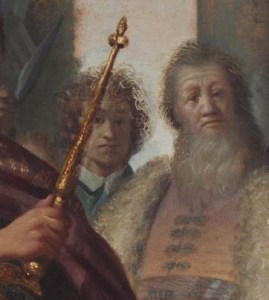
In the background, hidden by the scepter, we find Rembrandt himself, the witness who happened to come upon the scene and is looking on with wonder. Of the witnesses, he alone is shown dressed in the unadorned muted gray woolen clothing of a common man.

We know Rembrandt was well educated in history, and admired the Emperor Titus greatly, as he named his only surviving son after him.

About the Roman Emperor Titus, the Subject of this Painting (via Wikipedia):

Vespasian died of an infection on 23 June 79 AD, and was immediately succeeded by his son Titus. As Pharaoh of Egypt, Titus adopted the titulary Autokrator Titos Kaisaros Hununefer Benermerut (“Emperor Titus Caesar, the perfect and popular youth”). Because of his many (alleged) vices, many Romans feared that he would be another Nero. Against these expectations, however, Titus proved to be an effective Emperor and was well loved by the population, who praised him highly when they found that he possessed the greatest virtues instead of vices.

One of his first acts as Emperor was to order a halt to trials based on treason charges, which had long plagued the principate. The law of treason, or law of majestas, was originally intended to prosecute those who had corruptly “impaired the people and majesty of Rome” by any revolutionary action. Under Augustus, however, this custom had been revived and applied to cover slander and libel as well. This led to numerous trials and executions under TiberiusCaligula, and Nero, and the formation of networks of informers (Delators), which terrorized Rome’s political system for decades.

Titus put an end to this practice, against himself or anyone else, declaring:

“It is impossible for me to be insulted or abused in any way. For I do naught that deserves censure, and I care not for what is reported falsely. As for the emperors who are dead and gone, they will avenge themselves in case anyone does them a wrong, if in very truth they are demigods and possess any power.”

Consequently, no senators were put to death during his reign; he thus kept to his promise that he would assume the office of Pontifex Maximus “for the purpose of keeping his hands unstained.” The informants were publicly punished and banished from the city. Titus further prevented abuses by making it unlawful for a person to be tried under different laws for the same offense.  Finally, when Berenice returned to Rome, he sent her away.

As Emperor he became known for his generosity, and Suetonius states that upon realizing he had brought no benefit to anyone during a whole day, Titus remarked, “Friends, I have lost a day.”


Credits and Attributions:

History Painting, Titus (with self portrait of Rembrandt) by Rembrandt Harmenszoon van Rijn 1626

Wikipedia contributors, “Titus,” Wikipedia, The Free Encyclopedia,  https://en.wikipedia.org/w/index.php?title=Titus&oldid=950453618 (accessed April 24, 2020).

Wikimedia Commons contributors, “File:Rembrandt Historical Painting 1626 (Detail, with self-portrait).jpg,” Wikimedia Commons, the free media repository, https://commons.wikimedia.org/w/index.php?title=File:Rembrandt_Historical_Painting_1626_(Detail,_with_self-portrait).jpg&oldid=369318658 (accessed April 24, 2020).
Comments Off on #FineArtFriday: History Painting, Titus (with self portrait) by Rembrandt Harmenszoon van Rijn 1626 (revisited)

Filed under #FineArtFriday

#FineArtFriday: The Bird Concert by Jan Brueghel the Younger ca. 1640 – 45 (revisited)

OLYMPUS DIGITAL CAMERA

Artist: Jan Brueghel the Younger (1601–1678)

Title: the Bird Concert

Date: between circa 1640 and circa 1645

Medium: oil on copper

Dimensions: height: 13.2 cm (5.1 in); width: 17.9 cm (7 in)

Collection: Herzog Anton Ulrich Museum

Today we are taking a second look at one of my favorite paintings of the 17th century.

What I love about this painting:

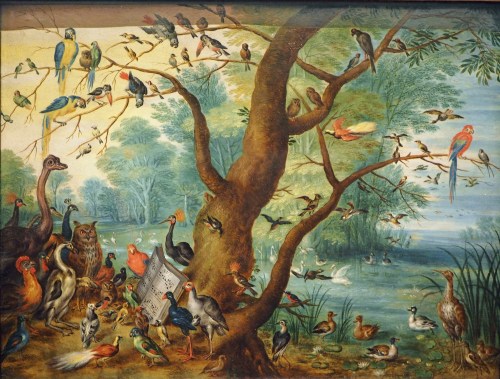
This is a joyous, surreal exploration of all the birds the artist had ever seen in his native Antwerp, and many rare birds that he could only imagine. Brueghel has gathered birds from all over the world into a mystical, fairytale glen, posing them around a songbook.

They are learning to sing a in a language they all can understand, a wonderful allegory of the aspirations of the artist for humanity in the turbulent times during which he lived.

This painting also celebrates the new discoveries made by European explorers, as Brueghel had only seen scientific drawings of many of these birds. Even though he hadn’t seen some of these birds personally, he paints them as if they are before him.

The amazing flock of birds gathered here gives us an insight into the mind and sense of humor of Jan Brueghel the Younger, a man not too different from us even though he lived over 300 years ago.

This composition must have been important to Brueghel and says something about him. He went to the expense of getting copper as the base upon which he painted this scene. He was comfortable but not rich, so that tells me he intended this painting to last, to be something he would be remembered for.

About the medium of Oil on Copper, via Wikipedia:

Oil on copper paintings were prevalent in the mid sixteenth century in Italy and Northern Europe. The use of copper as a substrate for an oil painting dates back to Medieval times. The Flemish masters and other artists including Jan Breughel the ElderClaudeEl GrecoGuido ReniGuercinoRembrandtCarlo SaraceniAmbrosius Bosschaert IICopley Fielding and Vernet painted on copper. They favored copper for its smooth surface which allowed fine detail, and its durability. Copper is more durable than canvas or wood panel as a support for oil painting, as it will not rot, mildew or be eaten by insects. Contemporary painters also use copper as a base for paintings, some of them allowing the metal or patina to show through.

The old masters prepared the copper for painting first by rubbing it with fine pumice abrasive. The copper surface was then treated with garlic juice which is believed to improve adhesion of the paint. Finally a white or grey ground layer of oil paint was applied as a primer. After drying the copper panel was ready for the artist to begin painting. Later artists used the patina process, in which the copper is oxidized with the use of various acidic solutions, as part of the art work itself. The resulting patina or verdigris includes darkening of the metal, green and blue tones, depending on the chemical solution used. Patina is characterized by beautiful, variated patterns and textures which occur on the metal’s surface. [1]

About the Artist, via Wikipedia:

Jan Brueghel the Younger was born in Antwerp on 13 September 1601 as the son of Jan Brueghel the Elder and Isabella de Jode. His mother was the daughter of the cartographer, engraver and publisher Gerard de Jode. He trained and collaborated with his father in his workshop. His father was a friend and close collaborator of Peter Paul Rubens. Brueghel likely assisted with his father’s large-scale commissions.

On the wishes of his father he traveled around 1622 to Milan where he was welcomed by Cardinal Federico Borromeo. The cardinal was a patron and friend of his father who had met in Rome about 30 years earlier. In what was likely an act of rebellion against his father, he went to Genoa where he stayed with his cousins, the Antwerp painters and art dealers Lucas de Wael and Cornelis de Wael. Their mother was a sister of Brueghel’s mother. At the time his friend and fellow Antwerp artist Anthony van Dyck was also active in Genoa. He later worked in Valletta on Malta in 1623. From 1624 to 1625 he also resided in Palermo on Sicily at the time when van Dyck was also working there.

Brueghel learned that his father had died on 13 January 1625 from cholera only after his return to Northern Italy in Turin. Wanting to return to Antwerp immediately, he had to delay his departure for 16 days due to a severe fever. After recovering from his illness, he set off for his homeland by way of France. In Paris he met the Antwerp art dealer and painter Peter Goetkint the Younger, who was the son of Peter Goetkint the Elder, the master of Jan’s father. Goetkint was eager to return to Antwerp because his wife was expected to deliver a baby soon. The child was born on 25 August, the day on which Breughel arrived in Antwerp with his traveling companion who himself died a few days later.

Brueghel took over the management of his father’s workshop, sold the finished works of his father and finished some of his father’s unfinished paintings after completing them. In the Guild year 1624-1625, Brueghel became a master painter of the Guild of Saint Luke of Antwerp.

In 1626 he married Anna Maria Janssens, daughter of Abraham Janssens, a prominent history painter in Antwerp. He continued to operate the large workshop of his father. He became dean of the Guild of Saint Luke in 1630. That same year he was commissioned by the French court to paint a series of paintings on the life of Adam. It seems that his studio declined after this period and that he started to paint smaller scale paintings which commanded lower prices than those produced earlier.

In later years, he worked independently in Paris in the 1650s and produced paintings for the Austrian court in 1651. He is recorded again in Antwerp in 1657 where he remained until his death. [2]


Credits and Attributions:

[1] Wikipedia contributors, “Oil on copper,” Wikipedia, The Free Encyclopedia, https://en.wikipedia.org/w/index.php?title=Oil_on_copper&oldid=1060711380 (accessed June 9, 2022).

[2] Wikipedia contributors, “Jan Brueghel the Younger,” Wikipedia, The Free Encyclopedia, https://en.wikipedia.org/w/index.php?title=Jan_Brueghel_the_Younger&oldid=1086952033 (accessed June 9, 2022).

Image: The Bird Concert by Jan Brueghel the Younger ca. 1640 -1645, PD|100. Wikimedia Commons contributors, “File:Bruegel Vogelkonzert@Herzog Anton Ulrich Museum (1).JPG,” Wikimedia Commons, the free media

Comments Off on #FineArtFriday: The Bird Concert by Jan Brueghel the Younger ca. 1640 – 45 (revisited)

Filed under #FineArtFriday, writing

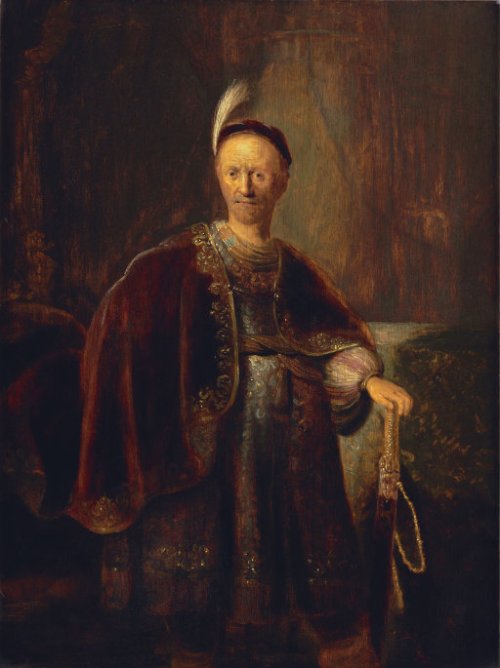
#FineArtFriday: Man in an Oriental Costume – Isaac de Jouderville

Man_in_an_Oriental_Costume_-_Isaac_de_JoudervilleArtist: Isaac de Jouderville  (1612–1645) Formerly attributed to Rembrandt (1606–1669)

Title: Man in an Oriental Costume

Description: English: Portrait shows Rembrandt’s father. The painting was identified by the BBC program Fake or Fortune? as a work looted by the Nazis and was reattributed to Isaac de Jouderville.

Date: 17th century before 1646

Medium: oil painting

About this painting, via Wikipedia:

Isaac de Jouderville’s painting Man in Oriental costume was featured in the fourth episode of the BBC TV programme, Fake or Fortune?. This painting was part of the stock of dealer’s Jakob and Rosa Oppenheimer that was seized by the Nazis and sold in 1935. It resurfaced at a Cape Town auction house in 2010. It was then, and still is today, listed in the Lost Art Database run by the Koordinierungsstelle für Kulturgutverluste in Magdeburg, Germany. It was subject to a long legal dispute as to whether the work was listed there legally. In February 2015 the Federal Administrative Court of Germany held that the Koordinierungsstelle did not have to delete it. [1]

Jouderville is known today for portraits and historical allegories.[1] Jouderville painted mainly Rembrandtesque heads or ‘tronies’. He was such a faithful follower of his master’s early work that several of his paintings were previously attributed to Rembrandt.[5]

If you are interested and have an hour to spare, here is the link to this exceptional story as told by Fiona Bruce and Phillip Mould. FAKE OR FORTUNE REMBRANDT SE1EO4 – YouTube

About the Artist, via Wikipedia:

Isaac de Jouderville (1612 in Leiden – 1645 in Amsterdam), was a Dutch Golden Age painter who was a pupil of Rembrandt.

De Jouderville was an orphan whose parents had come from Metz. He became a pupil of Rembrandt in November 1629 and traveled with him to Amsterdam in 1631. Documents concerning his apprenticeship drawn up by his guardians still exist.

He was back in Leiden to marry Maria le Febure (1619-1653) in 1636 and moved to Deventer in 1641. He lived in Deventer for a few years only; in 1643 he was back in Amsterdam, where he died young in 1645. His widow Maria married the glassmaker Pieter de Melder in 1648 and his daughter Mariecke, later married the painter Frederik de Moucheron.

After Maria le Febure died, her second husband claimed he was unable to support his wife’s three children by her first husband, along with his own two children, though he offered to raise Jacob Jouderville to the age of 18.[2] By that time De Melder was acting as art dealer, and the liquidation of his wife’s goods shows an interesting list of artists who were either owed money by her estate or who owed money to her estate. [1]


Credits and Attributions:

Image: Wikimedia Commons contributors, “File:Man in an Oriental Costume – Isaac de Jouderville.jpg,” Wikimedia Commons, https://commons.wikimedia.org/w/index.php?title=File:Man_in_an_Oriental_Costume_-_Isaac_de_Jouderville.jpg&oldid=527175855 (accessed May 26, 2023).

[1] Wikipedia contributors, “Isaac de Jouderville,” Wikipedia, The Free Encyclopedia, https://en.wikipedia.org/w/index.php?title=Isaac_de_Jouderville&oldid=1085547679 (accessed May 26, 2023).

Comments Off on #FineArtFriday: Man in an Oriental Costume – Isaac de Jouderville

Filed under #FineArtFriday

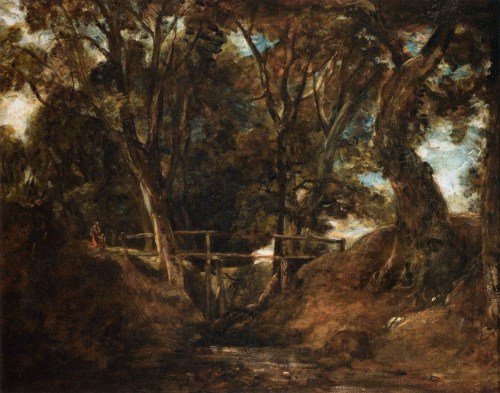
#FineArtFriday: John Constable – Helmingham Dell

John_Constable_-_Helmingham_Dell_-_WGA5193Artist: John Constable (1776–1837)

Title: Helmingham Dell

Genre: landscape art

Date: first half of 19th century

Medium: oil on canvas

Dimensions: height: 103 cm (40.5 in); width: 129 cm (50.7 in)

Collection: Louvre Museum

Current location: Department of Paintings of the Louvre

What I love about this image:

For those of us who write fantasy set in low-tech worlds, this is a view of how people bridged a creek for thousands of years, using the materials at hand. The scene is beautiful, cool and serene. One can hear the quiet murmur of the brook, the calls of different birds, and the chatter of squirrels arguing over their territories.

But at night, the silence is broken by the occasional hoot of an owl, and the rustle of underbrush as the small nocturnal creatures go about their business. A fox might wander through the dell, looking for a meal.

The amazing sky can be seen through the leaves and branches. John Constable gives us a lovely day, a moment of serenity to enjoy across the centuries.

About the Artist, via Wikipedia:

John Constable RA , 11 June 1776 – 31 March 1837) was an English landscape painter in the Romantic tradition. Born in Suffolk, he is known principally for revolutionising the genre of landscape painting with his pictures of Dedham Vale, the area surrounding his home – now known as “Constable Country” – which he invested with an intensity of affection. “I should paint my own places best”, he wrote to his friend John Fisher in 1821, “painting is but another word for feeling”.

Constable’s most famous paintings include Wivenhoe Park (1816), Dedham Vale (1821) and The Hay Wain (1821). Although his paintings are now among the most popular and valuable in British art, he was never financially successful. He became a member of the establishment after he was elected to the Royal Academy of Arts at the age of 52. His work was embraced in France, where he sold more than in his native England and inspired the Barbizon school. [1]


Credits and Attributions:

Image: Wikimedia Commons contributors, “File:John Constable – Helmingham Dell – WGA5193.jpg,” Wikimedia Commons, https://commons.wikimedia.org/w/index.php?title=File:John_Constable_-_Helmingham_Dell_-_WGA5193.jpg&oldid=723632044 (accessed May 25, 2023).

[1] Wikipedia contributors, “John Constable,” Wikipedia, The Free Encyclopedia, https://en.wikipedia.org/w/index.php?title=John_Constable&oldid=1152514837 (accessed May 25, 2023).

Comments Off on #FineArtFriday: John Constable – Helmingham Dell

Filed under #FineArtFriday

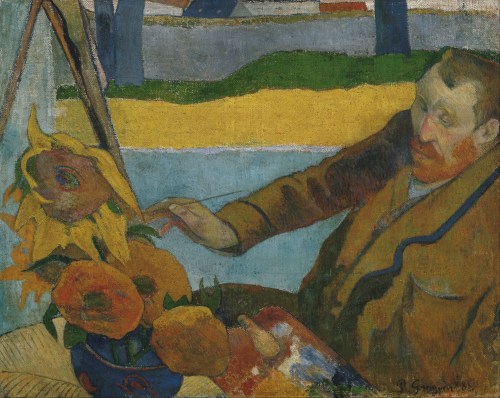
#FineArtFriday: Vincent van Gogh Painting Sunflowers by Paul Gauguin 1888 (revisited)

Title: Van Gogh Painting Sunflowers

Artist: Paul Gauguin

Genre: portrait

Date: 1888

Medium: oil on jute

Dimensions: Height: 73 cm (28.7 ″); Width: 91 cm (35.8 ″)


For a brilliant look a the life and art of Paul Gauguin, see:

Why Is Gauguin So Controversial? (Waldemar Januszczak Documentary) | Perspective – YouTube

For a wonderful documentary on Vincent’s Sunflowers, see:

The Mystery of Van Gogh’s Sunflowers | Raiders Of The Lost Art | Perspective – YouTube


About this Painting, via Wikipedia:

The portrait was painted when Gauguin visited Van Gogh in Arles, France. Vincent had pleaded with Gauguin to come to Arles to start an art-colony. Gauguin eventually agreed after funding for the transportation and expenses was provided by Vincent’s brother Theo Van Gogh; however Gauguin only stayed for two months as the two often quarreled and the famous incident where Van Gogh severed his left ear with a razor occurred after an argument with Gauguin.

Van Gogh’s first impression on seeing the painting was that Gauguin had depicted him as a madman. He later softened his view. “My face has lit up after all a lot since, but it was indeed me, extremely tired and charged with electricity as I was then.”

About the Artist, via Wikipedia:

Eugène Henri Paul Gauguin (UK: /ˈɡoʊɡæ̃/, US: /ɡoʊˈɡæ̃/; French: [øʒɛn ɑ̃ʁi pɔl ɡoɡɛ̃]; 7 June 1848 – 8 May 1903) was a French post-Impressionist artist. Unappreciated until after his death, Gauguin is now recognized for his experimental use of color and Synthetist style that were distinctly different from Impressionism. Toward the end of his life, he spent ten years in French Polynesia, and most of his paintings from this time depict people or landscapes from that region.

Gauguin’s relationship with Vincent proved fraught. In 1888, at (van Gogh’s brother)Theo’s instigation, Gauguin and Vincent spent nine weeks painting together at Vincent’s Yellow House in Arles. Their relationship deteriorated and eventually Gauguin decided to leave. On the evening of 23 December 1888 according to a much later account of Gauguin’s, van Gogh confronted Gauguin with a razor blade. Later the same evening, van Gogh cut off his own left ear. He wrapped the severed tissue in newspaper and handed it to a woman who worked at a brothel both Gauguin and van Gogh had visited, and asked her to “keep this object carefully, in remembrance of me”. Van Gogh was hospitalized the following day and Gauguin left Arles.


Credits and Attributions:

Vincent van Gogh Painting Sunflowers by Paul Gauguin 1888 [Public domain]

Wikipedia contributors, “Paul Gauguin,” Wikipedia, The Free Encyclopedia, https://en.wikipedia.org/w/index.php?title=Paul_Gauguin&oldid=899278654 (accessed May 31, 201 Wikipedia contributors, “The Painter of Sunflowers,” Wikipedia, The Free Encyclopedia, https://en.wikipedia.org/w/index.php?title=The_Painter_of_Sunflowers&oldid=853391418 (accessed May 31, 2019). 9).

Wikimedia Commons contributors, “File:Paul Gauguin – Vincent van Gogh painting sunflowers – Google Art Project.jpg,” Wikimedia Commons, the free media repository, https://commons.wikimedia.org/w/index.php?title=File:Paul_Gauguin_-_Vincent_van_Gogh_painting_sunflowers_-_Google_Art_Project.jpg&oldid=321446852 (accessed May 31, 2019).

5 Comments

Filed under #FineArtFriday

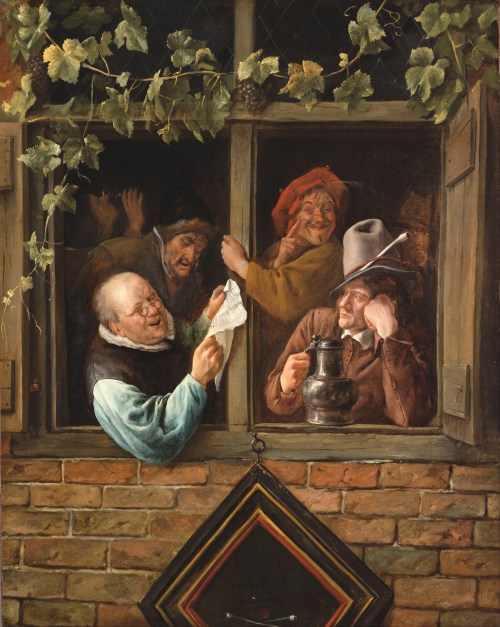
#FineArtFriday: Rhetoricians at a Window by Jan Steen ca. 1666 (revisite

Artist: Jan Steen  (1625/1626–1679)

Title: Rhetoricians at a Window

Genre: genre art

Date: c. 1661-66

Medium: oil on canvas

Dimensions: Height: 759.46 mm (29.90 in); Width: 586.23 mm (23.07 in)

Collection: Philadelphia Museum of Art

I regularly look to art for ideas. One of my favorite images is this one, Rhetoricians at a Window by the Dutch master, Jan Steen. It has appeared here several times, but no matter how often I see this painting, I find something new to appreciate about it.

What I love about this painting:

This is one of my all-time favorite Dutch genre paintings. The vivid characters who inhabit the scene inspired some the characters who pass through my Billy’s Revenge stories, people my protagonists meet along the way. These jolly rogues have such vivid personalities that the viewer immediately feels a kinship to them. Who were they? Did they keep their day jobs?

The reading of a poem or play was clearly the opportunity for the performers to have a good time. At left, the group’s orator reads a paper titled Lof Liet (Song of Praise), while the poet who composed the verse looks on over his shoulder. From the drinker in the shadows of the background, to the grapevines growing around the window, Steen tells us that wine and rhetoric are clearly entwined.

I love the inclusion of both “the critic” who leans his head on his hand and listens analytically, and the man behind him, who is clearly “a little over the limit,” and supports himself by grasping the window frame and heartily agreeing with some point.

The actor who reads is clearly enjoying himself, as are the others.

Symbolism: Some have said the characters in this painting represent the different emotions of the human condition:

  • Sanguine, (active, enthusiastic, and social)
  • Choleric, (fast, irritable, and short-tempered)
  • Melancholic, (analytical, quiet, and wise)
  • Phlegmatic, (peaceful and relaxed)

Thanks to Eelko Kappe’s wonderful article on this painting, Rhetoricians at the Window by Jan Steen, I now have four new words to broaden my vocabulary. I may never have a use for them, but now I know what they mean!

About the Artist (Via Wikipedia):

Jan Havickszoon Steen (c. 1626 – buried 3 February 1679) was a Dutch Golden Age painter, one of the leading genre painters of the 17th century. His works are known for their psychological insight, sense of humour and abundance of colour.

Daily life was Jan Steen’s main pictorial theme. Many of the genre scenes he portrayed, as in The Feast of Saint Nicholas, are lively to the point of chaos and lustfulness, even so much that “a Jan Steen household”, meaning a messy scene, became a Dutch proverb (een huishouden van Jan Steen). Subtle hints in his paintings seem to suggest that Steen meant to warn the viewer rather than invite him to copy this behaviour. Many of Steen’s paintings bear references to old Dutch proverbs or literature. He often used members of his family as models, and painted quite a few self-portraits in which he showed no tendency of vanity.

Steen did not shy from other themes: he painted historical, mythological and religious scenes, portraits, still lifes and natural scenes. His portraits of children are famous. He is also well known for his mastery of light and attention to detail, most notably in Persian rugs and other textiles.

Steen was prolific, producing about 800 paintings, of which roughly 350 survive. His work was valued much by contemporaries and as a result he was reasonably well paid for his work. He did not have many students—only Richard Brakenburgh is recorded—but his work proved a source of inspiration for many painters. [2]

About this painting, Via Wikipedia:

Chambers of rhetoric (Dutch: rederijkerskamers) were dramatic societies in the Low Countries. Their members were called Rederijkers (singular Rederijker), from the French word ‘rhétoricien’, and during the 15th and 16th centuries were mainly interested in dramas and lyrics. These societies were closely connected with local civic leaders and their public plays were a form of early public relations for the city. [1]

In 1945, Sturla Gudlaugsson, a specialist in Dutch seventeenth-century painting and iconography and Director of the Netherlands Institute for Art History and the Mauritshuis in The Hague, wrote The Comedians in the work of Jan Steen and his Contemporaries, which revealed that a major influence on Jan Steen’s work was the guild of the Rhetoricians or Rederijkers and their theatrical endeavors.

It is often suggested that Jan Steen’s paintings are a realistic portrayal of Dutch 17th-century life. However, not everything he did was a purely realistic representation of his day-to-day environment. Many of his scenes contain idyllic and bucolic fantasies and a declamatory emphasis redolent of theater.

Jan Steen’s connection to theater is easily verifiable through his connection to the Rederijkers. There are two kinds of evidence for this connection. First, Jan Steen Steen’s uncle belonged to the Rhetoricians in Leiden, where Steen was born and lived a substantial part of his life. Second, Jan Steen portrayed many scenes from the lives of the Rederijkers, an example being the painting Rhetoricians at a Window of 1658–65. The piece is currently held in the Philadelphia Museum of Art which was established in February 1876. The humanity, humor and optimism of the figures suggest that Jan Steen knew these men well and wanted to portray them positively.

With his lavish and moralising style, it is logical that Steen would employ the stratagems from theater for his purposes. There is conclusive evidence that the characters in Steen’s paintings are predominantly theatrical characters and not ones from reality. [2]


Credits and Attributions:

This post first appeared here on Life in the Realm of Fantasy  in September of 2020.

[1] Wikipedia contributors, “Jan Steen,” Wikipedia, The Free Encyclopedia, https://en.wikipedia.org/w/index.php?title=Jan_Steen&oldid=950709901 (accessed September 10, 2020).

[2] Wikipedia contributors, “Chamber of rhetoric,” Wikipedia, The Free Encyclopedia, https://en.wikipedia.org/w/index.php?title=Chamber_of_rhetoric&oldid=975283829 (accessed September 10, 2020).

Wikimedia Commons contributors, “File:Jan Steen, Dutch (active Leiden, Haarlem, and The Hague) – Rhetoricians at a Window – Google Art Project.jpg,” Wikimedia Commons, the free media repository, https://commons.wikimedia.org/w/index.php?title=File:Jan_Steen,_Dutch_(active_Leiden,_Haarlem,_and_The_Hague)_-_Rhetoricians_at_a_Window_-_Google_Art_Project.jpg&oldid=355150081 (accessed September 10, 2020).

2 Comments

Filed under #FineArtFriday, writing

#FineArtFriday: Red hollyhocks in the garden of the Ancher family at Markvej in Skagen by Anna Ancher ca. 1916 (revisited)

Anna_Ancher_-_Røde_stokroser_i_haven_ved_Ancher-familiens_hus_på_Markvej_i_SkagenArtist: Anna Ancher  (1859–1935)

Title: English: Red hollyhocks in the garden of the Ancher family at Markvej in Skagen.

Date: circa 1916

Medium: oil on canvas

Dimensions: Height: 63 cm (24.8 in); Width: 47 cm (18.5 in)

Collection: Unknown

Inscriptions: Signature bottom right: A. Ancher

What I love about this painting:

Winters tends to be dark and rainy here in the Pacific Northwest. Sunshine is brief and gloomy skies seem eternal. I need a summer day! I found us this gorgeous painting last year and loved it so much. One of my favorite artists, Anna Ancher gives us a perfect day in Skagen a century ago.

She is mostly known for her interiors, but Anna Ancher captured the essence of summer in this painting. Along with foxgloves, hollyhocks are my favorite summer flowers. Anna’s are beautiful, contrasted against the blue sky. Her eye for color was amazing. The yellow and red flowers perfectly complement the color of the building behind the garden.

I feel so much better for having had this glorious day in Anna’s serene garden.

About the Artist via Wikimedia: Anna Ancher preferred to paint interiors and simple themes from the everyday lives of the Skagen people, especially fishermen, women, and children. She was intensely preoccupied with exploring light and color, as in Interior with Clematis (1913). She also created more complex compositions such as A Funeral (1891). Anna Ancher’s works often represented Danish art abroad. Ancher has been known for portraying similar civilians from the Skagen art colony in her works, including an old blind woman.

While she studied drawing for three years at the Vilhelm Kyhn College of Painting in Copenhagen, she developed her own style and was a pioneer in observing the interplay of different colors in natural light. She also studied drawing in Paris at the atelier of Pierre Puvis de Chavannes along with Marie Triepcke, who would marry Peder Severin Krøyer, another Skagen painter.

In 1880 she married fellow painter Michael Ancher, whom she met in Skagen. They had one child, daughter Helga Ancher. Despite pressure from society that married women should devote themselves to household duties, she continued painting after marriage. [1]


Credits and Attributions:

Anna Ancher, Public domain, via Wikimedia Commons. Wikimedia Commons contributors, “File:Anna Ancher – Røde stokroser i haven ved Ancher-familiens hus på Markvej i Skagen.jpg,” Wikimedia Commons, the free media repository, https://commons.wikimedia.org/w/index.php?title=File:Anna_Ancher_-_R%C3%B8de_stokroser_i_haven_ved_Ancher-familiens_hus_p%C3%A5_Markvej_i_Skagen.jpg&oldid=616771666 (accessed January 14, 2022).

[1] Wikipedia contributors, “Anna Ancher,” Wikipedia, The Free Encyclopedia, https://en.wikipedia.org/w/index.php?title=Anna_Ancher&oldid=1041257716 (accessed January 14, 2022).

5 Comments

Filed under #FineArtFriday, writing

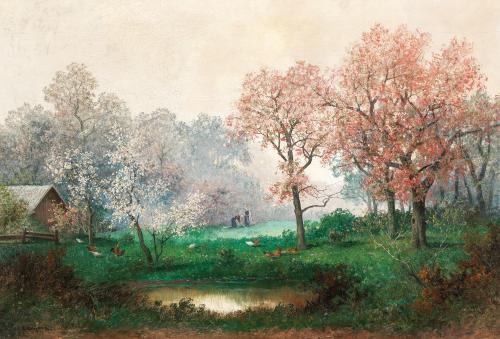
#FineArtFriday: Under flowering trees by Adolf Kaufmann

Adolf_Kaufmann_Under_the_treesjpgArtist: Adolf Kaufmann (1848–1916)

Title: Under flowering trees

Date: before 1916

Medium: oil on canvas

Inscription: signed A. Kaufmann

What I love about this painting:

Kaufmann gives us a beautiful spring day with apple trees and cherry trees in full bloom. The weather is misty, cool and damp the way spring mornings often are here in the Pacific Northwest.

Chickens roam the orchard, and two women are digging, breaking the ground for a spring garden.

To the left is a weathered building. Is it a barn? Is it their home? It’s hidden behind the shrubbery so it’s difficult to tell, but it has no window, so I think it may be a barn.

Nothing is romanticized—we see it the way the artist did on that spring day over a century ago.

About the Artist, via Wikipedia:

Adolf Kaufmann (15 May 1848, in Troppau – 25 November 1916, in Vienna) was an Austrian landscape and marine artist.

He was initially self-taught, but completed his studies with the animal painter, Émile van Marcke, in Paris and undertook several study trips, throughout Europe and the Middle East. His residence alternated between Paris, Berlin, Düsseldorf and Munich.

In 1890, he decided to settle in Vienna and opened a studio in the Wieden district. In 1900, together with Carl von Merode [de] and Heinrich Lefler, he opened an “Art School for Ladies”. He continued to visit Paris frequently and, when he painted there, signed his works with the pseudonym “A. Guyot”. Other names he signed with include “A. Papouschek”, “G. Salvi”, “A. Jarptmann”, “R. Neiber”, “J. Rollin” and “M. Bandouch”. Why he did this is unclear, although his choice of signature often reflects stylistic differences.

His landscapes were influenced by the Barbizon school and the style known as “paysage intime,” both of which he was exposed to in France during the 1870s. (The paysage intimate, French for “familiar landscape,” was a style of painting that dealt with simple, simple landscapes and emerged in the mid-19th century. It was the predecessor of the Impressionist style.) [1]


Credits and Attributions:

IMAGE: Wikimedia Commons contributors, “File:Adolf Kaufmann Unter blühenden Bäumen.jpg,” Wikimedia Commons, the free media repository, https://commons.wikimedia.org/w/index.php?title=File:Adolf_Kaufmann_Unter_bl%C3%BChenden_B%C3%A4umen.jpg&oldid=623159308 (accessed March 23, 2023).

[1] Wikipedia contributors, “Adolf Kaufmann,” Wikipedia, The Free Encyclopedia, https://en.wikipedia.org/w/index.php?title=Adolf_Kaufmann&oldid=1094252143 (accessed March 23, 2023).

7 Comments

Filed under #FineArtFriday

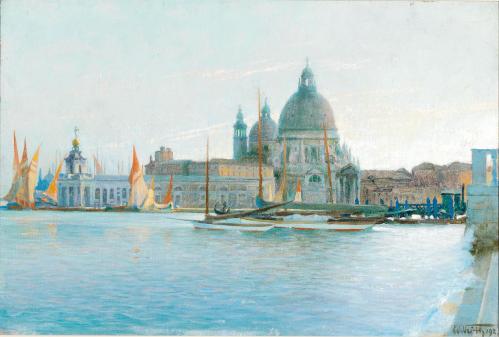
#FineArtFriday: Santa Maria della Salute by Eduard Veith

Eduard_Veith_-_Venezia-Santa_Maria_della_Salute

Artist: Eduard Veith  (1858–1925)

Title: Italian: Venezia: Santa Maria della Salute

Date: by 1925

Medium: oil on canvas

Dimensions: height: 39.5 cm (15.5 in); width: 58 cm (22.8 in)

Collection: Private collection

What I love about this painting:

Veith has captured Venice on a beautiful morning. The sun is shining, the sky is blue and the waters of the canal are calm. Colorful sails are being raised as the fishers prepare to head out to San Marco basin for the day.

In the center is the domed basilica of Santa Maria della Salute (in English, Saint Mary of Health).

This is the sort of morning that makes one feel that all is right in the world.

About the Santa Maria della Salute, via Wikipedia:

Santa Maria della Salute (English: Saint Mary of Health), commonly known simply as the Salute, is a Roman Catholic church and minor basilica located at Punta della Dogana in the Dorsoduro sestiere of the city of VeniceItaly.

It stands on the narrow finger of Punta della Dogana, between the Grand Canal and the Giudecca Canal, at the Bacino di San Marco, making the church visible when entering the Piazza San Marco from the water. The Salute is part of the parish of the Gesuati and is the most recent of the so-called plague churches.

In 1630, Venice experienced an unusually devastating outbreak of the plague. As a votive offering for the city’s deliverance from the pestilence, the Republic of Venice vowed to build and dedicate a church to Our Lady of Health. The church was designed in the then fashionable Baroque style by Baldassare Longhena, who studied under the architect Vincenzo Scamozzi. Construction began in 1631. Most of the objects of art housed in the church bear references to the Black Death. [1]

About the artist, via Wikipedia:

Eduard Veith (30 March 1858, Neutitschein – 18 March 1925, Vienna) was an Austrian portrait painter and stage designer. Many of his works were influenced by Symbolism. He was born to the decorative painter, Julius Veith (1820–1887), and his wife Susanna, née Schleif (1827–1883).

At first, he received training to follow in his father’s profession. Later, he went to Vienna, where he took classes at the Museum of Applied Arts from Professor Ferdinand Laufberger. He capped off his studies by creating sgraffito for exhibition buildings at the Exposition Universelle in Paris.

He then returned home, where he assisted his father with painting churches, synagogues and other ceremonial buildings. This was followed by several study trips to Italy, Belgium and Tunisia. He finally settled in Vienna; becoming a free-lance artist and working mostly by commission.

From 1890, he was a member of the Vienna Künstlerhaus. In 1896, he received a gold medal at the Große Berliner Kunstausstellung. In 1905, he was appointed a Professor at the University of Technology.  In 1911, he married Bertha Griesbeck (1872–1952), from Augsburg. He later taught at the University of Applied Arts Museum of Applied Arts and became a professor there in 1920. During his years in Vienna, he maintained contact with his home town, and held exhibitions there.

He died shortly before his sixty-seventh birthday. [2]


Credits and Attributions:

Image: Wikimedia Commons contributors, “File:Eduard Veith – Venezia-Santa Maria della Salute.jpg,” Wikimedia Commons, the free media repository, https://commons.wikimedia.org/w/index.php?title=File:Eduard_Veith_-_Venezia-Santa_Maria_della_Salute.jpg&oldid=627297217 (accessed March 16, 2023).

[1] Wikipedia contributors, “Santa Maria della Salute,” Wikipedia, The Free Encyclopedia, https://en.wikipedia.org/w/index.php?title=Santa_Maria_della_Salute&oldid=1134116004 (accessed March 16, 2023).

[2] Wikipedia contributors, “Eduard Veith,” Wikipedia, The Free Encyclopedia, https://en.wikipedia.org/w/index.php?title=Eduard_Veith&oldid=1133038416 (accessed March 16, 2023).

5 Comments

Filed under #FineArtFriday

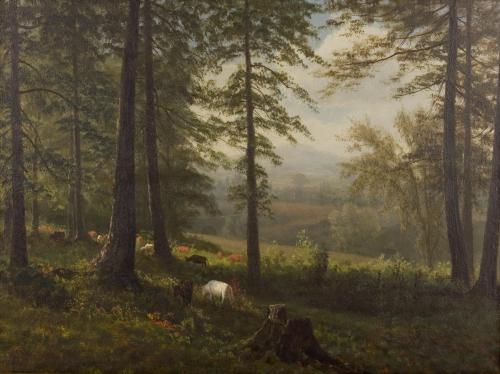
#FineArtFriday: View to a Clearing by Albert Bierstadt (revisited)

Title: View to a Clearing by Albert Bierstadt

Medium: oil on paper mounted on canvas

Dimensions: Height: 14 in (35.5 cm); Width: 19 in (48.2 cm)

Inscriptions: Signature bottom left: ABierstadt

What I love about this painting:

I first posted this painting a year ago. Sometimes life gets ahead of us, and we just need moment of serenity, a chance to relax and let go of stress. Life is a little hectic right now, with sorting through the possessions we’ve acquired over the years of living in this house. A box filled with corkscrews … how many does one family need?  A shopping bag packed with coaxial cables and no hint of what they were once connected to. What were we saving these for? And then there are the things people give you that you wouldn’t have bought for yourself, but which you now own and feel guilty for not appreciating.

We are moving those things on, donating them to Value Village, a store where someone else will want them and love them as they deserve. Today’s picture is a moment in time, a day long ago, but which is exactly what I needed on this dark and rainy March day.

I love the peace of this scene, one of Bierstadt’s quieter paintings.  The muted colors, the rising mist, the filtered light, and the cattle grazing show us a hazy afternoon. It was perfect for a picnic, for mind-wandering, and a good day for painting.

Bierstadt is one of my favorite artists because he was often over the top, a little fantastic, and usually epic. He saw drama in nature and painted it, and like every good storyteller, his imagination filled in the blanks, employing powerful imagery to show his stories.

About the artist, via Wikipedia:

Despite his popular success, Bierstadt was criticized by some contemporaries for the romanticism evident in his choices of subject and his use of light was felt to be excessive. Some critics objected to Bierstadt’s paintings of Native Americans on the grounds that Indians “marred” the “impression of solitary grandeur.”

Interest in Bierstadt’s work was renewed in the 1960s with the exhibition of his small oil studies.  Modern opinions of Bierstadt have been divided. Some critics have regarded his work as gaudy, oversized, extravagant champions of Manifest Destiny. Others have noted that his landscapes helped create support for the conservation movement and the establishment of Yellowstone National Park. Subsequent reassessment of his work has placed it in a favorable context, as stated in 1987:

The temptation (to criticize him) should be steadfastly resisted. Bierstadt’s theatrical art, fervent sociability, international outlook, and unquenchable personal energy reflected the epic expansion in every facet of western civilization during the second half of the nineteenth century.

Bierstadt was a prolific artist, having completed over 500 paintings during his lifetime.


Credits and Attributions:

Wikimedia Commons contributors, “File:Albert Bierstadt – View to a Clearing.jpg,” Wikimedia Commons, the free media repository, https://commons.wikimedia.org/w/index.php?title=File:Albert_Bierstadt_-_View_to_a_Clearing.jpg&oldid=343092014 (accessed March 5, 2021).

Wikipedia contributors, “Albert Bierstadt,” Wikipedia, The Free Encyclopedia, https://en.wikipedia.org/w/index.php?title=Albert_Bierstadt&oldid=1009967730 (accessed March 5, 2021).

12 Comments

Filed under writing