Tag Archives: Fine Art Friday

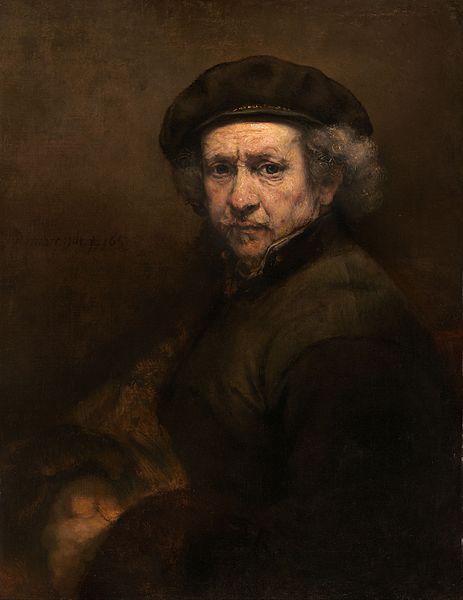
#FineArtFriday: Self Portrait, Rembrandt 1659 (revisited)

Rembrandt Harmenszoon van Rijn, commonly known simply as Rembrandt, is considered the finest artist of the 17th century. Some art historians consider him the finest artist in the history of art, and the most important artist in Dutch art history.

Speaking strictly as a Rembrandt fangirl and abject admirer, I consider his self-portraits to be more honest than those of any other artist.

Whenever he couldn’t afford to pay a model, he painted himself. And of all his known self-portraits, this is my favorite.

Quote from Wikipedia: His self-portraits form a unique and intimate biography, in which the artist surveyed himself without vanity and with the utmost sincerity.

This honesty comes across in all his works featuring himself as the subject. Each portrait shows an aspect of his personality, his sense of humor, his affection for his first wife, Saskia, who was the love of his life, and his wry acceptance of his own human frailties.

Money was a mystery to Rembrandt. He had no understanding of a budget, mishandled his son’s inheritance, spent far more than he earned, and didn’t pay his taxes. In short, he was always in trouble with the authorities, always skirting the edges of disaster.

Rembrandt knew he was talented but didn’t see himself as a creative genius. He was just a man with a passion for art, who lived beyond his means and died a pauper, as did Mozart, and as do most artists and authors.

I feel I know this man, this tired, stressed, poor old man, more so than I do the person he was in his earlier self-portraits. He’s matured, lost the brashness of his youth. When I observe the man in this self-portrait, painted ten years before his death, I see a good-humored man just trying to live a frequently difficult life as well as he can. His face is lined and blemished, not as handsome as he once was. But his eyes seem both kind and familiar, filled with the understanding that comes from living with all one’s heart and experiencing both great joy and deep sorrow.

The art of Rembrandt van Rijn shows us his world as he saw it. Others may disagree with me, but I feel his greatest gift was the ability to convey personality with each portrait. This gift allowed him to portray every person he painted as they really were, blemished and yet beautiful. This is a gift he taught his students, and they were able to copy his style quite effectively, making discerning his true work difficult even for the experts.


Credits and Attributions:

Wikipedia contributors, “Rembrandt,” Wikipedia, The Free Encyclopedia, https://en.wikipedia.org/w/index.php?title=Rembrandt&oldid=844357531(accessed June 8, 2018).

Wikimedia Commons contributors, “File:Rembrandt van Rijn – Self-Portrait – Google Art Project.jpg,” Wikimedia Commons, the free media repository, https://commons.wikimedia.org/w/index.php?title=File:Rembrandt_van_Rijn_-_Self-Portrait_-_Google_Art_Project.jpg&oldid=292800848 (accessed June 8, 2018).
Comments Off on #FineArtFriday: Self Portrait, Rembrandt 1659 (revisited)

Filed under #FineArtFriday

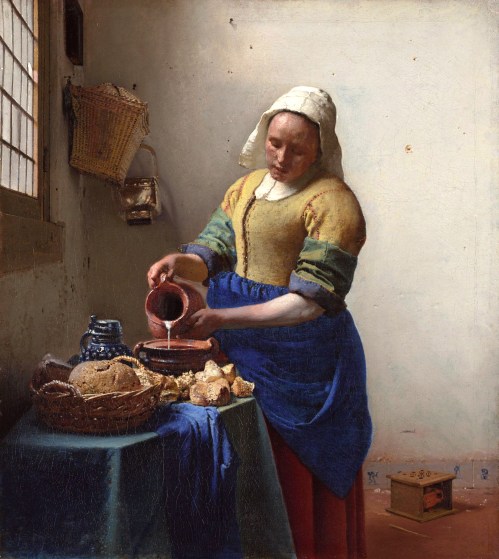
#FineArtFriday: The Milkmaid by Johannes Vermeer (revisited)

What I love about this painting:

It seems like a good time to revisit Vermeer’s famous painting, known as “the Milkmaid.” This is lovely look into the past, a window into daily life of 1657 – 1658. I love the realism, the way the maid carefully pours the milk into the bread.

All of Vermeer’s known works illustrate how the quiet moments in life can be the most profound.

Wikipedia has many things to say about this painting.


About Johannes Vermeer, the Master of Light (from Wikipedia)

Johannes Vermeer (October 1632 – December 1675) was a Dutch painter who specialized in domestic interior scenes of middle-class life. He was a moderately successful provincial genre painter in his lifetime but evidently was not wealthy, leaving his wife and children in debt at his death, perhaps because he produced relatively few paintings.

Vermeer worked slowly and with great care, and frequently used very expensive pigments. He is particularly renowned for his masterly treatment and use of light in his work.

Vermeer painted mostly domestic interior scenes. “Almost all his paintings are apparently set in two smallish rooms in his house in Delft; they show the same furniture and decorations in various arrangements and they often portray the same people, mostly women.”

He was recognized during his lifetime in Delft and The Hague, but his modest celebrity gave way to obscurity after his death. He was barely mentioned in Arnold Houbraken‘s major source book on 17th-century Dutch painting (Grand Theatre of Dutch Painters and Women Artists), and was thus omitted from subsequent surveys of Dutch art for nearly two centuries. In the 19th century, Vermeer was rediscovered by Gustav Friedrich Waagen and Théophile Thoré-Bürger, who published an essay attributing 66 pictures to him, although only 34 paintings are universally attributed to him today. Since that time, Vermeer’s reputation has grown, and he is now acknowledged as one of the greatest painters of the Dutch Golden Age. [2]

About the featured painting, The Milkmaid, also from Wikipedia:

Despite its traditional title, the picture clearly shows a kitchen or housemaid, a low-ranking indoor servant, rather than a milkmaid who actually milks the cow, in a plain room carefully pouring milk into a squat earthenware container (now commonly known as a “Dutch oven”) on a table. Also on the table are various types of bread. She is a young, sturdily built woman wearing a crisp linen cap, a blue apron and work sleeves pushed up from thick forearms. A foot warmer is on the floor behind her, near Delft wall tiles depicting Cupid (to the viewer’s left) and a figure with a pole (to the right). Intense light streams from the window on the left side of the canvas.

The painting is strikingly illusionistic, conveying not just details but a sense of the weight of the woman and the table. “The light, though bright, doesn’t wash out the rough texture of the bread crusts or flatten the volumes of the maid’s thick waist and rounded shoulders”, wrote Karen Rosenberg, an art critic for The New York Times. Yet with half of the woman’s face in shadow, it is “impossible to tell whether her downcast eyes and pursed lips express wistfulness or concentration,” she wrote.

“It’s a little bit of a Mona Lisa effect” in modern viewers’ reactions to the painting, according to Walter Liedtke, curator of the department of European paintings at The Metropolitan Museum of Art, and organizer of two Vermeer exhibits. “There’s a bit of mystery about her for modern audiences. She is going about her daily task, faintly smiling. And our reaction is ‘What is she thinking?'” [1]


Credits and Attributions:

The Milkmaid, by Johannes (Jan) Vermeer ca. 1658 [Public domain or Public domain], via Wikimedia Commons.

[1] Wikipedia contributors, “The Milkmaid (Vermeer),” Wikipedia, The Free Encyclopedia, https://en.wikipedia.org/w/index.php?title=The_Milkmaid_(Vermeer)&oldid=853243011 (accessed August 31, 2018).

[2] Wikipedia contributors, “Johannes Vermeer,” Wikipedia, The Free Encyclopedia, https://en.wikipedia.org/w/index.php?title=Johannes_Vermeer&oldid=854172655 (accessed August 31, 2018).

7 Comments

Filed under #FineArtFriday, writing

#FineArtFriday: Le Déjeuner sur l’herbe (Luncheon on the Grass) by Claude Monet ca. 1865

Monet_dejeunersurlherbeArtist: Claude Monet (1840–1926)

Title: French: Déjeuner sur l’herbe (English: Luncheon on the Grass) Central panel

Depicted people:

Date: between 1865 and 1866

Medium: oil on canvas

Dimensions: height: 248 cm (97.6 in) width: 217 cm (85.4 in)

Collection: Musée d’Orsay

Place of creation: Chailly-en-Bière

What I love about this painting:

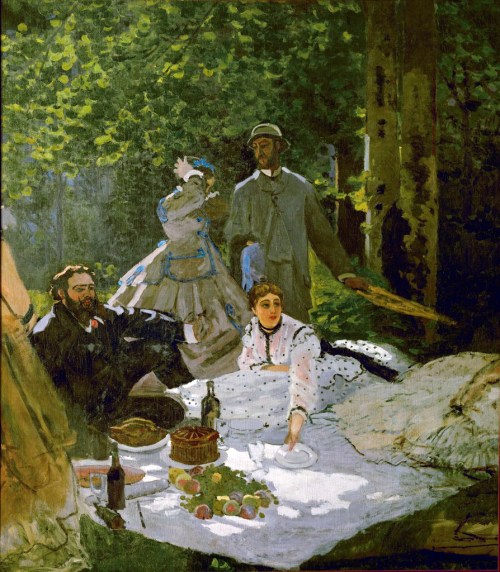
This painting may be unfinished, but in this section, the central panel, Monet gives us a beautiful day, sunny and warm. It’s a perfect day for a picnic with friends, to forget the stresses of life and just enjoy the beauty of the world around you. It’s the perfect counterfoil to my often-gloomy Pacific Northwestern winter, the kind of day that gives me hope that a pleasant spring waits just a few weeks away.

Thank you, Monsieur Monet. I needed this glimpse of summer.

About this painting via Wikipedia:

Le Déjeuner sur l’herbe (English: Luncheon on the Grass) is an 1865–1866 oil on canvas painting by Claude Monet, produced in response to the 1863 work of the same title by Édouard Manet. It remains unfinished, but two large fragments (central and left panels) are now in the Musée d’Orsay in Paris, whilst a smaller 1866 version is now in the Pushkin Museum in Moscow.

Monet included the artist Gustave Courbet in the painting.

The painting in its whole form shows twelve people. They are clothed in Parisian clothing which was fashionable at that time. They are having a picnic in near a forest glade. All the people are gathered around a white picnic blanket, where food as fruits, cake or wine is located. The mood in this natural space is primarily created by the play of light and shadow, which is created by deciduous tree above them. [1]

About the Artist, via Wikipedia:

Oscar-Claude Monet 14 November 1840 – 5 December 1926) was a French painter and founder of impressionist painting who is seen as a key precursor to modernism, especially in his attempts to paint nature as he perceived it. During his long career, he was the most consistent and prolific practitioner of impressionism’s philosophy of expressing one’s perceptions before nature, especially as applied to plein air (outdoor) landscape painting. The term “Impressionism” is derived from the title of his painting Impression, soleil levant, exhibited in 1874 (the “exhibition of rejects”) initiated by Monet and his associates as an alternative to the Salon.

His last time exhibiting with the Impressionists was in 1882—four years before the final Impressionist exhibition.

Monet, Renoir, Pissarro, Morisot, Cézanne and Sisley proceeded to experiment with new methods of depicting reality. They rejected the dark, contrasting lighting of romantic and realist paintings, in favour of the pale tones of their peers’ paintings such as those by Jean-Baptiste-Camille Corot and Boudin. After developing methods for painting transient effects, Monet would go on to seek more demanding subjects, new patrons and collectors; his paintings produced in the early 1870s left a lasting impact on the movement and his peers—many of whom moved to Argenteuil as a result of admiring his depiction. [2]


Credits and Attributions:

IMAGE: Le Déjeuner sur l’herbe (Luncheon on the Grass) by Claude Monet ca. 1865 Wikimedia Commons contributors, “File:Monet dejeunersurlherbe.jpg,” Wikimedia Commons, the free media repository, https://commons.wikimedia.org/w/index.php?title=File:Monet_dejeunersurlherbe.jpg&oldid=711036251 (accessed February 16, 2023).

[1] Wikipedia contributors, “Le Déjeuner sur l’herbe (Monet, Paris),” Wikipedia, The Free Encyclopedia, https://en.wikipedia.org/w/index.php?title=Le_D%C3%A9jeuner_sur_l%27herbe_(Monet,_Paris)&oldid=1134534732 (accessed February 16, 2023).

[2] Wikipedia contributors, “Claude Monet,” Wikipedia, The Free Encyclopedia, https://en.wikipedia.org/w/index.php?title=Claude_Monet&oldid=1137970938 (accessed February 16, 2023).

3 Comments

Filed under #FineArtFriday

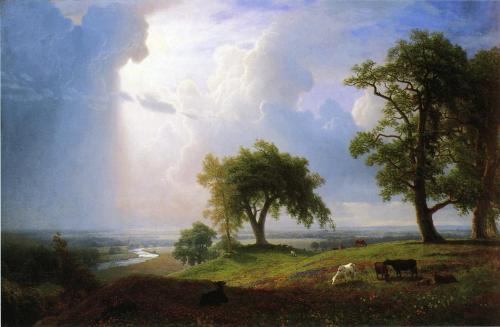
#FineArtFriday: California Spring by Albert Bierstadt 1875

Albert_Bierstadt_California_SpringArtist: Albert Bierstadt (1830–1902)

Title: California Spring

Genre: landscape art

Date: 1875

Medium: oil on canvas

Dimensions: height: 187.3 cm (73.7 in); width: 264.2 cm (104 in)

Current location: Fine Arts Museums of San Francisco

What I love about this painting:

I love this composition, the way everything is deliberately placed. Cattle graze on a hilltop beneath a grove of trees, uncaring of the rainstorm sweeping across the valley below, far off in the distance. The immensity of the sky is the focus of this scene, with the sun emerging from the clouds, a brief promise of warmer days. Spring has arrived on this hilltop.

Here at Casa del Jasperson, we’re tired of winter, done with rain and dark days. Albert Bierstadt paints us an idyllic scene of seasonal weather and the harmony of nature. The grass is green, the cattle are happy, and while rain may come, summer is around the corner.

About the artist, via Wikipedia:

Albert Bierstadt (January 7, 1830 – February 18, 1902) was a German American painter best known for his lavish, sweeping landscapes of the American West. He joined several journeys of the Westward Expansion to paint the scenes. He was not the first artist to record the sites, but he was the foremost painter of them for the remainder of the 19th century.

Bierstadt was born in Prussia, but his family moved to the United States when he was one year old. He returned to study painting for several years in Düsseldorf. He became part of the second generation of the Hudson River School in New York, an informal group of like-minded painters who started painting along the Hudson River. Their style was based on carefully detailed paintings with romantic, almost glowing lighting, sometimes called luminism. Bierstadt was an important interpreter of the western landscape, and he is also grouped with the Rocky Mountain School. [1]


Credits and Attributions:

Image: Wikimedia Commons contributors, “File:Albert Bierstadt California Spring.jpg,” Wikimedia Commons, the free media repository, https://commons.wikimedia.org/w/index.php?title=File:Albert_Bierstadt_California_Spring.jpg&oldid=701053175 (accessed February 9, 2023).

[1] Wikipedia contributors, “Albert Bierstadt,” Wikipedia, The Free Encyclopedia, https://en.wikipedia.org/w/index.php?title=Albert_Bierstadt&oldid=1137881139 (accessed February 9, 2023).

5 Comments

Filed under #FineArtFriday, writing

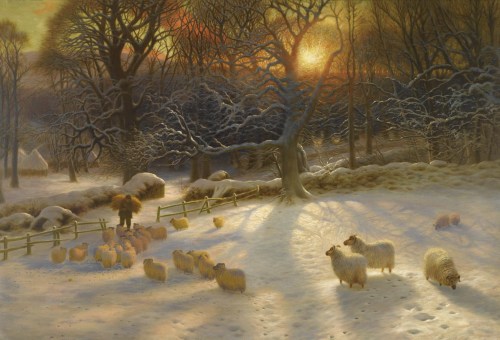
#FineArtFriday: Beneath the Snow Encumbered Branches by Joseph Farquharson 1903 (revisited)

Title: Beneath the Snow Encumbered Branches

Artist: Joseph Farquharson

Publisher: Hallmark Cards

Genre: landscape art

Date: Circa 1903

Medium: oil on canvas

Dimensions: 82 x 119.25 cm. (32 5/16 x 46 15/16 in.

What I love about this painting:

I first shared this painting in January of 2021. I found a haunting kind of nostalgia in it, an echo of times long gone. Joseph Farquharson perfectly captures the way the setting sun’s rays fall across the snow-covered landscape.

The snow is thick and heavy, and the sheep are fluffy in their long coats. Winter has come and the shadows are long, but the conical haystacks across the lane contain plenty to last through the harshest season.

I love how the afternoon light is reflected on the snowy landscape and in the branches. He shows it with a perfect golden luminosity, the hue that presages imminent dusk. 

About the Artist, via Wikipedia:

Joseph Farquharson DL RA (4 May 1846 – 15 April 1935) was a Scottish painter, chiefly of landscapes, mostly in Scotland and very often including animals. He is most famous for his snowy winter landscapes, often featuring sheep and often depicting dawn or dusk. The unusual titles of many of Farquharson’s paintings stand out and are sometimes long. Many of them were taken from poems by Burns, Milton, Shakespeare, and Gray. Farquharson was very patriotic and well versed in Scottish literature.

The remarkable realism of Farquharson’s work can be attributed to his desire to work en plein air. This had to be carried out in a unique way which was adapted to the harsh Scottish climate. Farquharson had constructed a painting hut on wheels, complete with a stove and large glass window for observing the landscape. Likewise to achieve as realistic a result as possible when painting the sheep which frequently appear in his snowscapes, he used a flock of “imitation” sheep which could be placed as required in the landscape of his choice. Farquharson painted so many scenes of cattle and sheep in snow he was nicknamed ‘Frozen Mutton Farquharson’.

Farquharson inherited the title of Laird in 1918 after the death of his elder brother Robert, a doctor and MP for West Aberdeenshire.

In 2008 the original of the 1901 painting Beneath the Snow Encumbered Branches came to light, for the first time in 40 years, when the lady owner put her house up for sale. The painting, which she had bought from a Bond Street dealer in the 1960s for £1,450, was expected to fetch up to £70,000 when it was offered for sale by auction at Lyon and Turnbull in Edinburgh. Nick Carnow, a director at the auctioneers, form said that the unnamed seller was moving to a smaller house and would not have room for the painting. In fact it sold for more than twice that estimate to another private collector in Scotland for £147,600.


Credits and Attributions:

Beneath the Snow Encumbered Branches Joseph Farquharson, Public domain, via Wikimedia Commons

Wikipedia contributors, “Joseph Farquharson,” Wikipedia, The Free Encyclopedia, https://en.wikipedia.org/w/index.php?title=Joseph_Farquharson&oldid=982764133 (accessed January 1, 2021).

Wikimedia Commons contributors, “File:The shortening winter’s day is near a close Farquharson.jpg,” Wikimedia Commons, the free media repository, https://commons.wikimedia.org/w/index.php?title=File:The_shortening_winter%27s_day_is_near_a_close_Farquharson.jpg&oldid=354603464 (accessed January 1, 2021).

2 Comments

Filed under #FineArtFriday

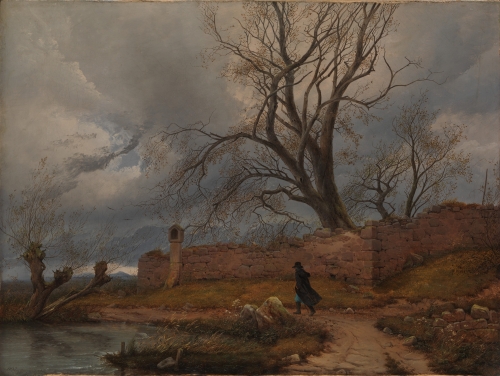
#FineArtFriday: Wanderer in the Storm by Carl Julius von Leypold 1835

Karl_Julius_von_Leypold_-_Wanderer_im_SturmArtist: Carl Julius von Leypold  (1806–1874)

Title: Wanderer in the Storm

Date: 1835

Medium: oil on canvas

Dimensions: height: 42.5 cm (16.7 in); width: 56.5 cm (22.2 in)

Collection: Metropolitan Museum of Art

What I love about this painting:

This painting completely describes the weather we’re experiencing this week in the cold, dark, and stormy Pacific Northwest—wind and rain and rain and wind. Winter is in full swing. Hopefully, we will avoid having more snow and ice, but it’s only January. Anything can be lurking around the corner.

I love the dark and moody sky that von Leypold paints for us. It has movement, a sense of life, of wind and rain gathering momentum, a small pause while it builds toward a tantrum of the wintery kind.

One can almost hear the water lapping at the shore. Beyond the muddy lane, the trees are like me, old but strong, holding their barren branches defiant before the storm. They seem to shout, “We will bend but never break!” and by bending with the winds, those trees will survive to see yet another blossoming of spring.

The ancient stone wall stands firm, still doing its duty despite being long neglected and left to ruin. It refuses to abandon its purpose, although it no longer remembers what that might be.

The man trudges purposefully, despite the wind that whips at his long coat. Does he feel the cold, or is he walking quickly enough that he is warm? And where is he going? Who is he so intent upon seeing that he would brave the storm on foot?

There is a story in this painting.

About the Artist, via Wikipedia:

Carl Julius von Leypold (1806–1874) was a German Romantic landscape painter known for his painting, “Wanderer in the Storm.”

Von Leypold studied landscape painting with Johan Christian Dahl at the Dresden Academy of Fine Arts between 1820 and 1829. From 1826 onwards, Caspar David Friedrich influenced his choice of subjects and painting style. His landscapes are characterized by “a painterly, but at the same time sharp-brushed style, in which high painting culture is combined with Biedermeier objectivity.”

On March 5, 1857, he became an honorary member of the Dresden Art Academy. [1]


Credits and Attributions:

Image: Wanderer in the Storm by Carl Julius von Leypold PD|100. Wikimedia Commons contributors, “File:Karl Julius von Leypold – Wanderer im Sturm.jpg,” Wikimedia Commons, the free media repository, https://commons.wikimedia.org/w/index.php?title=File:Karl_Julius_von_Leypold_-_Wanderer_im_Sturm.jpg&oldid=675091985 (accessed January 5, 2023).

[1] Wikipedia contributors, “Carl Julius von Leypold,” Wikipedia, The Free Encyclopedia, https://en.wikipedia.org/w/index.php?title=Carl_Julius_von_Leypold&oldid=1095364695 (accessed January 5, 2023).

4 Comments

Filed under #FineArtFriday, writing

#FineArtFriday: The Tax-collector’s Office by Pieter Breughel the Younger ca. 1615

Pieter_BRUEGHEL_Ii_-_The_tax-collector's_office_-_Google_Art_ProjectArtist: Pieter Breughel the Younger (1564–1638)

Title: The tax-collector’s office, also known as the Village Lawyer

Date: circa 1615

Medium: oil on panel

Dimensions: height: 74.5 cm (29.3 in); width: 106.5 cm (41.9 in)

Collection: Art Gallery of South Australia 

What I love about this painting:

Pieter the Younger was never considered as fine a painter as his father, Pieter Bruegel the Elder, or his brother, Jan Brueghel. He was, however, considered a master printmaker and his workshop was highly regarded. But he was not respected as an artist. Critics of the day felt he copied his father’s style, rather than developing his own. While he did paint in a folk-art style reminiscent of his father’s, his is sharper, more refined, taking it to the next level.

The people in the above picture are looking lean and ragged. The Little Ice Age gripped Europe, and times were hard. I love the color, the action, the commotion of the people. So many stories are shown in this one painting.

About this painting via Wikipedia:

Pieter Brueghel the Younger created original works largely in the idiom of his father which are energetic, bold and bright and adapted to the 17th-century style.  One of the artist’s most successful original designs was the painting of The Village Lawyer (sometimes also called the Tax Collector’s Office, the Payment of the Tithe, the Lawyer of Bad Cases and the Notary’s Office). The different titles of the work indicate that it may have been interpreted in these different ways in the 17th century. The title The Village Lawyer is probably the best suited since the person behind the desk is wearing a lawyer’s bonnet, the collection of taxes usually did not occur in such setting and the paperwork and bags on the desk look like those for requests and decrees. The picture also shows peasants lining up with presents such as chickens and eggs to please the lawyer, which was a common occurrence, whereas tithe payments were made in grain. The painting shows his interest in and close observation of village life. Pieter Brueghel the Younger’s workshop made many copies of the composition in different formats. There exist 19 signed and dated versions of this work (from between 1615–22) out of some 25 originals and 35 questionable versions. [1]


Credits and Attributions:

Image: Wikimedia Commons contributors, “File:Pieter BRUEGHEL Ii – The tax-collector’s office – Google Art Project.jpg,” Wikimedia Commons, the free media repository, https://commons.wikimedia.org/w/index.php?title=File:Pieter_BRUEGHEL_Ii_-_The_tax-collector%27s_office_-_Google_Art_Project.jpg&oldid=708678946 (accessed December 9, 2022).

[1] Wikipedia contributors, “Pieter Brueghel the Younger,” Wikipedia, The Free Encyclopedia, https://en.wikipedia.org/w/index.php?title=Pieter_Brueghel_the_Younger&oldid=1112359702 (accessed December 9, 2022).

6 Comments

Filed under writing

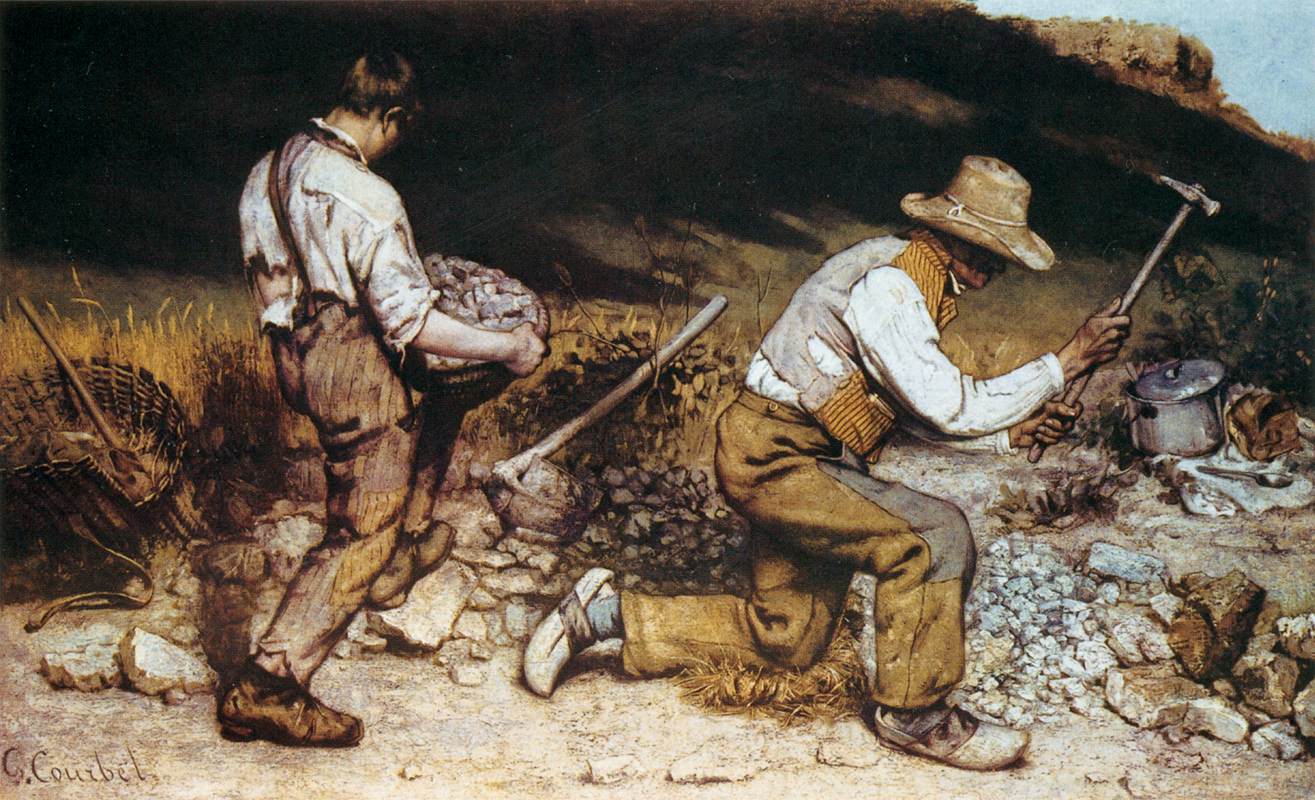
#FineArtFriday: The Stonebreakers by Gustave Courbet 1849

Gustave_Courbet_-_The_Stonebreakers_-_WGA05457Artist: Gustave Courbet  (1819–1877)

Title: The Stonebreakers

Date:1849

Medium: oil on canvas

Dimensions: height: 165 cm (64.9 in); width: 257 cm (101.1 in)

Current location: destroyed in fire, 1945 (Dresden, Germany)

Today’s image comes to us via the miracle of 20th century photography and modern digital photographic restoration.

The exact number of paintings and other art masterpieces that were either destroyed or are still missing since World War II is not known, but is estimated that during World War II, the Nazis looted some 600,000 paintings from Jews and Art Museums, at least 100,000 of which are still missing. Unfortunately, the original canvas of this painting was a casualty of war, destroyed in the bombing of Dresden.

About this image, via Wikipedia: Considered to be the first of Courbet’s great works, The Stone Breakers of 1849 is an example of social realism that caused a sensation when it was first exhibited at the Paris Salon in 1850. The work was based on two men, one young and one old, whom Courbet discovered engaged in backbreaking labor on the side of the road when he returned to Ornans for an eight-month visit in October 1848. On his inspiration, Courbet told his friends and art critics Francis Wey and Jules Champfleury, “It is not often that one encounters so complete an expression of poverty and so, right then and there I got the idea for a painting.”

While other artists had depicted the plight of the rural poor, Courbet’s peasants are not idealized like those in works such as Millet’s The Gleaners. [1]

Also via Wikipedia: The Stone Breakers (FrenchLes Casseurs de pierres) was an 1849 painting by the French painter Gustave Courbet. It was a work of realism, depicting two peasants, a young man and an old man, breaking rocks.

The Stone Breakers was first exhibited at the Paris Salon of 1850. As a work of realism the subject matter addressed a scene of everyday life. This painting was intended to show the hard labor that poor citizens experienced. Courbet did not show the figure’s faces, they represent the “every man” and are not meant to be specific individuals. At the same time the clothing of the figures implies some degree of individuality, the younger man’s pants are too short and the older man’s vest is striped.

The painting was destroyed during World War II, along with 154 other pictures, when a transport vehicle moving the pictures to the castle of Königstein, near Dresden, was bombed by Allied forces in February 1945. [2]

About the artist, via Wikipedia:

Jean Désiré Gustave Courbet (UK/ˈkʊərbeɪ/ KOOR-bay,[1] US/kʊərˈbeɪ/ koor-BAY,[2] French: [ɡystav kuʁbɛ]; 10 June 1819 – 31 December 1877) was a French painter who led the Realism movement in 19th-century French painting. Committed to painting only what he could see, he rejected academic convention and the Romanticism of the previous generation of visual artists. His independence set an example that was important to later artists, such as the Impressionists and the Cubists. Courbet occupies an important place in 19th-century French painting as an innovator and as an artist willing to make bold social statements through his work.

Courbet’s paintings of the late 1840s and early 1850s brought him his first recognition. They challenged convention by depicting unidealized peasants and workers, often on a grand scale traditionally reserved for paintings of religious or historical subjects. Courbet’s subsequent paintings were mostly of a less overtly political character: landscapesseascapeshunting scenesnudes, and still lifes. Courbet, a socialist, was active in the political developments of France. He was imprisoned for six months in 1871 for his involvement with the Paris Commune and lived in exile in Switzerland from 1873 until his death four years later. [1]

Credits and Attributions:

Image: Wikimedia Commons contributors, “File:Gustave Courbet – The Stonebreakers – WGA05457.jpg,” Wikimedia Commons, the free media repository, https://commons.wikimedia.org/w/index.php?title=File:Gustave_Courbet_-_The_Stonebreakers_-_WGA05457.jpg&oldid=661589775 (accessed December 1, 2022).

Wikipedia contributors, “Gustave Courbet,” Wikipedia, The Free Encyclopedia, https://en.wikipedia.org/w/index.php?title=Gustave_Courbet&oldid=1123079028 (accessed December 1, 2022). [1]

Wikipedia contributors, “The Stone Breakers,” Wikipedia, The Free Encyclopedia, https://en.wikipedia.org/w/index.php?title=The_Stone_Breakers&oldid=1070869064 (accessed December 1, 2022). [2]

4 Comments

Filed under #FineArtFriday

#FineArtFriday: Rembrandt through his own eyes, 1659 (revisited)

Rembrandt Harmenszoon van Rijn, commonly known simply as Rembrandt, is considered the finest artist of the 17th century. Some art historians consider him the finest artist in the history of art, and the most important artist in Dutch art history.

Speaking strictly as a Rembrandt fangirl and abject admirer, I consider his self-portraits to be more honest than those of any other artist.

Quote from Wikipedia: His self-portraits form a unique and intimate biography, in which the artist surveyed himself without vanity and with the utmost sincerity.

This honesty comes across in all his works featuring himself as the subject, even those where he portrays himself as a shepherd or the prodigal son. Each portrait shows an aspect of his personality, his sense of humor, his affection for Saskia who was the love of his life, and his wry acceptance of his own human frailties.

Rembrandt knew he was talented, but didn’t see himself as a creative genius. He was just a man with a passion for art, who lived beyond his means and died a pauper, as did Mozart, and as do most artists and authors.

I feel I know this man, more so than I do the person he was in his earlier self-portraits. He’s matured, lost some of the brashness of his youth. When I observe the man in this self-portrait, painted ten years before his death, I see a good-humored man just trying to live a frequently difficult life as well as he can. His face is lined and blemished, not as handsome as he once was. But his eyes seem both kind and familiar, filled with the understanding that comes from living with all one’s heart and experiencing both great joy and deep sorrow.

The art of Rembrandt van Rijn shows us his world as he saw it. Others may disagree with me, but I feel his greatest gift was the ability to convey personality with each portrait. This gift allowed him to portray every person he painted as they really were, blemished and yet beautiful. This is a gift he taught his students, and they were able to copy his style quite effectively, making discerning his true work difficult even for the experts.


Credits and Attributions:

Wikipedia contributors, “Rembrandt,” Wikipedia, The Free Encyclopedia, https://en.wikipedia.org/w/index.php?title=Rembrandt&oldid=844357531(accessed June 8, 2018).

Wikimedia Commons contributors, “File:Rembrandt van Rijn – Self-Portrait – Google Art Project.jpg,” Wikimedia Commons, the free media repository, https://commons.wikimedia.org/w/index.php?title=File:Rembrandt_van_Rijn_-_Self-Portrait_-_Google_Art_Project.jpg&oldid=292800848 (accessed June 8, 2018).
Comments Off on #FineArtFriday: Rembrandt through his own eyes, 1659 (revisited)

Filed under #FineArtFriday

#FineArtFriday: Peace at Sunset (Evening in the White Mountains) by Thomas Cole, ca 1827

Peace_at_Sunset_(Evening_in_the_White_Mountains)_Thomas_ColeArtist: Thomas Cole (1801–1848)

Title: Peace at Sunset (Evening in the White Mountains)

Date: circa 1827

Medium: oil on canvas

Dimensions: height: 68.9 cm (27.1 in); width: 81.9 cm (32.2 in)

Collection: Fine Arts Museums of San Francisco

What I love about this painting:

This is one of Cole’s early works. He was able to show us the kind of autumn day we love, with rain trying to sweep in, but held back by the sunshine. It’s good day, despite the chill breeze attempting to scour the leaves from the trees. Clouds brush the hilltops, but the reds and golds seem to glow in the sunlight.

About the Artist, via Wikipedia:

Thomas Cole (February 1, 1801 – February 11, 1848) was an English-American painter known for his landscape and history paintings. He is regarded as the founder of the Hudson River School, an American art movement that flourished in the mid-19th century. Cole’s work is known for its romantic portrayal of the American wilderness.

After 1827 Cole maintained a studio at the farm called Cedar Grove, in the town of Catskill, New York. He painted a significant portion of his work in this studio. In 1836, he married Maria Bartow of Catskill, a niece of the owners, and became a year-round resident. Thomas and Maria had five children. Cole’s daughter Emily was a botanical artist who worked in watercolor and painted porcelain. Cole’s sister, Sarah Cole, was also a landscape painter.

Additionally, Cole held many friendships with important figures in the art world including Daniel Wadsworth, with whom he shared a close friendship. Proof of this friendship can be seen in the letters that were unearthed in the 1980s by the Trinity College Watkinson Library. Cole emotionally wrote Wadsworth in July 1832: “Years have passed away since I saw you & time & the world have undoubtedly wrought many changes in both of us; but the recollection of your friendship… [has] never faded in my mind & I look at those pleasures as ‘flowers that never will in other garden grow-‘”

Thomas Cole died at Catskill on February 11, 1848, of pleurisy. The fourth highest peak in the Catskills is named Thomas Cole Mountain in his honor. Cedar Grove, also known as the Thomas Cole House, was declared a National Historic Site in 1999 and is now open to the public.


Credits and Attributions:

Peace at Sunset (Evening in the White Mountains) by Thomas Cole PD|100 via Wikimedia Commons.

Wikipedia contributors, “Thomas Cole,” Wikipedia, The Free Encyclopedia, https://en.wikipedia.org/w/index.php?title=Thomas_Cole&oldid=1120453843 (accessed November 10, 2022).

Comments Off on #FineArtFriday: Peace at Sunset (Evening in the White Mountains) by Thomas Cole, ca 1827

Filed under #FineArtFriday