Tag Archives: indie publishing

Wordless Dictionaries

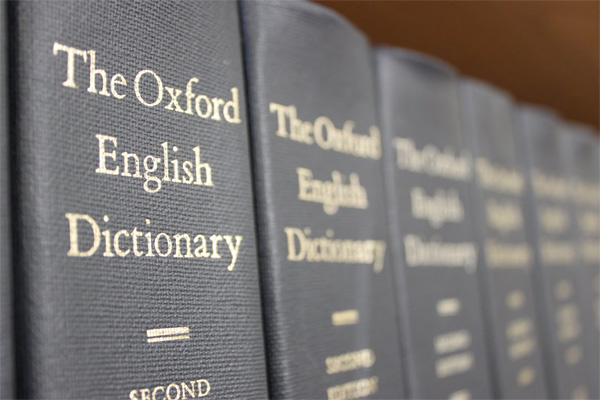
oxford_dictionaryWe are in the midst of an extreme shift in the English language, a continual evolution as impossible to stop as the  melting of the Antarctic ice-cap. This change is not necessarily a terrible thing, but it does come along with some interesting complications.

Robert Macfarlane discussed one negative aspect of our language shift in a blog post last week for The Guardian. He is not  saying that the rapid shift in our dialect and word-usage is bad–after all, language needs to be spoken and it is like water: it’s always on the move and incredibly difficult to contain.

cowslip

cowslip

But Macfarlane sees a negative in the modern view of this fluidity, one that struck a real chord with me: “Under pressure, Oxford University Press revealed a list of the entries it no longer felt to be relevant to a modern-day childhood. The deletions included acorn, adder, ash, beech, bluebell, buttercup, catkin, conker, cowslip,cygnet, dandelion, fern, hazel, heather, heron, ivy, kingfisher, lark, mistletoe,nectar, newt, otter, pasture and willow. The words taking their places in the new edition included attachment, block-graph, blog, broadband, bullet-point, celebrity, chatroom, committee, cut-and-paste, MP3 player and voice-mail. As I had been entranced by the language preserved in the prose‑poem of the “Peat Glossary”, so I was dismayed by the language that had fallen (been pushed) from the dictionary. For blackberry, read Blackberry.”

Now, admittedly Robert Macfarlane is an avid reader of literary fiction, and he also writes literary and travel books. However, many people are  still reading above the comic book level, and what he has to say in his piece concerns the dumbing-down or “flattening” of the language. Don’t try to tell me there isn’t enough room in the book for these words. Dictionaries are on-line now and there is in infinite amount of space in the internet for these words.

oxford school dictionaryDictionaries are the first reference book children will come into contact with in their schools, followed closely nowadays by Wikipedia. I admit that in a desk-reference form space is limited, but in a world where Blackberry means a smart-phone, there is no lack of space.

How will the landscape of our language look in fifty years? I sometimes doubt I would be understood, speaking in my ancient Northwest American dialect, using words that have no relevance. Without a comprehensive dictionary, how will the words I write today be understood by my great-grandchildren?

If I could say one thing to those who compile dictionaries it is that ALL the many words that make up our English language  have relevance and should be  included in what is being marketed as a truly comprehensive dictionary. At some point, a curious reader is going to want to know the meaning of a word, and if that word appeared in the dictionary  at one time, why must it be removed just because a committee of naive scholars with extremely limited experience feels it is not needed?

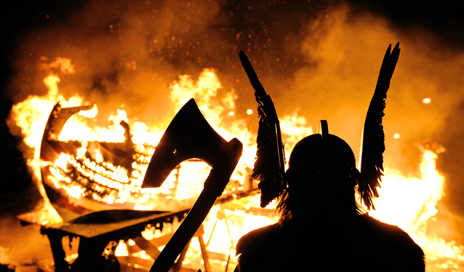
_72982736_vikings courtesy of BBCTo me, this is tantamount to a mass burning of books just because they contain “dangerous ideas.”

I have one thing to say to the modern publishers of dictionaries: You have unlimited space in an on-line dictionary. When you allow words to fall out of the dictionary because they have fallen out of common use in YOUR milieu,  your dictionary is not as comprehensive as you are pretending it is. You have lost YOUR relevance at that point.

These mongers of wordless dictionaries should feel some shame, because they are as responsible for the dumbing-down of the English language as is the casual speaker. Their own relevance is questionable, as more and more seekers of quick information will find it in the bowels of the fount of all knowledge, Wikipedia, OR they will Google it, as I did the word “inexorable.”

6 Comments

Filed under Adventure, Battles, Books, Fantasy, Humor, Literature, Publishing, Self Publishing, Uncategorized, writer, writing

Critique groups vs beta reading groups

Book- onstruction-sign copyEvery writer needs honest, constructive feedback in order to grow in their craft. Many will join critique or beta reading groups. These groups come in all sorts and sizes, some specializing in general fiction and some in genres like mystery, science fiction, fantasy, or romance.

Most communities have clusters of authors—after all, nowadays everyone either is an author or has a couple in the family . In your community you will find groups for beginners, or some that cater to more advanced crowds. I guarantee there will be one to fit your needs.

We’ve all heard the horror stories regarding critique groups, and perhaps even experienced one. Making a poor choice in writing groups can be devastating—it can undermine a budding author’s confidence and destroy a person’s joy in the craft. The seas are rough out there but many writing groups are really good, supportive gatherings of authors who stay for years and welcome new authors into their group with open arms.

Other groups can be cliquish, unwelcoming, and daunting to new arrivals. Authors just beginning to explore this necessary part of the craft will not come back to one of these groups if they were given the cold-shoulder the first time.

There is a difference in types of writing groups, too. Some are traditional critique groups, people who usually read a few pages aloud at their sessions and discuss it in detail in a round-table fashion. This sort of focus can be just right for some authors.

Because traditional critique groups focus only on 3 or 4 pages at a time, they lack the context to be able to discern if your protagonist has developed sufficiently along his character arc by the first 1/4 of the tale. However, they can tell you if you have made editing errors, and discuss small points of technique within those few pages.

Frankly, I am not interested in this kind of group.

These sorts of groups don’t have the ability to properly critique the larger picture—pacing, overall story arc, worldbuilding, character development, and on, and on–because these things can only be judged in larger context. So if, like me, that is the sort of input you are looking for, my advice is to find a beta reading group.

Critique groups cannot do what beta readers can.

But how do you select a group? Before you join a beta reading group, you have the right to know what that group focuses on. Ask yourself these questions:

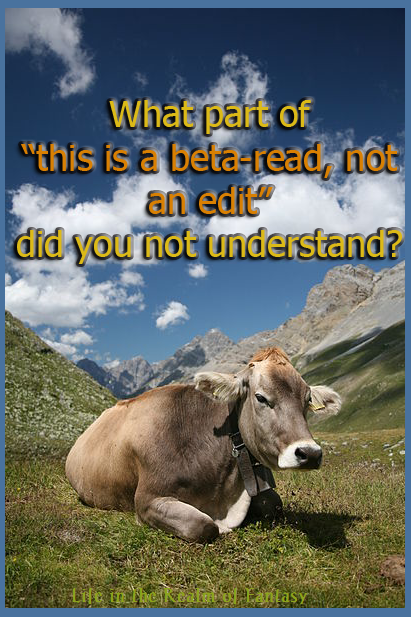
beta read memeWhat do I want from this group? Orson Scott Card says the answers should be:

  1. Where did my chapter bog down?
  2. What did they think about my characters?
  3. Where did they get confused and what did they have to read twice?
  4. Did it become unbelievable or too convenient at any point?
  5. What do they think will happen to the characters now?

Then after you have sat in on one of their sessions and observed how they treat each others’ work, ask yourself, “What kind of vibes did I get from this group of people? Will I benefit from sharing my work with this group? Did the comments they made to each other sound helpful?” Hopefully, the answer to those questions will be a resounding “yes.”

If not, run now. Run far, far away.

There are common negatives to watch out for in all writing groups: If you have stumbled into a group where the most visible member is a self-important, read-all-the-books-on-writing-so-I-know-it-all kind of a person, don’t bother joining or you’ll be subjected to many accounts of how their writing group in Minnesota was so much better than this pathetic group.

Another author you might watch out for is the ubiquitous Famous-Author-Name-Dropper, a person who must be important because she has been to a great many seminars and conventions with these famous people, and hung out in the bar with one of them once. If it turns out she is in your prospective group, it may not be the group you are looking for. Sometimes they are the same person, sometime not, but either one of these wannabe-famous authors are poison—in their eyes the group only exists to admire them, and they will causally cut your work to shreds, dismissing it as merely amateur in the face of their “professional” experience.

When you are considering joining a group, ask the leader/chairperson these questions:

  1. If the group is a beta reading group focused on first drafts, what do they consider a first draft? Do you have to hire an editor and have it thoroughly edited before you submit it to this group? Because that is not a first draft, and that group would be a waste of your time.
  2. Will you receive insights into your manuscript on points you hadn’t considered, or will the focus of the discussion centered on minor editing issues that you are already aware of?
  3. Ask the leader to define for you the specific areas that readers will be looking at: Character development, pacing the arc of the scene, pacing the arc of the conversation, worldbuilding.

So let’s say you have found a group who seems to a good bunch of people, and yes, they read and write in your genre. You trust them enough to submit your first piece to the group. After the session is over, ask yourself:

  1. Do I feel positive about my work or do I feel like my work was treated as being less than important?
  2. Did I gain anything from the experience that would advance the plot or did I just hear a rehash of arm-chair editing from a wannabe guru?

The answers to these questions have to be that you feel good about your work, that you saw through their eyes the weaknesses, and that they can be fixed.

beta read meme 2If the strengths and weaknesses of the characters, and the overall arc of the chapter were overlooked in the face of fixable editing errors then you did not get the insight into the particular trouble-spot that you were looking for.

Ask yourself this: “When I was discussing the direction I wanted to take the tale in, did I sense that they were interested in my story?” If the answer is anything other than a resounding “yes” you have the right to leave the group.

New authors join writing groups feeling a great deal of trepidation, filled with uncertainty and fear. They fear being belittled and told their work is crap, and sometimes that happens. At the end of the day, you have to feel as if you have gained something from the experience.

Hopefully you will be as fortunate as I have been, and find a group of beta readers you can mesh with, people who will support and nurture you in the same way that you will them.

6 Comments

Filed under Battles, Books, Fantasy, Humor, Literature, Publishing, Self Publishing, writer, writing

Comfort Books, the main course: The Wheel of Time, by Robert Jordan and Brandon Sanderson

The Eye Of The WorldFor the main course of this three course meal I’ve chosen a hearty 14-book trilogy. I warned you that many of the books I love and turn to when I need a good book are NOT comforting in any way, and for many people the incredibly long, epic series, the Wheel of Time, definitely falls into the UNcomfortable category. This is for a variety of reasons.

The Eye of the World was the opening volley in what would ultimately become one of the most controversial series in epic fantasy. Written by Robert Jordan and first published in 1990, this series of books has polarized the most dedicated fans of true fantasy into two groups: the lovers and the haters.  No reader walks away from this series unscathed.

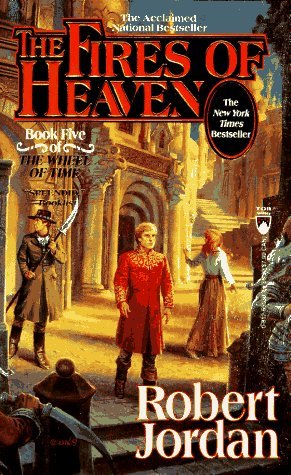
WoT05_TheFiresOfHeavenThe story begins in the exceedingly rural village of  Emond’s Field. They are so rural that they have no concept that they are still considered to be a part of a larger country. The village is suddenly attacked by Trollocs (the antagonist’s soldiers) and a Myrddraal (the undead-like officer commanding the Trollocs).  These creatures are intent on capturing the three protagonists, Rand al’Thor, Matrim (Mat) Cauthon, Perrin Aybara, although why they are being hunted is not revealed at first. To save their village from further attacks, Rand, Mat, Perrin, and Egwene (Rand’s first love interest) flee the village, accompanied by the Aes Sedai Moiraine Damodred, her Warder, Al’Lan Mandragoran, and gleeman, Thom Merrilin.They are later joined by Nynaeve al’Meara, who is their village’s medicine woman.

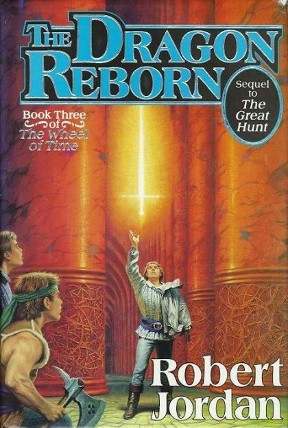
WoT03_TheDragonRebornThis huge range of characters and the many, many threads that weave an incredibly tangled plot are what polarizes the reading community over this series of books. Originally intended to be a trilogy, it eventually expanded to encompass fourteen LARGE, long books.

Robert Jordan passed away in 2007 while working on the final book, leaving the series uncompleted, but he left the rough draft and enough notes behind that Brandon Sanderson was able to finish the series, eventually breaking that final volume into three very large  books, and bringing the story to a satisfying conclusion.

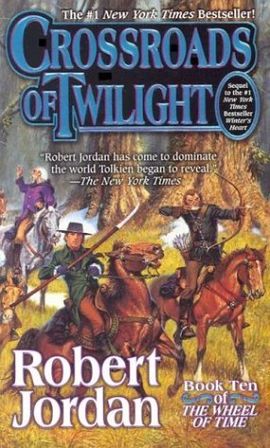
WoT10_CrossroadsOfTwilightSo what is the basis for the plot’s tension, what conflict could possibly draw the reader in and keep them reading for such a long, drawn out process? It’s Robert Jordan, folks–the eternal quest for power, and dominance through violence, religion and politics is the core of this tale. According to Wikipedia, the Fount of All Knowledge: The series draws on numerous elements of both European and Asian mythology, most notably the cyclical nature of time found in Buddhism and Hinduism, the metaphysical concepts of balance and duality, and a respect for nature found in Daoism. Additionally, its creation story has similarities to Christianity’s “Creator” (Light) and Shai’tan, “The Dark One” (Shaytan is an Arabic word which in religious contexts is used as a name for the Devil). It was also partly inspired by Leo Tolstoy’s War and Peace (1869).”

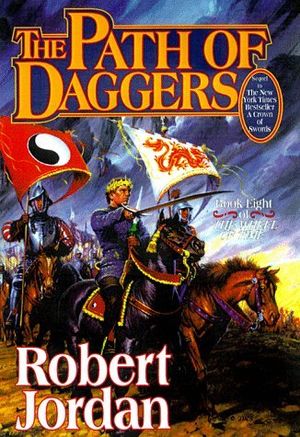
300px-WoT08_ThePathOfDaggersI loved the first three books in this series. I both enjoyed and endured the next three, hoping Robert Jordan would get to the point and finish the damned series. I had become a little irritated with book eight, Path of Daggers, but by the time Winter’s Heart came out, I was resigned to never seeing an end to it, and was back to simply enjoying each strange plot twist and new random thread for what it was–just a great tale.

When Robert Jordan died, I was thrilled that Brandon Sanderson was the author tapped to finally bring that unwieldy mess together. There were so many different stories within the greater story that the task of winding up each thread must have been incredibly daunting, and he did it magnificently.

The reason so many devoted fans abandoned the series somewhere around book six , Lord of Chaos, was that Rand al’Thor’s story ( and Mat’s and Perrin’s) stalled, and Jordan was sent way off track by the stories of Egwene, Nynaeve, and Elaine Trakand. In fantasy, there is a large contingent of readers who want instant gratification are not going to wait around for eight more books. They proved it by jumping ship and trash-talking his work.

TheGatheringStormUSCoverThroughout the series, the quality of the writing never faltered. The depth of story and the intensely alive characters whose stories graced those pages never failed to intrigue me. The fact that it felt like the conflict would never be resolved was, at times, upsetting to me as a reader, and is a lesson authors should take to heart with their own work.

To write a story that is so compelling that readers become so violently polarized over it is quite an accomplishment.  I see this happening with George R.R. Martin‘s fans right now. Although I adore him as a person, I’ve never cared much for his style of writing, as he jumps around too much even for me. Have patience, people! It looks like George has a large story there too, so it may take him a while.

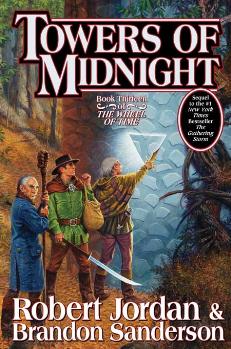
Towers_of_Midnight_hardcoverFor Brandon Sanderson to step into the wasps’ nest of controversy that was the Wheel of Time and complete the series with such grace and finesse is nothing short of amazing, and I am glad I stuck with it to the end. Brandon Sanderson has become one of my favorite authors because of what he did to wind up this epic series.

In the end, the final resolution was satisfying, and was well worth the journey.  I have gotten rid of most of my hard copies, and am down to only one room’s worth of hardbound books at our house. I don’t buy too many hard copies of books, being a fan of the Kindle, and  but I did make an exception for this book.   For me, some books need to be in hard copy form and the Wheel of Time Series is one of them, as are the Harry Potter books. There was a large contingent of people who were upset that the epub edition wasn’t released until 4 months after the paperbook, but this was a choice made by Robert Jordan’s widow and her publisher, TOR. It was a strange one in my opinion, but it was their choice.

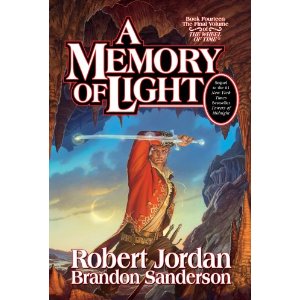
A_Memory_of_Light_coverAmazon’s early reviews of the later books in this series were rife with trolls and naysayers who couldn’t wait to emerge from the woodwork and have their say. Apparently very few of these people purchased the book, much less read it. That is the price of success and these days it’s almost an honor to have so many haters just spoiling to knock you down. But their strident caws and self-important rants should have no effect on the true fans of WoT. In my humble opinion these works are masterpieces and Brandon Sanderson’s three books are a triumphant finish to the series.

I love Brandon Sanderson’s handling of this series finale, and feel I more than got my money’s worth from this series of book, as I will definitely read it again and again–in my opinion it’s that good. If you love this series, you will love the way it ends!

The original cover artist for these amazing books was none other than the late Darrell K. Sweet, who was just as amazing a fantasy artist as is Michael Whelan. The newer covers are nice, but for me they lack the power of Sweet’s brilliant paintings.

And as we all know, I buy most books for their covers, even epubs, and then fall in love with the tale.

Comments Off on Comfort Books, the main course: The Wheel of Time, by Robert Jordan and Brandon Sanderson

Filed under Adventure, Battles, blogging, Books, Dragons, Fantasy, Humor, Literature, Politics, Publishing, Self Publishing, WordPress, writer, writing

Friday Interview: Carlie M.A. Cullen

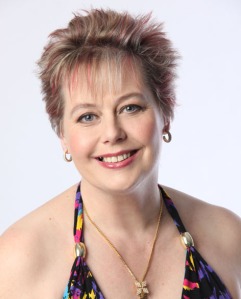
Photo of CarlieAs I promised a while back, today Carlie M A Cullen, author of The Heart Search trilogy, has consented to answer a few questions for us. She is a lovely, talented woman who has been one of my editors for several years now!

CC: Hi Connie! It’s lovely to be here. Thank you for the tea.

CJJ: Hello, and you’re welcome! Tell us a little of early life and how you began writing:

CC: I grew up as an only child. My parents worked full time and both had second jobs. As a result I was left to create my own entertainment. I loved the tales of Hans Christian Andersen and started to write my own fairy tales. I found myself disappearing into the stories I created and it made me feel less lonely. From there, I progresses to writing longer short stories and poems. It’s something I’ve continued to do into adulthood.

CJJ: As you know, I love this series. Tell us about your most recent book.

CC: I hope you’re not after any spoilers, Connie! [laughs] Heart Search: Betrayal is the final book in the trilogy and takes Remy and Joshua’s story to its natural conclusion. However, it’s not all hearts and flowers – far from it. There is a traitor who is passing copious amounts of information to someone who has a massive grudge against the coven, and who they are in league with. But there are four possible suspects. Which one is it and can the coven discover their identity before it’s too late? There are many twists and turns along the way, some good and some terrible. Certain characters really shine and there’s the discovery of new talents along the way. Unfortunately there are casualties, some of which may shock my readers.

CJJ: The story line in Betrayal is quite divergent from the previous two books. How did you come to write this novel?

CC: When I reached the halfway point in the first book, Heart Search: Lost, I knew there was too much of a story for just one. It was at that point I realized Heart Search would turn into a trilogy. I couldn’t leave the world I’d created and made the decision to complete the trilogy before moving onto other stories I had in my head.

CJJ: I always have that problem too. I think some stories are just larger than we originally thought. So, do you have a specific ‘Creative Process’ that you follow, such as outlining or do you ‘wing it’?

CC: It depends on what I’m writing really. With Heart Search, I had the first twelve chapters meticulously outlined, but around chapter five my characters decided they were going to take over and make me tell their story their way. I threw away the outline and have ‘winged it’ ever since. As I wrote this based on current day, it was easy to do.

With my next book, I’ve had to do some extensive world building and creating magic systems and the like before I began writing. However, as far as the story goes, again I’m winging it and seeing where my muse and characters takes me.

CJJ: Well your muse is taking you to some wonderful places! In your opinion, how does your work differ from others of its genre?

CC: I can only really talk about the Heart Search trilogy here. In the first book you have two POV’s: Remy in first person and Joshua in third person. Their stories run parallel to each other and every now and then they softly bump before going off again. I believe this is what makes it unique. In book two, I brought in extra character voices and gave them their own POV’s in third person. The final book takes even more POV’s into the mix, always in third person, whereas Remy has maintained a first person POV throughout.  I also believe (going by the reviews I’ve read) the storyline itself is completely different to what others have read before. Put all this together and that’s what I think makes my work so different from others in its genre.

CJJ: So now we get down to the question that I always wonder: Why do you write what you do?

CC: As I said earlier in the interview, I loved the Hans Christian Andersen fairy tales and that was a huge influence in my writing. Growing up I tried reading different genres, but I always came back to fantasy. There’s something so intriguing about the characters you can create, the worlds you can build, and adding to that those mystical creatures we all know so well: fairies, goblins, dragons, vampires, et al. It seemed only natural for me to write in this genre. It’s where I’m in my comfort zone.

CJJ: I know why I chose the indie route for my work, but I’m curious as to why you’ve chosen this path.

CC: Originally, I wanted the dream of getting an agent and a decent publishing deal, but I was new to the industry and quite naïve. After a few rejections, I decided that after all my hard work on the book it would be nice to give people a chance to read it. In addition, I had people I knew asking me for it. It was about that time I joined Myrddin Publishing. Everyone was so supportive from day one so I published it through them and haven’t looked back since.

Now I know more about the industry, I’m really glad I’ve taken this path. I have so much more control over where my books are sold, what sort of cover I want, what price to charge, and how much I want in royalties that I think I’d now be too stifled by a major publisher.

CJJ: I agree! Being a part of the Myrddin Group has been a blessing to me too, considering the assistance we give each other in every aspect of bringing a book to market. And the fact that you really are in control of your own work and profits makes this an adventure!  So what advice would you offer an author trying to decide whether to go indie or take the traditional path?

CC: This is a tricky one to answer because what’s right for one person isn’t necessarily right for another. I think the best thing they could do is talk to other authors, some who are indie and some who have gone the traditional route. Ask them about the pros and cons of both and then they can make an informed decision that’s best for them.

I wish I’d done that in the beginning as I was so green it was ridiculous, but I was one of the lucky ones who met some wonderful indie authors who helped me along the way.

But going back to the question, do your homework and don’t make any snap decisions or judgments that you may later regret.

CJJ: Very good advice! Thank you for taking the time from your busy schedule to visit with me, and for sharing your wisdom!

Alice in Wonderland Tea SetCC: Thanks so much for inviting me, Connie. I’ve really enjoyed chatting with you. Now, is there any more tea brewing?

CJJ: Yes, actually. This is a lovely citrus Lady Grey, I hope you like it! This tea set is my Alice in Wonderland set, which my children gave me last year!

>>>—<<<
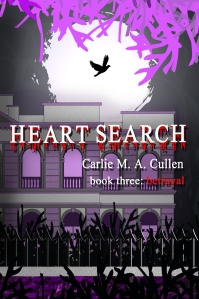
Betrayal front coverCarlie M A Cullen was born in London. She grew up in Hertfordshire where she first discovered her love of books and writing.

She has always written in some form or another, but started to write novels in 2011. Her first book was published by Myrddin Publishing in 2012. She writes in the Fantasy/Paranormal Romance genres for New Adult and Adult.

Carlie is also a principal editor for Eagle Eye Editors.

Carlie also holds the reins of a writing group called Writebulb. They have published four anthologies so far, two for adults and two for children, all of which raise money for a local hospice.

Carlie currently lives in Essex, UK with her daughter.

>>>—<<<

Links for Carlie M A Cullen

Website: http://carliemacullen.com

Twitter: @carlie2011c

Facebook: http://www.facebook.com/CarlieMACullen

Linkedin: https://www.linkedin.com/profile/view?id=240655941&trk=nav_responsive_tab_profile

Amazon: http://www.amazon.co.uk/-/e/B009MWVL5A

About.me: http://about.me/CarlieCullen

Wattpad: http://www.wattpad.com/user/CarlieCullen

Goodreads: https://www.goodreads.com/author/show/6550466.Carlie_M_A_Cullen

BOOKS:

Heart Search, book one: Lost: http://smarturl.it/HeartSearch-Lost

Heart Search, book two: Found: http://smarturl.it/HeartSearch-Found

1 Comment

Filed under Blogger, blogging, Books, Fantasy, Humor, Literature, mythology, Publishing, Self Publishing, vampires, writer, writing

Weak Prose vs Passive Voice

Book- onstruction-sign copyI read voraciously, and I read in many genres. I love books written with passion, but I don’t always love passionate writing. By that I mean—be crafty with how you deliver your descriptions, because I don’t want to be told what to think.

In various writing forums I regularly see authors complaining that Beta Readers don’t understand their ‘voice.’

Several things could cause that disconnect:

  1. The person who agreed to Beta Read for you does not read your genre, and genuinely does not like the kind of books you write. This happens all the time, so find a reader who enjoys romantic, urban fantasy, if that is what you write. A woman who reads hard sci-fi likely won’t love a fantasy-romance involving elves and vampires.
  2. Also, perhaps the person reading as a Beta Reader does not understand that Beta Reading is NOT picking a manuscript to shreds, it is giving general opinions on the manuscript as a whole. This is why I am selective as to who I share a manuscript with—the reader must be familiar with and read my genre, and understand the rules for Beta Reading, as set down by Orson Scott Card.
  3. We also must consider the possibility that we are mistaking lazy writing habits for voice. We love our glorious, elegant prose, but our reader was not as impressed. I hate it when that happens!

I had a conversation with an author who said, “My editor wants to change my voice. She won’t let me use ‘there was,’ but I don’t know how to tell my story without using it.”

She was not trying to change his voice, she was trying to encourage him to be creative and to write strong sentences.  Weak prose tells the story, holds the reader away from the immediacy of the experience.

Passive voice also tells a story, but when done well, it can be beautiful and immersive.

What is passive voice? I absolutely adore this paragraph from the American Bar Association website article “Writing Clear and Effective Legal Prose” by George D. Gopen:

“Lawyers cannot write sophisticated, powerful prose without a skillful use of the passive voice. I could offer you a theological proof: God would not have created the passive had it no use. Or perhaps you might prefer the Darwinian argument: The passive could not have survived unless it was fittest for something. But I prefer this circular reasoning: The passive is better than the active in all cases in which the passive does a better job than the active. It only remains to learn what those cases are.”

Notice how he meanders through that thought, but eventually arrives at the point? He never devolves into weak prose. This is also the way many new authors approach writing genre fiction, and is where they run afoul of their readers. Readers of genre fiction expect lean, action-oriented prose driving each scene toward a final conclusion.

So now we come to another point—what is GENRE FICTION? Modern genre fiction avoids passive voice, opting for active, pared-down sentences that have one purpose—resolving a conflict. Literary fiction often uses passive voice, but knows how to apply it correctly. Literary fiction takes the reader on a journey, often where they witness events as seen through other eyes. Both styles of writing have to be carefully crafted, and both must immerse the reader in the experience. Stephen Petite, in his article, “Literary Fiction vs Genre Fiction” says:

“An argument can be made that there are two types of fiction when it comes to novels: Genre Fiction and Literary Fiction. The former includes many subcategories such as Mystery/Thriller, Horror, Romance, Western, Fantasy, Science Fiction, etc. The latter is more difficult to classify or break apart into subcategories. To put it simply, Literary Fiction is anything that does not fit into a genre.”

The fact that literary fiction is anything that does not fit into a genre offers authors the option of writing in a more leisurely style, if that is their desire. However—do not mistake bad craftsmanship for literary style.

I read genre fiction for entertainment, for a riveting story, an escape from reality.

Literary fiction is not about escaping from reality. It seeks to better understand the world and delivers real emotional responses, often though situations that are rooted in fantasy. I often read and enjoy literary fiction.

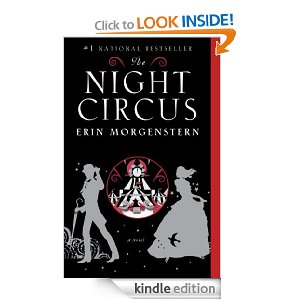
the night circus by erin morgensternDo you see the crossover there? Some fantasy qualifies as literary fiction because of the way in which the story is delivered. Erin Morgenstern’s beautiful fantasy, The Night Circus is a perfect example of this cross-over. Genre fantasy purists decry her lush, beautiful prose, and lack of direct conflict between the two magicians, while readers of literary fiction enjoy her lush, beautiful prose, and the deeper story that underlies the politely waged war between two magicians.

Know who your readers are. Select your beta readers from people who read in the genre you think you are writing for. It’s likely you are writing for yourself, so identify the sort of books you gravitate to, and choose your readers accordingly. If you’ve chosen the right beta readers, you will also know what your chosen market will be.

10 Comments

Filed under Books, Fantasy, Humor, Literature, Publishing, Self Publishing, writer, writing

Heart Search book three: Betrayal

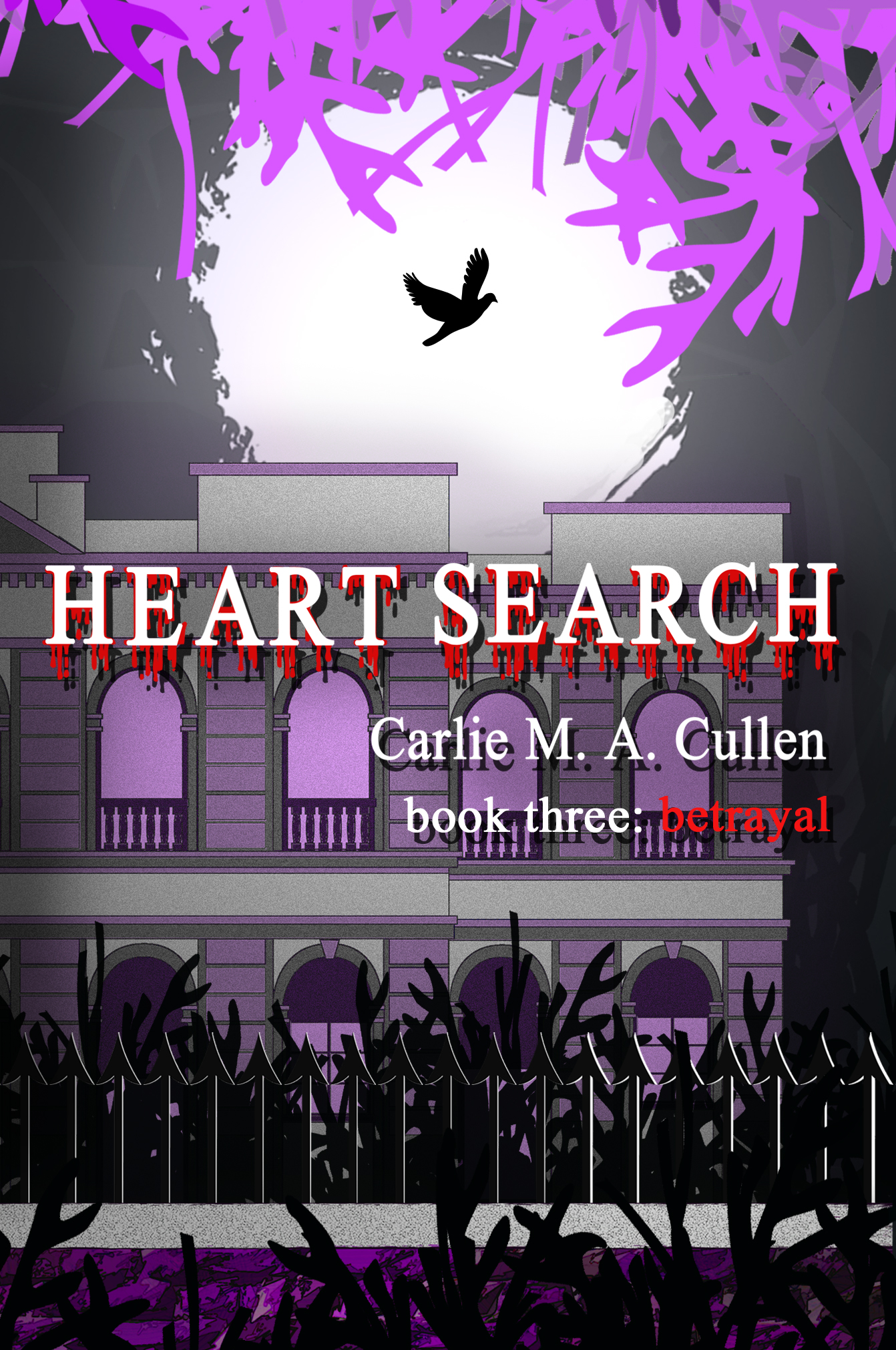
Betrayal front cover Today is the release of a book that I had a great time being a part of–Heart Search  book three: Betrayal, by UK author, Carlie M. A. Cullen. I had the privilege of being a structural editor for this, and it was a project I really enjoyed.

Where to start? It is the third book in a trilogy, and so it picks at the end of the previous book, of course–but a new reader could start with this book and not feel too confused.

For me, this book is a roller-coaster of events and emotion, as Samir’s and Joshua’s covens prepare to defend themselves from an upstart rival’s attempted takeover. The disappearance and kidnapping of Erika casts suspicion on several people, and the discovery of a traitor in their midst is an unpleasant monkey-wrench tossed into the works, making it difficult for Samir and Joshua to know who to trust.

Their enemy, Liam, is a low-class thug who has no problem starting the equivalent of a gang-war within the vampires’ society. His heavy-handed bullying of his subordinates and cruelty to his victims is evidence of that. His second in command, Max, is much smarter vampire, a man who could have been quite decent under other circumstances and isn’t quite sure that his maker is all that sane.

Phoenix, the hidden traitor in their midst is an arrogant, self-absorbed twit, and definitely a jerk. The traitor claims to care for the person handed over as a hostage, but does it anyway, knowing the hostage will not be treated well. Phoenix manages to cause nothing but trouble before their identity is finally revealed.

Remy’s sudden separation from her family has her twin in an uproar. Her emotional instability affects Becky, her twin, as do other aspects of her life, although neither woman is aware of that connection. The stilted, angry phone conversations between the two only serve to complicate things.

This book has many, many threads that are woven together to create a compelling story of intrigue, Stockholm Syndrome, and the arrogance that comes with immortality. It is filled with strong characters and inventive plot twists—some creepy, some chilling, and some downright horrifying.

It’s a paranormal romance, so some graphic sex and a great deal of violence make this book definitely an adult read.

When launching a new book, marketing is always a tough thing for an indie. I must say, Carlie has really stepped up for this:

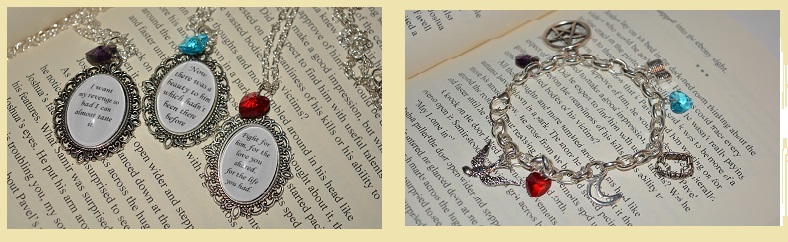
She is putting forth a Raffle Copter Giveaway of some gorgeous Heart Search themed jewelry.

heart search jewelry

That is some fabulous bling for her loyal fans!

Another thing that Carlie Cullen had done for marketing is she has created a really awesome book trailer for YouTube, The trailer is very noir, and really shows the atmosphere of the books:

Heart Search book three: Betrayal Trailer

These are really good marketing tools, and I feel sure her investments will pay off in the long run with good initial sales.

5 Comments

Filed under Adventure, Books, Fantasy, Humor, Literature, Publishing, Self Publishing, Uncategorized, vampires, writer, writing

Heart Search 3-Betrayal, Carlie Cullen

Betrayal front coverI read voraciously, in all genres and one of my not-so-secret vices is the occasional lust for a good paranormal fantasy.

One of my favorite authors in that genre is Carlie M.A. Cullen, who just happens have a new book coming out in her Heart Search Trilogy. Today she is revealing the cover for the final book in the series–and as with the first two covers, I  really love it. It totally speaks to the book’s dark theme. Her cover artist is Nicole Antonia Carro, who is one of the best indie graphic designers in the business, and an accomplished author in her own right.

I was fortunate enough to be one of the first to read this manuscript, and it is quite the finish to a bold trilogy.

What I find most intriguing about this series is that it revolves around people who have become vampires, and who no longer think the way humans do. But despite the real difference that having the kind of power they have makes in the way they view the world, they are family oriented and deeply committed to each other.

I’ve never considered writing about vampires and likely won’t, as my creativity doesn’t turn that way right now, but I confess I am curious about many things in regard to the conception of this series. To that end, I will be interviewing Carlie at a later date, and she has promised to answer most of my questions.

In the meantime here are the particulars for this book that is so beautifully covered:

Blurb for Heart Search: Betrayal

One bite started it all . . .

Joshua, Remy, and the twins are settled in their new life. However, life doesn’t always run smoothly. An argument between Becky and her twin causes unforeseen circumstances, an admission by Samir almost costs him his life, and the traitor provides critical information to Liam. But who is it?

As Jakki’s visions begin to focus on the turncoat’s activities, a member of the coven disappears, and others find themselves endangered.

And when Liam’s coven attacks, who will endure?

Fate continues to toy with mortals and immortals alike, and as more hearts descend into darkness, can they overcome the dangers they face and survive?

>>>—<<<

Carlie M.A. Cullen, Author

Photo of CarlieCarlie M A Cullen was born in London. She grew up in Hertfordshire where she first discovered her love of books and writing.

She has always written in some form or another, but started to write novels in 2011. Her first book was published by Myrddin Publishing in 2012. She writes in the Fantasy/Paranormal Romance genres for New Adult and Adult.

Carlie is also a principal editor for Eagle Eye Editors.

Carlie also holds the reins of a writing group called Writebulb. They have published four anthologies so far, two for adults and two for children, all of which raise money for a local hospice.

Carlie currently lives in Essex, UK with her daughter

>>>—<<<

You can find Carlie’s books at:

>>>—<<<

You can connect with Carlie via these social links:

>>>—<<<

Do take a look at her books–if you are a fan of paranormal romances, these books are a fun read, filled with characters that are larger-than-life, and adventures into the dark and mysterious world of the immortals who surround us.

Editors Note: I did make a typo in the Title of this post.  It is Heart Search : Betrayal, not Betrayed as was originally posted.

4 Comments

Filed under Battles, Blogger, blogging, Books, Fantasy, Humor, Literature, Self Publishing, Uncategorized, vampires, WordPress, writer, writing

Virtual unreality

midnight-new-years-champagneWhat are your New Years traditions? Normally my hubby and I do something a little fun to celebrate, but this year we were pretty low-key. I’ve been suffering from a flu-like virus, and I was finally fairly mobile, enough to go out to dinner at the local Mexican restaurant we like so much.

Then we spent New Year’s eve at an all-night party with friends from all over the world. I love the virtual reality of the internet universe. You’re never alone unless you log off Facebook.

canapes (1)My publisher, Myrddin Publishing threw a great virtual New Year’s party on Facebook where the authors and readers got to meet and have a rollicking time in the virtual universe. For a short time (until Sunday Jan 4th 2015) kindle downloads of Huw the Bard and Tales From The Dreamtime are on sale for .99 cents.

breakfastThe party is still going on today, with a virtual breakfast being served, and people popping in and out. I’ve had a lot of fun with that, despite being under the weather. And this morning on New Years Day, I actually feel good.

So what are my goals for this new year that looms fresh and untrammeled before us?

My goal is to create and implement a marketing plan for my books.  This is something I have attempted, but have always become side-tracked by life, and never got back to it. From what I’ve read on the internet this involves a combination of things:

1. During January I’m going to create a plan-of-action, and map out my strategy. Once I know the answers to the next two questions I will be able to develop a plan of attack.

2. I will identify my audience.  This is hard–I write for my own amazement, so I’m not sure what my audience is! But I will spend some  time figuring that out, and I will blog about the process.

2. I will figure out what makes my books different from all the other books out there, aside from their obvious, amazing wonderfulness. This is also difficult! I wrote these things while in a trance, apparently, as the minute someone asks me about them, my mind goes blank and I have no idea how they got here, or what they’re about. I will probably blog about that process too.

3. I will budget $$ for Google ads and Goodreads ads, and see how they perform. My Goodreads ad seems to get a lot of clicks, but I’m not sure it translates into sales. I haven’t done a Google ad yet.

Possibilites copyI’m pretty lousy at blatant self-promotion. But I intend to make this a good year for honing my marketing skills in such a way that I can sell a few books without annoying my friends!

It’s a brand new beginning, with endless possibilities. In completing and publishing my books, I’ve already achieved dreams I never thought possible, and now a new year lies before me. How wonderful to know that anything can happen!

Comments Off on Virtual unreality

Filed under Adventure, Battles, Books, Fantasy, Humor, Literature, Publishing, writer, writing

Winter’s Heart

HolidayTree2012Web Olympia Downtown Association

Olympia Downtown Association

I love the way the Christmas lights  light up the dark streets at this time of the year. It removes a little of the creepy ‘horror movie’ factor from being downtown at night. Why can’t we have them on the bare trees all winter long? They make the long, dark nights feel so much kinder.

It rains a lot here, some years more than others. This year seems to be a ‘more’ year, but that’s what we like up here. Something about the  gloomy days fires my desire to write. The climate of Northern Waldeyn in my book, Huw the Bard, is inspired by the weather here in the great Northwest, as are the forests and the mountainous countryside. Even the waterfalls are inspired by those that can be found here in my home state of Washington.

We made the weekend journey north to see our kids and drop off presents for our grandkids this weekend, slogging up I-5 in the pouring rain and heavy traffic. It’s not too bad if you aren’t in a hurry-so I never make that trip with high expectations of arriving anywhere in a timely fashion–it can’t be done. Far too many vehicles clog the lone artery that connects Olympia Washington with Vancouver, British Columbia to the North, and San Diego, California to the South.

With our traveling done, and the winter solstice past us, we’re just preparing for our small Christmas day celebration here at Casa del Jasperson. After Christmas, I intend to settle in and get serious about writing again. I’ve been editing a wonderful book, which is a pleasure. I also have several irons in the fire, so to speak–the third book in the Tower of Bones series, Mountains of the Moon, is in the middle of the editing process at Eagle Eye Editors. MOTM is a prequel to Tower of Bones, and is a lighthearted book.

I’m in the final stages of reformatting Tower of Bones to be republished sometime in early 2015–new cover, new maps, all new interior, and Forbidden Road also has a new cover, new maps and a newly reformatted interior. I am still working on the cover for Mountains of the Moon, but I have an idea of what I want to do. The design studio in my Room of Shame is cranking out artwork as fast as I can think it up.

I’ve gotten the two followup books to Forbidden Road through the rough draft stage and into to the final fleshing out. The Wayward Son, and Valley of Sorrows had to be written concurrently, and the story line necessitated a name change in the earlier books, as a minor character became a major character, and her name was nearly identical to that of another major character. Since I had already pulled the two earlier books for reformatting, I decided to just take the plunge, and make that change globally. The Wayward Son is the story of John Farmer’s redemption, and takes place during the same months as Forbidden Road.

I’ve learned how to make vectors, and am getting the hang of creating digital art, and have found that I have a talent for graphic design. At least I like my pretty pictures.

All in all, it’s going to be a busy year. I can hardly wait to see what is going to come along next–maybe I’ll take up alpaca ranching. I’ve never done that before. They can’t be any worse than sheep…which were a pain, if you want the truth.

Okay. No alpacas. But they are awfully cute.

4 Comments

Filed under Adventure, Battles, blogging, Books, Fantasy, Humor, Literature, Publishing, Self Publishing, writing

NaNoWriMo: The Final Push

edgar allen poe quoteI’ve been talking a lot about NaNoWriMo–National Novel Writing Month. My friends are curious and ask if it’s a contest.

The answer is yes, in a way, but no.

It is a contest in the sense that if you write 50,000 words and have them validated through the national website you ‘win.’ But it is not a contest in the sense that it is a month that is solely dedicated to the act of writing a novel.

Now lets face it–a novel that is only 50,000 words long is not a very long novel. That falls more into the line of a long novella and is only half a novel, in my opinion. But a dedicated author can get the basic structure and story-line of a novel down in those thirty days simply by sitting down for an hour or two each day and writing a minimum of 1667 words per day.

That is not a lot. Most authors, when they are in the zone, double or triple that.

And again, we must face an ugly fact: Just because you can sit in front of a computer and spew words does not mean you can write anything that others want to read. Over the next few months there will be many books emerging that will testify to this fundamental truth.

But also, over the next few months many people will realize they enjoy writing; that for them this month of madness was not about getting a certain number of words written by a certain date. This was about writing and completing a novel they had wanted to write for years, something that had been in the back of their minds for the longest time. These people will join writing groups and begin the long journey of learning the craft of writing.

neil gaiman quote 2They are the real winners.

These authors will take the time and make the effort to learn writing conventions, they will attend seminars, they will develop the skills needed to take a story and make it a novel with a proper beginning, a great middle and an incredible end.

They will properly polish and edit their work and run it past critique groups before they publish it.

These are books I will want to read.

It’s not easy. Sometimes what we hear back from our readers and editors is not what we wanted to hear. The smart authors haul themselves to a corner, lick their wounds, and rewrite the damned thing so it’s more readable. They will be successful, for a variety of reasons, all of them revolving around dedication and perseverance.

But when we write something that a reader loves–that is a feeling that can’t be described.

Success as an author these days can’t be measured in cash. It can only be measured in what satisfaction you as an author get out of your work. Traditionally published authors see less of their royalties than indies, but they sell more books. It is a conundrum, and one many new authors will be considering in the new year.

But if you don’t write that book, you aren’t an author, and you won’t have to worry about it. NaNoWriMo will jump-start many discussions about this very issue. At this writing there are 3 days counting today left for many writers to get their 50,000 words and earn that certificate. Some of us have completed our first draft, and some of us still have a ways to go.

Winner-2014-Twitter-ProfileMy book has a beginning, a middle and an end, but will not become a novel for two or more years..  It is, instead, a rough draft sitting in the pile of other rough drafts, waiting to be rewritten when that flash of inspiration takes me over and I am driven to make it real. Huw the Bard began life in NaNoWriMo 2011, under the working title, The Bard’s Tale. He was published in 2014, and his story makes a darned good novel, if I do say so myself. (Shameless, I know.)

But although he was written in 30 days, he was then rewritten over the course of the following year, and edited over the course of the year after that. The life of a book from concept to publishing is a process. Some are quicker at negotiating this process than others, but having once rushed to publish with unhappy results,  I now take a more leisurely path.


Comments Off on NaNoWriMo: The Final Push

Filed under Adventure, Battles, Blogger, blogging, Books, Fantasy, Humor, Literature, news of the world, Publishing, Self Publishing, Vegan, WordPress, writer, writing