Tag Archives: Jasper Francis Cropsey

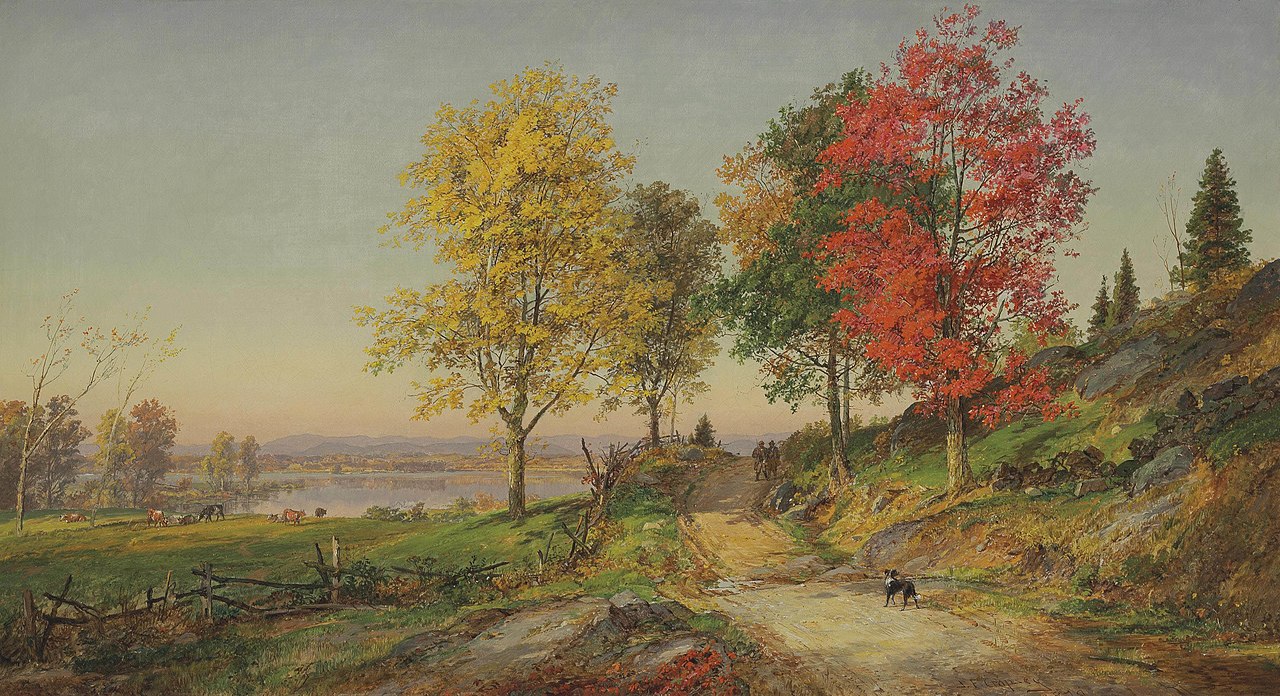
#FineArtFriday: Greenwood Lake by Jasper Francis Cropsey, 1879

Artist: Jasper Francis Cropsey (1823–1900)

Title: Greenwood Lake

Description: English: Greenwood Lake by Jasper Francis Cropsey

Date: 1879

Medium: oil on canvas

Dimensions: height: 60.3 cm (23.7 in); width: 110.5 cm (43.5 in)

Collection: Private collection

What I love about this painting:

Jasper Francis Cropsey loved the wild beauty of Greenwood Lake as it was in his day. I suspect he wouldn’t feel quite the same about it nowadays, since it is definitely a summer destination for modern vacationers. He found his muse in the rural beauty there.

Autumn seems to have been a favorite time of year for him. Each autumn, he made numerous paintings from his favorite spots along the shore and in the area. This painting was made just as warm September drifted toward the cold months of October and November. The deciduous trees are dressed in shades of red and gold.

Two men walk along the dirt lane that runs beside a meadow. Perhaps they are just going from one place to another, or maybe they are hunters. If so, they are returning empty-handed.

Cattle graze and gossip in the distance, as cows often do. A dog (perhaps the farm dog?) has stopped in the middle of the road to bark his greeting to the men.

I understand why Cropsey painted this scene many times from different angles. In my opinion, the end of September is the best part of autumn in the north. Soon, the beautiful colors will fade, falling to the ground and turning soggy and brown, marking the end of the annual cycle. But now, this day, Cropsey’s world is at peace, the air is crisp, and the leaves are at that wonderful stage that pleases the eye and makes one glad to be alive.

About the Artist, via Wikipedia:

Jasper Francis Cropsey (February 18, 1823 – June 22, 1900) was an American architect and artist. He is best known for his Hudson River School landscape paintings.

Cropsey trained as an architect under the tuition of Joseph Trench in the early 1840s, a period in which he was also trained in watercolor painting, instructed by Edward Maury, and took some life drawing courses at the National Academy of Design. He set up his own architecture office in 1843, but began exhibiting his watercolors at the National Academy of Design in 1844. A year later he was elected an associate member and turned exclusively to landscape painting; shortly after he was featured in an exhibition entitled “Italian Compositions”.[1]

To learn more about Jasper Francis Cropsey, go to Jasper Francis Cropsey – Wikipedia.

About the scenery in this painting via Wikipedia:

Greenwood Lake is an interstate lake approximately seven miles (11 km) long, straddling the border of New York and New Jersey. It is located in the Town of Warwick and the Village of Greenwood LakeNew York (in Orange County) and West MilfordNew Jersey (in Passaic County). It is the source of the Wanaque River.

Jasper Francis Cropsey created several paintings of Greenwood Lake beginning in 1843. Cropsey painted many paintings of the area such as American Harvesting (1864), Greenwood Lake (1870), Fisherman’s House, Greenwood Lake (1877), and Cooley Homestead–Greenwood Lake (1886). Cropsey met and married Maria Cooley, daughter of Issac P. Cooley, in 1847 and continued to visit the area for many years.

Some of Cropsey’s painting command high prices at auctions. Greenwood Lake (1879) sold at Christie’s auction in 2012 for $422,500. Sunset, Camel’s Hump, Lake Champlain (1877) sold for $314,500 in 2011. [2]


Credits and Attributions:

IMAGE: Wikimedia Commons contributors, “File:Greenwood Lake by Jasper Francis Cropsey, 1879.jpg,” Wikimedia Commons, https://commons.wikimedia.org/w/index.php?title=File:Greenwood_Lake_by_Jasper_Francis_Cropsey,_1879.jpg&oldid=617153620 (accessed September 4, 2025).

[1] Wikipedia contributors, “Jasper Francis Cropsey,” Wikipedia, The Free Encyclopedia, https://en.wikipedia.org/w/index.php?title=Jasper_Francis_Cropsey&oldid=1309347669 (accessed September 4, 2025).

[2]  Wikipedia contributors, “Greenwood Lake,” Wikipedia, The Free Encyclopedia, https://en.wikipedia.org/w/index.php?title=Greenwood_Lake&oldid=1300748871 (accessed September 4, 2025).
4 Comments

Filed under #FineArtFriday

#FineArtFriday: Summer, Lake Ontario by Jasper Francis Cropsey 1857 (revisited)

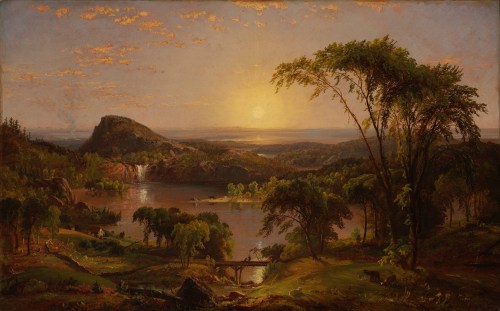
Cropsey,_Jasper_Francis_-_Summer,_Lake_Ontario_-_Google_Art_ProjectTitle: Summer, Lake Ontario by Jasper Francis Cropsey (1823–1900)
Genre: landscape art

Date: 1857

Medium: oil on canvas

Collection: Indianapolis Museum of Art

What I love about this painting:

Cropsey paints a summer evening in New York State, along the shore of one of Lake Ontario’s bays. Near the bottom center, a pair of fishers are placed on the wooden bridge over a creek. This image has a fantasy quality, as if it depicts a dream or a fond memory.

Our point of view is from a hill, looking down to the creek, the bridge, and the bay shore, and then across low hills to the great lake beyond. Cropsey gives equal importance to the earth below and sky above.

Cropsey’s signature deep colors are featured in this panoramic view of a summer evening. Warm reds, browns, yellows, and dark greens are lightened by wispy mists rising in the early evening air, lit by the setting sun.

About the Artist, via Wikipedia:

Jasper Francis Cropsey (February 18, 1823 – June 22, 1900) was an important American landscape artist of the Hudson River School.

Cropsey was born on his father Jacob Rezeau Cropsey’s farm in Rossville on Staten Island, New York, the oldest of eight children. As a young boy, Cropsey had recurring periods of poor health. While absent from school, Cropsey taught himself to draw. His early drawings included architectural sketches and landscapes drawn on notepads and in the margins of his schoolbooks.

Trained as an architect, he set up his own office in 1843. Cropsey studied watercolor and life drawing at the National Academy of Design under the instruction of Edward Maury and first exhibited there in 1844. A year later he was elected an associate member and turned exclusively to landscape painting; shortly after he was featured in an exhibition entitled “Italian Compositions.”

Cropsey traveled in Europe from 1847–1849, visiting England, France, Switzerland, and Italy. He was elected a full member of the Academy in 1851. Cropsey was a personal friend of Henry Tappan, the president of the University of Michigan from 1852 to 1863. At Tappan’s invitation, he traveled to Ann Arbor in 1855 and produced two paintings, one of the Detroit Observatory, and a landscape of the campus. He went abroad again in 1856, and resided seven years in London, sending his pictures to the Royal Academy and to the International exhibition of 1862.

Returning home, he opened a studio in New York and specialized in autumnal landscape paintings of the northeastern United States, often idealized and with vivid colors. Cropsey co-founded, with ten fellow artists, the American Society of Painters in Watercolors in 1866. He also made the architectural designs for the stations of the elevated railways in New York. [1]


Credits and Attributions:

Image: Summer, Lake Ontario by Jasper Francis Cropsey 1857. Wikimedia Commons contributors, “File:Cropsey, Jasper Francis – Summer, Lake Ontario – Google Art Project.jpg,” Wikimedia Commons, the free media repository, https://commons.wikimedia.org/w/index.php?title=File:Cropsey,_Jasper_Francis_-_Summer,_Lake_Ontario_-_Google_Art_Project.jpg&oldid=618625179 (accessed June 30, 2022).

[1] Wikipedia contributors, “Jasper Francis Cropsey,” Wikipedia, The Free Encyclopedia, https://en.wikipedia.org/w/index.php?title=Jasper_Francis_Cropsey&oldid=1093620569 (accessed June 30, 2022).

2 Comments

Filed under #FineArtFriday, writing

#FineArtFriday: Summer, Lake Ontario by Jasper Francis Cropsey 1857

Cropsey,_Jasper_Francis_-_Summer,_Lake_Ontario_-_Google_Art_ProjectTitle: Summer, Lake Ontario by Jasper Francis Cropsey (1823–1900)
Genre: landscape art

Date: 1857

Medium: oil on canvas

Collection: Indianapolis Museum of Art

What I love about this painting:

Cropsey paints a summer evening in New York State, along the shore of one of Lake Ontario’s bays. Near the bottom center, a pair of fishers are placed on the wooden bridge over a creek. This image has a fantasy quality, as if it depicts a dream or a fond memory.

Our point of view is from a hill, looking down to the creek, the bridge, and the bay shore, and then across low hills to the great lake beyond. Cropsey gives equal importance to the earth below and sky above.

Cropsey’s signature deep colors are featured in this panoramic view of a summer evening. Warm reds, browns, yellows, and dark greens are lightened by wispy mists rising in the early evening air, lit by the setting sun.

About the Artist, via Wikipedia:

Jasper Francis Cropsey (February 18, 1823 – June 22, 1900) was an important American landscape artist of the Hudson River School.

Cropsey was born on his father Jacob Rezeau Cropsey’s farm in Rossville on Staten Island, New York, the oldest of eight children. As a young boy, Cropsey had recurring periods of poor health. While absent from school, Cropsey taught himself to draw. His early drawings included architectural sketches and landscapes drawn on notepads and in the margins of his schoolbooks.

Trained as an architect, he set up his own office in 1843. Cropsey studied watercolor and life drawing at the National Academy of Design under the instruction of Edward Maury and first exhibited there in 1844. A year later he was elected an associate member and turned exclusively to landscape painting; shortly after he was featured in an exhibition entitled “Italian Compositions.”

Cropsey traveled in Europe from 1847–1849, visiting England, France, Switzerland, and Italy. He was elected a full member of the Academy in 1851. Cropsey was a personal friend of Henry Tappan, the president of the University of Michigan from 1852 to 1863. At Tappan’s invitation, he traveled to Ann Arbor in 1855 and produced two paintings, one of the Detroit Observatory, and a landscape of the campus. He went abroad again in 1856, and resided seven years in London, sending his pictures to the Royal Academy and to the International exhibition of 1862.

Returning home, he opened a studio in New York and specialized in autumnal landscape paintings of the northeastern United States, often idealized and with vivid colors. Cropsey co-founded, with ten fellow artists, the American Society of Painters in Watercolors in 1866. He also made the architectural designs for the stations of the elevated railways in New York. [1]


Credits and Attributions:

Image: Summer, Lake Ontario by Jasper Francis Cropsey 1857. Wikimedia Commons contributors, “File:Cropsey, Jasper Francis – Summer, Lake Ontario – Google Art Project.jpg,” Wikimedia Commons, the free media repository, https://commons.wikimedia.org/w/index.php?title=File:Cropsey,_Jasper_Francis_-_Summer,_Lake_Ontario_-_Google_Art_Project.jpg&oldid=618625179 (accessed June 30, 2022).

[1] Wikipedia contributors, “Jasper Francis Cropsey,” Wikipedia, The Free Encyclopedia, https://en.wikipedia.org/w/index.php?title=Jasper_Francis_Cropsey&oldid=1093620569 (accessed June 30, 2022).

2 Comments

Filed under #FineArtFriday, writing

#FineArtFriday: The Spirit of War by Jasper Francis Cropsey 1851

The spirit of war

Title: The Spirit of War by Jasper Francis Cropsey  (1823–1900)

Genre: landscape

Date: 1851

Medium: painting

Dimensions: Height: 110.8 cm (43.6 in); Width: 171.6 cm (67.5 in)

Collection: National Gallery of Art

Place of creation: United States of America [1]

What I love about this painting:

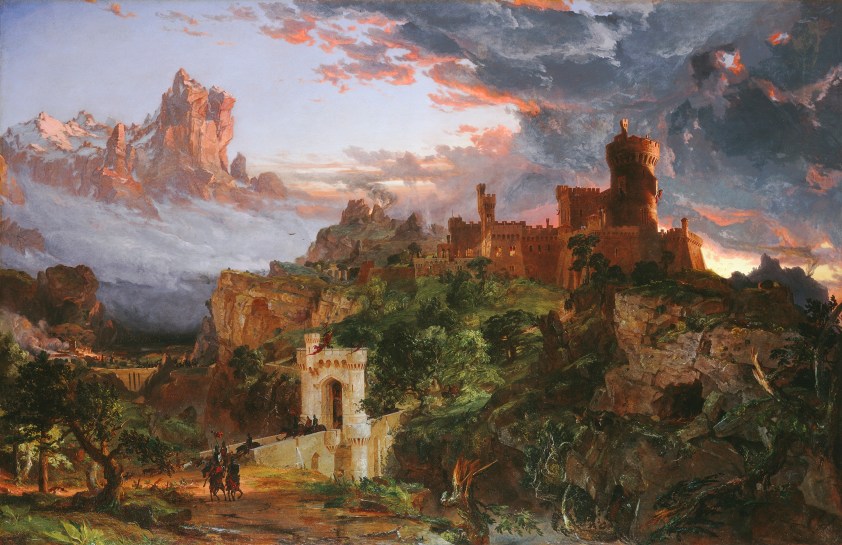
The Spirit of War by Jasper Francis Cropsey is one of a two-part fantasy that Cropsey painted in 1851; the other is the Spirit of Peace. During Cropsey’s lifetime, these two paintings were his most celebrated, but now he is known more for his ethereal paintings depicting autumn scenes, several of which I have featured here.

This painting was inspired both by the aftermath of the Mexican-American War and the looming threat of the American Civil War. It shows the young artist’s love of Arthurian tales and demonstrates his ability to deliver a story. His signature luminism is still in its infancy here, yet one can see the seeds of what would become a mastery of light and illumination.

Cropsey contrasts light and shadow as if they were good and evil. He paints godlike mountains that reign over deep valleys and strongholds. In the foreground, a strong fortress represents prosperity, her richly attired knights riding out to do battle. In the distance, a citadel burns, the smoke of raging fires billowing toward the darkening sky.

This is a powerful painting, one that tells a story and shows an entire novel.

About the Artist, via Wikipedia:

Jasper Francis Cropsey (February 18, 1823 – June 22, 1900) was an important American landscape artist of the Hudson River School.

Trained as an architect, he set up his own office in 1843. Cropsey studied watercolor and life drawing at the National Academy of Design under the instruction of Edward Maury and first exhibited there in 1844. A year later he was elected an associate member and turned exclusively to landscape painting; shortly after he was featured in an exhibition entitled “Italian Compositions”.

Cropsy traveled in Europe from 1847–1849, visiting England, France, Switzerland, and Italy. He was elected a full member of the Academy in 1851. Cropsey was a personal friend of Henry Tappan, the president of the University of Michigan from 1852 to 1863. At Tappan’s invitation, he traveled to Ann Arbor in 1855 and produced two paintings, one of the Detroit Observatory, and a landscape of the campus. He went abroad again in 1856, and resided seven years in London, sending his pictures to the Royal Academy and to the International exhibition of 1862.

Returning home, he opened a studio in New York and specialized in autumnal landscape paintings of the northeastern United States, often idealized and with vivid colors. Cropsey co-founded, with ten fellow artists, the American Society of Painters in Water Colors in 1866.

Cropsey’s interest in architecture continued throughout his life and was a strong influence in his painting, most evident in his precise arrangement and outline of forms. But Cropsey was best known for his lavish use of color and, as a first-generation member from the Hudson River School, painted autumn landscapes that startled viewers with their boldness and brilliance. As an artist, he believed landscapes were the highest art form and that nature was a direct manifestation of God. He also felt a patriotic affiliation with nature and saw his paintings as depicting the rugged and unspoiled qualities of America. [2]


Credits and Attributions:

[1] Wikimedia Commons contributors, “File:The-spirit-of-war.jpg,” Wikimedia Commons, the free media repository, https://commons.wikimedia.org/w/index.php?title=File:The-spirit-of-war.jpg&oldid=565046310 (accessed June 17, 2021).

[2] Wikipedia contributors, “Jasper Francis Cropsey,” Wikipedia, The Free Encyclopedia, https://en.wikipedia.org/w/index.php?title=Jasper_Francis_Cropsey&oldid=1018920537 (accessed June 17, 2021).

3 Comments

Filed under #FineArtFriday, writing

#FineArtFriday: Autumn On Greenwood Lake – two landscapes by Jasper Francis Cropsey (revisited)

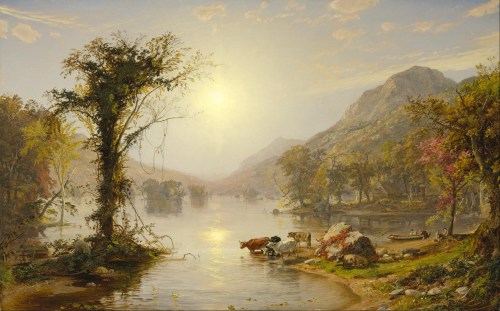
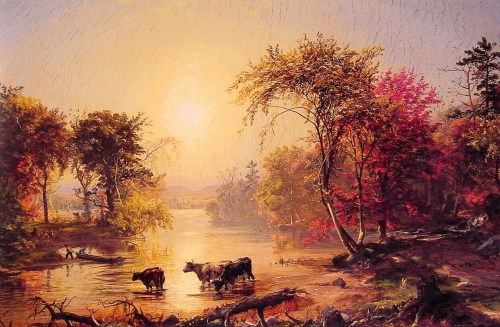
This post first appeared here in October of 2018. It features two beautiful images of Autumn in New England in the mid-nineteenth century. I like both these paintings for the way the water is depicted, and the hazy hills.

Jasper Francis Cropsey created many paintings of Greenwood Lake, a freshwater lake on the border between New York State and New Jersey, beginning in 1843. Over the next few decades, Cropsey painted numerous scenes of the area, many from the same viewpoint on the lake as today’s featured paintings, each with varying intensities of color.

What I love about these two paintings, done years apart, is  difference in the quality of  the light. One is done in an early autumn, the other later in the season. The subject matter is similar, cows drinking at waters edge, fishers and their rowboat, but the trees are different, more mature in the second, and it is later in the evening. The autumn haze completely hides the hills.

Clearly, this was a place that was beloved by the artist, as he returned year after year, and made many landscapes of this beach and the surrounding area.

About the artist (Via Wikipedia):

Jasper Francis Cropsey (February 18, 1823 – June 22, 1900) was an important American landscape artist of the Hudson River School. He was best known for his lavish use of color and, as a first-generation member from the Hudson River School, painted autumn landscapes that startled viewers with their boldness and brilliance. As an artist, he believed landscapes were the highest art form and that nature was a direct manifestation of God. He also felt a patriotic affiliation with nature and saw his paintings as depicting the rugged and unspoiled qualities of America.

Jasper Cropsey died in anonymity but was rediscovered by galleries and collectors in the 1960s.


Credits and Attributions:

Autumn on Greenwood Lake, ca. 1861, by Jasper Francis Cropsey [Public domain], via Wikimedia Commons

Autumn in America, by Jasper Francis Cropsey [Public domain], via Wikimedia Commons

Wikipedia contributors, “Jasper Francis Cropsey,” Wikipedia, The Free Encyclopedia, https://en.wikipedia.org/w/index.php?title=Jasper_Francis_Cropsey&oldid=842742891 (accessed October 19, 2018).

Comments Off on #FineArtFriday: Autumn On Greenwood Lake – two landscapes by Jasper Francis Cropsey (revisited)

Filed under #FineArtFriday

#FineArtFriday: Autumn On Greenwood Lake – two landscapes by Jasper Francis Cropsey

Jasper Francis Cropsey created many paintings of Greenwood Lake, a freshwater lake on the border between New York State and New Jersey, beginning in 1843. Over the next few decades, Cropsey painted numerous scenes of the area, many from the same viewpoint on the lake as today’s featured paintings, each with varying intensities of color.

What I love about these two paintings, done years apart, is  difference in the quality of  the light. One is done in an early autumn, the other later in the season. The subject matter is similar, cows drinking at waters edge, fishers and their rowboat, but the trees are different, more mature in the second, and it is later in the evening.

Clearly, this was a place that was beloved by the artist, as he returned year after year, and made many landscapes of this beach and the surrounding area.

About the artist (Via Wikipedia):

Jasper Francis Cropsey (February 18, 1823 – June 22, 1900) was an important American landscape artist of the Hudson River School. He was best known for his lavish use of color and, as a first-generation member from the Hudson River School, painted autumn landscapes that startled viewers with their boldness and brilliance. As an artist, he believed landscapes were the highest art form and that nature was a direct manifestation of God. He also felt a patriotic affiliation with nature and saw his paintings as depicting the rugged and unspoiled qualities of America.

Jasper Cropsey died in anonymity but was rediscovered by galleries and collectors in the 1960s.


Credits and Attributions:

Autumn on Greenwood Lake, ca. 1861, by Jasper Francis Cropsey [Public domain], via Wikimedia Commons

Autumn in America, by Jasper Francis Cropsey [Public domain], via Wikimedia Commons

Wikipedia contributors, “Jasper Francis Cropsey,” Wikipedia, The Free Encyclopedia, https://en.wikipedia.org/w/index.php?title=Jasper_Francis_Cropsey&oldid=842742891 (accessed October 19, 2018).

Comments Off on #FineArtFriday: Autumn On Greenwood Lake – two landscapes by Jasper Francis Cropsey

Filed under #FineArtFriday