Tag Archives: Lee French

When this job becomes work: the book signing event

SUPPORT YOUR LOCAL AUTHORSI must admit, I am not really a people person. I’m a bit awkward, and not really sure of myself, and I have a sense of humor that is too off-the-wall for most people. That is one reason why being an author is such a good fit for me–I can work from home and most of my interactions are imaginary.

Nevertheless, there are times when I must put on the public persona of the Successful Author. I’m not really that good at this one-on-one public thing…yet. I’ve had the good fortune to be involved in multi-author events with other indie authors, with more experience at it, and I’ve been able to see how they approach the gig.

It’s tricky–you can’t just assault people, shouting “Buy my book!”

Walking the line between being obnoxious, and telling people what they want to know about the book is tricky. The minute someone asks me what Huw the Bard is all about, my mind grinds to a halt. It’s almost like I never even read it, although I do remember writing it.

My first public event was last month at NorWesCon, and that was interesting because I was a vendor, so I was there all four days, but in the vendors’ room. For me, that was a tee-shirt-and-jeans event, because I don’t own any costumes, or ren-fair clothes (yet).

My second public event was this last Saturday. Two other local indies, fantasy author Lee French, and steampunk author Jeffrey Cook joined me at the Two Sister’s Tea Room in downtown Olympia for a book signing. This was a very different situation, and was much more pleasant. This signing was timed for the middle of one of the largest festivals in the the city, the annual Procession of the Species, so we had many people stopping and conversing with us.
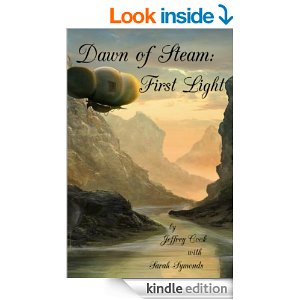
Dawn of Steam First LightSeveral people really stand out in my mind–I was moved to tears by one lady from Hawaii who bought Dawn of Steam, First Light, from Jeffrey.  She said she was a new reader, that she had come from a place where reading was not encouraged. She also said she was currently enjoying Charles Dickens’ classic novel,  The Pickwick Papers. I was awed by the absolute joy she took in the written word as she looked through Jeffrey’s book, and by how happy it made her that he signed it for her.

It was really brought home to me then that reading is still a privilege denied to many people of the world, often not by their wish, but by circumstances beyond their control.
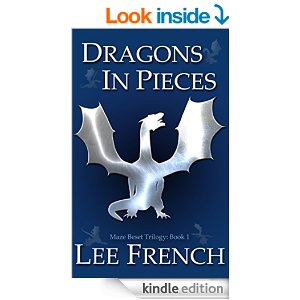
dragons in pieces lee frenchThen there was the wonderful character who was absolutely crazy for dragons. He not only bought Lee’s book, Dragons in Pieces, but insisted on buying one of the little plastic Dragon heads she had created with her 3-d printer as decorations.

Lee was selling books like she owned the only snocone stand in the desert.

I wasn’t, but I had a great time anyway, and handed out a lot of book marks.
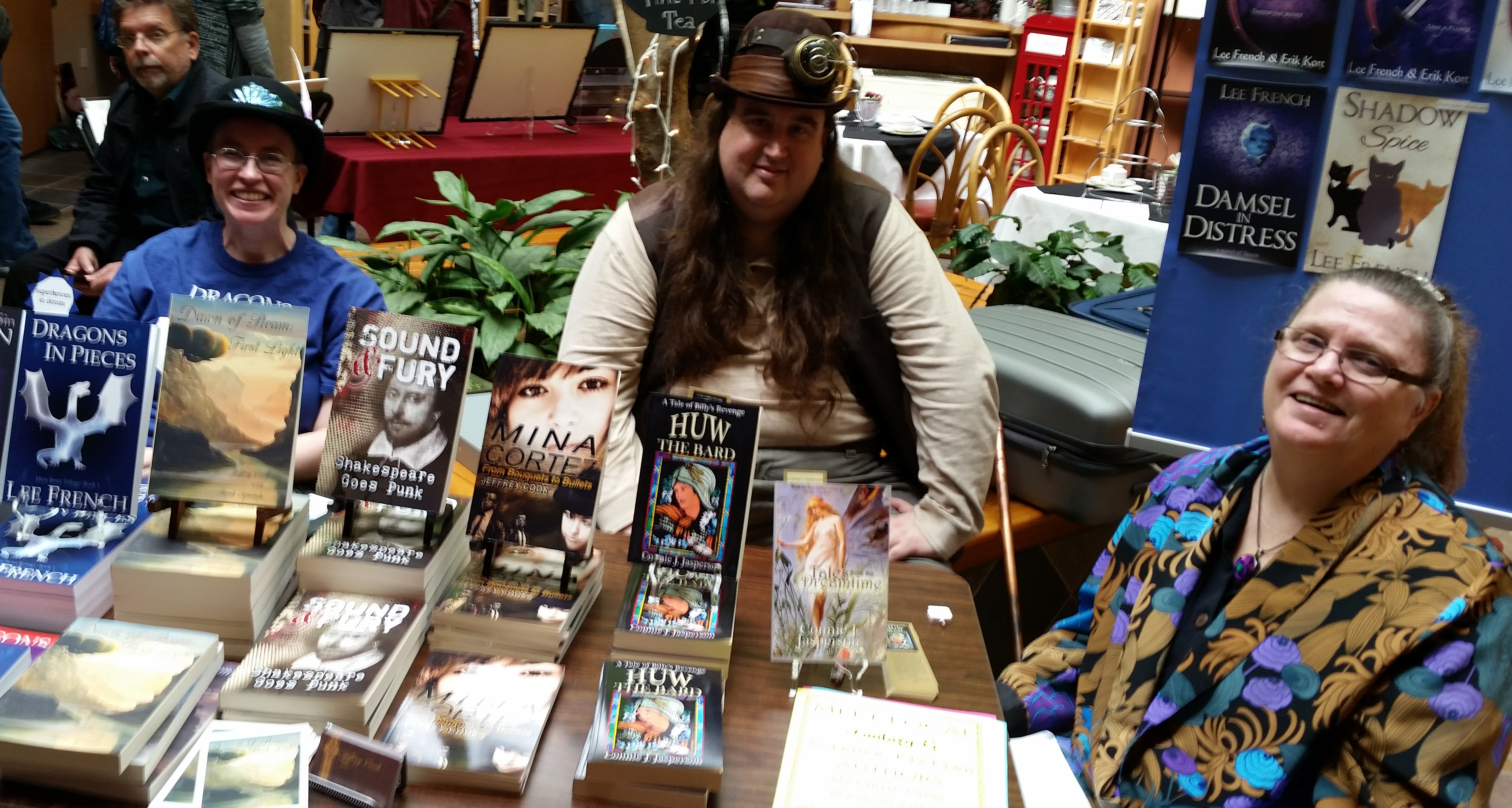
From left: Lee French, Jeffrey Cook, Connie Jasperson

From left: Lee French, Jeffrey Cook, Connie Jasperson

For that event, I went all out clothing-wise. I went to the Goodwill and shopped the fat-lady rack on senior citizens’ half-price day, and found what seemed like the perfect, brilliantly-garish, machine-washable, fancy-label jacket to wear with my rather boring black blouse and black trousers. It was only about twenty years out of style, and was the perfect price for my tapped out pocket-book: $3.99, with my old-peoples’ discount.

I am still looking for the right event-outfits. I want something a little wonderful, but with not quite as much purple as the flashy jacket. I love purple, but as an accent color.

Our next event is in three weeks, so that gives me a lot of time to find something suitable for the comfy grandma who writes RPG game-based hack-and-slash epic adventures, and also sometimes writes literary fantasy.

Maybe what I need is a green velvet renaissance faire dress, with Cloud’s buster-sword from Final Fantasy VII in a shoulder scabbard. That  should get my style of writing across well enough.
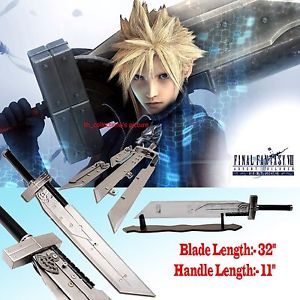
cloud strife and buster blade


2 Comments

Filed under Adventure, Battles, Books, Fantasy, Humor, Literature, Publishing, Uncategorized, writer, writing

Conventions: Hawking your books vs attending the convention

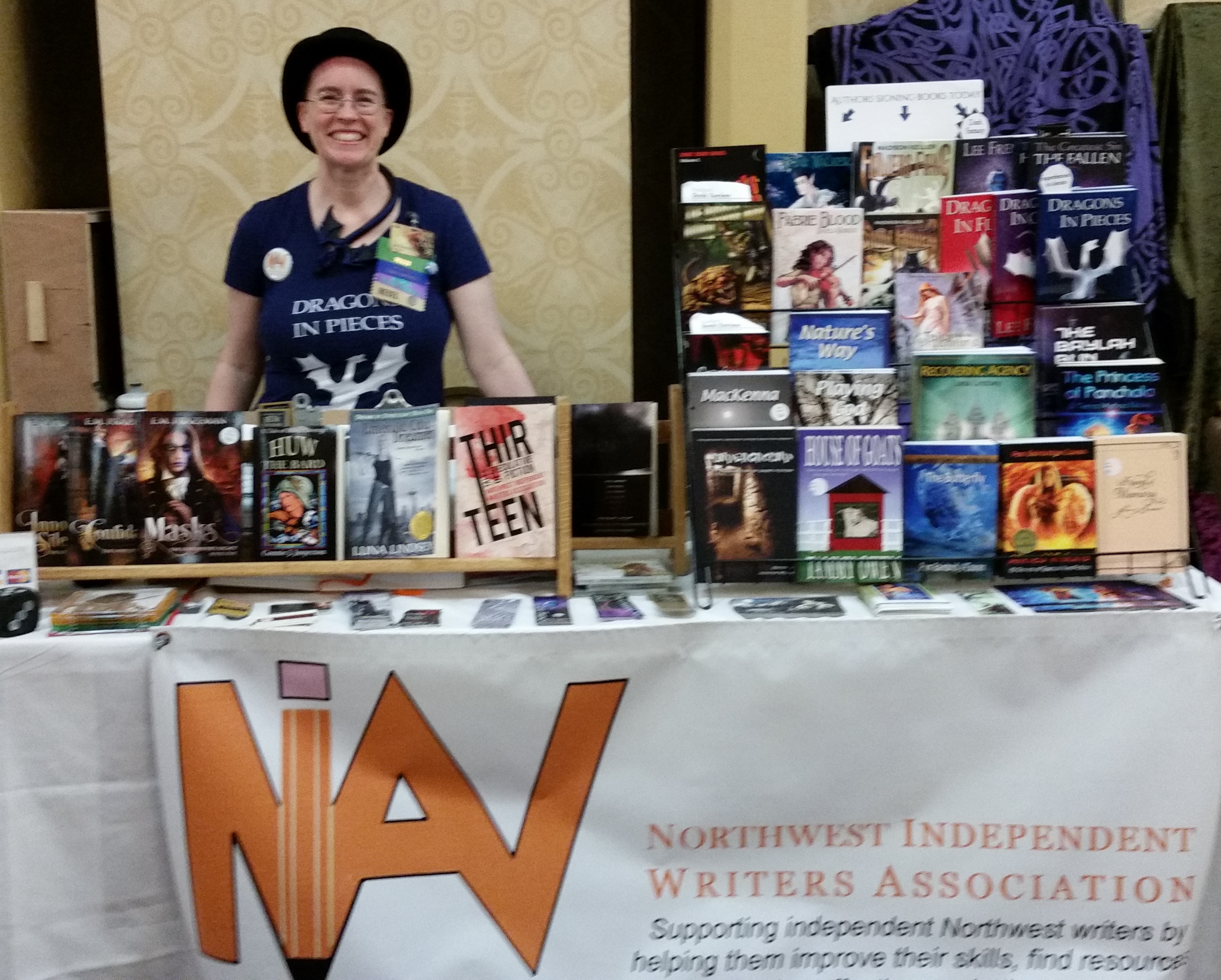
Lee French at Norwescon 2015 in NIWA Booth

Lee French at Norwescon 2015 in NIWA Booth

Going Indie means going it alone, and doing it the hard way. However–there are now small bands of indies coming together to help each other, and in the process, help themselves.

One such organization is Northwest Independent Writers Association, an organization of indie and small-press authors based in Western Oregon and Western Washington. We seem to be situated along the I-5 corridor from south of the Portland area north through the Seattle area.

This last week I attended Norwescon, carpooling the first day with fellow Myrddin Publishing Group author, Lee French. She is an awesome person, as well as a wonderful, creative author.

My book, Huw the Bard, was in the rack at the NIWA table, and I met some of the most wonderful people: Angela Korra’ti, Madison Keller, Jake Elliot, and Luna Lindsey were all there, manning the table and helping each person who stopped to find a book that fit them, regardless of if it was their own book or not–we were selling each others’ books as well as our own.

I ran into my good friend, fellow NIWA  member, Thomas Gondolfi , who was working his own booth.

Saturday night, Lee, Jake, Angela and I had dinner with fellow NIWA member, steampunk author, Jeffrey Cook.

Huw the Bard at NorwesconMy feet are killing me–today, I am not sure I will do it again, but I am glad I did this time.  My view will likely change as I begin to feel rested again.

Huw the Bard was not a good fit for that venue–they were more into fairies and steampunk, which Huw is obviously not. However, I think he would do well at a ren-fair, as the people who were interested in him were all ren-fair people.  Most likely my best books for a gaming venue will be my World of Neveyah series, as it is RPG game-based, and gaming of all varieties is what Norwescon is all about.

Standing in the booth for most of 4 days did me in, I do confess.  I also was somewhat of a 5th wheel, in that the booth was too small for the number of authors who were there and willing to contribute their time and energy to the project. There was only room for 1 chair, and so we stood. I felt a bit unnecessary, at times, which is not a good way to feel, but they very kindly tolerated me.

Angela Korra’ti has a knack for selling her books, and I tried to learn as much as I could from her. Jake Elliot and Lee French seemed to know what they were doing too–there is definitely a learning curve to pitching your book live and in person.

norwesconBeing an indie author, or being published by a small press means you are on your own as far as getting the word out about your books.  This means if you want your books seen at a convention, you have to pay for the table, buy your stock, and get the word out, because no one else will.

It also means you must spend the convention in the dealers’ room at your booth, pitching your product to strangers, rather than taking in the panels and hearing speakers like George R. R.  Martin. But I did see him in the lobby while I was getting coffee, and I saw many, many people who really love his work, far more than I do–and they stood for hours to get to see him.

I would have loved to hear George speak, but I had books of my own to hawk. I never thought I would live long enough to be able to say that.

This is where you discover that going indie means honing an elevator pitch that will sell your book in thirty seconds. That will be my next trick.

cashbox 3This is also where you discover that the Sparco cash-box you bought, and  that was not cheap, is nearly impossible to unlock, but it makes an awesome weapon if you are ever mugged on the way back to your hotel. Which I wasn’t, but I’m an author, and that’s how I think.

It’s also where you discover that your target audience was not at that convention.

Most importantly, this is where you realize that your poor old feet are  just not up to you spending 10 hours a day standing on them.

I understand there is some controversy regarding the Hugo award nominations–but I didn’t hear them announced, as I was trying to sell books. I suppose a shakeup is inevitable, and I will have to do some reading to find out for myself what the problem is, in the eyes of the reading world.  That will be interesting–accusations of blocks of special interest groups gaming the outcome and such intrigue me, and I will definitely want to get to the bottom of that!

14 Comments

Filed under Adventure, Books, Fantasy, Humor, Publishing, Uncategorized, writer, writing

Dark, Gothic, and hurtling toward disaster

Steampunks  by Kyle Cassidy

Steampunks by Kyle Cassidy

Well…apparently my current scifi work-in-progress, a short story, is steampunk. Who knew? My good friend, author Lee French, figured it out yesterday at our regular Tuesday morning brainstorming session at Panera. After she pointed it out, I could see it clearly, despite my original thought that because I had set it on a mining-colony world, it was a scifi tale.

I was a little surprised I hadn’t seen it earlier, and once it was pointed out, I could see why I was struggling with the tale–I didn’t know what I was writing.

It began as an exercise in writing from the point of view of the flâneur–the man of leisure, the idler, the urban explorer, the connoisseur of the street. Click here for Scott Driscoll‘s great blogpost on the flâneur. In short, he tells us that: “With a flâneur narrating, you can remove the noticing consciousness from your point of view character to accomplish other purposes.”  

The flâneur  is frequently found in literature from the 19th century.  The story is filtered through his eyes and perceptions–it distances the reader from the immediacy of the scene, so be forewarned: genre-nazis and arm-chair editors who want the material delivered in 60 second sound-bytes of action won’t love it. Literary fantasy explores the meaning of life or looks at real issues, and I tend to write from that aspect. Often, the fantastic setting is just a means to posing a series of questions. Sometimes the quest the hero faces is in fact an allegory for something else. I read good literary fantasy–it tends to be written by men and women who can actually write. Not only are the words and sentences pregnant with meaning, but they are often beautifully constructed, and I learn the craft of writing from reading it.

The Rainy Day, Gustave Caillebotte

The Rainy Day, Gustave Caillebotte

My flâneur is Martin Daniels, a young, wealthy, retired crystallographer. He spends his time roaming his city’s streets and sitting in sidewalk cafés observing his fellow citizens, and making social and aesthetic observations. He regularly finds himself crossing paths with one man in particular, Jenner: a self-made man who came up through the mines.

Jenner is battering against the prevailing social barriers which stand in the way of his achieving a political office that he covets, using whatever means at his disposal. He is uncouth, a barely civilized rough-neck with a bad reputation, but something about him draws Martin’s attention, and so he finds himself both observing Jenner, and listening to the whispered gossip that surrounds the man.

One day, as Jenner is passing Martin’s table,  his hat blows off and Martin catches it, returning it to him. Jenner then introduces himself, and admits that he has been watching Martin for some time. He has a task for Martin, one that intrigues him enough to bring him out of retirement. Thus begins an odd relationship.

Thus my flâneur ceases to be merely an observer, and becomes my protagonist, yet he is reporting the events from the distance of his memory, so he is still the observer.

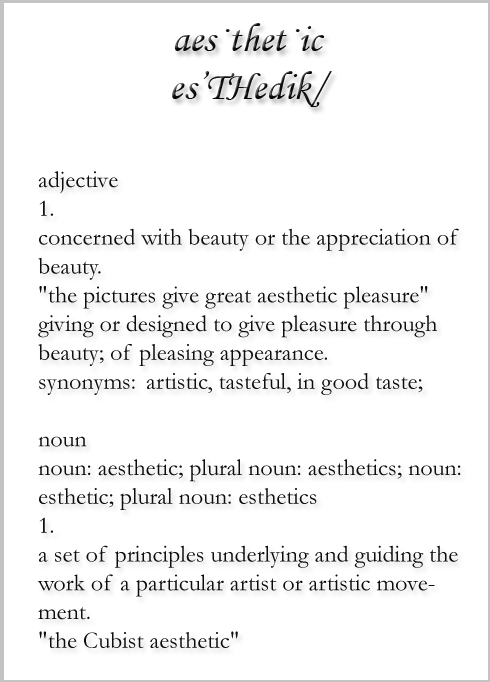
aesthetic definitionSo what is Steampunk?  Mike Perschon, in his dissertation, The Steampunk Aesthetic: Technofantasies in a Neo-Victorian Retrofuture, has described it as “…an aesthetic that mixes three features: technofantasy, neo-Victorianism, and Retrofuturism.” The key word here is aesthetic.

So how does that relate to my short story? When I looked at it with a critical eye, I realized it incorporates all three of those devices:

Technofantasy: Technology that lacks plausibility, or utilizes fantasy elements as the force or motive behind an action or process. No explanations will be given. The technology exists within the story, not the real world.

Neo-Victorianism: A setting that evokes the nineteenth century, whether it is set there or  not. In my tale, the use of the flâneur evokes a 19th century atmosphere, as do the other constraints I had inadvertently written into it.

Retrofuturism: How we think the past viewed the future. It is set in the distant future, but it is a future I think Victor Hugo would have recognized.

I have always perceived steampunk as cogs and diodes, dark atmosphere, rather Gothic, and with a plot that has the protagonists hurtling toward disaster. Now I know it is all that and more. They hurtle toward disaster, with a nineteenth century flair.

Thus my sci-fi flâneur is now the protagonist in a steampunk mystery. This short story, which had sort of stalled, is now back on track and fun to write. Through writing short stories we have the opportunity to write in different genres, and stretch our writing-wings.

I learn more about the craft of writing with each tale, and that fires me up, helping me see my longer works with fresh eyes.

2 Comments

Filed under Adventure, Books, Fantasy, Humor, Literature, Publishing, Self Publishing, Steampunk, Uncategorized, writer, writing