Tag Archives: LIndsay Schopfer

Book signing events, the art of Paul Cornoyer, and inspiration

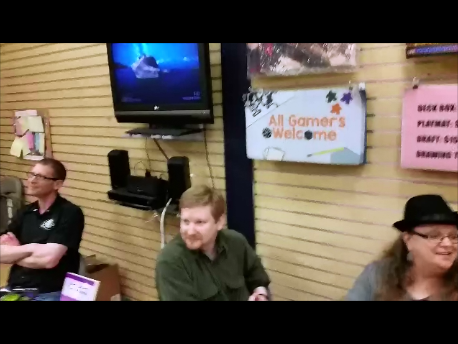
From left to right, Sechin Tower, Lindsay Schopfer and Connie J. Jasperson at Forever Knight Games 5-16-2015

From left to right, Sechin Tower, Lindsay Schopfer and Connie J. Jasperson at Forever Knight Games 5-16-2015

The signing at Forever Knight Games in Olympia went well. I met several wonderful authors I hadn’t had a chance to meet in person: Sechin Tower, Jolene Loraine, Rachel E. Robinson (Maquel A. Jacob), and Erik Kort. We were joined my my good friends, authors Lee French, Lindsay Schopfer, and Jeffrey Cook. These wonderful people write great books, and I was privileged to be counted among them!

We had a great time, and it was a good first event at that venue. I want to thank all my friends for coming out and meeting my favorite local authors. Tower of Bones was my big seller–which makes me happy.

paul cornoyer rainy day in madison square

Rainy Day in Madison Square, Paul Cornoyer

But then, after the big party was over (and it was a party–believe me) I had to drag myself back to reality. As I said the other day, sometimes my head isn’t in the right place for reading. At the event this last weekend, a friend asked me how that inability to read without the editor in my head making noise affects my ability to write. I had to answer that it does affect it to a certain extent.

The reason being in an editing frame of mind affects my writing is that while I am creative, it is like my creativity has to go through a maze to get to the ends of my fingers and into written form.

It’s a sloooooow process.

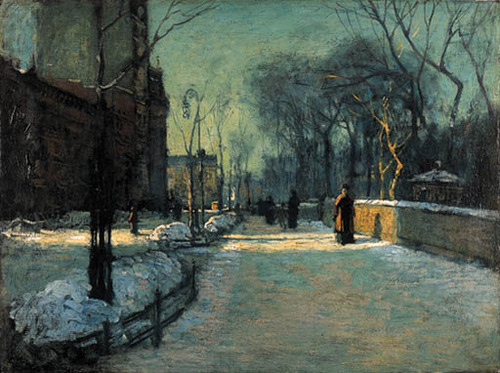
Paul Cornoyer Winter twilight along Central Park

Winter Twilight Along Central Park, Paul Cornoyer

I do a lot of things to jumpstart that creativity. I  clean things I don’t really care about under normal circumstances.  Something about a really orderly environment gets my mind relaxed enough to work properly.

Sometimes I write flash-fiction, 100 to 1000 word short stories.

I find great art that really makes my mind click–Wikimedia Commons is awesome for that.  Today I came across a download of a picture that, two years ago, sparked a 250 word flash-fiction. That  image, which I will get to later, was painted around the year 1910 by an American artist, Paul Cornoyer.

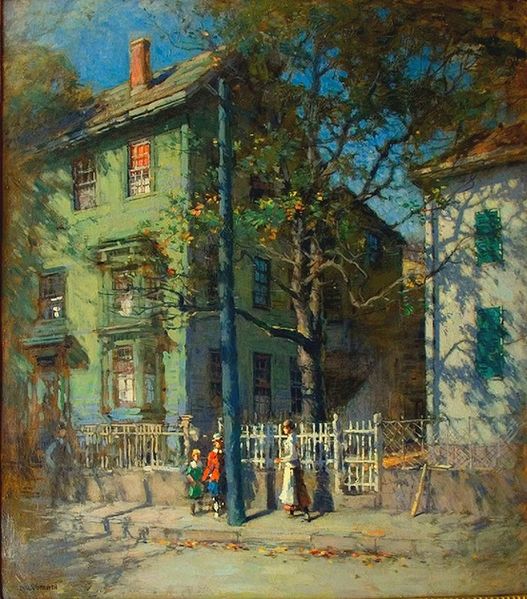
Paul Cornoyer -Gloucester

Glouster, Paul Cornoyer

His work is quite intriguing, and much of is done in an impressionistic style.

According to the Fount of all Knowledge, Wikipedia, Impressionism is a 19th-century art movement. Impressionist painting characteristics include relatively small, thin, yet visible brush strokes, open composition, emphasis on accurate depiction of light in its changing qualities (often accentuating the effects of the passage of time), ordinary subject matter, inclusion of movement as a crucial element of human perception and experience, and unusual visual angles.

The thing about the impressionists that so inspires my writing is that they don’t give you all the details–they give you what they saw including the mood of the piece.

Paul_Cornoyer_-_The_Plaza_After_Rain

The Plaza After Rain, Paul Cornoyer

In so many ways, good literature is like good art–all the important things are there, everything the eye needs to have a perfect vision of the mood, the setting, and characters–everything is there within the piece, but with economy. When you limit yourself to expressing the complete idea of the story in less than 300 words, you discover just how well (or how badly you can write.)

This last picture is the piece that inspired one of my better, short pieces of Flash Fiction, which will be featured later this month on Edgewise Words Inn. I will post links to that here when it goes up

It is called The Plaza After Rain. I love it because, even though it depicts New York City in a different time, it shows the way rain is in the springtime. The sky is dark, but the trees are just beginning to leaf out. The streets are wet with rain, but a hint of blue is showing through the dark sky. When you see this painting, you feel like sunshine could happen any minute.

That is what we try to convey in flash fiction, and that is why it’s so important to practice writing in short, complete bursts. You never know when one will become a longer tale, so you will have a backlog of  fodder to fuel your creativity when you need a good story idea. Being able to create an entire story in 3 paragraphs is an art. Sometimes I can do well at that, and sometimes not so much.


Comments Off on Book signing events, the art of Paul Cornoyer, and inspiration

Filed under Battles, Blogger, Books, Games, Humor, Literature, Publishing, Uncategorized, writer, writing

What’s in YOUR belfry?

APPROACHING HELLI’ve got a jammed-up calendar right now. I’m preparing my presentation on writing natural dialogue for Northwest Bookfest, which will be held in Kirkland Washington at Northwest University on Nov. 1 & 2, 2014. I’m really looking forward to that, but they’ve given me a slot between 10:30 a.m and 12:00  on Sunday morning-so that’s a lot of talking about talking. I can do it– heck, you know me. If I talk myself hoarse, I’ll let everyone out a few minutes early for lunch because that’s the kind of girl I am.

But in the meantime, I am still finalizing my seminar and the worksheets to go with it, and I have to also publicize it via twitter, press releases, and blogposts. After all–I really do want people to attend this sock-hop!

NaNoWriMo-General-FlyerNot only that, but I’m trying to get a book-signing/talk about the self-publishing industry for myself and Lindsay Schopfer at a local bookstore (whose website has no working contact links and who rarely answers their phone and never answers their voice-mail.) The nice-but-vague young man whom I have spoken to so far seems to have rather a low opinion of indies, but I am going to conquer that bookstore yet!

I am also building my calendar for my nano group in preparation for NaNoWriMo, which also begins on November 1st. While I do this, I have to  get the Christmas promotions finalized for my published books. I fit all of this in the copious amounts of free time I have between editing for clients, and making required revisions of my own current work, and finishing my next novel.

Being an indie author means it’s all on me. I have to generate any buzz about my books that will be generated, and I have to do it in such a way that my friends don’t all unfriend me, and my husband still looks forward to coming home. Maybe I do have bats in my belfry, but at least I’m having fun.

330px-Title_page_William_Shakespeare's_First_Folio_1623I console myself with the thought that Shakespeare had the same trouble. I do have my Twitter campaign planned–the genuine not-too-annoying-please-buy-my-books-I’ll-do-anything campaign. I have a Goodreads Ad campaign currently ongoing. I will stand naked on a street corner until I sell a book.  I will get a Google Ad campaign going.

I have several ads to put in the local paper regarding NaNoWriMo, and also I have a press release for Christmas O’ClockMyrddin Publishing’s charity anthology. We want to push that book and hopefully double our sales this year as the royalties from all sales go to benefit Water is Life. This charity is very dear to my heart, as millions of people go without safe drinking water, and they seek to change that.

I am my own publicist, secretary, chauffeur, housekeeper, and chef–so I guess you know, nothing much is getting done around the house.

Watch out for that low flying grandma–this broom ain’t stopping anytime soon.

4 Comments

Filed under Adventure, Battles, Blogger, blogging, Books, Fantasy, Humor, Literature, Publishing, Self Publishing, Uncategorized, WordPress, writer, writing

On Motivation

Periodically I get so far off track that I have to completely scrap the mess I am working on.  It’s as if I began writing one book, but somewhere along the line it becomes another.

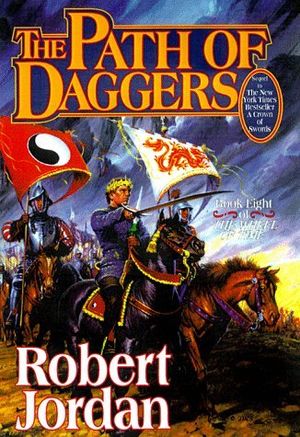
300px-WoT08_ThePathOfDaggersOne of the worst, most divergent messes I have created as a writer occurred early on in my current work-in-progress. I was  apparently channeling Robert Jordan. (The Path of Daggers) (Sorry, Wheel of Time fans–I had to say it. I loved the series overall, but he lost us there. It’s okay to admit it.)

I became so completely sidetracked by the stories of my random squirrels…er…side characters…that I completely lost track of the character whose story I had begun writing. I wrote well over 200,000 words that did not advance that story.

I got so lost that I had to rein it in somehow. I’m not Robert Jordan, so there’s no way folks are going to stick with me while I meander through 15 books in the trilogy.

I shelved that MS, re-titled it  Junk for my next book,  and started all over again, this time with an outline. But all is not lost–I have 3 books worth of material for later, and it was a good exercise in how NOT to write a novel.

What originally got me going off in so many directions  was the search for one particular character’s motivation. WHY does he behave the way he does?   I wasn’t sure how to go about it, and I began by writing a backstory that I knew would never make it into the book. It was intended to show me who this person is, and what motivates him, but it got out of hand rather quickly.

In a workshop I attended at a recent convention,indie author  Lindsay Schopfer boiled character motivation down to one  simple thing: Need. Every action by a character must be motivated by some need.

Well, it sounds simple, enough, but it really can be complicated. After Lindsay’s talk, it occurred to me that I had gone about it the hard way. The simplest way would be to graph it out, and the internet is rife with all sorts of inspirational thingys of this nature, but I’m a rebel. I gotta do it my own way.

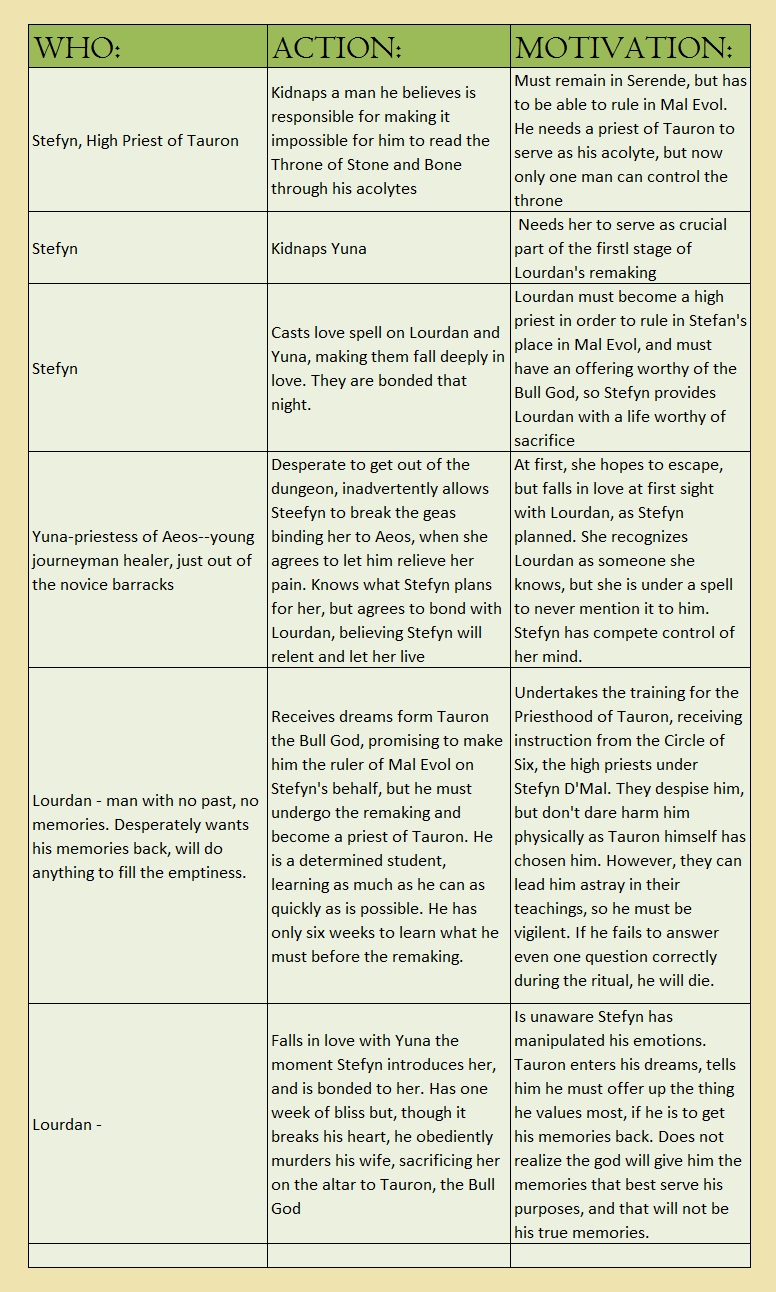
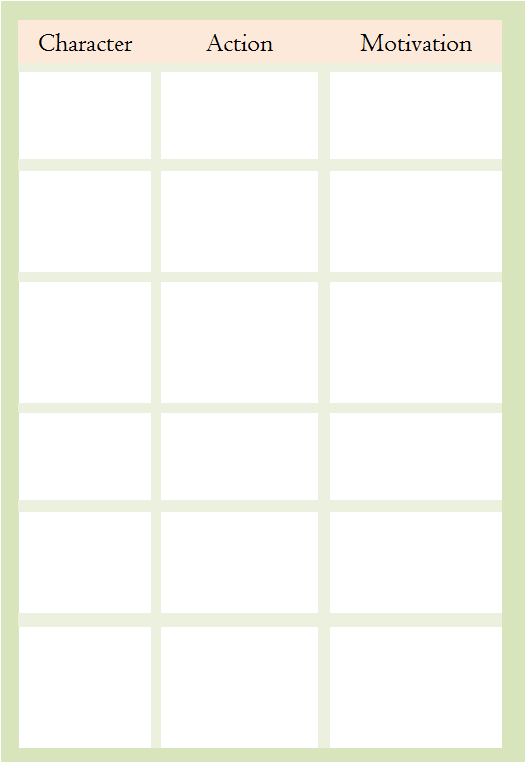
SO–I was a bookkeeper for years–I fired up Excel, and made me a handy-dandy Motivational Chart, where I identified the characters, what their action was, and what motivated that action.

What does a character need? Well, what do real people need?  The basics are  food, shelter, and garments. Once they have those items, they may need transportation, they may need entertainment. They need companionship. They need spirituality, or love, or sex. Once we identify what a character needs, we need to know how far they are willing to go to acquire it.

The lengths they will go to achieve their goal is the real story

This is one section of the long chart:

motvation table

Now, you don’t have to be able to use MS Excel to make your own motivational chart. Get your ruler out, and block off sections on a standard sheet of paper. If you don’t have a ruler, use the straight side of something long, like a foil-box or a plastic-wrap box.  The point is, you want to tame the chaos on one horizontal tier of a grid:

character –>his actions –> and why he did it (his motivations.)

motivation table - blank

In the process of doing that you may find yourself ironing out some plot wrinkles, as I did. I am a linear thinker–so I need to have my characters as clear to me as if they were my dearest friends. For me, that means I will make a chart from now on, rather than wasting time writing words to nowhere.

After I did this, I wrote 25,000 words that launched the real story. Charting my character’s motivations works well for me.  I will be story-boarding my work in this fashion in the future.


5 Comments

Filed under Battles, Books, Fantasy, Humor, Literature, Publishing, Self Publishing, Uncategorized, writer, writing

Setting inspiration ablaze

225px-Author_james_rollins_2008Last Thursday I was privileged to hear James Rollins speak at the opening of the 2014 Pacific Northwest Writers association conference in Seattle, Washington. He’s quite hilarious, and down to earth. He is still actively working a s veterinarian, which is a profession that would keep anyone humble, I  think.

It was a wonderful speech, and I was completely entertained, laughing so hard I had tears at one point. Jim kicked it off, but over those four days of immersion in the craft, 4 presenters in particular impressed me and rekindled my drive to write good novels.  Over the next weeks I will be blogging on the elements of the craft that each of these four speakers were able to convey.

scott-driscoll1The first to pique my interest and steal my literary heart was Scott Driscoll,  whose  novel, Better You Go Home , has been receiving high praise. I am in the middle of reading it now, and it is compelling work. I’ll be blogging at length about all the books I purchased at this convention.

Anyway, Scott gave 2 talks and I attended both of them  The first was on the arc of the scene, developing a rhythm for each scene that grips the readers attention, takes him through all the emotional points you want him to experience, and then sets the platform for the next scene.   The second was on literary fiction, which is my secret addiction.

In some ways I already understood the arc of the scene, but he was able to really get it across in an entertaining and concise way, and emailed me a wonderful handout to tape next to my computer. In his literary fiction seminar Scott Driscoll also discussed  a fourth point of view I had heard of in college, but forgotten about,and gave it a name I’d never heard of: the Flâneur (idler, lounger, loiterer,) which we will be discussing next week. Charles  Baudelaire characterized the flâneur as a “gentleman stroller of city streets,” he saw the flâneur as having a key role in understanding, participating in and portraying the city. Thus, a flâneur plays a double role by existing  as a present, but ignored, member of society who remains a detached observer of all that occurs within the story.

jason blackThe second speaker to really grab my interest was Jason Black. A well-known structural editor, Jason also writes middle-grade novels.  His discussion on steering your story where you want it to go was really pertinent to a problem I’ve been wrestling with in one of my current works in progress. I will be writing on his suggestions and putting them to work  for me.

One of the things that Jason jarred loose in my head is how I need to proceed with deploying information about a certain evil character while not revealing too much at the outset. He reminded me of the the concept of asymmetric information–A situation in which one party in a transaction has more or superior information compared to another. This often happens in business and stock transactions where the seller knows more than the buyer, although the reverse can happen as well. Potentially, this could be a harmful situation because one party can take advantage of the other party’s lack of knowledge.

In novels, not everyone in the scene knows everything, and those plot points are driven by the those characters who do have the critical knowledge. Applying this to my current plothole will be key to resolving it.

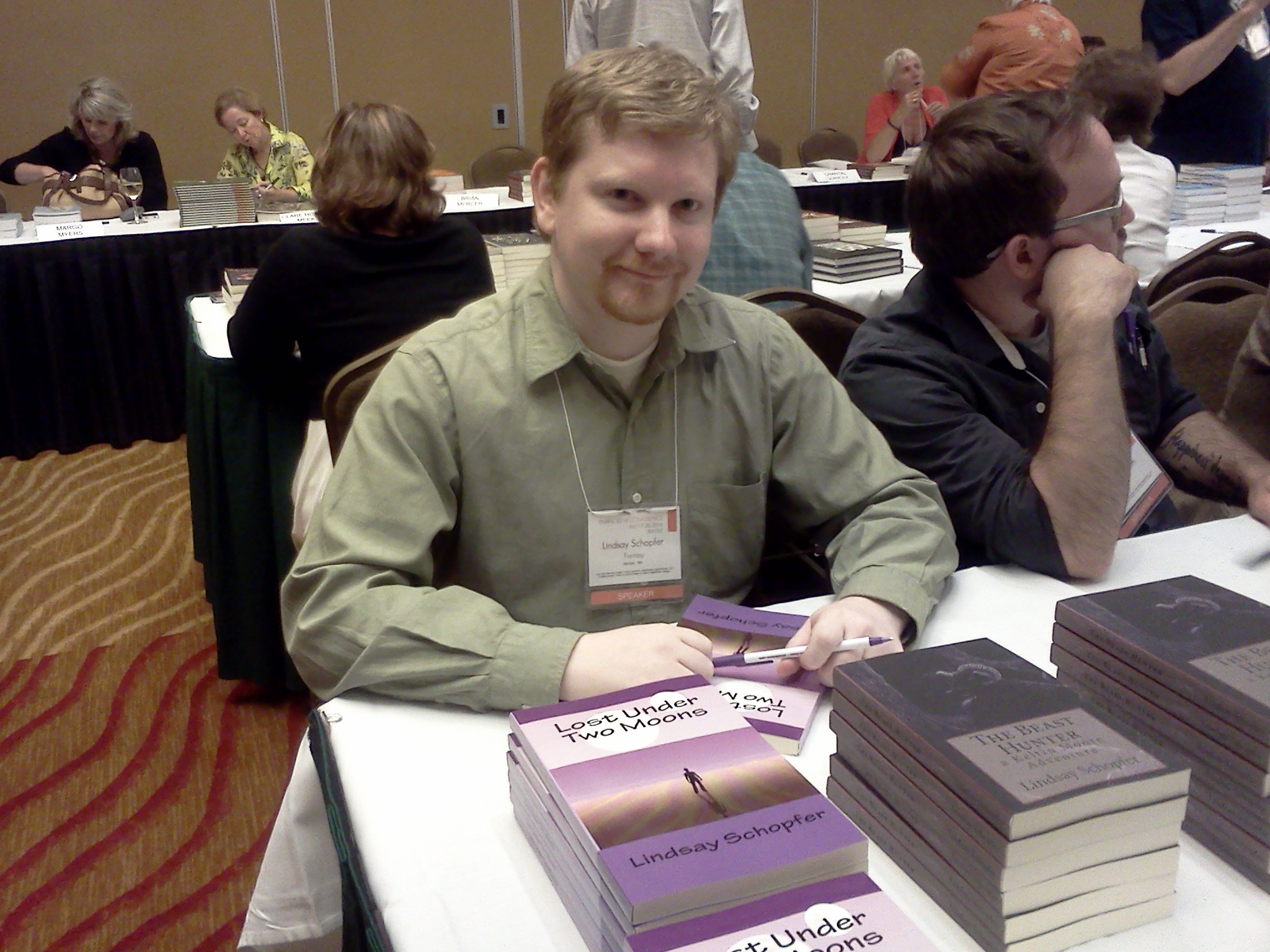
Lindsay Schopfer book signing PNWA 2014Then I was assisted by fantasy author, Lindsay Schopfer, in identifying character motivation. Sometimes it’s hard to understand why characters do the things they do–and Lindsay boiled how to identify it down to simple manageable chunks. Now I think my problems with the one evil character I am trying to flesh out will be resolved, because he now has clear motivations for his actions. I will be writing like a banshee for a week, anyway!

Lindsay’s characters leap off the page, and that is what we all want for our own work.   I really enjoyed The Beast Hunter and Lost Under Two Moons, and have reviewed both of them on Best in Fantasy.

Terry PersunAnother seminar I went to that really pushed my current work into focus was given by Terry Persun,  the award winning science fiction and fantasy author.  He was discussing point of view, the ubiquitous POV we sometimes struggle with, should we be omniscient, 3rd person, or first person? And what do they mean? Of course, I have a grip on that, but it was his side comments and sense of humor that jump-started my my brain. He managed to help me bring into focus the way to end the final bit of misery that is my current work in progress.

He made the point that the only POV a reader can really trust is the ‘omniscient’ as it is not told from any one character’s point of view and is therefore unlikely to be a lie. However, that said, he’s  written novels in every POV, because it’s more interesting for him as an author. I bought 4 of his books–just sayin’.  Can’t wait to get into Doublesight. I can smell a book blog review!

And while I was there, I finally met Janet Oakley in person. She is a long-time friend, an author I have known for several years, and whom I met through the Amazon Breakthrough Novel Awards Contest–but we only have known each other through the on-line community. She is an awesome person and her books, Timber Rose and Tree Soldier  have been winning awards right and left!

Janet and I met up with local author Don Harkcom, who writes thrillers, and who is now being courted by several agents. Don actually lives not far from me, and we spent a lot of time discussing everything from gaming to politics. All in all, it was a great conference and I am already looking forward to next year!

Me, Don Harkom, J.L. Oakley -Janet - PNWA 2014

Me, Don Harkcom, & J.L. Oakley at PNWA 2014

4 Comments

Filed under Uncategorized

Kicking off the annual PNWA writers conference

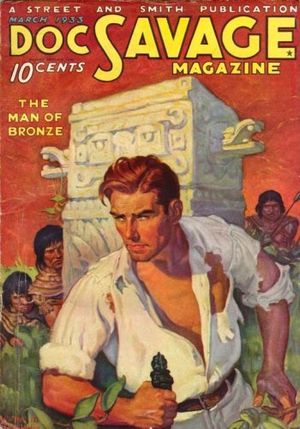
300px-DocsavageWell it’s that time of the year again–today is the first day of the Pacific Northwest Writers Association Conference, held in Seattle, Washington. I’m a proud member of PNWA, and find incredible inspiration at these conventions. This year’s keynote speaker is James Rollins, the well-known master of magic, mayhem, and monsters.  According to Wikipedia, the fount of all knowledge,  “Rollins found the authors of the Doc Savage series inspirational as a youth and acquired an extensive collection of the popular 1930′s and 1940′s pulp magazine stories.”

Quite frankly, I too adored Doc Savage, and discovering that another author was influenced by that wonderful, lurid, misogynistic series is quite a treat.  I’m looking forward to hearing him speak tonight.

Another person whose seminar I am looking forward to will be given by Lindsay Schopfer, author of The Beast Hunter. He will be talking on the subject of unlocking character motivation, and I am quite interested in hearing what he has to say on the subject, as he is an accomplished author, and his characters leap off the page.

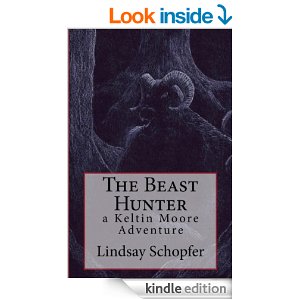
The Beast Hunter, Lindsay SchopferIt’s one thing to understand the mechanics of writing, the nuts and bolts of how to put together a coherent sentence and join it together with other sentences to make paragraphs. Most writers can do that. It’s quite another thing to write paragraphs that become stories other people will want to read.  Attending writers conferences and seminars gives me insight into how successful authors whom I’ve admired over the years think, and helps me stay fired up about my own work.

I will reconnect with many local northwest authors who I’ve become friends with over the years, and of course I’ll be connecting with agents and editors from all over the country.  This is a huge opportunity for me to absorb the mojo that happens whenever writers gather to talk shop. My next blog post will cover the events and hilarity of this one.

Jake RansomLast year I did learn one important thing–even the Hilton doesn’t have a clue when it comes to providing decent vegan entrees, no matter how the conference organizers claim they will offer them. Rather than starve as I did last year, this year I am commuting from home and bringing my own sack-lunch with plenty of snacks. It’s a bit of a drive, a little over 1 hour each way, but if the dinners provided are less than adequate, I’ll survive.

Today’s lunch will be an avocado, lettuce and tomato sandwich on whole-wheat. ♥  It doesn’t get any better than that!

Comments Off on Kicking off the annual PNWA writers conference

Filed under Adventure, Battles, Books, Humor, Publishing, Self Publishing, Uncategorized, Vegan, WordPress, writer, writing

Lindsay Schopfer, ‘The Beast Hunter’ launch

The Beast Hunter, Lindsay SchopferToday, Lindsay Schopfer, well-known Pacific Northwest author of science fiction and fantasy, instructor, and writing coach has consented to answer a few questions for us. His second book, The Beast Hunter is launching today, and I’ve been privileged to read an advance copy of it. If you are looking for an action-adventure in set in another world, brimming with political and personal intrigue, this is the book for you!

CJJ: Lindsay, you were one of my daughter Meg’s closest friends in high school. I’ve followed your career from the early days of your first play, “Techies,” knowing you had a wonderful future in writing ahead of you. Your own real life tale has been a wonderful journey, so tell us a little of early life and how you began writing:

LS: I started writing as a little kid, and I guess some people would have called me a prodigy. I wrote and produced my first full-length stage-play at 13, and went on to do five more, including two runs of “Techies.” After high school, I took a break from writing and spent two years as a service missionary on the Navajo Reservation in New Mexico. That experience, coupled with a health condition which could randomly cause me to be paralyzed for hours at a time, taught me important lessons of hardship, hope, and love.

I went to film school in Canada for a year, thinking that I would continue my passion for acting and directing, but I eventually realized that I just wouldn’t be able to tell the fanciful stories in my head unless I put them into novels. While I still daydream about film adaptations of my stories, I have to say that I’m very happy with my work and life right now.

CJJ: My favorite Lindsay Schopfer quote says it all, “I only write when I’m inspired, and I make sure I’m inspired every morning at 9 a.m.”  How do you channel the randomness of inspiration into an appointment?

LS: Actually, that quote originally comes from Peter De Vries, but it’s something that I try to live by as well. For me, turning on my inspiration means creating a mental place where I feel safe to be creative. I map out the times of day I have available when I seem to be the most productive and set them aside. I listen to music that fits my mood and the kind of writing I’ll be doing. I also try to remember that I can write whatever story I want to, so that I enjoy my work rather than feel confined by it. Ultimately, if I make writing my break from the world, then I don’t feel the need to take a break from my writing.
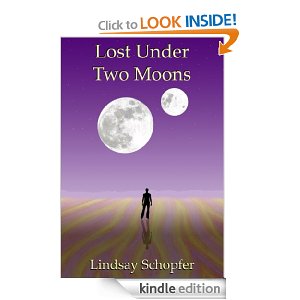
Lost Under Two moons, Lindsay SchopferCJJ: I read Lost Under Two Moons, and really enjoyed it. I find that your work is well-structured, with creative environments, good tension, and deep characters. Do you have a specific ‘Creative Process’ that you follow, such as outlining or do you ‘wing it’?

LS: My ideas for stories usually come in two parts, the beginning and the ending. Once I have those two points established in my mind, writing the novel is just a matter of connecting those two dots. I don’t do a lot of outlining because I find that I start to lose interest in a story if I feel ‘chained’ to a guideline I’ve set for myself. I do enjoy doing world-building early on, though I usually just sketch out enough details to get me started and only add to it if I get stuck. Of course, once the first draft is done, I always go back and fill out the rest of my backstory and world-building notes, but that’s usually a case of noting what I came up with as I was writing and trying to maintain continuity throughout the story.

CJJ: You are highly involved with the Pacific Northwest Writers Association, which I am also a member of. You gave a workshop on May 2nd, regarding turning off the inner critic. What advice would you give new authors, who may be struggling with this common problem?

LS: Like I said earlier, turning off the inner critic and getting inspired is a matter of creating a place where you feel safe to write. For some people, this means writing when you’re not fully awake. I do my best writing at three different times, when I first wake up, at around two in the afternoon (siesta time), and just before bed. Another way to turn off the inner critic that’s especially useful to new authors is to work on multiple projects at a time. Too many first-time authors have this mindset that they have to put all their good ideas into their first novel, or that the first book has to be perfect. By working on more than one project at a time, the writer is constantly reminded that she will have more chances than just this one book, which can be a common anxiety. Having a second project also means that you have a creativity lifeboat, and if you get writer’s block on one project you can “run away from it” and yet still be writing until you’re ready to go back.

CJJ: I absolutely agree, and I usually have three projects going at a time myself. So, I know why I chose the indie route for my work, but I’m curious as to why you’ve chosen this path.

LS: Actually, I never intended to be an indie author. When I finished Lost Under Two Moons, I pitched it to agents for a while before releasing it as an EBook and later in print. My decision to indie-publish that novel came mainly from a desire to start selling books and establishing a market for myself. I wanted credibility as a generative artist, and to be honest I felt like that happened once I finally had a book people could buy and read.

The Beast Hunter was also originally intended for a traditional publishing route. In 2012 I went to PNWA’s summer conference and asked agents what it would take to become a hot commodity to them. The answer I got was that I needed a built-in fan base, so I wrote The Beast Hunter online serial. Once I had the fan base, I went back in 2013 with my completed novel and loyal readers, and pitched it. I was shocked that the same agents who had encouraged me to do the serial now said I had ruined my chances for success with this book because I had already “saturated the market”, though I’d like to think that there are plenty of people who would like The Beast Hunter who haven’t read the serial! I decided to keep the serial going as a way to reward loyal fans, and indie-publishing the novel seemed like the best way to tie-in the serial with my novels.

I haven’t given up on traditional publishing. I have two additional book series that I’m working on that will be intended for a traditional book deal. I’m hoping that the exclusivity of these stories combined with the fan base from my indie publishing will finally allow me to be a hybrid author with both traditionally and independently published books.

CJJ: That is a great plan of action—one that addresses negotiating both sides of the publishing dilemma.  What advice would you offer an author trying to decide whether to go indie or take the traditional path?

LS: Don’t give up on traditional publishing. While the industry is still trying to figure out how to handle the electronic revolution, it is filled with very intelligent professionals that really know the business of selling books. On the other hand, I don’t think writers should give the industry any more power than it already has. An author desperate for representation and publication is an easily exploitable resource. I would advise authors to try for traditional publishing first, but don’t be overly eager. Remember that the greatest power you have is to say no, no to an agent that isn’t good for you, no to a publisher that won’t push your book, no to a book-deal that demands too many rights. Keep that in mind, and if you feel like your project isn’t right for traditional, go indie.

CJJ: Your new book, The Beast Hunter is launching today. This is a book with an interesting history! Tell us a little about it and how it came to be.

LS: The Beast Hunter actually started as a 1,000 word flash fiction story that I wrote more as an exercise for myself than anything else. I wanted to see if I could write an action sequence, something I hadn’t tried doing in my fantasy writing since becoming serious about pursuing a career as a novelist. At the time, I was playing a steampunk CRPG called Arcanum Of Steamworks & Magic Obscura, so I decided to try writing about a hunter using 19th century technology to bring down a monster.

I liked the result, and decided to expand on the character of Keltin Moore by continuing his adventures in a free, online serial.  A little more than a year later I’d finished the first season and The Beast Hunter had gained an international following. It’s kind of funny, because for a long time this story was my side-project, something that I wrote on to relax and just enjoy writing. To see it in print now is kind of like inviting all the world to play make-believe with me, and I’m excited to continue the adventure.

CJJ: Lindsay, thank you so much for being here today! I must say, I am looking forward to hearing your presentation at the PNWA convention on July 18, 2014 on UNLOCKING CHARACTER MOTIVATION.  I will be taking notes!

The Beast Hunter Books For Africa Fundraiser Event

To celebrate the launch of his latest book, Lindsay has decided to donate one dollar to Books For Africa for each verified copy of The Beast Hunter that is sold in the next two months!

Here’s how it works. Purchase The Beast Hunter in paperback or EBook form and then take a picture of yourself with your new book. Post that picture on this event page, and Lindsay will make a donation. Only one donation per copy of The Beast Hunter.

Books for Africa is an organization with just one goal: to end the book famine in Africa. BFA is the largest shipper of donated text and library books to the African Continent, and has a 4-star rating from Charity Navigator, America’s largest charity evaluator. A donation of 50 cents is enough to send a book to a child in Africa. For more about this amazing organization, check out http://www.booksforafrica.org.
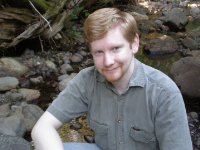
 

Lindsay SchopferAbout Lindsay Schopfer:

Lindsay Schopfer is the author of the rural steampunk adventure novel The Beast Hunter (2014) and the fantasy adventure novel Lost Under Two Moons (2012) . His short fiction has also appeared in The Daily Times, an international newspaper based in Pakistan. When he isn’t writing, Lindsay is a writing coach and instructor for Adventures In Writing, where he helps writers learn about and improve their craft.  He is also a mentor for Educurious, a Gates Foundation-funded program designed to connect high school students with professional writers.

Lindsay’s books are available at amazon.com and through his website, http://www.lindsayschopfer.com

You can also sign up for his wonderful workshops through his website at Adventures in Writinghttp://www.yourwritingadventure.com


Comments Off on Lindsay Schopfer, ‘The Beast Hunter’ launch

Filed under Adventure, blogging, Books, Fantasy, Literature, Publishing, Self Publishing, Uncategorized, writing