Tag Archives: Luminism

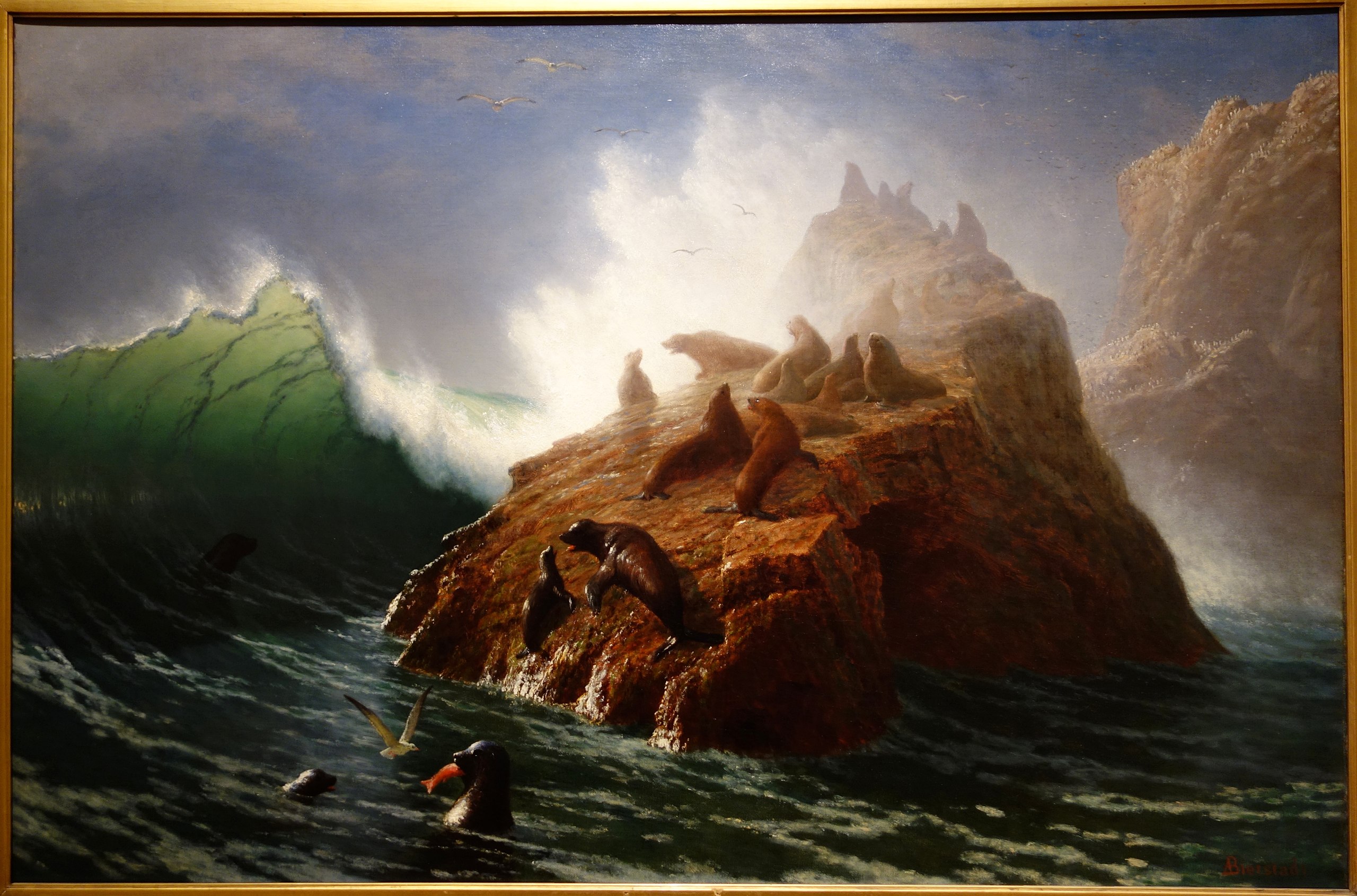
#FineArtFriday: Seal Rock by Albert Bierstadt

Artist: Albert Bierstadt (1830–1902)

Title: Seal Rock

Genre: marine art

Date: 1880s

Medium: oil on canvas

Dimensions:   height: 105 cm (41.3 in)

What I love about this painting:

It is a blustery day on the cold, wild sea. The sun briefly shines through, illuminating the rocks, glowing through a cresting wave. This is a masterful depiction of the scene, painted later in his life. It is dynamic and dramatic, conveying the power of the waves and the emotion of the scene.

Despite the efforts of the sea to wash them away, the rocks stand strong, offering a safe place for the seals.

As an avid watcher of nature shows, I love this painting.  Bierstadt captures these seals doing all the things seals do. They are fishing, lounging, and several pairs are apparently arguing.

Not unlike my family when we go out to lounge on a rock beside the sea.


About the Artist, via Wikipedia:

Albert Bierstadt (January 7, 1830 – February 18, 1902) was a German American painter best known for his lavish, sweeping landscapes of the American West. He joined several journeys of the Westward Expansion to paint the scenes. He was not the first artist to record the sites, but he was the foremost painter of them for the remainder of the 19th century.

Bierstadt was born in Prussia, but his family moved to the United States when he was one year old. He returned to study painting for several years in Düsseldorf. He became part of the second generation of the Hudson River School in New York, an informal group of like-minded painters who started painting along the Hudson River. Their style was based on carefully detailed paintings with romantic, almost glowing lighting, sometimes called luminism. Bierstadt was an important interpreter of the western landscape, and he is also grouped with the Rocky Mountain School. [1]


Credits and Attributions:

IMAGE: Seal Rock by Albert Bierstadt, Wikimedia Commons contributors, “File:Seal Rock by Albert Bierstadt, c. 1872-1887, oil on canvas – New Britain Museum of American Art – DSC09221.JPG,” Wikimedia Commons, https://commons.wikimedia.org/w/index.php?title=File:Seal_Rock_by_Albert_Bierstadt,_c._1872-1887,_oil_on_canvas_-_New_Britain_Museum_of_American_Art_-_DSC09221.JPG&oldid=975772252 (accessed March 27, 2025).

[1] Wikipedia contributors, “Albert Bierstadt,” Wikipedia, The Free Encyclopedia, https://en.wikipedia.org/w/index.php?title=Albert_Bierstadt&oldid=1277160716 (accessed March 27, 2025).
2 Comments

Filed under #FineArtFriday

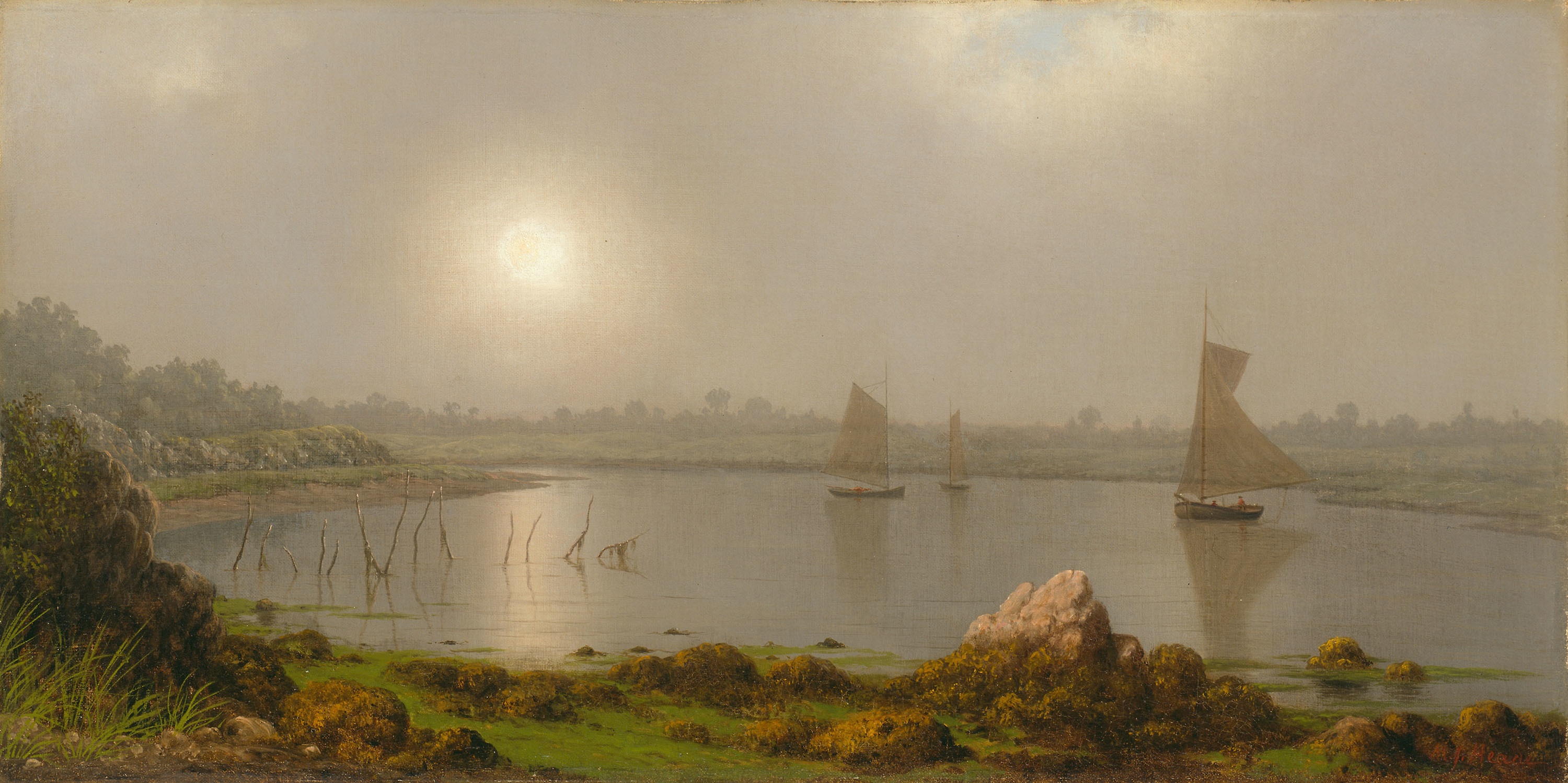
#FineArtFriday: York Harbor, Coast of Maine by Martin Johnson Heade 1877

Martin_Johnson_Heade_-_York_Harbor,_Coast_of_Maine_-_1999.291_-_Art_Institute_of_ChicagoArtist: Martin Johnson Heade  (1819–1904)
Title: York Harbor, Coast of Maine

Genre: marine art

Date: 1877

Medium: oil on canvas

Dimensions: height: 38.7 cm (15.2 in)

Collection: Art Institute of Chicago

What I love about this painting:

We see the sun rising, slowly burning off the morning mist–my favorite time of the day. I love the detail, the way Martin Johnson Heade shows us the truth about harbors that serve small communities in a low-tech world. They aren’t necessarily fancy, and they don’t accommodate large boats. Somewhere out of the picture is a simple wooden pier, a place for the fishing boats to offload their catch. Perhaps there is a sandy beach where fisherfolk can pull their boats above the waterline, resting them upside down when they’re not in use.

The scene he shows us is a salt marsh, alive with a thriving wildlife community.

The line of branches emerging from the water has been placed there by human hands, but for what purpose? Whatever they are meant to do, they have been there long enough that seaweed clings to them, nourished by the rise and fall of the tide.

About the Artist, via Wikipedia:

Martin Johnson Heade (August 11, 1819 – September 4, 1904) was an American painter known for his salt marsh landscapesseascapes, and depictions of tropical birds (such as hummingbirds), as well as lotus blossoms and other still lifes. His painting style and subject matter, while derived from the romanticism of the time, are regarded by art historians as a significant departure from those of his peers.

Heade’s primary interest in landscape, and the works for which he is perhaps best known today, was the New England coastal salt marsh. Contrary to typical Hudson River School displays of scenic mountains, valleys, and waterfalls, Heade’s marsh landscapes avoided depictions of grandeur. They focused instead on the horizontal expanse of subdued scenery, and employed repeating motifs that included small haystacks and diminutive figures. Heade also concentrated on the depiction of light and atmosphere in his marsh scenes. These and similar works have led some historians to characterize Heade as a Luminist painter. In 1883 Heade moved to Saint Augustine, Florida and took as his primary landscape subject the surrounding subtropical marshland. [1]

To read more about this Artist, go to Martin Johnson Heade – Wikipedia


Credits and Attributions:

IMAGE: Wikimedia Commons contributors, “File:Martin Johnson Heade – York Harbor, Coast of Maine – 1999.291 – Art Institute of Chicago.jpg,” Wikimedia Commons, https://commons.wikimedia.org/w/index.php?title=File:Martin_Johnson_Heade_-_York_Harbor,_Coast_of_Maine_-_1999.291_-_Art_Institute_of_Chicago.jpg&oldid=828607401 (accessed July 3, 2024).

[1] Wikipedia contributors, “Martin Johnson Heade,” Wikipedia, The Free Encyclopedia, https://commons.wikimedia.org/w/index.php?title=File:Martin_Johnson_Heade_-_York_Harbor,_Coast_of_Maine_-_1999.291_-_Art_Institute_of_Chicago.jpg&oldid=828607401 (accessed July 3, 2024).

8 Comments

Filed under #FineArtFriday, writing

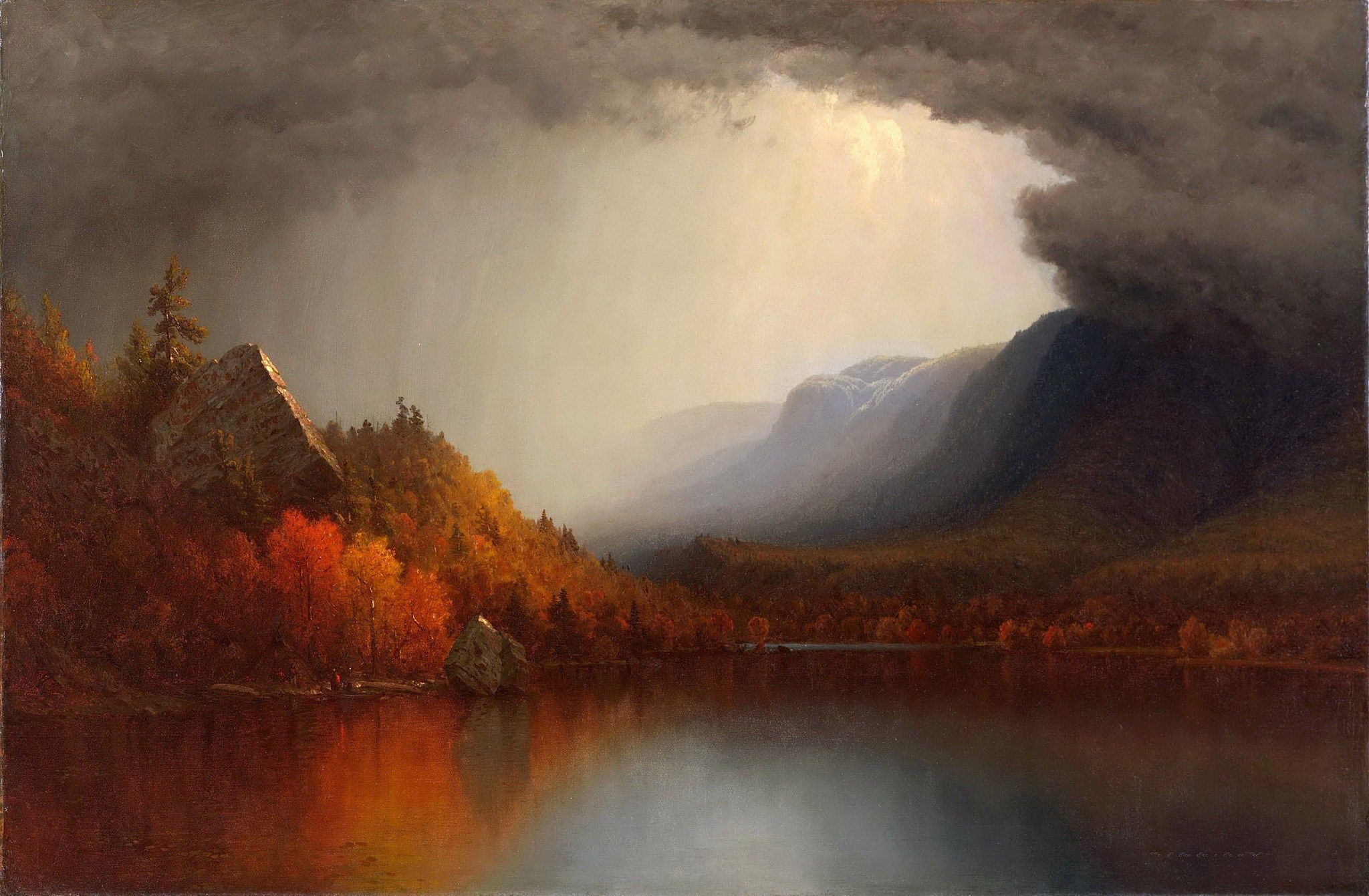
#FineArtFriday: A Coming Storm by Sanford Robinson Gifford

Gifford_A_Coming_Storm_1863-1880_PMA

Artist: Sanford Robinson Gifford,

Title: A Coming Storm (1863)

Date: 1863 (retouched 1880)

Location: Philadelphia Museum of Art.

What I love about this painting:

Gifford demonstrates his skill as a devotee of luminism and gives us the perfect view of a fine autumn day and the approaching storm. The way he contrasts the sun’s light against the ominous black clouds is true to nature, to how storms really look as they close in.

I like the way he shows the rock outcroppings, visible evidence of the hard stone of the mountains that lies beneath the lush finery of autumn foliage.

For the moment, the waters of the pond are quiet, reflecting the sky above. Rain cloaks the view of the distant valley, and soon we will feel the brunt of it. Enjoy the blaze of color while you can, as tomorrow those trees will be half-bare, and the ground will be covered in sodden tatters of red and gold.

While there appears to be some damage in the upper center, the integrity of the painting is still intact. It was retouched in 1880, but a modern retouching would likely bring it back to its original glory.

About the Artist, via Wikipedia:

Sanford Robinson Gifford (July 10, 1823 – August 29, 1880) was an American landscape painter and a leading member of the second generation of Hudson River School artists. A highly regarded practitioner of Luminism, his work was noted for its emphasis on light and soft atmospheric effects.

Although trained as a portrait painter, the first work Gifford exhibited at the National Academy was a landscape, in 1847. Thereafter, Gifford devoted himself primarily to landscape painting, becoming one of the finest artists of the Hudson River School. He was elected an Associate of the National Academy in 1851, and an Academician in 1854.

2008 National Academy of Design controversy:

In December 2008, one of Gifford’s paintings, Mount Mansfield, Vermont (1859), became part of a controversy over deaccessioning by the National Academy of Design. The Academy was a member of the Association of Art Museum Directors, whose policy stated that member museums could not sell works of art to cover operating expenses, only to purchase superior works or to weed out inferior or redundant ones. Prior to joining AAMD, the Academy had sold two Thomas Eakins works (including his “diploma painting,” Wrestlers) in the 1970s, and Richard Caton Woodville‘s War News from Mexico (1848) in 1994. According to its former curator, David Dearinger: “When the Academy later applied to the museum association for accreditation, Mr. Dearinger recalled, it was asked about the Woodville sale and promised not to repeat such a move.”

In a 2008 sale, the Academy quietly sold Frederic Edwin Church‘s Scene on the Magdalene (1854) and Sanford Gifford’s Mount Mansfield, Vermont (1859) to a private collector for US$13.5 million. The former was the Academy’s only painting by Church; the latter was its only painting by Gifford. Both had been “donated to the Academy in 1865 by another painter, James Augustus Suydam.” News of the sale was broken by arts blogger Lee Rosenbaum. As punishment for these actions, AAMD asked its other member museums to “cease lending artworks to the Academy and collaborating with it on exhibitions.” The Academy had contemplated selling additional paintings, but those plans were abandoned after being reported by Rosenbaum. [1]


Credits and Attributions:

IMAGE: A Coming Storm by Sanford Robinson Gifford. Wikimedia Commons contributors, “File:Gifford A Coming Storm 1863-1880 PMA.jpg,” Wikimedia Commons, https://commons.wikimedia.org/w/index.php?title=File:Gifford_A_Coming_Storm_1863-1880_PMA.jpg&oldid=803742381 (accessed October 5, 2023).

[1] Wikipedia contributors, “Sanford Robinson Gifford,” Wikipedia, The Free Encyclopedia, https://en.wikipedia.org/w/index.php?title=Sanford_Robinson_Gifford&oldid=1176083433 (accessed October 5, 2023).

Comments Off on #FineArtFriday: A Coming Storm by Sanford Robinson Gifford

Filed under #FineArtFriday

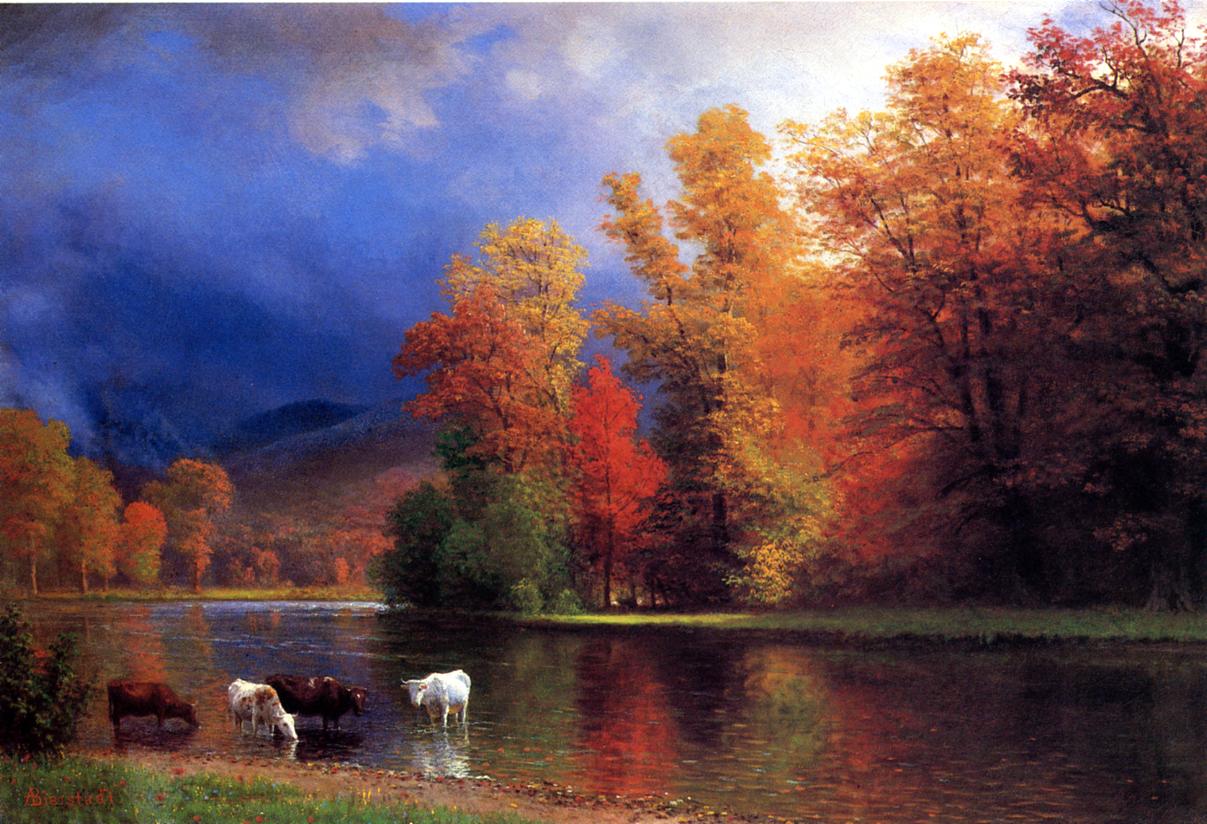
#FineArtFriday: On the Saco by Albert Bierstadt (revisited)

Bierstadt_Albert_On_the_SacoArtist: Albert Bierstadt (1830–1902)

Title: “On the Saco”

Genre: landscape art

Description: Of the Saco River, Maine.

Date: Unknown date (19th century)

Medium: oil painting.

What I love about this image:

Bierstadt understood and respected the power of nature. The way he rendered the sky is wonderful. He captured that brilliant darkness of a distant storm against the bright sunshine of an autumn afternoon. I love contrasts in this painting, the bright foliage in every shade of red and yellow, the serenity of the cattle drinking in the shallows.

The heavy darkness of the storm in the hills seems to be pushed back by the serene glow of fall’s sunlight on the river. Will it rain itself out before it passes over the herd? Possibly.

About the Artist, via Wikipedia:

Albert Bierstadt (January 7, 1830 – February 18, 1902) was a German-American painter best known for his lavish, sweeping landscapes of the American West. He joined several journeys of the Westward Expansion to paint the scenes. He was not the first artist to record the sites, but he was the foremost painter of them for the remainder of the 19th century.

Bierstadt was born in Prussia, but his family moved to the United States when he was one year old. He returned to study painting for several years in Düsseldorf. He became part of the second generation of the Hudson River School in New York, an informal group of like-minded painters who started painting along the Hudson River. Their style was based on carefully detailed paintings with romantic, almost glowing lighting, sometimes called luminism. Bierstadt was an important interpreter of the western landscape, and he is also grouped with the Rocky Mountain School. [1]


Credits and Attributions:

Image: On the Saco by Albert Bierstadt, Wikimedia Commons contributors, “File:Bierstadt Albert On the Saco.jpg,” Wikimedia Commons, the free media repository, https://commons.wikimedia.org/w/index.php?title=File:Bierstadt_Albert_On_the_Saco.jpg&oldid=618723154 (accessed September 16, 2022).

[1] Wikipedia contributors, “Albert Bierstadt,” Wikipedia, The Free Encyclopedia, https://en.wikipedia.org/w/index.php?title=Albert_Bierstadt&oldid=1107140650 (accessed September 16, 2022).

Comments Off on #FineArtFriday: On the Saco by Albert Bierstadt (revisited)

Filed under #FineArtFriday

#FineArtFriday: On the Saco by Albert Bierstadt

Bierstadt_Albert_On_the_SacoArtist: Albert Bierstadt (1830–1902)

Title: “On the Saco”

Genre: landscape art

Description: Of the Saco River, Maine.

Date: Unknown date (19th century)

Medium: oil painting.

What I love about this image:

Bierstadt understood and respected the power of nature. The way he rendered the sky is wonderful. He captured that brilliant darkness of a distant storm against the bright sunshine of an autumn afternoon. I love contrasts in this painting, the bright foliage in every shade of red and yellow, the serenity of the cattle drinking in the shallows.

The heavy darkness of the storm in the hills seems to be pushed back by the serene glow of fall’s sunlight on the river. Will it rain itself out before it passes over the herd? Possibly.

About the Artist, via Wikipedia:

Albert Bierstadt (January 7, 1830 – February 18, 1902) was a German-American painter best known for his lavish, sweeping landscapes of the American West. He joined several journeys of the Westward Expansion to paint the scenes. He was not the first artist to record the sites, but he was the foremost painter of them for the remainder of the 19th century.

Bierstadt was born in Prussia, but his family moved to the United States when he was one year old. He returned to study painting for several years in Düsseldorf. He became part of the second generation of the Hudson River School in New York, an informal group of like-minded painters who started painting along the Hudson River. Their style was based on carefully detailed paintings with romantic, almost glowing lighting, sometimes called luminism. Bierstadt was an important interpreter of the western landscape, and he is also grouped with the Rocky Mountain School. [1]


Credits and Attributions:

Image: On the Saco by Albert Bierstadt, Wikimedia Commons contributors, “File:Bierstadt Albert On the Saco.jpg,” Wikimedia Commons, the free media repository, https://commons.wikimedia.org/w/index.php?title=File:Bierstadt_Albert_On_the_Saco.jpg&oldid=618723154 (accessed September 16, 2022).

[1] Wikipedia contributors, “Albert Bierstadt,” Wikipedia, The Free Encyclopedia, https://en.wikipedia.org/w/index.php?title=Albert_Bierstadt&oldid=1107140650 (accessed September 16, 2022).

5 Comments

Filed under #FineArtFriday

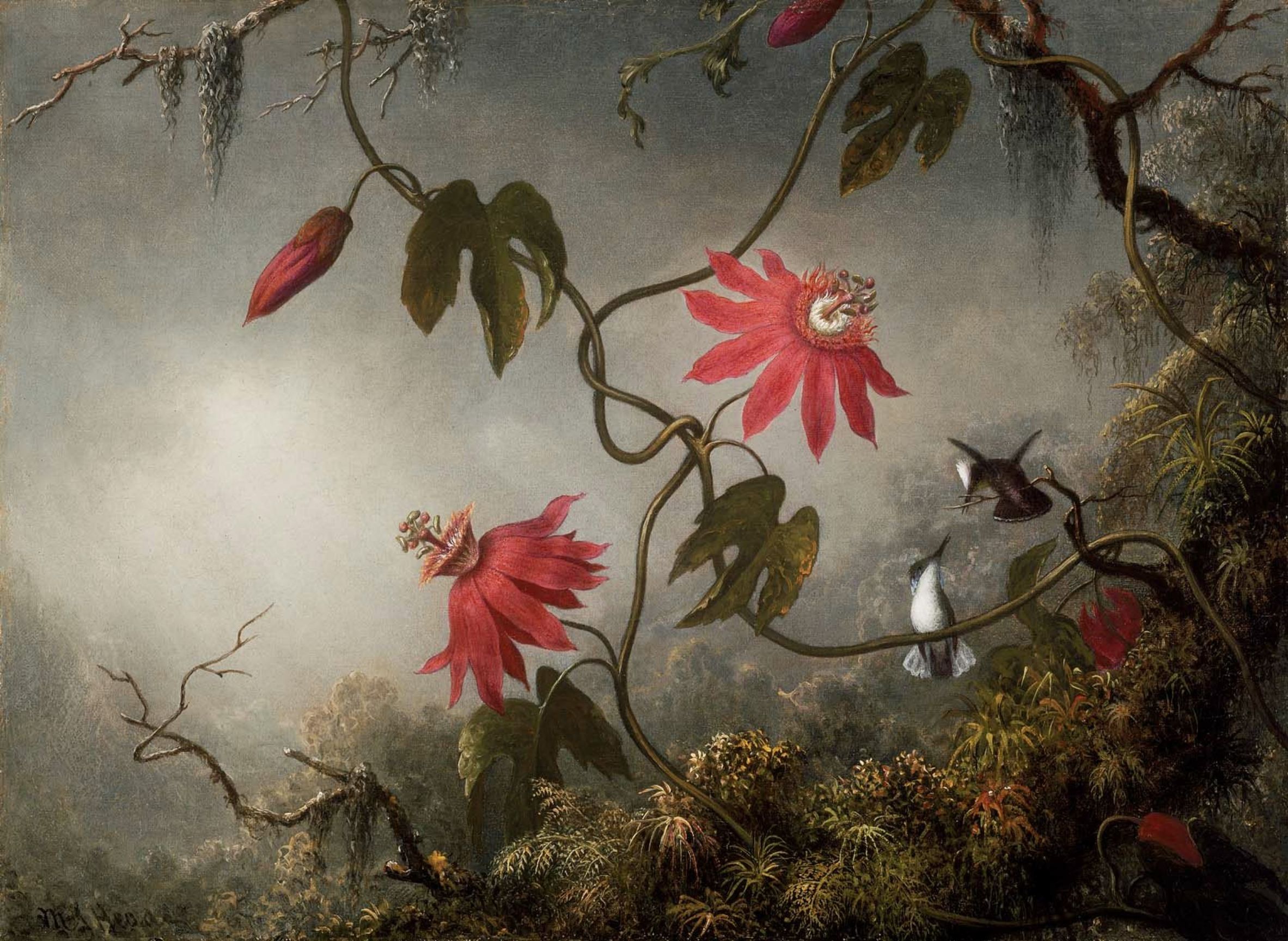
#FineArtFriday: Passion Flowers and Hummingbirds by Martin Johnson Heade

MJ_Heade_Passion_Flowers_and_HummingbirdsArtist: Martin Johnson Heade (1819–1904)

Title: Passion Flowers and Hummingbirds

Genre:  floral painting

Date: circa 1870–83

Medium: oil on canvas

Dimensions: Height: 39.3 cm (15.5 in); Width: 54.9 cm (21.6 in)


About this painting, via Wikimedia Commons:

[1] In Passion Flowers and Hummingbirds, Heade depicted two snowcap hummingbirds, small black-and-white birds found in Panama, and the most brilliantly colored species of passionflower, Passiflora racemosa, in a steamy, lush jungle setting.

The passionflower is so named because missionaries saw correspondences between the parts of the flower and the Passion (or sufferings) of Christ. For example, the ten petals represent the ten apostles present at the crucifixion, the corona filaments resemble the crown of thorns, and the three stigmas relate to the nails.

In this work, Heade successfully combined his scientific interests and his aesthetic sensitivity. He rendered the birds and the passionflowers accurately in a close-up view but also gracefully composed the winding stems across the surface of the picture and contrasted the cool greens and grays with the dazzling red of the flowers.

Although Heade was one of the first to reflect Darwin’s theories in his paintings of flowers in their natural habitats, other artists were subsequently affected by Darwin’s view of the vitality of plants and the interaction of plants with their environment. [1]

About the Artist, via Wikipedia:

[2] Martin Johnson Heade (August 11, 1819 – September 4, 1904) was an American painter known for his salt marsh landscapes, seascapes, and depictions of tropical birds (such as hummingbirds), as well as lotus blossoms and other still lifes. His painting style and subject matter, while derived from the romanticism of the time, are regarded by art historians as a significant departure from those of his peers.

Heade was born in Lumberville, Pennsylvania, the son of a storekeeper. He studied with Edward Hicks, and possibly with Thomas Hicks. His earliest works were produced during the 1840s and were chiefly portraits. He travelled to Europe several times as a young man, became an itinerant artist on American shores, and exhibited in Philadelphia in 1841 and New York in 1843. Friendships with artists of the Hudson River School led to an interest in landscape art. In 1863, he planned to publish a volume of Brazilian hummingbirds and tropical flowers, but the project was eventually abandoned.

He travelled to the tropics several times thereafter, and continued to paint birds and flowers. Heade married in 1883 and moved to St. Augustine, Florida. His chief works from this period were Floridian landscapes and flowers, particularly magnolias laid upon velvet cloth. He died in 1904. His best known works are depictions of light and shadow upon the salt marshes of New England.

Heade was not a widely known artist during his lifetime, but his work attracted the notice of scholars, art historians, and collectors during the 1940s. He quickly became recognized as a major American artist. Although often considered a Hudson River School artist, some critics and scholars take exception to this categorization. Heade’s works are now in major museums and collections. His paintings are occasionally discovered in unlikely places such as garage sales and flea markets. [2]


Credits and Attributions:

[1] Wikimedia Commons contributors, “File:MJ Heade Passion Flowers and Hummingbirds.jpg,” Wikimedia Commons, the free media repository, https://commons.wikimedia.org/w/index.php?title=File:MJ_Heade_Passion_Flowers_and_Hummingbirds.jpg&oldid=577409420 (accessed July 29, 2021).

[2] Wikipedia contributors, “Martin Johnson Heade,” Wikipedia, The Free Encyclopedia, https://en.wikipedia.org/w/index.php?title=Martin_Johnson_Heade&oldid=1013422150 (accessed July 29, 2021).

Comments Off on #FineArtFriday: Passion Flowers and Hummingbirds by Martin Johnson Heade

Filed under #FineArtFriday, writing

#FineArtFriday: A View of a Lake in the Mountains by George Caleb Bingham


  • Title: A View of a Lake in the Mountains
  • Artist: George Caleb Bingham
  • Medium: Oil on canvas
  • Date: between circa 1856 and circa 1859
  • Dimensions: Height: 53.9 cm (21.2 ″); Width: 76.5 cm (30.1 ″)
  • Current Location: Los Angeles County Museum of Art

What I love about this picture:

This scene depicts an hour of utter serenity in the turbulent life of the artist. The late afternoon sunlight falls gently on the rocky path above the calm waters. Shadows fall in all the right places but don’t darken the moment.  There is a dreamlike quality to the day, as if the artist painted his deepest wish. This is a pleasant, restful painting.

About the Artist, via Wikipedia:

George Caleb Bingham (March 20, 1811 – July 7, 1879) was an American artist, soldier and politician known in his lifetime as “the Missouri Artist”. Initially a Whig, he was elected as a delegate to the Missouri legislature before the American Civil War where he fought the extension of slavery westward. During that war, although born in Virginia, Bingham was dedicated to the Union cause and became captain of a volunteer company which helped keep the state from joining the Confederacy, and then served four years as Missouri’s Treasurer. During his final years, Bingham held several offices in Kansas City, as well as became Missouri’s as Adjutant General. His paintings of American frontier life along the Missouri River exemplify the Luminist style.

Bingham ran for election as a Whig to the Missouri House of Representatives the following year. He appeared to have won in 1846 by 3 votes but lost in a recount. In a reprise of the election in 1848, Bingham won the seat by a decisive margin, becoming one of the few artists to serve in elected political office. He actively opposed the pro-slavery “Jackson resolutions” in 1849, although their proponent was also a resident of Saline County. He would also represent Missouri’s eighth district at the Whig National Convention in June 1852. Bingham’s political interests would be reflected in his vivid paintings of frontier political life.

About the Luminist style, via Wikipedia:

Luminism is an American landscape painting style of the 1850s to 1870s, characterized by effects of light in landscape, through the use of aerial perspective and the concealment of visible brushstrokes. Luminist landscapes emphasize tranquility, and often depict calm, reflective water and a soft, hazy sky.

As defined by art historian Barbara Novak, luminist artworks tend to stress the horizontal, and demonstrate the artist’s close control of structure, tone, and light. The light is generally cool, hard, and non-diffuse; “soft, atmospheric, painterly light is not luminist light”. Brushstrokes are concealed in such a way that the painter’s personality is minimized. Luminist paintings tend not to be large so as to maintain a sense of timeless intimacy. The picture surface or plane is emphasized in a manner sometimes seen in primitivism. These qualities are present in different amounts depending on the artist, and within a work.

Luminism has also been considered to represent a contemplative perception of nature.

Novak states that luminism, of all American art, is most closely associated with transcendentalism. The definitional difficulties have contributed to over-use of the term.[5]

The artists who painted in this style did not refer to their own work as “luminism”, nor did they articulate any common aesthetic philosophy outside of the guiding principles of the Hudson River School.


Credits and Attributions:

A View of a Lake in the Mountains by George Caleb Bingham, via Wikimedia Commons.  Los Angeles County Museum of Art [Public domain].

Wikipedia contributors, “George Caleb Bingham,” Wikipedia, The Free Encyclopedia, https://en.wikipedia.org/w/index.php?title=George_Caleb_Bingham&oldid=900386053 (accessed June 6, 2019).

Wikipedia contributors, “Luminism (American art style),” Wikipedia, The Free Encyclopedia, https://en.wikipedia.org/w/index.php?title=Luminism_(American_art_style)&oldid=886912140 (accessed June 6, 2019).


2 Comments

Filed under #FineArtFriday