Tag Archives: magic system

Post NaNoWriMo World Building part 1 – creating the physics of magic #amwriting

I read fantasy novels as much as I read in any other genre. In reading five books a week, I come across both indie and traditionally published work in all genres. Many are books I cannot recommend. A sad truth is, both sides of the publishing industry are guilty of publishing novels that aren’t well thought out.
How the written universe works magic and superpowers1Fantasy is and always has been my favorite genre. I became a fan when I first read the Hobbit at the age of nine. I have read countless works written by people who understood how to construct a plot and set it in a believable world. These classics trained me to notice contradictions in what I read, whether in a magic system or elsewhere in a book.

Inconsistencies are usually only one aspect of a poorly planned fantasy novel. One can see how an author was unaware of contradictions as they emerged during the writing process. They wrote the story as it came to them and didn’t check for logic or do much revising. They wrote the first draft, edited it, and published it, trying to keep to the three or four book a year schedule that many gurus tout as the way to gain readers.

I believe keeping to this kind of schedule is unreasonable and wish some of my favorite traditionally published authors weren’t contractually obligated to produce that many novels a year. It results in shallow, throw-away books written by people whose first books were brilliant, thought-provoking novels I wished I had written.

For me as a reader, the struggle is the story.

I like fantasy novels where the author has taken the time to devise a science of magic. When magic has limitations, story is forced to become character driven. It details how the protagonists develop the skills to overcome the roadblocks in their path and succeed in their quest.

Magic should exist as an underlying, invisible layer of your written universe, the way gravity exists in reality. We know gravity works and accept it as a part of daily life.

I use the physics of light photons as an example of how magic should behave. Photons can do some things, and they cannot do others. Magic is not science as we know it but should be logical and rooted in solid theories.

Several things to consider in designing a story where magic and superpowers are fundamental plot elements:

First, you must decide if the ability to use magic is either

  • learned through spells,
  • an inherent gift,
  • or both.

Your world should establish which kind of path you are taking at the outset.
magicI can suspend my disbelief when magic is only possible if certain conditions have been met. The most believable magic occurs when the author creates a system that regulates what the characters can do.

Magic is believable if 

  • the number of people who can use it is restricted to only a small number.
  • the ways it can be used is limited.
  • most mages are constrained to one or two kinds of magic.

It becomes slightly less believable when some mages can use every type of magic, but if the author explains that exception well and limits that kind of power to only a chosen few, I will keep reading.

Why restrict your beloved main character’s abilities? No one has all the skills in real life, no matter how good they are at their job.

Expertise in any field requires practice and dedication, working on the most minor details of technique.

  • Magicians and wizards should develop skills and abilities the way musicians do.

Virtuosity requires complete dedication and focus. Some are naturally talented but without practice they never rise to the top.

Magic becomes believable when the author defines what each kind of magic can and cannot do.

  • Those rules should define the conditions under which magic works.
  • The same physics should explain why it won’t work if those conditions are not met.

Are you writing a book that features magic? I have a few questions that you may want to consider:

  • Are there some conditions under which the magic will not work?
  • Is the damage magic can do as a weapon, or is the healing it can perform somehow limited?
  • Does the mage or healer pay a physical/emotional price for using or abusing magic?
  • Is the learning curve steep and sometimes lethal?

When you answer the above questions, you create the Science of Magic.

So, what about superpowers? Aren’t they magic?

scienceSuperpowers are both science and something that may seem like magic, but they are not. Think Spiderman. His abilities are conferred on him by a scientific experiment that goes wrong.

Like science and magic, superpowers are believable when they are limited in what they can do. These limitations provide excellent opportunities for plot development.

If you haven’t considered the challenges your characters must overcome when learning to wield their magic or superpower, now is a good time to do it.

  • Are they unable to fully use their abilities?
  • Why are they handicapped?
  • How does their inability affect their companions?
  • How is their self-confidence affected by this inability?
  • Do their companions struggle to master their skills too?
  • What has to happen before your hero can fully realize their abilities?

I want you to understand that these are only my opinions as a reader, and I employ these theories in my own work. The limits an author places on magic, science, or superpowers are barriers to success, and overcoming those roadblocks is what the story is all about

magicWhile an ordinary life is comforting to those of us who simply long for peace and stability in our daily lives, we read for adventure. The story must take an average person, someone who could be your friend, into an extraordinary future.

The struggle must push the characters we grow to love out of their comfortable environment. It must force them to be creative, and through that creativity, our favorite characters become more than they believe they are. I become invested in the outcome of the story.

The next post will delve into powers that are familiar tropes of speculative fiction and fantasy: healing and telepathy.
9 Comments

Filed under writing

Worldbuilding part 3—Magic

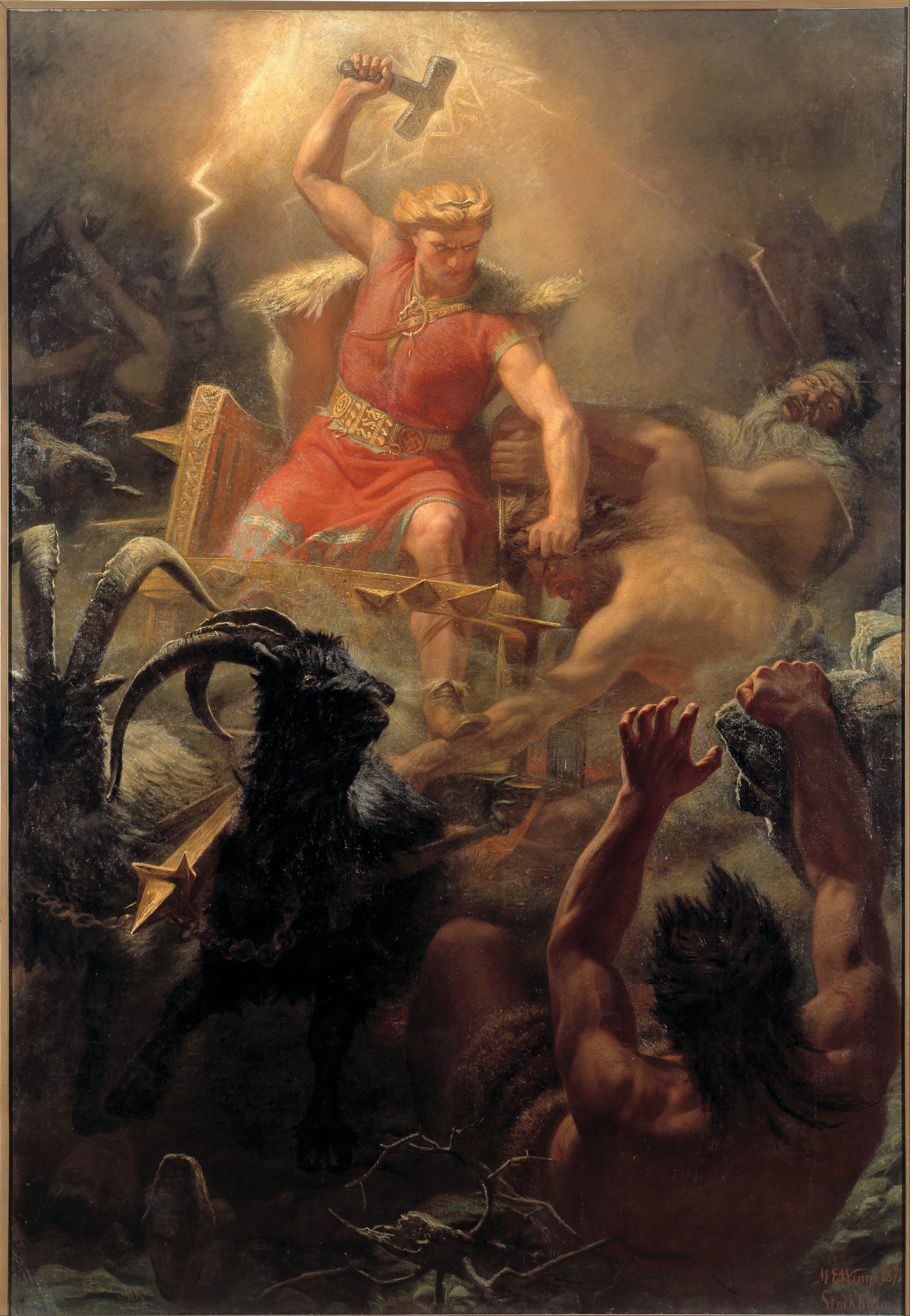
Mårten_Eskil_Winge_-_Tor's_Fight_with_the_Giants_-_Google_Art_ProjectEvery now and then I read a book where it’s clear the author has no concept of his own magic system.  You, as the reader,  are sailing; the story is flowing; and then suddenly you realize that Bart the Mage seems to have unlimited magic ability.  Well, that’s no good, because now there is no tension; no great ordeal for Bart to overcome. Bart can do anything–game over–end of story. The book goes into the recycling bin, unfinished and you never buy that author’s work again.

Every author has their own way of doing this, but I approach it from an engineering and scientific viewpoint–I spend time designing the system:

Let’s talk about Bart. He’s a lowly journeyman mage. For a multitude of reasons he has decided that he must rid the world of Evil Badguy; a very powerful, very naughty wizard.  Evil Badguy is very strong, and has great magic, and he seems unstoppable! But fortunately for our story, there are rules, so he is not omnipotent. He has a weakness and your protagonists now have the opportunity to grow and develop to their fullest potential in process of finding and exploiting that weakness.

Now let’s say that Bart is a mage with offensive magic – maybe he can cast lightning at an enemy, or perhaps he can set fires with his magic.  Can he also use magic to heal people?  Can he heal himself?  What are the rules governing these abilities and how do these rules affect the progress of the story?  When it comes to magic, limitations open up many possibilities for plot development.

Let’s say that Bart can only reliably use one sort of magic. This is good, because now you have need for other several characters with other abilities. They each have a story which will come out and which will contribute to the advancement of the plot. Each character will have limits to their abilities and because of that they will need to interact and work with each other and with Bart whether they like each other or not if they want to win the final battle against Evil Badguy.  This gives you ample opportunity to introduce tension into the story. Each time you make parameters and frameworks for your magic you make opportunities for conflict within your fantasy world, and conflict is what drives the plot.

VAYNE final-fantasy-xii_305674What challenge does Bart have to overcome in order to win the day?

  • Is he unable to fully use his own abilities?
  • If that is so, why is he hampered in that way?
  • How does that inability affect his companions and how do they feel about it?
  • Are they hampered in any way themselves?
  • What has to happen before Bart can fully realize his abilities?

Without rules, there would be no conflict, no reason for Bart to struggle and no story to tell.

So now, you realize that you must create the ‘rules of magic.’  Take the time to write it out, and don’t break the laws, without having a damned good explanation for why that particular breaking of the rules is possible.

Each world should be unique, and so we need to tailor the magic to fit each unique situation.

  • Who can use magic?
  • What kind of magic can they use?
  • How are they trained?
  • What happens to those who abuse their gifts?
  • How common is magic?
  • How does the ability to wield magic fit into the political system?

I have two worlds that I am currently writing in, and their magic systems are radically different.

The following was my first list from 2009 for creating the world when we were originally designing a game that eventually became The World of Neveyah series.

Elemental Battle Magic of Neveyah

 Water:   non battle-use can fill water jugs and basins

  • Water spout (novice)
  • Gully Washer (intermediate)
  • High Seas (Advanced)
  • Raging River (Advanced)

Earth:   non-battle use, putting out campfires, digging holes, gardening

  • Square Dance (novice)
  • Landslide (intermediate)
  • Mudslide (advanced)
  • Mountain Drop (Advanced)

Fire:  non battle use – can light candles, and ignite fire in fireplace

  • Hot Shot (novice)
  • Fire Ball (Intermediate)
  • Inferno (advanced)
  • Hell Fire (Advanced)

Lightning:  non-battle use for lightning: creating finish on armor, glazing pottery

  • Cat-Zapper (novice)   Zippety-Doo-Dah (novice-spell)
  • Thunder Fist (intermediate)
  • Curtain Call (Advanced)
  • Thunder Walking (Advanced)

This basic grocery list has since evolved into a complete curriculum for domestic uses, and the names for most of those spells has changed, but it remains relevant because it shows how I divided it. A game player would have had to gain in strength in order to use those spells, and that is how my characters do in the Neveyah books.

Saint_georges_dragon_grasset_beguleIt’s very different in the Billy’s Revenge series which set in Waldeyn, an alternate-medieval earth which is the setting for Huw the Bard. There, the actual environment is magic and Huw’s journey involves his overcoming its inherent dangers. The plants and animals of Waldeyn are shaped by the overwhelming abundance of magic in that world, like radioactivity affects and mutates life here.  Many of the most dangerous creatures are born of twisted magic, or as they call it, majik.

Mind-majik, healing, and the ability to imbue their healing majik into a potion or salve is the feminine side of majik, governed by the Sisters of Anan.

The ability to bind the elements into weapons and wield them is the male side, and they are governed by the Brotherhood of St. Aelfrid.

Part of their political/religious power comes from the fact that it has been determined the majik is a God-given gift, and all who’ve been granted that ability must be bound to the church.

There are strict rules, and if a gifted person doesn’t choose to serve the people through being bound to the church, the ability to sense majik is taken from them by the Mother Church.

I don’t have any main characters in Waldeyn who are majik wielders, although one side character in the forthcoming novel, Billy Ninefingers, is a member of the Brotherhood of St. Aelfrid: the Fat Friar, Robert DeBolt. However, many times these characters are in need of healing. (Heh heh.)

Because of my characters’ frequent tendency to bleed, gaining and acquiring good healing potions and salves is important.

In the World of Neveyah, which is where the Tower of Bones series is set, the situation was different—The Tower of Bones grew out of what was originally the walk-through for a computer-based RPG that was never built. Thus the constraints of magic are quite strict, but as you saw in the list above, they are game-based.

final-fantasy-guys-xii-basch_255851In the forthcoming prequel to Tower of Bones, Mountains of the Moon, a mage is either a healer or a battle-mage. Healing is building and preserving, battle-magic is death and destruction. It is thought that one can’t be both, because on the rare occasions that a dually-gifted mage is born, they go mad. There is a strict system in place for controlling magic and those who are able to use it, and this creates the conflict.

Once again, there is a governing body for mages–in Neveyah it is the Temple of Aeos. Children with the gifts are taken to the Temple and trained in the use of their gifts until they are adults. They are sworn to serve and protect the Goddess Aeos and her people, or die doing so.

But forty years after Wynn Farmer’s tale, during the time in which the Tower of Bones takes place, the clergy has been decimated by a great war that took place twenty years before. The goddess Aeos is in danger of losing the battle with Tauron the Bull God. She slightly changes the way her magic works. Wynn’s grandson, Edwin Farmer, is the first to be born with the ability to wield both sides of the magic who also has the force of character to survive the learning process. His biggest problem is there is no one who can teach him how to use his dual gifts—his teachers only know how one side or the other works.

That learning process forms a huge part of his story. Yes, Edwin has access to power, but so does the antagonist, Stefyn D’Mal, and he is completely mad. Even so, he has rigid constraints. These constraints create the conflict.

Remember, unlimited power in a mage equals unlimited boredom to the reader. Magic without rules is tiresome and unbelievable, and no one wants to read that story.

Thor-Everything-Loki


11 Comments

Filed under Adventure, Battles, Books, Fantasy, Humor, Literature, Publishing, Self Publishing, Uncategorized, writer, writing