Tag Archives: marine art

#FineArtFriday: Sommarnöje (Summer Fun) by Anders Zorn 1886

Sommarnöje_(1886),_akvarell_av_Anders_ZornArtist: Anders Zorn  (1860–1920)

Title: (Swedish: Sommarnöje)  (English: Summer Fun)

Genre: marine art

Date: 1886

Medium: watercolor paint on paper

Dimensions: height: 76 cm (29.9 in)

Collection: Private collection

Place of creation: Dalarö, Sweden

Inscriptions: Signature and date bottom left: Zorn -86

What I love about this painting:

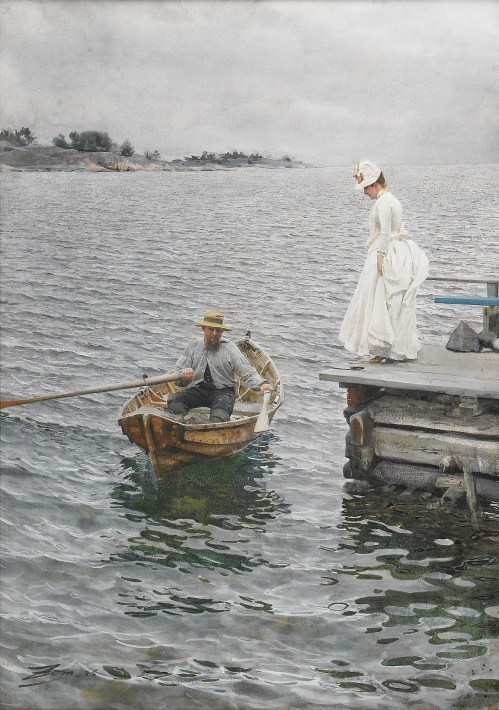
This image, the way the lake is shown, took me back to my childhood. I grew up in a house that faced directly onto a large lake, with a wide beach for swimming, a wooden dock, and few neighbors. The southern Puget Sound area experiences more overcast days in June than most people like. Many days, the waters and the sky looked exactly as Anders Zorn has depicted them here.

Zorn’s brushwork is so meticulous, it is nearly photographic. He captures the feeling of the day, of the breeze, slightly sharp but not too cold, and the anticipation of going out on the water.

About this painting, via Wikipedia:

Zorn painted Sommarnöje in Dalarö in the early summer of 1886, after the couple had returned from honeymoon but before they settled in Mora. He made a smaller sketch first, which measures 30.2 by 18.8 centimeters (11.9 in × 7.4 in), now held by the Zorn Museum in Mora.

The completed watercolor captures a fleeting moment and shows influence from the works of the French Impressionists that Zorn had seen while in Paris, but with a distinctively austere Scandinavian palette.

The painting depicts the artist’s wife Emma Zorn standing in a white dress and hat, waiting on the edge of a wooden pier beside the water, as their friend Carl Gustav Dahlström approaches in a rowing boat.

The reflective glassy surface of the water is rippling in a breeze, under cloudy grey skies. The figures, pier, boat and sea are finely rendered, almost as if the work was made in oil paint, showing Zorn’s skill as a watercolorist. Less attention is paid to the other side of the lake, sketched roughly in the background. It is signed and dated in the lower left corner, “Zorn 86”.

It was acquired by Edvard Levisson of Gothenburg, and then descended through the Schollin-Borg family. The painting was sold at the Stockholms Auktionsverk in June 2010 for SEK 26 million, setting a record for a Swedish painting.

About the Artist, via Wikipedia:

Zorn was born in Mora, Sweden, between the lakes of Siljan and Orsasjön. He studied at the Royal Swedish Academy of Arts in Stockholm from 1875 to 1880, and then spent time travelling in Europe, painting watercolours and society portraits in London, Paris and Madrid.

He returned to Sweden in 1885, and on 16 October, he married Emma Zorn (née Lamm) (1860 – 1942). After spending their honeymoon abroad, in eastern Europe and Turkey, they returned to Sweden in 1886, spending time with Emma’s family at Dalarö, before settling near Mora, where their house, which is now the home of the Zorn Collections, is located.


Credits and Attributions:

IMAGE: Wikimedia Commons contributors, “File:Sommarnöje (1886), akvarell av Anders Zorn.jpg,” Wikimedia Commons, https://commons.wikimedia.org/w/index.php?title=File:Sommarn%C3%B6je_(1886),_akvarell_av_Anders_Zorn.jpg&oldid=842907051 (accessed February 29, 2024).

[1] Wikipedia contributors, “Sommarnöje,” Wikipedia, The Free Encyclopedia, https://en.wikipedia.org/w/index.php?title=Sommarn%C3%B6je&oldid=1149795747 (accessed February 29, 2024).
5 Comments

Filed under writing

#FineArtFriday: Dort or Dordrecht: The Dort packet-boat from Rotterdam becalmed by J. M. W. Turner 1818 (revisited)

B1977.14.77

Artist: J. M. W. Turner (1775–1851)

Title: Dort or Dordrecht: The Dort packet-boat from Rotterdam becalmed

Genre: marine art

Date: 1818

Medium: oil on canvas

Dimensions: Height: 157.5 cm (62 in); Width: 233.7 cm (92 in)

Collection: Yale Center for British Art

What I love about this painting:

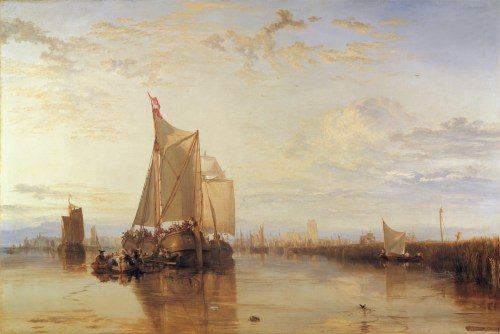
The colors show us a windless evening in summer or fall, a time of day when the smoke from factories and chimneys lingers and turns the sky brown and gold, reflected on the waters.

This is a glimpse into the history of how we once moved goods and mail across long distances. Some packet boats were medium-sized ships, able to navigate shallow rivers and canals. Others were ocean-going vessels. Some were steam driven, but the one we see in this painting is an early ship, powered by the wind.

The wind has failed, and so the crew is being ferried off the ship via a smaller row-boat.

About this painting via Wikipedia:

The Dort, or Dort or Dordrecht: The Dort packet-boat from Rotterdam becalmed is an 1818 painting by J. M. W. Turner, based on drawings made by him in mid-September 1817.  It shows a view of the harbour of Dordrecht. It is the finest example of the influence of Dutch marine painting on Turner’s work.

It was exhibited at the Royal Academy in 1818, where it was described by The Morning Chronicle as “one of the most magnificent pictures ever exhibited, and does honour to the age”. In 1832, John Constable wrote of the picture, “I remember most of Turner’s early works; amongst them one of singular intricacy and beauty; it was a canal with numerous boats making thousands of beautiful shapes, and I think the most complete work of a genius I ever saw”.

It was purchased by Walter Fawkes for 500 guineas at the request of his son, and hung in the drawing room at Farnley Hall until it was bought by Paul Mellon in 1966. It was then donated to the Yale Center for British Art upon the founding of the centre. [1]

About the Artist, via Wikipedia:

Joseph Mallard William Turner was born in Maiden Lane, Covent Garden, London, to a modest lower-middle-class family. He lived in London all his life, retaining his Cockney accent and assiduously avoiding the trappings of success and fame. A child prodigy, Turner studied at the Royal Academy of Arts from 1789, enrolling when he was 14, and exhibited his first work there at 15. During this period, he also served as an architectural draftsman. He earned a steady income from commissions and sales, which due to his troubled, contrary nature, were often begrudgingly accepted. He opened his own gallery in 1804 and became professor of perspective at the academy in 1807, where he lectured until 1828. He travelled to Europe from 1802, typically returning with voluminous sketchbooks.

Intensely private, eccentric and reclusive, Turner was a controversial figure throughout his career. He did not marry, but fathered two daughters, Eveline (1801–1874) and Georgiana (1811–1843), by his housekeeper Sarah Danby. He became more pessimistic and morose as he got older, especially after the death of his father, after which his outlook deteriorated, his gallery fell into disrepair and neglect, and his art intensified. In 1841, Turner rowed a boat into the Thames so he could not be counted as present at any property in that year’s census. He lived in squalor and poor health from 1845, and died in London in 1851 aged 76. Turner is buried in Saint Paul’s Cathedral, London. [2]


Credits and Attributions:

Wikimedia Commons contributors, “File:DortorDordrecht.jpg,” Wikimedia Commons, the free media repository, https://commons.wikimedia.org/w/index.php?title=File:DortorDordrecht.jpg&oldid=554289467 (accessed October 28, 2021).

[1] Wikipedia contributors, “Dort or Dordrecht: The Dort packet-boat from Rotterdam becalmed,” Wikipedia, The Free Encyclopedia, https://en.wikipedia.org/w/index.php?title=Dort_or_Dordrecht:_The_Dort_packet-boat_from_Rotterdam_becalmed&oldid=1000618596 (accessed October 28, 2021).

[2] Wikipedia contributors, “J. M. W. Turner,” Wikipedia, The Free Encyclopedia, https://en.wikipedia.org/w/index.php?title=J._M._W._Turner&oldid=1050867512 (accessed October 28, 2021).

3 Comments

Filed under #FineArtFriday, writing

#FineArtFriday: Dort or Dordrecht: The Dort packet-boat from Rotterdam becalmed by J. M. W. Turner 1818

B1977.14.77

Artist: J. M. W. Turner (1775–1851)

Title: Dort or Dordrecht: The Dort packet-boat from Rotterdam becalmed

Genre: marine art

Date: 1818

Medium: oil on canvas

Dimensions: Height: 157.5 cm (62 in); Width: 233.7 cm (92 in)

Collection: Yale Center for British Art

What I love about this painting:

The colors show us a windless evening in summer or fall, a time of day when the smoke from factories and chimneys lingers and turns the sky brown and gold, reflected on the waters.

This is a glimpse into the history of how we once moved goods and mail across long distances. Some packet boats were medium-sized ships, able to navigate shallow rivers and canals. Others were ocean-going vessels. Some were steam driven, but the one we see in this painting is an early ship, powered by the wind.

The wind has failed, and so the crew is being ferried off the ship via a smaller row-boat.

About this painting via Wikipedia:

The Dort, or Dort or Dordrecht: The Dort packet-boat from Rotterdam becalmed is an 1818 painting by J. M. W. Turner, based on drawings made by him in mid-September 1817.  It shows a view of the harbour of Dordrecht. It is the finest example of the influence of Dutch marine painting on Turner’s work.

It was exhibited at the Royal Academy in 1818, where it was described by The Morning Chronicle as “one of the most magnificent pictures ever exhibited, and does honour to the age”. In 1832, John Constable wrote of the picture, “I remember most of Turner’s early works; amongst them one of singular intricacy and beauty; it was a canal with numerous boats making thousands of beautiful shapes, and I think the most complete work of a genius I ever saw”.

It was purchased by Walter Fawkes for 500 guineas at the request of his son, and hung in the drawing room at Farnley Hall until it was bought by Paul Mellon in 1966. It was then donated to the Yale Center for British Art upon the founding of the centre. [1]

About the Artist, via Wikipedia:

Joseph Mallard William Turner was born in Maiden Lane, Covent Garden, London, to a modest lower-middle-class family. He lived in London all his life, retaining his Cockney accent and assiduously avoiding the trappings of success and fame. A child prodigy, Turner studied at the Royal Academy of Arts from 1789, enrolling when he was 14, and exhibited his first work there at 15. During this period, he also served as an architectural draftsman. He earned a steady income from commissions and sales, which due to his troubled, contrary nature, were often begrudgingly accepted. He opened his own gallery in 1804 and became professor of perspective at the academy in 1807, where he lectured until 1828. He travelled to Europe from 1802, typically returning with voluminous sketchbooks.

Intensely private, eccentric and reclusive, Turner was a controversial figure throughout his career. He did not marry, but fathered two daughters, Eveline (1801–1874) and Georgiana (1811–1843), by his housekeeper Sarah Danby. He became more pessimistic and morose as he got older, especially after the death of his father, after which his outlook deteriorated, his gallery fell into disrepair and neglect, and his art intensified. In 1841, Turner rowed a boat into the Thames so he could not be counted as present at any property in that year’s census. He lived in squalor and poor health from 1845, and died in London in 1851 aged 76. Turner is buried in Saint Paul’s Cathedral, London. [2]


Credits and Attributions:

Wikimedia Commons contributors, “File:DortorDordrecht.jpg,” Wikimedia Commons, the free media repository, https://commons.wikimedia.org/w/index.php?title=File:DortorDordrecht.jpg&oldid=554289467 (accessed October 28, 2021).

[1] Wikipedia contributors, “Dort or Dordrecht: The Dort packet-boat from Rotterdam becalmed,” Wikipedia, The Free Encyclopedia, https://en.wikipedia.org/w/index.php?title=Dort_or_Dordrecht:_The_Dort_packet-boat_from_Rotterdam_becalmed&oldid=1000618596 (accessed October 28, 2021).

[2] Wikipedia contributors, “J. M. W. Turner,” Wikipedia, The Free Encyclopedia, https://en.wikipedia.org/w/index.php?title=J._M._W._Turner&oldid=1050867512 (accessed October 28, 2021).

Comments Off on #FineArtFriday: Dort or Dordrecht: The Dort packet-boat from Rotterdam becalmed by J. M. W. Turner 1818

Filed under #FineArtFriday, writing