
Today we’re continuing to prep for NaNoWriMo by thinking about the plot and the story our characters inhabit. In post one, we thought about what kind of project we intend to write—novels, short stories, poems, memoirs, personal essays, etc.
Post two of this series introduced the protagonist(s), giving us an idea of who they are and what they do. Post three explored the setting, so we know where they are and their circumstances. Post four detailed creating the skeleton of a plot. Post five jumped to the end, giving us a finite event to write to.
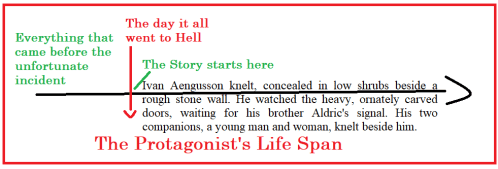
 Today, we will pinpoint the moment in our protagonist(s) life where the story starts. We’re locating the point where this particular memoir, poem, novel, or short story begins.
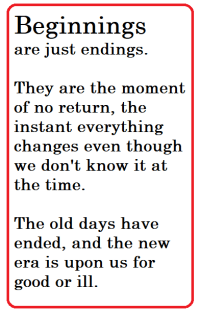
The day that changed everything should open the story.
We see the protagonists in their familiar environment. By evening, a chain of events has begun. A tiny, insignificant stone rolls downhill, the first incident that will soon precipitate an avalanche of problems our protagonist must solve.
When we are new in this craft, we have a burning desire to front-load the history of our characters into the story, so the reader will know who they are and what the story is about.
I am the queen of front-loading. Fortunately, my writer’s group is made up of industry professionals and one in particular, Lee French, has an unerring eye for where the story a reader wants to know begins.
I have to remind myself that the first draft is the thinking draft. It’s where we build worlds and flesh out characters and relationships. It’s also where the story grows as we add to it.
We need a finite starting point, a place of interest. Have faith—the backstory will emerge as the story progresses. If we have our world solidly in our heads as we write, the reader will visualize a version of it that works for them, without our info dumping the history.
Let’s plot the beginning of a medieval fantasy:
Act 1: the beginning:
 Setting: Venice in the year 1430.The weather is unseasonably cold. A bard is concealed amongst the filth and shadows in a dark, narrow alley. Sebastian hides from the soldiers of a prince he has unwisely humiliated in a comic song.
Opening plot point–the hook: the soldiers surround and capture Sebastian, and he is hauled before the angry prince. The trial is brief and painful. Beaten and bloody, Sebastian is thrown into prison and sentenced to be beheaded at dawn.
That moment of despair is the end of chapter one.
You have done some prep work for character creation, so Sebastian is your friend. You know his backstory, who he is attracted to (men, women, none, or both), how handsome he is, and his personal history.
You know who he will meet in prison, someone who will help him escape. Depending on Sebastian’s romantic preference, Chance (an assassin’s professional name) will be male or female and dislikes the bard on sight. Still, Chance needs Sebastian’s help to escape as he/she/they will also die at dawn.
You have decided that the prince is a dark-path warlock. His brother is a highly placed cardinal who intends to become pope, protects him.
You have designed Sebastian and Chance’s escape, which is the first pinch point— the place where what they learn from each other fuels a quest: that of killing the Warlock Prince. Each has different reasons for this, but the enemy of my enemy is my friend, and all that.
But now they are on the run and have no idea how to accomplish that task. Circumstances force them to work together despite their clash of personalities.
And we all know how friction heats things up. Romance or no romance, this tension is crucial.
We (the author) know the Warlock Prince must die if they are to save Venice, but who will be willing to help them, and what roadblocks stand in their way? These people will emerge as you write the first draft.
You’ve written down some ideas for the ending, so you have a goal to write to. At this point, the middle of the story is murky, but it will come to you as you write toward the ending. Every event and roadblock that happens to Sebastian between his arrest and the final moments of his victory will emerge from your imagination as you write your way through this first draft.
 But the opening moment, the scene showing a lowly bard hiding behind a rubbish heap, is the moment in Sebastian’s life where the story the reader wants to hear starts. That scene is where this story begins regardless of how interesting Sebastian’s story, Venice’s story, or the Warlock Prince’s story was before that day. It is the beginning because this is the point where all the essential characters are in one place and are introduced:
- The reader meets the villain and sees him in all his power
- Sebastian knows one thing—the Warlock Prince must be stopped. He can sink no lower—he has hit bottom, and from there he can only go up.
- Chance is in the same low emotional place, but he/she/they have an escape plan.
The story kicks into gear at this pinch point because the assassin is at risk on two fronts, which means Sebastian is too. Chance’s original task of killing the prince has failed, so now they must avoid both the prince’s soldiers and the mysterious employer‘s goons. For Chance, it’s a matter of pride that the original commission must be fulfilled despite the fact there will be no payment. Sebastian agrees to help ensure it happens because he has a conscience and wants to protect the people of Venice from the prince and his brother.
Attraction often grows in the most unlikely of places. Will it blossom into romance? It’s Venice, a city filled with romance and intrigue. But you’re the author, so only you know how their relationship grows as you write their adventure.
What else will emerge over the following 40,000 or more words (lots more in my case)?
- Who is the assassin’s mysterious employer and what is their agenda?
- Who is Chance really, what is their true name, and how did he/she/they become an assassin?
Sebastian will find this information out as the story progresses and only when he needs to know it. With that knowledge, he will realize his fate is sealed—he’s doomed no matter what. But it fires him with the determination that if he goes down, he will take the Warlock Prince and his corrupt brother with him.
If you dump the history at the beginning, the reader has no reason to go any further. You have wasted words on something that doesn’t advance the plot, doesn’t intrigue the reader.
The people who will help our hapless protagonist will enter the story as he needs them. Each person will add information the reader wants, but only when Sebastian requires it. Some characters, people who can offer the most help will be held back until the final half of the story.
By the end of the novel, the reader will have acquired the important history of Sebastian, Chance, the mysterious employer, and the Warlock Prince. With the last bits of information, the final pieces of the puzzle will fall into place.
Gaining all that knowledge is the carrot that keeps the reader involved in the book.
Next up, in post 7, we will talk about resources for beleaguered writers. Memoirs, poems, essays, novels–every author needs handy resources to bookmark.
The final post in this 8-part series will be on how to carve out time for writing whether you are participating in NaNoWriMo or just writing for fun.
Posts in this series:
#NaNoWriMo prep part 1: Deciding on the Project #amwriting
#NaNoWriMo prep part 2: Character Creation #amwriting
#NaNoWriMo prep part 3: Designing Worlds #amwriting
 Post two
 Marco arrives at the inn. The innkeeper mentions Klaus was there, but now he’s gone. Marco sees his barge is still there, and the deckhands don’t know where he is. He goes to the gatehouse where Dinah is supposed to be on duty and immediately knows something is wrong. He fears Klaus has gotten to her, and instinct tells him to go to the Temple.
 In real life, people live happily, but no one really lives deliriously happy ever after. But that’s another story and a different genre.
 Every world in which every story is set is imaginary. This is true whether it is a memoir, a cookbook, a math book, a sci-fi novel, a contemporary novel set in London, or an encyclopedia.
 When writing our narrative, we want to avoid contradicting ourselves about our protagonist’s world. Keeping it all in your head is not a good idea, especially if you’re like me—too much data means I regularly have the eternal loading screen when trying to recall something. (I’ll never forget what’s-his-name.)
 Just like we do when creating our characters, we want to begin with a paragraph that might be the encyclopedia explanation of where the action takes place. I write fantasy, so here is the one paragraph I might start with:
 If I were to write a thriller set in the current
  The internet has information about every kind of environment that exists on Earth. All we have to do is use it.
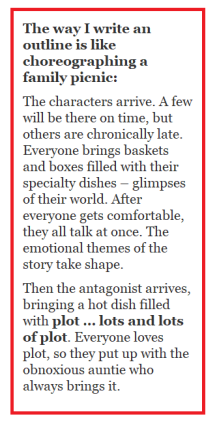 I am a planner, but I’m also a pantser. I’m just writing to a loose outline. All I need is a little free time in advance of November to let my mind wander.
 Next, I ask the creative universe who the protagonist is. I create a brief personnel file, less than 100 words. It’s a paragraph with all the essential background information. Sometimes it takes a while to know what a character’s void is (a deep emotional wound), but it will emerge. I note the verbs, adjectives, and nouns the character embodies, as those give me all the necessary information.
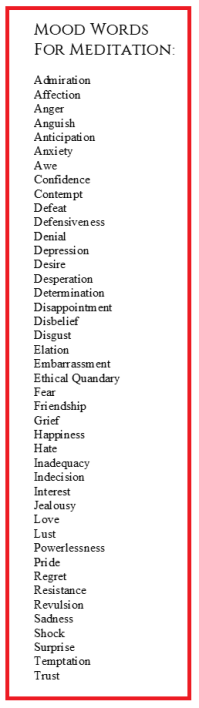 Meditating on mood words often precipitates a flash of brilliance that has nothing to do with anything. What if …
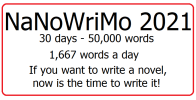 NaNoWriMo is a personal challenge, a month that is solely dedicated to the act of writing a novel. It is a speed-run with daily goals to meet.
 As always, there is a downside to this intense month of stream-of-consciousness writing. Just because you can sit in front of a computer and spew words does not mean you can write a novel that others want to read.
 Some new authors seek out books about writing craft and attend seminars. They will join writing groups and develop the skills needed to take a story and make it a novel with a proper beginning, a great middle, and an incredible end.
 This is time-consuming, and you will feel as if you need a personal assistant to handle these things. I know several authors who rely on the services of
  So, what do we need to have in place during the next seven days before the big event?
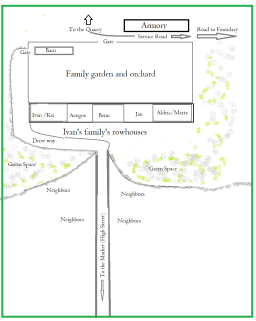 Environment: Ivan and Kai live in Weiland, Tribe Weila’s riverport and mining center. Ivan’s extended family has five rowhouses at the upper end of High Street. It’s a steep but easy walk to the market for his grandfather, who lives next door and watches the children while Ivan and Kai work. I drew a little map for my notes, so I know the layout of where everything is in regard to their home and businesses. It could change, but I have something to start with.
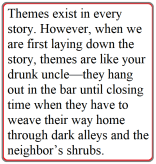 A common theme in fantasy is the juxtaposition of chaos and stability (or order). This subtheme will feature strongly in my novel. Good vs. evil is a
 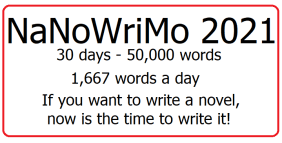 Writing is easier once it becomes a daily
  We have this perception that taking time for creativity is selfish, and that will be your biggest hurdle. Trust me, it is not asking too much of your family for you to have some time every day that is sacred and dedicated to writing.
 Write for five minutes here and ten minutes there all day long if that is all you can do. Every word counts toward your finished manuscript. I took my lunch to work and wrote during my lunch half-hour whenever possible. I also wrote on the bus when I didn’t own a car.
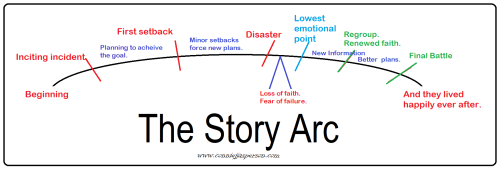
 Remember, what you are writing is a rough draft, so your story arc will be bumpy and uneven. It doesn’t have to be perfect, so don’t worry about making it so. The goal of NaNoWriMo is to get that first draft written in thirty days. So, every time you have fifteen minutes to spare, sit down and write as much as you can in that short length of time. Spew your story as fast as you can in those moments before you are pulled away. With six or seven short bursts of writing, you can really rack up the word count.
 But sometimes, when writing the first draft, we realize our manuscript has gone way off track and is no longer fun to write. That is where the storyboard and my loose outline become important.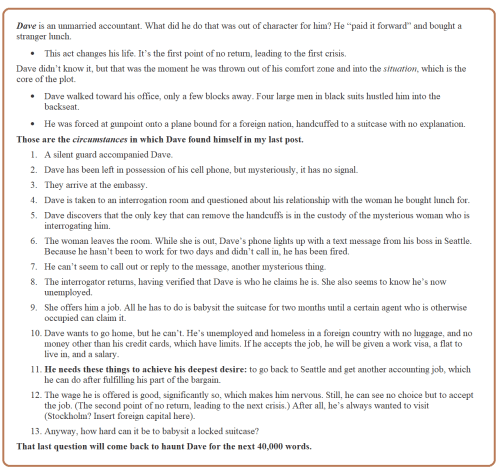
 Every novel is different, has a different genesis, and emerges from the author’s mind with its own personality.
 I usually do this with a little advance preparation. Then on November 1st, I sit in front of my computer, and using the ideas I have outlined as my prompts, I wing it for at least two hours.
 How will the next phase of Dave’s story start? That will begin the middle section of the story, and this is what we are going to give a brief outline of.
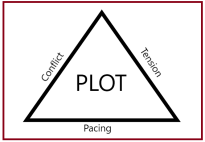 In any story, the crucial underpinnings of conflict, tension, and pacing are bound together. Go too heavily on one aspect of the triangle, and the story fails to engage the reader. By outlining a few important events now, we can add trouble and hitches during the writing process and increase the tension. Pacing will be something to worry about in the second draft—at this point, we just want to get the bones of his adventure down on paper.
 Whether you hope to be published traditionally or plan to go indie, you must know what the reading public is buying. You will probably write a book that is squarely set in your favorite genre.
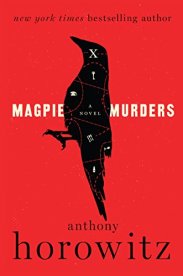 When editor Susan Ryeland is given the manuscript of Alan Conway’s latest novel, she has no reason to think it will be much different from any of his others. After working with the bestselling crime writer for years, she’s intimately familiar with his detective, Atticus Pünd, who solves mysteries disturbing sleepy English villages. An homage to queens of classic British crime such as Agatha Christie and Dorothy Sayers, Alan’s traditional formula has proved hugely successful. So successful that Susan must continue to put up with his troubling behavior if she wants to keep her job.
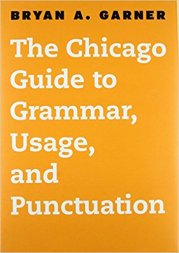 Now, let’s talk MECHANICS. The author of the Magpie Murders has worked as a journalist. He has taken the time to become educated in grammar and understands common industry standards.


 Life in the Realm of Fantasy