
As NaNoWriMo winds down, I am preparing to face a manuscript full of wandering, garbled sentences. These are the products of my fingers not being able to keep up with my brain. I might know what that sentence means, but my editor won’t. My job in December is to be alert and watch for ambiguous phrasings.
 About garden-path sentences, via Wikipedia, the fount of all knowledge:
(The term) garden path refers to the saying “to be led down the garden path,” meaning to be deceived, tricked, or seduced.
After reading, the sentence seems ungrammatical and makes almost no sense, requiring rereading to fully understand its meaning after careful parsing.” [1]
In this case, confusion arises because we attempt to understand sentences as we are reading them. The “garden-path sentence” begins by taking you toward a particular destination. Midway through, it takes a turn for the bizarre.
There are two types of garden-path sentences. The first is a “local ambiguity,” meaning it can be cleared up easily with the addition of a word or punctuation, such as:
“The raft floated down the river sank.” Add one word to make it clear: “The raft that floated down the river sank.”
“We told the man the dog bit a medic could help him.” Add two words for clarity: “We told the man whom the dog bit that a medic could help him.”
Wikipedia offers this example: “The old train the young fight.” Adding a comma reads: “The old train, the young fight.” The addition of the comma makes sense of the words. One could also argue that the sentence means “The old train the young to fight.”
The other type of garden-path sentence is “globally ambiguous” because the meaning stays unclear no matter how many times you reread it when it is taken out of context.
A sentence should be understandable even when removed from its context. Wikipedia offers the sentence: “The cat was found by the shed by the gardener.”
 When I have asked a beta reader to read a section of my work, they sometimes flag a paragraph as unclear. It might make perfect sense to me, but if I am the only one who understands it, it’s time to tear that paragraph down to see if each sentence can stand on its own.
Sara’s missing cat was found by the shed by the gardener. Mittens was frightened and hungry but safe.
Let’s break that paragraph down sentence by sentence:
- Sara’s missing cat was found by the shed by the gardener.
- Mittens was frightened and hungry but safe.
The first sentence is passive and ambiguous, open to interpretation. Was the cat by the shed? Or was the shed by the gardener? Or were the cat and the gardener both next to the shed?
Once I’ve taken it out of context, it’s easy to see why the reader didn’t understand it.
Usually, a simple rewording to make my phrasing more active is all that is required.
The gardener found Sara’s cat near the shed. Mittens was frightened and hungry but safe.
Often, a new author has been criticized for using the relative pronoun ‘that’ too freely. Thin-skinned and bleeding profusely, they will go to any length to avoid using the word that, which can lead to awkwardly phrased sentences.
Relative pronouns have a fundamental place in English. While it’s easy to turn them into crutch words, they are essential words that make nouns specific.
- That dog bites, so watch out.
- Harry Potter was the boy who lived.
The way to resolve the garden-path sentence is to:
- Insert a relative pronoun (such as “that” or “who”) for clarity.
- Insert proper punctuation for clarity.
- Reword the sentence to make the prose active.
Readers want to read without bumps and hiccups. Anytime they have to stop and reread something, you risk losing them. Sentences that are ambiguous stop the eye, which throws the reader out of the story.
 I don’t want to introduce vagueness into my work. Just because I like what I wrote doesn’t mean it has to stay in the finished product. Maybe I don’t see that it’s confusing, but my friends who read my raw manuscripts will.
Every time I participate in NaNoWriMo and then take that manuscript through revisions, my first draft skills become a little stronger. I write stronger sentences in my first drafts and have to make fewer changes, which feels like a victory.
Credits and Attributions:
[1] Wikipedia contributors, “Garden-path sentence,” Wikipedia, The Free Encyclopedia, https://en.wikipedia.org/w/index.php?title=Garden-path_sentence&oldid=1053287156 (accessed November 28
 Once the first draft is a complete novel, I will step away from it for a few weeks and work on other projects. Then when I come back to it, I use the global search (find option) to look for each instance of ‘ly’ words and rewrite those sentences to make them active.
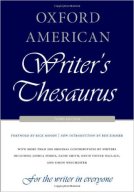 Synonyms for ominous that we could use: baleful, dire, direful, foreboding, ill, ill-boding, inauspicious, menacing, portentous, sinister, threatening.
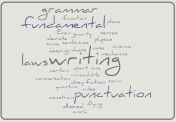 If you are writing any kind of genre work, the best way to use your descriptors is to find the word that conveys the atmosphere you want with the most force. That word will help you visualize the scene and enable your ability to spew the story.
 The emergence of these traits is exciting, fueling the passion they have for their stories.
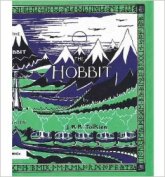 Bilbo’s sudden irrational decision to accept the task of Burglar sets him on a path that becomes a personal pilgrimage, a search for the courage he always possessed but had never needed.
 In one of my current works in progress, my protagonist is a soldier of the Bull God’s world of Serende, an enemy sworn to conquer the goddess’s world of Neveyah. He undergoes a religious conversion, and his story takes him on a physical and spiritual journey.
 This method involves hopping around in the story arc, but it works for me. I have a master file already with the storyboard in it. Today, I began writing each scene as a short story, labeling the file with a title like FoR_pub_scene_at_Linniston (Fires of Redemption, pub scene at Linniston). The title tells me where this scene will fit in the story arc. Everything will go into the master file in my writing folder and be saved to Dropbox. I’m starting with this one, as it introduces everyone.
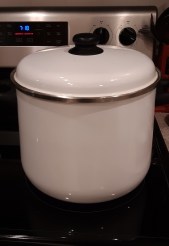 This will be one of the more challenging years for me, as life is throwing roadblocks in my path. A water pipe has broken beneath our master bedroom closet, and two weeks on, we are still waiting for a plumber. In the meantime, we have no hot water, but we do have cold still flowing, so we aren’t hurting too badly. I make hot water with the spaghetti boiler on my stove and feel glad we aren’t hauling it here from the creek.
 That was a week ago. We’ve been waiting for the plumber for two weeks, but a light is on the horizon. Hope looms, and an appointment for tomorrow has finally been confirmed.
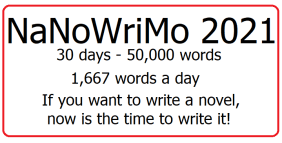
 NaNoWriMo is a personal challenge, a month that is solely dedicated to the act of writing a novel. It is a speed-run with daily goals to meet.
 As always, there is a downside to this intense month of stream-of-consciousness writing. Just because you can sit in front of a computer and spew words does not mean you can write a novel that others want to read.
 Some new authors seek out books about writing craft and attend seminars. They will join writing groups and develop the skills needed to take a story and make it a novel with a proper beginning, a great middle, and an incredible end.
 This is time-consuming, and you will feel as if you need a personal assistant to handle these things. I know several authors who rely on the services of
  So, what do we need to have in place during the next seven days before the big event?
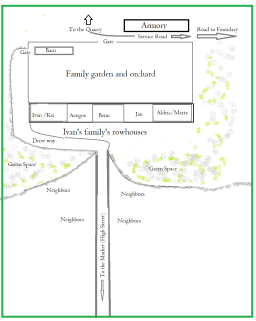 Environment: Ivan and Kai live in Weiland, Tribe Weila’s riverport and mining center. Ivan’s extended family has five rowhouses at the upper end of High Street. It’s a steep but easy walk to the market for his grandfather, who lives next door and watches the children while Ivan and Kai work. I drew a little map for my notes, so I know the layout of where everything is in regard to their home and businesses. It could change, but I have something to start with.
 A common theme in fantasy is the juxtaposition of chaos and stability (or order). This subtheme will feature strongly in my novel. Good vs. evil is a
  Writing is easier once it becomes a daily
  We have this perception that taking time for creativity is selfish, and that will be your biggest hurdle. Trust me, it is not asking too much of your family for you to have some time every day that is sacred and dedicated to writing.
 Write for five minutes here and ten minutes there all day long if that is all you can do. Every word counts toward your finished manuscript. I took my lunch to work and wrote during my lunch half-hour whenever possible. I also wrote on the bus when I didn’t own a car.
 Remember, what you are writing is a rough draft, so your story arc will be bumpy and uneven. It doesn’t have to be perfect, so don’t worry about making it so. The goal of NaNoWriMo is to get that first draft written in thirty days. So, every time you have fifteen minutes to spare, sit down and write as much as you can in that short length of time. Spew your story as fast as you can in those moments before you are pulled away. With six or seven short bursts of writing, you can really rack up the word count.
 Once there, create a profile. You don’t have to get fancy unless you are bored and uber-creative.
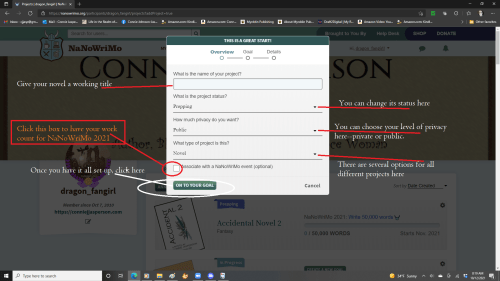 You can play around with your personal page a little to get used to it. I use my NaNoWriMo avatar and name as my Discord name and avatar. This is because I only use Discord for NaNoWriMo and one other large organization of writers. (Next week, we’ll talk about Discord and why NaNoWriMo HQ wants us to use it for word sprints and virtual write-ins.)
 Next, check out the community tabs. If you are in full screen, the tabs will be across the top. If you have the screen minimized, the button for the dropdown menu will be in the upper right corner and will look like the blue/green and black square to the right of this paragraph.
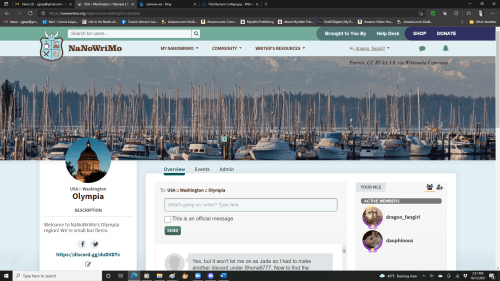 You may find the information you need in one of the many forums listed here.
 Make a master file folder that is just for your writing. I write professionally, so my files are in a master file labeled Writing.
 Give your document a label that is simple and descriptive. My NaNoWriMo manuscript will be labeled: Accidental_Novel_2.
 Still, we can come together and support each other’s writing via the miracle of the internet. My region is finalizing a schedule for “Writer Support” meet-ups via Zoom – little gab sessions that will connect us and keep us fired up.
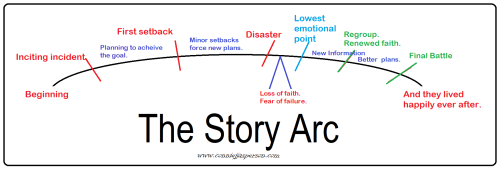
 But sometimes, when writing the first draft, we realize our manuscript has gone way off track and is no longer fun to write. That is where the storyboard and my loose outline become important.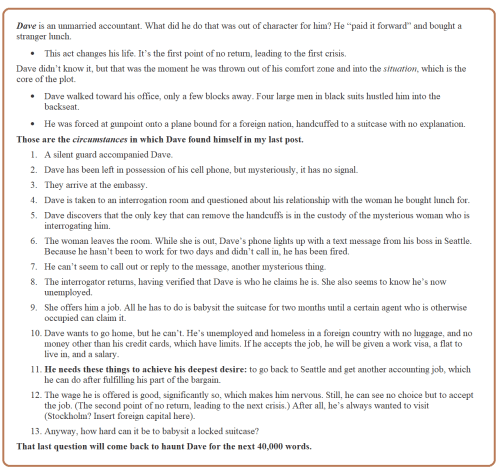
 Every novel is different, has a different genesis, and emerges from the author’s mind with its own personality.
 I usually do this with a little advance preparation. Then on November 1st, I sit in front of my computer, and using the ideas I have outlined as my prompts, I wing it for at least two hours.
 How will the next phase of Dave’s story start? That will begin the middle section of the story, and this is what we are going to give a brief outline of.
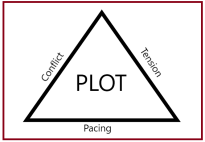 In any story, the crucial underpinnings of conflict, tension, and pacing are bound together. Go too heavily on one aspect of the triangle, and the story fails to engage the reader. By outlining a few important events now, we can add trouble and hitches during the writing process and increase the tension. Pacing will be something to worry about in the second draft—at this point, we just want to get the bones of his adventure down on paper.


 Life in the Realm of Fantasy