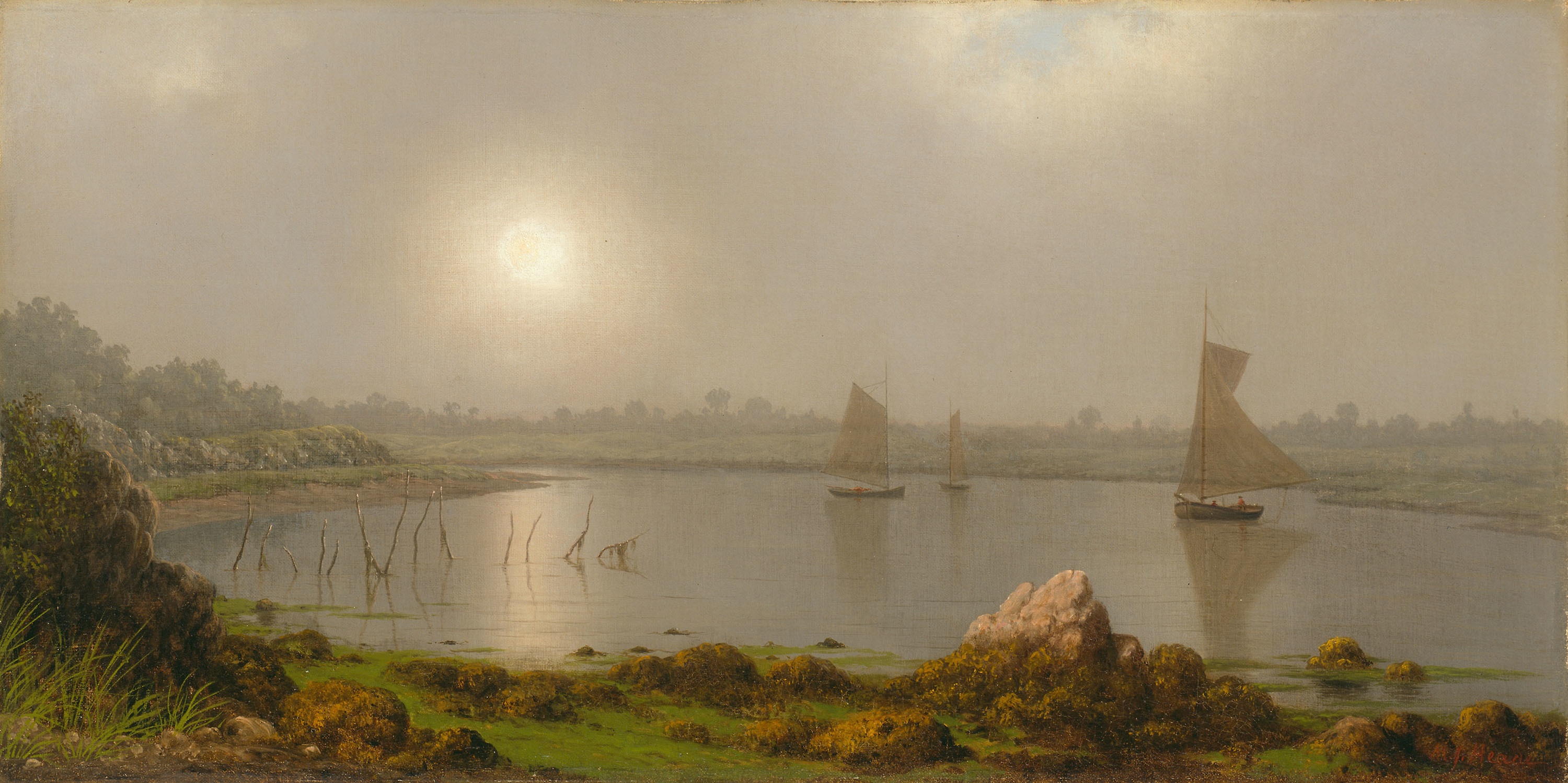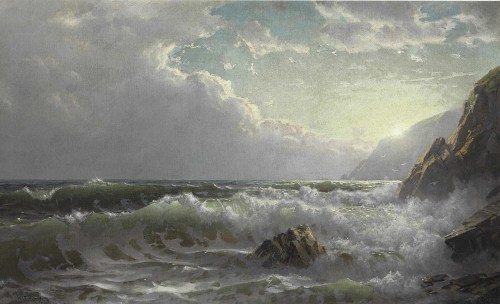
Tag Archives: seascapes

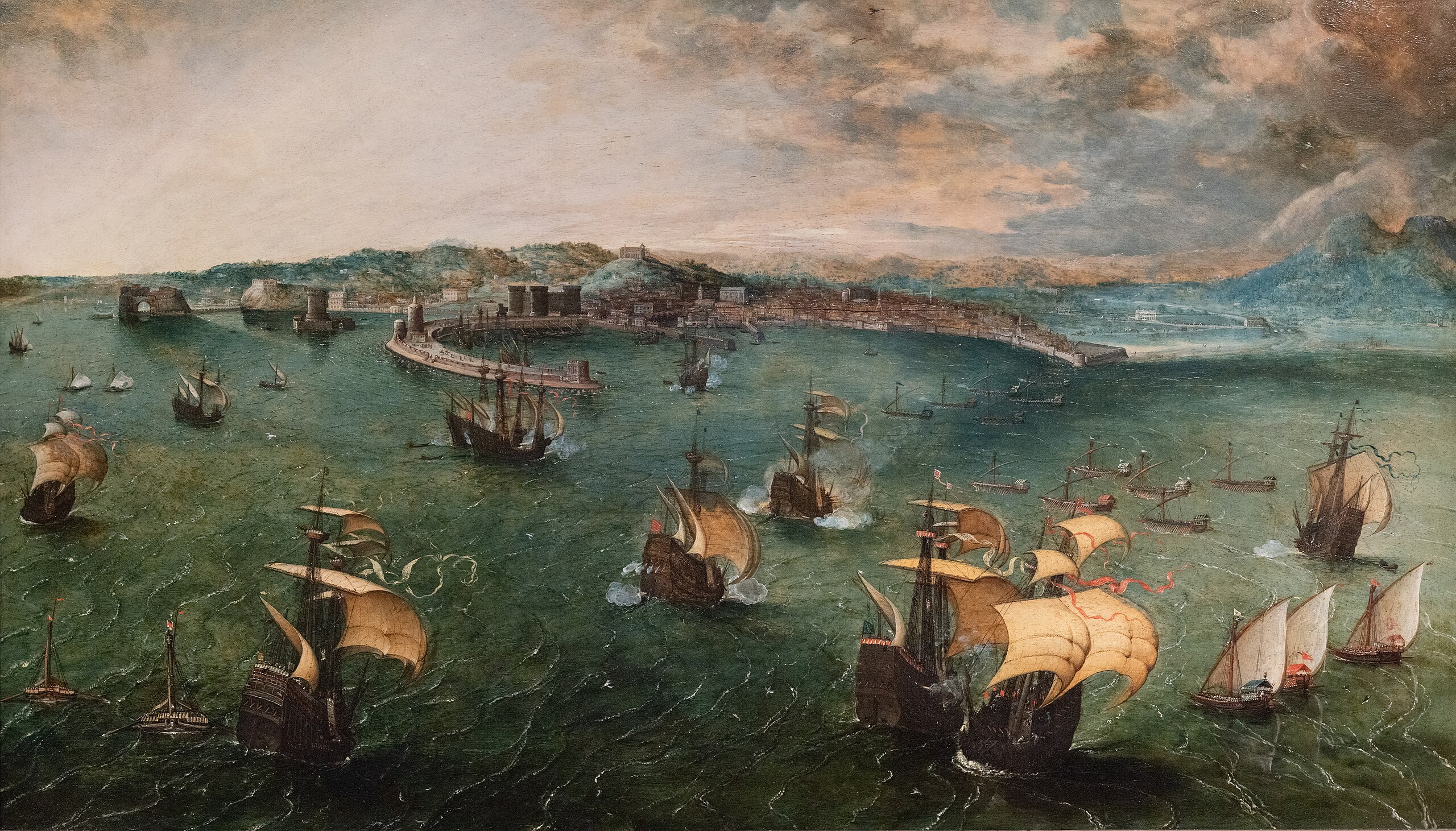
#FineArtFriday: Naval Battle in the Gulf of Naples by Pieter Bruegel the Elder ca. 1556 – 1558

Artist: Pieter Brueghel the Elder (1526/1530–1569)

Title: View of the Bay of Naples

Description: English: Bruegel — Naval Battle in the Gulf of Naples

Date: 1556 / circa 1558 / between 1550 and 1559

Medium: oil on panel

Dimensions: height: 42.2 cm (16.6 in)

Collection: Galleria Doria Pamphilj

What I love about this painting:

Bruegel shows us a stylized version of the Battle of the Gulf of Naples, which took place some three hundred year before the time of his painting. It was a historic victory for Roger of Lauria, who commanded the AragoneseSicilian fleet against the AngevinNeopolitan fleet, led by Prince Charles of Salerno.

Pieter Bruegel the Elder was famous for inserting subtle political and (sometimes snide) social commentaries into his paintings, and also for creating fantasy landscapes that he peopled with his contemporary peasants and tradesfolk. Many of his paintings that are set in his native Brabant feature mountains – and the Netherlands is a flat country, one that has no mountains.

In this painting he gives us a fantasy naval battle, featuring the sort of ships he was familiar with, and canon fire. Some ships are sinking, and others are closing in on them. He knew what ships looked like but had never actually seen a battle at sea.

About this painting, via Wikipedia:

Bruegel traveled to the Italian peninsula, with Abraham Ortelius, in 1551 and 1553. They stopped in Rome, Naples, and Messina. Many drawings were produced, including one depicting a naval confrontation in the Straits of Messina, which was turned into an engraving by Frans Huys. The veduta takes historical and topographical licenses: no such battle occurred in precisely this setting, nor does the harbor resemble Bruegel’s depiction. The exact date of the composition is disputed; scholars do agree, however, that the volcano and its positioning seem to reflect Bruegel’s neoplatonic pantheism.

In the foreground, a naval battle is perhaps taking place; it involves several vessels (sailing ships, galleys and smaller rowing boats), amidst puffs of smoke and barely legible trajectories of cannonballs, which make it difficult to unambiguously define the scene.

The background of the painting is the Gulf of Naples, with Mount Vesuvius visible at the right; it is depicted with a raised horizon, over half the painting, typical of the Flemish artists, which allows the view to have a particularly broad scope. Several monuments can be recognized: on the left, the remains of Castel del’Ovo, the Castel Nuovo, the lost Torre San Vincenzo and the semicircular piers. The last detail is an imaginative creation of the artist, since in the topographical maps of the time the port appears to be rectangular in shape: this “softening” perhaps derives from his wish to make the view more elegant and dynamic. [1]

ABOUT THE AUTHOR, via Wikipedia Commons:

Pieter Bruegel (also Brueghel or Breughelthe Elder, 1525–1530 to 9 September 1569) was among the most significant artists of Dutch and Flemish Renaissance painting, a painter and printmaker, known for his landscapes and peasant scenes (so-called genre painting); he was a pioneer in presenting both types of subject as large paintings.

Van Mander records that before he died he told his wife to burn some drawings, perhaps designs for prints, carrying inscriptions “which were too sharp or sarcastic … either out of remorse or for fear that she might come to harm or in some way be held responsible for them”, which has led to much speculation that they were politically or doctrinally provocative, in a climate of sharp tension in these areas. [2]]


Credits and Attributions:

IMAGE: Wikimedia Commons contributors, “File:Bruegel — Naval Battle in the Gulf of Naples.jpg,” WikimediaCommons, https://commons.wikimedia.org/w/index.php?title=File:Bruegel_%E2%80%94_Naval_Battle_in_the_Gulf_of_Naples.jpg&oldid=1037815605 (accessed July 9, 2025).

[1] Wikipedia contributors, “Naval Battle in the Gulf of Naples,” Wikipedia, The Free Encyclopedia, https://en.wikipedia.org/w/index.php?title=Naval_Battle_in_the_Gulf_of_Naples&oldid=1292197650 (accessed July 11, 2025).

[2] ABOUT THE AUTHOR: Wikipedia contributors, “Pieter Bruegel the Elder,” Wikipedia, The Free Encyclopedia, https://en.wikipedia.org/w/index.php?title=Pieter_Bruegel_the_Elder&oldid=1299614602 (accessed July 9, 2025).

Comments Off on #FineArtFriday: Naval Battle in the Gulf of Naples by Pieter Bruegel the Elder ca. 1556 – 1558

Filed under #FineArtFriday

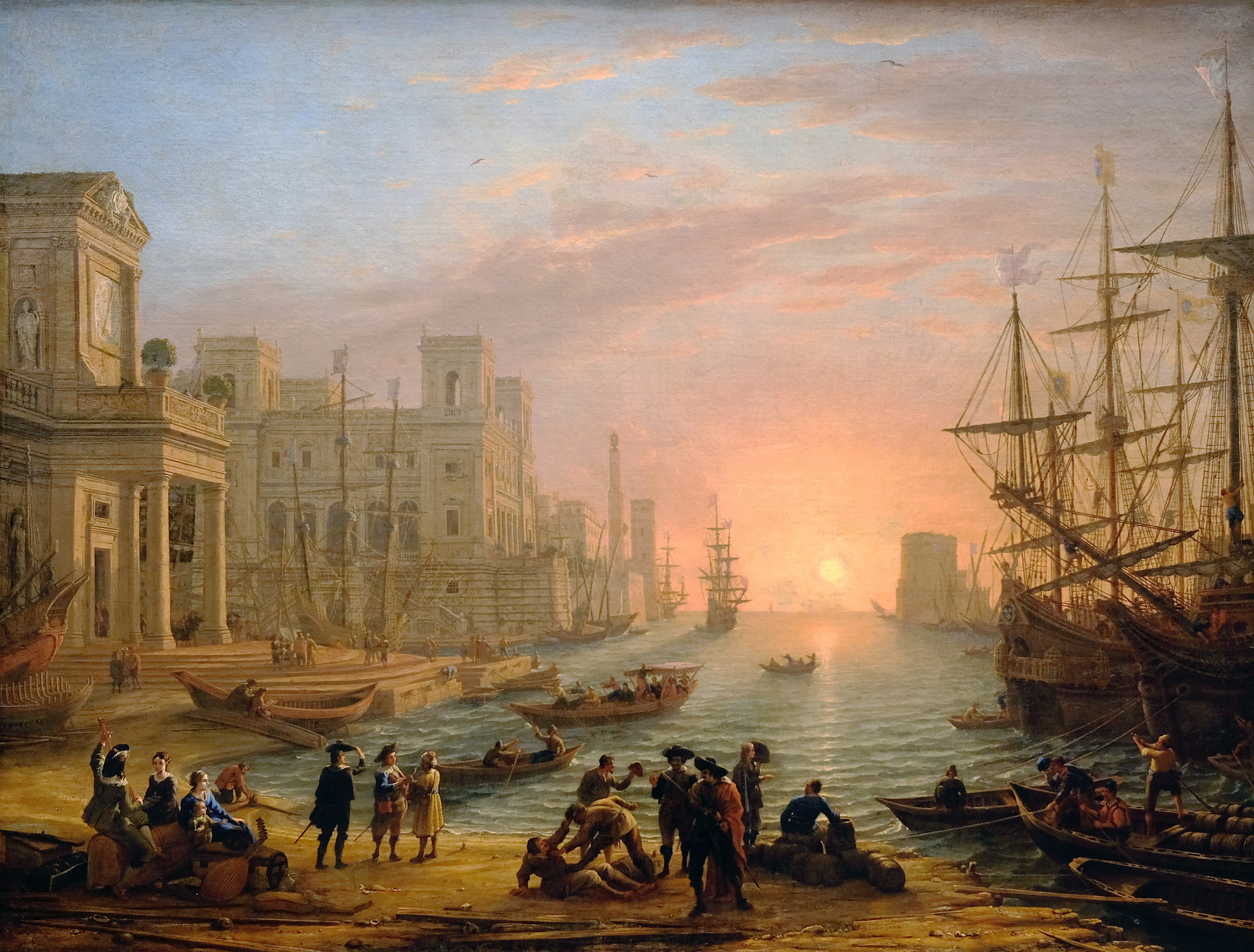
#FineArtFriday: Seaport at sunset by Claude Lorrain 1682

Artist: Claude Lorrain (1604/1605–1682)

Title:   Seaport at sunset

Genre: landscape painting

Date: 1639

Medium: oil on canvas

Dimensions: height: 1 m (40.5 in); width: 1.3 m (53.9 in)

What I love about this painting:

Wow! Where to start? This is what true genius looks like. The overall scene is masterfully done, one of the best seascapes I have seen. The waters are calm, allowing for goods and passengers to be transferred safely to shore. The sky is that incredible quality that nature sometimes offers us on a summer evening. A haze is rising, and ships are still entering the harbor, waiting for their turn to offload their cargoes and passengers. Waves lap softly at the shore, a gentle rhythm.

Claude shows us a thriving, prosperous seaport under a glorious sunset. In fact, the scenery is so beautiful, it’s easy to overlook the dramas playing out in the foreground. However, we shouldn’t, as that is where the real story he wanted to show us lies.

In the bottom left, a family is seated on an upturned boat. Are they waiting to board a ship? They seem to be musicians, as the man plays a cittern, and a lute rests beside the woman and child, along with a pile of baggage.

To their right, a pair of merchants discuss business with a foreign trader, whose clothing suggests he is from Persia. Are they negotiating the purchase of rare spices? Or are they attempting to sell him something?

In the bottom center, violence has erupted as a pair of ruffians have decided to settle their dispute the old-fashioned way. Sailors on shore leave? Too much to drink? Fighting over a woman? The onlookers are disgusted but do not step in to break it up. Apparently, someone “had it coming.”

To the right of the combatants and knot of friends, a pair of well-dressed men, one seated on an upturned boat and one standing, are clearly waiting for something. Perhaps these people are all waiting to board the same ship.

And finally, on the far right, we have several ships, accompanied by small boats called tenders, which are going to and from them. In the foreground, sailors row tenders to the strand. Will our passengers be rowed out to board their ship? This is a bustling harbor, and it’s clear that berths along the quayside are at a premium. Perhaps, rather than paying for a berth when his cargo consists of passengers rather than goods, this ship’s owner keeps his costs down by bringing supplies on board by tender and ferrying passengers to and from the shore.

Claude’s glorious sunset hints that hope lies beyond the horizon. Are the passengers embarking on a journey to the New World? Perhaps they are going to India, or even to the French colonies in the South Pacific. Wherever they are going, I hope their journey is peaceful and ends well.

About the artist, via Wikipedia:

Claude Lorrain (born Claude Gellée), called le Lorrain in French; traditionally just Claude in English; c. 1600 – 23 November 1682) was a painter, draughtsman and etcher of the Baroque era originally from the Duchy of Lorraine. He spent most of his life in Italy, and is one of the earliest significant artists, aside from his contemporaries in Dutch Golden Age painting, to concentrate on landscape painting. His landscapes often transitioned into the more prestigious genre of history paintings by addition of a few small figures, typically representing a scene from the Bible or classical mythology. [1]

To learn more about this artist go to Claude Lorrain – Wikipedia


Credits and Attributions:

IMAGE: Seaport at sunset by Claude Lorrain 1682. Wikimedia Commons contributors, “File:F0087 Louvre Gellee port au soleil couchant- INV4715 rwk.jpg,” Wikimedia Commons, https://commons.wikimedia.org/w/index.php?title=File:F0087_Louvre_Gellee_port_au_soleil_couchant-_INV4715_rwk.jpg&oldid=967103912 (accessed June 27, 2025).

[1] Wikipedia contributors, “Claude Lorrain,” Wikipedia, The Free Encyclopedia, https://en.wikipedia.org/w/index.php?title=Claude_Lorrain&oldid=1298367934 (accessed July 2, 2025).

2 Comments

Filed under #FineArtFriday, writing

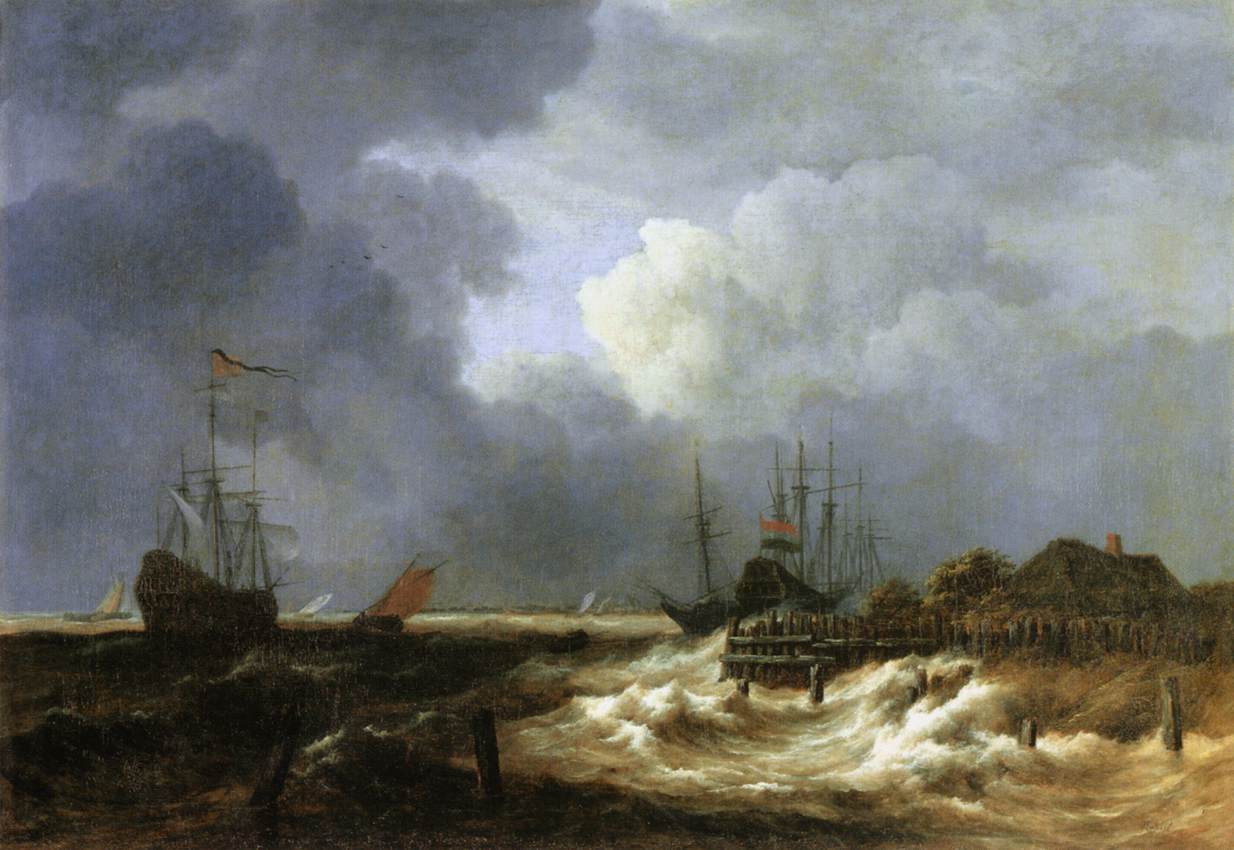
#FineArtFriday – “The Breakwater” or “Storm off a Sea Coast” by Jacob van Ruisdael ca. 1670

Artist: Jacob van Ruisdael (1628/1629–1682)

Titles: The Breakwater (current title)

Also known as: Storm off a Sea Coast

Also known as: Ships in Stormy Weather off the Coast

Also known as: A Storm at Sea Off the Dykes of Holland

Genre: marine art

Date: between 1670 and 1672

Medium: oil on canvas

Dimensions: height: 110 cm (43.3 in); width: 160 cm (62.9 in)

Collection: Louvre Museum

What I love about this painting:

Jacob van Ruisdael shows us a wild day down at the port. Several cargo ships are attempting to dock before the full force of the storm descends upon them. He shows us the action, the motion of the clouds flying across the sky above, and the roiling sea below. A shaft of light illuminates the white foam of the churning waves.

Will the ships’ captains and crews manage to get their vessels into the harbor and safely berthed? Will some be dashed against the rocks or tossed up onto the seawall?

Van Ruisdael paints us a story, but we must imagine the ending for ourselves.


About this painting via Wikipedia:

Storm Off a Sea Coast, also known as The Breakwater, is a 1670 oil on canvas painting by the Dutch Golden Age painter Jacob van Ruisdael. It is in the collection of the Louvre in Paris.

The painting is called A Storm at Sea Off the Dykes of Holland in the 1911 catalogue raisonné compiled by Cornelis Hofstede de Groot, in which it is catalogue number 961. De Groot described the scene: “On the right is a dyke lined with piles, beyond which is a fisherman’s cottage with a few trees. On the left corner of the dyke, great waves are breaking. Farther back rise the masts of several large vessels, as well as the stern with a Dutch flag.” The painting is called Storm Off a Sea Coast in Slive’s 2001 catalogue raisonné of van Ruisdael, in which it is given catalogue number 653.

In the 19th century, Vincent van Gogh called this painting by van Ruisdael, along with The Bush and Ray of Light, “magnificent”. The Louvre has in French: “L’Estacade ou Gros temps sur une digue de Hollande, dit aussi Une tempête” (the Jetty or Stormy Weather on a Dike in Holland, also known as A Storm). Its inventory number is INV. 1818. Its dimensions are 110 cm x 160 cm. [1]

About the artist, via Wikipedia:

Jacob Isaackszoon van Ruisdael c. 1629 – 10 March 1682) was a Dutch painter, draughtsman, and etcher. He is generally considered the pre-eminent landscape painter of the Dutch Golden Age, a period of great wealth and cultural achievement when Dutch painting became highly popular.

Prolific and versatile, Ruisdael depicted a wide variety of landscape subjects. From 1646 he painted Dutch countryside scenes of remarkable quality for a young man. After a trip to Germany in 1650, his landscapes took on a more heroic character. In his late work, conducted when he lived and worked in Amsterdam, he added city panoramas and seascapes to his regular repertoire. In these, the sky often took up two-thirds of the canvas. In total he produced more than 150 Scandinavian views featuring waterfalls.

Ruisdael’s only registered pupil was Meindert Hobbema, one of several artists who painted figures in his landscapes. Hobbema’s work has at times been confused with Ruisdael’s. Ruisdael always spelt his name thus: Ruisdael, not Ruysdael.

Ruisdael’s work was in demand in the Dutch Republic during his lifetime. Today it is spread across private and institutional collections around the world; the National Gallery in London, the Rijksmuseum in Amsterdam, and the Hermitage Museum in St. Petersburg hold the largest collections. Ruisdael shaped landscape painting traditions worldwide, from the English Romantics to the Barbizon school in France, and the Hudson River School in the US, and influenced generations of Dutch landscape artists. [2]


Credits and Attributions:

IMAGE: The Breakwater, Wikipedia contributors, “Storm Off a Sea Coast,” Wikipedia, The Free Encyclopedia, https://en.wikipedia.org/w/index.php?title=Storm_Off_a_Sea_Coast&oldid=1252177345 (accessed May 22, 2025).

[1] Wikipedia contributors, “Storm Off a Sea Coast,” Wikipedia, The Free Encyclopedia, https://en.wikipedia.org/w/index.php?title=Storm_Off_a_Sea_Coast&oldid=1252177345 (accessed May 22, 2025).

[2] Wikipedia contributors, “Jacob van Ruisdael,” Wikipedia, The Free Encyclopedia, https://en.wikipedia.org/w/index.php?title=Jacob_van_Ruisdael&oldid=1290856128 (accessed May 22, 2025).

2 Comments

Filed under #FineArtFriday

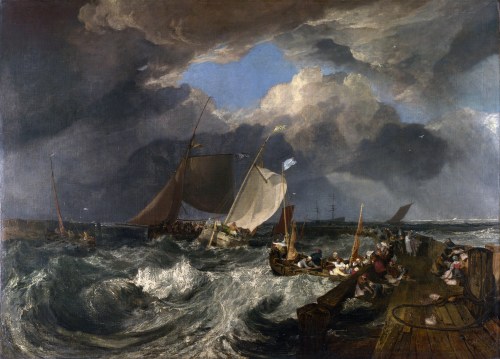
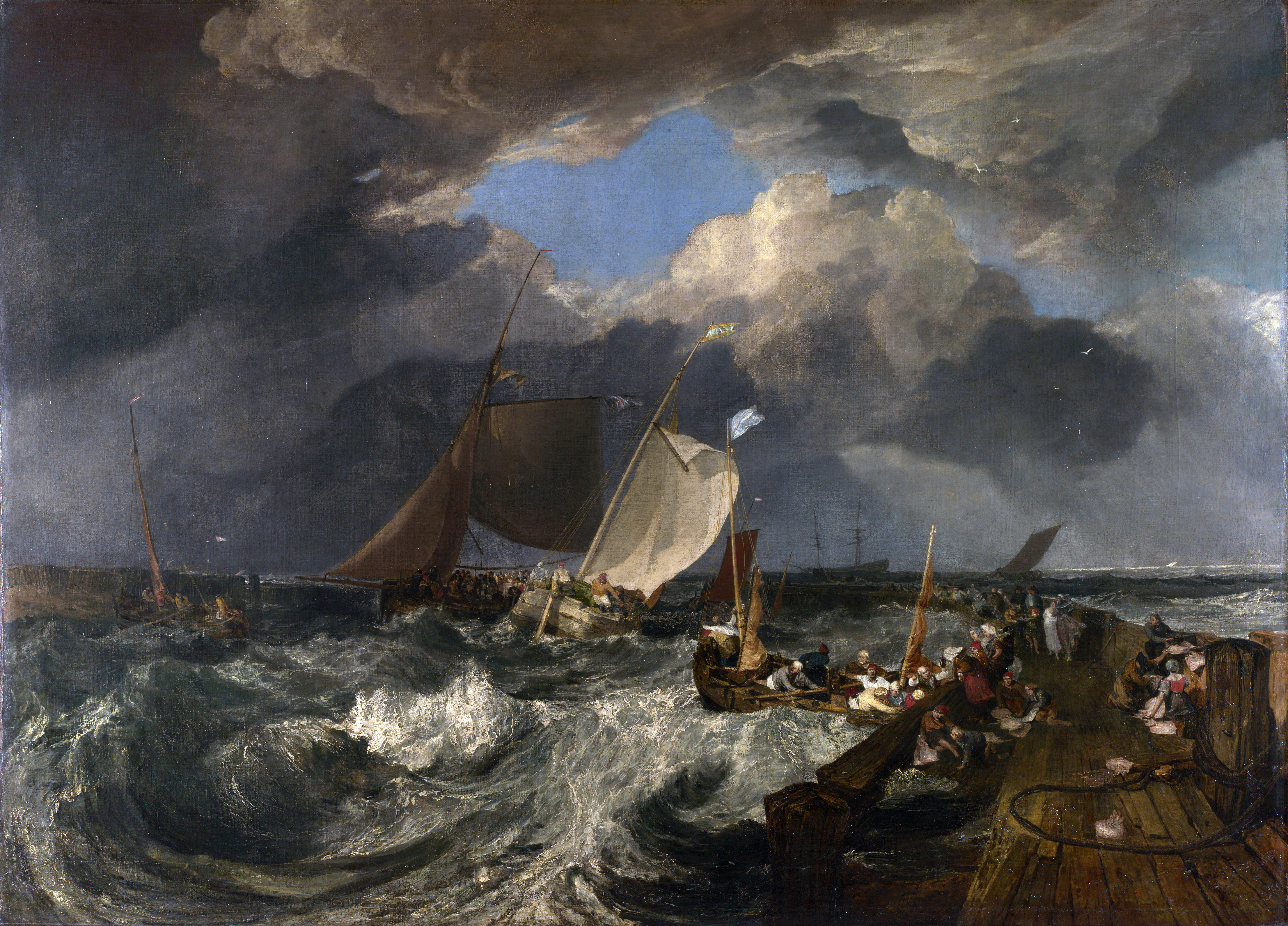
#FineArtFriday: a closer look at “Calais Pier by J.M.W. Turner, 1803”

Calais_pier_Joseph_Mallord_William_Turner_024

Artist: J. M. W. Turner (1775–1851)

Title: Calais Pier

Date: 1803

Medium: oil on canvas

Dimensions: height: 172 cm (67.7 in); width: 240 cm (94.4 in)

Collection: National Gallery

What I love about this painting:

The art of Joseph Mallord William Turner holds a large place in my heart. His originality, his later lack of deference to artistic conventions of the day often made his life hard. But what wonderful works emerged from his view of the world. Much like Van Gogh would do thirty years later, Turner’s work eventually evolved into a style that was original and sheer genius. His ability to paint what he saw and felt rather than the accepted classic literal depiction of a scene inspired the next generation of artists, the Impressionists.

Caiais Pier is one of his earlier works, painted when he was still influenced by his classical training. And yet, it is an emotion-packed image, the scene of a near-tragedy. The packet boat has arrived at Calais with a full load of passengers. The storm dominates the scene with lowering clouds and a heavy swell, but the sun breaks through and lights on the sail. A shaft of light shines down to the sea illuminating the center of the composition.  The young artist put his experience and terror into the image, depicting the ferocity of the sea and the violence of the landing.

The National Gallery website says of this picture, “Although it had a mixed response when first exhibited at the Royal Academy in 1803, the critic John Ruskin declared it to be the first painting to show signs of ‘Turner’s colossal power’. Calais Pier is based upon an actual event. On 15 July 1802, Turner, aged 27, began his first trip abroad, travelling from Dover to Calais in a cross-channel ferry (a packet) of the type shown here. The weather was stormy, and Turner noted in his sketchbook: ‘Our landing at Calais. Nearly swampt.’” [1] Joseph Mallord William Turner | Calais Pier | NG472 | National Gallery, London

About the Artist, Via Wikipedia:

Joseph Mallord William Turner RA (23 April 1775 – 19 December 1851), known in his time as William Turner, was an English Romantic painter, printmaker and watercolorist. He is known for his expressive coloring, imaginative landscapes and turbulent, often violent marine paintings. He left behind more than 550 oil paintings, 2,000 watercolors, and 30,000 works on paper. He was championed by the leading English art critic John Ruskin from 1840 and is today regarded as having elevated landscape painting to an eminence rivalling history painting.

Turner was born in Maiden Lane, Covent Garden, London, to a modest lower-middle-class family and retained his lower class accent, while assiduously avoiding the trappings of success and fame. A child prodigy, Turner studied at the Royal Academy of Arts from 1789, enrolling when he was 14, and exhibited his first work there at 15. During this period, he also served as an architectural draftsman. He earned a steady income from commissions and sales, which due to his troubled, contrary nature, were often begrudgingly accepted. He opened his own gallery in 1804 and became professor of perspective at the academy in 1807, where he lectured until 1828. He travelled around Europe from 1802, typically returning with voluminous sketchbooks.

Intensely private, eccentric, and reclusive, Turner was a controversial figure throughout his career. He did not marry, but fathered two daughters, Evelina (1801–1874) and Georgiana (1811–1843), by his housekeeper Sarah Danby. He became more pessimistic and morose as he got older, especially after the death of his father in 1829; when his outlook deteriorated, his gallery fell into disrepair and neglect, and his art intensified. In 1841, Turner rowed a boat into the Thames so he could not be counted as present at any property in that year’s census. He lived in squalor and poor health from 1845, and died in London in 1851 aged 76. Turner is buried in St Paul’s Cathedral, London. [2]


Credits and Attributions:

“Calais Pier” by J.M.W. Turner, 1801. Wikipedia contributors, “Calais Pier,” Wikipedia, The Free Encyclopedia, https://en.wikipedia.org/w/index.php?title=Calais_Pier&oldid=1287504024 (accessed May 9, 2025).

[1] National Gallery contributors, Calais Pier, Joseph Mallord William Turnerhttps://www.nationalgallery.org.uk/paintings/joseph-mallord-william-turner-calais-pier (accessed May 9, 2025).

[2] Wikipedia contributors, “J. M. W. Turner,” Wikipedia, The Free Encyclopedia, https://en.wikipedia.org/w/index.php?title=J._M._W._Turner&oldid=1289276733 (accessed May 9, 2025).

2 Comments

Filed under #FineArtFriday

#FineArtFriday: York Harbor, Coast of Maine by Martin Johnson Heade 1877

Martin_Johnson_Heade_-_York_Harbor,_Coast_of_Maine_-_1999.291_-_Art_Institute_of_ChicagoArtist: Martin Johnson Heade  (1819–1904)
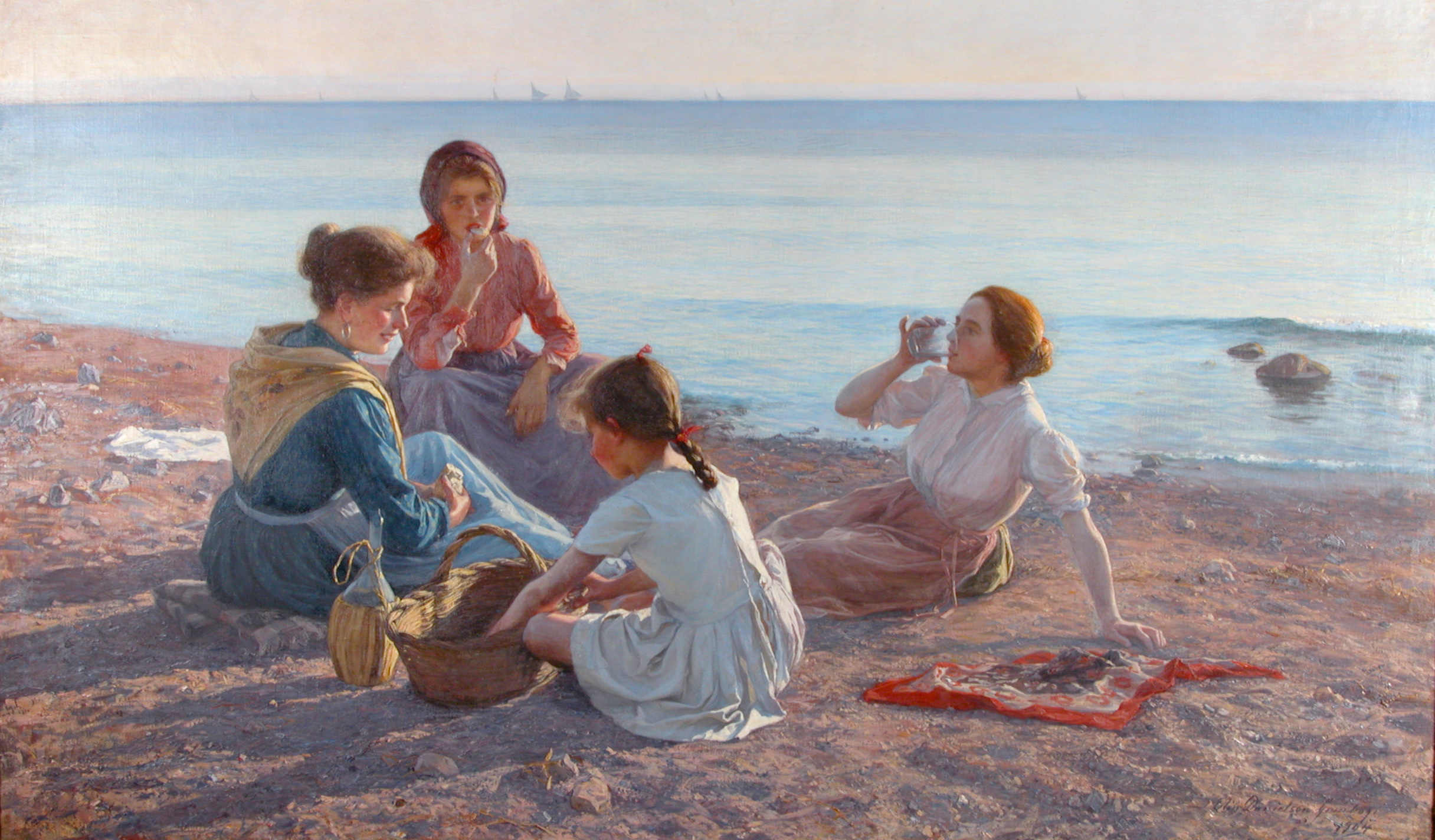
Title: York Harbor, Coast of Maine

Genre: marine art

Date: 1877

Medium: oil on canvas

Dimensions: height: 38.7 cm (15.2 in)

Collection: Art Institute of Chicago

What I love about this painting:

We see the sun rising, slowly burning off the morning mist–my favorite time of the day. I love the detail, the way Martin Johnson Heade shows us the truth about harbors that serve small communities in a low-tech world. They aren’t necessarily fancy, and they don’t accommodate large boats. Somewhere out of the picture is a simple wooden pier, a place for the fishing boats to offload their catch. Perhaps there is a sandy beach where fisherfolk can pull their boats above the waterline, resting them upside down when they’re not in use.

The scene he shows us is a salt marsh, alive with a thriving wildlife community.

The line of branches emerging from the water has been placed there by human hands, but for what purpose? Whatever they are meant to do, they have been there long enough that seaweed clings to them, nourished by the rise and fall of the tide.

About the Artist, via Wikipedia:

Martin Johnson Heade (August 11, 1819 – September 4, 1904) was an American painter known for his salt marsh landscapesseascapes, and depictions of tropical birds (such as hummingbirds), as well as lotus blossoms and other still lifes. His painting style and subject matter, while derived from the romanticism of the time, are regarded by art historians as a significant departure from those of his peers.

Heade’s primary interest in landscape, and the works for which he is perhaps best known today, was the New England coastal salt marsh. Contrary to typical Hudson River School displays of scenic mountains, valleys, and waterfalls, Heade’s marsh landscapes avoided depictions of grandeur. They focused instead on the horizontal expanse of subdued scenery, and employed repeating motifs that included small haystacks and diminutive figures. Heade also concentrated on the depiction of light and atmosphere in his marsh scenes. These and similar works have led some historians to characterize Heade as a Luminist painter. In 1883 Heade moved to Saint Augustine, Florida and took as his primary landscape subject the surrounding subtropical marshland. [1]

To read more about this Artist, go to Martin Johnson Heade – Wikipedia


Credits and Attributions:

IMAGE: Wikimedia Commons contributors, “File:Martin Johnson Heade – York Harbor, Coast of Maine – 1999.291 – Art Institute of Chicago.jpg,” Wikimedia Commons, https://commons.wikimedia.org/w/index.php?title=File:Martin_Johnson_Heade_-_York_Harbor,_Coast_of_Maine_-_1999.291_-_Art_Institute_of_Chicago.jpg&oldid=828607401 (accessed July 3, 2024).

[1] Wikipedia contributors, “Martin Johnson Heade,” Wikipedia, The Free Encyclopedia, https://commons.wikimedia.org/w/index.php?title=File:Martin_Johnson_Heade_-_York_Harbor,_Coast_of_Maine_-_1999.291_-_Art_Institute_of_Chicago.jpg&oldid=828607401 (accessed July 3, 2024).

8 Comments

Filed under #FineArtFriday, writing

#FineArtFriday: La Mirenda (The Snack) by Elin Danielson-Gambogi 1904

Elin_Danielson-Gambogi_-_La_Merenda_(1904)Artist: Elin Danielson-Gambogi  (1861–1919)
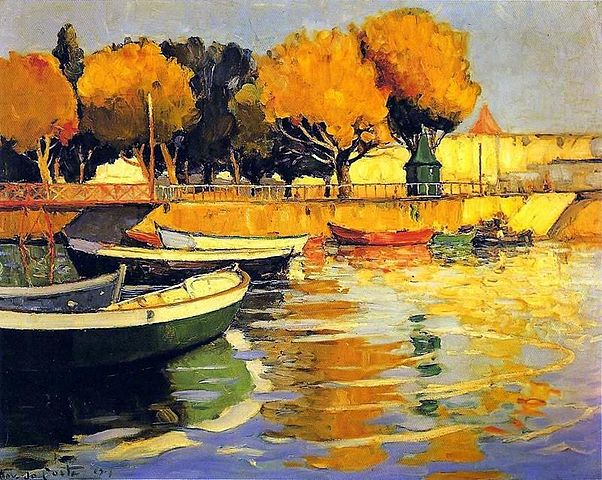
Title: By the Sea – The Snack (La Merenda)

Date: 1904

Medium: oil on canvas

Dimensions: height: 102 cm (40.1 in)

Collection: K. H. Renlund art collection

What I love about this painting:

Elin Danielson-Gambogi gives us a perfect afternoon for an afternoon picnic by the sea with friends. An afternoon beside the surf and the company of friends—it doesn’t get any better.

The good years just prior to the outbreak of WWI seem golden in many ways. Women’s work was never done but they have the luxury of a little leisure time, and they are enjoying it. Two women have removed their headscarves as if they don’t care if they get a little sun-browned. The cast-off squares of cloth lie on the rocky beach as if blown by the wind.

The girl is very likely the artist’s niece, as she and her mother figure prominently in many of Elin’s paintings. I like to think she is pleased to have been included in the picnic, proud to be serving the snacks.

There is a pleasant warmth to this image, the peace of a Goldilocks day, that rare summer’s afternoon that is just right.

About the Artist, via Wikipedia:

Elin Kleopatra Danielson-Gambogi (3 September 1861 – 31 December 1919) was a Finnish painter best known for her realist works and portraits. Danielson-Gambogi was part of the first generation of Finnish women artists who received professional education in art, the so-called “painter sisters’ generation”. The group also included Helene Schjerfbeck (1862–1946), Helena Westermarck (1857-1938), and Maria Wiik (1853-1928).

In 1883 Danielson received a grant and moved to Paris. While there, she took lessons at the Académie Colarossi under Gustave Courtois and painted in Brittany during the summertime. A few years later she returned to Finland and lived with her relatives in Noormarkku and Pori. In 1888 she opened an atelier in Noormarkku. During the 1880s and 1890s she worked as a teacher in several art schools around Finland.  She also attended the artists’ colony Önningeby in Ålands.

In 1895, she received a scholarship and traveled to Florence, Italy. A year later she moved to the village of Antignano in Livorno where she met an Italian painter 13 years younger than herself, Raffaello Gambogi (1874–1943). They began working together and got married on February 27, 1898.  They held exhibitions in Paris, Florence (where she was awarded an art prize by the city) and Milan, and in many Finnish cities, and their paintings were also included in the 1900 World’s Fair in Paris, where she again won bronze medal. She also got to second place in the 1901 national portrait painting competition organized by the Finnish state.  In 1899, King Umberto purchased a painting from her. That same year, she participated in the Venice Biennale.

Their marriage was strained when Raffaello had an affair with Danielson’s Finnish friend Dora Wahlroos.  While the affair quickly ended, it had a lasting impact on the Gambogis’ marriage.  She moved to Finland for a while but returned to Antignano in 1903.  Because of World War I, her connection to her homeland was cut, and by the time she died, of pneumonia, at Antignano in 1919, she had been mostly forgotten in Finland.

Because of her choice of rare subject matters that often even caused some offence, Danielson is now seen as one of the central artists of the Golden Age of Finnish Art. Danielson-Gambogi was included in the 2018 exhibit Women in Paris 1850-1900. [1]


Credits and Attributions:

IMAGE: Wikimedia Commons contributors, “File:Elin Danielson-Gambogi – La Merenda (1904).jpg,” Wikimedia Commons, https://commons.wikimedia.org/w/index.php?title=File:Elin_Danielson-Gambogi_-_La_Merenda_(1904).jpg&oldid=848460780 (accessed June 20, 2024).

[1] Wikipedia contributors, “Elin Danielson-Gambogi,” Wikipedia, The Free Encyclopedia, https://en.wikipedia.org/w/index.php?title=Elin_Danielson-Gambogi&oldid=1203975014 (accessed June 20, 2024).

5 Comments

Filed under #FineArtFriday, writing

#FineArtFriday:Porto de Leixões by Mário Navarro da Costa 1901

602px-Mário_Navarro_da_Costa_-_Porto_de_Leixões,_1901Artist: Mário Navarro da Costa (1883-1931)
Description: Português: Porto de Leixões (English: Port of Leixões)

Dimensions: 81 x 100 cm

Date: 1901

Source/Photographer: Collection of the Pinacoteca do Estado de São Paulo

What I love about this painting:

I love the intensity of this scene. One can feel the heat of a Portuguese day at the end of summer, a moment lingering on the edge of autumn. He brings his native Brazilian passion for color to the composition, with vibrant hues and strong visual texture.

More than a century after da Costa painted these humble fishing boats, Porto de Leixões is the largest port city in northern Portugal handling giant cargo vessels. The port boasts a 21st century  cruise ship terminal that is a visually stunning structure.

About the artist, via CoPilot GPT (source links included):

Mário Navarro da Costa (1883–1931) was a Brazilian painter and diplomat. He dedicated himself primarily to marine art and received private lessons from José Maria de Medeiros (1849–1925) and Rodolfo Amoedo (1857–1941) 1. His work falls within the realm of Impressionist and Modern painting. Over the years, his pieces have been offered at auction multiple times, with realized prices ranging from $596 to $2,630, depending on the size and medium of the artwork 2One notable work is “Barreiro Old Mills”, which achieved a record price of $2,630 at auction in 2019 2.


Credits and Attributions:

IMAGE: Wikimedia Commons contributors, “File:Mário Navarro da Costa – Porto de Leixões, 1901.jpg,” Wikimedia Commons, https://commons.wikimedia.org/w/index.php?title=File:M%C3%A1rio_Navarro_da_Costa_-_Porto_de_Leix%C3%B5es,_1901.jpg&oldid=841285378 (accessed April 11, 2024).

Comments Off on #FineArtFriday:Porto de Leixões by Mário Navarro da Costa 1901

Filed under #FineArtFriday

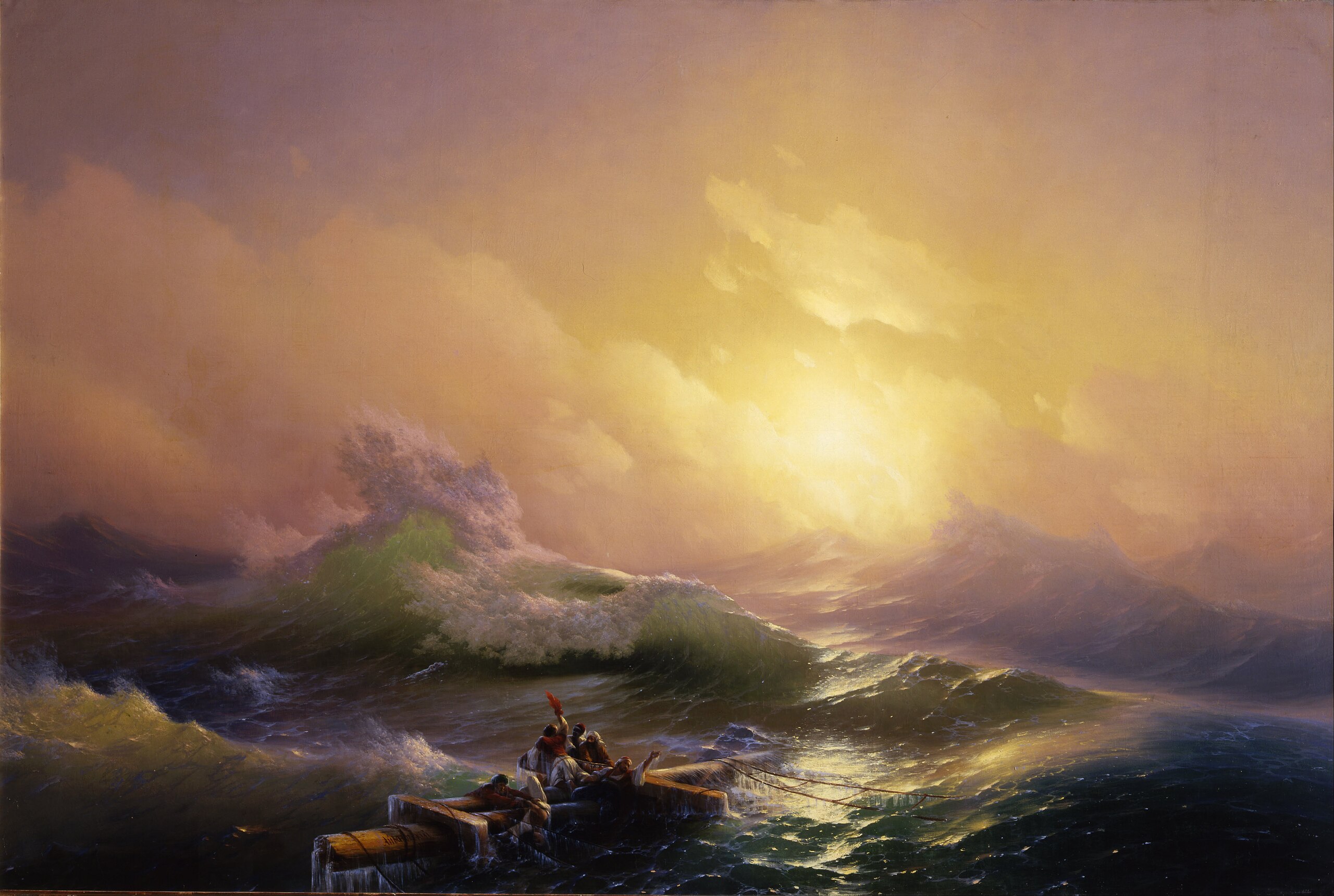
#FineArtFriday: The Ninth Wave by Ivan Aivazovsky 1850

Hovhannes_Aivazovsky_-_The_Ninth_Wave_-_Google_Art_ProjectArtist: Ivan Aivazovsky (baptized Hovhannes Aivazovsky) (1817 – 1900)
Title: The Ninth Wave

Genre: marine art

Date: 1850

Medium: oil on canvas oil on canvas

Dimensions: height: 2,210 mm (87 in); width: 3,320 mm (10.89 ft)

Collection: Russian Museum

What I love about this painting:

Aivazovsky tells a story here, an epic tale showing the power and emotion of the situation. These sailors are lost at sea; their ship has gone down in a storm and even though the sun is shining in the distance, a wave of catastrophic proportions is bearing down on them.

It’s not the first such wave they’ve survived, and it won’t be the last. But that sun shining in the distances is a beacon, and they cling to hope as desperately as they do their broken mast.

About this painting via Wikipedia:

The title refers to an old sailing expression referring to a wave of incredible size that comes after a succession of incrementally larger waves.

It depicts a sea after a night storm and people facing death attempting to save themselves by clinging to debris from a wrecked ship. The debris, in the shape of the cross, appears to be a Christian metaphor for salvation from the earthly sin. The painting has warm tones, which reduce the sea’s apparent menacing overtones and a chance for the people to survive seems plausible. This painting shows both the destructiveness and beauty of nature. [1]

About the Artist via Wikipedia:

Ivan Aivazovsky was born on 29 July [O.S. 17 July] 1817 in the city of Feodosia (Theodosia), Crimea, Russian Empire. In the baptismal records of the local St. Sargis Armenian Apostolic Church, Aivazovsky was listed as Hovhannes, son of Gevorg Aivazian. He became known as Aivazovsky since c. 1840, while in Italy. He signed an 1844 letter with an Italianized rendition of his name: “Giovani Aivazovsky”.

After meeting Aivazovsky in person, Anton Chekhov wrote a letter to his wife on 22 July 1888 describing him as follows:

Aivazovsky himself is a hale and hearty old man of about seventy-five, looking like an insignificant Armenian and a bishop; he is full of a sense of his own importance, has soft hands and shakes your hand like a general. He’s not very bright, but he is a complex personality, worthy of a further study. In him alone there are combined a general, a bishop, an artist, an Armenian, an naive old peasant, and an Othello.

The house in Feodosia, where Aivazovsky lived between 1845 and 1892. It is now an art gallery.

After traveling to Paris with his wife, in 1892 he made a trip to the United States, visiting Niagara Falls in New York and Washington D.C. In 1896, at 79, Aivazovsky was promoted to the rank of full privy councillor.

Aivazovsky was deeply affected by the Hamidian massacres that took place in the Armenian-inhabited areas of the Ottoman Empire between 1894 and 1896. He painted a number of works on the subject such as The Expulsion of the Turkish Ship, and The Armenian Massacres at Trebizond (1895). He threw the medals given to him by the Ottoman Sultan into the sea and told the Turkish consul in Feodosia: “Tell your bloodthirsty master that I’ve thrown away all the medals given to me, here are their ribbons, send it to him and if he wants, he can throw them into the seas painted by me.”  He created several other paintings capturing the events, such as Lonely Ship and Night. Tragedy in the Sea of Marmara (1897).

He spent his final years in Feodosia. In the 1890s, thanks to his efforts a commercial port (ru) was established in Feodosia and linked to the railway network of the Russian Empire. The railway station, opened in 1892, is now called Ayvazovskaya [ru] and is one of the two stations within the city of Feodosia.

Aivazovsky also supplied Feodosia with drinking water. [2]


Credits and Attributions:

IMAGE: File: Hovhannes Aivazovsky – The Ninth Wave – Google Art Project.jpg Hovhannes Aivazovsky – The Ninth Wave – Google Art Project – The Ninth Wave – Wikipedia (accessed January 10, 2024).

[1]Wikipedia contributors, “The Ninth Wave,” Wikipedia, The Free Encyclopedia, https://en.wikipedia.org/w/index.php?title=The_Ninth_Wave&oldid=1160319059 (accessed January 10, 2024).

[2] Wikipedia contributors, “Ivan Aivazovsky,” Wikipedia, The Free Encyclopedia, https://en.wikipedia.org/w/index.php?title=Ivan_Aivazovsky&oldid=1194332468 (accessed January 10, 2024).

4 Comments

Filed under #FineArtFriday

#FineArtFriday: Calais Pier by J.M.W. Turner, 1803

Calais_pier_Joseph_Mallord_William_Turner_024

Artist: J. M. W. Turner (1775–1851)

Title: Calais Pier

Date: 1803

Medium: oil on canvas

Dimensions: height: 172 cm (67.7 in); width: 240 cm (94.4 in)

Collection: National Gallery

What I love about this painting:

This is an emotion-packed image, the scene of a near-tragedy. The packet boat has arrived at Calais with a full load of passengers. The storm dominates the scene with lowering clouds and a heavy swell, but the sun breaks through and lights on the sail. A shaft of light shines down to the sea illuminating the center of the composition.  The young artist put his experience and terror into the image, depicting the ferocity of the sea and the violence of the landing.

The National Gallery website says of this picture, “Although it had a mixed response when first exhibited at the Royal Academy in 1803, the critic John Ruskin declared it to be the first painting to show signs of ‘Turner’s colossal power’. Calais Pier is based upon an actual event. On 15 July 1802, Turner, aged 27, began his first trip abroad, travelling from Dover to Calais in a cross-channel ferry (a packet) of the type shown here. The weather was stormy, and Turner noted in his sketchbook: ‘Our landing at Calais. Nearly swampt.’” [1] Joseph Mallord William Turner | Calais Pier | NG472 | National Gallery, London

About the Artist, Via Wikipedia:

Joseph Mallord William Turner RA (23 April 1775 – 19 December 1851), known in his time as William Turner, was an English Romantic painter, printmaker and watercolorist. He is known for his expressive coloring, imaginative landscapes and turbulent, often violent marine paintings. He left behind more than 550 oil paintings, 2,000 watercolors, and 30,000 works on paper. He was championed by the leading English art critic John Ruskin from 1840 and is today regarded as having elevated landscape painting to an eminence rivalling history painting.

Turner was born in Maiden Lane, Covent Garden, London, to a modest lower-middle-class family and retained his lower class accent, while assiduously avoiding the trappings of success and fame. A child prodigy, Turner studied at the Royal Academy of Arts from 1789, enrolling when he was 14, and exhibited his first work there at 15. During this period, he also served as an architectural draftsman. He earned a steady income from commissions and sales, which due to his troubled, contrary nature, were often begrudgingly accepted. He opened his own gallery in 1804 and became professor of perspective at the academy in 1807, where he lectured until 1828. He travelled around Europe from 1802, typically returning with voluminous sketchbooks.

Intensely private, eccentric, and reclusive, Turner was a controversial figure throughout his career. He did not marry, but fathered two daughters, Evelina (1801–1874) and Georgiana (1811–1843), by his housekeeper Sarah Danby. He became more pessimistic and morose as he got older, especially after the death of his father in 1829; when his outlook deteriorated, his gallery fell into disrepair and neglect, and his art intensified. In 1841, Turner rowed a boat into the Thames so he could not be counted as present at any property in that year’s census. He lived in squalor and poor health from 1845, and died in London in 1851 aged 76. Turner is buried in St Paul’s Cathedral, London. [2]


Credits and Attributions:

“Calais Pier” by J.M.W. Turner, 1801. Wikimedia Commons contributors, “File:Joseph Mallord William Turner 024.jpg,” Wikimedia Commons, https://commons.wikimedia.org/w/index.php?title=File:Joseph_Mallord_William_Turner_024.jpg&oldid=618399843 (accessed October 7, 2023).

[1] National Gallery contributors, Calais Pier, Joseph Mallord William Turnerhttps://www.nationalgallery.org.uk/paintings/joseph-mallord-william-turner-calais-pier (accessed  October 11, 2023).

[2] Wikipedia contributors, “J. M. W. Turner,” Wikipedia, The Free Encyclopedia, https://en.wikipedia.org/w/index.php?title=J._M._W._Turner&oldid=1179617592 (accessed October 11, 2023).

Comments Off on #FineArtFriday: Calais Pier by J.M.W. Turner, 1803

Filed under #FineArtFriday

#FineArtFriday: View of Dordrecht by Aelbert Cuyp, ca. 1665

View of Dordrecht, by Aelbert Cuyp

View of Dordrecht *oil on canvas *97.8 x 137.8 cm *signed b.r.: A cuyp *circa 1655

Artist: Aelbert Cuyp  (1620–1691)

Title: View of Dordrecht

Date: circa 1665

Genre: marine art

Medium: oil on canvas

Size: 97.8 x 137.8 cm

Inscription: signature, A Cuyp

Collection: Kenwood House


What I love about this painting:

We see history in action, a working harbor alive and bustling with activity beneath a sky larger and more powerful than the sea. The eye is drawn to the center, to the majestic vessel moored in the harbor.

But that’s not where the action is.

In the bottom left, a barrel has fallen from a ship, perhaps during unloading, and floats freely. A small boat filled with sailors rows out to retrieve it. Beyond, at the docks, seagulls skim, sailing just above the water.

In the lower right, a raft of logs is guided past a moored ship, a small one perhaps waiting for a berth.

A fishing vessel heads out to sea.

The piers are jammed with ships. Stevedores in browns and dark colors blend into the background as they work the docks. They are laborers without whom the port would grind to a halt. They’re nearly invisible, yet Cuyp paints them with movement, bringing life to their anonymity.

This is a painting with many stories to tell.

About Aelbert Cuyp’s style, via Wikipedia:

Sunlight in his paintings rakes across the panel, accentuating small bits of detail in the golden light. In large, atmospheric panoramas of the countryside, the highlights on a blade of meadow grass, the mane of a tranquil horse, the horn of a dairy cow reclining by a stream, or the tip of a peasant’s hat are all caught in a bath of yellow ocher light. The richly varnished medium refracts the rays of light like a jewel as it dissolves into numerous glazed layers. Cuyp’s landscapes were based on reality and on his own invention of what an enchanting landscape should be.

Cuyp’s drawings reveal him to be a draftsman of superior quality. Light-drenched washes of golden-brown ink depict a distant view of the city of Dordrecht or Utrecht. [1]

About the Artist, via Wikipedia:

Aelbert Jacobszoon Cuyp (Dutch pronunciation: [kœyp]) (or Cuijp; 20 October 1620 – 15 November 1691) was one of the leading Dutch Golden Age painters, producing mainly landscapes. The most famous of a family of painters, the pupil of his father, Jacob Gerritszoon Cuyp (1594–1651/52), he is especially known for his large views of Dutch riverside scenes in a golden early morning or late afternoon light. Little is known of his life. He was born and died in Dordrecht. [1]


Credits and Attributions:

IMAGE: View of Dordrecht by Aelbert Cuyp, ca. 1665, PD|100.  Wikimedia Commons contributors, “File:View of Dordrecht, by Aelbert Cuyp.jpg,” Wikimedia Commons, the free media repository, https://commons.wikimedia.org/w/index.php?title=File:View_of_Dordrecht,_by_Aelbert_Cuyp.jpg&oldid=704142240 (accessed January 19, 2023).

[1] Wikipedia contributors, “Aelbert Cuyp,” Wikipedia, The Free Encyclopedia, https://en.wikipedia.org/w/index.php?title=Aelbert_Cuyp&oldid=1132221182 (accessed January 19, 2023).

6 Comments

Filed under #FineArtFriday