
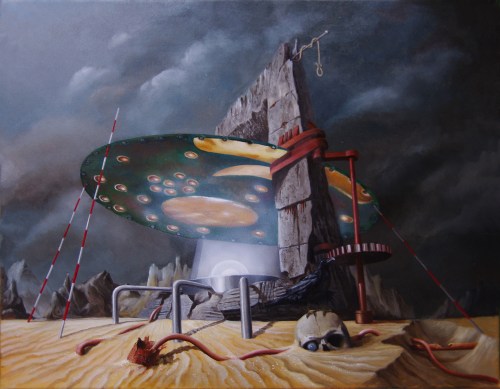
Title: (Deutsch) Was bleibt?
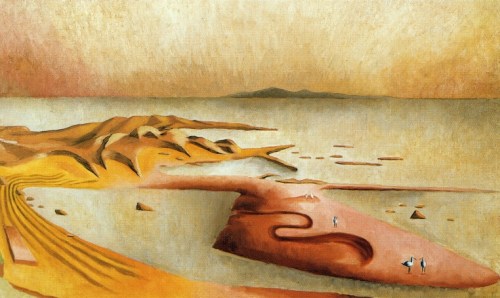
Title: (English) What remains?
Artist: Eberhard Marx
Description: (Deutsch) surrealistisches Gemälde mit der Himmelsscheibe von Nebra
Description: (English) surrealist painting with the Nebra Sky Disc
Date: 19 May 2016
Today we are looking at Surrealism in art, as painted by a contemporary German artist, Eberhard Marx. This image comes from Wikimedia Commons, as does most of the work featured here.
When viewing surrealist art, the viewer can decide the intent of each element and how they are placed in the composition. The historical importance of the Nebra sky disc, the antiquity of the disc itself, and the craftsmanship that went into its making have always intrigued me, so this painting really caught my eye.
I visited the artist’s website and found where he offers us a way to view his works:
“Eberhard Marx wishes the viewer to take a walk in his paintings. The works are not botanical gardens with descriptions, but rather a bewitched park.” [1]
I have been enjoying doing just that!
About the Nebra sky disc, via Wikipedia:
The Nebra sky disc is a bronze disc of around 30 cm (12 in) diameter and a weight of 2.2 kg (4.9 lb), having a blue-green patina and inlaid with gold symbols. These symbols are interpreted generally as the Sun or full moon, a lunar crescent, and stars (including a cluster of seven stars interpreted as the Pleiades). Two golden arcs along the sides, interpreted to mark the angle between the solstices, were added later. A final addition was another arc at the bottom with internal parallel lines, which is usually interpreted as a solar boat with numerous oars, though some authors have also suggested that it may represent a rainbow, or the Aurora Borealis.
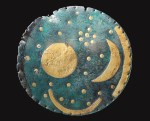 The disc was found buried on the Mittelberg hill near Nebra in Germany. It is dated by archaeologists to c. 1800–1600 BCE and attributed to the Early Bronze Age Unetice culture.Various scientific analyses of the disc, the items found with the disc, and the find spot have confirmed the Early Bronze Age dating.
The Nebra sky disc features the oldest concrete depiction of astronomical phenomena known from anywhere in the world. In June 2013, it was included in the UNESCO Memory of the World Register and termed “one of the most important archaeological finds of the twentieth century.” [2]
About Surrealism in Art, via Wikipedia:
Surrealism is a cultural movement that developed in Europe in the aftermath of World War I in which artists depicted unnerving, illogical scenes and developed techniques to allow the unconscious mind to express itself. Its aim was, according to leader André Breton, to “resolve the previously contradictory conditions of dream and reality into an absolute reality, a super-reality”, or surreality. It produced works of painting, writing, theatre, filmmaking, photography, and other media.
Works of Surrealism feature the element of surprise, unexpected juxtapositions and non sequitur. However, many Surrealist artists and writers regard their work as an expression of the philosophical movement first and foremost (for instance, of the “pure psychic automatism” Breton speaks of in the first Surrealist Manifesto), with the works themselves being secondary, i.e., artifacts of surrealist experimentation. Leader Breton was explicit in his assertion that Surrealism was, above all, a revolutionary movement. At the time, the movement was associated with political causes such as communism and anarchism. It was influenced by the Dada movement of the 1910s.
The term “Surrealism” originated with Guillaume Apollinaire in 1917. However, the Surrealist movement was not officially established until after October 1924, when the Surrealist Manifesto published by French poet and critic André Breton succeeded in claiming the term for his group over a rival faction led by Yvan Goll, who had published his own surrealist manifesto two weeks prior. The most important center of the movement was Paris, France. From the 1920s onward, the movement spread around the globe, impacting the visual arts, literature, film, and music of many countries and languages, as well as political thought and practice, philosophy, and social theory. [3]
I highly recommend a visit to the artist’s website, HOME | EBERHARD MARX (eberhard-marx.eu). You will find many more of his amazing paintings, or you can purchase prints if something interests you.
Credits and Attributions:
Image: Was bleibt? ( English: what remains?). Wikimedia Commons contributors, “File:Was bleibt.jpg,” Wikimedia Commons, https://commons.wikimedia.org/w/index.php?title=File:Was_bleibt.jpg&oldid=528401859 (accessed April 27, 2023).
[1] Quote from Eberhard Marx website, HOME | EBERHARD MARX (eberhard-marx.eu) (accessed April 27, 2023)


 Life in the Realm of Fantasy


