Tag Archives: The Hudson River School

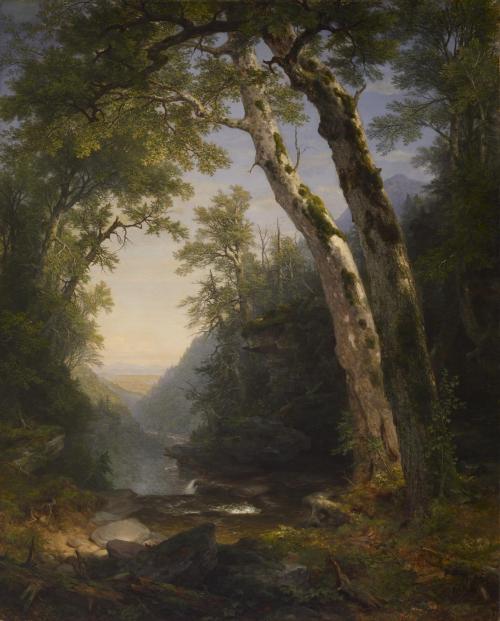
#FineArtFriday: a closer look at “The Catskills,” by Asher Brown Durand 1858

Artist: Asher Brown Durand (1796–1886)

Title: The Catskills

Date: 1859

Medium: oil on canvas

Dimensions: height: 158.8 cm (62.5 in); width: 128.3 cm (50.5 in)

What I love about this painting: 

I grew up in a forested place, not unlike that depicted here. That sentiment has endeared this style of art to me. I have become attached to the modern fantasy painters, those modern artists like Michael Whelan and the late Darrell K. Sweet, who paint images in this style for fantasy novels and RPG games. Their style is called Imaginative Realism.

What strikes me the most about this particular painting is not only the attention to detail, but the fairy-tale quality of Durand’s vision of realism. Viewed as a whole, this composition has an otherworldly quality to it, almost as if Elrond or Galadriel lurk just out of view, beyond the edges.

Quote from Wikimedia Commons on The Catskills: This painting was commissioned by William T. Walters in 1858, when the 62-year-old Durand was at the height of his fame and technical skill. The vertical format of the composition was a trademark of the artist, allowing him to exploit the grandeur of the sycamore trees as a means of framing the expansive landscape beyond. Durand’s approach to the “sublime landscape” was modeled on that of Thomas Cole (1801-48), founder of the Hudson River school of painting. The painters of this school explored the countryside of the eastern United States, particularly the Adirondack Mountains and the Catskills. Their paintings often reflect the Transcendental philosophy of Ralph Waldo Emerson (1803-82), who believed that all of nature bore testimony to a spiritual truth that could be understood through personal intuition.

>>><<<

Quote from Wikipedia (the fount of all knowledge): Asher Brown Durand is remembered particularly for his detailed portrayals of trees, rocks, and foliage. He was an advocate for drawing directly from nature with as much realism as possible. Durand wrote, “Let [the artist] scrupulously accept whatever [nature] presents him until he shall, in a degree, have become intimate with her infinity…never let him profane her sacredness by a willful departure from truth.”

Like other Hudson River School artists, Durand also believed that nature was an ineffable manifestation of God. He expressed this sentiment and his general opinions on art in his essay “Letters on Landscape Painting” in The Crayon, a mid-19th century New York art periodical. Wrote Durand, “[T]he true province of Landscape Art is the representation of the work of God in the visible creation…”


Credits and Attributions

[1] Wikimedia Commons contributors, “File:Asher Brown Durand – The Catskills – Walters 37122.jpg,” Wikimedia Commons, https://commons.wikimedia.org/w/index.php?title=File:Asher_Brown_Durand_-_The_Catskills_-_Walters_37122.jpg&oldid=354202161 (accessed August 21, 2025).

[2] Wikipedia contributors, “Asher Brown Durand,” Wikipedia, The Free Encyclopedia, https://en.wikipedia.org/w/index.php?title=Asher_Brown_Durand&oldid=1291945600 (accessed August 21, 2025)..
5 Comments

Filed under #FineArtFriday

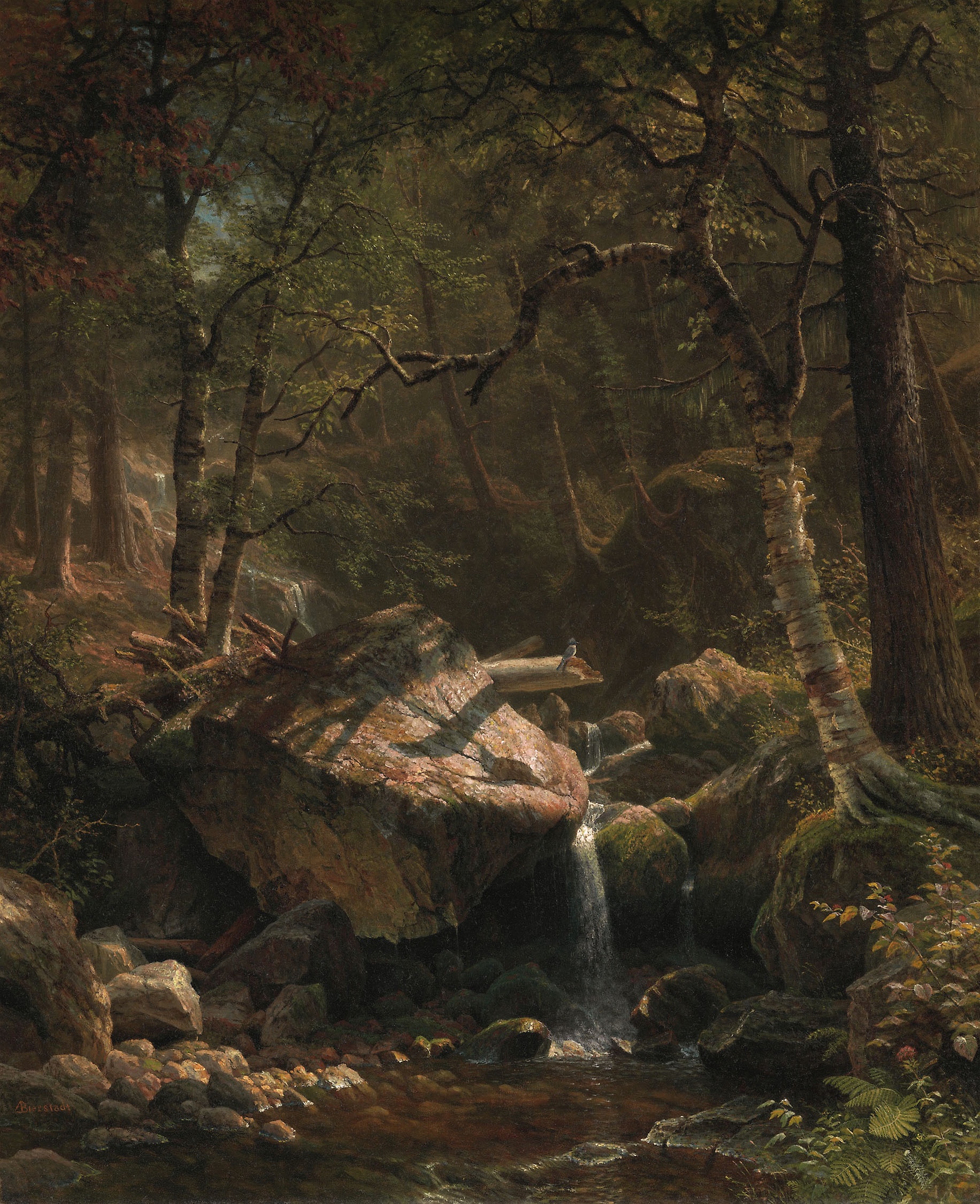
#FineArtFriday – the Mountain Brook by Albert Bierstadt 1863

Mountain_Brook_oil_1863_Albert_BierstadtArtist: Albert Bierstadt  (1830–1902)

Title: Mountain Brook

Genre: landscape painting

Date: 1863

Medium: oil on canvas

Dimensions: height: 111.8 cm (44 in); width: 91.4 cm (35.9 in)

Collection: Art Institute of Chicago

What I love about this painting:

This is an unusual subject for Albert Bierstadt. There is no immensity of sky watching over all who walk below. Instead, he gives us the immensity of a quiet wood and the solitude of a small mountain stream.

I love this peaceful glade, with the sun filtering through the forest canopy. I could sit there happily, writing the day away.

About the artist, via Wikipedia:

Albert Bierstadt (January 7, 1830 – February 18, 1902) was a German American painter best known for his lavish, sweeping landscapes of the American West. He joined several journeys of the Westward Expansion to paint the scenes. He was not the first artist to record the sites, but he was the foremost painter of them for the remainder of the 19th century.

Bierstadt was born in Prussia, but his family moved to the United States when he was one year old. He returned to study painting for several years in Düsseldorf. He became part of the second generation of the Hudson River School in New York, an informal group of like-minded painters who started painting along the Hudson River. Their style was based on carefully detailed paintings with romantic, almost glowing lighting, sometimes called luminism. Bierstadt was an important interpreter of the western landscape, and he is also grouped with the Rocky Mountain School.

In 1851, Bierstadt began to paint in oils. He returned to Germany in 1853 and studied painting for several years in Düsseldorf with members of its informal school of painting. After returning to New Bedford in 1857, he taught drawing and painting briefly before devoting himself full-time to painting.

Bierstadt’s popularity in the U.S. remained strong during his European tour. The publicity generated by his Yosemite Valley paintings in 1868 led a number of explorers to request his presence as part of their westward expeditions. The Atchison, Topeka, and Santa Fe Railroad also commissioned him to visit and paint the Grand Canyon and surrounding region.

Despite his popular success, Bierstadt was criticized by some contemporaries for the romanticism evident in his choice of subjects and for his use of light, which they found excessive.

Some critics objected to Bierstadt’s paintings of Native Americans based on their belief that including Indigenous Americans “marred” the “impression of solitary grandeur.” [1]


Credits and Attributions:

IMAGE: Wikimedia Commons contributors, Mountain Brook by Albert Bierstadt, Public domain, via Wikimedia Commons Commons, https://commons.wikimedia.org/w/index.php?title=File:Bierstadt_Albert_Bavarian_Landscape.jpg&oldid=823443562 (accessed July 25, 2024).

[1] Quote: Wikipedia contributors, “Albert Bierstadt,” Wikipedia, The Free Encyclopedia, https://en.wikipedia.org/w/index.php?title=Albert_Bierstadt&oldid=1210445403 (accessed July 25, 2024).

3 Comments

Filed under #FineArtFriday

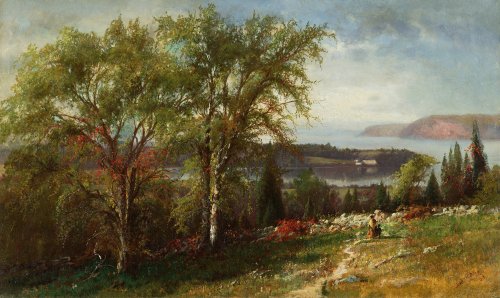
#FineArtFriday: Hudson River at Croton Point by Julie Hart Beers 1869

JulieBeers-Hudson_River_at_Croton_Point_1869Artist: Julie Hart Beers  (1834–1913)

Title: Hudson River at Croton Point

Genre: landscape art

Date: 1869

Medium: oil on canvas

Dimensions: height: 12.2 in (31.1 cm); width: 20.2 in (51.4 cm)

What I love about this image:

I love the way this scene is framed. We look downhill towards the Hudson River, seeing the rock outcroppings and stony land that is this part of New York State. Julie Hart Beers places a woman and child in this scene, rather than the usual men at work or draft and dairy animals that the male artists of the time usually placed in their work.

The trees at the edge of the meadow, birch and maples, are just beginning to turn red and gold—autumn is nearly here. I love the serenity of this scene, the peace of a day not too long after the end of the Civil War. It was a day of calm during a time when politics were still turbulent.

I love that Julie Hart Beers, a woman artist who was denied formal training solely because she was female, had brothers who gave her the education she needed. I love that they respected her as she made her way in an art world dominated by men jealous of their position, and achieved a grudging respect from the critics.

About the Artist, via Wikipedia:

Julie Hart Beers Kempson (1835 – August 13, 1913) was an American landscape painter associated with the Hudson River School who was one of the very few commercially successful professional women landscape painters of her day.

Born Julie Hart in Pittsfield, Massachusetts, she was the daughter of James Hart and Marion (Robertson) Hart, who had immigrated from Scotland in 1831. Her older brothers William Hart and James McDougal Hart were also important landscape painters of the Hudson River School, and her nieces Letitia Bonnet Hart and Mary Theresa Hart became well-known painters as well. Another niece, Annie L. Y. Orff, became an editor and publisher.

In 1853, she married journalist George Washington Beers. After his death in 1856 she and her two daughters moved to New York City, where her brothers had their studios. Like most women artists of the day, she had no formal art education, but it is thought that she was trained by her brothers.

Well into her forties, with her second husband, Peter Kempson, she moved to Metuchen, New Jersey, where she set up her own studio. She continued to use the surname Beers when signing her artwork.

At the time of her death she was living in Trenton.

By 1867, Beers was exhibiting her paintings. Although she had her own studio in New Jersey, she continued to use William’s studio on 10th Street in New York City as a showroom. She was one of very few women to become a professional landscape painter in the America of her day, in part because women were excluded from formal art education and exhibition opportunities.

Beers’s mature style balances sweeping, well-balanced compositions with telling details. In the 1870s and 1880s, she exhibited frequently at the National Academy of Design as well as at the Brooklyn Art Association, the Boston Athenæum, and the Pennsylvania Academy of Fine Arts. She was able to sell a good deal of work through the Brooklyn Art Association,  but she also took groups of women on sketching trips to the mountains of New York and New England to supplement her income.

She also painted some still lifes. [1]


Credits and Attributions

IMAGE: Hudson River at Croton Point by Julie Hart Beers. Wikimedia Commons contributors, “File:JulieBeers-Hudson River at Croton Point 1869.jpg,” Wikimedia Commons, https://commons.wikimedia.org/w/index.php?title=File:JulieBeers-Hudson_River_at_Croton_Point_1869.jpg&oldid=659236570 (accessed November 9, 2023).

[1] Wikipedia contributors, “Julie Hart Beers,” Wikipedia, The Free Encyclopedia, https://en.wikipedia.org/w/index.php?title=Julie_Hart_Beers&oldid=1163696436 (accessed November 9, 2023).

Comments Off on #FineArtFriday: Hudson River at Croton Point by Julie Hart Beers 1869

Filed under #FineArtFriday

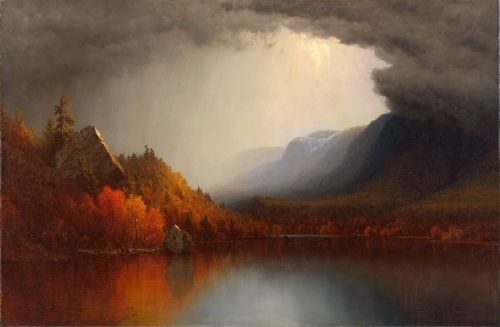
#FineArtFriday: A Coming Storm by Sanford Robinson Gifford

Gifford_A_Coming_Storm_1863-1880_PMA

Artist: Sanford Robinson Gifford,

Title: A Coming Storm (1863)

Date: 1863 (retouched 1880)

Location: Philadelphia Museum of Art.

What I love about this painting:

Gifford demonstrates his skill as a devotee of luminism and gives us the perfect view of a fine autumn day and the approaching storm. The way he contrasts the sun’s light against the ominous black clouds is true to nature, to how storms really look as they close in.

I like the way he shows the rock outcroppings, visible evidence of the hard stone of the mountains that lies beneath the lush finery of autumn foliage.

For the moment, the waters of the pond are quiet, reflecting the sky above. Rain cloaks the view of the distant valley, and soon we will feel the brunt of it. Enjoy the blaze of color while you can, as tomorrow those trees will be half-bare, and the ground will be covered in sodden tatters of red and gold.

While there appears to be some damage in the upper center, the integrity of the painting is still intact. It was retouched in 1880, but a modern retouching would likely bring it back to its original glory.

About the Artist, via Wikipedia:

Sanford Robinson Gifford (July 10, 1823 – August 29, 1880) was an American landscape painter and a leading member of the second generation of Hudson River School artists. A highly regarded practitioner of Luminism, his work was noted for its emphasis on light and soft atmospheric effects.

Although trained as a portrait painter, the first work Gifford exhibited at the National Academy was a landscape, in 1847. Thereafter, Gifford devoted himself primarily to landscape painting, becoming one of the finest artists of the Hudson River School. He was elected an Associate of the National Academy in 1851, and an Academician in 1854.

2008 National Academy of Design controversy:

In December 2008, one of Gifford’s paintings, Mount Mansfield, Vermont (1859), became part of a controversy over deaccessioning by the National Academy of Design. The Academy was a member of the Association of Art Museum Directors, whose policy stated that member museums could not sell works of art to cover operating expenses, only to purchase superior works or to weed out inferior or redundant ones. Prior to joining AAMD, the Academy had sold two Thomas Eakins works (including his “diploma painting,” Wrestlers) in the 1970s, and Richard Caton Woodville‘s War News from Mexico (1848) in 1994. According to its former curator, David Dearinger: “When the Academy later applied to the museum association for accreditation, Mr. Dearinger recalled, it was asked about the Woodville sale and promised not to repeat such a move.”

In a 2008 sale, the Academy quietly sold Frederic Edwin Church‘s Scene on the Magdalene (1854) and Sanford Gifford’s Mount Mansfield, Vermont (1859) to a private collector for US$13.5 million. The former was the Academy’s only painting by Church; the latter was its only painting by Gifford. Both had been “donated to the Academy in 1865 by another painter, James Augustus Suydam.” News of the sale was broken by arts blogger Lee Rosenbaum. As punishment for these actions, AAMD asked its other member museums to “cease lending artworks to the Academy and collaborating with it on exhibitions.” The Academy had contemplated selling additional paintings, but those plans were abandoned after being reported by Rosenbaum. [1]


Credits and Attributions:

IMAGE: A Coming Storm by Sanford Robinson Gifford. Wikimedia Commons contributors, “File:Gifford A Coming Storm 1863-1880 PMA.jpg,” Wikimedia Commons, https://commons.wikimedia.org/w/index.php?title=File:Gifford_A_Coming_Storm_1863-1880_PMA.jpg&oldid=803742381 (accessed October 5, 2023).

[1] Wikipedia contributors, “Sanford Robinson Gifford,” Wikipedia, The Free Encyclopedia, https://en.wikipedia.org/w/index.php?title=Sanford_Robinson_Gifford&oldid=1176083433 (accessed October 5, 2023).

Comments Off on #FineArtFriday: A Coming Storm by Sanford Robinson Gifford

Filed under #FineArtFriday

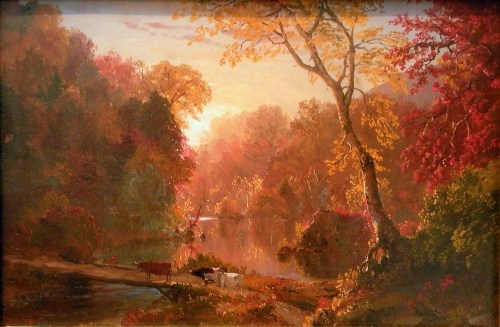
#FineArtFriday: Autumn in North America by Frederic Edwin Church 1896

Autumn_in_North_America-Frederic_ChurchArtist: Frederic Edwin Church  (1826–1900)
Title: Autumn in North America

Genre: landscape art

Date: 1856

Medium: oil on board

Dimensions: height: 28.5 cm (11.2 in); width: 43.1 cm (17 in)

Collection: Thyssen-Bornemisza Museum

What I love about this picture:

This is a New England autumn in full color, the way autumns never are here in my part of the world. Yes, non-native trees will turn these bright shades, but the only bright red fall color in native species will be vine maples. Staghorn Sumac is a non-native plant that has become a part of our local flora, and it turns bright red also. But we do have gorgeous golds and oranges beginning to show in our native deciduous forests.

Many years it is too wet for a colorful fall, and the leaves turn a soggy brown and drop off their trees, sodden masses nearly impossible to rake.

About the Artist, via Wikipedia:

Frederic Edwin Church (May 4, 1826 – April 7, 1900) was an American landscape painter born in Hartford, Connecticut. He was a central figure in the Hudson River School of American landscape painters, best known for painting large landscapes, often depicting mountains, waterfalls, and sunsets. Church’s paintings put an emphasis on realistic detail, dramatic light, and panoramic views. He debuted some of his major works in single-painting exhibitions to a paying and often enthralled audience in New York City. In his prime, he was one of the most famous painters in the United States. [1]


Credits and Attributions:

IMAGE: Wikimedia Commons contributors, “File:Autumn in North America-Frederic Church.jpg,” Wikimedia Commons, https://commons.wikimedia.org/w/index.php?title=File:Autumn_in_North_America-Frederic_Church.jpg&oldid=718218353 (accessed September 19, 2023).

[1] Wikipedia contributors, “Frederic Edwin Church,” Wikipedia, The Free Encyclopedia, https://en.wikipedia.org/w/index.php?title=Frederic_Edwin_Church&oldid=1162133197 (accessed September 19, 2023).

6 Comments

Filed under #FineArtFriday

#FineArtFriday: The Emerald Pool, Worthington Whittredge, 1868 reprise

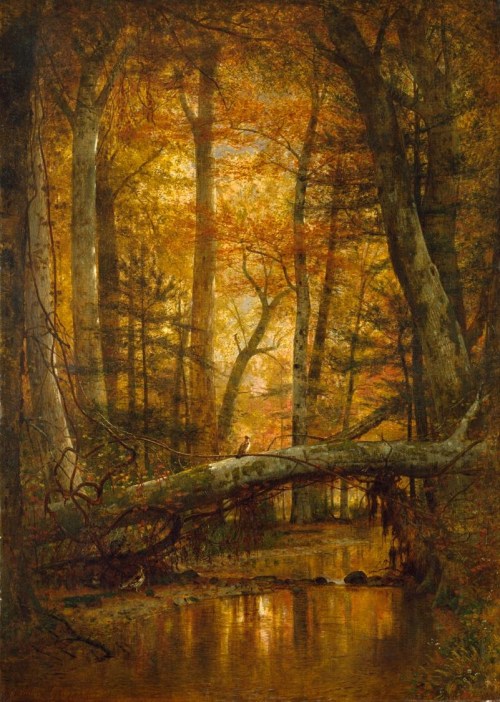
About this image:

“The Emerald Pool” is also titled “Woods of Ashokan” and is a gloriously composed representation of an Autumn afternoon in the quiet woods. Sunlight is the core element here, in the way it filters through the leaves and touches branch and trunk, and then reflects from the pool.

The trees look very much like those that would have existed in parts of the woods near the house I grew up in, places where the evergreens had been cut and maples, alder, and ash could grow. Sun filters through the leaves which have turned colors but still remain on the trees. A few small firs struggle to grow in the deciduous forest, but one day those firs will cast a wide, dark shadow and the sunlit glade will be no more.

A pheasant (I think?) poses for his portrait, bringing the center focus of the painting to the calm pool beneath the log he stands on. The pool is masterfully shown, its waters rippling as if touched by a slight breeze, reflecting the scene above.

>>><<<

ABOUT THE ARTIST (From Wikipedia): Thomas Worthington Whittredge (May 22, 1820 – February 25, 1910) was an American artist of the Hudson River School. Whittredge was a highly regarded artist of his time, and was friends with several leading Hudson River School artists including Albert Bierstadt and Sanford Robinson Gifford. He traveled widely and excelled at landscape painting, many examples of which are now in major museums. He served as president of the National Academy of Design from 1874 to 1875 and was a member of the selection committees for the 1876 PhiladelphiaCentennial Exposition and the 1878 Paris Exposition, both important venues for artists of the day.

Artist:  Worthington Whittredge  (1820–1910)

Title:   The Emerald Pool

Date    1868

Medium          oil on canvas

Dimensions     Height: 144.8 cm (57 in); Width: 102.9 cm (40.5 in)

Current location: Chrysler Museum of Art


Credits and Attributions

This is the reprint of a post that first appeared here on Life in the Realm of Fantasy September 14, 2018.

Wikipedia contributors, “Worthington Whittredge,” Wikipedia, The Free Encyclopedia, https://en.wikipedia.org/w/index.php?title=Worthington_Whittredge&oldid=857357141 (accessed September 13, 2018).

Wikimedia Commons contributors, “File:Thomas Worthington Whittredge – Woods of Ashokan.jpg,” Wikimedia Commons, the free media repository, https://commons.wikimedia.org/w/index.php?title=File:Thomas_Worthington_Whittredge_-_Woods_of_Ashokan.jpg&oldid=296638658 (accessed September 13, 2018).

4 Comments

Filed under writing

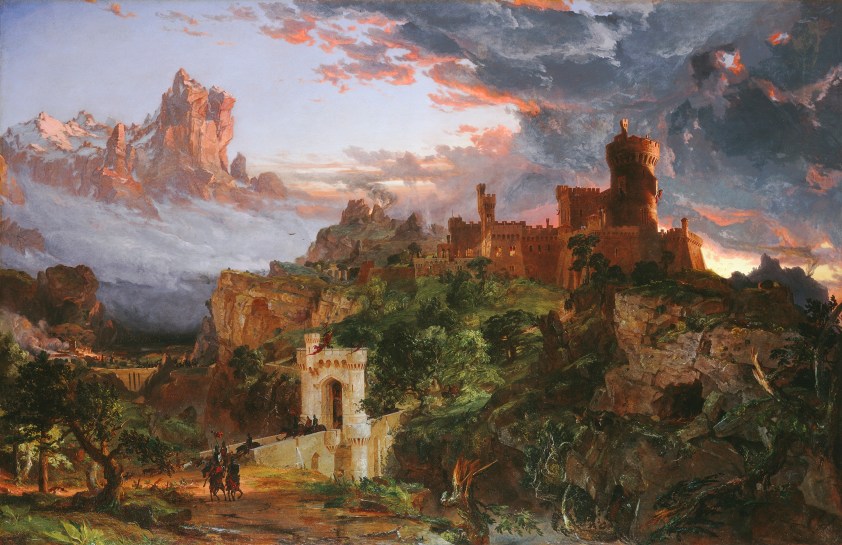
#FineArtFriday: The Spirit of War by Jasper Francis Cropsey 1851

The spirit of war

Title: The Spirit of War by Jasper Francis Cropsey  (1823–1900)

Genre: landscape

Date: 1851

Medium: painting

Dimensions: Height: 110.8 cm (43.6 in); Width: 171.6 cm (67.5 in)

Collection: National Gallery of Art

Place of creation: United States of America [1]

What I love about this painting:

The Spirit of War by Jasper Francis Cropsey is one of a two-part fantasy that Cropsey painted in 1851; the other is the Spirit of Peace. During Cropsey’s lifetime, these two paintings were his most celebrated, but now he is known more for his ethereal paintings depicting autumn scenes, several of which I have featured here.

This painting was inspired both by the aftermath of the Mexican-American War and the looming threat of the American Civil War. It shows the young artist’s love of Arthurian tales and demonstrates his ability to deliver a story. His signature luminism is still in its infancy here, yet one can see the seeds of what would become a mastery of light and illumination.

Cropsey contrasts light and shadow as if they were good and evil. He paints godlike mountains that reign over deep valleys and strongholds. In the foreground, a strong fortress represents prosperity, her richly attired knights riding out to do battle. In the distance, a citadel burns, the smoke of raging fires billowing toward the darkening sky.

This is a powerful painting, one that tells a story and shows an entire novel.

About the Artist, via Wikipedia:

Jasper Francis Cropsey (February 18, 1823 – June 22, 1900) was an important American landscape artist of the Hudson River School.

Trained as an architect, he set up his own office in 1843. Cropsey studied watercolor and life drawing at the National Academy of Design under the instruction of Edward Maury and first exhibited there in 1844. A year later he was elected an associate member and turned exclusively to landscape painting; shortly after he was featured in an exhibition entitled “Italian Compositions”.

Cropsy traveled in Europe from 1847–1849, visiting England, France, Switzerland, and Italy. He was elected a full member of the Academy in 1851. Cropsey was a personal friend of Henry Tappan, the president of the University of Michigan from 1852 to 1863. At Tappan’s invitation, he traveled to Ann Arbor in 1855 and produced two paintings, one of the Detroit Observatory, and a landscape of the campus. He went abroad again in 1856, and resided seven years in London, sending his pictures to the Royal Academy and to the International exhibition of 1862.

Returning home, he opened a studio in New York and specialized in autumnal landscape paintings of the northeastern United States, often idealized and with vivid colors. Cropsey co-founded, with ten fellow artists, the American Society of Painters in Water Colors in 1866.

Cropsey’s interest in architecture continued throughout his life and was a strong influence in his painting, most evident in his precise arrangement and outline of forms. But Cropsey was best known for his lavish use of color and, as a first-generation member from the Hudson River School, painted autumn landscapes that startled viewers with their boldness and brilliance. As an artist, he believed landscapes were the highest art form and that nature was a direct manifestation of God. He also felt a patriotic affiliation with nature and saw his paintings as depicting the rugged and unspoiled qualities of America. [2]


Credits and Attributions:

[1] Wikimedia Commons contributors, “File:The-spirit-of-war.jpg,” Wikimedia Commons, the free media repository, https://commons.wikimedia.org/w/index.php?title=File:The-spirit-of-war.jpg&oldid=565046310 (accessed June 17, 2021).

[2] Wikipedia contributors, “Jasper Francis Cropsey,” Wikipedia, The Free Encyclopedia, https://en.wikipedia.org/w/index.php?title=Jasper_Francis_Cropsey&oldid=1018920537 (accessed June 17, 2021).

3 Comments

Filed under #FineArtFriday, writing

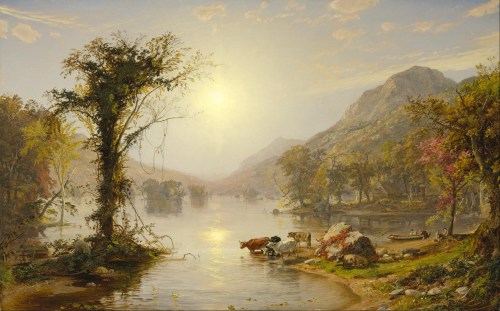
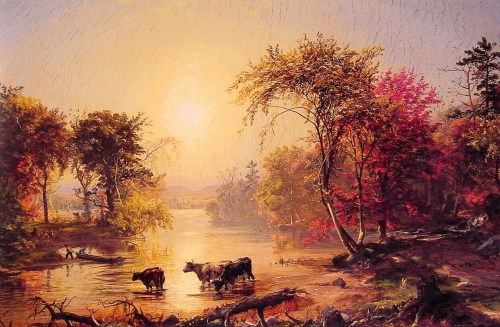
#FineArtFriday: Autumn On Greenwood Lake – two landscapes by Jasper Francis Cropsey (revisited)

This post first appeared here in October of 2018. It features two beautiful images of Autumn in New England in the mid-nineteenth century. I like both these paintings for the way the water is depicted, and the hazy hills.

Jasper Francis Cropsey created many paintings of Greenwood Lake, a freshwater lake on the border between New York State and New Jersey, beginning in 1843. Over the next few decades, Cropsey painted numerous scenes of the area, many from the same viewpoint on the lake as today’s featured paintings, each with varying intensities of color.

What I love about these two paintings, done years apart, is  difference in the quality of  the light. One is done in an early autumn, the other later in the season. The subject matter is similar, cows drinking at waters edge, fishers and their rowboat, but the trees are different, more mature in the second, and it is later in the evening. The autumn haze completely hides the hills.

Clearly, this was a place that was beloved by the artist, as he returned year after year, and made many landscapes of this beach and the surrounding area.

About the artist (Via Wikipedia):

Jasper Francis Cropsey (February 18, 1823 – June 22, 1900) was an important American landscape artist of the Hudson River School. He was best known for his lavish use of color and, as a first-generation member from the Hudson River School, painted autumn landscapes that startled viewers with their boldness and brilliance. As an artist, he believed landscapes were the highest art form and that nature was a direct manifestation of God. He also felt a patriotic affiliation with nature and saw his paintings as depicting the rugged and unspoiled qualities of America.

Jasper Cropsey died in anonymity but was rediscovered by galleries and collectors in the 1960s.


Credits and Attributions:

Autumn on Greenwood Lake, ca. 1861, by Jasper Francis Cropsey [Public domain], via Wikimedia Commons

Autumn in America, by Jasper Francis Cropsey [Public domain], via Wikimedia Commons

Wikipedia contributors, “Jasper Francis Cropsey,” Wikipedia, The Free Encyclopedia, https://en.wikipedia.org/w/index.php?title=Jasper_Francis_Cropsey&oldid=842742891 (accessed October 19, 2018).

Comments Off on #FineArtFriday: Autumn On Greenwood Lake – two landscapes by Jasper Francis Cropsey (revisited)

Filed under #FineArtFriday

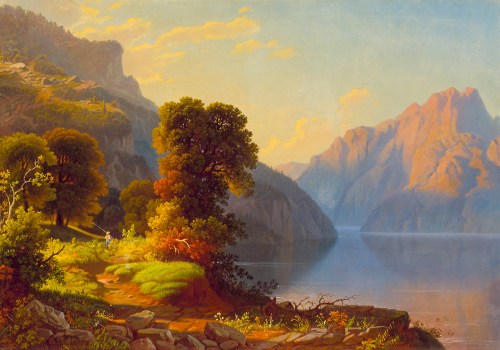
#FineArtFriday: A View of a Lake in the Mountains by George Caleb Bingham


  • Title: A View of a Lake in the Mountains
  • Artist: George Caleb Bingham
  • Medium: Oil on canvas
  • Date: between circa 1856 and circa 1859
  • Dimensions: Height: 53.9 cm (21.2 ″); Width: 76.5 cm (30.1 ″)
  • Current Location: Los Angeles County Museum of Art

What I love about this picture:

This scene depicts an hour of utter serenity in the turbulent life of the artist. The late afternoon sunlight falls gently on the rocky path above the calm waters. Shadows fall in all the right places but don’t darken the moment.  There is a dreamlike quality to the day, as if the artist painted his deepest wish. This is a pleasant, restful painting.

About the Artist, via Wikipedia:

George Caleb Bingham (March 20, 1811 – July 7, 1879) was an American artist, soldier and politician known in his lifetime as “the Missouri Artist”. Initially a Whig, he was elected as a delegate to the Missouri legislature before the American Civil War where he fought the extension of slavery westward. During that war, although born in Virginia, Bingham was dedicated to the Union cause and became captain of a volunteer company which helped keep the state from joining the Confederacy, and then served four years as Missouri’s Treasurer. During his final years, Bingham held several offices in Kansas City, as well as became Missouri’s as Adjutant General. His paintings of American frontier life along the Missouri River exemplify the Luminist style.

Bingham ran for election as a Whig to the Missouri House of Representatives the following year. He appeared to have won in 1846 by 3 votes but lost in a recount. In a reprise of the election in 1848, Bingham won the seat by a decisive margin, becoming one of the few artists to serve in elected political office. He actively opposed the pro-slavery “Jackson resolutions” in 1849, although their proponent was also a resident of Saline County. He would also represent Missouri’s eighth district at the Whig National Convention in June 1852. Bingham’s political interests would be reflected in his vivid paintings of frontier political life.

About the Luminist style, via Wikipedia:

Luminism is an American landscape painting style of the 1850s to 1870s, characterized by effects of light in landscape, through the use of aerial perspective and the concealment of visible brushstrokes. Luminist landscapes emphasize tranquility, and often depict calm, reflective water and a soft, hazy sky.

As defined by art historian Barbara Novak, luminist artworks tend to stress the horizontal, and demonstrate the artist’s close control of structure, tone, and light. The light is generally cool, hard, and non-diffuse; “soft, atmospheric, painterly light is not luminist light”. Brushstrokes are concealed in such a way that the painter’s personality is minimized. Luminist paintings tend not to be large so as to maintain a sense of timeless intimacy. The picture surface or plane is emphasized in a manner sometimes seen in primitivism. These qualities are present in different amounts depending on the artist, and within a work.

Luminism has also been considered to represent a contemplative perception of nature.

Novak states that luminism, of all American art, is most closely associated with transcendentalism. The definitional difficulties have contributed to over-use of the term.[5]

The artists who painted in this style did not refer to their own work as “luminism”, nor did they articulate any common aesthetic philosophy outside of the guiding principles of the Hudson River School.


Credits and Attributions:

A View of a Lake in the Mountains by George Caleb Bingham, via Wikimedia Commons.  Los Angeles County Museum of Art [Public domain].

Wikipedia contributors, “George Caleb Bingham,” Wikipedia, The Free Encyclopedia, https://en.wikipedia.org/w/index.php?title=George_Caleb_Bingham&oldid=900386053 (accessed June 6, 2019).

Wikipedia contributors, “Luminism (American art style),” Wikipedia, The Free Encyclopedia, https://en.wikipedia.org/w/index.php?title=Luminism_(American_art_style)&oldid=886912140 (accessed June 6, 2019).


2 Comments

Filed under #FineArtFriday

#FineArtFriday: Autumn On Greenwood Lake – two landscapes by Jasper Francis Cropsey

Jasper Francis Cropsey created many paintings of Greenwood Lake, a freshwater lake on the border between New York State and New Jersey, beginning in 1843. Over the next few decades, Cropsey painted numerous scenes of the area, many from the same viewpoint on the lake as today’s featured paintings, each with varying intensities of color.

What I love about these two paintings, done years apart, is  difference in the quality of  the light. One is done in an early autumn, the other later in the season. The subject matter is similar, cows drinking at waters edge, fishers and their rowboat, but the trees are different, more mature in the second, and it is later in the evening.

Clearly, this was a place that was beloved by the artist, as he returned year after year, and made many landscapes of this beach and the surrounding area.

About the artist (Via Wikipedia):

Jasper Francis Cropsey (February 18, 1823 – June 22, 1900) was an important American landscape artist of the Hudson River School. He was best known for his lavish use of color and, as a first-generation member from the Hudson River School, painted autumn landscapes that startled viewers with their boldness and brilliance. As an artist, he believed landscapes were the highest art form and that nature was a direct manifestation of God. He also felt a patriotic affiliation with nature and saw his paintings as depicting the rugged and unspoiled qualities of America.

Jasper Cropsey died in anonymity but was rediscovered by galleries and collectors in the 1960s.


Credits and Attributions:

Autumn on Greenwood Lake, ca. 1861, by Jasper Francis Cropsey [Public domain], via Wikimedia Commons

Autumn in America, by Jasper Francis Cropsey [Public domain], via Wikimedia Commons

Wikipedia contributors, “Jasper Francis Cropsey,” Wikipedia, The Free Encyclopedia, https://en.wikipedia.org/w/index.php?title=Jasper_Francis_Cropsey&oldid=842742891 (accessed October 19, 2018).

Comments Off on #FineArtFriday: Autumn On Greenwood Lake – two landscapes by Jasper Francis Cropsey

Filed under #FineArtFriday