
 Artist: Winslow Homer (1836–1910)
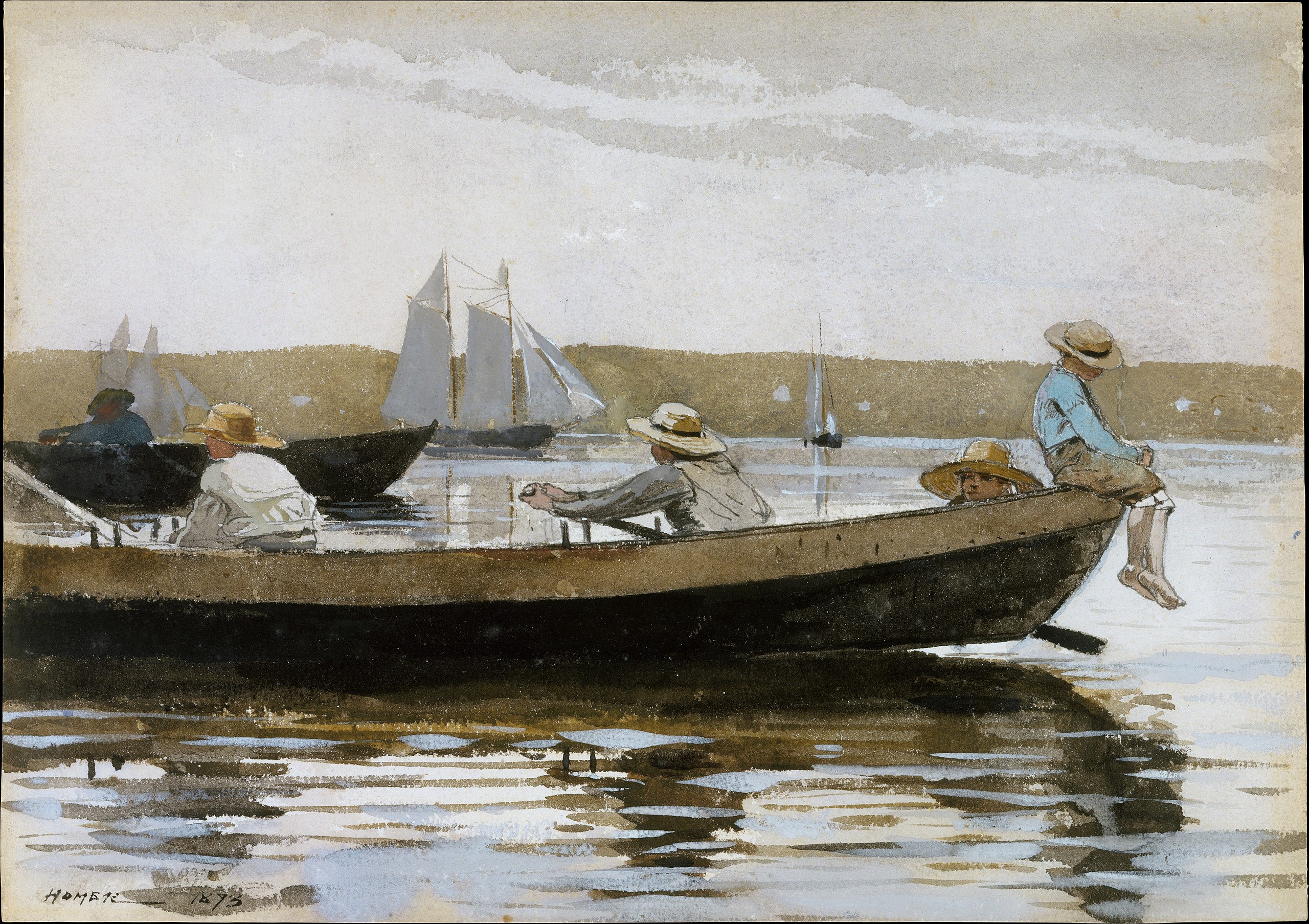
Title: Boys in a Dory
Date: 1873
Medium: Watercolor washes and gouache over graphite underdrawing on medium rough textured white wove paper
Dimensions: 9 3/4 x 13 7/8 in. (24.8 x 35.2 cm)
Collection: Metropolitan Museum of Art
Inscription: signed Homer 1873
What I love about this image:
Here we have four boys out for a summer’s day on the water. Are they brothers? They all wear similar long-sleeved lightweight cotton shirts and straw hats as protection against the sun.
The two youngest ride, while the older boys row. The water is calm, perfect for a sunny afternoon of freedom. Do they plan to fish or are they just out for the fun of it?
I especially like how Homer paints the water. He depicts the reflections perfectly, showing us how they mirror on the soft movement of the water’s surface. He shows us the sailing craft in the distance with minimal strokes, clearly showing the other boats heading out for a day’s fishing or pleasure boating.
About this painting via Wikipedia:
Boys in a Dory is one of Homer’s first watercolors. According to the Met’s description of the painting, the artist’s initial style of watercolors resulted in Boys being simple and direct.
The painting was rendered by Homer while he was in Gloucester, Massachusetts. [1]
About the dory, via Wikipedia:
The dory can be defined as a small boat which has:
- a flat bottom, with the bottom planks fastened lengthwise (bow to stern).
- a hull shape defined by the natural curve of a sawn plank (never steam-bent).
- planks overlapping the stem at the front of the boat and an outer “false” stem covering the hood ends of the planks.
- (with some exceptions) a fairly narrow transom often referred to as the “tombstone” due to its unique shape.
The hull’s bottom is transversely flat and usually bowed fore-and-aft. (This curvature is known as “rocker”.) The stern is frequently a raked narrow transom that tapers sharply toward the bottom forming a nearly double-ended boat. The traditional bottom is made from planks laid fore and aft and not transverse, although some hulls have a second set of planks laid over the first in a pattern that is crosswise to the main hull for additional wear and strength.
As the need for working dories diminished, the Swampscott or beach dory types were modified for pleasure sailing. These sailing dories became quite popular at the beginning of the 20th century around the town of Marblehead, Massachusetts. They were generally longer yet remained narrow with low freeboard and later were often decked over. Another common distinctive feature of the sailing dory was a long boom on the rig that angled up with a mainsail that was larger along the foot than the luff. [2]
About the Artist via Wikipedia:
Winslow Homer (February 24, 1836 – September 29, 1910) was an American landscape painter and illustrator, best known for his marine subjects. He is considered one of the foremost painters of 19th-century America and a preeminent figure in American art in general.
Largely self-taught, Homer began his career working as a commercial illustrator. He subsequently took up oil painting and produced major studio works characterized by the weight and density he exploited from the medium. He also worked extensively in watercolor, creating a fluid and prolific oeuvre, primarily chronicling his working vacations. [3]
Credits and Attributions:
IMAGE: Boys in a Dory by Winslow Homer. Wikimedia Commons contributors, “File:Boys in a Dory MET DT5026.jpg,” Wikimedia Commons, https://commons.wikimedia.org/w/index.php?title=File:Boys_in_a_Dory_MET_DT5026.jpg&oldid=928781177 (accessed April 3, 2025).
[1] Wikipedia contributors, “Boys in a Dory,” Wikipedia, The Free Encyclopedia, https://en.wikipedia.org/w/index.php?title=Boys_in_a_Dory&oldid=1249874568 (accessed April 3, 2025).
[2] Wikipedia contributors, “Dory (boat),” Wikipedia, The Free Encyclopedia, https://en.wikipedia.org/w/index.php?title=Dory_(boat)&oldid=1281846716 (accessed April 3, 2025).
[3] Wikipedia contributors, “Winslow Homer,” Wikipedia, The Free Encyclopedia, https://en.wikipedia.org/w/index.php?title=Winslow_Homer&oldid=1277975900 (accessed April 3, 2025).
 Artist:


 Life in the Realm of Fantasy