
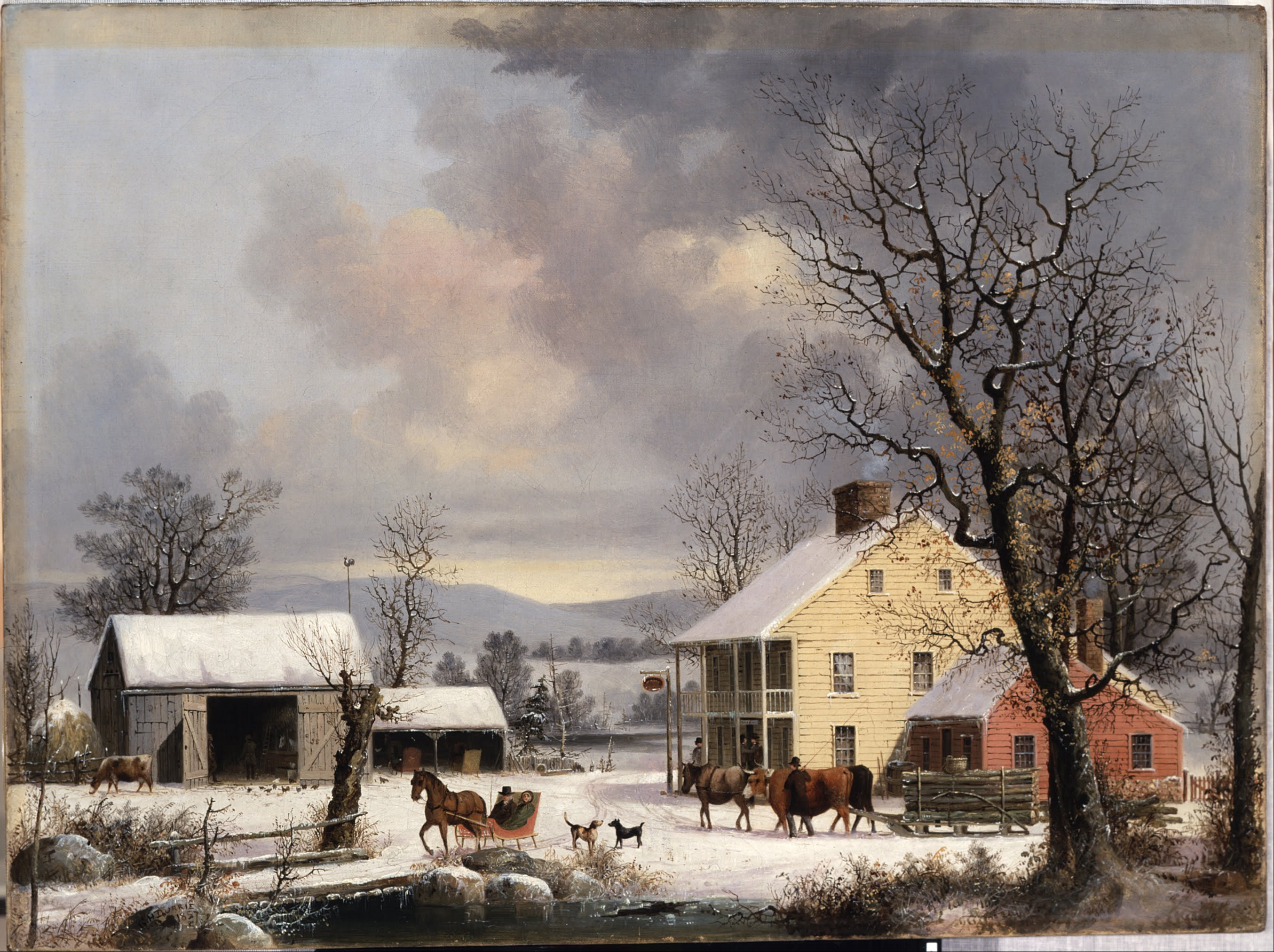
 Artist: George Henry Durrie (1820–1863)
Title: Winter in the Country (Winter Time at Jones Inn)
Date: 1857
Dimensions: height: 457.20 mm (18 in); width: 609.60 mm (24 in)
Collection: Fine Arts Museums of San Francisco
What I love about this painting:
As you have probably guessed, George Henry Durrie’s winter scenes are some of my favorite paintings. They make me feel cozy and warm, especially now, when the cold and damp of winter has come to the Pacific Northwest.
Durrie had a style all his own, one that resonates when events, both good and bad, move so fast on a national level that a little calm is needed. His work offers us a small fantasy of comfort and prosperity.
This scene depicts the Jones Inn, a country inn in his home town of New Haven Connecticut, and which he painted many times from various different angles. The inn and the people who worked and stayed there were some of his favorite subjects.
Durrie was especially fond of including horses and cattle in his scenes, and also wood-gathering and haymaking.
But snow and winter skies were his forte. The popularity of his works among the middle and working classes meant the critics dismissed his work as “too common.”
In my (admittedly uneducated) opinion, that was their loss!
About the Artist, via Wikipedia:
Durrie was born in New Haven, Connecticut, one of six children born to John and Clarissa Clark Durrie, who were Hartford natives. The Durries moved to New Haven in 1818, where John Durrie became a partner in the printing firm of Durrie and Peck, stationers and book publishers. He attended Hopkins School in New Haven. In 1837 John Durrie contracted with Nathaniel Jocelyn, a noted New Haven engraver and portrait painter, for painting instruction for George Durrie and his brother John. By 1839, George Durrie was painting portraits professionally in Hartford and Bethany, Connecticut, and in 1840, he was working in Meriden and Naugatuck, Connecticut.
For many years, Durrie made a living primarily as a portrait painter, executing hundreds of commissions. After marriage, he made frequent trips, traveling to New York, Massachusetts, New Jersey, and Virginia, fulfilling commissions and looking for new ones. His diary reveals that he was an enthusiastic railroad traveler, in the early days of the railroads. Durrie also painted what he called “fancy pieces”, whimsical studies of still lives or stage actors, as well as painting scenes on window-shades and fireplace covers. But portrait painting commissions became scarcer when photography came on the scene, offering a cheaper alternative to painted portraits, and, as his account-book shows, Durrie rarely painted a portrait after 1851.
In Durrie’s time, winter landscapes were not popular with most curators and critics, but nevertheless, by the time of his death, Durrie had acquired a national reputation as a snowscape painter. Durrie died in 1863, at age 43, probably from typhoid fever, not long after Currier and Ives began reproducing his paintings as prints. [1]
Credits and Attributions:
IMAGE: Wikimedia Commons contributors, “File:George Henry Durrie – Winter in the Country – Google Art Project.jpg,” Wikimedia Commons, https://commons.wikimedia.org/w/index.php?title=File:George_Henry_Durrie_-_Winter_in_the_Country_-_Google_Art_Project.jpg&oldid=995260522 (accessed November 19, 2026).
[1] Wikipedia contributors, “George Henry Durrie,” Wikipedia, The Free Encyclopedia, https://en.wikipedia.org/w/index.php?title=George_Henry_Durrie&oldid=1375908429 (accessed November 19, 2026).


