Tag Archives: #writerlife

Thoughts on Poetry and the Evolution of Language #writing

This last week has been extremely busy. I was able to bring my husband home from the rehab facility, and that was a wonderful thing. However, the transition has not been painless. He is mostly wheelchair-bound and can’t reliably communicate his needs. Fortunately, I have caregivers coming in every morning and evening to help with the rougher parts of his day.

Prose, and finding the right words to convey more than merely a recounting of fictional events is on my mind. Unfortunately, I was so busy that time got away from me, and I didn’t have time to write a proper post on that subject.

So, I am revisiting a post from 2020. The evolution of language is, I believe, a natural thing. And now, without further discussion, here is my post:

Words-And-How-We-Use-ThemI think of poetry and language as coming into existence as conjoined twins. I can remember anything I can set to a rhyme or make into a song.

Yet, much of the time, modern songs and poetry don’t rhyme. Even so, they have tempo and rhythm.

If it doesn’t rhyme, what makes poetry “poetic?” And where does it fit into modern narrative prose?

Poetry is a primal form of communication in the human species, the literary invention that emerged as soon as we had words. It presents thoughts and feelings as abstractions and allusions rather than the concrete.

Poets select words for the impact they deliver. An entire story must be conveyed using the least number of words possible. For that reason, choices are made for symbolism, power, and syllabic cadence, even if there is no rhyme involved.

Narrative prose is broader, looser, more all-encompassing, with no limit on how long it takes for the story to unfold.

Modern humans deliver highly detailed concepts and ideas with packets of noise formed into individual words. We learn the meanings of these sound-packets as infants. By stringing these meaningful sound-packets together, we can share information with others of our species.

I suspect using rhyme as a mnemonic is fundamental to human nature. Research with modern primates in the wild proves that, while we were still in Africa before the great diaspora, humans developed complex languages within our tribal communities.

By observing primates in the wild, we see that our earliest ancestors had the ability to describe the wider world to their children. With that, we could teach them skills and the best ways to acquire food.

We understood and were able to see the motives of another person.

We developed compassion and burial rites.

Early humans relied on the cadence of repetition and rhyme. They could explain the how and why of a great flood or any other natural disaster, passing it forward across many generations.

The availability of food is central to the prosperity of all life, not just humans. Our ancestors saw the divine in every aspect of life, especially around the abundance or scarcity of food. They developed mythologies combining all of these concepts to explain the world around us and our place in it.

With the ability to pass on knowledge of toolmaking, we had leisure to contemplate the world. We discussed these things while eating and sharing food with each other.
We now know that other primates also deliver information by using sound-packets. Gorillas have been observed singing during their meals. Humans have always sung.

Chimpanzees and Bonobos have been observed chatting during leisurely meals.

We humans love to sit around the table and chat.

The larynx and vocal cords of each primate species are formed differently, which affects how they communicate. They understand each other perfectly, but because they are so different from us, our human ears can’t differentiate the meanings of the individual sound-packets that make up their calls.

To us, their communications are just mindless screeching, and so we have always assumed they must not be self-aware.

I suspect that in years to come we will find that we have been wrong. We may be the only species we reliably converse with, but we are not the only self-aware species who communicate through vocalizations.

For many humans, dogs and cats are their beloved family members, self-aware people who love and accept them like no one else does.

This brings me to another point – if we can’t figure out and understand the languages of the other intelligent creatures in this world, i.e., Elephants, Cetaceans, and other Primates, then how can we ever expect to communicate with an alien extraterrestrial being?

And if we can’t recognize, value, and protect the individual self-awareness and personhood of beings like Elephants, Cetaceans, and other Primates, how will we recognize an extraterrestrial life-form? How will we behave toward them? After all, to us, these fellow creatures of earth have been nothing but resources for us to exploit.

Like modern Great Apes, proto humans used rhyme and cadence to memorize and pass on ideas as abstract as legends or sagas to their children and to others they might meet in friendly circumstances. By handing down those stories through the generations, we learned lessons from the mistakes and heroism of our ancestors.

Rhyme and cadence were fundamental to our ability to make tools out of stone and bone. The capacity to learn, remember, and reliably pass on knowledge was why the three human genomes we call Homo Sapiens, Neanderthal, and Denisovan could master fire. This is why they could develop the tools that made them the apex predators we became. We could reliably feed our young, rear them to adulthood, and still have time to create art on the walls of caves.

Every tribe, every culture that ever arose in our world, had a tradition of passing down stories and legends using rhyme and meter. Rhyme, combined with repetition and rhythmic simplicity, enabled us to remember and pass on our histories and knowledge to our children.

In times gone by, writers used words for their beauty, employing them the way they decorated their homes. Authors labored over their sentences, ensuring each word was placed in such a way as to be artistic as well as impactful.

In writing poetry, we are forced to think on an abstract level. We must choose words based on their power. The emotions these words evoke, and the way they show the environment around us is why I gravitate to narratives written by authors who are also poets—the creative use of words elevates what could be mundane to a higher level of expression. When it’s done subtly, the reader doesn’t consciously notice poetic derivations in prose, but they are moved by them.

We have no need to memorize our cultural knowledge anymore, just as we no longer need the ability to accurately tally long strings of numbers in our heads. Readers seek out books with straightforward prose and few descriptors. Words for the sake of words is no longer desirable to the modern reader.

Modern poetry has evolved too. The love of poetry continues, and new generations seek out the poems of the past while creating powerful poetry of their own.

Modern authors, such as Patrick Rothfuss in his novel, The Name of the Wind craft narratives packed with powerful, evocative prose. We eagerly read their work because it is both straightforward and poetic. Most readers are unaware that they are drawn to the subtle poetry of his work as much as to the story that unfolds within the narrative.

I write poetry, some that follow traditional rhyming, and much that does not. Regardless of the structure, the cadence of syllables and the words I choose are recognizably mine. The emotions they evoke and the way they portray the environment I imagine is what lends my voice to my work.

Authors like me who read and sometimes write speculative fiction can enjoy our modern stripped-down narratives, guilt free.

That said, we who love the rhythm and cadence of words can still appreciate beauty combined with impact when it comes to our prose. And, if you love dark, heroic speculative fiction and haven’t yet read The Name of the Wind, by Patrick Rothfuss, I highly recommend it.


Credits and Attributions:

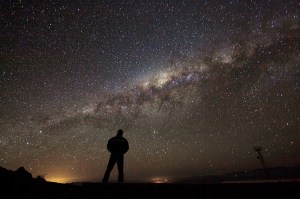
Admiring the Galaxy |CCA 4.0 ESO/A. Fitzsimmons
5 Comments

Filed under writing

Weddings, equipment failures, industry news, and awesome sunrises #amwriting

This last week has been a productive week for writing despite the irritations. Yet, those bumps were quickly ironed out, and no one died.

R2D2ServingTeaSomething we don’t think about when we’re young and healthy is that the equipment disabled people rely on can fail. The first thing that failed this week was his little walker for getting around in indoor spaces—I’ve named it R2D2 since it’s perfect for serving drinks on the space-yacht that is our home.

R2 is ideal for getting around inside restaurants and theaters. Unfortunately, one of the screws holding the bar that keeps it from collapsing while my husband is using it lost the washer and nut, so I spent the weekend making sure the screw stayed where it was supposed to, which was distracting. Fortunately, Amazon carries bolts, nuts, and washers and ships them overnight and it is now repaired.

Then, there was assembling the paperwork for getting our will redone, this time including a durable power of attorney and an advance healthcare directive. When we had our will made twenty years ago, it was a simple thing, merely a list of our assets, rights of survivorship, and on the survivor’s death, dividing what is left equally among our blended family of five children.

This time, we had to fill out a pre-appointment questionnaire that asked questions I felt were intrusive and had no bearing on the disposition of our not-so-vast fortune.

I became a bit testy.

My husband, ever a man of common sense, talked me into a more rational frame of mind. He explained we need to ensure no random claims arise that could hold up the disposition of any $$ and intellectual properties we might leave our children.

FileDocumentSo, we had to supply dates and names of previous marriages and divorces—which, in my case, involved getting copies of three divorce decrees from the county. (I’ve had a life, and while I could have done some things differently, I don’t regret it for a moment.)
My Gramma Ethel (born in 1909) stayed with me when I was going through some hard times, watching my kids while I worked two jobs. My grandmother, bless her, was a cleaning tornado. She threw things like Christmas cards and old legal documents out when she cleaned—without asking first. These things were over and done in her mind, so why keep junk you don’t need? She hated things that took up space and gathered dust.

It was a trivial failing. Every evening, I came home to a clean house, a hot meal, and happy children. She was the best, and I valued her wisdom and unconditional love more than I can say. She still influences me in all the best ways. (Except I don’t clean house as well as she did.)

But back to equipment failures. The next one is slightly hilarious–my husband’s “ejector chair” suddenly failed to eject. Greg is 6’3” and is not overweight. But he’s a big man. Trying to get him out of the chair stuck in the reclined position was complicated and entertaining. I could hardly breathe for laughing.

Just so you know, the chair does not move when it doesn’t have power, or if the controller fails, which is what happened.

He sleeps much of the night in that chair, and it enables him to be more mobile in his daily life. But the people at the store where we purchased it came to our home and fixed it immediately, so Grandpa is back in business.

We attended our nephew’s wedding on Friday—a happy day for the family. It was beautiful, romantic, and everything a wedding should be. It was held in a local venue, a barn converted to host large gatherings. Greg and I are especially close to this nephew, as he spent part of a summer with us when his brother was seriously injured in an off-road vehicle accident, and his parents had to make an emergency trip to Oklahoma.

(Getting R2 folded and stowed in my sister-in-law’s trunk – and out again – is where the loose screw became a bit of a pain. But as I mentioned above, the wedding wasn’t held in Midsomer County, so nobody died.)

But let’s talk about sunrises—oh my goodness. One thing I love about our apartment is the view of the morning sky. Some sunrises are spectacular, and I find a reason to see every sunrise I can. This morning, clouds were moving in, and the eastern horizon was lit with crimson fire—a sight that only lasted briefly. Still, brief though it was, remembering it makes me glad to be alive.

steampunk had holding pen smallBut enough chit-chat about me. Let’s talk about writing. This week, I made headway on a first draft I had set aside a year or so ago because I was stuck at the 30,000-word point. I changed the narrative tense from close third person omniscient to first person present tense for the protagonist and third person present tense for the side characters. That change kickstarted things and the plot is unfolding as it should.

I always have several projects in the works, so when creativity fails in one, I move on to another. I have been making the loose outline for my NaNoWriMo project to finish the second half of a duology.

And finally, Greg and I will be attending the Pacific Northwest Writers Conference in Seattle on Wednesday. I attend this conference every year. I benefit from the presentations as much as the networking. I will talk more about the two conferences of this month next week.

And now for a bit of publishing industry news:

We’re all trying to get our books noticed, and sometimes the blurb on the back of the book isn’t enough, so we turn to other authors who might be willing to give us an endorsement we can print on the cover or use on our Amazon page. For an interesting article on the usefulness (or not) of author endorsements, I recommend ‘A Plague on the Industry’: Book Publishing’s Broken Blurb System (msn.com).

An excellent article on creativity and AI is AI vs human: the publishing industry’s way through the AI revolution (msn.com).

If you haven’t watched “The Other Black Girl,” you might be interested in this article: Hulu thriller ‘The Other Black Girl’ mocks publishing industry: review (msn.com).

Finally, for an article on diversity and equal representation, I heartily recommend Latino Coalition Launched to Boost Latino Representation in the Publishing Industry – Latin Heat.

So, that’s the way the week was at Casa del Jasperson. May the week ahead be filled with all the good things, and may your words flow freely! What follows is an amazing image of sunrise, found on Wikimedia Commons just for you.

Laanemaa_järv_Orkjärve_looduskaitsealal

Sunrise at Lake Laanemaa at Orkjärve Nature Reserve, Estonia


Credits and Attributions:

IMAGE: Sunrise at Lake Laanemaa at Orkjärve Nature Reserve, Estonia.  Wikimedia Commons contributors, “File:Laanemaa järv Orkjärve looduskaitsealal.jpg,” Wikimedia Commons, https://commons.wikimedia.org/w/index.php?title=File:Laanemaa_j%C3%A4rv_Orkj%C3%A4rve_looduskaitsealal.jpg&oldid=801967887 (accessed September 17, 2023).

5 Comments

Filed under writing

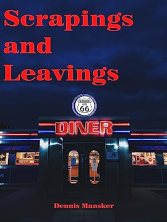
Guest post: Five Things I Learned While Writing Scrapings and Leavings by Dennis Mansker

Today I’m featuring a post by fellow author, Dennis Mansker. Dennis is one of the more interesting characters I’ve met in the local writing community. I have found his work to be intriguing and daring.

MyWritingLife2021BHis chosen genre is mainstream fiction, and the characters he presents are interesting and full of human frailties. So, without any more talk on my part, here is Dennis Mansker.

>>><<<

  1. The story sometimes writes itself; most of the time it doesn’t. But I am continually amazed at how … mystical … the writing process is. I can sit down with a loose idea for a story – I usually have a beginning and an end in mind, but the middle is a vague and nebulous fog. Two or three hours later I regain consciousness and have a finished story. How it got that way remains one of the great mysteries. Always be prepared for surprises. For example, “The Lolita of Rogue River” started out as a completely different story, but my characters kind of bullied me out of the way and took over. I’m glad that happened; the original story, when I finally wrested control back, turned out to be so lengthy and involved, with so many moving parts, that it is now going to be my next book, Destiny in Dallas.
  2. Character is everything. You can have a perfectly serviceable plot, but if your characters are wooden, are cardboard cutouts, are simulacra of real human beings, you really don’t have a story. That said, you may notice my intentional violation of this precept in a story or two in the book.
  3. scrapings and leavings by dennis manskerDid I mention be prepared for surprises? I can’t stress this too much. When I started what I call my New Wave of stories, in 2022, it wasn’t with the idea of collecting them in a book, but by the time I had written several of them and was reminded once again that the market for short stories was, to say the least, depressed, it dawned on me that if I collected what I considered the best of my previous stories along with the new ones, I had a book!
  4. Editing can be a bitch! No one wants to dismember his own children, but sometimes that’s what it feels like. Still, one needs to be ruthless, and sometimes no matter how much I may LOVE a story, it just doesn’t work. This is where friends come in. I put the manuscript out to three of my friends whose judgment I value, and took mostof their suggestions, even though it was painful. Some people like reading over their reviews on Amazon, some people don’t. Go ahead if you have a thick skin. I’ve gotten a few one-star reviews on Amazon for my first book, A Bad Attitude: A Novel from the Vietnam War, but these are far outweighed by the many four and five star reviews.
  5. You are never too old! I am at 78 among the very latest of late bloomers. Never give up! You are uniquely you. Make your voice heard!

>>><<<

Thank you for this fun and informative post, Dennis! Scrapings and Leavings will go live on September 1st but it is now available for preorder at Scrapings and Leavings – Kindle edition by Mansker, Dennis. Literature & Fiction Kindle eBooks @ Amazon.com.


Dennis Mansker author photoAbout the author: Dennis Mansker considers himself at 78 one of the latest of late bloomers. He published his first book, A Bad Attitude: A Novel from the Vietnam War, in 2002 at the age of 57. His second book, Scrapings and Leavings, will be published in 2023, and he is hard at work on his third book, Destiny in Dallas, which is on track to be published early in 2024.
He was born in Longview WA, spent five years on a dairy farm near Bristow OK, and is a 1973 graduate of Western Washington University in Bellingham WA.

He was drafted into the army in 1967, and spent nearly a year in Vietnam as company clerk of two US Army Transportation Corps trucking companies, an experience which formed the basis for the plot of his first book.

He retired after 31 years of state service with the Washington State Employment Security Department. He is responsible for producing four children, nine grandchildren and seven great-grandchildren (so far).

He lives in Olympia WA with his long-suffering wife Susan and two cats, who generously allow their humans to think that they are in charge.

Dennis Mansker at Amazon: Amazon.com: Dennis Mansker: books, biography, latest update

Comments Off on Guest post: Five Things I Learned While Writing Scrapings and Leavings by Dennis Mansker

Filed under Author Interviews, writing

The story arc – plot points, a series of life-changing events #amwriting

Every good story has an arc to it. It begins at a place of change and is created by one event following another until it comes to a place where the narrative is concluded.

MyWritingLife2021The inciting incident is followed by a series of plot points, places where complications are introduced into the narrative.

Real life is the same way. As many of you know, this last year has been one of change for me and my husband. If I were writing the story of this year,  it would begin with the inciting incident which occurred a year ago this last week. My husband was involved in a car wreck which ultimately led to his diagnosis of Parkinson’s disease. That was a bad day for us, but thankfully he wasn’t seriously injured, and we got it handled.

Just as in a novel, there was fallout from the inciting incident. Unfortunately, it meant the protagonist’s spouse could no longer drive. That would be the second plot point because it meant all plans for the summer had to be rearranged on the fly.

Orange_Door_with_Hydrangeas_©_Connie_Jasperson_2019The opening setting for this story is a small town in an exceedingly rural part of Thurston County. One must travel at least ten miles in any direction to find another city. After sundown, you must drive on narrow, winding, pitch-black country roads. I, the protagonist in my story, suffer from severe night blindness, which meant we had to return home before sundown, putting a real crimp in our social life.

The third pinch point comes in the sudden amount of traveling we had to do for physical therapy and neurology appointments. All medical services are twenty miles north in the Olympia area, as are the full-service grocery stores and a multitude of services we now need. It was like having a day job again. We would get up, have breakfast, and hit the road.

The story’s midpoint comes when, in January, we examined our options. Ultimately, we decided the best solution was to sell our home of eighteen years and move twenty miles north, back to Olympia.

The plot arc of the year had crested the midpoint, and now it was hurtling toward the next complication—trying to pack up, get the house ready to sell, and be a contributing grandparent to the family.

That was not easy.

Three family members have faced serious health problems since January. For one, epilepsy reared its head like the curse it is, and he landed in the hospital again. For the first time, I wasn’t any help other than offering a supportive voice on the other end of a phone call.

medical symbolMajor surgeries happened for the other two, and I was many miles away to the south, getting our house on the market. But our sons and daughters are entering middle age, and our older grandchildren are adults. Despite our worries, our granddaughters proved they were mature and more than capable of handling their lives.
And they all do so, brilliantly.

This is the final battle. The protagonists have been forced to let go and be the caring sounding board whenever one is needed.

And now, we approach the happy ending. The protagonists have managed to get packed up and moved by the deadline. Every task was done, and the house was ready to put on the market by the self-imposed deadline. As of today, our two characters have received some good offers and accepted one. Now they have to hope everything goes as well as possible and the deal closes by the end of June as it should.

Is there an epilogue? Of course. What is the setting for this final chapter? We find our couple in a small apartment in an urban village.

Lucky Coffee CupThe protagonists are settling into the new neighborhood. One of the niftiest things about their community is the Starbucks—and yes, I did say Starbucks. The owners of the Chambers Prairie Grange building took a huge risk, choosing to renovate rather than tear it down. It was built in 1908 when this area was outside the city limits and was long abandoned, falling into serious disrepair. This Starbucks has the feel and ambiance of a mom-and-pop coffee shop with plenty of comfortable, widely spaced seating placed with a post-pandemic eye. The original flooring has been refurbished, along with the original walls. Even the old Chambers Prairie Grange sign is hung inside there.

Moving to this neighborhood is coming full circle for me, the protagonist. I worked for a large rhododendron nursery in 1989, and the greenhouses I worked in were on the very site where my apartment building currently sits. Across the street from my windows is the property where my uncle and aunt lived in 1966. A large condominium complex is going up where my uncle’s house was, nearing completion. Some friends of ours have bought one of the condos.

From our windows, we have a view of the old grange hall. Back in the day, my ex-hubby’s heavy metal band played there for keggers. Attendees paid two dollars at the door. One dollar went to the band, the other to the host to pay for the beer. (No one underage allowed, no exceptions.) They played many a night there in the early 1970s before the grange hall was shut down and abandoned.

The epilogue of our story shows how life is much simpler for our protagonists. It shows the point of view character, me, admitting how she could get used to the lack of stress and how it feels like a vacation.

The story is an arc that begins at a place of change (the inciting incident), details the complicating events (pinch points), and concludes at a place of relative calm and introspection (the epilogue).

boxLIRF04182023I find that writing is easy here. Creativity comes in bursts, and I feel good about my writing. We have pared our possessions down to the point that they don’t possess us—something you don’t realize is a problem until you are faced with serious downsizing.
With my husband’s diagnosis of Parkinson’s, we have entered a new phase of life. Our children tell us we have earned our stress-free life, and it’s time to enjoy it.

Yes, winter was long and hard, but now summer is here, and the days are long and bright. So, let the good times roll—real life is unscripted, unpredictable, and no matter the plot points, life is always good.

12 Comments

Filed under writing

Guest post: Five Things I Learned While Writing The Adventures of Keltin Moore by Lindsay Schopfer

As my regular readers know, my husband and I are in the process of moving from our home of eighteen years to an apartment, and time is short. So, while I am neck deep in paring down my possessions, sci-fi and fantasy author, Lindsay Schopfer, has kindly agreed to help me out today. I’ve attended several seminars presented by him, and think you’ll enjoy this post. I really like his work and am looking forward to the launch of the third book in his Beast Hunter series, which happens on Friday.

Take it away, Lindsay!


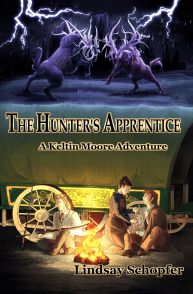
BookCover FinalIt’s been over ten years since I first started writing my series about the adventures of a professional monster hunter. With the release of The Hunter’s Apprentice as the fourth installment in the series, I thought I’d take a little time to reflect on some of the things I’ve learned while writing these stories over the last decade.
An Appreciation for Steampunk

When I first started writing Keltin’s adventures, I struggled to find a suitable name for the genre I was working in. Despite the stories’ fanciful monsters and subtle magic system, there was something in the technology and aesthetic of the world that suggested something a little different from a standard epic fantasy environment. After some searching, I stumbled on steampunk as a genre and a community and quickly embraced them both. That being said, I’ll admit that my stories are more rural than most of the Victorian, urban settings found in typical steampunk fiction, which is why I’ve taken to calling my stories steampunk-flavored fantasy. Regardless, I am still immensely grateful to have discovered the world of steampunk, and I will always be grateful to have been adopted into this creative and friendly community.

How to Pan for Gold

In book two of the series, Keltin and his friends go Into the North to protect prospectors from all sorts of monsters during a Yukon-inspired gold rush. In an effort to add an air of authenticity to the book, I decided to talk with an experienced gold panner and practice the art of prospecting a little bit. While I may not have struck it rich, I was inspired by the experience and the thrill of seeing that flash of gold amongst the silt.

The History and Mechanics of Firearms

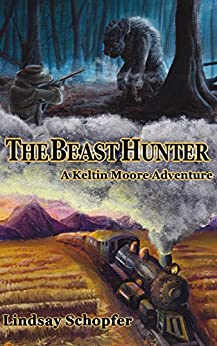
the beast hunterOne of my most treasured experiences in writing The Adventures of Keltin Moore has been meeting the fantastic subject experts in the course of my research. I already mentioned panning for gold, but there have been so many more generous, enthusiastic people I’ve spoken to on subjects ranging from big game hunters to horse-pulled wagons. In particular, I feel blessed to have known Gordon and Nancy Frye. The Fryes are a fantastic wealth of historical information, particularly regarding the development and implementation of firearms over the centuries. If you ever read something in my stories and thought that something involving guns was particularly cool, you can probably thank the Fryes for contributing to it!

How to be an Author

The Keltin Moore Online Serial came out before I’d even published my first novel, and I’ve been working on Keltin’s adventures ever since. Over the course of writing this series, I’ve learned how to craft, revise, format, publish, and market my books. I’ve learned how to work with cover artists, how to price my books, and how to pitch them at book dealer events. The Adventures of Keltin Moore have been the vehicle that have carried me through the majority of my career as an independent author thus far, and for that, I am deeply indebted to these stories.

How to Keep Having Fun While Writing

The inspiration for Keltin Moore came as a quirky little idea, and the stories were more for my benefit than anyone else’s, especially at first. Despite a long publication history and a growing community of amazing fans, Keltin’s stories have remained very personal to me. Years ago, I gave myself permission to write stories that I enjoyed, and I’ve held myself to that commitment ever since. I write my stories for myself first, focusing on characters, plots, and settings that inspire, uplift, and entertain me. The Adventures of Keltin Moore do all of that for me and more, and I’m so grateful that so many fans feel the same way.

***

If you’d like to begin your own adventures with Keltin, be sure to start where it all began with The Beast Hunter: A Keltin Moore Adventure.


Lindsay SchopferLindsay Schopfer is the award-winning author of The Adventures of Keltin Moore, a series of steampunk-flavored  fantasy novels about a professional monster hunter. He also wrote the sci-fi survivalist novel Lost Under Two Moons and the fantasy short story collection Magic, Mystery and Mirth. Lindsay’s workshops and seminars on the craft of writing have been featured in a variety of Cons and writing conferences across the Pacific Northwest  and beyond.

Lindsay’s Social Media Links

Author Website:  www.lindsayschopfer.com

Amazon Author Page: http://www.amazon.com/Lindsay-Schopfer/e/B007EF3MQS

Twitter: https://twitter.com/LindsaySchopfer

Facebook: https://www.facebook.com/lindsayschopfer

Goodreads: https://www.goodreads.com/author/show/7078379.Lindsay_Schopfer

Patreon: https://www.patreon.com/lindsayschopfer?ty=h

2 Comments

Filed under writing

My Writing Life – packing up and moving on #amwriting

We who write must also live in the real world. Sometimes things go smoothly, other times not. Let me just say that moving to a new place has really shown me what hoarders my hubby and I are. You can acquire a large pile of cheap Chinese junk if you stay in one place for eighteen years.

MyWritingLife2021BThe movers came on Friday to take what furniture we could gracefully fit into the new apartment. They loaded the van far more quickly than I thought they would. The main hiccup in that day came in the form of the elevator in our building. We are in building C but must go in through the main lobby in building B, take the elevator to our floor, and cross to our building via the sky bridge. It’s a long trek.

Worst of all, the elevator for building C is across the hall from our door.

Now the real work begins. We must finish emptying the house, so we will travel back and forth for the next week and a half.

On Saturday, we began the necessary repairs to the house. Our repairman is a lovely man named Brian. He replaced the fanlight on the back porch. He also mended and repainted the front steps.

We sort through the debris of our lives, pick what we know we have room for, and I stuff the car. Greg does as much as he can, and we are exhausted by the day’s end.

Hydrangea_cropped_July_11_2017_copyright_cjjasperson_2017 copyOver the next week, we have to donate as much as possible to be reused, and the rest will be hauled away by the junk removal company. They will not only take the junk but also clean the garage floor. (!!!)
After that, the house cleaners will do their best to make our old place look good.

The sprinkler repair people will also be out that day.

Finally, the carpet cleaners will attempt to make the fitted carpet we never wanted in the first place look passable.

At some point, I will have to shop for food, as we do need to eat. My new kitchen is functional, but I must pare down what was already pared down to keep it that way.

On June 1st, the house will officially be for sale.

Worst of all, we had an unusually early heatwave, with temperatures in the high eighties and low nineties and high humidity. (30 or so, Celsius.) Even with my hot pink beach wagon, making two or three trips to empty the car is exhausting. It began cool down to normal temps on Sunday, and fingers crossed, we hope the weather will stay that way.

Once the elevator in my building is repaired, that will be less of a problem. It will happen as soon as the company can get the parts.

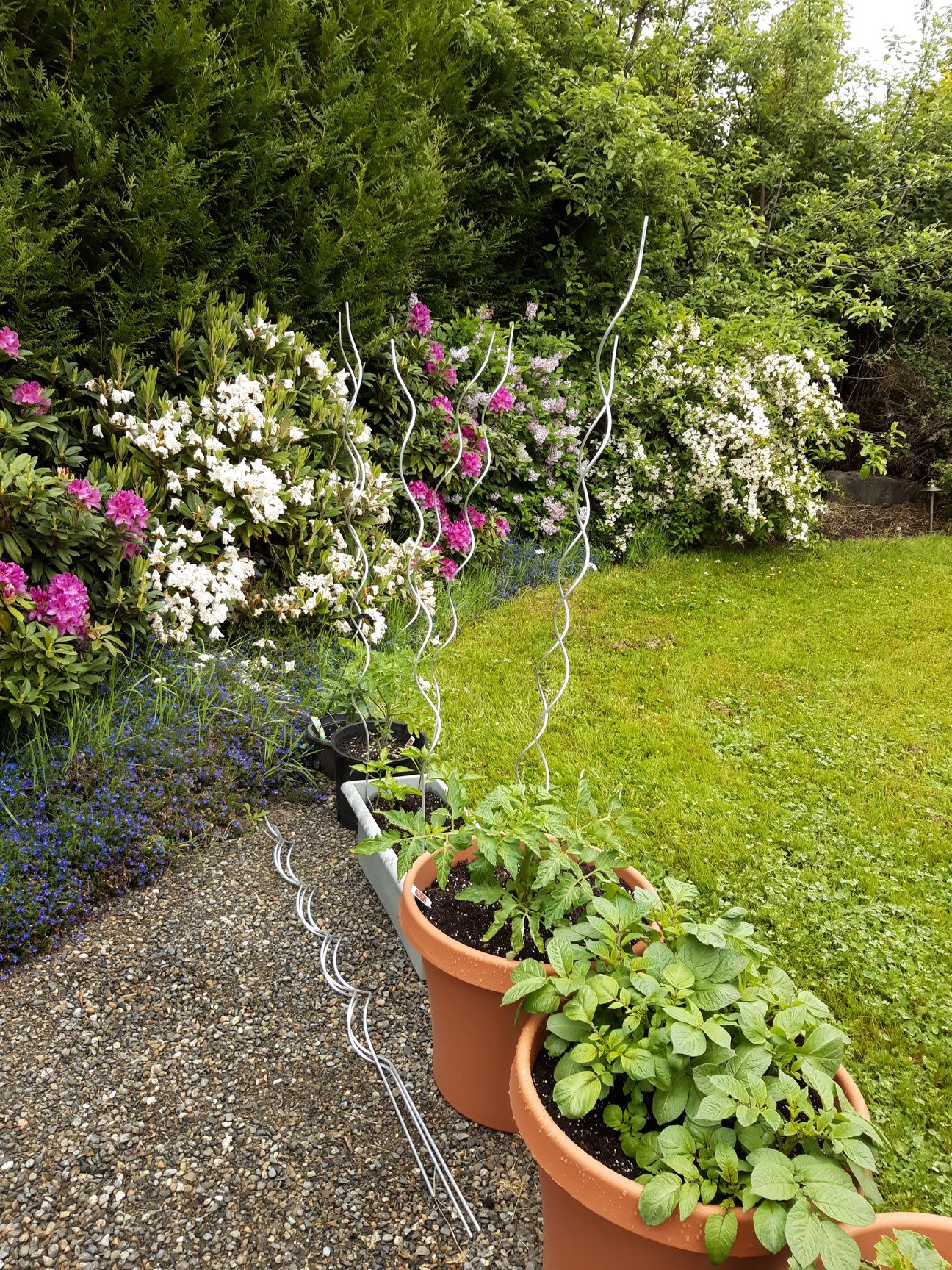
BackYardMay202020On the good side, it is easy to write here. I have been writing bits and bobs here and there on old unfinished manuscripts between bursts of unpacking, writing whenever I sit down to rest my back. It keeps me from fidgeting.
This next week is crammed full of things we must do, but we are getting it done, one piece at a time.

In the meantime, have a great week, and may your words flow freely.

10 Comments

Filed under writing

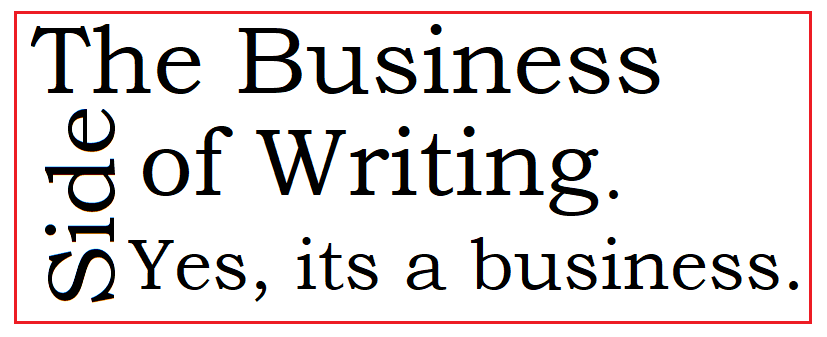
The Business Side of the Business: book signing events, income, and expense #amwriting

In my previous post, we discussed the logistics and costs of in-person sales events, so today we are revisiting managing our expenses. I did cover this a few months ago, so if you already have seen this, thank you for stopping by!

If you intend to make personal appearances at local bookstores, fairs, or conventions, you should have an inventory of books to manage and account for at the end of the year. You will have expenses to report. This can be quite a headache if you have more than one or two books to track.

Its a BusinessThe good businessperson has a spreadsheet of some sort to account for this side of the business, as it will be part of your annual business tax report. An excellent method for assembling the information we generate for your tax report is discussed in a guest post by Ellen King Rice, The Business Sequence for Writers. Her article offers an excellent framework for keeping our business records straight, so filling out our annual tax forms will be easy.

As a former bookkeeper, I strongly suggest you keep an account of your costs for each book. This is for tax and insurance purposes if the stock of books is lost or damaged in a house fire or flood.

You can do this on notebook paper with a pencil, a ruler, and a calculator. However, a green or yellow ledger book with eight to twelve columns is already set up for you to begin using. These are available at Amazon and can be found at all office supply stores and some grocery stores.

I began working as a bookkeeper in 1982, using the industry-standard tools of the trade for the time. We noted each transaction with a red or black pencil in ledger books of varying sizes (2 to 32 columns). In those days, we used rulers or yardsticks to ensure we tracked a particular item on the correct line across all the columns. The handiest electronic device on my desk was the calculator with a printout tape.

The tools for this method of accounting are still available in the stationery section of any store and are quite affordable.

I use Excel for all my accounting purposes, but no matter how you create your spreadsheet, each title you have on hand to take to book fairs or shows has several associated costs.

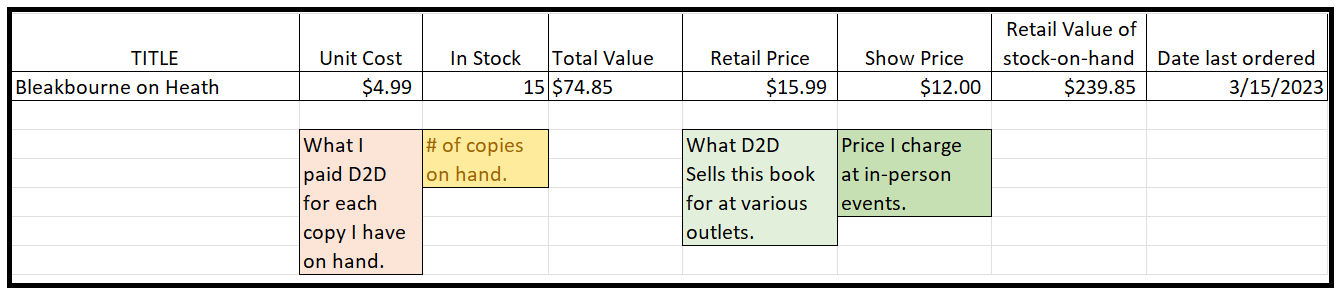
The first column contains the heading Titles: under that heading, list the title of each book you take to shows. We will use my most recent book, Bleakbourne on Heath, as our example book.

On the same line as the word Titles, working to the right in column 2, write unit cost. This is the price you pay for each copy you must take to a show and varies from title to title by the book’s length and trim size. On the same line as the book’s title, write the cost you pay D2D, KDP, Ingram Sparks, or your publisher for that paper book. In this case, I pay Draft2Digital  $4.99.

Column 3 is the current stock-on-hand at the end of the taxing quarter: Quantity in stock: 15

calculatorColumn 4 is the sum of column three times column twoInventory value: $89.11. That is what you would have to pay to replace those books. It is also what some Departments of Revenue may tax you on at the end of the year if the value of that stock is over a specific limit, say $5,000.00. The total value of stock-on-hand for all my books combined rarely exceeds $500.00.
Annual inventory taxes are why retail stores have end-of-the-year sales. They need to offload their inventory to keep their taxes low.

Column 5 is the retail price. This is what Draft2Digital charges for the book: $15.99. You set your retail price to cover the cost of replacing the book, with some revenue to cover table and vendor fees at shows and conventions (see my previous post, the Business Side of the Business: budgeting for in-person sales events,) and still allow for a small profit.

Column 6 is the special show price (if you discount your books at shows): $12.00.

Column 7 is the retail value of your stock on hand. It is the sum of column 3 times column 6: $228.00.

stock-on-hand-demo-LIRF04042023

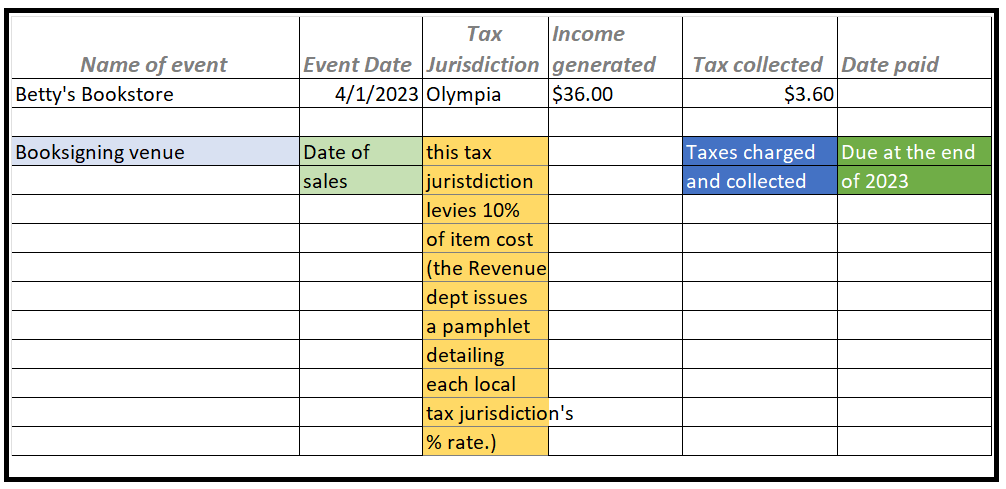
Did you collect sales tax from your customers? When you apply for your business license, you will receive a pamphlet with all the taxing jurisdictions in your licensing area and their tax rates. These range between .08 and .11 here in Thurston County.

Washington State has no income tax, so all our revenues come from quarterly business and sales taxes collected at the time of purchase.

Note the tax jurisdiction where the books were sold, as you may be required to forward the taxes collected to your state or province’s Department of Revenue. If you are smart, you will make another page with these columns:

Income-statement-demoLIRF04042023

At the bottom of both spreadsheets, total each column. That will give you the stock expenses for all your titles. There will be no scrambling at the end of the quarter for Business and Occupation taxes if you live in a state like Washington State or at the end of the year if you live elsewhere. Be smart and set aside the money collected as sales tax because it is not yours and is not part of your income.

That way, you will have it at the end of the year if you only do a few shows a year like me, or quarterly if you do shows and signings every week.

Bookkeeping should take less than an hour after each show. If you have kept your spreadsheets updated, filling out annual business tax forms for your state and federal agencies will go quickly. You will have all the numbers you need to back up your reports if you are audited.

Also (and this is important), you will know the exact number of books you have on hand in each title. You will know when it’s time to reorder more stock. There is a two-to-three-week lag in printing and shipping time, so ordering books in advance is critical. You don’t want to waste money by purchasing stock you have plenty of, but you need to have a supply of your better sellers.

My personal spreadsheet is a little more detailed and is saved in the cloud, as are all my business and other records. I also back up my files to an external drive because it never hurts to be vigilant.

Something we rarely consider is the infrequent natural disaster. I live on the northwest coast of the US, so we must sometimes deal with forest fires, earthquakes, volcanic eruptions, Pacific hurricanes, and, occasionally, tornadoes. They don’t happen often, but it can be devastating when they do.

water not a friend of booksDepending on where you live, the natural world can be hazardous. If something should happen to your stock of books due to theft, fire, or flood, you will be able to claim your business loss.

Many authors are far more prolific than I am. Replacing the stock of 1 to 30 titles is a burdensome expense to carve out of the family budget unless an author has sold enough to cover that cost.

Are you covering your costs? Keeping good records will ensure you can see where you stand and allow you to make good decisions regarding your expenses.

6 Comments

Filed under writing

Writing through the chaos #amwriting

I have to say, it’s been a bit chaotic here at Casa del Jasperson. Writing goes on amidst the boxes and procrastination. We’re sorting things into “keep” and “toss” piles, and the toss piles are far bigger than the keepers. At some point, we will be done with the big dig, and whether we move or stay put, we’ll be better off for having done it.

MyWritingLife2021Who needs a box of corkscrews? Apparently, we do as they go along with our three boxes of wine glasses. Greg’s medication precludes alcohol consumption, and I am a teetotaler. But we proudly serve Washington wines – Wikipedia. Party on!

Twenty coffee cups from friends, seven travel mugs from organizations we volunteer with, two boxes of home canning supplies, nine flower vases, six forms for making heart-shaped fried eggs (unused for twelve years since I became vegan), and two large muffin tins ….

I miss the days when I could load everything I owned into a Volkswagen Beetle and move house in one day.

Writing continues despite the distraction. Living in my fantasy world for several hours each evening keeps me functioning normally and allows me an escape from the mess.

My NaNoWriMo novel has a complete story arc now. All I need to do is stop binge-watching Death in Paradise and get on with it.

coffee cupsThe house seems to have a rhythm. In the morning, a tide of ancient artifacts rolls into the living room from every closet and corner, making me irritable. The afternoon sees boxes of items ebb out to the car, driven away to be donated to charities. By evening the sea of clutter is down to a moderately tidy level, only for the tide of chaos to rise again the next day.

Writing is my place of normalcy. When I can’t focus on my current work-in-progress, I can always come here to my blog and chat about the craft of writing. This blog is where everything is tidy and neatly put away.

Life is good, and to be honest, packing up isn’t all that terrible. The objects and appliances that found their way to our home and never left are intriguing in their own right.

Four Japanese porcelain dolls. The complete works of William Shakespeare. Five worn-out sets of the Lord of the Rings Trilogy, one for each of the last five decades.

And look, here are seven cookbooks on Vegan Cuisine—these are keepers. My favorite is Miyoko Schinner’s The Homemade Vegan Pantry. I’ve given each of my vegan friends a copy of that book.

667px-PlayStation_3_Logo_neu.svgAnd over here, we have three PlayStation consoles (1, 2, and 3), an early Wii, a Super Nintendo console, and a cabinet full of the games that go with every platform. I quit playing console games after the PS3, and now I play on the PC with an Xbox controller. It’s simpler and takes up less space.
Thank heavens for my nephew Robbie, who used to manage a Game Stop. He works in the tech world now but still collects old game consoles, gear, and memorabilia. I know my precious darlings have gone to a good home.

My Coffee Cup © cjjasp 2013Yes, getting our house ready to put on the market is a daunting task, and it sometimes makes me crazy. But something gets done every day, and we’re inching closer to being able to make that final decision.

So that is the update from Casa del Jasperson. Life is good!

8 Comments

Filed under writing

The Business Side of the Business: Managing Inventory #writerlife

Today’s post is a follow-up to Monday’s post by Ellen King Rice. It is tax season, and many people will begin trying pull together the numbers needed for their federal tax returns. If you sell books at book signing events or trade shows, you are in business for yourself, and Ellen’s post details what your responsibilities are.

Its a BusinessAuthors make readers when they do in-person book signings. We have the chance to connect with potential readers on a personal level, and they might buy a paper book. If we are personable and friendly, they might tell their friends how much they liked meeting us. Those friends will buy eBooks. (We hope!)

Most shows and events will require you to have a business license if you intend to sell books in person. This means you will have a small amount of paperwork after each in-person signing, so I am revisiting a post from 2022 detailing how authors can manage an inventory of books and have the right numbers for tax purposes.

For eBook sales, you have no obligation to report sales taxes, only your royalties as listed on the 1099 issued by Amazon or Draft2Digital, or other eBook sellers.

Whether you are traditionally published or indie, if you intend to make personal appearances at local bookstores, fairs, or conventions, you will have an inventory of books on hand to manage and account for at the end of the year. But more importantly, even if you are traditionally published, you pay for the books you sell at shows. 

The good businessperson has a spreadsheet of some sort to account for this side of the business, as it will be part of your annual business tax report. An excellent method for assembling the information you will generate for your tax report is discussed the previous post, The Business Sequence for Writers. Ellen King Rice has given us a great framework for keeping our business records straight.

There is only one more skill to have, and this is only for those who intend to sell books in person. A wise author understands that good records ensure a successful business and sets up the bookkeeping system before they go to book fairs. They have a list of the stock on hand, what books are on reorder, the day they were ordered, and how long it takes for them to ship. Also, you should keep an account of your cost for each book, both for tax purposes and insurance purposes, just in case the stock of books is lost or damaged in a house fire or flood.

You can do this on notebook paper with a pencil, a ruler, and a calculator.  I began working as a bookkeeper in 1982, using the industry-standard tools of the trade for the time. We noted each transaction with a red or black pencil in a green or yellow ledger book of varying sizes (2 to 32 columns). Then, we used rulers or yardsticks to ensure that we tracked a particular item on the correct line across all the columns. The handiest electronic device on my desk was the calculator with a printout tape.

The tools for this method of accounting are still available in the stationery section of any store and are quite affordable. I have used Excel since 1993 for all my accounting purposes, but no matter how you create your spreadsheet, each title you have on hand to take to book fairs or shows has several costs associated with it.

What follows are several screenshots of a simple way to organize a spreadsheet:

Picture1

The first column contains the heading Titles: under that heading, list each book you take to shows by the title. We will use Huw the Bard as our example book.

On the same line as the title, working to the right in column 2, write unit cost. This is the price you pay for each copy you must take to a show and varies from title to title by the length of the book and the trim size. On the same line as the book’s title, write the cost you pay KDP or Ingram Sparks or your publisher for that book: $4.99. (edited, thank you Judy!)

Column 3 is the current stock-on-hand at the end of the taxing quarter: Quantity in stock: 19

Column 4 is the sum of column three times column two: Inventory value: $89.11. That is what you would have to pay to replace those books. It is also what some Departments of Revenue may tax you on at the end of the year if the value of that stock is over a certain limit, say $5,000.00. My stock on hand never even approaches that limit.

This is why retail stores have end-of-the-year sales. They need to offload their inventory to keep their taxes low.

Column 5 is the retail price. This is what the book sells for at bookstores: $12.99. You set your retail price to cover the cost of replacing the book, with some revenue to cover table and vendor fees at shows and conventions, and still allow for a small profit.

Column 6 is the special show price (if you discount your books at shows): $12.00.

Column 7 is the retail value of your stock on hand. It is the sum of column 3 times column 6: $228.00.

Were you required to collect sales tax from your customers? When you apply for your business license, you will receive a pamphlet with all the taxing jurisdictions in your licensing area and their tax rates. These range between .08 and .11 here in Thurston County. Washington State has no income tax, so all our state’s revenues come from businesses and sales taxes collected at the time of purchase.

Make a note of the city or county where the books were sold, as you may be required to forward the taxes collected to the Department of Revenue or your local Business and Occupation tax collecting agency. If you are smart, you will make a second page with these columns:

Picture2

At the bottom of the page for both spreadsheets, total each column. That will give you the stock expenses for all your titles. There will be no scrambling at the end of the quarter for Business and Occupation taxes if you live in a state like Washington State or at the end of the year if you live elsewhere. Be smart and set the money collected as sales tax aside because it is not yours and shouldn’t be considered part of your income.

That way, you will have it at the end of the year if you only do a few shows a year like me, or quarterly if you are out there doing shows and signings every week.

The bookkeeping side of your business should take less than an hour after each show. If you have kept your spreadsheets updated, filling out annual business tax forms for your state and federal agencies will go quickly. You will have all the numbers you need to back up your reports if you are audited.

Also (and this is important), you will know the exact number of books you have on hand in each title. You will know when it’s time to reorder more stock. There is a two-to-three-week lag in printing and shipping time, so ordering books in advance is critical. You don’t want to waste money purchasing stock you have plenty of, but you need to have a supply of your better sellers.

My personal spreadsheet is a little more detailed and is saved in the cloud as are all my business and other records. It looks like this:

Dummy_Inventory_Spreadsheet

Something we rarely consider is the random natural disaster, but we must be prepared. If something should happen to your stock of books due to theft, fire, or flood, you will be able to claim your business loss. Many authors are more prolific than I am.  For most of us, replacing the stock of 1 to 30 titles is an expense that is difficult to carve out of the family budget unless we have sold enough to cover that cost.

Theft is rare, as people are usually quite decent at conventions and trade shows. I’ve only had one book stolen from a table at a show in all these years—a $15.00 (show cost) loss (or $6.80 my cost).

While it disturbed me on one level, I was a bit honored that someone wanted my book that badly. The experience left me confused as to how I was supposed to feel. But on the good side, it was nice to know that shoplifters are readers too!

5 Comments

Filed under writing

Revisiting the Business Sequence for Writers, guest post by Ellen King Rice #writerlife

Today I am revisiting a guest post from last year, written by Ellen King Rice. She has great advice about the business side of this business, and information we all can use. Ellen is a successful indie author of an engrossing series of mushroom thrillers set in the Pacific Northwest.

Its a BusinessShe also wrote the brilliant, hilarious standalone novel, Larry’s Post Rapture Pet Sitting Service. If you haven’t read that book, I highly recommend it. I laughed out loud and couldn’t set the book down.

And now, here is Ellen King Rice and her advice on how to treat this business like a business.

*** *** ***

Moving from hobbyist to professional can be challenging in any field. For indie authors, financial numbers and formal paperwork matter. There are several steps, and the sequence of them can make life easier or . . . not.

The first step in finding a path through the thicket of “business stuff” is to remember past challenges conquered. For many people this may be recalling a first bicycle ride or an early cooking effort. For others there may be a wince as we remember that first round of playing “Hot Cross Buns” on an instrument. Whatever your early challenge was, you didn’t know everything when you started, but you learned quickly.

Today, let’s build a ramp up to a business set up, including tax prep work.

  1. Author’s name.

Search your name on the internet. Make sure you are aware of other writers, activists, artists and business people who share your name. In my case, there were several, including one who shared my middle initial. After some agonizing, I decided my author’s name would be Ellen King Rice even as my friends and family know me as Ellen Rice.

  1. Publisher’s Name

I highly recommend that you chose something other than your author’s name. This gives the writer flexibility to write in more than one genre. There are also times when the publishing house name gives a bit more cachet to projects. I chose Undergrowth Publishing.

  1. Tax Number

This requirement will vary by nation. In the United States, you will want an EIN tax number from the Internal Revenue Service. There is an on-line application here: IRS EIN application online.

The EIN is a Federal Tax ID number used to identify businesses.

Having a Publisher’s name and Tax number helps with getting a business license and a bank account. Of course, I didn’t know this, so I did things backwards and sideways. I tried to get a tax EIN and failed when I was faced with the question “What is your name?”  I highly recommend brisk walks and much chocolate to break up paperwork-filing sessions.

  1. Business license

Again, requirements will vary by location and jurisdiction. If you are resident of the State of Washington, you can find the details here:

https://dor.wa.gov/open-business/apply-business-license

I chose Sole Proprietor for my business, but some writers choose to form a Limited Liability Company.

Do you need city or county licenses? In my area, obtaining a state business license triggered a letter from the city demanding I purchase a local license. It took some research, but I determined that the local vendor’s license did not apply to my circumstances (I live in the county, and I sell books on-line).

It’s wise to learn about your community rules, but often these rule sets only apply to those who are selling in person (i.e., your online sales aren’t part of the local tax structure). Even then, there are times when small vendors or special events like an arts fair are exempted.

  1. Bank account

With your writer/publisher names sorted, a Tax EIN and your business license number, getting a business bank account should be straightforward. Mine is with the Washington State Employees Credit Union. I was able to open the business account with $50 and a $5 savings reserve. This gives me an account for Amazon expenses and deposits. I also asked for a dozen checks, which the credit union provided as a courtesy.

Credit card? A business debit card is easy to request once your account is set up, but a business credit card is hard to get. So far, I’ve managed without one.

  1. Spreadsheet and Tax Forms

Last steps! At this point, it is wise to print off the small business end-of-year-tax form that you’ll be using so you can see the information required.

In the United States, this is the Schedule C “Profit or Loss from Business” form from the IRS website. We can use this form to set up a spreadsheet, by category.

We want things set up so a “Sum this category” command will make it easy to fill out the Schedule C at the end of the year.

Details matter. Take some time looking over the Tax form for your situation. Think of it as your End-of-Year Party destination. A party in the tropics requires different prep than a party with penguins. Knowing the lines to be filled makes for clever spreadsheet set up. And, yes, it feels wonderful to be fast and accurate at year’s end.

For Americans, pay attention to Schedule C, Part I which asks what your “gross receipts or sales” are (line 1) and your “cost of goods” (say, printing 30 copies of your book) for line 4.

Next look at Part II. Lines 8 to 27 list different expense categories you can report. Line 8 is Advertising, so I want an “advertising” category when I set up my writer’s spreadsheet for the year. Line 11 is “Contract Labor”, so I’ll set up that category too. My book cover designer fees can go here. Line 18 is “Office expense.”  I set up Office Expense as a category and that’s the designation to house all my paper and printer cartridge charges.

DEFINITELY check in with a qualified tax advisor (which I am not!) to make sure what you are doing is correct before you file your taxes. All I’m encouraging here is to use the Schedule C as a guide to setting up bookkeeping for easy end-of-year number crunching.
Once you have slogged your way through all six of these steps, you should be well on your way as a writing professional. Be sure to celebrate!

Footnote for American tax filers: What happens if I don’t make money? After filling in Part I (income) and Part II (Expenses), I typically show a Net loss (line 31).  That loss amount will go onto a Schedule One form, and from there to Line 8 of the 1040 form as a negative number, which will lower my taxable income.


Thank you, Ellen, for allowing me to reprint this wonderful and enlightening post. If we intend to sell books at book signings and conventions, we have a business. If we want to avoid problems with our respective taxing agencies, we must jump through the proper hoops.

The next post in this series will revisit my post discussing book signings and book fairs, and tracking inventory for both tax and insurance purposes. The pandemic has eased, and many authors have held signings and in-person events. It doesn’t matter if we are indies or traditionally published – if we sell books in person, we need to manage our costs and protect our investments.

This something we all need to consider no matter where we live in this ever-smaller world.


EKR_author_photo_2022About Ellen King Rice:

I am a wildlife biologist who suffered a spinal cord injury many years ago. Although my days of field work are over, biology continues to intrigue me.

I am fascinated by sub-cellular level responses to ecosystem changes. I also like the predictability of animal behavior, once it is understood.

A fast-paced story filled with twists is a fun way to stimulate laughs, gasps and understanding. I work to heighten ecological awareness. I want the details and your new insights to remain in your thoughts forever.

You can find me and my books at www.ellenkingrice.com

​Please join me on Instagram at:

https://www.instagram.com/mushroom_thrillers.

And on Facebook:

https://www.facebook.com/mushroomthriller/

EKR_3book_covers_01162022LIRF

7 Comments

Filed under writing