Tag Archives: #writerlife

Reading to Impact Your Writing: Writing Books, Inspirations, and Beyond by Joyce Reynolds-Ward

This is the fifth in a six-week blog tour series for the Northwest Independent Writers’ Association. You can catch up with them at https://www.niwawriters.com/.

Generally, when the discussion about reading to impact your writing begins, many people’s thoughts turn toward writing references and guides. That’s good for a beginning. But reading books about writing mechanics, process, and the like should not be the only things you read as a writer. Part of developing yourself as a writer includes expanding your reach as a reader—after all, growth arises in many ways, and reading something for the purposes of growing your awareness of style, idea usage, and the like. Picking up a challenging new book in a genre you don’t normally read can often provide insights on your own writing. Or reading a favorite author’s journal or memoir about writing process may help you past your own struggles. It all really depends on what resonates with you. Here are some of my favorites.


For myself, reading journals, letters, and memoirs/autobiographies (not biographies!) of my favorite authors has been a good source of writing inspiration and development. I was an early fan of John Steinbeck, thanks to one of my high school teachers. As a result, one of the earliest writer reads that has stuck with me over the years is John Steinbeck’s Journal of a Novel: The East of Eden Letters. While writing East of Eden, Steinbeck would start every writing day with a short letter to his editor and friend Pascal Covici. It was part of his warmup process and a means of separating from daily concerns to developing the focus needed for the day’s work. In a similar vein is Working Days: The Journals of the Grapes of Wrath and Steinbeck: A Life in Letters. Because Steinbeck often used letter writing as a tool for warming up, his letters frequently reflect not only what was going on in his life at the moment but what was happening with his writing process—a valuable insight into the struggles that all writers have.

I tend to prefer journals and letters to memoirs and autobiographies because writers can and will embellish later accounts while journals and letters reflect the writer’s state of mind at the time they were writing. May Sarton’s Journal of a Solitude is billed as “the intimate diary of a year in the life of a creative woman,” and it does not disappoint. While ostensibly a book about the process of writing, Jay Lake’s Process of Writing 2005-2010 is a collection of blog posts Jay wrote about writing organized into topics which—really—tells you as much about Jay’s daily struggles with the writing life as it does anything else. Also, given Jay’s reputation as an extremely fast writer, he gives a breakdown of exactly what that looks like and what it means for him economically as a writer. His analysis of his differing rates of writing speed is something that I recommend every writer read.

And then we get to memoir and biography. One book that I think every writer should read is Anthony Trollope’s An Autobiography. Trollope wrote over sixty books over the course of his life, in part by exercising the discipline of rising early and writing 250 words every quarter of an hour for three hours before going to his day job with the British Post Office as a surveyor. His observations of the mid-19th century writing world (hint: Trollope does not like Dickens) are priceless and, if you have read Trollope or watched productions of his novels, you gain insights into how he built his characters. Ursula K. LeGuin’s essays on writing, often found mixed in with her other essays, are definitely worth considering.

And then there are the books explicitly about the craft of writing. Oh, the many books about writing techniques. I own a lot of them, and have bought and discarded many others. For me, the problem with many craft books is that they often speak to me at a particular stage in my writing or process. But as I progress beyond what they have to offer, I end up walking away from books I once loved. The reality about many books about the writing process is that they are often limited to a particular time and market. There’s nothing wrong with that, but if you pick up an old Writer’s Digest book about writing, you need to crosscheck it to ensure that certain things about the field have not changed. Heck, that is true of any book explicitly about writing technique, because the techniques change and evolve.

Furthermore, while I know of many writers who cling to their favorite writing advice book over the course of the years, for me, the books that have resonated the most are those where the writer speaks candidly about the struggles they face in the writing life. The letters. The memoirs. The autobiographies. Those details where the struggle of the creative life is chronicled without whitewash or embellishment. The advice books often move on, except for a select few…but oh, the value of a chronicle of a writer’s struggle. At least that is what works for me.

And what about you?


Other posts in this series by Joyce Reynolds-Ward (note: each website owner will post at some point during the week listed).

March 29-April 4th—Organizing Your Plot www.joycereynoldsward.com

April 5-11—Self-editing, grammar, and beta readers https://authorwilliamcook.com/blog/

April 12-18—Genre and cross-genre https://tanstaaflpress.com/news

April 19-25—My Approach to the writing process https://varidapr.com

April 26-May 2—Reading to Impact your writing www.conniejjasperson.com

May 3-9—Advice for new writers https://lecatts.wordpress.com
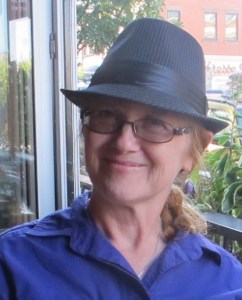

Joyce Reynolds-Ward is a speculative fiction writer from Enterprise, Oregon. Her short stories include appearances in Well…It’s Your Cow, Children of a Different Sky, Allegory, River, and Fantasy Scroll Magazine. Her agripunk thriller trilogy, The Ruby Project: Origins, The Ruby Project: Ascendant, The Ruby Project: Realization, are due for release in November, 2020. Her books include Shadow Harvest, Choices of Honor, Judgment of Honor, and Klone’s Stronghold. Joyce has edited two anthologies, Pulling Up Stakes (2018), and Whimsical Beasts (2019). Besides writing, Joyce enjoys reading, quilting, horses, and hiking, and is a member of Soroptimist International of Wallowa County.

You can find Joyce’s books at her website, Peak Amygdala or on her author page at Amazon.com.
 

4 Comments

Filed under writing

Writing Contemporary Fiction in a Time of Uncertainty #amwriting

The pandemic, combined with the political uncertainty of our time, has left many authors feeling unable to write. In an online group, an author who writes YA contemporary/near-future sci-fi novels said that looking at his keyboard made him feel like a deer staring into the headlights of an oncoming car.

This subject also came up at our last writing group meeting via Google Chat. A good friend who is an integral part of my writing posse is suffering from this crippling inertia.

The block these authors are experiencing is caused by the extreme uncertainty of our times and the constant barrage of bad and often conflicting news. No one knows what the near future holds, so writing something that will be affected either by the next election or how the pandemic progresses is a difficult proposition.

For some people, writing anything right now is impossible.

To write contemporary or near-future sci-fi, one must be able to predict a multiplicity of futures and decide which is most likely to occur. This is an iffy thing even in less turbulent times.

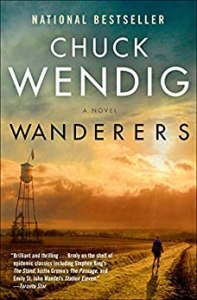
Chuck Wendig managed to nail how our society might react to a true global pandemic with The Wanderers, A Novel. Just as in the novel, we have deniers and blame-casters who categorically refuse to accept scientific evidence. We are blessed with fools aplenty.

Isaac Asimov in The Naked Sun, George Orwell in Nineteen Eighty-Four: A Novel, Ray Bradbury in Fahrenheit 451—these were the forward-thinkers of their time. These authors were able to extrapolate a possible future from reading about current events in the newspapers and watching the evening news on TV or radio.

These novels don’t describe a perfect example of how things are, but they contain glimpses of our modern life. In The Naked Sun, we find people who communicate almost exclusively via an internet of sorts and rarely meet in person.

In Nineteen Eighty-Four: A Novel, we see the effects of mass surveillance and the brutal regimentation of all aspects of behavior within a society. Dangerous thoughts are illegal, and the Thoughtpol (thought police) spy on everyone to detect and eliminate those whose independent thinking questions the powers-that-be.

In Fahrenheit 451, we are asked to consider a society in which books have been ruthlessly condensed to accommodate short attention spans. Minority groups protest the controversial, outdated content they believe exists in literature. However, comic books and pornography remains, as these feed the mainstream population’s desire for mindless entertainment. At the outset of the story, it is illegal to own a book.

These are novels that raise questions and ask us to take a hard look at ourselves.

These authors were conscious of how people react to given events, how the herd mentality takes over, and how mobs function. They also paid attention to the cutting edge science and theories of the day.

We denizens of the 21st century spend a lot of time on the internet, communicating via social media. Our phones and computers are under constant surveillance by our governments as part of the war on terrorism, and Google Earth knows where we are and what we are doing.

And finally, in many homes, reading takes a distant second place to television when it comes to family entertainment.

This raises the question, does our society shape sci-fi, or does sci-fi shape us? We tease about our cell phones and e-book readers being Star Trek devices. But all jokes aside, cell phones and electronic books and notebooks are integral parts of our culture that were described by Gene Roddenberry as part of his 1966 sci-fi televisions series.

So, while the early speculative fiction authors weren’t seers or clairvoyants, they took the information that was available to them and wrote stories that intuited a multitude of possible future timelines fairly accurately, some aspects of which closely resemble our 21st-century society.

This time of uncertainty will pass. We may never go back to standing next to strangers in a line at the grocery store, but we will create a new normal. We will find security in whatever form that new normal takes once we get used to the routine.

In real life, the good guys never win completely, but neither do the bad guys. One may have the upper hand for a while, but the pendulum swings two ways.

Pandemics are horrible, but they do eventually pass, and we will recover as a society.

This sense of powerlessness will pass.

You who write contemporary and near-future fiction and who are momentarily unable to put pen to paper will regain your creative muse, and words will flow. You will once again write insightful stories, delving deeply into what it means to be human. You will show us what a beautiful, interconnected world we live in, and how fragile each link in the web of life is.

The words will come, and you will write them.


Credits and Attributions

Eye on Flat Panel Monitor, Image by © Royalty-Free/Corbis

Dog Using Laptop Computer CC0 1.0 Universal (CC0 1.0)

2 Comments

Filed under writing

Why Authors Should Blog #amwriting

We authors, whether indie or traditionally published, are responsible for building our own brand. I have found most of this aspect of my career to be difficult. However, I have managed to succeed at one of the foundations of building my brand–I have a working author website and blog.

When I began, I used the free sites offered by both WordPress and Blogger, so cost should not hold anyone back. And the dashboards of both platforms are easy to learn with a little trial and error. If I can learn them, anyone can.

I often hear writers complain that they don’t update their author blog regularly because they have nothing to say. I disagree—they’re writers for heaven’s sake. Writers can wax poetic out the ends of their fingers, ranting for hours on the oddest subjects.

The trick is rambling on for 500 words or so and sticking to a schedule of sorts. Writers like to rant, but deadlines cause us to go into procrastination mode.

Still, although many will claim they aren’t able to write under pressure, that is when I do my best work.

NaNoWriMo has proven to me that nothing improves your writing chops more than writing every day.

Blogging offers me a mix of self-imposed goals and gives me the chance to riff on my favorite subject—the craft of writing. Much of what I have learned as a writer over the past decade has come about through researching topics for this blog.

I wasn’t always a confirmed blogger. In 2011, I signed up for a free Blogger (Google’s platform) website, taking that plunge only because my former publisher forced me to. He swore it would help get my name out there and give me a regular platform for my opinions.

The posts I wrote for that first attempt at blogging were pathetic attempts to write about current affairs and politics as a journalist, which is something that has never interested me. I was lucky if I managed to post one piece a month and had no readers or followers.

I soon realized I could not write on the subjects my publisher wanted and quit altogether.

After talking to some friends who were successful in marketing their work, it occurred to me there was one subject I could talk about for hours on end:

Books.

I went back to that old site and scrapped the awkward, unloved posts. I changed the site’s name and shifted to writing about something I loved—books. I wrote one book review post a week for the next five years.

While I haven’t had a lot of time lately to keep it updated, the site is the home of Best in Fantasy, my book review blog.

I hate to say this because we parted ways rather messily: despite my resistance, my former publisher was right about the importance of having an author’s website and writing the occasional blog post.

During the time I was first writing for Best in Fantasy, I began to realize that I was marketing everyone else’s work, but no one was promoting mine.

I needed a place to showcase my work.

That’s how this site came into existence.

It wasn’t until I stopped trying to fit into the mold someone else had designed for me that I discovered how much I love writing, and blogging is writing in its purest form.

You really are writing on the wing.

I write my posts, proofread them, and schedule them to publish on regular specific days.

That in itself is an adventure, opening you up to all sorts of embarrassing literary moments. As many of you know, despite my best efforts, my work sometimes posts “warts and all.”

Writing for this site has made me a thinking author, as well as a pantser, and has proven that I can write to a deadline. I can write using the “stream of consciousness” method, or I can write several days in advance by putting together a quick outline about whatever aspect of the craft occupies my thoughts at the time.

Usually, I do the research, and the post begins to write itself.

I’ve made many friends through blogging, people all over the world who I may never meet in person, but who I am fond of, nevertheless. This place, Life in the Realm of Fantasy, is where I develop seminars on the craft of writing. I find that talking about my obsession helps me organize my thoughts.

Blogging is only successful if you are passionate about what you are discussing. Usually, I talk about writing craft because I’m an obsessive nerd, but sometimes real life gets in the way of creativity.

When I need to, I talk about the difficulties of traveling while vegan. I’ve written about the challenges of having two children with epilepsy, the dysfunctionality of growing up with a father suffering battle-related PTSD and many other aspects of just trying to live a happy life in the real world.

Having a blog on your website and updating it at least twice a month is a way to connect with your readers on a human level. Fans will enjoy hearing what your writing goals are. They want to know where you will be signing books.

Also, they love to hear about the books you are reading.

Readers enjoy seeing little off-the-cuff pieces once in a while. Articles of less than 1000 words are fun to write and often find their way into your other work, as they are a great way to brainstorm ideas.

To my knowledge, I have never been plagiarized. I have a notice clearly in the sidebar on my website that the content is copyrighted. I also make sure all quoted material is credited to the original authors with links back to their websites.

So:

  • Keep it down to about 500 – 1000 words more or less.
  • Use the spellchecker tool to look for glaring errors.
  • Write in draft form and don’t publish it right away–come back and read it over again, and make corrections.
  • If you use information that you found elsewhere, quote it and credit the author
  • Use images that are either public domain or that you have the legal right to use
  • Put links to other informative sites in the text

Be Consistent.

Life in the Realm of Fantasy has evolved over the years because I have changed and matured as an author.

If you are wondering how to get started, please check out my post, Creating your Author Blog.  There, you can find detailed, step by step instructions for getting a free website, and getting started on either WordPress or Blogger. I use both platforms, and they are not too hard once you learn the ropes.

In the meantime, stay safe. One last thought: if you are finding writing difficult because of stress we all feel via the pandemic, riffing on a completely random subject might rest your mind and free your creativity. Give it a shot, and let us all know how it goes!

3 Comments

Filed under writing

How to be a good Beta Reader #amwriting

Beta Reading is the first reading of a manuscript by someone other than the author. One hopes the reader is a person who reads and enjoys the genre that the book represents.

I am fortunate in that I have excellent friends who are willing to do this for me, and their suggestions are both kind and spot on.

This first reading by an unbiased eye is meant to give the author a general view of the overall strengths and weaknesses of their story. This phase of the process should be done before you submit the manuscript to an editor.

In my work, the suggestions offered by the beta reader (first reader) guide and speed the process of revisions, so that my editor can focus on doing her job without being distracted by significant issues that should have been caught early on.

If you agree to read a raw manuscript for another author, you must keep in mind that it has NOT been edited. The author is not asking you to edit the manuscript.

This manuscript is the  child of the author’s soul. Be sure to make positive comments along the way and never be chastising or accusatory. Always phrase your suggestions in a non-threatening manner

What are the larger issues that must be addressed before the fine-tuning can begin? If you are beta reading an unedited manuscript, these are the more significant issues you should look at:

How does it open? Did the opening hook you? As you read on, is there an arc to each scene that keeps you turning the page? Make notes of any places that are confusing.

Setting: Does the setting feel real? Did the author create a sense of time, mood, and atmosphere? Is the setting an important part of the story?

Characters: Is the point of view character (protagonist) clear? Did you understand what the character was feeling?  Were the characters likable? Did you identify with and care about the characters? Was there a variety of character types, or did they all seem the same? Were their emotions and motivations clear and relatable?

Dialogue: Did the dialogue and internal narratives advance the plot? Did they illuminate the tension, conflict, and suspense? Were the conversations and thoughts distinct to each character, or did they all sound the same?

Pacing: How did the momentum feel? Where did the plot bog down and get boring? Do the characters face a struggle worth writing about, and if so, did the pacing keep you engaged?

Does the ending surprise and satisfy you? What do you think might happen next?

Grammar and Mechanics: At this point, you can comment on whether or not the author has a basic understanding of grammar and industry practices that suit their genre.

Be gentle—if they lack knowledge, suggest they get a style guide such as the Chicago Guide to Grammar, Usage, and Punctuation, or if you feel up to it, offer to help them learn a few basics.

I know how difficult it is to share your just-completed novel with anyone. My friends offer comments that help me turn my vision of what the story could be into a reality.

For that reason, being the first reader for their work is a privilege I don’t take lightly.

4 Comments

Filed under writing

You Asked for Feedback. How to Handle it #amwriting

Let’s pretend that you have just joined a professional writers’ group. After attending a few meetings, you ask a member for feedback about your book or short story.

Be prepared for it to come back with some critical observations.

We are full of expectations that all readers will enjoy our just finished work and tell us how stellar it is.

That daydream quickly dissolves into hard reality when we get our first assessment back, and it isn’t what we thought we would hear.

Perhaps the reader noticed those massive info dumps, long paragraphs we thought were so important to the why and wherefore of things.

Worse, perhaps they were familiar with horses (or medicine, or police procedure). Maybe they told us that we have it all wrong, that we need to do more research and then rewrite what we thought was the perfect novel.

Our unrealistic belief that our work is perfect as it falls from our mind is a failing that we must overcome if we want to engage readers.

Some of us don’t know how to react when a beta reader points out the flaws in our work. For some authors, even mild comments feel like their work has been torn to shreds.

When I shared my first novel with the sister of a friend, I received feedback that was the opposite of what I expected. It hurt, but I managed to take her comments like a grownup and learn from the experience.

As a teenager, I was a hockey player and a speed skater. In that competitive environment, I learned how skill and growth can only come through education, practice, and effort. Education comes when you seek advice and follow it.

I had to suck it up and use her suggestions to improve my work.

A good, honest critique can hurt if you are only expecting to hear about the brilliance of your work. Even if it is worded kindly, criticism can make you feel like you have failed.

Not understanding how to correct our bad writing habits is the core of why we feel so hurt.

Experiencing failure and moving on is the path to growth. Critiques hurt in those days, but looking back, I can clearly see why it was not acceptable in the state it was in.

I had no idea what a finished manuscript should look like, nor did I understand how to get it to look that way.

I didn’t understand how to write to a particular theme.

I didn’t understand how to punctuate written dialogue.

I resented being told I used clichés.

I disliked being told my prose was passive. But I couldn’t understand what they meant when they said to write active prose.

Worst of all, I didn’t know where to begin or who to turn to for answers. 

There was only one way to resolve this problem. I had to find a way to educate myself.

I joined an online organization for new and beginning writers, Critters Writers Workshop. There I saw discussions about books that would help me get to my goal. I had bought a few books on the craft which was why my work wasn’t completely abysmal.

Armed with better information, I sought out books on the craft of writing that were tailored to my needs. I am still buying books on the craft today. I will never stop learning and improving.

The feedback we receive from first drafts isn’t always what we wanted to hear, so I rarely offer a beta reader anything that isn’t as clean as I can make it.

Even so, they always find flaws. When we get the feedback we asked for, we need to be strong, stay calm, and understand that the reader has gone to some trouble for you.

Something to consider—if the reader is an author, they may be involved with the same forums in all the many social platforms you are, so have a care what you say online. Please, don’t go into a rant about that reader to your friends on your favorite writers’ forums.

If you respond publicly in an unprofessional way, the innocent bystanders will remember you and won’t be inclined to work with you either.

In this new world of social media, we should all be aware that how we interact online with others is public information and is visible to the world.

Don’t ask a fellow member of a professional writers’ forum to read your work unless you want advice that is honest.

Even if they don’t “get” your work, they spent their precious time reading it, taking time from their own writing.

Maybe you don’t know any writers to ask. Perhaps you only have family and friends to go to for input. Before you do, take the time to consider the people you know and who have a large influence in your life.

Some people, even people you love respect, are not cut out to be beta readers. Perhaps they are not cut out to be readers at all.

Some people are like my Aunt Jo was. She found fault with everything, shot from the hip, and her blunt comments took no prisoners. She took pride in “just being honest,” declaring that she was doing you a favor.

For that reason, as an adult I never asked her opinion of anything. If you offer your work to a person like Aunt Jo, don’t expect praise.

Writer’s groups and forums are made of humans, and none of us are perfect. Any group may have an Aunt Jo among the members. If you have offered your work to a person like her and then discovered she had nothing good to say, don’t feel guilty for not asking them to read for you again.

Let the manuscript rest for a day or two. Then, look at their comments with a fresh eye and try to see why they made them. There may be a kernel of truth hidden in the barbs that you need to look at.

Conversely, they may simply not like your style or genre, and that dislike impedes their ability to give a good critique. You must learn to accept human frailty in your fellow writers and not hold it against them.

Negative feedback is a necessary part of growth. This is where you have the chance to cross the invisible line between amateur and professional.

Never be less than gracious to a person who reads and critiques your work when you communicate with them.

Sit back and cool down.

Consider the areas they find problematic and find ways to revise and resolve those problems.

Above all, keep writing.

6 Comments

Filed under writing

William J. Cook, Advice for New Writers #writetip

This is the second in a six-week blog tour series for the Northwest Independent Writers Association. You can catch up with them at https://www.niwawriters.com/

Today’s guest post is by Indie author William Cook. William writes mysteries, set in my part of the world, the Pacific Northwest. I’ve enjoyed his work in the anthologies we have both been featured in and look forward to hearing what he has to say!

~~~~

Let me begin by saying I still consider myself a new writer, even though I have several books under my belt. Although I’ve “written” all my life, I only got serious about producing books when I retired in 2011. I hope I’ve continued to improve my craft since then, but only my readers can judge that. What follows are only my opinions, and I’m sure if you polled all our NIWA members, you’d find a hundred more.

Number One: Please don’t quit your day job. Truth be told, most of us are only meagerly supplementing our incomes, not debuting on the world stage of #1 Bestsellers. Although some of us have been quite successful, there are very few, if any, Andy Weirs among us. The fortune and fame that showered The Martian are akin to winning the lottery or being struck by lightning—it happens, but the odds against it can be astronomical.

So why do we write? We write because we have to—it has to come out of us. We write for the sheer joy of seeing our creations on paper and on a digital screen. If we make a few bucks, that’s frosting on the cake. Knowing we have family and friends who read our work and like it is reward enough. No, we never stop trying to be successful—taking courses in marketing, scheduling book signings at local bookstores and conferences, begging reviews from readers and local media outlets, doing whatever we can to improve our craft—but we also accept that we are very likely not the next John Grisham or Dean Koontz.

Number Two: Should you try to get an agent or should you publish independently? This is a complicated question. I have never had an agent, so I can only repeat what I have heard from others who have.

Potentially, getting an agent can give your book wider exposure. Your agent gets you a publishing company, and you have the support of that company behind you, hopefully helping you with advertising, book tours, media outlets, etc. On the down side, you may lose a lot of control over your book—content as well as cover. I spoke with one author who told me her company insisted she change one of her characters or they wouldn’t publish her novel. Another said her company just sat on her book and did no promotion at all. Of course, there are other situations where the agent is perfect for the job, establishes a trusting relationship with the writer, and both go on to be very successful together over the course of several books.

Bottom line: decide at the outset whether you want to try to get a literary agent BEFORE you go ahead and publish independently. Once you’ve published independently, it’s much harder to get an agent for that same book, or for a book that comes later in a series. It’s the proverbial Catch-22: your prospective agent will ask, “If your book is successful published independently, why do you want me? If it’s not successful, why should I take the risk?”

Anyway, an excellent resource is https://querytracker.net/ Two essential books are How Can I Find a Literary Agent and Step by Step Pitches and Proposals, both by Chip MacGregor with Holly Lorincz. Also, a better way to land an agent than sending out proposals cold, is to buy face-to-face time with an agent at a literary conference. The biggest one in Oregon, the Willamette Writers Conference, will be in Portland in August (depending, of course, on the pestilence situation at the time).

So far, I have opted to publish independently. Although there are many independent platforms out there, such as IngramSpark, Draft2Digital, Bookbaby, Smashwords, and Kobo, I’m a bit of a dinosaur and have done all mine through Kindle Direct Publishing. That means I can only sell my books on Amazon, and that most bookstores don’t want my paperbacks because Amazon has no return policy for them. Some stores will do it on consignment, and I am fortunate to have a local store that is very kind to independent writers.

What I like about being an indie author is the freedom it gives me. I control everything—content, cover, timing of release, the works. The only deadlines I have to meet are my own. Self-publishing has introduced me to a thriving community of authors who have been extraordinarily helpful. In short, it’s fun!

Number Three: Should you look to see what’s trending and write to that? My answer? Please don’t pimp your writing. Write your own story, not the one you think other people may want to read because it’s currently fashionable. If you don’t write from your heart, you probably won’t survive the dark periods when you’re afraid the Muse has abandoned you and you’re only a hack who shouldn’t have started writing in the first place. (Yes, those days will come.)

Number Four: Should you write every day on a regular schedule? Writing is not “one-size-fits-all.” If you can write every day, that’s wonderful. I know there are many writers of great discipline (and success!) who write four to six hours every day, like clock-work. Hats off and more power to them. But I have a rich life away from my computer, and I can’t. For some people, writing is like fishing. The old adage, “Any time you can get away is a good time to fish,” can be applied to writing as well. Any time you can squeeze in an hour or two is a good time to write.

But you may ask, “What if I get stuck? What if the dreaded Writer’s Block hits me like COVID-19?” Then make a covenant with yourself: you will write one sentence every day—good, bad, or indifferent, however long it takes. If more comes out of you, fine, but your commitment is for one sentence only.

Number Five: Join writing groups. Like good parenting, good writing takes a village. At the very least, join a critique group. This should be small enough (maximum 5 people?) to afford each writer plenty of time to strut their stuff and get the honest feedback he or she deserves. Some groups email their pages in advance, while others bring printed copies for everyone to the group. By all means, read your work out loud. That’s the quickest way to spot the awkward sentence, the overly stiff dialogue, the plot hole you’ve missed. Other groups are available as well. In Oregon, Willamette Writers has local branches throughout the State. In Salem, Writers Yesterday, Today, and Tomorrow (WYTT) meets weekly. NIWA is a Facebook group that has been enormously helpful to me.

Number Six: Beware the perils of self-editing! I will write more about this in a future blog, but for now, always be aware that your brain operates like the autocorrect function on your phone. It will fill in the missing word, remove the repeated word, fix the misspelling. Make sure other eyes get to look at your work before you publish it.

Number Seven: The necessity of marketing. Ah, the dreaded M-word. I have found that marketing is an entirely different skill-set from writing. And I’m not very good at it—yet. When your book gets published on Amazon, it will be the proverbial needle in a haystack, lost among the millions of volumes already there. Good advertising makes it stand out. Unless you can afford to pay someone to do it for you, you’re going to have to learn how to advertise on Amazon, Facebook, Instagram. But you can take it a little at a time. Get that book written first!

So there’s my two cents. I hope I haven’t been too negative. The truth is, holding that book in your hands, whether it’s your first or your fifth, is a thrill like no other. Go for it!


Thank you for those excellent words of wisdom, William!

If you want to read other posts in this series by this author, go to https://authorwilliamcook.com/blog/   “Reading to Impact Your Writing (And Can Watching Movies be a Business Expense?)”

Watch for the next post in the series by this author:

https://lecatts.wordpress.com/   “My Approach to the Writing Process”

About William J. Cook:

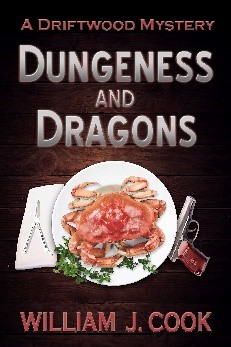
William Cook moved to the Pacific Northwest from the East Coast in 1989, and worked for a total of 37 years as a mental health therapist until his retirement in 2011. He splits his time between writing, babysitting for his 15 grandchildren, and sneaking off to mid-week matinees (when theaters are open!). The Kindle edition of his latest book, Dungeness and Dragons: A Driftwood Mystery, is available now for pre-order and will be published on April 24. Find all his books at:

https://authorwilliamcook.com/

Comments Off on William J. Cook, Advice for New Writers #writetip

Filed under writing

The view from the Room of Shame #amwriting

Today marks yet another Monday in our extended time of voluntary house arrest. Work continues on various writing projects. I’m still writing in the Room of Shame, that “no man’s land” of boxes, bags, luggage, and household debris that is our third bedroom.

I suppose if we actually did manage to get it tidied up, I would lose the ability to write.

All right, probably not, but that’s my excuse.

As a side note, I am making masks for our family unit. I don’t have a sewing machine, but I’ve rediscovered the serenity of hand-sewing, something my Grandmothers both did, and taught me.

My homemade masks aren’t as fancy as some made by our friends, but if you are looking for a simple pattern to make your own, here is a link: USA TODAY Make your own facemask.

I’m getting pretty tired of my own cooking, but I’m branching out again. Homemade vegan pizza on Wednesday night and fancy dinner salads break up the routine of casseroles and crockpot meals.

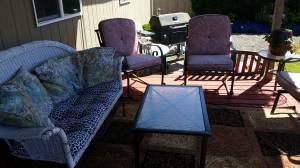
My back porch has become my personal escape. Watching the birds and letting my mind wander is restful. The flow of random thoughts is the source of creativity and this porch is my haven.

Having the time to just sit and daydream is important. Letting your mind roam free and allowing the possibilities to enter your stream of consciousness (or not, as they will) is beneficial for you.  Fifteen or twenty minutes a day of merely watching the world go by will rejuvenate you.

I do my best work when I have the chance to sit and let my mind wander. So, even when we aren’t in the middle of a quarantine, I always take the time to watch the town go by from my porch.

According to the internet, we daydream less as we get older. I wonder, is this nature or nurture?

What really happens when we allow ourselves to just sit and think about nothing in particular? What happens on a neurological level when we let our minds off the leash and allow it to run free and unencumbered?

One interesting fact is that apparently if we daydream about the past, we tend to forget what we were doing before the daydream started. This happens to me all the time.

Sometimes I gaze at the scenery with no conscious awareness of thought for long periods. This means my mind is entirely at rest. With this relaxing of conscious thought, I become rested, and my mind is cleared of the white-noise that hinders my creative process.

Some people call it meditation, and others call it a waste of time.

I call it essential.

Letting your mind roam with no particular direction lowers your stress levels, which immediately improves your health and your thought processes.

Sometimes we can visualize a complex emotional theme for our work but can’t find the words to describe it. If we can’t explain it, how do we show it? Often, the answers will come to me if I take the time to sit outside. I watch the clouds or the birds or listen to the trains passing at the other end of town.

I have discovered that when I am not thinking about the problem, the answer will come to me.

I hope that during this time of social distancing and quarantine, you have been able to set aside the stress and worry of our new normal. I am deeply aware of my good fortune in having a back porch and a garden to escape to.

When I was in my twenties, I moved often because of work. I usually lived in apartment complexes, which don’t always offer pleasant views or outdoor spaces.

I hope the views out your windows are worth looking at.

In the days ahead, my wish for you is that you will find the head-space to write and take any opportunity you can to simply let your mind wander.

5 Comments

Filed under writing

NIWA Blog hop Post 1: My Writing Process

This is the first in a six-week blog tour series for the Northwest Independent Writers Association. You can catch up with them at https://www.niwawriters.com/ The topic today is my writing process. I had a difficult time formulating how I wanted to write this post. Finally, I asked myself 3 questions, as if it were an interview.


  1. What am I working on?

I am working on three novels and was seriously procrastinating on a fourth, until the plague hit. The one I’m now getting through the formatting stage of the publishing pipeline is an alt-medieval fantasy, Julian Lackland. It is set in Waldeyn, a mishmash of Venice, Wales, and England. While the characters from Billy Ninefingers and Huw the Bard have significant roles in it, each book in the series is a standalone book.

I love Julian and his story, but I had a hard time letting go of him.

The novel I have on hold, Heaven’s Altar, is a two-book subseries set in the Tower of Bones world of Neveyah. It is a prequel, set 500 years before Mountains of the Moon. It deals with a historical figure, Aelfrid Firesword, who frequently gets mentioned as a kind of superhero in children’s books. All three of my main characters in that world were influenced by these books as children.

Alf is not superhuman. He’s a young mage with a destiny he’s not comfortable with. At the outset, his wife has abandoned him, leaving him with a sick child. Along with that, he faces the disapproval of his people for having married a woman who was not of the tribes. Alf has a long struggle ahead of him to prove he is worthy of taking up his grandfather’s task of War Leader.

My third work-in-progress, Bleakbourne on Heath, began as a serialized novel and ran for two years on a now-defunct website. This tale is an inverted Alternate-Arthurian story. In their history, Arthur was a Caligula-like figure. The Druids conquered Rome, and the Church reflects that.

I have fleshed it out, addressed the inadvertent discrepancies and contradictions that writing and publishing a chapter a week and winging it inevitably generated. That experience of writing by the seat of my pants taught me that I really DO need to have an outline.

Now I am trying to end the story and am working on the final battle. Leryn (with Merlin and Bramblestein) must face the Demon Knight, Mordred.

A fourth novel has been pulled out of storage and dusted off. Surprisingly, this paranormal scifi fantasy doesn’t stink as much as I thought it did. I’m finding a lot of useful material here.

  1. How does my work differ from others of its genre? Why do I write what I do?

First of all, I write from the point of view of both a gamer and an addict for fantasy novels. I am a freak for the brilliant early Final Fantasy console games. Final Fantasy VII, VII, X/X2, and XII are among the great classics in gaming. I want to inject the action, the romance, and the drama of a full-throttle action/adventure into my books. I want it set in a sweeping landscape, with my characters beset by nearly insurmountable challenges. I want the philosophies and moral choices, as well as personal relationships, to mean something to the reader.

Gaming teaches us that magic has finite limits, and no character has unlimited power.

In my worlds, those limitations are what drive the action because the characters have to struggle to overcome them. The power of the story is in the struggle. The final redemption must justify the effort and the losses incurred as they struggle toward the conclusion.

  1. How does my writing process work? 

Typically, when I first have the idea to write a book, I visualize it as the walkthrough for an RPG game. I spend days building the outline, the shell of the story. Because the Tower of Bones series began as the storyline for an RPG, I still have the habits developed in that industry.

I figure out the political and religious systems and create the rules for magic. Most importantly, I draw maps to keep my characters going in the right direction.

Each world is unique, and I want to know how my characters fit into their society.

My outlines are formed by the answers to these twelve questions:

  1. What is the inciting incident?
  2. What is the goal/objective?
  3. At the beginning of the story, what could the hero possibly want that pushes them to risk everything to acquire it?
  4. How badly do they want it, and why?
  5. Who is the antagonist?
  6. Why are they the enemy?
  7. What ethical choices will the protagonist have to make in their attempt to gain their objective?
  8. What happens at the first pinch point?
  9. In what circumstances do we find the group at the midpoint?
  10. What is their health like?
  11. Why does the antagonist have the upper hand? What happens at the midpoint to change everything for the worse?
  12. At the ¾ point, the protagonist should be ready to face the antagonist. Do I have the story set up correctly to this point so I can choreograph that meeting?

All stories must have a logical arc, but each character should too. It’s my job to make sure that the characters evolve and grow throughout the story. For me and my style of writing, the character arcs benefit most from the outline, even more than the overall story arc does.

Once I have that all done, I start at the beginning and write, connecting the dots between the vignettes. When all the dots are connected, I have a book—albeit a raw rough draft of a book. I set it aside and work on something else for several weeks before I begin the rewrite. Setting it aside is important because when I come back to it, I need to see the raw draft through unbiased eyes.

My work in the Tower of Bones series tends to be linear as it began life as the walkthrough for an RPG that was never built. Each protagonist has a specific goal or “quest.” Many obstacles hinder them on the path to achieving those goals. My task is to make it an emotionally gripping journey for the reader, so I have to be careful when choreographing scenes. I can’t go too over the top, but I need to be creative and logical.

The Billy’s revenge series has been anything but linear. The storylines in each could easily have gone awry, if I hadn’t had a basic outline to keep things logical.

I have to negotiate carefully between the two radically different series when I am writing, as I want to stay true to the intent and flavor of each.  This is where having a writing posse really helps.


I hope your writing journey has been as satisfying as mine. Thank you for being a part of my writing life!

The next installment of this series will feature William J. Cook, who will be sharing some excellent advice for new writers. Look for his post on Thursday, April 9th. You can find out more about him at https://authorwilliamcook.com

3 Comments

Filed under writing

Formatting the Final Manuscript #amwriting

I’m in the process of formatting a manuscript for publication, both for the paper version and the book version. While there are significant differences between the layout of the two types of documents, some fundamental things remain the same.

I create three manuscripts. Before I embark on making mobi files for Kindle or designing the interior of my paper book, I create a base manuscript, one which has been thoroughly combed by my writing posse. At this point, it is as well-edited as we can get it.

Name it as the BookTitle_Final_.doc

I strongly suggest you save it as a Word 97 – 2003 compatible document (NOT a template) rather than as a .docx. Saving as a compatible document ensures fewer problems in the upload.

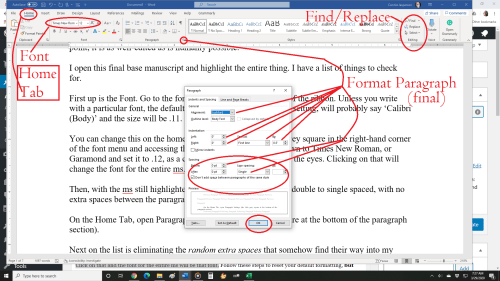
I have made several screenshots with the following steps highlighted for you, so if my instructions aren’t clear, my garbled artwork can confuse you even more.

I open my final base manuscript, and using select all, I highlight the entire thing. I have a list of things to check for.

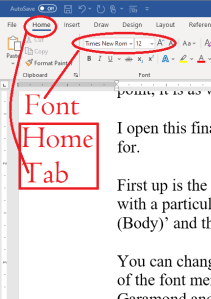
First up is the Font. Go to the font group, on the left-hand end of the ribbon. Unless you write with a particular font, the default font, or pre-designed value or setting, will probably say ‘Calibri (Body),’ and the size will be .11.

You can change this on the home tab by clicking on the little grey square in the right-hand corner of the font menu and accessing the drop-down menu. Scroll down to Times New Roman or Garamond and set it to .12. A standard serif font is easiest on the eyes. Clicking on that will change the font for the whole thing (if you used select all to highlight the entire ms).

Next on the list is eliminating the random extra spaces that somehow find their way into my work as I go. Extra spaces interfere with formatting for eBooks and other electronically uploaded applications. Other than at a few specialty printers, ALL books and magazines are uploaded electronically nowadays, even printed books.

Extra spaces are most frequently found at the end of sentences, or where you have cut and pasted a passage. For older authors, there may be two spaces at the end of every sentence. When I was learning to type in school, they taught us to hit the space bar twice (two spaces) between sentences, for the sake of readability.

That was a difficult habit to break, but it must be done.

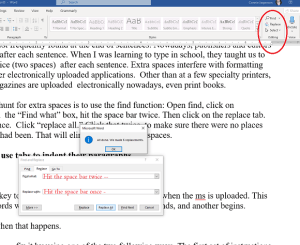
The simple way to hunt for extra spaces is to use the “find function” in the upper right corner of your toolbar:

  1. Open Find, click on “advanced find.”
  2. In the “Find what” box, hit the space bar twice.
  3. Then click on the replace tab.
  4. In the replace with box, hit the space bar once.
  5. Click “replace all.”
  6. Click that twice, to make sure there were no places where three spaces had been inadvertently inserted.

That will eliminate all the extra spaces.

I use “control-F” to open the Navigation Pane because it highlights the spaces in yellow, making them easy to see. The instructions are the same as when opening Find by using the toolbar. But for people who are new to word processing programs or who don’t use MS Word, using the toolbar on the ribbon is the simplest method.

Next, I make sure my paragraphs all look the way I want them to.

Some authors still use tabs to indent their paragraphs.

Don’t do it.

If you used the tab key to indent your paragraphs, the indents fail when the ms is uploaded. This creates a wall of words with no way to tell where one paragraph ends, and another begins.

Publishers hate it when that happens.

If you have done that, you can fix it by using one of the two following ways. The first set of instructions only work if you have a ten-key pad on your keyboard.

To remove tabs from a manuscript in Word or most other word-processing programs, open the “Find” box (right side of the ribbon on the home tab). In the “Find” field, type in ^t. (press the alt key 94 to make ^ and key the t) This only works if you have a ten-key (number pad) at the right side of your keyboard. ^t.

Then click “Replace.” In this field, type nothing. One click on “Replace all” will remove every tab.

That will leave you with no indents whatsoever.

If you don’t have a ten-key pad on your keyboard, you will have to remove each one by hand, which is a daunting task no publisher or editor has time for. Beginning with the first paragraph on the first page, scroll down and use the backspace key to remove the tab indenting every paragraph.

This will temporarily make your ms look like a wall of words, but you are going to resolve that the right way.

Once the tabs are all removed, use the following instructions to format paragraphs.

There are two ways to do this.

The easiest way is to open the “home” tab, click on “select all,” and with the manuscript highlighted, choose “normal” from the “styles” tab on the ribbon.

If your word processing program doesn’t have that option, you can format the paragraphs by using the simple formatting tool:

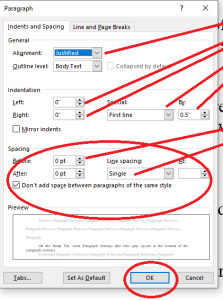
Step 1: On the Home tab, look in the group labeled ‘Paragraph.’ On the lower right-hand side of that group is a small grey square. Click on it. A pop-out menu will appear, and this is where you format your paragraphs.

Step 2: Justify the text. In justified text, the spaces between words and letters (known as “tracking”) are stretched or compressed. Justified text aligns with both the left and right margins. It gives you straight margins on both sides, but remember, this type of alignment only comes into play when a manuscript is being made ready for publication.

Step 3: Indentation: leave that alone or reset both numbers to ‘0’ if you have inadvertently altered it.

Step 4: Where it says ‘Special’: on the drop-down menu select ‘first line.’ On the ‘By’ menu, select ‘0.5.’ (You can specify a different number, 0.3 or 0.2, but 0.5 is standard.)

Step 5: ‘Spacing’: set both before and after to ‘0.’

Step 6: ‘Line Spacing’: set to ‘single.’This kind of formatting is not for work you are submitting to an agent, editor, or publisher. This is for a finished product that you intend to publish yourself.

You can get fancy with your layout, but remember, when it comes to eBooks, simple is better because it’s less distracting and less likely to fail in the upload.

I take this finished base manuscript to Draft2Digital and create my eBook and Mobi files there. As a member of Myrddin Publishing Group, I have all the ISBNs I need, but you can use theirs at no cost if you choose.

I use an old CreateSpace template to make my paper books, and even with that premade template, it’s a bit of a hassle. But that is part of the fun of publishing your work.

Next up, on Wednesday, I’ll begin a 6 part series that will post on Thursdays, featuring five guest authors and publishers who will discuss various aspects of Indie Publishing and how they negotiate the sometimes rough waters. I’m really looking forward to hearing what they have to say!

9 Comments

Filed under writing

The creative process #amwriting

A few years ago, I accepted a NaNoWriMo dare to write an Arthurian tale with a steampunk twist.

I rather quickly regretted that.

The first question I asked myself was: Where do Arthurian and steampunk connect well enough to make a story?

The answer was that they don’t. I was faced with the mental blankness we all feel when a story refuses to reveal itself.

For me, a bit of mind-wandering always loosens things up, so I sat on my back porch. I picked a knight at random, Galahad, and pondered the problem. What kind of a person might Galahad have been, had he truly existed?

Those characters were supposed to be men of the 5th or 6th century, ordinary men. But the tales featuring them were written centuries later. Their 11th-century chroniclers presented them in contemporary armor as worn by Crusaders, and so did all subsequent authors.

Despite the heroic legends written about them, they would have been flesh and blood and would have been subject to the same emotions and physical needs as any other person.

What if Galahad and Gawain were lovers? That thought led to these questions:

What really happened after the Grail was found? What if somehow Galahad got separated from Gawain through a door in time when the magic in the world vanished with the Grail? How would Galahad get back to Gawain?

What if Galahad was marooned in Edwardian England, with Merlin. That was how the steampunk aspect of the story came into being.

That story became Galahad Hawke

The main character is Galahad Du Lac, son of Lancelot Du Lac, illegitimate, some chroniclers have said. If he is, we have to accept that the fifth century was a lot less concerned about the proprieties than Victorian Romantics gave them credit for.

Galahad is a knight-errant, a classic character in medieval chivalric romance literature. The adjective errant in this context means wandering. These characters roam the land in search of adventures to prove their chivalric worth.

They engaged in knightly duels or went in pursuit of courtly love. The medieval romance of highly ritualized courtly love was a rigid structure. It defined the behaviors of noble ladies and their lovers. It was tightly intertwined with the principles of the Code of Chivalry.

The Chivalric Code was a system of values combining a warrior culture, knightly piety, and courtly manners. Adherence to the Code of Chivalry ensured a knight epitomized bravery, honor, and nobility.

Thus, since the established canon dictates that Galahad isn’t attracted to women, he goes on quests to find strange and magical objects such as the Holy Grail.

The story is told from Galahad’s point of view and opens just after the Grail is found. As I said above, history and fantasy merge in the Middle Ages, so I took the high fantasy route.

Galahad Hawke was published in a short collection called Tales from the Dreamtime.

I read some medieval literature in college and found his story both varied and fascinating. So, different versions of Galahad appear regularly in my work.

Nowadays, Galahad is considered a minor knight. However, what we regard as canon about him is taken from Sir Thomas Malory’s 1485 work, Le Morte d’Arthur, in which he has a prominent role.

Mallory’s collection was a reworking of traditional tales that were hundreds of years old, even in his day. Also, he wrote it while in prison for a multitude of crimes, so we can be sure it’s not historically accurate.

Traditionally, Galahad is an illegitimate son of Lancelot du Lac. He goes on the quest to find the Holy Grail and immediately goes to heaven, raptured as a virgin.

But was he raptured? If he was not raptured, what could have happened to make medieval chroniclers think he was?

And he never married, but humans tend to be human, so why would bachelorhood make Arthurian chroniclers assume he was a virgin?

You might wonder why the notion of a virgin knight and being taken to heaven before death was so important to the medieval chroniclers. Why would they write it as though it were factual recorded history?

People always rewrite history to suit the times in which they live.

Medieval chroniclers were writing some 300 to 400 years after the supposed event, during the final decades of the Crusades. We have excellent records of 15th and 16th-century political struggles, and yet we make things up about the Tudors and Elizabethans as we go along, because they were interesting people and we love to imagine what they must have been like.

Religion and belief in the Christian truths espoused by the Church were in the very air the people of the time breathed. All the physical and material things of this world were entwined and explained by the religious beliefs of the day.

Literature in those days was filled with religious allegories, the most popular of which were the virginity and holiness of the Saints, especially those Saints deemed holy enough to be raptured.

Death was the common enemy, the one thing kings feared as much as beggars did. Those saints who were raptured did not experience death. Instead, they were raised to heaven, where they live in God’s presence for all eternity.

Thus, Galahad’s state of virginity and grace was written to be an example of what all good noblemen should aspire to.

The High Middle Ages, the period of European history that commenced around 1000 and lasted until 1300 (or so), saw a flowering of historical-fantasy writing in England. The craft of researching history was not an academic subject taught in school.

Reading history and writing their own accounts was a hobby for educated men who had the time, social position, and the talents to pursue it. Also, it was the purview of well-educated members of the clergy. The scientific method did not yet exist, so their “histories” were colored by daydreams, fantasies, and religious beliefs.

This means the assertions these authors claimed were history weren’t authenticated by the kind of intense research that we apply to academic subjects today.

I like to think that if J.R.R. Tolkien had been writing history in a monastery during the 7th and 8th century, The Lord of the Rings would have the same place in our historical narrative that the Arthurian Cycle has now, and Aragorn would have been the king who united all of Britain.

Sure, the histories from this period are highly questionable. However, they’re entertaining fantasy reads, leaving us free to riff on them and create our own mythologies.

So that is what I’m doing—working on my Alt-Arthurian novel, and also an unfinished spec-fic novel I pulled out the archives, looking for something cheerful to write.

What are you writing? I hope you are enjoying good writing time during this period of uncertainty and voluntary house-arrest!

5 Comments

Filed under writing