
Scope creep (aka project creep, requirement creep, or kitchen sink syndrome) in project management refers to the changes and continuous (or uncontrolled) growth of a project. This can occur at any point after the project commences.
 The plan or design is submitted to the client, who likes it. A mockup of the first iteration is submitted to the client, who still likes it, but … their needs have changed a little, and a new adjustment must be incorporated.
Project creep sometimes occurs because we fail to envision and raise potential issues at the outset. Then, situations arise that are out of our control, and which affect production.
Everything takes longer than we thought it would.
We compound the problem by failing to evaluate new requests before approving them, not assessing whether fulfilling these add-ons is even feasible. At some point we must face the unpleasant truth.
These errors and oversights will either kill the entire project or alter it beyond recognition.
Requirement creep occurs when the project’s original scope is brilliant but nebulous, which is how novels are born – a glorious idea that isn’t fully formed but exponentially grows as we write.
 Books are one area where project creep is not only appreciated but encouraged. Stories are particularly prone to this continual expansion of the original ideas. Short stories grow into novellas and then into novels, becoming a series of books.
Nothing upsets a reader more than a book where the author contradicts something that has gone before. The storyboard is one visible, easy-to-comprehend way to keep on top of project creep. When creating a story, one must manage both time and distance, a difficult task.
Oh, as you are writing, you think you have it all straight in your head.
But as a child who has ever told a lie knows—stories grow and evolve in the telling. Eventually, it looks nothing like the way it started out.
Even on the surface, writing fiction is complex. Authors who want to take their books from idea to paperback must become project managers.
We don’t consciously think about this, but organizational skills are critical because we want the story to flow easily from scene to scene. This is why successful authors are project managers, even if they don’t realize it.
 The first aspect of this is to Identify your Project Goals – create a rudimentary outline with names, who they are in relation to the protagonist, and decide who is telling the story. Remember, your story is your invention. Some inventions are in development for years before they get to market. Others are complete and ready to market in a relatively short time. Regardless of your production timeline, this is where project management skills really come into play.
I use a phased (or staged) approach. This method breaks down and manages the work through a series of distinct steps to be completed.
- Concept: The Brilliant Idea. Make a note of that idea, so you don’t forget it.
- The Planning Phase: create a raw outline. Some people don’t need this step, but I do.
- The Construction Phase—writing the first draft from beginning to the end and continuing through multiple drafts.
- Monitoring and Controlling—This is where you build quality into your product.
Write the basic story. Build your storyboard/stylesheet and note the changes you make as you go. See my post on stylesheets/storyboard’s here: Self-editing: Ensuring Consistency.
- Find beta readers and heed their concerns in the rewrites. Take the manuscript through as many drafts as you must, to have the novel you envisioned.
- Employ a good line editor to ensure consistency in the quality of your product.
- Find reliable proofreaders. (Your writing group is an invaluable resource.)
Completion or Closing—Employ a cover designer if you are going indie.
-
- Find an agent if you are taking the traditional route.
- Employ a professional formatter for the print version if you are going indie.
- Court a publisher if you are taking the traditional route.
Maps and calendars are essential tools for the author, no matter what genre you are writing in. Regardless of how you create your stylesheet/storyboard, I suggest you include these elements:
- GLOSSARY – A list of names and invented words as they arise, all spelled the way you want them.
- MAPS – nothing fancy, just something rudimentary to show you the layout of the world.
- CALENDAR of events – especially important if the characters must travel.
A fourth thing your stylesheet/storyboard could include is the rough outline of your projected story arc. This is a good tool for fantasy authors because we invent entire worlds, religions, and magic systems. We don’t want to contradict ourselves.
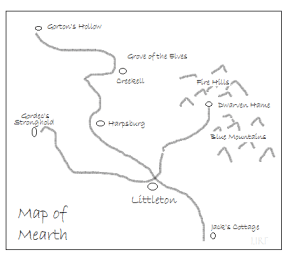 Your map doesn’t have to be fancy – all you need are some lines and scribbles telling you all the essential things, like which direction is north and what certain towns are named. Use a pencil, to easily update your map if something changes during revisions.
If you aren’t artistic and want a nice map later, your scribbled map will enable a map artist to provide you with a beautiful and accurate product. You will have a map that contains the information needed for readers to enjoy your book.
If your story takes place in the real world, use Google Maps, and print out a copy for your reference, or scan a map into your storyboard.
You need to know how the land looks to your characters, mountains, lakes, oceans, etc. You also need to know what lies to the north, south, east, and west. You should have some notion of where rivers and forests are relative to towns because those landmarks will be mentioned at some point.
Readers remember the smallest details and use them to visualize the world they are reading about. This is why you need some idea of distances and how long it takes to travel using the common mode of transportation.
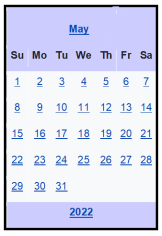 Time can get a little mushy when we are winging it through a manuscript. A calendar gives us a realistic view of how long it takes to travel from point A to point B, or how much time it will take to complete a task.
It helps to know what season your events occur in, as foliage changes with the seasons and weather is a part of worldbuilding.
The map shows the terrain your story takes place on, and weather can affect the terrain. Your characters will interact with their environment in different ways, depending on the season and the weather.
Project management is a vital tool for the author. Maps and calendars are the author’s project management tools. They work together to help you visualize your story. They enable you to manage time and distance in a logical way that doesn’t intrude into the reader’s awareness.
And that is important.
 Thus, it makes sense to consider whether your story is complex enough to hold up well across a series.
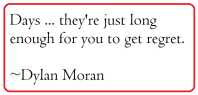 If you are done with your first draft and are just now realizing your novel could be the beginning of a saga, you should consider making notes as to what the future holds for your crew beyond the end. Otherwise, you may find yourself writing a continuation of book one, but with no goal, no purpose.
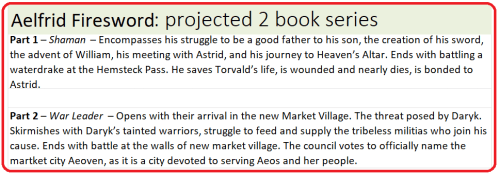 So, for a saga you might want to draw up an overall story arc for the entire series. For a standalone book featuring a recurring character, you likely won’t need to have an all-encompassing projected arc.
 Think about it – the universe contains all we can measure and know, all of space and time and their contents, including planets, stars, galaxies, and all forms of matter and energy. It likes balls and spirals and has a structure that repeats itself. This is reflected in the shape and behavior of the smallest particles to the largest quasars.
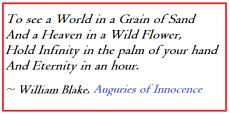 First off, no matter our conscious thoughts regarding the universe and God, writers don’t exist in reality. We exist in what we think reality is, and collectively, we create it as we go along, for good or ill.
 But if you make a map of what you can see, your own
 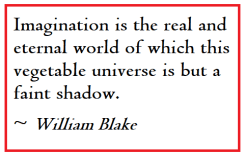 As I wrote, the outline for that first book took its shape. The written universe is in constant flux, and the storyboard records the changes and keeps the fabric of time from warping.
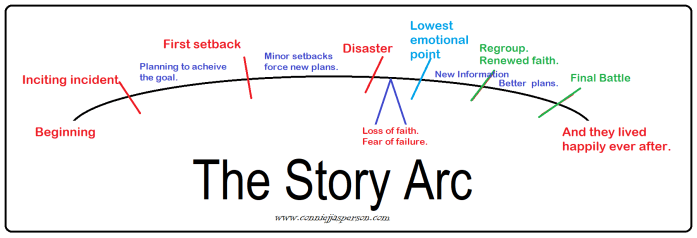 Once I have decided the proposed length, I know where the turning points are and what should happen at each. The outline ensures an arc to both the overall story and the characters’ personal growth.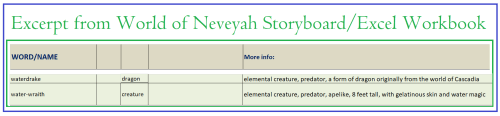
 In other words, something we can’t see or measure is out there, shaping our known universe. For lack of a better term, scientists refer to it as “dark matter” and “dark energy.”
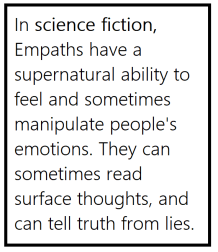 Unless your story is set in a school (such as the
 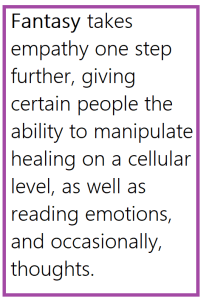 In real life, if a person had the kind of power that our fictional empaths wield, we would hope they were noble, compassionate, and above all, respectful of other people’s wish for privacy. One would want them to be circumspect and never rummage in people’s minds uninvited.
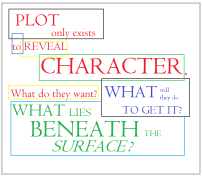 What does healing cost the healer? Does it exhaust them? Does some of the healing magic come from the patient? Do they need to sleep afterward?
 Magic should exist as an underlying, invisible layer of your written universe, the way gravity exists in reality. We know gravity works and accept it as a part of daily life.
 First, the ability to use magic is either learned through spells, an inherent gift, or both. Your world should establish which kind of path you are taking at the outset.
 Consider musicians. A person who wins international piano competitions most likely won’t be a virtuoso at brass instruments.
 Like science and magic, superpowers are believable when they are limited in what they can do.
 However, we can learn a great deal from books embodying poorly executed plots and badly scripted dialogue.
 Structurally, the books in this subseries feel like he knew how to end it but struggled to fill in the arc. Past events and conversations get repeated verbatim to every new character. Long passages of remembering and agonizing over what is done and dusted fluffs up the narrative.
 To me, book 21 reads as if (while books 19 and 20 were in the publishing gauntlet) he still had to fluff up the ending to make book 21 long enough to be considered a novel. The evidence of a lack of genuine inspiration is the absurd “scar” the protagonist is left with after winning an unbelievable victory and nearly dying.
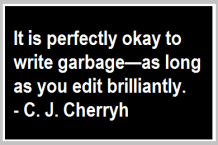
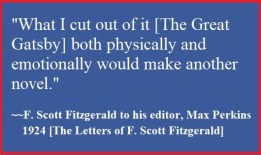 Everyone, even your favorite author, writes a stinker now and then.
 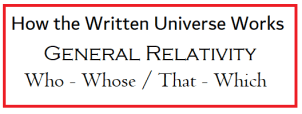 It deals with things like the mass of objects, the speed at which they travel, how speed and mass are converted to energy, and how mass warps the fabric of space and time.
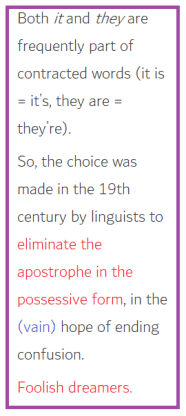 But what about “It?” Here, we are dealing with possession by the inanimate. We don’t need an exorcist, although a good maid service would resolve a great deal here at Casa del Jasperson. But in this case, we are referencing something owned by the inanimate:
 In the case of number 4, the sentence would be stronger without it. Most of the time, the prose is made stronger when the word “that” is cut and not replaced with anything. I say most, but not all the time.
 In the written narrative, the many forms of this verb are what
 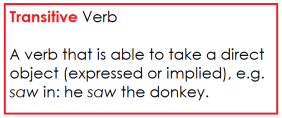 “Lay” is a transitive verb that refers to putting something in a horizontal position. At the same time, “lie” is an intransitive verb that refers to being in a flat position.
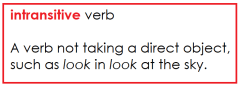 To lie is an intransitive verb: it shows action, and the subject of the sentence engages in that action, but nothing is being acted upon (the verb has no direct object).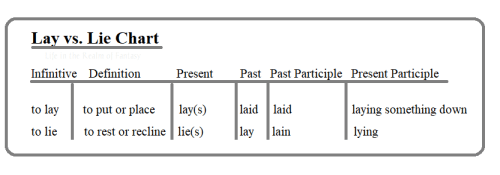
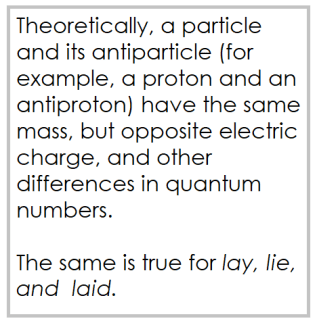 The verb that means “to recline” is “to lie,” not “to lay.” If we are talking about the act of reclining, we use “lie,” not “lay.” “When I have a headache, I lie down.”
 All around us, gravity works in hidden ways. Gravity on a small scale keeps everything securely stuck to the surface of Planet Earth.
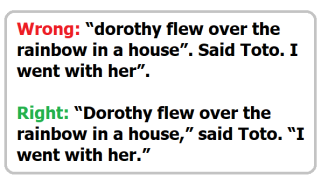
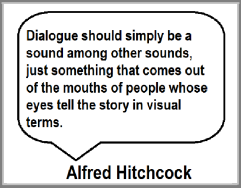 Creating memorable characters is the goal of all authors. After all, who would read a book with bland and uninteresting dialogue? Dialogue is where most information is given to the characters and the reader. However, when we are just beginning to write, many of us are confused about how to punctuate conversations. It’s not that complicated. Here are four rules to remember:
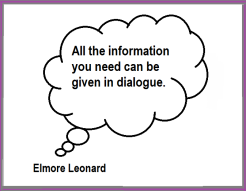 When you envision your characters in conversation, you must think about what the word natural means. People don’t only use their words to communicate. Bodies and faces tell us a great deal about a person’s mood and what they feel.
 For this reason, we don’t want to inject an excess of flushing, smirking, eye-rolling, or shrugging into the story. Those actions have a specific use in conveying the mood, but anything used too frequently becomes a crutch.
 We are emotional creatures. When we are just starting on this path, getting an unbiased critique for something you think is the best thing you ever wrote can feel unfair.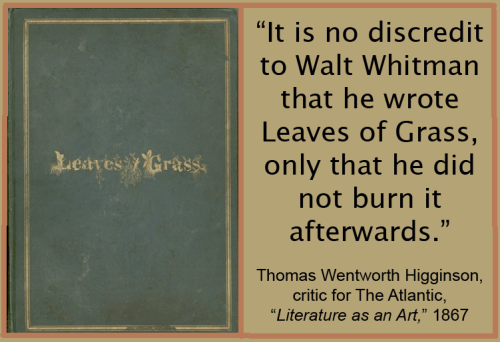
 I could have embarrassed myself and responded childishly, but that would have been foolish and self-defeating. When I really thought about it, I realized that particular plot twist had been done many times before. I thanked him for his time because I had learned something valuable from that experience.
 Treat all your professional contacts with courtesy, no matter how angry you are. Allow yourself some time to cool off. Don’t have a tantrum and immediately respond with an angst-riddled rant.


 Life in the Realm of Fantasy