Tag Archives: writing craft

#amwriting: Repetition

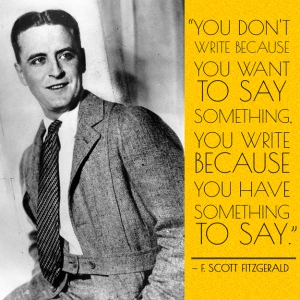
f scott fitzgerald The Great GatsbyAs it is March and is that month known as National Novel Editing Month or NaNoEdMo, I will be revisiting some of my posts on the craft of writing. Today we are looking at Repetition: Repetition can be an effective literary tool, or it can be boring, the overuse of a crutch word, or even the inadvertent repetition of an entire paragraph.

Unconsciously using the same words too often in our descriptions is one of the pitfalls of writing. It happens to all of us, and for me, it occurs most often when I am laying down the first draft. I’m hurrying and trying to get the ideas out of my head and onto the paper, and my vocabulary can’t keep up.

Many common words (the, and, etc.) don’t really stand out when used more than a few times in a paragraph, and you couldn’t write well if not for those words. However, some words will always stand out more than others, and if you use them more than once in a paragraph, it looks like you’re unimaginative or a lazy writer. This is especially true if the word in question has a lot of synonyms you could have used instead of repeating the same word. Having a good thesaurus at hand is a great help to the brain-stranded author.

Some words don’t have a lot of obvious synonyms, so you get hung up on the few you can find.  In my own work, the word sword is one of the main culprits. The type of blade my characters wield in the World of Neveyah books is a claymore, and four ensorcelled blades figure prominently in the Tower of Bones series.

Therefore, some obvious synonyms will not work as these are distinct blade types that are in no way like a broadsword.

  • Rapier
  • Epee
  • Foil

Because of this constraint, I am limited to:

  • Sword
  • Blade
  • Weapon
  • Steel (if I’m desperate, but I despise using that to reference a weapon that isn’t an epee or a rapier)

The spell-check function of your word processing program will pick many inadvertent repetitions out for you, such as “the the.” However, I recommend printing out each chapter. Then, starting on the last page, place a blank sheet of paper over your chapter, covering all but the last paragraph on the last page. This paragraph is your starting point. With a highlighter, start from the bottom and work your way up, paragraph by paragraph. Use the highlighter to mark the places you want to correct.

Once you have marked up your hardcopy, you can open your digital files, and make your revisions much more quickly, simply by looking at your notes and crossing them off as they are completed. This method saves me weeks of work when I am trying to get a manuscript submission ready.

Working with hardcopy from the bottom up, blind to what has gone before in that chapter, allows you to see the work through unbiased eyes. When you do this, you will also find places you have repeated an entire thought almost verbatim, and places you don’t like your phrasing. You may decide to change some things around.

However, sometimes we use intentional repetition:

Sometimes we want to emphasize a concept, and deliberate repetition is the way to do it. Some of the best authors use the repetition of certain key words and phrases to highlight an idea or to show the scene. This technique is an accepted rhetorical device and is commonly found in mainstream fiction. It is used to evoke an emotional response in the reader and can be exceedingly effective when done right.

Literarydevices.net says, “The beauty of using figurative language is that the pattern it arranges the words into is nothing like our ordinary speech. It is not only stylistically appealing, but it also helps convey the message in a much more engaging and notable way. The aura that is created by the usage of repetition cannot be achieved through any other device.”  (End quoted text)

Also according to literarydevices.net, repetition as a literary device can take these forms:

  • Repetition of the last word in a line or clause.
  • Repetition of words at the start of clauses or verses.
  • Repetition of words or phrases in opposite sense.
  • Repetition of words broken by some other words.
  • Repetition of same words at the end and start of a sentence.
  • Repetition of a phrase or question to stress a point.
  • Repetition of the same word at the end of each clause.
  • Repetition of an idea, first in negative terms and then in positive terms.
  • Repetition of words of the same root with different endings.
  • Repetition both at the end and at the beginning of a sentence, paragraph, or scene.
  • A construction in poetry where the last word of one clause becomes the first word of the next clause. (End quoted text)

Some famous examples of repetition as a literary device:

“Every book is a quotation, and every house is a quotation out of all forests, and mines, and stone quarries; and every man is a quotation from all his ancestors.”  Ralph Waldo Emerson, Prose and Poetry

“About half way between West Egg and New York the motor-road hastily joins the railroad and runs beside it for a quarter of a mile so as to shrink away from a certain desolate area of land. This is a valley of ashes—a fantastic farm where ashes grow like wheat into ridges and hills and grotesque gardens, where ashes take the forms of houses and chimneys and rising smoke and finally, with a transcendent effort, of men who move dimly and already crumbling through the powdery air.” F. Scott Fitzgerald, The Great Gatsby

When an author writes it intentionally to drive home a point, repetition is an effective tool. It is when words are inadvertently used with a lack of creativity that repetition ruins a narrative.

ozford-american-writers-thesaurusConsider buying a thesaurus or make use of the many online thesauruses that are available.

I have a well-worn copy of the Oxford American Writer’s Thesaurus. This book has become just as important to me as my copy of the Chicago Manual of Style. This large book of synonyms can be purchased used from Amazon, for as little as $9.99 in the hardcover form. I do recommend purchasing this as a paper book rather than an eBook. Once you see the amazing variety of words at your disposal, it’s one you will refer back to regularly.


Credits & Attributions

LiteraryDevices Editors. “Repetition” LiteraryDevices.net. 2013. https://literarydevices.net/metaphor/ (accessed March 8, 2017).

Ralph Waldo Emerson, The Complete Works. Published 1904. Vol. VIII. Letters and Social Aims, VI. Quotation and Originality, Bartleby.com, accessed (March 8, 2017)

F. Scott Fitzgerald, The Great Gatsby, pub. 1925 Charles Scribner & Sons.


3 Comments

Filed under writing

#amwriting: Hyphens are the Devil

Book- onstruction-sign copyAs it is March and is that month known as National Novel Editing Month, or NaNoEdMo, I will be be revisiting some of my posts on the craft of writing. Today we are looking at that most abused morsel of punctuation, the Hyphen. In my own work I will be looking at each hyphen and deciding if it stays or if it goes. Much of the time, they must go. 


Most authors know that a compound word is a combination of two or more words that function as a single unit of meaning. Most of us even know that there are two types of compounds: those written as single words, with no hyphenation and which are called “closed compounds”– such as the word “bedspread,”  AND  the “hyphenated compounds,” such as “jack-in-the-box” and “self-worth.”

But there is a third group, and they are the bane of my life–those mysterious, ephemeral denizens of the deepest corner of writer’s hell, called open compounds. These seemingly innocent instruments of torture are written as separate words–the nouns “school bus” and “decision making,” for example.

But how do I tell if  it’s one word, two words or a hyphenated word?  

Do not use a hyphen unless it serves a purpose. If a compound adjective cannot be misread or, as with many psychological terms, its meaning is established, a hyphen is not necessary. For example:

  • covert learning techniques,
  • health care reform,
  • day treatment program,
  • sex role differences,
  • grade point average

Do use one in a temporary compound that is used as an adjective before a noun, use a hyphen if the term can be misread or if the term expresses a single thought:

For example:

“the children resided in two parent homes” means that two homes served as residences, whereas if the children resided in “two-parent homes,” they each would live in a household headed by two parents.  In that case, a properly placed hyphen helps the reader understand the intended meaning.

We also use hyphens for compound words that fall into these catagories:

  • the base word is capitalized: pro-African
  • numbers: post-1910, twenty-two
  • an abbreviation: pre-ABNA manuscript
  • more than one word: non-achievement-oriented students
  • All “self-” compounds whether they are adjectives or nouns such as self-report, self-esteem,  self-paced.

We hyphenate words that could be misunderstood if they’re unhyphenated:

  • re-pair (to pair again) as opposed to repair (to mend)
  • re-form  (to form again) as opposed to reform (to improve)

We hyphenate words in which the prefix ends and the base word begins with the same vowel:

  • meta–analysis, anti–intellectual

But really, unless you are a technical writer, how often are we going to use these terms? Hence, the confusion when we DO use them.

Get It Write online dot com says, “One way to decide if a hyphen is necessary is to see if the phrase might be ambiguous without it. For example, “large-print paper” might be unclear written as “large print paper” because the reader might combine “print” and “paper” as a single idea rather than combining “large” and “print.” Another such example is “English-language learners.” Without the hyphen, a reader might think we are talking about English people who are learning any language rather than people who are learners of the English language.”

Write most words formed with prefixes and suffixes as one word with NO hyphen.

  • Prefixes: Afterglow, extracurricular, multiphase, socioeconomic
  • Suffixes: Arachnophobia, wavelike, angiogram

APPROACHING HELL © cjjasperson 2012 Lif In the Realm of FantasyHooray for Merriam-Webster! One can also look the word up in an online dictionary, to see the various different ways it can be combined. Just go to: http://www.merriam-webster.com

Now the real point of all this is that no matter how much I know when I am editing for another author, I always manage to screw up my own work amazingly well. It’s like my finger has a twitch that absolutely MUST add a hyphen. Thank god for good editors.


Credits:

Get It Write Online, Writing Tip Compound Words: When To Hyphenate © 2003, http://www.getitwriteonline.com/archive/042703compwdshyph.htm, accessed Feb 28, 2017

25 Comments

Filed under writing

#amwriting: theme

ofmiceandmenTheme is the core of the plot, an idea-thread that runs through your story from the opening pages to the end, binding the elements of characters, conversations, actions, and reactions. Theme is independent of the setting or genre.

Wikipedia, the fount of all knowledge, describes theme as:

The most common contemporary understanding of theme is an idea or point that is central to a story, which can often be summed in a single word (e.g. love, death, betrayal). Typical examples of themes of this type are conflict between the individual and society; coming of age; humans in conflict with technology; nostalgia; and the dangers of unchecked ambition. A theme may be exemplified by the actions, utterances, or thoughts of a character in a novel. An example of this would be the theme loneliness in John Steinbeck‘s Of Mice and Men, wherein many of the characters seem to be lonely. It may differ from the thesis—the text’s or author’s implied worldview.

Often we can visualize a complex theme but we can’t explain it. If we can’t can’t explain it, how do we show it? Consider the theme of “grief.” It is a common emotion that can play out against any backdrop, sci-fi or reality based, where there are humans interacting on an emotional level.

Perhaps you have a story about a woman who has just lost her husband to a preventable accident. Her grief is the main theme. When you learn the accident that killed him was preventable, you know the subtheme: anger. The protagonist’s goal in this story is to prevent such accidents from happening again–perhaps she must battle a corporation or take on a government agency. Rage is the motivator that forces her to wake up each day and take on the Goliaths, but at the root of the story it is her grief that is the driving force behind her subsequent actions.

But the main theme of grief is an extremely complex experience, as anyone who has ever suffered the loss of a loved one will tell you. It is a fundamental emotion, chaotic and weighing heavy in the heart of one who grieves. It is experienced in many identifiable stages with elements of loneliness, anger, guilt, and deep suffering. It is sometimes accompanied by thoughts of suicide.

Everything your character sees and experiences in the opening pages underscores and represents her sense of loss and inspires the accompanying emotions of anger, futility, and depression. As her story progresses and she begins live despite her loss, she will still be affected on many levels and to a certain extent, driven by those complex emotions. While she is interacting with others who are happy and who believe she has gotten past her pain, you can employ allegories and symbolism to paint the deeper picture of her mental state to show how she is deeply depressed and possibly suicidal.

Once your protagonist has beaten the enemy, what is her reaction? Without the battle to sustain her rage, does she learn to accept her loss begin to find happiness? Or does she allow herself to spiral into ever worsening depression?

Perhaps you are writing a tale where a group of people faces terrible challenges in a war. On the surface, this looks like it is all about the action, but in reality, it is not. It is about relationships, the bonds of friendship, and the way the events of this war bind a group of soldiers together and also the way events test those bonds, perhaps breaking them. The theme of this tale is brotherhood: the way fighting a common enemy binds strangers from all walks of life together, creating brothers- and sisters-in-arms.

How do you identify your theme? Sometimes it’s difficult unless you start out with one in mind. Most of my books are based around the hero’s journey, and how the events my protagonists experience shape them. The hero’s journey allows me to employ the theme of good vs. evil and the sub-themes of brotherhood, and love of family.

These concepts are important to me on a personal level, and so they find their way into my writing.

What themes are important to you? When you look for a book, what catches your interest? I am not talking genre here, I am speaking of the deeper story. When you look at it from a distance, what do all the stories you love best have in common?

Political thrillers: Set against the backdrop of a political power struggle. Political corruption, terrorism, and warfare are common themes.

Romance Novel: Two people as they develop romantic love for each other and work to build a relationship. Both the conflict and the climax of the novel are directly related to that core theme of developing a romantic relationship, although the novel can also contain subplots that do not specifically relate to the main characters’ romantic love.

Literary fiction focuses on the protagonist of the narrative, creating introspective. These are in-depth character studies featuring interesting, complex and developed characters. Action and setting are not the primary drivers of the story arc here. Instead, action and setting are carefully developed in such a way they frame the character, and provide a visual perspective. Allegory is a featured motif in many literary fiction novels.

allegoryScience Fiction: realistic speculation about possible future events, based solidly on adequate knowledge of the real world, past and present, and on a thorough understanding of the nature and significance of the scientific method. Science and technology are a dominant theme but based on current reality. Characters are still subject to sub-themes such as morality and love, but setting and science are the main themes.

Fantasy: Often set in alternate Earths, medieval times, or ancient worlds, the common themes are good vs. evil, hero’s journey, coming of age, morality, romantic love. Can also be set in urban settings with paranormal tropes.

On the surface, these types of books look widely different but all have one thing in common–they have protagonists and side-characters. These imaginary people will all have to deal with and react to the underlying theme of the book.

Morality, love, coming of age–these ideas can be found in nearly every book on my shelves or in my Kindle.


Credits:

Wikipedia contributors, “Theme (narrative),” Wikipedia, The Free Encyclopedia, https://en.wikipedia.org/w/index.php?title=Theme_(narrative)&oldid=765573400 (accessed February 22, 2017).

2 Comments

Filed under writing

#amwriting: sorting out the sound-alike words

they're their there cupWriting the first draft of your novel can be difficult as word-wrangling is not for the faint of heart. Often I write and rewrite the same paragraph three or even ten times, and still hate it. There are times when getting your phrasing right is confusing.  Many frequently used words are “homonyms” or sound-alike words.

At times, only a homonym, a word that sounds very much like another, can be used in a sentence. That similarity makes it hard to know which word is the correct word in a given circumstance, and when you are spewing the first draft of a manuscript, autocorrect may “help you” by inserting the wrong instance of those words. If their meaning is similar but not exactly the same, negotiating the chicken yard of your manuscript in the second draft becomes quite tricky.

This is where the diligent author does a little research. We go to the internet and Google every possible spelling of the word and decide which of the sound-alike words is the one we want to use.

Consider whether or not you want to use the word “ensure.”

There are three words that could work, and they sound alike. They have similar but different meanings.  So I do my research:

Assure: promise, as in I assure you the house is clean.

Ensure: confirm, as in Ensure that you have set the burglar alarm before going on a long trip.

Insure: protect with an insurance policy, as in Insure your home for your peace of mind.

Some other oft confused soundalikes are (these are borrowed directly from the Purdue Online Writing Lab)

  • advise = verb that means to recommend, suggest, or counsel:

I advise you to be cautious.

  • advice = noun that means an opinion or recommendation about what could or should be done:

I’d like to ask for your advice on this matter.

Than, Then

Than used in comparison statements: He is richer than I.
used in statements of preference: I would rather dance than eat.
used to suggest quantities beyond a specified amount: Read more than the first paragraph.
Then a time other than now: He was younger then. She will start her new job then.
next in time, space, or order: First we must study; then we can play.
suggesting a logical conclusion: If you’ve studied hard, then the exam should be no problem.

Their, There, They’re

  • Their = possessive pronoun:

They got their books.

My house is over there.

(This is a place word, and so it contains the word here.)

They’re making dinner.

(Pronouns have apostrophes only when two words are being shortened into one.)

To, Too, Two

  • To = preposition, or first part of the infinitive form of a verb:

They went to the lake to swim.

  • Too = very, also:

I was too tired to continue. I was hungry, too.

  • Two = the number 2:

Two students scored below passing on the exam.

Two, twelve, and between are all words related to the number 2, and all contain the letters tw.

Too can also mean or can be an intensifier, and you might say that it contains an extra o (“one too many”)

One of my worst failings is the word “it.” If I am going to muck up my manuscript, this word will be a major culprit. I try to do a global search for every instance, and make sure the word is correctly used:

  • The texture of the wall —it’s rough. (It is rough.)
  • I scratched myself on its surface. (The wall’s surface.)

Its… it’s… which is what and when to use it?

The trouble here can be found in the apostrophe. In probably 99% of English words an apostrophe indicates possession, but once in awhile, it indicates a contraction.

  1. It’s is the contraction of “it is” and sometimes “it has.”
  2. Its denotes possession: It owns it

I highly recommend you go to the Purdue Online Writing Lab for a complete list of often used homonyms. Purdue OWL is an excellent resource for information crucial to the craft of writing. Much of what I know about the craft comes from there.

When you’re in the throes of a writing binge, these little no-no’s will pop up and confuse you the second draft. The problem is, you will see it as you intend it to be, not as it is written, so these are words you must pay attention to. Sometimes, doing a global search will locate these little inconveniences.

Some words stick out like sore thumbs:

they’re,

their,

there.

But some like

accept and

except

are so frequently confused and misused in our modern dialect that it is best to simply look it up to make sure you are using the right word for that context. If you search for these now, you will save your editor having to do this for you, and your edit will be much more productive.

Searching for these bloopers is what I like to think of as sorting the rattlesnakes out of the chicken yard, and is part of making your manuscript submission-ready.


Credits:

“ Spelling: Common Words that Sound Alike,” Purdue OWL, Contributors: Purdue OWL,  https://owl.english.purdue.edu/owl/resource/660/01/  (accessed  February 14, 2017).

9 Comments

Filed under writing

#amwriting: What Editors Want

My Writing LifeToday we are discussing a particular kind of editor: the submissions editor. When I first began this journey, I didn’t understand how specifically you have to tailor your submissions when it comes to literary magazines, contests, and anthologies. Each publication has a specific market of readers, and their editors look for new works their target market will buy.

In the publishing world, there are several different kinds of editors:  line editors, structural editors, submissions editors, and so on. Each does a specific job within the industry. When you look at the annual salaries, you can see that none of these jobs pay well, so it’s clear that, while they like to eat and pay the mortgage as much as any other person, editors in all areas of publishing work in the industry because they love a good story.

I’m just going to lay it out there for you: it’s not worth a publisher’s time to teach you how to be a writer. You have to learn that on your own.

So, if they aren’t going to edit your work, what does the editor for that publisher do?

According to Lynne Barrett in her article for The Review Review: A magazine editor is a person who enjoys bringing new writing to the world in a publication that will be seen, read, appreciated, and talked about.

Editors for contests and large publishers of books do the same—they find and bring work they enjoyed to the public. If your work has made it into that first part of their process, they may ask you for revisions to enable the book to sell better, but they won’t offer you technical advice.

This is because they shouldn’t have to. You must have the technical skill down before you submit your work to an agent or submissions editor. But if the gatekeeper wants perfect work, how do you get your work inside the gate?

You must do the work of submitting a clean manuscript that is marketable to the readers of the publication you are courting.

I know! If we have to do all the work why bother? For the indie author, magazines, contests, and anthologies are the most logical places for getting their names out to the reading world.

Large publications have wide readerships. The more people who read and enjoy a short piece by you, the more potential readers you have for your novels. These people likely read novels and guess what? If you have done your work as an indie publisher well, your novels are available as both paper and ebooks through Amazon, Barnes and Noble, and other digital booksellers.

When you have a great story that you believe in, you must find the venue that might be interested in your sort of work. This means you must buy magazines, read them, and write to those standards. For those of us who are not able to buy magazines, you can go to websites like Literary Hub, and read excellent pieces culled from various literary magazines for free.This will give you an idea of what you want to achieve and where you want to submit your work.

Go to the publisher’s website and find out what their submission guidelines are and FOLLOW THEM. (Yes, they apply to EVERYONE, no matter how famous, even you.) If you skip this step, you can wait up to a year to hear that your manuscript has been rejected, and they most likely won’t tell you why.

Formatting your manuscript is crucial. If you are unsure how that works, see my blogpost of July 24, 2015,  How to Format Your Manuscript for Submission.

Lascaux 2015For an excellent article that explains the expectations magazine publishers AND authors have and our symbiotic relationship, I suggest you read What Editors Want; A Must-Read for Writers Submitting to Literary Magazines by Lynne Barrett. This article touches on every aspect of the relationship between authors and submissions editors for ALL sorts of magazines, anthologies, and publishers in general:

  • The Editor’s Job
  • Your Job
  • Submission
  • How to Receive a Rejection
  • How To Respond To A Minimally Encouraging Rejection
  • How To Respond To A Longer, More Personal Rejection
  • Acceptance: Dos and Don’ts
  • How To Greet The Issue Your Work Is In

As I’ve said before, I have enough rejections to wallpaper my house, but I have also had a few short pieces accepted.  Not everyone will love your work–you don’t love everything you read either.

You have to keep trying, keep improving as an author, and keep believing in yourself and in your work. Most importantly, you must never give up.

25 Comments

Filed under writing

#amwriting: Pacing and the Story Arc

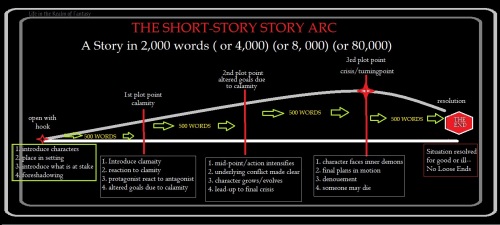
Pacing is a fundamental aspect of your story and is directly tied into the Story Arc.

But what, you ask, is “pacing” and how does it apply to the story I am writing?

Gerry Visco, for the Writers’ Store, describes pacing this way: “Pacing, as it applies to fiction, could be described as the manipulation of time. Though pacing is often overlooked and misunderstood by beginning writers, it is one of the key craft elements a writer must master to produce good fiction.”

As our narrative follows the arc of the story our characters experience action and reaction. The story has a certain life, almost as if it is breathing. It moves forward, then allows a brief moment where the reader and the protagonist process what just happened, and then it moves forward again. The speed with which these things occur is called “pacing.”

Depending on the type of story you are writing, this is more difficult to achieve than it sounds. When we’re in the throes of laying down our first draft, we usually manage to stick to the story arc we had envisioned, although sometimes it becomes more of a “story-wave.”  We have places where it moves along well, and then it bogs down.

The Story Arc copy


The website, Literary Devices, gives us some examples of pacing:

  • Action – An action scene dramatizes the significant events of the story and shows what happens in a story.
  • Cliffhanger – When the end of a chapter or scene is left hanging, naturally the pace picks up, because readers would turn the pages to see what happens next.
  • Dialogue – A rapid fire dialogue with lesser or irrelevant information is captivating, swift and invigorates scenes.
  • Word Choice – The language itself is a means of pacing, like using concrete words, active voice, and sensory information.

Action is a key element in genre fiction.

Conversation is also key, and in genre fiction it should pertain to and impart information the protagonist and the reader need to know, but only at the appropriate time. Writers Digest says, “The best dialogue for velocity is pared down, an abbreviated copy of real-life conversation that snaps and crackles with tension.”

In my opinion, this is true. In Literary Fiction, conversation and pacing can be more leisurely as the internal journey the protagonist is taking the reader on is the core of the story. For this reason, I disagree with the Literary Devices editors on this one point: even in slower-paced stories, irrelevant information doesn’t advance the story and will lose the reader.

If you are writing a murder mystery or a thriller, or sci fi or most kinds of fantasy, conversations have to show something important about the story or the characters at that moment and must move the story forward.

How fast do you want the events to unfold? Writers Digest points out three critical places in the Story Arc where a faster pace is optimal:

  • the opening,
  • middle,
  • and climax of your story.

They also say:

“Suspense and, by extension, forward movement are created when you prolong outcomes. While it may seem that prolonging an event would slow down a story, this technique actually increases the speed, because the reader wants to know if your character is rescued from the mountainside, if the vaccine will arrive before the outbreak decimates the village, or if the detective will solve the case before the killer strikes again.”

Book- onstruction-sign copyThat quote seems contradictory, but it isn’t. Consider the most popular genre: romance novels. These things fly off the shelves. Why? Because the path to love is never straightforward. Obstacles to the budding romance keep the reader involved and make them determined to see the happy ending even more.

In all stories, complications create tension, which is what keeps the reader reading.

The trick is to dole the action and reactions out in a smooth manner. Many instructors I have had taken seminars from have likened this to the way a skater skates: Push—glide—push—glide—push and so on, though the course of the novel.

Pacing is another area where screenwriters have something to offer us. Story, by Robert McKee, is an excellent reference manual.

Also, consider investing in The Sound on the Page, by Ben Yagoda. While it primarily deals with developing a unique style and voice, it has a lot to offer in terms of incidental information on the nuts and bolts of the craft. How you habitually pace your work is part of your style and voice.


For further reading on this subject, these are my sources for this post:

Gerry Visco, Pacing in Writing Techniques You Need to Know, Copyright © 1982 – 2017 The Writers Store ® Incorporated.

LiteraryDevices Editors. “Pacing” LiteraryDevices.net. 2013. http://literarydevices.net/pacing/      (accessed February 7, 2017)

Writers Digest 7 Tools For Pacing A Novel & Keeping Your Story Moving At The Right Pace By: Courtney Carpenter | April 24, 2012 (Accessed February 7, 2017)


Comments Off on #amwriting: Pacing and the Story Arc

Filed under writing

#amwriting: Too many characters?

my-books-cjjasp-own-workYou’re writing the first draft of your novel.  A beta reader has pointed out that you may have too many named characters to keep track of, and now you’re on a mission to whittle down your cast of thousands.
But who should go and who should stay? What is the optimal number of characters for a book? Some say only four, others fifteen, but I say introduce however many characters it takes to tell the story but use common sense. Put the reader first–they must be able to keep them straight without any effort.

When you introduce a named character, ask yourself if it is someone the reader should remember. Does he or she offer information the protagonist and reader must know? Some characters will give us clues to help our protagonist complete his/her quest.  Others show us something about the protagonist, give us a clue into their personality or past.

Does the person return later in the story or does he or she act as part of the setting, showing the scenery of, say, a coffee shop, or a store?

Only give names to characters who advance the plot.

In an excellent article on screenwriting, Christina Hamlett of the Writer’s Store writes:

In a screenplay, the rhythm you’re attempting to establish–along with the emotional investment you’re asking a reader to make–is disrupted whenever you devote more than two lines of introduction to a character who is simply there to take up space. In order to justify their existence, each player in your script should perform a unique function or deliver a specific line that:

  1. Advances the plot,
  2. Thwarts the hero’s objectives,
  3. Provides crucial background, and/or
  4. Contributes to the mood of the scene.

If you’ve included characters who don’t fulfill one or more of these jobs, they’re probably not critical to the storyline and can be deleted.

While she is speaking of screenplays, this is true of a novel or short story. A name implies a character is an important part of the story. Ask yourself if the character is an example of “Chekhov’s Gun.” Does this character serve a purpose the reader must know? If not, don’t give them a name.

One of my current works in progress has this passage, which takes place in an inn and involves a conversation overheard from a table adjacent to my protagonists:

The older merchant’s face darkened at the mention of the prince and his henchman. Quickly looking over his shoulder at the other guests in the common room, he hushed his son. “We’ll have no more mention of them at this table. If the wrong person overhears such talk, we’ll all end our days in our own beds with our throats slit!”

Culyn’s eyebrow rose, and he looked at Jack, who nodded.

Despite the fact the merchant and his sons give my protagonists information they needed, they are in this scene for only one purpose: to be overheard and don’t appear again. For this reason, only Jack and Culyn, and the three others of their party are named in the full transcript of this scene.

Novelists can learn a great deal about how to write a good, concise scene from screenwriters. An excellent book I have gained a lot of knowledge from is Story by Robert McKee. If you can get your hands on a copy, I highly recommend it.

We want the reader to stay focused on the protagonist(s) and their story. The second draft is where we make every effort to find the distractions we may have have inadvertently introduced in our rough draft, and extraneous named characters is an easy one to fix. Simply remove their name, and identify them in general terms. The reader will move on and forget about them.


Credit: Minor Characters Don’t Need Major Introductions, Christina Hamlett, Copyright © 1982 – 2017 The Writers Store ® Incorporated.

5 Comments

Filed under writing

#amwriting: words to seek and destroy

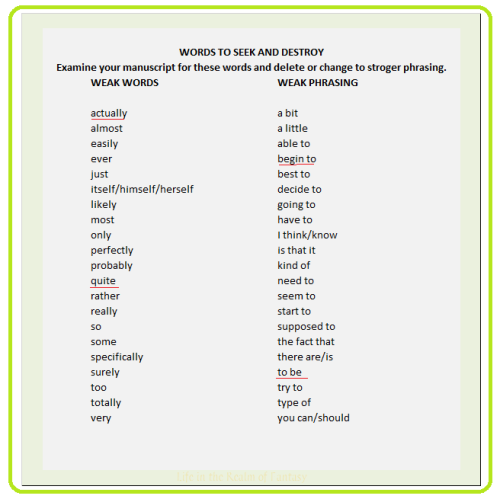
It’s been about a year since I last discussed what have been termed “weed words.” Certain words and phrases don’t add to the narrative and only serve to increase the wordiness. Used too freely, they separate the reader from the experience.

In my first draft, these words are like tics–they fall out of my fingers and into my keyboard randomly, and out of my voluntary control. I never self-edit as I write the first draft because I am just trying to get the story down. The second and third drafts are where you deal with grammar and phrasing.

One of my three current manuscripts is an epic fantasy and is genre fiction. This means I must write active prose, so I don’t want to use words with no power behind them.

words_to_seek_and_destroy_lirf_cjjasp1-17-2017

And these are just the tip of the verbal iceberg. I seek out adverbs, descriptors, qualifiers, and other “weed words,” look at how they are placed in the context of the sentence, and decide if they will stay or go.

In the second draft  I address larger things like the story arc, and plotting problems. I have a reader who will gladly tell me where I have gone off the rails, and he is merciless. Call me a glutton for punishment, but putting Dave’s suggestions into play is the best part of my writing experience, even though it is hard to give up some of my favorite passages.

If they don’t add to the story, they have to go to the outtakes file, my tears notwithstanding.

The third draft is the most difficult, primarily because I just want to be done with it. This is where I go on a “search and destroy” mission, seeking out instances of weak words and timid phrasing words. Consider adverbs: I do a global search for the letters “ly.” I kid you not, a kajillion of them will pop up in my left margin, and my ms will become a mass of words with yellow highlighted “ly’s.” It’s a daunting task, but I look at each and see how they fit into that context. If they weaken the narrative, I change or remove them. When it comes to adverbs, most often simply removing them strengthens the prose.

At this stage, I am preparing this manuscript to be edited professionally. The character arcs are solid, major plot problems have been addressed, and the story is as good as I can make it. Before I bother an editor with it, I want to make the process as smooth as possible. In order to find the offending words, I do what is called  a “global search.”

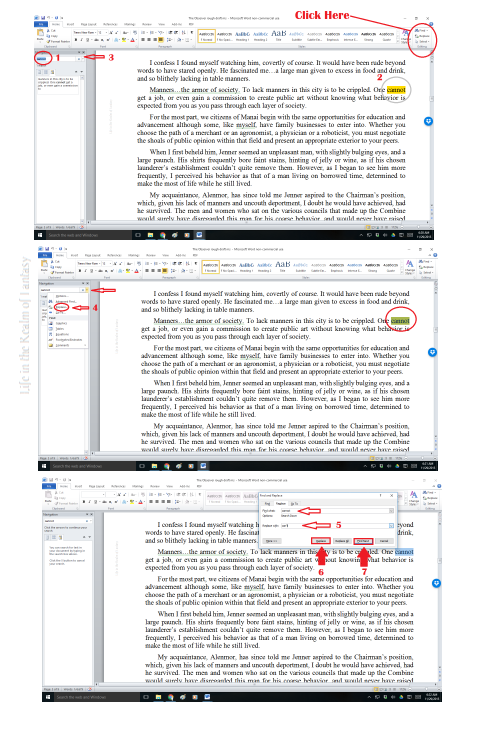
With your mouse or stylus, highlight the word you want to find every occurrence of. On the far right of the home tab, click ‘find.’ This will open the navigation pane.

Or, on your keyboard press the ‘ctrl’ key and the ‘f’ key at the same time. This is the keyboard shortcut to the navigation pane. Follow the instructions in this image:

LIRF Global Search all steps

Caution: if you are hasty or impatient a global search can be dangerous and can mess up an otherwise good manuscript.

Be aware: This is a boring, time-consuming task.

stop don't click replace allYou can’t take shortcuts. If you get hasty and choose to “Replace All” you run the risk of creating inadvertent bizarreness in your work.

Suppose you decide to simply eliminate every instance of the word “very” because you have discovered you overuse it. You open the navigation pane and the advanced search dialog box. In the ‘Replace With’ box you don’t key anything, thinking this will eliminate the problem.

Before you click ‘replace all’ consider three common words that have the letters v-e-r-y in their makeup:

  • Every
  • Everyone
  • Everything

Deleting every instance of ‘very’ could mess things up on an incredibly large scale.

Examine the context. Have you used the word “actually” in a conversation? If so, you may want to keep it, as dialogue must sound natural, and people use that word in conversation. If you have used it to describe an object, consider ditching it.

Do take the time to look at each example of the offending words and change them individually. The way I see it, what’s a day or two spent doing the job right, as compared to the year or more you’ve already spent writing that novel?

As always, while I am going through this, I address the occasional awkward phrasings and other things that pop up when you look at your manuscript from a different view.

It’s unfortunate, but there is no quick way to do this. Every aspect of getting your book ready for the reading public must be done with the human eye, patience, and attention to detail.

As I have mentioned before, editing programs are out there, some free, and some for an annual fee. Grammarly is one, but the problem is, these programs are unable to see the context. They operate by finite rules and will often strongly suggest you insert an unneeded article, or change a word to one that is clearly not the right one for that situation:

  • “The tea was cool and sweet, quenching her thirst.“
  • Grammarly suggested replacing quenching with quenched. I have no idea why.

Context is defined as the parts of a written or spoken statement that precede or follow a specific word or passage, usually influencing its meaning or effect. 

At this time in our technology, understanding context is still a human function. Because context is so important, I am wary of relying on these editing programs for anything other than alerting you to possible comma and spelling malfunctions.

I don’t mind taking the time to visit each problem and resolve them one at a time. Remember, readers don’t forget the authors whose work they despised.

11 Comments

Filed under writing

Learning from the masters: @TadWilliams: contrast and texture #amwriting

tadwilliams-the-heart-of-what-was-lostOne of my favorite authors is Tad Williams, who wrote the watershed series, Memory, Sorrow, and Thorn. To my eternal joy, he has set another series of books in the world of Osten Ard. The first installment, The Heart of What Was Lost, is set to launch on January 3, 2017.
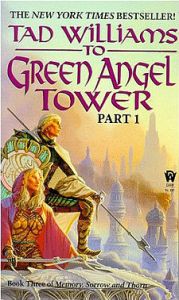
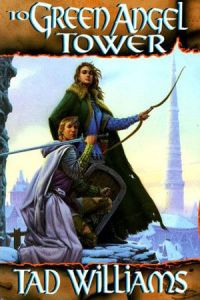
I have it on pre-order, as you might imagine—a Happy New Year present to me.

I became a confirmed fan of epic fantasy in 1988 when I first entered this world of Osten Ard and the books of Tad Williams. Each character was deserving of a novel, and the diverse races whose cultures were so clearly shown fascinated me. The arrogance some members of each race have with regard to their innate superiority struck me as illustrating a truth about the real world, something the Buddha once said: “We are what we think. All that we are arises with our thoughts. With our thoughts, we make the world.”  

Why did I become so captivated by Tad Williams’ work in the original series?

Contrast.

It is well-written, with harsh, beautiful prose, but more importantly an entire world is encapsulated in those pages. It is built from both good and evil, with all the many grey places between those two absolutes clearly defined. For each misery, some small glimmer of hope is introduced, offering a reason for the characters to keep struggling.

Tad Williams created the world of Osten Ard masterfully, exploring it through the diverse people’s thoughts and conversations. He used their impressions to show the setting, the history, and the core of the conflict. He started out slow, introducing Simon Mooncalf (Seoman) and the other players, showing a certain amount of background by Simon’s wandering path through the various places in his familiar environment.

Simon Mooncalf is an orphaned kitchen boy, serving in the immense castle, the Hayholt. He is in service to King John Presbyter, but he is a dreamer, unable to concentrate on the mundane tasks he’s been given. With the reputation of being an idiot, his fortunes change when he is apprenticed to the good Doctor Morgenes, the castle’s healer and wizard.

Green_Angel_Tower_P1Unfortunately, the king dies. Many dark, terrible events transpire, and ultimately Simon finds himself alone and on the run, carrying Dr. Morgenes’ true biography of the good King John.

The action then intensifies, as do Simon’s struggles. He finds friends who help him along the way, but they are also in danger. Love, friendship, and loyalty are tested when thrown against a lust for power, a desire for complete domination, and the endless desire of the ultimate mastermind behind the war, Ineluki, the immortal Storm King.

Tad Williams uses contrast. He opens in a place that feels comfortable and familiar, a place where food is plentiful and cats are lazy. He then slingshots the reader into a world of violence and darkness, hunger and fear. Simon is lost, alone, helpless, and terrified. Despite his being an orphan, he has only known comfort and now his life of deprivation is more than he can bear.

When I first began reading the series, it was clear to me that Tad Williams understood a fundamental truth of life: if you have never felt hunger, you can never understand what it is to have plenty. In the same context, if you have never known sorrow, how can you know joy? The contrasts of life are the flavors, the textures that give it meaning.

Since we are waxing philosophical, the Buddha also offered this morsel of wisdom for authors to consider, “There has to be evil so that good can prove its purity above it.”  

That contrast of good and evil is a fundamental truth for all writers of traditional fantasy fiction to consider when devising plots. It is one that J.R.R. Tolkien understood quite clearly. After all, what would have been the point of Frodo and Sam going to the depths of Mordor, suffering the hardships they endured if not to destroy the One Ring and negate the power of Sauron? And why would they do this, if Sauron was not the embodiment of evil?

In both the Lord of the Rings trilogy, and Memory, Sorrow, and Thorn, we have two of the most enduring works of modern fiction. Both feature an epic quest where through it all, we have joy and contentment sharply contrasted with deprivation and loss, drawing us in and inspiring the deepest emotions.

This use of contrast is why Tolkien’s work is the foundation upon which modern epic fantasy is built. It’s also why Tad William’s work changed the way people saw the genre of epic fantasy, turning it into hard fantasy. The works of these authors inspired a generation of authors: George R.R. Martin and  Patrick Rothfuss, to name just two of the more famous.

To_Green_Angel_Tower

In my own current work (as in all my work), good people have found themselves in bad situations. It’s my task to demonstrate the beauty of life through the drama, heartache, and violence.

Employing contrast gives texture to the fabric of a narrative. My intention is to use the emotions that are experienced when joys are contrasted against sorrows to draw the reader in. If I do this right, my readers will think about this story and these characters long after it has ended.

As a writer, if I can create a tale in which the reader experiences the full gamut of human emotion, I will have done my job.  The longer I am at this craft, the more I see that the rest of my life will be a training ground, teaching me new things, widening my writing horizons everyday. Reading and analyzing the works of the masters is a joy and a privilege, and is a necessary component of my education in the craft of writing.

1 Comment

Filed under writing

#amwriting: the #nanonovel: starting with the basics

a writer's styleI receive a lot of unsolicited manuscripts, by new authors looking for an editor. Most of them are from authors who just completed NaNoWriMo. They’re just learning the ropes and don’t realize their work is still in the unreadable stage. I always explain to them why these manuscripts are not submission ready, much less ready for an editor to have a look at.

What many first-time authors lack is knowledge, so I direct them to workshops, seminars, and writing groups.

This is where the work comes into it. We must learn and use the basic writing conventions that underpin how all English literature is written. These conventions consist of:

  • Spelling
  • Punctuation
  • Capitalization
  • Grammar

These are the fundamental rules authors follow so their work is understandable by any person who can read English, no matter if they are from Sacramento, London, Sydney, or Mumbai.

Kathleen Cali, in an article at Learn NC, says: “Conventions are the surface features of writing — mechanics, usage, and sentence formation. Conventions are a courtesy to the reader, making writing easier to read by putting it in a form that the reader expects and is comfortable with.”

When we write, whether we are writing a book, an essay, or an email, we are writing something we want the intended reader to comprehend. Therefore, we write using universally accepted rules for sentence construction.

So what makes an understandable sentence? It will consist of

  • a subject (My dog)
  • a verb (barked)
  • some words to help explain those two things (all night long.)
  • My dog barked all night long.

Sentences consist of clauses. Commas are the universally acknowledged pausing and joining symbol. Periods (or full stops) are how we signify the end of a sentence. Without these pausing and stopping symbols, our words become a jumble and make no sense. You might think this is a “Well, Duh!” moment, but when a person is in the throes of laying down the first draft they begin to write in a kind of mental shorthand, and sometimes these fundamentals fall by the way. This is why we do a second draft before we have anyone look at it.

Readers expect to find a pause between two clauses and commas are sometimes the signifiers of those pauses. Words that are conjunctions (such as and, or, but) also serve to join clauses to form compound sentences.

According to About Education: A clause may be either a sentence (an independent clause) or a sentence-like construction within another sentence (a dependent or subordinate clause).

Subordinate Clause definition: A group of words that has both a subject and a verb but (unlike an independent clause) cannot stand alone as a sentence. Also known as a dependent clause. Contrast with coordinate clause.

Example:

If a free society cannot help the many who are poor, it cannot save the few who are rich.”
(John F. Kennedy)

Mostly I find subordinate clauses cropping up in conversation–dialogue–when I look at my own writing. These “grammatical juniors” are like any other form of seasoning in our writing and must be used consciously and sparingly. When we write with too many subordinate clauses, we separate the reader from the narrative.

We provide balance in how we phrase our sentences, using a variety of sentence structures. We use complex sentences, consisting of:

  1. a simple clause 

I went to the grocery store.  (the meat of the matter)

  1. a dependent clause

because I needed skewers. (technically not necessary but adds to it)

  1. I went to the grocery store because I needed skewers.  

Who was I going to skewer? I don’t know, but I at least I had the right tool for the job.

We can set the clause off with commas:

The lake, its surface calm and black, called to me.

The lake called to me is the meat of this sentence, the clause describing it is technically not necessary, but without that clause the sentence is flat.

Sometimes, we want to use sentence fragments in our narrative. When they are written well and interspersed correctly, using sentence fragments emphasizes certain passages, creates a desired atmosphere, and can make conversations sound more natural.

A sentence expresses a complete thought.  Also, every sentence, no matter how short, contains a subject—or an implied subject—and a verb.  Linda Neuman of Sophia.org says:

So a sentence fragment would be a piece of a sentence.  It’s not a sentence because it’s incomplete, and does not contain both a subject and a verb.  Sometimes sentence fragments are referred to as incomplete sentences.  There is something missing, and you know it when you read it.  The thought is not complete, like a sentence would be.

Example of a sentence:  Her car was old, but very stylish.

Example of a sentence fragment:  Her car was old.  But very stylish.

The internet is full of good information about sentence construction and how to write a narrative that any reader of English, no matter what their nationality, will be able to understand. You can access a great deal of information on how to construct a readable narrative and it will cost you nothing.

commaThe Chicago Manual of Style is a volume that defines the rules of the road for US English Grammar.  I consider it an indispensable guide for serious authors. This particular book is the reference manual used by the US publishing industry and is the foundation book for my personal reference library. It is one of the oldest and most comprehensive style guides available, and for me in my role as an editor, it’s an indispensable tool because it contains information that I can’t find anywhere else. While I could easily access it all via the online version, I do like having my large book at my fingertips.


Quoted and Researched Sources:

AboutEducation.com: Clause (Grammar) by Richard Nordquist, accessed Dec. 11, 2016

GrammarRevolution.com:  What are Clauses by Elizabeth O’Brien, accessed Dec. 11, 2016

LearnNC.com: The five features of effective writing, by Kathleen Cali and Kim Bowen, accessed Dec. 11, 2016

Sophia.org: Using Sentence Fragments Wisely, by Linda Neuman, accessed Dec. 11, 2016

11 Comments

Filed under writing