Tag Archives: writing craft

#amwriting: Power Punctuation

A little power is a dangerous thing, and certain punctuation has power.

Exclamation points!

Em dashes—

Ellipses…

These are all wonderful, fun things to play with, but making too free with the power punctuation makes the narrative too breathless, or in the case of ellipses, too slow. When prose is well written, it conveys the excitement of the moment without force. A good author doesn’t resort to creating excitement with the overuse of exclamation points as this makes the narrative breathless. It tells the reader what to think, rather than showing them a scene that is exciting.

When I am laying down the first draft, I am just as guilty of filling the manuscript with exclamations, em dashes, and ellipses.  I am in a rush to get the ideas down on paper, so in some places, this is a subconscious shorthand for the second draft, which is where I take those telling scenes and show them.

I do a global search for exclamation points, ellipses, and em dashes. At each one, I examine the scene. Nine times out of ten, I change the power punctuation to a period, or I find the em dash or ellipsis was not needed.

Exclamation points, em dashes, and ellipses are like speech tags. They are necessary, but simplicity is the key to making them unobtrusive. Generally, dialogue worded powerfully, along with the way you visualize and then show the attitude of the characters and their situation will serve to convey the emotions.

When it’s done right, you will only need one or two morsels of power punctuation, and the punctuation you use won’t be a needle in the eye of the reader. The common, garden-variety period or comma will usually serve the situation well, and won’t throw the reader out of the book.

All punctuation has its place and should be used appropriately. Exclamation points, em dashes, and ellipses should be used, but only at important points. For the most part, the way you have set the scene combined with the dialogue itself will convey the tension without your having to sprinkle the narrative with power punctuation.

I suggest you do a global search and change most of them to a period.

But what about !?  I only recently learned that these are called “interrobangs.” Comic books frequently employ interrobangs, generally because the authors are limited on space for narrative and use creative punctuation as a shorthand. They do this as a way of telling the story.

It’s your narrative, so of course, you will do as you see fit. However, the exclamation point before a question mark is not accepted punctuation in literature intended for adults, so don’t be surprised if you receive negative feedback in reviews. Interrobangs are a writing habit professional writers will avoid if they want to be taken seriously.

Peppering the narrative with exclamation points and interrobangs is a form of telling the reader “this is exciting”, as opposed to showing the excitement. We want to immerse the reader, not blow them out of the manuscript. A great resource for ideas on how to convey strong emotions without telling the reader what the character is feeling is The Emotion Thesaurus: A Writer’s Guide to Character Expression by Angela Ackerman and Becca Puglisi.

All sentences should have only one punctuation mark to signify the end. “Ahah!” you say. “What about the ellipsis?” When the ellipsis falls at the end of the sentence, it should be three dots followed by the required punctuation.

  • If the ellipsis falls at the end of a sentence in dialogue, use a comma at the end of it followed by a speech tag. “But, my dog…,” Annie said, her brow furrowed.
  • If no speech tag is used, employ a period, question mark, etc. “But, my dog….” Annie’s brow furrowed.

This is because the ellipsis or em dash at the end of a sentence symbolize unspoken words, trailing off. They are not considered punctuation.

This is what the Chicago Manual of Style says:

Use an ellipsis for any omitted word, phrase, line, or paragraph from within a quoted passage. There are two commonly used methods of using ellipsis: one uses three dots for any omission, while the second makes a distinction between omissions within a sentence (using three dots: . . .) and omissions between sentences (using a period and a space followed by three dots: . …). An ellipsis at the end of a sentence with no sentence following should be followed by a period (for a total of four dots).

Once again, I emphasize that we use the Chicago Manual of Style if we are writing fiction and intend to publish it. The Chicago Manual of Style is written specifically for writers, editors, and publishers and is the publishing industry standard. All the editors at the major publishing houses own and refer to this book when they have questions.

What is the best style guide for writing technical user manuals?

Are you writing for a newspaper? AP style was developed for expediency in the newspaper industry and is not suitable for novels or for business correspondence, no matter how strenuously journalism majors try to push it forward. If you are using AP style, you are writing for the newspaper, not for literature. These are two widely different mediums with radically different requirements.

For business correspondence, you want to use the Gregg Reference Manual.

If you develop a passion for words and ways in which we bend them, as I have done, you could soon find your bookshelf bowing under the weight of your reference books. Writing is not a one-size-fits-all kind of occupation. There is no one style guide that will fit every purpose. Each essay and book may be meant for a different reader, and each should be written with the style that meets the expectations of the intended readers.

However, some things are universal:

Exclamation points must be used sparingly.

Ellipses symbolize omitted words and are not punctuation, so when the conversation trails off, you must add an ending punctuation. My God, I thought. What…?

Em dashes can either set off phrases—like this—or if used at the end of a sentence an em dash can indicate cut off words.

Consider the following quote from A Dog’s Tale by Mark Twain. In this case, you do not add punctuation:

It did seem to me that life was just too lovely to—

It is your task to write the narrative so that it shows the character’s emotions. Their eyes will widen, or their mouth will drop open, or they will stop and stare. When it comes to punctuation, do you tell, or do you show? You make the decision, but I see the interrobang and the overuse of the exclamation point as if they were too much seasoning, strong flavors that can ruin the the taste of the narrative.


Sources and Attributions:

The Chicago Manual of Style (16th ed.), page 639 sections 13.51 – 13.55 The Chicago Manual of Style 16th edition text © 2010 by The University of Chicago.

The Chicago Manual of Style (16th ed.), page 334 Section 6.84 Em dashes to Indicate Sudden Breaks, The Chicago Manual of Style 16th edition text © 2010 by The University of Chicago.

A Dog’s Tale,  by Mark Twain. © 1904 Harper & Brothers, via Wikipedia, The Free Encyclopedia, https://en.wikipedia.org/w/index.php?title=A_Dog%27s_Tale&oldid=769178379 (accessed May 16, 2017).

15 Comments

Filed under writing

#amwriting: Drawing on Life Experience

Writers, even dedicated, passionate ones, have lives outside the confines of their craft, and while it frequently derails our ability to write, it is also where we find the realism we need to inject into our work. Life must come before writing because writing doesn’t pay the bills unless you are one of the fortunate few.

I have several family members with serious health issues. Sometimes, I must step away from the keyboard and be the wife, niece, mother, or grandmother they need and you know what? My writing is better for it.

I nursed my mother, with whom I had a complicated relationship, through the last year of her life. She had smoked until the age of 42, and was addicted to perfumes and air-fresheners. She was a self-described clothes-horse who loved expensive cologne and used it liberally.

Even after her death, after they had been laundered and dry cleaned, her clothes still smelled strongly of her brand of Estee Lauder’s cologne.  In her home, she had a Glade plug-in in every outlet, and the spray bottle of Febreze in her hand at all times.

She died of lung cancer.

During her last year, we spent four days a week at the cancer center, and the rest of our time with me caring for my frail mother as if she were my baby. It was difficult mostly because watching someone you love slowly die is the worst. My sanity during that difficult year was made possible because of writing. I wrote 260,000 words during that year, some of it good, some of it off the rails. Much of the experiences of that year are unconsciously referenced in my current writing. It is the part of me that goes into each tale.

It was a devastating year made more difficult by my brother’s mental illness and drug addiction. Yet, that same year was made richer by the strange friendship that developed between me and my mother. All the many things that had stood between us and which had seemed so important were set aside and never addressed. This was because, in the face of her final battle, the hurts of the past just did not seem that important to me. We began to enjoy being in each others’ company, enjoy the quiet of an afternoon, or the bustle of a Starbucks. The ‘F’ word that some of us find so hard to say, forgiveness, became such an easy thing, and when she died, I had lost a friend as well as a mother.

On this blog, I’ve discussed the way epilepsy has affected my two of my adult children, and how our lives are affected by witnessing their struggle. Many hours have been spent writing in hospitals, and this last weekend was no different. I am there when they need me, and when they are ready to stand on their own, I allow them the space they need to do just that.

I have also mentioned how having an eccentric father with battle related PTSD forged my need to escape into books and inspired my writing. Some of us have survived the alcoholic parents who did their best, but dealt with an addiction they denied having. Every writer deals with family issues and experiences, both good and bad, and we are a composite of all of them.

Every time our heart is broken, every time we feel that glorious rush of infatuation, and every time we stick our foot in our mouth or must eat humble pie—these moments should find their way into our work and emerge as characters with real emotions, people who live and breathe and feel real to the reader.

Life in all its glorious beauty and ugliness fuels my writing, and I am not alone. We authors take what we know and reformulate it into something we can live with. In some ways, hope drives my writing. The fact I have hope allows me to write about things that are painful. I find that the fullness of life and the occasional emptiness of despair are easier written about when I set them in an alternate universe, and wrap it in a story that embraces the emotions, even though the story doesn’t parallel my life directly.

I’m like the character in a long, brilliant and sometimes bad, novel. My life is a mix of great joy, romance, helpless sorrow, extreme anger, and faith in the future. I hope your life is balanced as well as mine is, with the good outweighing the bad. This maelstrom of life experience is the well we draw from when we are creating our characters.

4 Comments

Filed under Epilepsy, writing

#amwriting: creating intimacy: Point of View

Narration is the use of a written or spoken commentary to convey a story to an audience. Wikipedia explains that a narrative consists of three components:

  • Narrative point of view: the perspective (or type of personal or non-personal “lens”) through which a story is communicated.

  • Narrative voice: the format (or type presentational form) through which a story is communicated.

  • Narrative time: the grammatical placement of the story’s time-frame in the past, the present, or the future.

We want to create a sense of intimacy, of being in the character’s head. One way to do that is to use stream of consciousness, a narrative mode that offers a first-person perspective by attempting to replicate the thought processes as well as the actions and spoken words of the narrative character.

This device incorporates interior monologues and inner desires or motivations, as well as pieces of incomplete thoughts that are expressed to the audience but not necessarily to other characters. Consider this passage from James Joyce’s Ulysses:

“A dwarf’s face, mauve and wrinkled like little Rudy’s was. Dwarf’s body, weak as putty, in a whitelined deal box. Burial friendly society pays. Penny a week for a sod of turf. Our. Little. Beggar. Baby. Meant nothing. Mistake of nature. If it’s healthy it’s from the mother. If not from the man. Better luck next time.

—Poor little thing, Mr Dedalus said. It’s well out of it.

The carriage climbed more slowly the hill of Rutland square. Rattle his bones. Over the stones. Only a pauper. Nobody owns.”

In this narrative mode, we see the POV character’s rambling thoughts, as well as witness their conversations and actions. This is a tricky device to do well, and the only time I have employed it was in a writing class.

When they want to tell a story though the protagonist’s eyes, many authors employ the first-person point of view to convey intimacy. With the first-person point of view, a story is revealed through the thoughts and actions of the protagonist within his or her own story.  The waves carried me, and I fell upon the shore, a drowning man, clutching at the stones with a desperation I had never before known.

I have used first-person, and find it easy to write. I prefer to read a third-person narrative so that is what I write in most often.

If you prefer, as I do, to write in an omniscient voice, the story is told from an outside, overarching point of view. The narrator sees and knows everything that happens within the world of the story, including what each of the characters is thinking and feeling. A way to convey intimacy when writing in third person omniscient is to use the third-person subjective.

Again, Wikipedia says, “The third-person subjective is when the narrator conveys the thoughts, feelings, opinions, etc. of one or more characters. If there is just one character, it can be termed third-person limited, in which the reader is “limited” to the thoughts of some particular character (often the protagonist) as in the first-person mode, except still giving personal descriptions using “he”, “she”, “it”, and “they”, but not “I”. This is almost always the main character (e.g., Gabriel in Joyce’s The Dead, Nathaniel Hawthorne’s Young Goodman Brown, or Santiago in Hemingway’s The Old Man and the Sea). Certain third-person omniscient modes are also classifiable as “third person, subjective” modes that switch between the thoughts, feelings, etc. of all the characters.”

This mode is also referred to as close 3rd person. I like this mode and frequently use it. At its narrowest and most subjective, the story reads as though the viewpoint character were narrating it. This is comparable to the first person, in that it allows an in-depth revelation of the protagonist’s personality, but differs as it always uses third-person grammar. Because it is always told in the third person, this is an omniscient mode. I like reading works written in this mode as it is easy for me as reader to form a deep attachment to the protagonist.

Some writers will shift perspective from one viewpoint character to another, such as George R. R. Martin does. I admit I don’t care for that but occasionally find myself falling into it. I then have to stop and make hard scene breaks, because it’s easy to fall into head-hopping, which is a serious no-no.

Head-hopping occurs when an author switches point-of-view characters within a single scene and happens most frequently when using a Third-Person Omniscient narrative because the thoughts of every character are open to the reader.

Experiment with POV. Write a scene from one of your works in progress using a different narrative mode. You might be surprised what insights you will gain in regard to your own work.


Sources and Attributions:

Wikipedia contributors, “Narration,” Wikipedia, The Free Encyclopedia, https://en.wikipedia.org/w/index.php?title=Narration&oldid=777375141 (accessed May 7, 2017).

Quote from Ulysses, by James Joyce, published 1922 by Sylvia Beach

Wikipedia contributors, “Ulysses (novel),” Wikipedia, The Free Encyclopedia, https://en.wikipedia.org/w/index.php?title=Ulysses_(novel)&oldid=777540958 (accessed May 7, 2017).

7 Comments

Filed under Literature, writing

#amwriting: demystifying the semicolon

Semicolons are misunderstood and misused bits of punctuation. Some people believe they are extra-long pauses, halfway between a comma and a (full stop) period. With that in mind, they litter their work with instances of typographical madness.

Semicolons are NOT extra-firm pauses. When writing genre fantasy, em dashes (or hyphens if you are British) serve that function. Semicolons have a different place in the universe. So now we’re going to examine the semicolon and discover what it is that they actually do.

The proper use of a semicolon is to join two short sentences that are directly related to each other, turning them into a compound sentence.

No one enjoys reading a choppy narrative because too many short sentences can be distracting and hard to get into. The way we smooth the narrative is to join short sentences into longer, compound sentences. But frequently, that creates run-on sentences. (I am the queen of those.)

SEMICOLON: Use a semicolon in place of a period to separate two complete, stand alone sentences where the conjunction has been left out. These sentences MUST be directly related to each other.

Incorrect: Call me tomorrow; if it rains. (The semicolon is not needed because “if it rains” is not a stand alone sentence. This sentence should be written: Call me tomorrow, if it rains.)

Incorrect: Call me tomorrow; the car is running in the driveway. (Each clause can stand alone but they have no relation at all to each other. They are separate thoughts completely.)

Correct: Call me tomorrow; we’ll make the arrangements then. (The conjunction and has been replaced by the semicolon.)

The key to understanding semicolons is to understand what a stand alone sentence is. A stand alone sentence consists of a subject and a verb, and expresses a complete thought:

Vera walked carefully across the rough ground.

Dogs and their owners came from all over to play in that park.

If you have sentences that express complete thoughts but make the narrative choppy, you can connect them with a conjunction: Rain had fallen. The yard was flooded. We were trapped.

Rain had fallen, and the yard was flooded, so we were trapped.

Alternatively, we could rewrite the sentences in such a way they aren’t choppy:

Rain had fallen, flooding the yard. We were trapped.

If you don’t want to use a conjunction and you absolutely must use a semicolon, or you will burst into flames, you have the legal right to do so.

Rain had fallen, flooding the yard; we were trapped.

Authors who truly believe in themselves and their work will go out of their way to learn the proper use of punctuation. Once we know the mechanics of the English language, we will use it in ways that define our vision for our work.

When we learn how punctuation functions in making our sentences flow for the reader, we begin to develop our sense of style. We begin to craft our work with intention.

As a result, our work ceases to be uneven, with occasional flashes of brilliance. It becomes engrossing, something our readers can get lost in.

However, there are some considerations for each author to ponder when it comes to the use of the infamous semicolon. For general fiction or literary fiction, semicolons are no big deal. Used properly, readers and reviewers won’t even notice them.

If you are writing in genres such as paranormal fantasy or hard science fiction, I suggest you use conjunctions or rewrite the sentences in such a way they aren’t choppy, rather than resorting to using semicolons. Some reviewers in those genres seem to despise semicolons, saying they are “archaic.” These reviewers will criticize work sprinkled with semicolons as being “too literary” (whatever that means).

Maybe they are archaic, but I doubt it. When I first began writing, I used to employ semicolons far too frequently and improperly. I had the good fortune of having an editor who was patient and happy to explain how they actually function. I bought a copy of the Chicago Manual of Style and that book is what I refer back to when I have questions about how punctuation works.

While I rarely use them myself nowadays, the semicolon is a legitimate punctuation mark, and when used correctly, it has a specific task. I suspect the many haters of this little morsel of madness are simply confused by the proper use of it, and therefore they consider it unnecessary.

8 Comments

Filed under writing

#amwriting: the first draft

Children are often full of fibs and fabulous tales. They crack me up with how obvious they are about it. But little white lies happen in adult life, too.  They are usually a gut-reaction, a sometimes irrational reflex that we justify with the comforting thought that “it doesn’t really matter, and this way we’ll avoid an argument.”

We’ve all done it at one time or another, and in much the same way as our toilet habits are, it’s not a subject we like to discuss in polite company.

But it makes an interesting plot development. In real life, white lies can escalate into big, complicated messes that can end marriages.  Love and white-lies are like the two sides of the family I grew up in – they don’t really mix well. In a good marriage, there are no white lies.  White lies happen when you don’t trust the other person to accept what you have either done or plan to do.

Trust is the key word here.

In the Tower of Bones series, I have one character whose life is one long string of white lies, and that made for the most pivotal plot development in the story. It was difficult to write his tale, and yet his penchant for avoiding the truth was the snowflake that caused the landslide, and it drove the plot. The repercussions of his white-lies in book two form the tension for the next books in that series.

In my opinion, the best stories take elements of life and that are sometime uncomfortable and give them that little twist, sending the protagonist down a path where the reader would never dare to go. We just have to do it in such a way that it feels organic and not forced.

In my current work, I am writing the first draft, trying to find out who these characters are. What are their personal strengths? What are their weaknesses? I will have to exploit their weaknesses to the max, but ultimately their strengths must win out.

Trust and the bonds of brotherhood are the core of this new series. Each book will feature a different protagonist, and the final book brings them all together in the finale.

When I first conceived my new series, the Aeoven Cycle, I had a vague idea of who these characters were. The main protagonist is a legendary hero, appearing in the time of Tower of Bones in children’s books as a superhero type of character. He is the Superman character, a mythical hero who always saved the day.

In Edwin’s time, history remembers Aelfrid as a hero, a mighty mage gifted with the ability to make his sword appear as if it were made of fire. His legacy was the Temple of Aeos and the College of Warcraft and Magic. He was that man, but who was he really?

As I get deeper into this first draft, I am discovering my protagonist, and finding out what his flaws and blind spots are. His real life had little to do with the amazing legends that grew up featuring him as a great hero, but he was heroic in the ways that matter. He is loyal, which is his great weakness, and which ultimately will force him down a path he doesn’t want to travel.

At this point my first draft sits on my desk, filled with repetitiousness and flat prose.  No matter how I grasp for words, a sword remains a sword, remains a sword… since to refer to it as a blade or weapon would require stretching my vocabulary and I’m struggling enough with trying to figure out the how and why of things.

It is, I keep reminding myself, only the first draft. Once I have the entire story down it will be come a four book cycle, with all the threads of the first three books coming together in the final book.

The important thing here is to get Alf’s story onto the paper. Once I have done that, I can tweak the prose and cut the fluff. It will take three drafts, and possibly two years, but I will eventually make this into something I would like to read, and hopefully, a story others will enjoy too.

2 Comments

Filed under writing

#amwriting: How to Handle Rejection

I have received my share of rejections. It hurts every time, but now that I am further down the road as a professional, I have enough scar tissue that I don’t feel the agony the way I used to.

Sometimes we receive a standard rejection that boils down to “Sorry, but no.” It’s not personal so I don’t brood over it. In my experience, those kinds of rejections are bad only because they don’t tell us why the piece wasn’t acceptable. I can only assume that the piece I sent in was not what the editor was looking for that day, or perhaps ever.

Not everything you write will resonate with everyone you submit it to.  Put two people in a room, hand them the most thrilling thing you’ve ever read, and you’ll get two different opinions and they probably won’t agree with you.

Some of us handle rejection with grace and dignity, and others go ballistic and make an uncomfortable situation worse.

The best kind of rejections, in my opinion, are when we receive a little encouragement: “Try us again.” That means exactly what it says, so the next time you have something you think will fit in that anthology or magazine, send them a submission.

I know it doesn’t make sense, but the more an editor writes in a letter about why they have rejected a piece, the more likely the author will be hurt and angry. This is because it’s a rejection and may contain detailed criticism. It’s like a bad review and feels unfair.

I once got a rejection from an anthology along with a curt note that said only that the subject had been done before.

I was a bit put off by the abruptness of the note, but I realized it was just this particular editor’s way. He’s a busy man with no time to waste on fools. Yet, he took the time to send me a note instead of a form letter.

The fact he sent me a note encourages me to believe he might be more receptive to a different story, so if I have one I think he’ll like, I’ll send it to him.

I could have embarrassed myself and responded childishly, but that would have been foolish and self-defeating. The truth was that it had been done before. I still love that story, but an editor’s bluntness is valuable, so I will someday rework that tale with a different twist.

We must have a care about the way we behave. We are judged by the manner in which we act and react in every professional interaction. If you respond to a peer’s criticism without thinking it through, you risk doing irreparable damage to your career—you will be put on that editor’s “no way in hell” list.

You need to be strong, stay calm, and understand that the editor has gone to some trouble for you. DO NOT respond to the letter with a flame-mail, and DO NOT go off hurt, bad-mouthing that editor to your homies on your favorite writers’ forums. They saw something good in your work, and you need to try this editor again.

But what if you have submitted to an anthology and, while they sent you no contract, they did send a letter of interest and a request for revisions?

That is huge. You have your foot in the door, so put on your grownup pants and make whatever changes they request. Your piece still may not make it, but give it your best shot. If the editor wants changes, they will make clear what they want you to do.

This happens most often for submissions to an anthology. You must trust that the editor knows what the intended readers expect to see, and you want those readers to like your work.

Never be less than gracious to the editor when you communicate with them. Make those revisions. Do what that editor has asked and make no complaint. Be a professional and work with them.

Negative feedback is a necessary part of growth. When an author becomes too important in their own mind to tolerate the merest whiff of criticism, they can create a situation that is intolerable for all those around them. Treat all your professional contacts with courtesy, no matter how angry you are. Allow yourself some time to cool off. Don’t have a tantrum and immediately respond with an angst-riddled rant.

I keep a file of my rejection letters/emails. Many are simple “We are not interested in this piece at this time.” Some have short notes attached “Try us again in the future.” Some contain the details of why a piece was rejected, and while those are painful, they are the ones I learn from.

Never burn your bridges, even if the magazine or anthology you were rejected from is a minor player in the publishing world. You can’t say “Well, that editor’s a nobody.” That has nothing to do with it because every famous editor/author begins as a nobody, and they all receive work that must be rejected. Your submission didn’t fit their needs, and you must move on, or if they requested changes, you should do your best to make them.

This is where you have the chance to cross the invisible line between amateur and professional. Always take the high ground—if an editor has sent you a detailed rejection, respond with a simple “thank you for your time.” If it’s a form letter rejection, don’t reply.

But either way, do keep trying to crack that nut. Keep submitting work you think they will like and eventually you might succeed.

6 Comments

Filed under writing

#amwriting: getting lost in translation

The question about using foreign languages in dialogue recently arose again, so it seemed appropriate to revisit a situation from one of last year’s posts.

The quote that started it all was posted in a writers forum: “I have a main character in a fantasy novel who speaks no English. She speaks several other languages, though. Should I put the translations for her dialogue in italics or in parentheses?”

The answer to both options is a resounding no. We write in our native language for people who read in that language.

We can add a slightly foreign flair, but translations should not be necessary at all. We don’t put the reader through that kind of torture, wading through a language they don’t understand, and then giving them the translation in italics. (Or large chunks of whatever in parentheses.)

The writer whose question had begun this was writing a fantasy novel, and there are certain conventions readers expect authors to adhere to in this genre. When writing genre fantasy it’s a generally accepted practice that thoughts are set off with italics, not parentheses (aka Virginia Woolf), and so brackets have no place in the fantasy narrative.

Too many brackets clutter up the narrative just as much as large blocks of italics. In fantasy, the em dash or ellipsis has the function of setting portions of the narrative aside or giving it emphasis.

Italics, parentheses, and foreign dialogue are like cayenne—a little goes a long way. It’s all right to include an occasional foreign word or phrase, as long as it is done in such a way that the reader who most likely does not speak that language is not completely thrown out of the book.

My next thought when I was told about this particular conversation was, does the writer speak the languages she is writing, or is she getting her Russian (or Spanish or German) from Google Translate?

If that is the case, this author has a hot mess on her hands and her readers aren’t likely to finish her book.

Original sentence in English: “It appears as if my dog may have fleas.”

Google translation in French: “Il semble que si mon chien peut avoir des puces.”

Re-run that French phrase through Google translator: “It seems as if my dog can have fleas.”

Note the slight change in the translation—one word has been shifted, “may” becomes “can.” While these words are sometimes interchangeable in English, they don’t always mean the same thing:

  • May sometimes means might or perhaps; or sometimes may gives permission.
  • Can gives permission or enables.

That slight switching out of the word “can” for “may” changes the meaning of the sentence. The first sentence with “may” suggests it is possible the dog has fleas. The second translation to French assumes the word “may” is permission and gives the dog permission to have fleas.

These are two entirely different concepts.

English originally developed from a set of Anglo-Frisian or North Sea Germanic dialects originally spoken by Germanic tribes traditionally known as the Angles, Saxons, and Jutes.  So, modern English is an offshoot of Frisian, as is Dutch. Basically, we speakers of English speak a version of Dutch.

I hear you now: “But I don’t understand Dutch!”

This is because even though we share the same roots, we have widely different syntax.  English is heavily influenced by Latin, thanks to the Roman Conquest of Britain. In linguistics, syntax is the set of rules, principles, and processes that govern the structure of sentences in a given language, specifically word order.

How do you know that the Google translator understands syntax? The answer is: it doesn’t.

Imagine this situation: Your character from Amsterdam has bent a spoke on his bicycle wheel. He speaks Dutch. Filtered through the translator, it goes like this:

English: “Oh no. My bicycle has a bent spoke. How can I fix it?”

1st Dutch translation: “Oh nee. Mijn fiets heeft een gebogen sprak. Hoe kan ik dat op?”

2nd English translation: “Oh no. My bike needs an bent. How can I fix it?”

Note the misplaced words: When we retranslate it back to  English, the second translation makes no sense.

Google Translate is an extremely useful tool, but it is not intended to be used to translate an entire book into a foreign language. You need to hire a translator for that.

So, now we know that texts translated via Google Translate often emerge slightly twisted and make no sense, which is not what we want. If you do use the occasional foreign word or phrase, it’s no big deal as long as it is used appropriately and in a context that will be understandable to readers who don’t speak that language. It lends a certain realism when done with a deft and sparing hand.

Just don’t rely on Google Translate to help you write your Russian spy novel’s love scene.

13 Comments

Filed under writing

#Amwriting: The Coordinating Conjunction

In grammar, a conjunction is a connection: a part of speech that connects words, phrases, or clauses.

What are coordinating conjunctions and why should you care? For one thing, conjunctions are like any other essential part of English grammar. They have a particular use, and when they are used correctly, they blend into the background.

The Fount of All Knowledge, Wikipedia, says:

Coordinating conjunctions, also called coordinators, are conjunctions that join, or coordinate, two or more items (such as words, main clauses, or sentences) of equal syntactic importance. In English, the mnemonic acronym FANBOYS can be used to remember the coordinators for, and, nor, but, or, yet, and so. These are not the only coordinating conjunctions; various others are used, including “and nor” (British), “but nor” (British), “or nor” (British), “neither” (“They don’t gamble; neither do they smoke”), “no more” (“They don’t gamble; no more do they smoke”), and “only” (“I would go, only I don’t have time”). Types of coordinating conjunctions include cumulative conjunctions, adversative conjunctions, alternative conjunctions, and illative conjunctions.

Here are some examples of coordinating conjunctions in English and what they do:

For – presents rationale (“They do not gamble or smoke, for they are ascetics.”)

And – presents non-contrasting item(s) or idea(s) (“They gamble, and they smoke.”)

Nor – presents a non-contrasting negative idea (“They do not gamble, nor do they smoke.”)

But – presents a contrast or exception (“They gamble, but they don’t smoke.”)

Or – presents an alternative item or idea (“Every day they gamble, or they smoke.”)

Yet – presents a contrast or exception (“They gamble, yet they don’t smoke.”)

So – presents a consequence (“He gambled well last night, so he smoked a cigar to celebrate.”)

We use and, or, and but as connectors of words, phrases, clauses, or sentences of equal rank.

  • apples and oranges
  • apples or oranges
  • apples, but not oranges

In a sentence, we can use “and” and “or” to join strings of nouns or strings of verbs:

  • Apples and oranges and bananas (are tasty).
  • Wash and dry (the dishes).
  • Apples or bananas or oranges
  • Apples and oranges, but not bananas
  • I love cooking and my pets and my family.

I would prefer to use serial commas to connect my string rather than conjunctions:

  • Apples, bananas, or oranges
  • Apples, bananas, and oranges
  • I love cooking, my pets, and my family.

Yes, I said I would use a serial comma. I’ve seen people launch into rants against serial commas, claiming it’s too many and looks awful.

That argument is hogwash.

For whom are you writing? Are you writing only yourself or are you writing for an unknown reader who may one day buy your book? If you are writing for your own eyes only, do whatever you like. But if you expect others to enjoy your work, you need to think about the reader. Using serial commas will make your work easy for the reader to understand what you are saying. Other aspects of commas may escape me at times, but the serial comma, also known as the Oxford comma, is one I adhere to in my own work, and heartily wish other authors would too.

But enough about the commas–let’s get back to conjunctions.

The word “but” is a little different from “and” or “or.”  It is a coordinating conjunction, and we use “but” to join two words:”

  • (I want you to) sing, but loudly.

“But” is also a connector that indicates contrast.

  • I like black but not white.

“But” can connect just about any kind of word or phrase that “and” and “or” can connect, with one difference: it can’t connect nouns in phrases.

  • Consider Betty and Judy (went shopping). We wouldn’t say Betty but Judy (went shopping).

However, “but” can connect noun phrases to other phrases:

  • Betty and Judy (went shopping) but I don’t know who drove.

When I speak, I have a habit of beginning my sentences with the conjunctions “and,” “but,” “because,” and “so.” Because these words are conjunctions, connector words, some people will say this is wrong.  I disagree with them, for this reason: in this case, these conjunctions are connecting ideas.

On page 257, The Chicago Manual of Style says this rule has “no historical or grammatical foundation.” The CMOS further points out that William Shakespeare, Mark Twain, and the authors of America’s Declaration of Independence freely began sentences with those four conjunctions.

These people were well educated, and we can assume they understood grammar as well as anyone. Consider the following sentence, written by Abraham Lincoln:

“But, in a larger sense, we can not dedicate, we can not consecrate, we can not hallow this ground.” (Abraham Lincoln’s Gettysburg Address)

As he was a lawyer as well as a respected public speaker, we know Abe was a well-educated man.

Get It Write Online says:

“Most likely, many people believe they should not start a sentence with a coordinating conjunction because their grammar teachers in grade school discouraged them from doing so. Yet such a rule is completely unjustifiable. When grammar teachers teach youngsters the essentials of sentence structure, they most likely explain that coordinating conjunctions are used to hold together elements within a sentence. Therefore, they may discourage students from starting sentences with coordinating conjunctions because they are trying not only to explain conjunctions but also to help their students learn to avoid sentence fragments like this one:

She was a nice girl. And smart, too.

In this example, using “and” after the period is wrong because the second “sentence” is not really a sentence at all: it has neither a subject nor a verb.

So, just like the ubiquitous (but often unnecessary) “comma before the word because” and the silly debate over the incredibly important serial comma, we will likely have this disagreement for many generations to come.


Sources and Attributions:

Wikipedia contributors, “Conjunction (grammar),” Wikipedia, The Free Encyclopedia, https://en.wikipedia.org/w/index.php?title=Conjunction_(grammar)&oldid=771179901  (accessed March 28, 2017).

Weird Coordinating Conjunctions: Yet, For, and So, © Mignon Fogarty, Grammar Girl, July 10, 2014, http://www.quickanddirtytips.com/education/grammar/weird-coordinating-conjunctions-yet-for-and-so, (accessed Mar. 28, 2017).

University of Chicago (2010). The Chicago Manual of Style (16th ed.). Chicago: Univ. of Chicago Press. p. 257. ISBN 978-0-226-10420-1.

Starting Sentences with “And” or “But,” © 03/26/2001 Nancy Tuten,  Get It Write, http://www.getitwriteonline.com/archive/032601startsentandbut.htm  (accessed Mar. 28, 2017).

23 Comments

Filed under Self Publishing, writing

#amwriting: worldbuilding: a framework to hang a story on

I write in many different worlds with widely varying levels of technology and forms of government, some set in fantasy worlds and some set in contemporary real-world environments. When I first began writing I had been reading and studying the works of Ursula K. Le Guin, Anne McCaffrey, and the many other pioneering sci-fi and fantasy writers of the 1960s, 1970s, and 1980s.

This was long before eBooks, and I had discovered the joys of the secondhand book store. Every payday I had several new books to add to my collection. In fact, it became hard to find people to help me move whenever my work took me to a different place, because of my large collection of secondhand books.

Many times the actual details of the society and the infrastructure didn’t matter and didn’t come into their stories at all. But the authors knew them, and their visualization of each character, each setting, and the other elements of the scene came across clearly in their writing.

These are subjects that arise my mind in the second draft because after the story has been laid down in its raw form, the answers to these questions matter. And in truth, the answers to these questions are only important in a peripheral way, an invisible framework to hang your story on. The answers ensure continuity and prevent inadvertent contradictions from arising within your manuscript.

Social Organization: What place does your character occupy in her society? That will determine how she interacts with others. Society is always composed of many layers and classes. How is your society divided? Who has the wealth? Are there

  • Nobility?
  • A servant class?
  • A merchant class
  • A large middle class?
  • Who makes up the poorest class?
  • Who has the power, men, women—or is it a society based on mutual respect?

Language, the written word, and accounting: Do they have a written language? This is really important if you are setting your people in a medieval world or in a really low-tech society because access to a written language determines how knowledge is passed on.

Is there a system for communicating knowledge across generations? How does historic information get passed along? How do they communicate knowledge over long distances? Books? Songs? Messengers? Subspace Communication?

Some ideas to consider:

  • How are people educated?
  • Who is allowed to learn to read and write?
  • How are bards, storytellers, teachers, and other disseminators of knowledge looked upon?

Ethics and Values: We currently live in a world where ethics and values are hot topics, and morality in government is a mushy concept. This especially true if a politician has enough plausible deniability or enough bravado to tell and maintain a bald-faced lie despite a mountain of evidence to the contrary. In your fictional society, what constitutes morality? What constitutes immorality?

  • Is marriage required?
  • How are women treated? How are men treated?
  • How are same-sex relationships viewed?
  • How are unmarried sexual relationships seen in the eyes of society?
  • How important is it to be seen as honest and trustworthy?
  • How important is it to only tell the truth?
  • What level of deceitful dealings is acceptable?

Crime and the Legal System: What constitutes criminal behavior and how are criminals treated?

  • How important is human life? How is murder punished?
  • How are thieves viewed? What place in society do professional thieves have?
  • How are treachery, hypocrisy, envy, and avarice looked upon?
  • What about drunkenness/drug abuse?

Level of Technology: What tools and amenities do people have available to them? What about transport? Low technology generally can begin with an oral tradition and have some written languages. But low-tech means it takes time to pass along messages, and information can get lost or skewed over generations. Low technology in my books ends with the invention of the printing press and widespread access to Roman-style plumbing.

In my work, high levels of technology begin with the invention of the telephone, steam engines, blimps, and other motorized transport, and the use of radio communication. It grows from there to include cyborg technology for instantaneous communication, warp engines, and all manner of nanotechnology.

  • Hunter/Gatherers?
  • Agrarian/farming
  • Greco-Roman metallurgy and technology?
  • Medieval metallurgy and technology?
  • Pre-industrial revolution or late Victorian?
  • modern day?
  • How do we get around and how do we transport goods? On foot, by horse & wagon, by train, or by space shuttle?

 Do they have the use of magic or a magic-based technology? First you must consider who has magic? What kind of magic–healing or offensive or both? What are the rules for using that magic and why do those rules exist? Magic is an intriguing tool in fantasy, but it should only be used if certain conditions have been met:

  1. if the number of people who can use it is limited
  2. if the ways in which it can be used are limited
  3. if not every mage can use every kind of magic
  4. if there are strict, inviolable rules regarding what each kind magic can do and the conditions under which it will work.
  5. if there are some conditions under which the magic will not work
  6. if the learning curve is steep and sometimes lethal

Government: There will be a government somewhere, even if it is just the local warlord. Someone is always in charge because it’s easier for the rest of us that way:

  • Is it a monarchy, theocracy, or a democratic form of government?
  • How does the government fund itself?
  • How are taxes levied?
  • Is it a feudal society?
  • Is it a tribal clan-based society?
  • Warlord, President, or King/Queen?
  • How does the government use and share the available wealth?
  • How is the government viewed by the citizens?

Religion and the Gods: How important is religion in this tale? Feel free to skip this section if religion plays no role in your tale. If religion is central, ask yourself: Is there one god/goddess or many? If the worship of a deity is a key part of your tale, you must design the entire theology. You must know the rituals and know how their deity holds their hearts. You must know how that deity considers his/her worshipers.

  • What sort of political power does the priestly class wield?
  • What is the internal hierarchy of the priesthood?
  • Who has the power?
  • Is this religion a benevolent entity or all-powerful, demanding, harsh?
  • How does the priesthood interact with the community?
  • Who can join the priesthood
  • Do people want to join the priesthood or do they fear it? How is the priesthood trained?

Foreign Relations: Does your country coexist well with its neighbors?

  • If not, why? What causes the tension?
  • Can people freely cross borders?

The Art of War, by Sun Tzu is part of a collection at the University of California, Riverside.

Waging War: This is another area where we have to consider the level of technology. It is critical for you as the author to understand what sort of weapons your characters will bring to the front, and also what the enemy will be packing. Do the research and choose weaponry that fits your established level of technology.

  • What kind of weaponry will they use?
  • How are they trained?
  • Who goes to battle? Men, women, or both?
  • How does social status affect your ability to gain rank in the military?

When you have cemented the world in your mind,  you will leave enough clues in your writing that the environments your characters inhabit will flow naturally, and your protagonists will fit into them organically. Your fantasy society will be visually real to the reader, even if the world it evokes in their minds isn’t exactly your vision of it. You will have done your job, by giving them a solid framework to imagine the story around.


Attributions:

First Edition cover of A Wizard of Earthsea, by Ursula K. Le Guin, Illustrator, Ruth Robbins, published 1968 by Parnassus Press.

The Art of War, by Sun Tzu, image by vlasta2, bluefootedbooby on flickr.com [CC BY 2.0 (http://creativecommons.org/licenses/by/2.0)%5D, via Wikimedia Commons

8 Comments

Filed under writing

#amreading: Stephen Swartz, EPIC FANTASY * With Dragons

Today I am talking with a dear friend of mine, author Stephen Swartz. Along with myself and twenty other authors, Stephen is a founding member of Myrddin Publishing. We have been down a great many rough roads together since those early days of taking the plunge and leaving our former publisher. Not a day goes by that I don’t communicate with him in some way, and he always has a way of making me laugh.

His most recent novel is an ambitious project called EPIC FANTASY *With Dragons which was just launched. I had the opportunity to be a beta reader and liked the book in its proto version very much. I am enjoying the book in its final form immensely. The world it is set in is barbaric and exotic. Corlan is a solid character, a great protagonist who is unlike most squeaky clean, modern heroes. In a purely human way, Corlan has faults and blind spots. But he attracts an odd assortment of people, wonderful characters who force him to see the world more realistically. In his travels, Corlan becomes a worthy hero, but never loses his human nature.

CJJ: EPIC FANTASY *With Dragons is an awesome title for the book. Your dragons are most definitely not the friendly sort of dragon Anne McCaffrey wrote about. How long did you toy with the idea of this book before you began writing it, and what made you decide to embark on such an ambitious project?

SW: The fact is the title was the first thing I thought of. Because I was challenged to write an “epic fantasy” I started with that as the title, more of a spoof, I suppose, but also a focus. I imagined poking fun at the tropes of the epic fantasy genre. Of course, that’s not what I ended up with: it was not a spoof but a serious work of daring-do over a harsh landscape.

I had never been a fan of dragons as a story element. Too many dragons were cute, affectionate, like pets to humans, or the opposite: dragons hoarding gold, talking to humans. I couldn’t deal with those. So I went full biologist and reimagined dragons as perfectly wild beasts following the laws of physics and biology. Then I let them be nuisances, then terrors. I imagined a life where dragons constantly flew overhead, snatching children and livestock, setting thatch roofs on fire, depositing their waste everywhere. People would not put up with that for long. Hence, the need for “gamekeepers” to keep them in check.

As is often the case for me, I had an image in my head, the opening scene. It had to be a fantasy world. Some guy doing his thing in that fantasy world. So I thought of dragons flying by and there is our hero, sitting on the side of a cliff shooting them down. And then what happens? I thought for about a month, then continued: he goes home and faces all kinds of trouble, a bad weekend in the city which ends with him being banished by the prince.

Now that I’ve finished Epic Fantasy *With Dragons, I’m finally reading McCaffrey’s books. Long ago, when I was a child, I showed my mother a story I had written and when she said it reminded her of The Hobbit, I swore never to read The Hobbit so nobody could say I got my story idea from Tolkien. Now, however, we do research. Even so, I don’t think my take on a dragon tale is like any others that I’ve read or heard of.

CJJ: The works of yours I am most familiar with, Aiko, After Ilium, and A Girl Called Wolf are contemporary fiction, set in our real world, as is your vampire novel, A Dry Patch of Skin. You’ve also written an epic Sci-Fi series, The Dreamland Trilogy. This book is a real departure from those novels, as the prose is far more formal and literary. Corlan is a compelling character, and the story moves along at a rapid pace, but I would say it is not a quick read. What kind of reader were you writing this for?

SW: I began writing science fiction, which was what I read as a child and teenager. I transitioned into magical realism by the time I entered an MFA program in college. There we were supposed to write literary fiction, introspective stories of real people in a real world. So that became my focus. There are good things and not so good things about each genre, something that satisfies me when writing each but also challenges for each genre. It comes down to the story: Is it better as a real story in a contemporary setting or as a sci-fi story in an invented world? I usually do not have the choice; the story comes to me already set in the genre it wants to be.

The novels you mention had some basis in my own reality. For Aiko I lived in Hawaii and then in Japan. After Ilium began with me studying Classical rhetoric and the epics of Homer; I transported Homer’s ancient tales to a modern setting. A Girl Called Wolf is really the biography of a friend; I felt her story of hardship growing up in Greenland would make a great novel. I encouraged her to write it but she gave up and insisted I write it for her.

One thing I did learn in that MFA program was that all stories are about people – not the setting, or the technology or the aliens or the dragons. That made a big difference in the writing I’ve done since then. So in Epic Fantasy *With Dragons I focused on my protagonist, making him a real person with real problems but also, as per the epic fantasy rules, some dark secrets, some stubbornness, and some talents. The Dream Land Trilogy, although sci-fi, also focuses more on the characters and their relationships than on the interdimensional doorway and the world they discover and come to rule. Perhaps it is all a matter of growing older myself and experiencing relationships. Who knows?

With the epic fantasy genre comes the criteria: a strange landscape, a variety of odd characters, a quest, and a lot of words to get the reader to the destination. When I began, I decided to aim for 200,000-plus words. I was half joking at first, just like with the title. But it really did not take so long or was too much effort to put that many words on paper. As a quest tale, the right number of episodes would naturally add up to the designated word count. I wrote quickly and did not linger to write lavish descriptions of places or a character’s fashion; I kept my focus on action, dialog, and moving to the next scene.

Like everything I write, I try to do two things, with regard to readers: give them a story that is compelling and within the criteria of the genre, and do something different, enough different, to make it not the same old thing they have read before. I think I’ve achieved that with Epic Fantasy *With Dragons. There is a deeper story that gradually boils to the surface by the end. I hope readers will enjoy the familiar elements of an epic fantasy and then appreciate how I’ve toyed with those elements to make some new and different.

CJJ: Now we get to the question I really want to know the answer to. At what age did you start reading, and what books influenced you most as a young reader?

SW: Being the child of a pair of teachers, I began reading at an early age. It wasn’t too soon after I began writing my own stories. They were comic strips at first: drawings with dialog. Then I dropped the pictures and added more words. All my teachers liked the stories I wrote, often having me read them for the whole class. In 7th grade I invented a superhero: Micro Man who could shrink himself to get out of tight jams. Everyone awaited the next episode every Friday. As a teenager I read sci-fi and fantasy…as well as some of the unabridged Classics on the shelves of my house. Ben Bova, Robert Silverberg, Roger Zelazny, Michael Moorcock, Damon Knight are the authors I remember always reading. Plus Homer, the Russian novelists, especially Dostoevsky, and some Italians like Dante. And I tried to write better stories than what I read. Or at least as good: “Write the stories you want to read.” That’s what I do.

CJJ: How did these books influence your early writing?

SW: Aside from some stylistic tricks and some phrasing quirks from the authors I named, I was shown many (more) ways of seeing the universe than I ever could in my simple world of Missouri. And that’s the reason we read, especially sci-fi and fantasy. Technically, I still use the “two-fer phrase” (He dipped the cup into the stream, drank it.) that I learned from reading Zelazny. I got a literary lesson on how, in a conflict, the side that seems morally right at first glance is not always morally right, courtesy of Moorcock (The Eternal Champion). As an only child who spent a lot of time entertaining myself, I loved reading and writing. Now I teach others to enjoy reading and appreciating literature and to write academically and creatively.

CJJ: I like that. In the opening chapters of EPIC FANTASY *With Dragons, Corlan is possessed of that raw self-centeredness that many of Roger Zelazny’s protagonists embodied. Do you ever take a vacation from writing? Do you have a current work in progress?

SW: The only vacation from writing I take are the agonizing weeks between projects. I might slip into a depression, fearing I’ll never write again. Maybe I’ll have no more ideas. Gradually an idea will emerge from the vagaries of daily life and once again I become excited at inventing something that did not exist before. I’m in that slump presently but I will soon be able to get back to work on something.

Work-in-progress? I hesitate to mention it because that in itself might prove to be a spoiler, but I have ideas and a plan for a sequel to Epic Fantasy *With Dragons. I have tentatively titled it Epic Fantasy 2 *Without Dragons. Now that the dragon situation has been resolved, our hero will turn to problems in the north. We will also learn more of the War of the Five Princes…mapped out in 1973, long before George R. R. Martin thought up his Game of Thrones.

CJJ: What would you like to say in closing about EPIC FANTASY *With Dragons?

SW: EF*WD started as a spoof, then became a serious tale of a quest. Then began the painting of patina of philosophy under many of the scenes, letting characters discuss the issues relevant to them and by extension to all of humanity. That is why I remarked at the close that I had said everything I wanted to say. And that, I believe, is something of the requirements of the epic fantasy: to make a statement about the human condition (without being preachy, of course) that gives the reader far more than a simple quest tale with action and romance. Perhaps that’s what I like most about writing fiction: juxtaposing the mundane reality of our present world with the vivid possibilities of the fantastical world and finding somewhere between them, in the cracks, a few universal truths. Then I can sit back and muse: “My work here is done.”

Stephen Swartz, thank you for stopping by and talking about your work and especially about this wonderful new novel.

Stephen can be found blogging regularly at Deconstruction of the Sekuatean Empire, where he discusses all aspects of his travels and writing life and also illuminates the darker corners of the craft of writing.

>>>|<<<
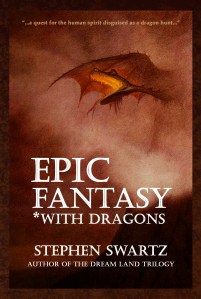
EPIC FANTASY *WITH DRAGONS

CORLAN, MASTER DRAGONSLAYER, the best in the Guild, the best in the Burg!

And yet, returning from his latest expedition, Corlan discovers jealous rivals have conspired

with the Prince to banish him from the city.

Sent into the Valley of Death, Corlan conjures a plan. He and his new sidekick, a runaway boy

from the palace kitchen, will trek the thousand miles to the far end of the valley, where a vast marsh provides nesting grounds for the dragon horde. Once there, Corlan vows to smash dragon eggs and lance younglings, ending dragon terror once and for all time.

And yet, as dangers, distractions, and detours harry him along the way, Corlan learns ancient secrets that threaten to destroy everything in his world. Even with the aid of wizards and warriors, he must use all his guile, his bravado, and the force of his stubborn will just to survive – and perhaps return home – no matter how the gods challenge him with their harshest tests.

Stephen Swartz grew up in Kansas City where he was an avid reader of science-fiction and quickly began emulating his favorite authors. Since then, Stephen studied music in college and, like many writers, worked at a wide range of jobs: from French fry guy to soldier, to IRS clerk to TV station writer, before heading to Japan for several years of teaching English. Now Stephen is a Professor of English at a university in Oklahoma, where he teaches many kinds of writing. He still can be found obsessively writing his latest manuscript, usually late at night. He has only robot cats.

CONTACT Stephen Swartz at:
BLOG

http://stephenswartz.blogspot.com/

TWITTER

@StephenSwartz1

FACEBOOK

https://www.facebook.com/pages/Author-Stephen-Swartz/149555308427639

STEPHEN SWARTZ BOOK LINKS 

Amazon Author Page:
http://www.amazon.com/Stephen-Swartz/e/B007391TQK

Goodreads Author Page:

EPIC FANTASY *WITH DRAGONS (Mar. 2017)
paper https://www.amazon.com/dp/1680630253

kindle https://www.amazon.com/dp/B06XF5FQ57

A GIRL CALLED WOLF (Dec. 2015)

A BEAUTIFUL CHILL (Feb. 2014)

paper http://www.amazon.com/dp/1939296307

kindle http://www.amazon.com/dp/B00I6M4R9Y

A DRY PATCH OF SKIN (Oct. 2014)

AFTER ILIUM (2012)

paper http://www.amazon.com/dp/1939296218

kindle http://www.amazon.com/dp/B009SDW1KC

AIKO (May 2015)

THE DREAM LAND TRILOGY

BOOK 1: Long Distance Voyager (Sept. 2013)

paper http://www.amazon.com/dp/1939296226

kindle http://www.amazon.com/dp/B00AH1V78Q

BOOK 2: Dreams of Future’s Past (Nov. 2013)

BOOK 3: Diaspora (Dec. 2013)

paper http://www.amazon.com/dp/1939296277

kindle http://www.amazon.com/dp/B00GVJGP9E


Comments Off on #amreading: Stephen Swartz, EPIC FANTASY * With Dragons

Filed under Dragons, Fantasy, Publishing, writer, writing