
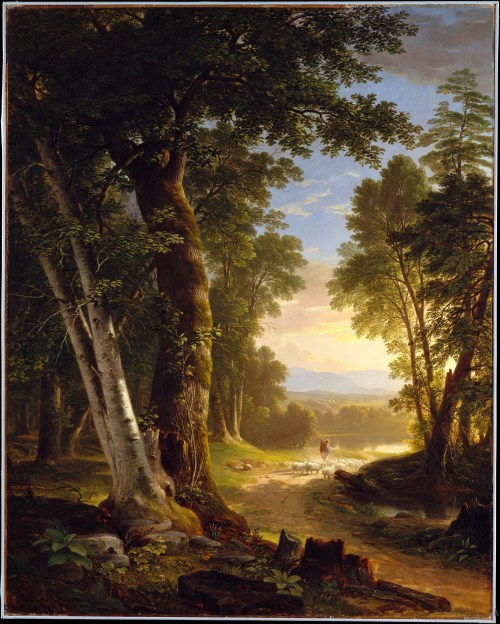
 Artist: Asher Brown Durand (1796–1886)
Title: The Beeches
Genre: landscape art
Date: 1845
Medium: oil on canvas
Dimensions: 60 3/8 x 48 1/8 in. (153.4 x 122.2 cm)
Collection: Metropolitan Museum of Art
Current location: American Paintings and Sculpture
What I love about this painting:
It’s been raining cats and dogs here, a regular monsoon. There has been some minor flooding here as the street drains aren’t able to cope with the quantities of rain that has fallen for the last week. It seems like a good time to revisit one of my favorite paintings, one detailing a sunny day painted during a calmer time.
Asher Brown Durand gives us a summer day on the shore of a large pond, in a grove of beech and birch trees. The large beech tree is magnificent, with its rough, moss-covered bark commanding the center stage. In the distance, as if they were accidentally included, a shepherd leads a flock of sheep, a minor part of the scene as compared to the superb majesty of the beech tree.
Yet, nothing in this painting is accidental. The sheep and their shepherd are painted in exquisite detail, with as much attention as he gives to the texture of the bark and the moss. Each leaf, each blade of grass, each stone—every part of this scene is painted with intention. Each component of this landscape painting is as true and perfect as they were in real life.
I love the natural feeling of the plants, the intense colors of nature, the sense of a place that is vibrant and alive.
This painting is not merely a photographic representation of a summer morning in 1845. It has a life, a sense that you are there. We can almost feel the warming sunshine and slight breeze lifting the morning haze, hear the sheep as they walk to the water, perhaps even catch the earthy scent of the woods around us.
What story will you find in this scene? I think there are several. The observer has a story, but so does the shepherd and the sheep. The tree also has a story, but trees rarely tell what they know.
Durand was a master in the Hudson River School, a group of artists who believed that nature in the form of the American landscape was a reflection of God. Durand himself wrote, “The true province of Landscape Art is the representation of the work of God in the visible creation.” [1]
This painting demonstrates that conviction.
About the Artist, via Wikipedia:
Asher Brown Durand (August 21, 1796, – September 17, 1886). (He) was an American painter of the Hudson River School. was born in, and eventually died in, Maplewood, New Jersey (then called Jefferson Village). He was the eighth of eleven children. Durand’s father was a watchmaker and a silversmith.
Durand was apprenticed to an engraver from 1812 to 1817 and later entered into a partnership with the owner of the company, Charles Cushing Wright (1796–1854), who asked him to manage the company’s New York office. He engraved Declaration of Independence for John Trumbull during 1823, which established Durand’s reputation as one of the country’s finest engravers. Durand helped organize the New York Drawing Association in 1825, which would become the National Academy of Design; he would serve the organization as president from 1845 to 1861.
Asher’s engravings on bank notes were used as the portraits for America’s first postage stamps, the 1847 series. Along with his brother Cyrus he also engraved some of the succeeding 1851 issues.
Durand’s main interest changed from engraving to oil painting about 1830 with the encouragement of his patron, Luman Reed. In 1837, he accompanied his friend Thomas Cole on a sketching expedition to Schroon Lake in the Adirondacks Mountains, and soon after he began to concentrate on landscape painting. He spent summers sketching in the Catskills, Adirondacks, and the White Mountains of New Hampshire, making hundreds of drawings and oil sketches that were later incorporated into finished academy pieces which helped to define the Hudson River School.
Durand is remembered particularly for his detailed portrayals of trees, rocks, and foliage. He was an advocate for drawing directly from nature with as much realism as possible. [1]
Credits and Attributions:
Image: The Beeches by Asher Brown Durand, PD|100. Wikimedia Commons contributors, “File:The Beeches MET DT75.jpg,” Wikimedia Commons, the free media repository, https://commons.wikimedia.org/w/index.php?title=File:The_Beeches_MET_DT75.jpg&oldid=617658539 (accessed November 6, 2025).
[1] Wikipedia contributors, “Asher Brown Durand,” Wikipedia, The Free Encyclopedia, https://en.wikipedia.org/w/index.php?title=Asher_Brown_Durand&oldid=1129313847 (accessed November 6, 2025).
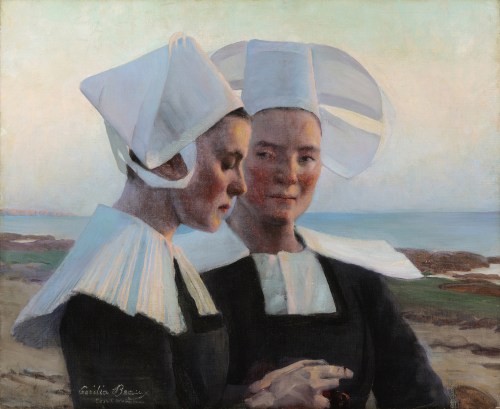 Twilight Confidences by Cecilia Beaux (1855–1942)
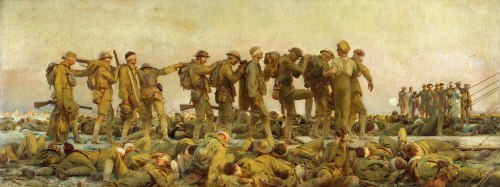 Artist: John Singer Sargent (1856–1925)
 I’m not educated as an art historian and would never claim to be one. I’m just a woman who loves the paintings of great artists because they tell a story. Thanks to Wikimedia Commons, an online museum of sorts, anyone with access to the internet can see the great art and photography of the past and the present.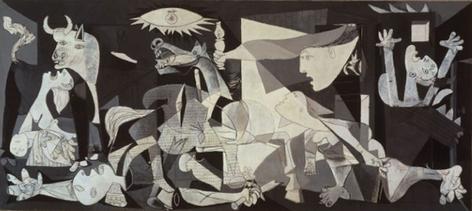
 I love the chaos in this painting. Is this a New Year’s party? Whatever they are celebrating, they’re having a great time.
 Perhaps so. But take the time to write those thoughts down. Your notes could become a storyboard, which could become a novel.
 Crockpot soups are high on the menu here at Casa del Jasperson. I do most of the work for dinner in the morning and get it out of the way along with the other housework, and then I can write and whine about writing.
 The work inspired by a visual prompt often has nothing to do with the image. But it has everything to do with the nature of storytelling. The ability to explain the world through stories and allegory emerges strongly in artists of all mediums—painters, sculptors, writers, musicians, and dancers.
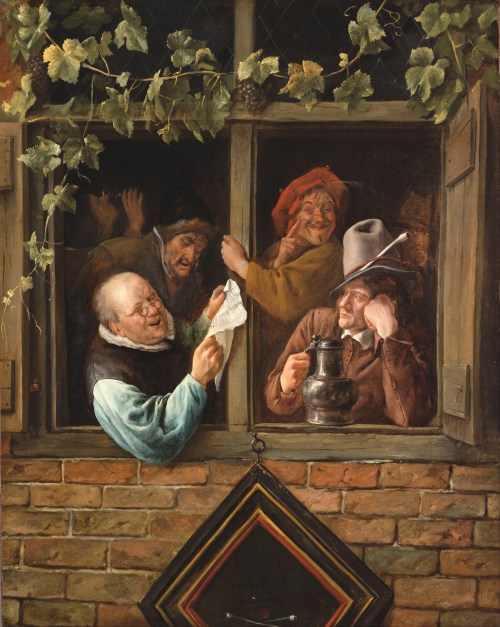 These jolly rogues have such vivid personalities that the viewer immediately feels a kinship. Who were they? Did they keep their day jobs? Or were they charming moochers living off the kindness of friends?
 And what other symbolism was incorporated in this painting that art patrons in the 17th century would know but we who view it through 21st-century eyes wouldn’t? Eelko Kappe’s article on this painting,
 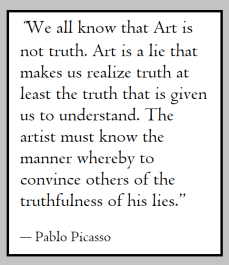 Often the work that is inspired by a visual prompt has nothing to do with the image. But it has everything to do with the nature of storytelling. The ability to explain the world through stories and allegory emerges strongly in some people. Many are naturally able to form and express a story, and others find the subliminal prompting of an image will be the spark that lights their creativity.
 Picasso’s choice to use black and white to tell that story is brilliant. Newsreels of the day were black and white, which influenced his decision. This piece is powerful because of the emotion the artist painted into the image.
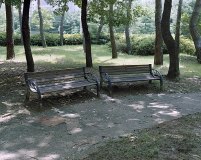 nspiration can be found in the image of an unoccupied park bench in winter. The gray weather, the barren scenery, the loneliness of the empty bench could be the seeds from which a novel grows. Who is that bench waiting for? Who has just left it? Is the story light or dark?


 Life in the Realm of Fantasy
