Tag Archives: writing the end of a story

Idea to Story part 6 – Plotting the End #writing

We have been working on plotting a novel for the last month in our series, Idea to Story. The previous installments are listed below, but at this point, we have our two main characters, Val (Valentine), a lady knight, and the enemy, Kai Voss, a court sorcerer. Both are regents for the sickly, underage king.
We also have our ultimate enemy, Donovan Dove, Kai’s half-brother and most trusted advisor. I have landed on a working title that speaks to the genre, Valentine’s Gambit.

We have allowed the characters to tell us the story. Save everything you cut to a new document, labeled and dated: “Outtakes_ValentinesGambit_03-08-25.” (That stands for Outtakes, Valentine’s Gambit, March 2025.)

The Inciting Incident: The plot as it stood last week: Twelve-year-old Edward has been steadily declining in health since the deaths of his parents. Information has come to Val’s attention that someone highly trusted has cursed the young king with a wasting illness. She immediately suspects Kai and moves Edward to a safe place. The story is off and running.

Kai has also received information from his most trusted source that Edward is being poisoned. His suspicions immediately fall on Val, whom he believes wishes to take the throne and rule as a warrior queen. When he discovers the king has been taken from the castle (kidnapped, as he believes), he rallies the soldiers loyal to him and mounts a search.

Roadblocks arise as Val and her soldiers hinder Kai’s attempts to regain custody of Edward. Kai finds a way around them, leading to another crisis scene and a stalemate.

At the Midpoint, Donovan Dove springs his trap, capturing both Kai and Valentine and imprisoning them in his dungeon. He posts announcements in all the towns proclaiming that they are traitors who have tried to kill the young king. He assumes the role of regent and plans to behead them at dawn.
Val immediately comprehends what just happened and finds a way to escape. Against her better judgment, she makes a spur-of-the-moment decision to free Kai, dragging him to her grandmother’s house. Only now is the mage discovering the magnitude of his brother’s betrayal.

This dungeon scene tells the reader that our true quest will be rescuing Edward before he dies from Donovan’s curse.

Now, we must consider the best way to end this mess. Something big and important must be achieved in the final chapters.

First, Val and Kai have to stop blaming each other and agree to work together.

  • Val’s grandmother has some tough love for both of them.

Second, they must gather a core group of talented people. Donovan has murdered the friends he used as messengers in his betrayal, but several other friends of each are in hiding. So, Val and Kai must leave her grandmother’s hut and rally their supporters.

They need a thief/spy and two soldiers, and Val knows where to find them. They also need a healer because Edward is near death. Val’s grandmother could fill that role—she is already named and her abilities are established.

  • They can build up an army if you choose, but limiting the number of named characters is crucial.

Third, they need a base, a place to live, and resources to gather while they devise the plan to free Edward. Grandmother’s hut is known to Donovan’s minions so they must move on.

What is the core conflict? For me, a good way to find the ending is to revisit the notes I have made as the story evolves. If I have been on top of things, each change has been noted, so I’m looking at the current blueprint of the novel to this point.
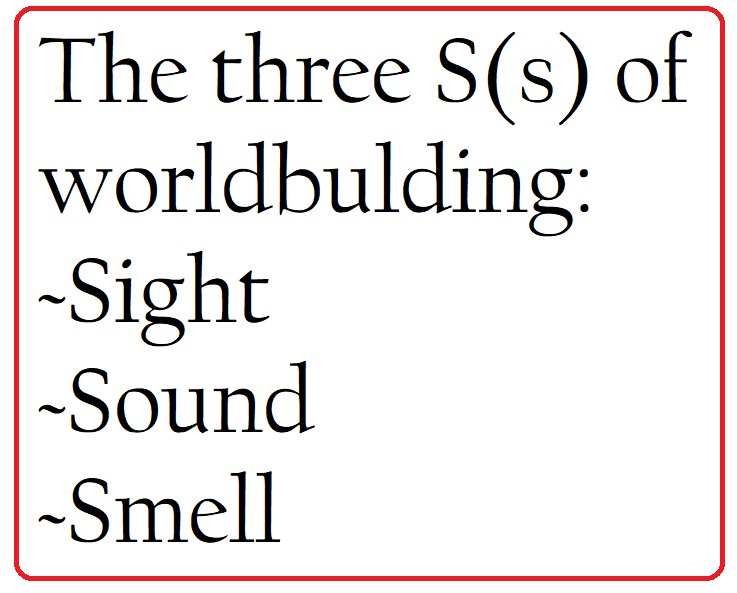
This is when I go back to square one. By seeing the whole picture of the story to this point, I usually find the inspiration to put together the final scenes that I know must happen. I sit down with a notebook (or, in my case, a spreadsheet) and make a list of what events must occur between the place where they escape the dungeon and the end. I save that document with a title, something like:

Valentines_Gambit _Final_Chpts_Worksheet_03-08-2025

At first, the page is only a list. The chapter headings are pulled out of the ether, accompanied by the howling of demons as I force my plot to take shape:

  • Chapter – Val drags Kai to a safe place. Discovery of the deaths of close friends.
  • Chapter – Donovan’s plan revealed.
  • Chapter – Evading Donovan’s bespelled soldiers.
  • Chapter – Discovering where Edward is being held
  • (and so on until the last event) Mage duel – ends when Kai casts a beginner’s spell to trip Donovan, and Val kills him.
  • Final chapter – Val and Kai reinstated as regents. Together they raise Edward to adulthood and he grows up to be a good, beloved king, Will they marry? It’s a romance, so yes, they will live as happily as people ever do.

I begin writing details that pertain to the section beneath each chapter heading as they occur to me. Once that list is complete, those sketchy details get expanded on and grow into complete chapters, which I then copy and paste into the manuscript.

So, let’s talk about the elephant in the room – what to do with scenes that no longer work now that we’re nearing the end. Something we all suffer from is the irrational notion that “if we wrote it, we have to keep it,” even though it no longer fits.

Let’s be honest. No amount of rewriting and adjusting will make a scene or chapter work if it’s no longer needed to advance the story. If the story is stronger without that great episode, cut it.

What you have written but not used in the finished novel is a form of world-building. It contributes to the established canon of that world and makes it more real in your mind. I urge you to save your outtakes with a file name that clearly labels them as background or outtakes. Not having to reinvent those useful sections will significantly speed up other projects.

Use the outtakes as fodder for a short story or novella set in that world. This is how prolific authors end up with so many short stories to make into compilations. It’s useful to know that with a few name changes, every side quest not used in the final manuscript can quickly be made into a short story.

Another good reason to save everything you cut in a separate document is this: I often reuse some of that prose later, at a place where it makes more sense.

That need to cut and rearrange is why I don’t number my chapters in the first draft. You may have noticed in the example above that I head each section with the word “chapter” (and no number) written out. I want to be able to find the word “chapter” with a global search when I do insert the numbers.

This is because (in my world) most first drafts are not written linearly. For me, the story arc changes structurally as I lay down that first draft, so chapter numbers become confusing. Nowadays, I put the numbers in when the manuscript has made it through the final draft and is ready for my editor.

Designing the ending is as challenging (and yet easy) as writing the opening scenes. It is so satisfying to write those final pages—one of the best feelings I have experienced as an author.

The sample plot that we have used for this series has a happy ending. This is because within the first five chapters, when we began writing our characters, it became a Romantasy and romance readers want happy endings.

Sometimes, we all want happy endings.
PREVIOUS IN THIS SERIES:

Idea to story, part 1: novel, poetry, memoir, or short story? #writing | Life in the Realm of Fantasy

Idea to story part 2: thinking out loud #writing | Life in the Realm of Fantasy

Idea to story part 3: plotting out loud #writing | Life in the Realm of Fantasy

Idea to story part 4 – the roles of side characters #writing | Life in the Realm of Fantasy

Idea to story part 5 – plotting treason #writing | Life in the Realm of Fantasy

11 Comments

Filed under writing

Pacing part 3 – Plotting the End #amwriting

Maybe you’re a “pantser,” not a “plotter.” Unlike me, you like to wing it when you write; just let the ideas flow freely.

Margaret Atwood on writing LIRF07252022I have “pantsed it” occasionally, which can be liberating but for me, there always comes a point where I realize my manuscript has gone way off track and is no longer fun to write. Then I must return to the point where the story stopped working and make an outline.
This year, I finally published Bleakbourne on Heath, a novel that began as a serial published in 2015 – 2016 on Edgewise Words Inn. That experience was how I discovered that writing and publishing a chapter a week is not my forte. I hit a dead spot at the ¾ mark, and the book was on hold for several years because of other writing commitments, but finally, it was finished, and now it is out the door.

Another bit of unfinished business is book two of a duology. I’ve committed to writing the second book in this set before publishing the first because I know from experience it will be years between installments, and readers don’t like that. This ensures the wait time for the second book’s release is reasonable. Even though the entire story will span two books, this first half must have a finite ending, and I think I have finally achieved that goal.

It’s at what would be considered the midpoint of the 2-book story arc. The problem has been deciding where in the overall story arc of the duology the ending of book one occurs and how it leads into the action of the opening chapters in the second half.

I have stopped floundering and (literally) cut my losses. I trimmed book two back to where the narrative dissolved into chaos. Now I must figure out how to bring the story to its intended conclusion.

This isn’t unusual. Fortunately, my years of doing NaNoWriMo have given me some tools for just such an emergency.

Jack Kerouak on writing LIRF07252022The first tool is a sense of balance. Every published novel has entire sections that were cut or rewritten at least once before it got to the editing stage.
Much of what you cut out can be recycled, reshaped, and reused, so never delete weeks of work. Save everything you cut to a new document, labeled and dated something like “Outtakes_AF_rewrite2_06-19-2023.” (For me, that stands for Outtakes, Aelfrid Firesword, rewrite 2, June-19-2023)

Now, we must consider what will be the most logical way to end this mess.

What is the core conflict? For me, a good way to pull the ending out of my subconscious is to revisit the outline I made of the story arc. Fortunately, I have been on top of things, so deviations from the original plans have been noted on my outline.

The problem I am experiencing now is that I didn’t know precisely where this duology would end when I began writing it so that part never got plotted. Now I can see how the internal growth of the characters has caused two of them to fundamentally change from what was originally planned. Their personal goals have radically deviated from what I had initially thought, and they have a lesser part to play.

By visualizing the whole picture of the story to this point, I usually find the inspiration to put together the final scenes that I know must happen. I know what must be achieved in the last chapters – I just can’t get it onto paper. This is where I stop and drag out a notebook and pen. I sit outside or in a coffee shop and write down those loose ideas for an hour or so. I find an outline is crucial, especially when trying to write a solid ending. The list of events helps me get the story out of my head in a logical sequence.

What must occur between the place where the plot was derailed and the end? I write a list of chapters with the keywords for each scene noted.

Once I have made a few notes as ideas occur to me, I start a new document and save it with a name indicating that it’s a worksheet for that novel: AF_Final_Chpts_Worksheet_06-19-2023 (Aelfrid Firesword, final chapters worksheet, and the date)

F Scott Fitzgerald on Good Writing LIRF07252022At first, the page is only a list of headings that detail the events I must write for each chapter. I know what end I have to arrive at. But the chapter headings are pulled out of the ether, accompanied by the howling of demons as I force my plot to take shape:
  • Chapter – Sunhammer revealed/Alf swears the vows of protection
  • (and so on until the last event)

You’ll note that there are no numbers, but the word “chapter” and a rudimentary title are there. I don’t number my chapters until the final draft is complete, although I do head each section with the word “chapter” written out, so it is easy to find with a global search. The titles will disappear, or be changed, depending on which series it is.

This is because, in my world, first drafts are not written linearly. Things change structurally with each rewrite. So the numbers are only put in when the manuscript is finalized.

  • I begin writing details that pertain to the section beneath each chapter heading as they occur to me.
  • Once that list is complete, those sketchy details get expanded on and grow into complete chapters,
  • Which I then copy and paste into the manuscript.

When I begin designing the ending, it’s as challenging as plotting the opening scenes. I go back to the basics and ask myself the same questions I asked in the beginning.

It’s a good idea to have a separate worksheet that lists each character and contains notes detailing what they wanted initially. That way, you can see how they’ve been changed by the events they have experienced.

  1. What do the characters want now that they have achieved a significant milestone?
  2. What will they have to sacrifice next?
  3. What stands in the way of their achieving the goal?
  4. Do they get what they initially wanted, or do their desires evolve away from that goal when new information is presented?

ok to write garbage quote c j cherryhDon’t be afraid to rewrite what isn’t working. Save everything you cut because I guarantee you will want to reuse some of that prose later at a place where it makes more sense.

Not having to reinvent those useful sections will significantly speed things up, so I urge you to save them with a file name that clearly labels them as background or outtakes.

We all suffer from the irrational notion that if we wrote it, we have to keep it, even though it no longer fits. No amount of rewriting and adjusting will make a scene or chapter work if it’s no longer needed to advance the story. When the story is stronger without that great episode, cut it.

Outtakes are fodder for a short story or novella set in that world. This is how prolific authors end up with so many short stories to make into compilations. Every side quest not used in the final manuscript can quickly become a short story featuring characters you already know well.

What you have written but not used in the finished novel is a form of world-building. It contributes to the established canon of that world and makes it more real in your mind.

UrsulaKLeGuinQuote

3 Comments

Filed under writing

My writing life: magic and mayhem #amwriting

This last week I managed to get quite a lot of writing done—just not on the projects I had planned. I seem to be more in short story mode right now.

I had an idea for a short fantasy involving Gods and mortals, and that one is finished.

Then I had an idea for a post-apocalyptic tale of madness and murder, which is about halfway to the conclusion.

I am still reworking and rewriting the first draft of a novel set in my Tower of Bones world whenever I have a flash of brilliance.

Also, I am still working on devising a shocking-but-logical finale for my alternate Arthurian novel, Bleakbourne on Heath.

Many of you know that Bleakbourne began life in serialized form in 2015 on a now-defunct site called Edgewise Words Inn. It was written and published one episode a week.  I began with writing and publishing the first chapter only, and no idea where it was going to go after that.

It was a challenge, writing it in serial form and trying to turn out one installment a week.

At first, it all went well. However, at what would be the midpoint of the novel, the well of creativity ran dry. I had no clue as to what to do next. When that happened, once a week became twice a month.

I managed to squeeze four more installments out and then couldn’t think of how to write the final stand against Evil. On my writing group’s advice, I ended the serial on a happy note with a wedding but left a major thread dangling.

Cliffhanger endings aggravate readers who don’t want to wait a year for the rest of the story. I had to give my readers a reward for their faithfulness, and resolve most of the subplots. This is why I wound up most of the side threads and ended the Bleakbourne serial with a wedding.

This last December, I went back to edit and flesh out the first chapters and add a few that weren’t included in the original serial. In that process, I discovered that my subconscious mind had left several important clues that point me in the direction for the final confrontation.

I need to do some serious mind-wandering, and let this magic-flinging shindig roll around in my head a bit before I can write it.

Writing Bleakbourne as a serial and publishing it almost as soon as it left my head was a good experience. I had great input from readers, which was something I hadn’t expected.

It was also terribly difficult to keep on task and meet the publishing deadline. Making each installment readable took up far more time than I expected it would. I had no time to write anything else.

I discovered that, while I can write quickly if I have to, I don’t write well under the pressure of a weekly deadline.

For me, writing good endings is the most difficult part of writing. And in Bleakbourne,  so many possibilities presented themselves that I had no idea which way to end that unwieldy, complicated storyline.

That experience reinforced my need to write from an outline as a way of not getting stuck without a good finish. I may not stick to the outline but having a list of ideas gives me a jumping off point. Even with an outline I struggle to make every story’s finish logical, yet unexpected and memorable.

The final cataclysmic event must be a powerful emotional thing for the reader. Therefore, I have gone back and put more pressure on Merlin and Leryn in the earlier chapters.

The higher the emotional stakes when they meet Mordred for the final showdown, the more emotionally satisfying the final resolution will be for the reader.

This resolution will be final, with no loose threads.

2 Comments

Filed under writing

#amwriting: the end: separation anxiety

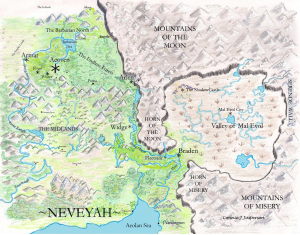
Map of Neveyah, for RizAeroNothing is more difficult (in my opinion) than finishing a novel that has been stalled for three years. My current work in progress has been through three different incarnations.

Two other books have been published during this time because  I couldn’t find a satisfying way to end this chapter in the history of Neveyah.  Perhaps it is a case of separation anxiety, but for one reason or another, it has never gotten to the true finish line.

My current focus is on finishing the final draft of this novel and getting it submitted to my editor. This book must wind up the Tower of Bones series, and it has to finish BIG.

While I am doing this, I confess I feel the same mix of feelings as I did when my youngest child left home–a sense of loss combined with pride and the thought that freedom looms.

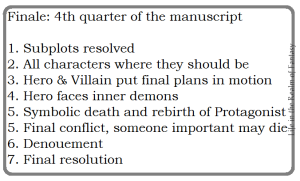
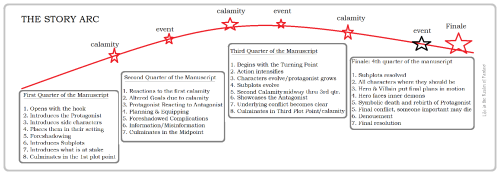
4th qtr of MSSo let’s talk about the all-important fourth quarter of the story arc.

At this point in the story arc, the final plans are in motion. We’ve met the enemy part 1 and survived the encounter. We’ve suffered a terrible setback. Now we’ve regrouped.

In the third quarter, major events have unfolded that point to the conclusion. Based on my structural editor’s suggestions, I  inserted new scenes into the existing narrative that drive the action to the final conflict. Those are all finished and are where they should be.

  1. At the outset of the 4th quarter, all my subplots are resolved and the final focus is on the Dark God’s move.
  2. The Dark God’s final pawn in this game must be exposed to the reader.
  3. The enemy’s plan and their true nature must be shown.
  4. Someone who was previously safe is now in peril. Their fate hangs on a thread and the outcome is unclear.
  5. The heroes must face the fact that their efforts to preserve their homeland has forced the enemy’s hand in a way they never expected
  6. The resolution for these characters is final, no loose threads can be left at the end of this book, as it completes the trilogy.

My work right now revolves around taking the new material and blending it into the existing story. Foreshadowing must be inserted and some otherwise great passages will be cut. This is because anything that does not drive the plot to this end is a side quest, and there can be no more of those.

This means one whole storyline that took six months to write will be cut, but it’s not a waste. There will be more opportunities for writing in this world, and that storyline could become a novella. These are great characters and the villains are as intriguing as the heroes.

As I said at  the beginning of this post, I am seeing this novel coming together at long last, and I am loath to let go of it. But I am excited to see it coming to this conclusion and feel good about it, despite having to shed some of the work that took so long to write.

The events have been detailed. Making sure this story flows seamlessly is time-consuming but it’s my obsession, so poring over the manuscript is what I am doing when I could be playing games. (Hear that Aveyond Stargazer?)

The Story Arc copy

4 Comments

Filed under Publishing, writer, writing