
So, today is the first day of November, and NaNoWriMo has begun. But November is also the month of cooking, my other hobby. And it’s also a month of doctor appointments – go figure.
 On Monday, I had to drive to Seattle to take the hubby for a consult with a neurosurgeon. Getting to the doctor was fine. It was a matter of spending one hour sitting in traffic trying to leave Olympia and another hour of actually rolling forward once we made it past the Nisqually River. I had planned ahead for that, so we were on time. The upshot is no back surgery for him unless there is no other option, as Parkinson’s patients do very poorly after surgeries.
Which explains his cognitive difficulties after the hip replacement. Surgery Complications for People with Parkinson’s | APDA (apdaparkinson.org)
However, the neurosurgeon explained some of the non-surgical options which may help. Surgery is a last resort, and hopefully, one we can avoid.
The trip home was easy once I found an entrance to the southbound lanes of I-5. I found all sorts of options to go north, but Olympia is 65 miles south of Seattle, so north was the wrong direction. I finally went north, passed a southbound onramp, exited, and doubled back to that street. An hour later, we were back in Olympia.
 So, what am I writing today? I’m working on the second half of a novel I began writing seven years ago, so all the world-building and character creation has happened. The plot for this half is evolving. I know the ending, and over the next thirty days, my characters will take me from this high point in the middle, through several hurdles yet to be determined, to that final victory.
I expect you’re wondering how a novel goes half-finished for seven years—I sometimes wonder too, but it happened, so there you go. During that time, I wrote a novel that is nearly ready to be published. I also reworked two existing novels into one and published it (Shadows of Redemption). Also, I finished my alternate Arthurian mashup, Bleakbourne on Heath, finally getting it published.
I can write quickly during NaNoWriMo, but revisions usually take several years.
My half-finished novel was set aside when I was stricken with the idea for my forthcoming book, The Ruins of Abeyon. If all goes well with the beta read and Irene’s final edit, Ruins will be out this summer.
Our new furniture has arrived, and we no longer live like college students. Dining on a card table and sitting in a folding saucer chair was fun for the first week or two, but it wore thin after four months. Hauling my 70-year-old self out of the chair meant for teenagers was not a pretty sight.
 I’m settling into the new office. In my old house, my ramshackle desk was in the Room of Shame, a jumbled mess of a storeroom. My new desk is not duct taped together and has the right amount of storage for what I need.
All in all, this office has the best ambiance of any room I’ve ever had. Writing is easy here, and I hope this novel will fly out of my head and be finished in about 55,000 words.
Unless I am suddenly stricken with a new novel.
(Saints forbid, because I think I’m really going to finish it this time.)
Our apartment has very little storage, so I am gradually unpacking. The shelves do their appointed tasks, and the extra storage is ideal. Even so, some of what I had thought we could keep will have to go.
 Today, the office/guestroom walls are barren, but I hope to have all the family pictures hung by the end of this week. The hide-a-bed sofa and side chair make a pleasant conversation area or guest room, whichever is needed. All I lack is my new desk chair, which is on its way here from Norway. (Yes, I splurged on a Stressless desk chair since I spend most of my time sitting in front of my computer.) It should be here in a week or two, and I can hardly wait as my current desk chair loses its appeal after an hour or so.
November is not just for writing here at Casa del Jasperson. My oldest daughter and her family will be with us for Thanksgiving this year, so a certain amount of food preparation will happen. And yes, the vegan will roast a turkey for her son-in-law, along with all the trimmings. Thanksgiving falls on Thursday, the 23rd, so my pre-cooking will be done over the course of that week. Anything that can be cooked in advance will be, and writing will happen as always.
 What are some of my planned treats? Cranberry and walnut shortbread, for one thing. Shortbread is so easy and affordable to make that it always surprises me when people don’t. I have veganized all of my old traditional recipes, so everyone can sneak a treat now and then.
November is one of my favorite months. I connect with the local writing scene, meet new authors, and make lots and lots of comfort foods. I feel incredibly fortunate to be at this place in my life. Happiness means something different for each person, but for me, it’s a comfy home with my husband, a good space for writing, and food with family and friends.
So, on this first day of NaNoWriMo 2023, may you find a little joy, and may your words flow freely!
 Getting those ideas out of your head now is what is important. The bloopers and grammar hiccups can all be ironed out in the second draft.
 Yes, we do need to show moods, and some physical description is necessary. Lips stretch into smiles, and eyebrows draw together. Still, they are not autonomous and don’t operate independently of the character’s emotional state. The musculature of the face is only part of the signals that reveal the character’s interior emotions.
 Bad advice is good advice taken to an extreme. But all writing advice has roots in truth. So, when it comes to making revisions, consider these suggestions:
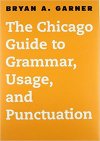 I recommend investing in a grammar book, depending on whether you use American or UK English. These books will answer your questions, and you won’t be in doubt about how to use the standard punctuation readers expect to see.
 I recommend checking out the NaNoWriMo Store, which offers several books to help you get started. The books available there have good advice for beginners, whether you participate in November’s writing rumble or want to write at your own pace.
 I study the craft of writing because I love it, and I apply the proverbs and rules of advice gently. Whether my work is good or bad—I don’t know. But I write the stories I want to read, so I am writing for a niche audience of one: me.
 Magic or the supernatural are core plot elements in most of my work. I see them as part of the world, the way the Alps were a core plot element in the story of the
 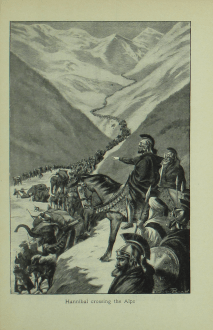 Hannibal paid a heavy price for bringing his superweapons (elephants) to the battle. The ability to use magic should come at some cost, either physical or emotional. Or it should require coins or theft to acquire magic artifacts.
  It’s fair to write stories where magic is learned through spells if one has an inherent gift, and it’s also fair to require a wand. That is how magic was always done in traditional fairy tales and J.K. Rowling took those worn-out tropes and made them new and wonderful.
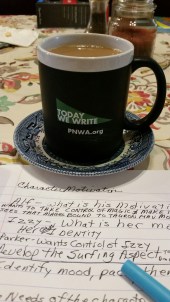 I can suspend my disbelief when magic and supernatural abilities are only possible if certain conditions have been met. The best tales featuring characters with paranormal skills occur when the author creates a system that regulates what the characters can NOT do.
 A crucial reason for establishing the science of magic and the paranormal before randomly casting spells or flinging fire is this: the use of these gifts impacts the wielder’s companions and influences the direction of the plot, creating tension.
 or the paranormal in your NaNo novel, how can you take these common tropes in a new direction?
 First, what sort of world is your real life set in? When you look out the window, what do you see? Close your eyes and picture the place where you are at this moment. With your eyes still closed, tell me what it’s like. If you can describe the world around you, you can create a world for your characters.
 What does the outdoor world look and smell like? Is it damp and earthy, or dry and dusty? Is there the odor of fallen leaves moldering in the gutters? Or have we wandered too near the chicken coop? (Eeew … get it off my shoe!) If an author can inject enough sight, sound, and scent into a fantasy or sci-fi setting, the world will feel solid when I read it.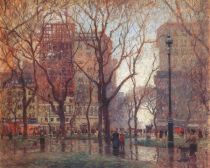
 What about transport? How do people and goods go from one place to another?
 Names and directions might drift and change as you write your first draft. Also, if they’re invented words, consider writing them close to how they are pronounced.
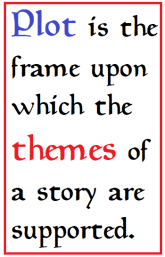
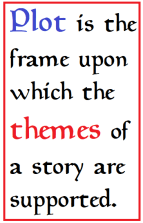
 When someone asks me what a book I wrote is about, my mind grinds to a halt as I try to decide what to say. I could give them the rundown of the plot, which is the arc of events the characters experience.
 The story writes itself when I begin with a strong theme and solid characters. A 19th-century writer many have heard of but never read,
  When
When Love is only one theme, yet it has so many facets. Other themes abound, large central concepts that build tension within the narrative.
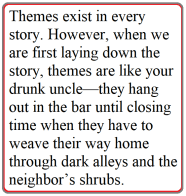 Sometimes, we can visualize a complex theme but can’t explain it. If we can’t explain it, how do we show it? Consider the theme of “grief.” It is a common theme that can play out against any backdrop, whether sci-fi or reality based, where humans interact on an emotional level.
 Even if you don’t have an idea of what you want to write, it’s time to go out to
  Once there, create a profile. You don’t have to get fancy unless you are bored and feeling hypercreative.
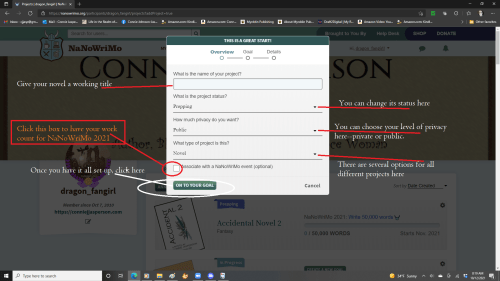 You can play around with your personal page a little to get used to it. I use my NaNoWriMo avatar and name as my
  Next, check out the community tabs. If you are in full screen, the tabs will be across the top. If you have the screen minimized, the button for the dropdown menu will be in the upper right corner and will look like the blue/green and black square to the right of this paragraph.
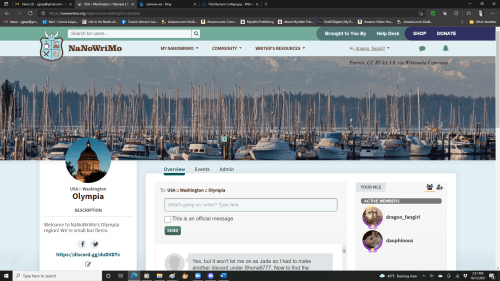 You may find the information you need in one of the many forums listed here.
 Make a master file folder that is just for your writing. I write professionally, so my files are in a master file labeled Writing.
 Give your document a label that is simple and descriptive. My NaNoWriMo manuscript will be labeled: Stowe_Bridge_NaNoWriMo_2023.
 This year we will have write-ins at the local library. The authors in our region will come together and write for two hours and support each other’s journey. We will also meet via the miracle of the internet, using Discord and Zoom. My co-ML and I are finalizing a schedule for November.
 I am the queen of front-loading too much history in my first drafts. Fortunately, my writer’s group has an unerring eye for where the story really begins.
 You have done some prep work for character creation, so Tam is your friend. You know his backstory, who he is attracted to (men, women, none, or both), how handsome he is, and his personal history. But none of this matters to the reader in the opening pages. The reader only wants to know what will happen next.
 Tam and Dagger will tell you what events and roadblocks must happen to them between their arrests and the final victory. This knowledge will emerge from your imagination as you write your way through this first draft.
 Tam will find this information out as the story progresses and we will learn it as he does. With that knowledge, he will realize his fate is sealed—he’s doomed no matter what. But it fires him with the determination that if he goes down, he will take the Warlock Prince and his corrupt Cardinal, with him.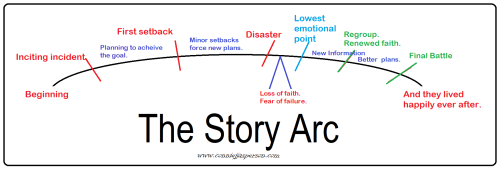
 Now, we’re going to hear what our characters have to say about what their story might be.
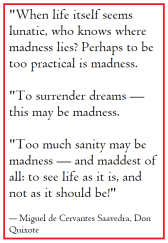 An important point to remember is that no matter how decent they are, people lie to themselves about their motives. It’s human nature to obscure truths we don’t want to face behind other, more palatable truths. Those secrets will emerge as you write.
 In my most recent book,
  I’m going off-topic here for a moment. While the death of a character stirs the emotions, it must be a crucial turning point in that story. It must be planned and be the impetus that changes everything. The death of a character must drive the remaining characters to achieve greatness.
 Unless, of course, you are writing paranormal fantasy. Death and resurrection may be the whole point if that’s the case.
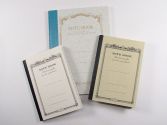 If your employment isn’t a work-from-home job, using the note-taking app on your cellphone to take notes during business hours will be frowned upon. I suggest keeping a pocket-sized notebook and pencil or pen to write those ideas down as they come to you.
 We talked about getting a start on our characters in Monday’s post. Today, we’re going to visualize the place where our proposed novel is set, the place where the story opens.
 All worldbuilding must show a world that feels as natural to the reader as their native environment. I used the forests and lowlands of Western Washington State as my template. The entire series evolved out of three paragraphs that answered the following question:
 Seagulls are a good example of what could happen. They fly and do their business while on the wing, and sometime find enjoyment in “bombing” windshields.
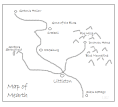 Some of us (Me! Me!) will make pencil-sketched maps of our fantasy world or the sci-fi setting. I find that maps are excellent brainstorming tools for when I can’t quite jostle a plot loose. It’s a form of doodling, a kind of mind wandering, and helps me find creative solutions to minor obstacles.
 No matter how many characters you think are involved, one will stand out. That person will be the protagonist.
 Once I know the basic plot, I make a page in my workbook with a bio of each character, a short personnel file. Sometimes, I include images of RPG characters or actors who most physically resemble them and who could play them well—but this is only to cement them in my mind.
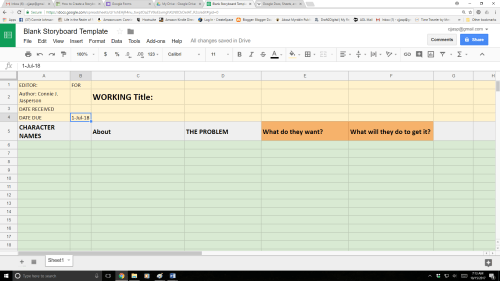 Names say a lot about characters. If you give a character a name that begins with a hard consonant, the reader will subconsciously see them as more intense than one whose name starts with a soft sound. It’s a little thing, but it is something to consider when conveying personalities.


 Life in the Realm of Fantasy