
In cosmology, the concept of space-time combines space and time into a single abstract universe. Apparently, we all move through time. Here on earth, time either passes us, or we pass the time. It’s all relative (Einstein humor) to how fast you are going and a lot of sub-atomic particle stuff I can’t really take the time to explain here, and you aren’t interested in anyway.
 Time interests me because I mostly write fantasy, although I write contemporary short fiction and poetry. Fantasy, and all speculative fiction, relies heavily on worldbuilding, and managing time is a facet of that skill.
But all genres, including contemporary and literary, require worldbuilding. Every story, true or fiction, is set SOMEWHERE, either in this world we are familiar with or in an alternate fantasy universe.
When I begin writing a book, I create a stylesheet in a spreadsheet program like Google Sheets or Excel for the universe, a workbook that has a page devoted to a glossary for that world, and a page for the calendar of events. A calendar is an essential tool that helps you with pacing and consistency.
- Calendars are good for pacing, as they keep the events moving along the story arc.
- They ensure you allow enough time to reasonably accomplish large tasks, enabling a reader to suspend their disbelief.
- They ensure you don’t inadvertently jump from season to season in your visuals surrounding the characters.
So, for me, the calendar is a device that keeps the events happening logically.
 HERE is where I confess my great regret: in 2008, a lunar calendar seemed like a good thing while creating my first world.
- Thirteen months, twenty-eight days each,
- one extra day at the end of the year,
- a Holy Day on the winter solstice. They have two Holy Days and a big party every four years.
That arrangement of thirteen months is actually quite easy to work with. Where it becomes difficult is in the choices we made in naming things. You know how planning meetings are–ideas tossed at the wall like spaghetti and seeing what sticks.
We were just beginning to design the game, and while I had the plot and the synopsis, I didn’t have some details of the universe and the world figured out. So, in a burst of creative predictability, I went astrological in naming the months, to give the player a feeling of familiarity.
- Caprica, Aquas, Piscus, (winter).
- Arese, Taura, Geminis (spring)
- Lunne, Leonid, Virga (summer)
- Libre, Scorpius, Saggitus (harvest)
- Holy Month (begins winter). Holy Day falls at the end of this thirteenth month, occurring on the winter solstice. The premise of the game was the War of the Gods, so religion is central.
 In an even worse bout of predictability, I went with the names we currently use when I named the days, only I twisted them a bit and gave them the actual Norse god’s name. (The gods and goddesses of Neveyah are not Norse.)
That choice is an example of how what seems like a good idea at the time, may not be.
- Lunaday
- Tyrsday
- Odensday
- Torsday
- Frosday
- Sunnaday – this is the confusing day, as it falls where Saturday is in our normal calendar.
- Restday
One thing I did right was sticking to a twenty-four-hour day. I can’t stress enough how important it is to keep things simple when we are worldbuilding. Simple things are less likely to add to the chaos when the plot gets complicated.
That game was never built for several reasons, but I retained the rights to my work. I took my maps and the storyline and wrote Mountains of the Moon, an epic portal fantasy. That story was the genesis of an entire series set at various points along the timeline of that universe.
I couldn’t get that story out of my head and onto paper fast enough—it obsessed me. As I wrote, the calendar I had invented for the RPG was incorporated into the world of Neveyah, and now it is canon.
Time can be an abstract thing when we are writing the first draft of a story where many events must occur. Things are accomplished in too short a period to be logical, or we take too long.
Calendars are maps of time. They turn the abstract concept into an image we can understand.
Even though I regret how I named the days in Mountains of the Moon, my characters progress through their space-time continuum at a rate I can comprehend. I can move events forward or back in time by looking at and updating their calendar. The sequence of events forming the plot arc remains believable.
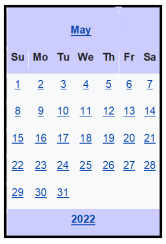 I LEARNED from my mistakes – the timeline for the Billy’s Revenge 3-book series, Huw the Bard, Billy Ninefingers, and Julian Lackland, uses the familiar calendar we use today.
I heartily suggest you stick to a simple calendar. That is the advice I would give any new writer—stick to something close to the calendar we’re familiar with and don’t get too fancy.
Next up: Time and Distance – how calendars and rudimentary maps work together to keep the plot moving and believable.
 Thus, it makes sense to consider whether your story is complex enough to hold up well across a series.
 If you are done with your first draft and are just now realizing your novel could be the beginning of a saga, you should consider making notes as to what the future holds for your crew beyond the end. Otherwise, you may find yourself writing a continuation of book one, but with no goal, no purpose.
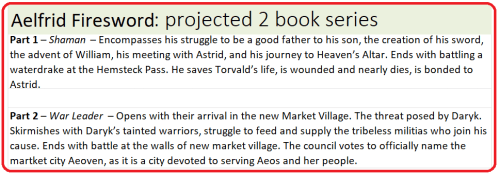 So, for a saga you might want to draw up an overall story arc for the entire series. For a standalone book featuring a recurring character, you likely won’t need to have an all-encompassing projected arc.
 Think about it – the universe contains all we can measure and know, all of space and time and their contents, including planets, stars, galaxies, and all forms of matter and energy. It likes balls and spirals and has a structure that repeats itself. This is reflected in the shape and behavior of the smallest particles to the largest quasars.
 First off, no matter our conscious thoughts regarding the universe and God, writers don’t exist in reality. We exist in what we think reality is, and collectively, we create it as we go along, for good or ill.
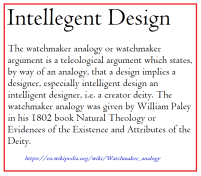 But if you make a map of what you can see, your own
 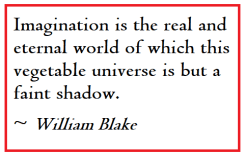 As I wrote, the outline for that first book took its shape. The written universe is in constant flux, and the storyboard records the changes and keeps the fabric of time from warping.
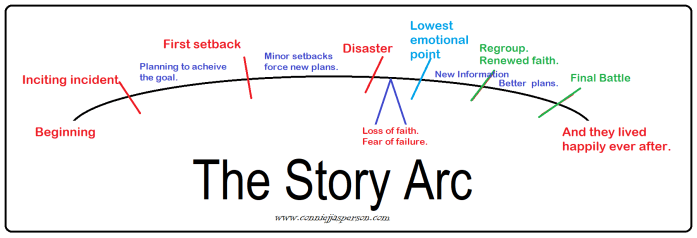 Once I have decided the proposed length, I know where the turning points are and what should happen at each. The outline ensures an arc to both the overall story and the characters’ personal growth.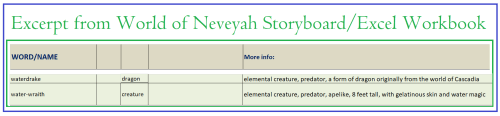
 In other words, something we can’t see or measure is out there, shaping our known universe. For lack of a better term, scientists refer to it as “dark matter” and “dark energy.”
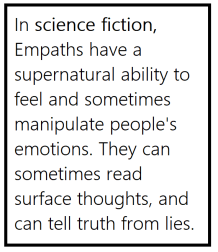 Unless your story is set in a school (such as the
 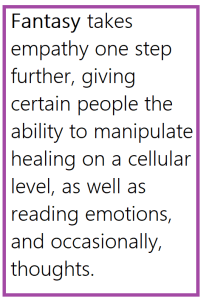 In real life, if a person had the kind of power that our fictional empaths wield, we would hope they were noble, compassionate, and above all, respectful of other people’s wish for privacy. One would want them to be circumspect and never rummage in people’s minds uninvited.
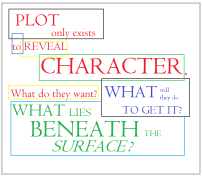 What does healing cost the healer? Does it exhaust them? Does some of the healing magic come from the patient? Do they need to sleep afterward?
 Magic should exist as an underlying, invisible layer of your written universe, the way gravity exists in reality. We know gravity works and accept it as a part of daily life.
 First, the ability to use magic is either learned through spells, an inherent gift, or both. Your world should establish which kind of path you are taking at the outset.
 Consider musicians. A person who wins international piano competitions most likely won’t be a virtuoso at brass instruments.
 Like science and magic, superpowers are believable when they are limited in what they can do.
 Authors need to understand the rules of how the language we write in works. When we are just starting out, we might have a grip on the basics, but we don’t understand how or when to use the rare punctuations.
 This bring us to creative punctuation, such as the symbol “!?.” An exclamation point followed by a question mark, these mutant morsels of madness are called “interrobangs.”
 The semicolon. This joining punctuation is not complicated once you know the one rule about when to use semicolons:
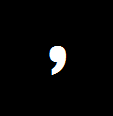 Compound sentences combine two separate ideas (clauses) into one compact package. A comma should be placed before a conjunction only if it is at the beginning of an independent clause. So, use the comma before the conjunction (and, but, or) if the clauses are standalone sentences. If one of them is not a standalone sentence, it is a dependent clause, and you do not add the comma.
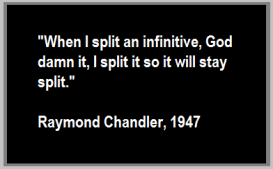 Explain why you want that particular grammatical no-no to stand, and your editor will most likely understand. If you know the rule you are breaking, you will be better able to explain why you are doing so.
 However, we can learn a great deal from books embodying poorly executed plots and badly scripted dialogue.
 Structurally, the books in this subseries feel like he knew how to end it but struggled to fill in the arc. Past events and conversations get repeated verbatim to every new character. Long passages of remembering and agonizing over what is done and dusted fluffs up the narrative.
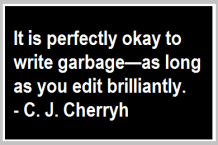 To me, book 21 reads as if (while books 19 and 20 were in the publishing gauntlet) he still had to fluff up the ending to make book 21 long enough to be considered a novel. The evidence of a lack of genuine inspiration is the absurd “scar” the protagonist is left with after winning an unbelievable victory and nearly dying.
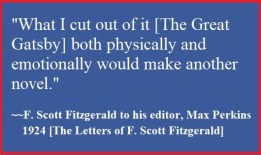 Everyone, even your favorite author, writes a stinker now and then.
  It deals with things like the mass of objects, the speed at which they travel, how speed and mass are converted to energy, and how mass warps the fabric of space and time.
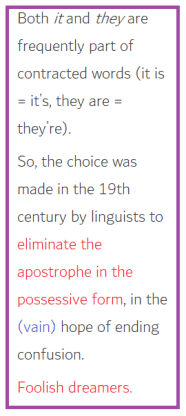 But what about “It?” Here, we are dealing with possession by the inanimate. We don’t need an exorcist, although a good maid service would resolve a great deal here at Casa del Jasperson. But in this case, we are referencing something owned by the inanimate:
 In the case of number 4, the sentence would be stronger without it. Most of the time, the prose is made stronger when the word “that” is cut and not replaced with anything. I say most, but not all the time.
 In the written narrative, the many forms of this verb are what
 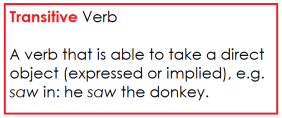 “Lay” is a transitive verb that refers to putting something in a horizontal position. At the same time, “lie” is an intransitive verb that refers to being in a flat position.
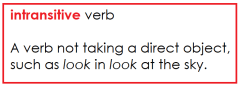 To lie is an intransitive verb: it shows action, and the subject of the sentence engages in that action, but nothing is being acted upon (the verb has no direct object).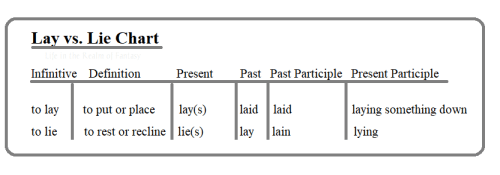
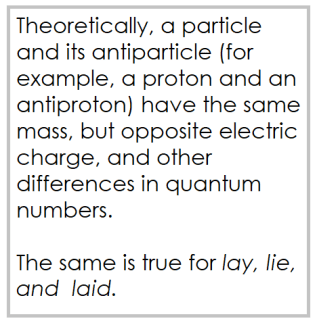 The verb that means “to recline” is “to lie,” not “to lay.” If we are talking about the act of reclining, we use “lie,” not “lay.” “When I have a headache, I lie down.”
 All around us, gravity works in hidden ways. Gravity on a small scale keeps everything securely stuck to the surface of Planet Earth.
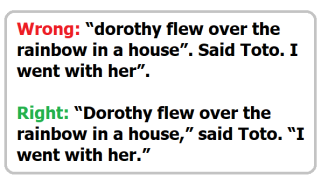
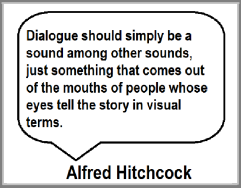 Creating memorable characters is the goal of all authors. After all, who would read a book with bland and uninteresting dialogue? Dialogue is where most information is given to the characters and the reader. However, when we are just beginning to write, many of us are confused about how to punctuate conversations. It’s not that complicated. Here are four rules to remember:
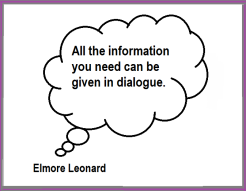 When you envision your characters in conversation, you must think about what the word natural means. People don’t only use their words to communicate. Bodies and faces tell us a great deal about a person’s mood and what they feel.
 For this reason, we don’t want to inject an excess of flushing, smirking, eye-rolling, or shrugging into the story. Those actions have a specific use in conveying the mood, but anything used too frequently becomes a crutch.


 Life in the Realm of Fantasy