Tag Archives: writing

#amwriting: Interview with author Stephen Swartz

Today is the final installment in my series of interviews with working authors who are also teaching writing craft. This has been a wonderful series, as each approaches the craft from a different angle, and my final guest has a great deal to offer.
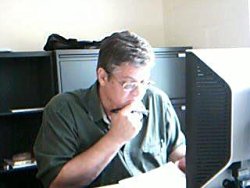
stephen-swartzA little background on today’s guest, author Stephen Swartz. He is a Professor of English at a major Midwestern university, and is a world traveler, often spending his summers teaching in Beijing, China at the University of International Business and Economics. Also, he is the author of numerous short stories and novels, and is a fellow founding author of Myrddin Publishing. He has also published poetry and written for scholarly journals on the subject of composition and identity, linguistics, and psychology.

CJJ: What do you enjoy the most about teaching?  Conversely, what would you change about your job if you were able?

SS: I’m rather parental when it comes to teaching. I like seeing my students become excited about writing and push themselves to explore their potential. I enjoy seeing their writing improve paper by paper, not only technically but also in showing their deeper thought processes. As it is, there are constraints on what I think would be best when it comes to writing instruction. Partly, it is a matter of budgeting, enrollment, and accreditation requirements. It is also a matter of what students are interested in career-wise; many do not think they will need to write in their careers. So I have limitations I must work within. And, of course, each semester brings a new mix of students so I must constantly adapt the lessons to accommodate them; it really is like reinventing the wheel. Writing fiction keeps me balanced.

CJJ: As you know, many authors are writing for children, preteens (middle-grade), and YA. In a comment on this blog recently, you said, “Meanwhile, the style (I think) should match the nature of the story and especially the mindset and education level of the narrator.” Can you expand on that idea a little?

SS: What I think I meant was in reference to the sophistication of the language the narrator of a story uses. That’s the author’s responsibility. If the narrator of a story is well-educated (for example, see my vampire novel A Dry Patch of Skin), he would speak in a well-educated manner, with sophisticated style and a large vocabulary. A less educated character (or a child) would speak differently, using simpler vocabulary and often incorrect sentence constructions. A foreign character speaking English would have similar language limitations; the dialog should show those limitations. However, we cannot let the language be too authentic if doing so would cause the reader difficulty. I once wrote a character who was supposed to speak with a Scottish accent; the result was rather bad. Having just enough (a particular repeating word or phrase) to hint at the accent would have been enough. I’ve been fortunate to have both studied linguistics and foreign languages as well as listened to speakers of varying ages and accents. I lived in Japan for five years and teaching English there taught me how non-native speakers “butcher” the language. I think I captured that effect well in my novel Aiko, set in Japan. Besides formal training, I also think I have a good ear for speech and so I do my best to replicate the character’s way of speaking based on the real speaking I’ve heard.
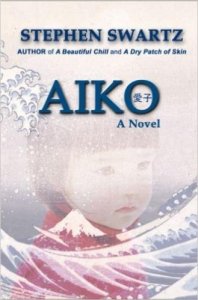
aikoCJJ: You have published eight books, in a variety of genres, and are now finishing up an epic fantasy novel (of EPIC proportions!). Yet, none of your characters have a sameness to them. How do you visualize your characters when you begin to place them in their story?

SS: Excellent question. My answer must, however, be simple. I’m schizophrenic. My mental defect allows me to grab pieces of other people’s lives, behavior, speech, and motivations which I then craft into plausible, even realistic, fictionalized personas. I recognize I have a few stock-in-trade character I use over and over with names changed and perhaps a quirk switched for a different quirk. I suppose I take one of my stock characters and customize him/her for the role I need him/her to play.

The hardest character to write is the protagonist because that character usually starts as a version of myself. The challenge is to let the hero act as the hero would naturally act (following his/her motivations and typical behavior) and not as I, the real me, would likely act. When I wrote out the story of a friend of mine who grew up in Greenland, I was writing a female protagonist—and using the first-person point of view. That novel was based on her life so I could imitate her way of speaking from interviews with her. The challenge for me in writing that novel was to make her language style change from her childhood to her teenage years to her adulthood.

For my current work-in-progress, the epic fantasy, I returned to a basic male protagonist, a hunky dragonslayer, and cobbled together a bit of a movie star, a little of me, and a pieces of other people I know to create the singular hero.

CJJ: In your upcoming novel, EPIC FANTASY *WITH DRAGONS, you portray a variety of races in a fantasy environment, each with unique cultures. What tips can you give in regard to keeping fantasy cultures diverse, and yet not devolving into too much backstory?

 SS: Not truly different races, not in the sense that Tolkien has them with dwarves and hobbits. I tried to keep the ethnicity in my story more subtle. Given the setting (no spoilers here), there is a wide variety of “types” among the cast members, not just to make a politically correct checklist but because they mix well in interesting ways. One famous author (I think it was Dostoevsky but it may be a more modern writer) liked to think up unique people and ponder how they might interact if put in a room together. I did the same with my epic fantasy only on the larger stage of the story world.

Regarding the world-building, I cheated a bit in this novel by setting it in a familiar setting (again, no spoilers here). Readers may recognize it eventually but it is not explicitly “given away” in the text. Even so, as I traced the path my hero would take on his quest, I marked certain locations on the map as being “different” societies with unusual customs—not different races or ethnicities. Like all good epic fantasy tales based on a quest, there is a series of episodes—self-contained mini-story arcs, strung together, one adventure after another—so the structure is easy to arrange. Following the geographical layout of the setting, what “can happen” to our hero necessarily changes from location to location.

A better example of world-building may be my science-fiction trilogy The Dream Land, which involves a pair of nerdy teens who discover a doorway to another world—which I created as a fully realized planet with continents, oceans, history and culture, and several different races, as well as unique flora and fauna. The world-building was half the fun of writing those novels; pushing my hero and heroine into this new world and watching them figure things out was the other fun part.

I think the key to “keeping fantasy cultures diverse, and yet not devolving into too much backstory” is to remember that, to the characters in the story, it is all known and common (usually) so they should speak and act toward everything there as though it was all common to them. You have to find creative ways of introducing ideas and details without them coming out as a “Let’s go meet Bill, your cousin, who, as you know, is also my long-lost brother” kind of writing. In my current epic fantasy novel, I can get away with some of that “messaging” because my hero is on a quest and does not know about the places he visits, so having a local character explain things is quite natural. People like to talk, so I let these “local yokels” ramble on and the history and customs of the place come out in a more natural way.

CJJ: In all of your novels, there is a certain amount of world building, even the novels set in contemporary environments. What advice can you give regarding making the settings feel real to the reader while keeping the backstory minimal?

SS: Research, if it is a real place. Read other books about the location, fiction or non-fiction. As I wrote A Girl Called Wolf, which is set in Greenland, I also read a very evocative book on the travels of early explorers written by a woman undertaking her own contemporary travels there. Her writing and descriptions painted such vivid pictures for me that I could describe the locations both accurately and passionately.

The most realistic setting I’ve ever used was my own city in the set in the same year I was writing it. I’m referring to my vampire novel, set in Oklahoma City with places named, set in 2014, when I was actually writing it so what happened in real time happened in the book. That was a fun exercise. But then our hero goes to Europe so I went back to researching.

For make-believe worlds, I think it’s simply a matter of transposing what we know of real locations to an imaginary location. For example, in The Dream Land Trilogy, I would think of an Earth animal and reinvent it as something more exotic: the common mount, a horse, became a 3-toed donkey with a dewlap, stripes on half its body, long rabbit ears, and a rat tail. Similarly, I’m more science-focused so even in a fantasy story I remain concerned with such things as the distance of the planet from its sun and the ratio of land to ocean, and so on. Even in my epic fantasy, a genre where magic is required, I have magic operating on scientific principles but it is explained in highly metaphorical language—but it still looks like magic!

CJJ: Thank you for indulging my curiosity, Stephen. I love talking craft with you around the virtual water cooler at Myrddin, and enjoy your blog, The DeConstruction of the of the Sekuatean Empire.

>>><<<

You can find Stephen Swartz at any of these places:

Stephen Swartz Amazon Author Page

Website: The DeConstruction of the Sekuatean Empire

Stephen Swartz  Myrddin Publishing page

Twitter: @StephenSwartz1

Stephen Swartz’s FB Author Page
2 Comments

Filed under writing

#amwriting: consider the scenery

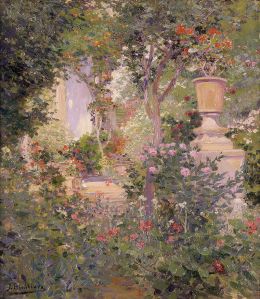
 The Garden of the Author, by José Benlliure Gil via Wikimedia Commons


The Garden of the Author, by José Benlliure Gil via Wikimedia Commons

I had an intriguing email conversation with a new acquaintance, a young man I met through PNWA at the recent conference. He was struggling in his writing group, trying to get a handle on  the showing vs. telling aspect of writing. As he writes mysteries, the setting and environment of certain scenes are quite important.

I suggested he view the scene through his protagonist’s eyes.

Every memorable element in a fictional story must be necessary to the story.  In creative writing, this concept is referred to as “Chekhov’s Gun,” as it is a principal formally attributed to the great Russian playwright, Anton Chekhov. He said this with regard to the settings for his plays, but in terms of writing, what this means is that if your characters notice a gun on the wall, someone must fire that gun, or it should be removed from the scene.

It was a neighborhood Dionte was unfamiliar with.  Just as he entered Tyrone’s gate, his phone dinged, a text from Ty. He’d had to leave for a minute, but Dionte should go on in and wait in the kitchen. Both men were on the board of the Community Action Council, but he didn’t know Tyrone well, and wondered where he’d been called off to.

What does Dionte see, and how does it register in his awareness?

He went up the walk, climbing the worn steps of the front porch. Feeling odd at entering the home of a casual acquaintance when he wasn’t there, Dionte reached for the knob and turned it. The door swung open, and entering the small sitting room, he was overwhelmed by the amount of clutter.

Tyrone had no TV that Dionte could see, but most of the furniture in the room was buried under stacks of newspapers and piles of laundry. His computer was partially hidden behind a stack of library books and a coffee cup, half full, sat atop them. A plate with a slice of toast sat beside the keyboard as if Ty had left in the middle of his breakfast.

Feeling claustrophobic, Dionte found the path to the kitchen, unsure now what sort of mess awaited him in there. To his surprise, the kitchen was immaculate.

The incongruity of the pristine kitchen contrasting with the clutter of Tyrone’s living room is all noted mentally. Each thing on our character’s path into and through Ty’s home is an image that registers in Dionte’s consciousness briefly, but is not mentioned again.

Tyrone had said there might be a serious problem, but wanted Dionte’s take on it before he brought it up at a meeting. Wondering what it could be, Dionte sat at the table, looking at the clock on the stove, seeing it was 11:15. He’d gotten the text only a few minutes before. Tyrone had to have been called to somewhere close by, as he’d left his house unlocked. He hadn’t passed Dionte in the front, so he must have left through the back.

The sound of someone coming up the back steps caught his attention, and his eyes were drawn to the screen door.

It’s a murder mystery, so who was approaching? What happened next? And why is the toast by the computer important?

Scenes require a certain amount of description. Let’s say we’re writing a short story about a grandfather fixing dinner for his grandson. He’s had to go out shopping, and now he carries his groceries home in a snowstorm, fearing he will slip and fall. This scene could be set several ways, and here are two, one less wordy than the other.

Snow fell softly. Holding a bag of groceries, he gazed at the stairs leading from the walk to the front door, fearing a layer of ice lurked beneath the pristine whiteness.

OR

He gazed at the icy stairs leading from the un-shoveled walk to the front door, his bag of groceries growing heavier.

Either way works, but personally, I would go with the second.

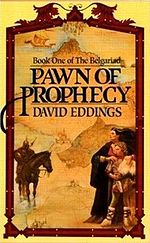
Pawn_of_Prophecy_coverIn 1982 I picked up Pawn of Prophecy by the late David Eddings. This was an amazing, eye-opening book for me, both as a reader and an author.  Eddings had the ability to convey a sense of place in a few well-chosen words. He put those words into  beautiful, poetic prose. The book opens in the kitchen of a farmhouse with Garion’s memories of playing under the table in a kitchen as a small child.

Garion’s earliest memories are of being a toddler: the sound of knives deftly dicing vegetables, his aunt keeping him corralled and happy under the table while she works, the sparkle of the gleaming pots and kettles high on the wall lulling him to nap.

“And sometimes in the late afternoon when he grew tired, he would lie in a corner and stare into one of the flickering fires that gleamed and reflected back from the hundred polished pots and knives and long-handled spoons that hung from pegs along the whitewashed walls and, all bemused, he would drift off to sleep in perfect peace and harmony with all the world around him.”

Later, when Garion has been completely uprooted, this passage becomes important, as it describes the place he thinks of as home. In that paragraph, we see the important things in the room, and we have a visual image of it. The child’s sense of contentment and safety that the kitchen represented is conveyed by the impressions of the kitchen instead of the image of it. The detail supports the story rather than impeding it.

The scenery in the narrative must be organic. It has to be purposeful and not just there to fill the space. I like books where the scenery is shown in brief impressions. We see it only when it needs to be there. Sometimes we see it through the protagonist’s eyes, and other times we see the protagonist set in the scene as described by a narrator, but everything we see must be a part of the characters’ experience.

4 Comments

Filed under writing

#amwriting: em dash; en dash; hyphen

Book- onstruction-sign copyAn em dash (—)   is a versatile punctuation mark. It is the width of an ‘m’, hence the name. An em dash serves as a comma, does the same task as parentheses, and also does the work of the colon. Used in these situations, the em dash creates a slightly less formal effect and is a useful tool in the author’s arsenal.

To insert an em dash in a Word document: type two hyphens next to each other without any space between the words or hyphens:

  • A—B (LetterHyphenHyphenLetter) Once you hit the space key after the second word, the two hyphens will form an em dash.

They can be more emphatic than a comma, and will really set apart any clause bracketed by them. In dialogue, we don’t use semicolons to join short related independent clauses. Instead, we use em dashes. Used sparingly, and not in every paragraph, they can smooth a choppy conversation and make it more normal sounding.

Unfortunately, I have a tendency to use them far too frequently, and in my hands, they lose their effectiveness. When combing a final ms for bloopers, I find them sprinkled through my work, maniacally creating run-on sentences where brevity would be a better choice.

The en dash (–) is the width of an ‘n’, hence the name. It denotes a span or range of numbers, dates, or time. Depending on the context, the en dash signifies “to” or “through.” When keying, type a space between the en dash and the adjacent material and then hit the spacebar.

To insert an en dash in a Word document: type a single hyphen between two words, with a space on either side of it:

  • 1994 – 1996 (1994SpaceHyphenSpace1996) Once you hit the space key after the second word, the hyphen will form an en dash.

Hyphens join certain compound words. Never use a hyphen in the place of an em dash or en dash.

Do not use a hyphen unless it serves a purpose. If a compound adjective is easily understood without a hyphen or its meaning is established, a hyphen is not necessary.

  • An English-speaking country
  • A time-saving device
  • A thirty-floor building

Some compounds are created on the spot to fulfill a specific need (on-the-spot creations). Permanent compounds began as improvised compounds but became so widely accepted they are now included in the dictionary as permanent compounds.

Examples of temporary compounds that have made the transition to permanent compounds are:

  • know-it-all
  • heart-stopping
  • free-for-all
  • down-at-the-heel

Context determines whether or not to hyphenate.  Ask yourself, “How will the words be interpreted by the reader if I don’t hyphenate?”

Wikipedia offers the following examples:

Man-eating shark (as opposed to man eating shark, which could be interpreted as a man eating the meat of a shark)

Wild-goose chase (as opposed to wild goose chase, which could be interpreted as a goose chase that is wild)

Long-term contract (as opposed to long term contract, which could be interpreted as a long contract about a term)

Zero-liability protection (as opposed to zero liability protection, which could be interpreted as there being no liability protection).

Overuse of em dashes and hyphens is a characteristic of lazy writing habits. We are in a hurry to get the story down, and we use the em dash to connect clauses that would be better if left to stand alone, and we hyphenate compound words that don’t require a hyphen.

I see these habits in my work and am forcing myself to be more creative. The em dash has a proper place in my work, but it can work its way into every paragraph. It is like an exclamation point. If I want my em dash to really emphasize a point, I have to only use it when nothing else will have the desired effect.

Only by seeing our work through a critical eye can we grow as authors. By writing every day and striving for growth, the quality of our work improves. Our beta readers will notice this growth and thank us for it.

11 Comments

Filed under writing

#amwriting: Two punctuation wrongs that don’t make a right

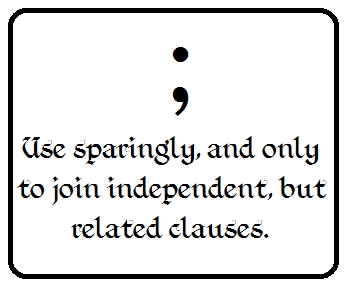
semicolon memeToday, I am revisiting independent clauses and how NOT to join them. This has been discussed at length elsewhere on this blog, so I’ll keep today’s discourse short and to the point.
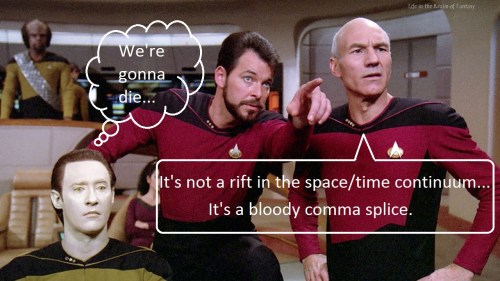
You do not join independent clauses (clauses that can stand alone as separate sentences) with commas as that creates a rift in the space/time continuumthe Dreaded Comma Splice:

Comma Splice: My car is a blue Chevy Malibu and I like it, the dog likes to ride shotgun.

Same thought, written correctly: My car is a blue Chevy Malibu, and I like it. The dog likes to ride shotgun.

Would it be better if we used a semicolon? No. The dog riding shotgun is an independent clause and does not relate at all to the color of the car.

A semicolon in an untrained hand is a needle to the eye of an editor.

Remember: Semicolons join independent clauses, which are clauses that can stand alone, and your best bet is to avoid using them except under extreme duress as they can create some lo-o-o-o-ong, run-on sentences.

But what if you absolutely, positively have to use a semicolon, or your hair will fall out? Trust me, it won’t happen, but there are rules for using this type of punctuation, and the wise author will follow them:

Two clauses that are joined together with a semicolon should be

  1. complete sentences that relate to each other
  2. if they don’t relate to each other, make them separate sentences and reword them so they are not choppy.

Two separate ideas done wrong: We should go to the Dairy Queen; it’s nearly half past five.

The first sentence is one whole idea—they want to go somewhere. The second sentence is a completely different idea—it’s telling you the time.

Two separate ideas done right, assuming the mention of time is important: We should go to the Dairy Queen soon. They close at eight, and it’s nearly half past five.

If time is the issue in both clauses, and you feel like you absolutely MUST use a semicolon or you will explode, say, “The Dairy Queen is about to close; it’s nearly half past five.”

I generally try to find alternatives to semicolons, but I don’t dislike them, as some editors do. I do think they are too easily abused and misused, and should not be used if you are in doubt.

Comma splices—don’t do it. The universe will grind to halt, and everyone will die, and it will be your fault.

Semicolons—use only when two stand-alone sentences or clauses are really short and relate directly to each other.

Comma Splice Meme


7 Comments

Filed under writing

#amwriting: finding paradise

Amaranthus and Savvy at the needles by haystack rock cannon beach 2012My annual visit to the sunless Oregon Coast is upon us. For the next week I’ll be reading and gazing out the window at the ghostly rocks of Tillamook Head rising from the mist. Terrible Tilly, the most infamous lighthouse on the West Coast rises a mile out to sea, but is shrouded in fog and mist–I can’t see her today.  It is supposed to rain most of the week here–and that is what we come to this place for.

The many moods of the stormy waters, the seabirds–this place inspires me and clears my head like no other place.

I will be writing whenever the muse seizes me. Our condo is one we often stay at, and is perfect for us with a fully outfitted kitchen. I will cook many meals for my family, as being vegan, I can’t really eat in too many restaurants, although there are a few beginning to offer vegan options here.

As I write this at 06:15 a.m., the rain-slick streets are nearly empty, making this my town, my personal paradise. Despite the bad weather, people will soon be out, and it won’t be mine any more, but the hum and bustle of the streets brings a different vibe of excitement.

Walking along the beach in this sort of weather, one finds so many more things. The wave deposit sand dollars and the seabirds dine on them, leaving behind the hollowed shell for me.

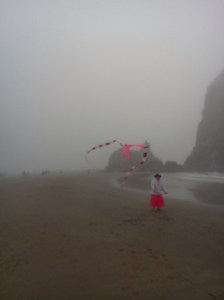
The author goes kite flying in the fog, Cannon Beach, Haystack Rock , August 2013I may not have the chance to fly my kite until later in the week, but then again, some years I find myself kite-flying in the fog. Rather like my normal life, I suppose–with so many stories whirling in my head I’m always in a fog, so to speak.

Sun or no, this is my writing and reading paradise. I have the opportunity to do both here, in undisputed peace. Today, my husband and I will stroll along the beach, or visit the small shops, or just chill on the deck, observing the sea in all her many moods.

This is my piece of Heaven. Have you found yours?


Comments Off on #amwriting: finding paradise

Filed under Adventure, writing

#amwriting: ensuring consistency: the stylesheet

Book- onstruction-sign copyWhen a manuscript comes across their desk, editors and publishers create a list of names, places, created words, and other things that may be repeated and that pertain only to that manuscript. This is called a stylesheet. Some editors refer to this as a “bible.”

The stylesheet can take several forms, but it is only a visual guide to print out or keep minimized until it’s needed. I copy and past every new word or name onto my list,  doing this the first time they appear in the manuscript. If I am conscientious about this, I’ll be less likely to inadvertently contradict myself later on in the tale.

Some people use a program called Scrivener which is not too expensive, but which seems to have a tricky learning curve. I downloaded the free version but couldn’t make heads or tails of it and found it quite frustrating. Nevertheless, I understand that it works well for many people, and to them, I say, “Good for you.”

For myself, I don’t want a fancy word-processing program. I just use MS Office, because I have been using the programs that come with that software since 1993, and I’ve been able to adapt to each upgrade they have made. It’s affordable, so I use Word to write and edit in, and occasionally use Excel to make small charts that are my style guides for each novel or tale I write, and also for every book I edit.

You can do this in Google Docs too, and that is free.

Regardless of how you create your stylesheet, I suggest you include these elements:

  • Word/Name
  • Page it first appears
  • Meaning

Bleakbourne Style Sheet

This is especially crucial for fantasy authors because we invent entire worlds, creating names for people, places, and creatures.

Take my own work-in-progress: it has characters with names that can be spelled several ways, and when I am in the throes of writing the first draft I fling them out any old way.

Thus, a character named Claire on page one can become Clair by page six. Dominick can become Dominic. Place names become mushy, and any word that is important or invented can evolve over the course of a manuscript.

I first learned about creating a stylesheet years ago when Huw the Bard was being edited. As she was editing my manuscript, my editor made a global search for every possible variant of the words I had created. She alerted me to these discrepancies, and I replaced the incorrect instances with the version I like best.

I have kept a Stylesheet for every work in progress since then, for short stories as well as novels.

map of Waldeyn 2015 with lettering cooper black copyPlace names evolve too, so maps are essential tools when you are building the world. Places written on a map tend to be ‘engraved in stone’ so to speak. Readers will wonder where the town of Maldon is when the only town on the map at the front of the book that comes close to that name is listed as Malton.

To prevent that from happening, double check what you have written on the map, and then do a global search for every possible variant of that name in your rough draft.

Just because you invented the world doesn’t mean you know it like the back of your hand. That world is constantly evolving in your mind. I have been writing in the world of Neveyah since 2009, and I still frequently contradict myself, which is why the stylesheet is so important.

9 Comments

Filed under writing

#ammwriting: Firing Chekhov’s gun

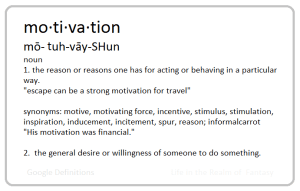
Motivation memeThis last weekend, I attended PNWA’s annual writing conference in Seattle, Washington. I garnered a great deal of advice from industry professionals and took seminars offered by well-known authors, agents, and editors.

I attend this conference every year. PNWA is where I come to learn both the craft of writing and business of publishing. Craft and business: two aspects of writing that every serious author must know whether they are going indie or taking the traditional route.

Today’s post is about identifying what motivates your characters. Well-known writing coach,  Lindsay Schopfer, gave a seminar on this, which unlocked ideas for my works in progress. That is how writers’ conferences work for me—they pry loose the ideas that have been stuck and help me verbalize them.

You have probably heard of the literary rule known as Chekhov’s Gun, which says nothing should appear in the scene that has no use. If a rifle is important enough to be shown hanging on the wall, someone had better fire it, or it should be removed from the setting.

Firing Chekhov’s gun brings us to motivation. When I was in elementary school, I was taught  “the 5 Ws” of journalism. I feel sure they still teach this, but just to remind you, they are:

  • Who
  • What
  • When
  • Where
  • Why

These five words form the core of every story. Who did what? When and where did it happen?

Why did they do it?

In some stories the author had made the what quite clear, but the why is murky. I hate it when the author is at a loss as to why their protagonist wants to do the task set before them.

If a character commits a murder, you’d better know why they were compelled to do it. Random events inserted to keep things interesting don’t advance the story.

When a character arrives at the inciting event, the things that motivate him/her should already be established. Identifying what makes your character do the things they do is the core of character development. Some characters are easy:

  • Edwin wants to save Marya.
  • Wynn wants to get back to his wife and his forge.
  • Huw wants to avoid being hanged for treason.

Some characters have motives that are more difficult to identify. Motives are driven by need, what a character desires, and what they are willing to do to attain it.

Suppose we have a protagonist who realizes her marriage is failing. We’ll call her Anna. Before we begin writing, we need to do a little brainstorming about Anna and find out who she is and what makes her tick.

She is a well-educated, professional woman, a writer of paranormal fantasy. She is married to another writer, David.

What motivates her? David is strong, charismatic and brilliant. There is nothing he doesn’t feel entitled to, and he will do anything to achieve his goals. Although she is a best-selling author of popular fiction and is the person paying the bills, Anna has made a habit of catering to his needs.

At first, she wants to keep her marriage together and presents herself as whatever she thinks David wants her to be. She feels as if she casts no shadow of her own. As the summer progresses and events unfold, she evolves, becoming an individual who no longer needs his validation. In the process, Anna finds that she is, and has always been, the strong one in the relationship.

With those paragraphs, we know the main protagonist’s desire—on the surface she has a deadline for her book and wants to save her marriage, but really she is seeking her sense of self-worth, trying to find who she is.

Now, let’s find out who the other characters are:

Anna and David rent a secluded house on the wild Washington coast for the summer. They invite 3 companions to join them for the summer, as a working retreat. All five characters have deadlines, and that is their official reason for accepting Anna’s invitation. However, the four other characters each have their own agendas. Other than Anna, they each have strong personalities, are charismatic, and are used to a certain amount of privilege. At first, although it is subtle, each of them uses and manipulates Anna for their own purposes.

Every member of the cast has a secret, including Anna. With the revelation of each secret to the reader, the motivations for subsequent actions become clear. Someone will attempt murder to ensure their secret is kept. In the end, three will die by accident, and two will be left to pick up the pieces.

With this information complete, we know the genre–this novel is a contemporary fiction, and is the story of Anna’s journey to self-knowledge. It will be slower paced than a thriller, and will be about the people and their relationships more than the events. However, the events will shape the people.

LOTR advance poster 2Unless each character’s wants and needs are clearly defined, the events won’t make any sense. Without clear motivations, it’s just a bunch of drama queens cooped up with a psychopath, in a house by the gloomy Washington North Pacific coast. Once we know their motivation, it becomes a story. And as a writer trying to flesh out characters, it becomes easy to picture these five people as individuals possessing depth and desires.

Motivation is the character’s quest to fulfill his/her deepest needs. Consider Frodo: he has seen what the ring did to Bilbo and Gollum, but more than that, he loves the Shire and does’t want it to fall to shadow. Without a real, personal motivation, there is no reason for Frodo to  agree to walk to Mordor and certain death just to toss a ring into an active volcano.


1 Comment

Filed under Literature, writing

#amreading: The Karaoke Novelist

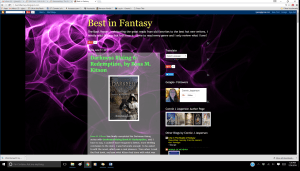
BIF Blog Print ScreenI used to write an indie book review blog, before I got too busy to read as much as the blog required. The blog was called Best in Fantasy, and I still post reviews to it once in awhile, but only when something really rings my bells.

Sometimes I had to attempt to read six novels before I found one worth reviewing. In the process of searching Amazon for those really good fantasy reads, I’ve read a large share of badly written books. There is no  describing the agony of seeing a perfectly good idea for a plot destroyed by an author who was too eager to share their genius and rushed to publish what was clearly an excellent first draft .

You will get no snarky reviews from me—in fact I don’t review books I don’t like. I just move on to the next one in my pile and hope for the best.

Instead, I focus on the really awesome books I have enjoyed, some written by the famous, but most by the NOT so famous. Many of the great books I have enjoyed will never be best sellers because they are just one drop in an ocean of Kindle books.

It’s the wild west of indie publishing right now, and while it’s not necessarily a terrible thing, many untutored authors publish less than stellar works. These books are written and published by people who have no idea how the industry works.

Writing is like any other craft. There is a learning curve. Publishing is a separate craft, but nowadays the two go hand-in-hand.

At some point,  as indies gain the knowledge of what is involved in writing and publishing a good novel, the overall quality will  improve and level out. Those who are in it for the long haul will gain better visibility.

I have some hard-earned advice for new authors, those of you who want to leave the ranks of the Karaoke novelists, screeching their inept renditions of Wind Beneath my Wings. If you’re serious about your work, get your manuscript professionally edited.

Yes, it will cost you money, and you may get feedback you don’t want to hear. But that experience will enable you to put a book out there that you can be proud of, one that will stand up to any put out by the big publishers.

When I was writing a book review blog on a weekly basis, I often spent my week looking through five reasonably priced books only to discover they were

  1. Poorly formatted.
  2. Poorly edited.
  3. Rife with newbie errors such as beginning the book with a big info dump (been there done that).
  4. Thick, lush descriptions of “creamy blue eyes” (pardon, must barf now).
  5. Written by an author with no concept of a story arc.
  6. Boring filler conversations to fluff up the word count.
  7. Threads to nowhere,
  8. A random event that was intended as a cliff-hanger ending, but was obviously stuck there to entice the reader to get the sequel, which hadn’t been written yet and was now on my “No Way in Hell” list.

This also happens regularly with traditionally published books.  TOR can publish a novel that was poorly edited and no one will blink an eye, because they are one of the Big 5 Publishing houses.

Indies have to be better than that. Indies are scrutinized more closely and are held to a much higher standard. Flaws in our work are held up as an example of all that is wrong with the industry.

I used to curse at my Kindle when I read the first pages of books, both indie and traditionally published, that were  travesties. Many had gorgeous covers. I feel strongly the authors would be better served if they spent that money having their manuscript professionally edited.

I cringe when someone blithely tells me their friends edit for them. Most people aren’t best mates with a professional editor, and if you don’t have a degree in creative writing, you probably need a professional eye on your work.

Indies–aren’t you glad I only reviewed the books I liked? I didn’t want to be known for being a bitch, which is what I felt like when I read some of those travesties.

Thus, I say

  1. Go to writing craft seminars and conventions.
  2. Take writing classes at your local community college.
  3. Take online classes in writing.
  4. Buy and read books on the craft of writing.
  5. Write every day, even if it is only a paragraph.
  6. Hire a professional editor and consider following their suggestions.
  7. Have your manuscript proofread professionally before you publish it.

keep clam and proofreadI can’t stress this enough: before you publish that book you wrote during NaNoWriMo, please develop the craft of writing and rewrite that amazing novel.

You can join a writing group in your town and they will help you with these things. With the right group helping you grow, you will develop the skills needed to truly be a published author. And remember, if one group doesn’t really feel like a good fit, keep looking until you find a group you can work with.

2 Comments

Filed under writer, writing

#amwriting: Sturm und Drang

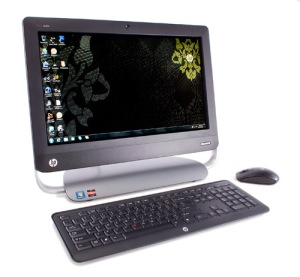
hp-touchsmart-320-1030-full-setMy main, desktop computer died on Saturday. It’s been limping along for a while. We had into the shop about six months ago, and should have known then it was terminal. The thing is, while I love Sturm und Drang in my literature, I prefer my electronic life to be stress-free.
Limping along on my ancient, half-functional laptop, I can get by well enough to write the odd blogpost or work on my own work. But the screen is too small for me to use to edit for a client. Also, I can’t do any work requiring Photoshop, as that program is on my dead dinosaur.

I have my headphones on and the laptop strategically positioned, so it blocks the 50-inch technological disaster that is our TV and which seems to take up an entire wall. It also needs replacing as a series of vertical lines obscures the view on part of the screen but I doubt that will happen this year–TV is not that important. Music is mostly my form of entertainment.

Greg’s laptop is older than this one, although he is keeping it alive. All our technology is older than dirt. So, after I finish writing this blogpost, we are going shopping and two new machines will come to our house.

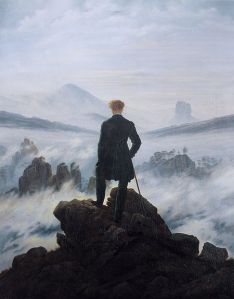
Caspar David Friedrich, Wanderer Above the Sea of Fog, 1818

Caspar David Friedrich, Wanderer Above the Sea of Fog, 1818 PD|100 via Wikimedia Commons

Let’s talk about Sturm und Drang. The English translation is literally, Storm and stress.

Google defines it as: a literary and artistic movement in Germany in the late 18th century, influenced by Jean-Jacques Rousseau and characterized by the expression of emotional unrest and a rejection of neoclassical literary norms.

What does this mean in simpler terms?

Sturm und Drang as a literary form evolved during the time of the American Revolutionary War, which a period of global unrest and great hardship, especially in Europe. The main feature is the expression of high emotions, strong reactions to events, and often, rebellion against rationalism. It is characterized by violent individualism and complex emotions. Literature and music written in this style were aimed at shocking the audience and infusing them with extremes of emotion.

Classical literature in this style began in 1772 with “Prometheus,” a poem by Johann Wolfgang von Goethe, in which the character of the mythic Prometheus addresses God (as Zeus) in misotheistic accusation and defiance. Misotheism is the hatred of God, or the Gods, in literature described as stemming from a moment in a person’s life where one feels the gods have abused and abandoned him. Misotheism requires a firm belief in a God or Gods.

Again, Wikipedia tells us this: Prometheus is the creative and rebellious spirit which, rejected by God, angrily defies him and asserts itself; Ganymede is the boyish self which is adored and seduced by God. One is the lone defiant, the other the yielding acolyte. As the humanist poet, Goethe presents both identities as aspects or forms of the human condition.

Modern genre and indie literature using this style can be found as an underlying trope in Cyberpunk.

Wikipedia defines Cyberpunk as: a subgenre of science fiction in a future setting that tends to focus on the society of the proverbial “high tech low life[1][2] featuring advanced technological and scientific achievements, such as information technology and cybernetics, juxtaposed with a degree of breakdown or radical change in the social order.[3]

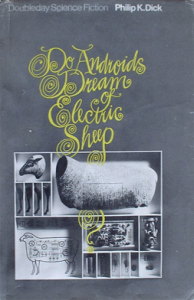
DoAndroidsDreamIt is exemplified by post-industrial dystopias that tend to feature wide divisions in the social order and extreme chaos in society. Protagonists acquire and make use of technology in ways never anticipated by its original inventors (“the street finds its own uses for things”).  Much of the genre’s atmosphere is heavily film noir, and  employs techniques and style reminiscent of detective fiction.

The difference between classical Sturm und Drang and modern Cyberpunk is Technology and Industry are the Gods whose knowledge the mortals desire, and whom they seek to replace. All aspects of Sturm und Drang can be found in Cyberpunk.

Cyberpunk began as a niche rebellion by authors like Phillip K. Dick, and is now mainstreamed and growing in popularity.

Authors writing in the early days of speculative fiction were Indies who were finding success getting short stories published in popular sci-fi magazines, and who were fortunate enough to have some farsighted editors take chances with publishing their longer work. They formed publishing companies and became giants. That opportunity will always be out there.

Indie authors have a great deal of latitude in their choice of what to write, as we can write and publish edgy work that would be deemed too chancy by traditional publishers. Authors always engage in artistic rebellion, and society always appreciates it—years afterward.

And tonight, I will continue my artistic rebellion while getting my new computing thing, whatever it shall be, up and running.

2 Comments

Filed under Fantasy, Literature, Uncategorized, writing

#FlashFictionFriday: Astorica

800px-Ladies_safety_bicycles1889Chance Jensen approached The Duck Walk Inn, aiming for the front door. It was classier than most of Astorica’s cocktail lounges, and was the third place she’d looked that afternoon. She entered, peering around to see if Jack was there.

He was, and ignoring the worried glances from the few men who were present in the otherwise empty bar, she walked toward him.

Stella, the bartender, chatted with Chuck Moore, Astorica’s lone hooker. Chuck’s clientele was comprised mostly of lonely, blue-collar laborers, women who worked in the shipyard. Stella nodded at Chance, as she lit Chuck’s cigarette.

Chuck exhaled a cloud of smoke, and glared at Chance. “You’ve been neglecting him, Chance Jensen. Don’t take your husband for granted. You’re a lucky woman to have a man like Jack. He shouldn’t be sitting in a place like this.”

“I know. I’ll do better, I promise.” She did have to smile, getting advice on her marriage from the local whore. But, she supposed, Chuck had seen plenty of marriages fail.

“Good. I don’t want to have this conversation again.” With a flounce, Chuck turned back to Stella.

The nervous-looking men at the corner table had moved their handbags to hide their cocktails, obviously regretting their decision to be so daring as to go into a cocktail lounge unaccompanied.

Jack looked out of place at the bar, dressed in his usual proper, suburban, house-husband style. He glanced up from his iced-tea. “What do you want? I’m not going back unless you’ve changed your mind.”

“Jack, we had a quarrel. I’m sorry I shouted. But, you can’t file for a divorce, as you don’t have grounds. I don’t beat you or cheat on you. You’re just angry because I can’t afford to buy you a bicycle like Loris did her husband.”

Jack straightened his sweater and crossed his trouser-clad legs. “You’re right, I am unhappy about that. I might not be able to get a divorce, but I don’t need one. I’m not interested in dating, so I have no desire to be single. But no law says I have to share your roof. If I got a job as a waiter or a housekeeper, I could support myself and buy my own bicycle. One with a good-sized basket for carrying things.”

Chance attempted to reason with him. “Jack, if you took a job outside our home what would people think? They’d think I can’t manage on my salary. I’m just starting out with this company. I don’t need that kind of image dogging me, holding me back, or I’ll never be promoted. They’re assigning me better routes now, so things will improve. I promise.”

He burst out, “I have needs too, you know. I want to go places, and do things. I’m tired of being cooped up, with nothing to do but slave away, making sure that when you come home, you find a clean house and a hot meal. Where’s the joy in that?” Jack wiped a tear, a sure sign he was really worked up. His voice, however, was calm. “It’s just, if we had a child, I would feel needed. I don’t have a purpose, Chance.” He met her eyes. “Give me a purpose, and I’ll stay.”

Chance sighed. It always came back to that. “I’d like a child too. I don’t know why we haven’t been blessed. We’re both healthy. There’s no reason we haven’t conceived.”

Jack looked around the room. “See? They’re the same as me. We’re bored stiff. Playing bridge on Tuesdays and going to Tupperware parties just doesn’t fill the void. It’s not just us. Fewer and fewer babies—something’s wrong with this world, and no one will admit it.” He stared down at his handbag. “It’s more than that. It’s everything. I get up at five to cook  breakfast and fix your lunch. The darkest corners in our house are so clean they glow in the dark! I do laundry. I wash windows. Every day, the same things.”

Chance started to agree, but Jack cut her off.

“At ten I get all dressed up and take the bus to the market, then I haul the groceries home and put them away. Once that’s done, I change and go out to work in the flower beds, because God forbid the neighbors should see an untidy yard! Once every bloody just-sprouting weed has been yanked, I prepare your dinner, and fifteen minutes before you get home I get all dolled up, just to look good while I serve you dinner. Then I have to clean the kitchen. The next day it starts all over again. My life revolves around cooking, cleaning, and what the damned neighbors might think of us.”

Hoping to calm him, Chance said,“I know it’s difficult for you, depending on public transportation. But I’m a truck driver. You knew that when you married me. Maybe I’m not as romantic or rich as the wives in your soap operas, but I do try. Don’t I give you a large enough allowance? I never ask how you spend it. I don’t care if you have lunch out with the boys, or have your hair done twice a week. I love you! I married you for keeps, and I respect the vows we took.”

“You could tell me you love me more often.” Jack sat  hunched in on himself.

“I know. I’m not good at saying how I feel.” Chance put her hand on his shoulder. “I’ll try to do better.”

Jack burst out, “I could learn to drive, but men aren’t allowed to. I could vote and help pass laws that would improve society, but no, men aren’t allowed to. We’re too emotional, too high strung to be allowed the same privileges as women.”

Desperate to head off the men’s emancipation argument, Chance said, “I know you’d be great at all those things, better than some women if I’m truthful. But it’s the way things are, and we have to live with it. And guess what—I got a raise, today.”

Jack’s eyes it up. “Really? That’s wonderful.”

Pressing her advantage, Chance said, “You know what that means? We can save up for your bicycle. If we’re careful, next month you can buy it.”

Picking up his handbag, Jack stood up. “Let’s go home. I’ll make a pie to celebrate your raise.”

Relief flooded Chance. Taking his elbow, she opened the door for Jack and guided him across the parking lot, reminding herself that men were the fairer sex, and required gentle handling. Chuck was right–she had been neglecting Jack’s emotional needs. She resolved to be more attentive.

She loved Jack , but he confused her. He had an overabundance of paternal instincts. It occurred to her that a puppy might take Jack’s mind off things. And, it just so happened Chance’s new boss, Carol, was trying to find homes for six dachshund puppies.

That was a brilliant idea. She’d gain favor with the boss and surprise Jack with a puppy, solving both problems in one swoop. Smiling, Chase opened the car door for her husband, helping him into the sedan.


“Astorica” © 2016 Connie J. Jasperson, All Rights Reserved

4 Comments

Filed under #FlashFictionFriday, Fantasy, writing