Tag Archives: writing

#amwriting: Thoughts on #NaNoWriMo2016

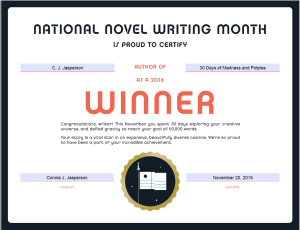
winners-certificateIt is the final day of NaNoWriMo for 2016. I wrote 96,603 words: ten short stories and fifteen chapters on my next novel set in the world of Neveyah. I had my winners certificate by the 23rd, but I write everyday and update my wordcount. More than sixty of the 265 participants in my region will also get their winner’s certificates, which is a very good year. Some years only thirty participants in our region make it to the finish line. On average, 7 out of ten entrants will fall by the way in any given year, because 50,000 words is a difficult goal to achieve in only 30 days, if you are not completely fired up by your novel.

Those who fall by the way are authors who discover that having an idea that would be a good book and writing that book are two radically different things. They are daunted by the amount of work that is involved.

NaNoWriMo (National Novel Writing Month) is a contest in the sense that if you write 50,000 words and have them validated through the national website you ‘win.’ But it is not a contest in any other way as there are no huge prizes or great amounts of acclaim for those winners, only a PDF winners certificate that you can fill out and print to hang on your wall.

It is simply a month that is solely dedicated to the act of writing a novel.

Now lets face it–a novel that is only 50,000 words long is not a very long novel. That falls more into the line of a long novella and is only half a novel, in my opinion. But a dedicated author can get the basic structure and story-line of a novel down in those thirty days simply by sitting down for an hour or two each day and writing a minimum of 1667 words per day.

That is not too hard. In this age of word processors, most authors can double or triple that.

As always, there is a downside to this free-for-all style of writing. Just because you can sit in front of a computer and spew words does not mean you have the ability to write a novel that others want to read.

Over the next few months many cheap or free eBooks will emerge testifying to this fundamental truth.

The good thing is, over the next few months many people will realize they enjoy the act of writing. They will find that for them this month of madness was not about getting a certain number of words written by a certain date, although that goal was important. For a very few, participating in NaNoWriMo has fired them with the knowledge that they are authors. For them it was about writing and completing a novel they had wanted to write for years, something that had been in the back of their minds for all their lives.

These are the people who will join writing groups and begin the long journey of learning the craft of writing. They may go back to school and get their MFA.

These authors will take the time and make the effort to learn writing conventions (practices). They will attend seminars, they will develop the skills needed to take a story and make it a novel with a proper beginning, a great middle and an incredible end.

They will properly polish and edit their work and run it past critique groups before they publish it.

These are books I will want to read.

It’s not easy. Sometimes what we hear back from our readers and editors is not what we wanted to hear. The smart authors haul themselves to a corner, lick their wounds, and rewrite it so it’s more readable. They will be successful, for a variety of reasons, all of them revolving around dedication and perseverance.

But when we write something that a reader loves–that is a feeling that can’t be described.

Authors must keep their day jobs, because success as an author these days can’t be measured in cash. It can only be measured in what satisfaction you as an author get out of your work. Traditionally published authors see a smaller percentage of their royalties than indies, but if they are among the lucky few, they can sell more books.

2016-placeholder-book-cover-smallThe fact your book has been picked up by a traditional publisher does not guarantee they will put a lot of effort into pushing a first novel by an unknown author. You will have to do all the social media footwork yourself. You may even have to arrange your own book signing events, just as if you were an indie.

Going indie or aiming for a traditional contract—it’s a conundrum many new authors will be considering in the new year.

However, if you don’t write that book, you aren’t an author, and you won’t have to worry about it. The concept of NaNoWriMo will jump-start many discussions about this very issue.

Today marks the end of NaNoWriMo 2016.  For many, it will be a mad scramble between now and midnight to get their 50,000 words and earn that certificate.

Some of us have completed our first draft, and some of us still have a ways to go. But we are all walking a path that is more rewarding than any high-paying job I’ve ever had.

nanowrimo_2016_webbanner_winner_congrats

7 Comments

Filed under writing

#amwriting: mindwandering and the creative muse

kleenexI’ve been suffering from a heavy cold all weekend, and doing my work from bed. Me and NyQuil are once again best friends. So, imagine my surprise yesterday when I wrote what was supposed to be today’s blogpost and instead of pressing the “save as draft” button, I hit “publish.”

Oops.

So that meant I didn’t have a post for today. Thus, I have gone to the archives, and pulled up an old post, updated a few thing and voila! I have a post for today. Yesterday’s post  still there, so check it out!


When people first discover I write fantasy tales, the first thing they ask (after what the heck are you thinking) is where I get ideas for my tales.  I usually give them some song-and-dance about adapting modern relationships and values to mythological world situations and while it’s true, it’s not the whole truth.

The real truth is, these thing just pop into my head, and I think “Wow – that would be a good story.”  I will be riding in the car listening to music, not thinking about anything in particular and I will have a flash of brilliance – What if the dark ages never happened? or  How would Europe look if the Druids had conquered Europe instead of the Romans?

If I’m smart, I will write the idea down, because I’m 63 years old and the old main-frame ain’t what she used to be, memory-wise.

The flow of random thoughts really is the river of creativity for me. Letting your mind roam free and allowing the possibilities to enter your stream of consciousness (or not, as they will) is good for you.  Fifteen or twenty minutes a day of simply watching the world go by will rejuvenate you.

Some people will say, “I don’t have time to waste daydreaming,” and that’s all right for them. I personally need to throw open the windows of my mind and let the breezes clear away the musty ideas which get in the way of my creativity. For me, the path to writer’s block is paved with “I don’t have time to relax!”

Don’t get me wrong, I get up at 5:30 am and immediately begin blogging. After noon I read for several hours and then I do revisions or work on my current Work In Progress. I read before I go to sleep.  I do two weekly book review blogs besides this blog, and all in all I work 10 to 16 hours a day at this job, but it is interspersed with various household tasks and errands.  I also take the time to let my mind rest, simply watching the town go by from my back porch.

Some people call it meditation, and some people call it a waste of time.

I call it necessary.

I think of my mind as if it were an ‘idea farm.’.Just as a wise farmer allows his fields to occasionally lie fallow it is important to let your mind rest. Letting farmlands lie fallow is one of the best ways of allowing the land to replenish its nutrients, and regain its fertility. Letting your mind roam with no particular direction is essential in lowering your stress levels (!) which immediately improves your health and your thought processes.

So I guess  when  someone asks me where I get ideas for my tales I should tell them the truth:

I don’t really know!


mindwandering and the creative muse was first published on Life in the Realm of Fantasy on July 11, 2012 under the title The Idea Farm.

Comments Off on #amwriting: mindwandering and the creative muse

Filed under writing

#amwriting: choosing an effective writing group

MSClipArt MP900390083.JPG RF PD

As it is November, and I am attending a lot of write-ins with people just beginning their writing careers, I am frequently asked if I am a member of a writing group. I am, but it is not a traditonal group, by any means. We are all published authors and are more of an author-support beta-reading group. But what the new author is asking, is how to find a group that will be a good fit for them. To answer that question, I am revisiting a post from March of 2015, originally titled “Critique groups vs beta reading groups.”


Every writer needs honest, constructive feedback in order to grow in their craft. Many will join critique or beta reading groups. These groups come in all sorts and sizes, some specializing in general fiction and some in genres like mystery, science fiction, fantasy, or romance.

Most communities have clusters of authors—after all, nowadays everyone either is an author or has a couple in the family . In your community you will find groups for beginners, or some that cater to more advanced crowds. I guarantee there will be one to fit your needs.

We’ve all heard the horror stories regarding critique groups, and perhaps even experienced one. Making a poor choice in writing groups can be devastating—it can undermine a budding author’s confidence and destroy a person’s joy in the craft. The seas are rough out there but many writing groups are really good, supportive gatherings of authors who stay for years and welcome new authors into their group with open arms.

Other groups can be cliquish, unwelcoming, and daunting to new arrivals. Authors just beginning to explore this necessary part of the craft will not come back to one of these groups if they were given the cold-shoulder the first time.

I suggest that you sit in on a group in your area. Do not offer your work on the first time, but do take notes, paying special attention to these points:

  1. Do they treat the submitted work with respect, or do they nitpick it to shreds?
  2. Do they allow discussion of a critiqued work or is the author supposed to sit there and silently take the punishment?

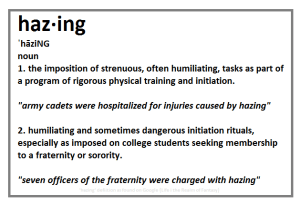
hazing-definitionIf the latter is the case, that group is engaged in a subtle form of hazing, more than in critiquing. Thank them for allowing you to sit in, and walk away from them.

There is a difference in types of writing groups, too. Some are traditional critique groups, people who usually read a few pages aloud at their sessions and discuss it in detail in a round-table fashion. This sort of focus can be just right for some authors, especially those in the final stages of making their manuscript submission-ready.

Because traditional critique groups focus only on 3 or 4 pages at a time, they lack the context to be able to discern if your protagonist has developed sufficiently along his character arc by the first 1/4 of the tale. However, they can tell you if you have made editing errors, and discuss small points of technique within those few pages, which you can then apply to the overall manuscript.

This is an important aspect of the process, but is not always the kind of input an author is seeking.

The one flaw these sorts of groups have is they don’t have the ability to properly critique the larger picture—pacing, overall story arc, worldbuilding, character development, and on, and on–because these things can only be judged in larger context. So if, like me, that is the sort of input you are looking for, my advice is to find a beta reading group.

Critique groups cannot do what beta readers can.

But how do you select a group? Before you join a writing group, you have the right to know what that group focuses on.

A beta reading group will focus on these questions:

  1. Where did my chapter bog down?
  2. What did they think about my characters?
  3. Where did they get confused and what did they have to read twice?
  4. Did it become unbelievable or too convenient at any point?
  5. What do they think will happen to the characters now?

Then after you have sat in on one of their sessions and observed how they treat each others’ work, ask yourself, “What kind of vibes did I get from this group of people? Will I benefit from sharing my work with this group? Did the comments they made to each other sound helpful?” Hopefully, the answer to those questions will be a resounding “yes.”

If the answer is anything other than a resounding “yes,” run now. Run far, far away.

Red Flags to Watch For:

There are common negatives to watch out for in all writing groups: If you have stumbled into a group where the most visible member is a self-important, read-all-the-books-on-writing-so-I-know-it-all kind of a person, don’t bother joining or you’ll be subjected to many accounts of how their writing group in Minnesota was so much better than this pathetic group.

Another author you might watch out for is the ubiquitous Famous-Author-Name-Dropper, a person who must be important because she has been to a great many seminars and conventions with these famous people, and hung out in the bar with one of them once. If it turns out she is in your prospective group, it may not be the group you are looking for. Sometimes they are the same person, sometime not, but either one of these wannabe-famous authors are poison—in their eyes the group only exists to admire them, and they will casually cut your work to shreds, dismissing it as merely amateur in the face of their “professional” experience.

When you are considering joining a group, ask the leader/chairperson these questions:

  1. If the group is a beta reading group focused on first drafts, what do they consider a first draft? Do you have to hire an editor and have it thoroughly edited before you submit it to this group? I say this because a fully edited manuscript is not a first draft, and that group would be a waste of your time.
  2. Will you receive insights into your manuscript on points you hadn’t considered, or will the focus of the discussion centered on minor editing issues that you are already aware of?
  3. Ask the leader to define for you the specific areas that readers will be looking at:
  1. Character development,
  2. pacing the arc of the scene,
  3. pacing the arc of the conversation,
  4. worldbuilding,

So let’s say you have found a group who seems to a good bunch of people, and yes, they read and write in your genre. You trust them enough to submit your first piece to the group. After the session is over, ask yourself:

  1. Do I still feel positive about my work or do I feel like my work was treated as being less than important?
  2. Did I gain anything from the experience that would advance the plot or did I just hear a rehash of arm-chair editing from a wannabe guru?

that which does not kill meThe answers to these questions have to be that you feel good about your work, that you saw through their eyes the weaknesses, and that they can be fixed.

New authors join writing groups feeling a great deal of trepidation, filled with uncertainty and fear. They fear being belittled and told their work is crap, and sometimes that happens. At the end of the day, you have to feel as if you have gained something from the experience.

Hopefully you will be as fortunate as I have been, and find a group of beta readers you can mesh with, people who will support and nurture you in the same way that you will them.


This post was first published March 2, 2015, under the title “Critique groups vs beta reading groups” by Connie J. Jasperson

7 Comments

Filed under writing

#amwriting: when writing becomes work

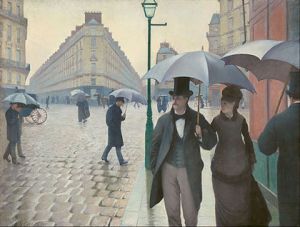
The Rainy Day, Gustave Caillebotte

Winter is approaching, here in the great Northwest.  It’s still warm now, but soon we will enjoy endless days of rainy grey darkness interspersed with brief moments of frozen hysteria. Yes, we who live in the rural parts of the Northwest dread those clear, cold nights when, just before dawn, the temperature hovers at 28 degrees Fahrenheit, and a fine glaze of ice encases the county roads, keeping things interesting.

In my part of the Northwest, the months of November through March are famous for the phenomenon known as Black Ice. The drive to the freeway is a white-knuckle experience: tightly controlled panic interspersed with moments of sheer terror. But I rarely have to drive in it, so it’s mostly my husband who gets the adrenaline rush of having survived yet another commute.

The dark days are sometimes depressing. I force myself to write, because to go a day without writing is to let the demons win. And even though I am not as inspired as I wish I was at this moment, I am getting the nuts and bolts out of the way, doing work that needs to be done, but isn’t that fun.

  • Plotting
  • Developing the theme.
  • Getting to know the characters.
  • Building the world.
  • Designing the magic system.

My boots sit damply near the door, and the umbrella rests near them. Soon the retention-pond in the front yard will be full, and puddles will dot the landscape.  I will walk the neighborhood, swathed in fleece and Gortex, dry and warm in the midst of side-ways rain storms, but not because I want to.  I will do it because its “good for me.”

I will walk and consider my work in progress. Am I remaining faithful to my theme? How can I show the disintegration of a relationship without resorting to the same arguments and spats that are the cliché tropes of badly crafted romance novels? I decide that what I need to do is continue crafting the allegories, and build the layers of tension.

And once I have brainstormed my block into submission, I will stop in at the diner, order a coffee, and pull out my android tablet. I will write for an hour putting those thoughts together. It will be a productive hour, just because I have walked in the fresh air, and changed my writing environment.

Everyone suffers from stalled creativity. For me, the only solution is to force my way through it. Once I have a hole punched through the wall, new ideas crystallize and I am fired with the knowledge of what has to be done next.

3 Comments

Filed under writing

#amwriting:  therapy to get you writing through the block

We’ve all had moments where our creativity failed us. We had an idea, but couldn’t make it real—the words wouldn’t come, or when they did they felt stilted, awful. We felt incredibly alone and isolated in this because we are writers; the words are supposed to fall from our fingers like water down Niagara Falls.

I have learned to write my way through the block. Yes, the work I produce at that moment is awful, and no, I wouldn’t show it to the dog. But the act of writing every day keeps you fit and in the habit of writing. This job requires us to practice, as if it were dancing or ice-skating. And, just like any sport, doing well at it requires discipline. When we stop writing for any reason, we lose our momentum and our purpose.

We lose our passion.

When you have come to a place where you believe you can’t write, save the file, close it, and walk away from that manuscript. Delete nothing. You will come back to this later and will be able to use some or all of it, so file it properly.

Sometimes, the problem is that your mind has seen a shiny thing, a different project that wants to be written. If that is the case, my advice is this: work on the project that is on your mind. Let that creative energy flow, and you will eventually be able to become reconnected with the first project.

writers-block-smallBut what about those times when you need to write, you have to write, but the words won’t come? I think of it like having a sports injury: Dr. Jasperson has diagnosed you with a sprained-brain. (Did she really write that? Insert groans here.)

Seriously, I have some physical therapy for your bruised writing-muscles.

First, we have the fear factor to overcome. You need to be able to prove to yourself that you can write. This is a small exercise, very short, and I got the idea for this while in a seminar on the craft of writing essays offered by the bestselling author of Blackbird, Jennifer Lauck. As I was sitting in her class and embarking on the writing drills for structuring your essay, I had one of those bolt-of-lightning moments, a tangent to nowhere, as it didn’t pertain to essays, but it seemed important so I wrote it down.

What had happened was, Jennifer gave us prompts and asked us to write to them. I have never been good at writing to someone else’s prompts. My ideas don’t flow that way. To make it worse, we were going to have to share them with someone else in the class.

I never share work that hasn’t been revised. it might not seem as perfect to you as believe it is, but it has been revised and is the best I could offer. I felt panicky, terrified I wouldn’t be able to write, and would embarrass myself. My mind was blank.

But then, I saw what Jennifer’s prompt was, and it occurred to me that I could do that.

When I read the prompt and had that “I can do this” moment, I realized that most of the time, writer’s block is a result of not being able to visualize what you want to write about, and if you can’t visualize it, you can’t describe it. Once you have experienced that moment of complete inability, fear of not being able to write magnifies the problem until it paralyzes us.

So, I am offering you the same writing prompt Jennifer Lauck used as the first exercise in her class:

  1. Open a new document. At the top of this document type: Where I Am Today:

This is going to be a literal interpretation and description of your surroundings. Look around you, and see the place where you are. Briefly describe the environment you are sitting in, what you see, and then describe how you feel sitting in that place. Just give it two or three paragraphs.

For me, sitting here at this moment on a Sunday morning and writing this post, it runs like this:

I sit in the small, third bedroom of my home. It’s technically my office, but is, in reality, a cluttered storeroom, known here as the Room of Shame. A glass of water sits beside my elbow, as does my cell phone. My desk holds numerous books on the craft of writing and my computer.  

Two clear plastic bins containing books and paraphernalia organized to take to book signings are stacked beside the door. I prop my feet on a large bookshelf stuffed with books, so full the shelves have bowed. Stacks of cardboard boxes filled with things that were, at one time, deemed important to keep, surround me. Filing cabinets full of legal papers, tax forms, and research also take up space, all stuffed with the debris of our business life.

The desk is not my friend. The sliding keyboard shelf is broken on the left side, hanging at a slight angle. I work with a broken desk, despite the large box which contains my new desk, which leans against the closet behind me. That dusty box has been there for six months or more, unopened.

I could easily clean this space, and set up my desk. It would take no time at all, perhaps a day at most. It’s a mountain I put off climbing.

See? At the end of this exercise, you have written a drabble, a small short story. But, more importantly, you have written the setting for a scene. Those paragraphs are around 216 words and are nothing special. Nor were the words I wrote in the seminar, but I felt good about writing them because I had been given a task that had at first left me feeling helpless and unable to do it: writing to a prompt. However, in that class, because it was a simple, non-threatening thing, I was able to accomplish it, and I felt empowered.

So, now we are going to gently rebuild our damaged writing muscles.

  1. For your next exercise, go somewhere else and take your notebook. Write three more paragraphs detailing what you are looking at, and how you fit into it, and how it makes you feel.

You could do this at the mall, sitting in a coffee shop, or the parking lot at the supermarket.  Or you can do what I am doing: sit on your porch and write a few paragraphs about the space you are in, what you see, and what you sense.

My back porch is quiet, and the day is gray. Rain is falling softly. Just beyond the auto repair shop’s parking lot, and the coffee stand, glimpsed between the conical cypress trees, the sounds of the highway are muted. One of the neighbors has let their dog out without a leash, and the free-range cats are disturbed by it. The scent of sodden vegetation is fresh and speaks of autumn.

The third exercise is more abstract:

  1. Where do you want to be? Visualize it, and describe it the same way as you described the places you could see. For me, that runs like this:

I want to be on a foggy beach, walking along the high-tide mark. I want to hear the gulls and sh-shing of the waves. I want to feel at peace again.

gear-brain-clip-art-smallIf you do these three exercises at the same time every day, describing the environments and your perceptions in a different space each time, even when you have nothing to say that is worth reading, you are writing. With perseverance, you will be writing your other work again. The important thing is to write even if it is only a few paragraphs. This is the physical therapy I recommend for overcoming writer’s block.

Just like an athlete recovering from an injury, you must gradually rebuild your confidence, strengthen your writing muscles, and regain your writing work ethic.  You need to empower your creativity for it to flow.

As I said, this how my mind works. If you are suffering a dry spell, give these exercises try, as you have nothing to lose. I hope that when these exercises are no longer painful, you will be able to write again.

3 Comments

Filed under writing

#amwriting: Interview with author Stephen Swartz

Today is the final installment in my series of interviews with working authors who are also teaching writing craft. This has been a wonderful series, as each approaches the craft from a different angle, and my final guest has a great deal to offer.
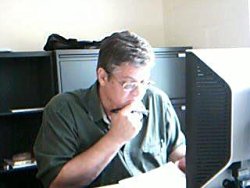
stephen-swartzA little background on today’s guest, author Stephen Swartz. He is a Professor of English at a major Midwestern university, and is a world traveler, often spending his summers teaching in Beijing, China at the University of International Business and Economics. Also, he is the author of numerous short stories and novels, and is a fellow founding author of Myrddin Publishing. He has also published poetry and written for scholarly journals on the subject of composition and identity, linguistics, and psychology.

CJJ: What do you enjoy the most about teaching?  Conversely, what would you change about your job if you were able?

SS: I’m rather parental when it comes to teaching. I like seeing my students become excited about writing and push themselves to explore their potential. I enjoy seeing their writing improve paper by paper, not only technically but also in showing their deeper thought processes. As it is, there are constraints on what I think would be best when it comes to writing instruction. Partly, it is a matter of budgeting, enrollment, and accreditation requirements. It is also a matter of what students are interested in career-wise; many do not think they will need to write in their careers. So I have limitations I must work within. And, of course, each semester brings a new mix of students so I must constantly adapt the lessons to accommodate them; it really is like reinventing the wheel. Writing fiction keeps me balanced.

CJJ: As you know, many authors are writing for children, preteens (middle-grade), and YA. In a comment on this blog recently, you said, “Meanwhile, the style (I think) should match the nature of the story and especially the mindset and education level of the narrator.” Can you expand on that idea a little?

SS: What I think I meant was in reference to the sophistication of the language the narrator of a story uses. That’s the author’s responsibility. If the narrator of a story is well-educated (for example, see my vampire novel A Dry Patch of Skin), he would speak in a well-educated manner, with sophisticated style and a large vocabulary. A less educated character (or a child) would speak differently, using simpler vocabulary and often incorrect sentence constructions. A foreign character speaking English would have similar language limitations; the dialog should show those limitations. However, we cannot let the language be too authentic if doing so would cause the reader difficulty. I once wrote a character who was supposed to speak with a Scottish accent; the result was rather bad. Having just enough (a particular repeating word or phrase) to hint at the accent would have been enough. I’ve been fortunate to have both studied linguistics and foreign languages as well as listened to speakers of varying ages and accents. I lived in Japan for five years and teaching English there taught me how non-native speakers “butcher” the language. I think I captured that effect well in my novel Aiko, set in Japan. Besides formal training, I also think I have a good ear for speech and so I do my best to replicate the character’s way of speaking based on the real speaking I’ve heard.
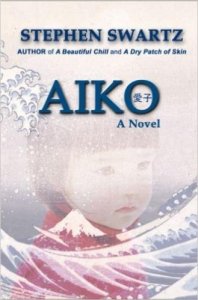
aikoCJJ: You have published eight books, in a variety of genres, and are now finishing up an epic fantasy novel (of EPIC proportions!). Yet, none of your characters have a sameness to them. How do you visualize your characters when you begin to place them in their story?

SS: Excellent question. My answer must, however, be simple. I’m schizophrenic. My mental defect allows me to grab pieces of other people’s lives, behavior, speech, and motivations which I then craft into plausible, even realistic, fictionalized personas. I recognize I have a few stock-in-trade character I use over and over with names changed and perhaps a quirk switched for a different quirk. I suppose I take one of my stock characters and customize him/her for the role I need him/her to play.

The hardest character to write is the protagonist because that character usually starts as a version of myself. The challenge is to let the hero act as the hero would naturally act (following his/her motivations and typical behavior) and not as I, the real me, would likely act. When I wrote out the story of a friend of mine who grew up in Greenland, I was writing a female protagonist—and using the first-person point of view. That novel was based on her life so I could imitate her way of speaking from interviews with her. The challenge for me in writing that novel was to make her language style change from her childhood to her teenage years to her adulthood.

For my current work-in-progress, the epic fantasy, I returned to a basic male protagonist, a hunky dragonslayer, and cobbled together a bit of a movie star, a little of me, and a pieces of other people I know to create the singular hero.

CJJ: In your upcoming novel, EPIC FANTASY *WITH DRAGONS, you portray a variety of races in a fantasy environment, each with unique cultures. What tips can you give in regard to keeping fantasy cultures diverse, and yet not devolving into too much backstory?

 SS: Not truly different races, not in the sense that Tolkien has them with dwarves and hobbits. I tried to keep the ethnicity in my story more subtle. Given the setting (no spoilers here), there is a wide variety of “types” among the cast members, not just to make a politically correct checklist but because they mix well in interesting ways. One famous author (I think it was Dostoevsky but it may be a more modern writer) liked to think up unique people and ponder how they might interact if put in a room together. I did the same with my epic fantasy only on the larger stage of the story world.

Regarding the world-building, I cheated a bit in this novel by setting it in a familiar setting (again, no spoilers here). Readers may recognize it eventually but it is not explicitly “given away” in the text. Even so, as I traced the path my hero would take on his quest, I marked certain locations on the map as being “different” societies with unusual customs—not different races or ethnicities. Like all good epic fantasy tales based on a quest, there is a series of episodes—self-contained mini-story arcs, strung together, one adventure after another—so the structure is easy to arrange. Following the geographical layout of the setting, what “can happen” to our hero necessarily changes from location to location.

A better example of world-building may be my science-fiction trilogy The Dream Land, which involves a pair of nerdy teens who discover a doorway to another world—which I created as a fully realized planet with continents, oceans, history and culture, and several different races, as well as unique flora and fauna. The world-building was half the fun of writing those novels; pushing my hero and heroine into this new world and watching them figure things out was the other fun part.

I think the key to “keeping fantasy cultures diverse, and yet not devolving into too much backstory” is to remember that, to the characters in the story, it is all known and common (usually) so they should speak and act toward everything there as though it was all common to them. You have to find creative ways of introducing ideas and details without them coming out as a “Let’s go meet Bill, your cousin, who, as you know, is also my long-lost brother” kind of writing. In my current epic fantasy novel, I can get away with some of that “messaging” because my hero is on a quest and does not know about the places he visits, so having a local character explain things is quite natural. People like to talk, so I let these “local yokels” ramble on and the history and customs of the place come out in a more natural way.

CJJ: In all of your novels, there is a certain amount of world building, even the novels set in contemporary environments. What advice can you give regarding making the settings feel real to the reader while keeping the backstory minimal?

SS: Research, if it is a real place. Read other books about the location, fiction or non-fiction. As I wrote A Girl Called Wolf, which is set in Greenland, I also read a very evocative book on the travels of early explorers written by a woman undertaking her own contemporary travels there. Her writing and descriptions painted such vivid pictures for me that I could describe the locations both accurately and passionately.

The most realistic setting I’ve ever used was my own city in the set in the same year I was writing it. I’m referring to my vampire novel, set in Oklahoma City with places named, set in 2014, when I was actually writing it so what happened in real time happened in the book. That was a fun exercise. But then our hero goes to Europe so I went back to researching.

For make-believe worlds, I think it’s simply a matter of transposing what we know of real locations to an imaginary location. For example, in The Dream Land Trilogy, I would think of an Earth animal and reinvent it as something more exotic: the common mount, a horse, became a 3-toed donkey with a dewlap, stripes on half its body, long rabbit ears, and a rat tail. Similarly, I’m more science-focused so even in a fantasy story I remain concerned with such things as the distance of the planet from its sun and the ratio of land to ocean, and so on. Even in my epic fantasy, a genre where magic is required, I have magic operating on scientific principles but it is explained in highly metaphorical language—but it still looks like magic!

CJJ: Thank you for indulging my curiosity, Stephen. I love talking craft with you around the virtual water cooler at Myrddin, and enjoy your blog, The DeConstruction of the of the Sekuatean Empire.

>>><<<

You can find Stephen Swartz at any of these places:

Stephen Swartz Amazon Author Page

Website: The DeConstruction of the Sekuatean Empire

Stephen Swartz  Myrddin Publishing page

Twitter: @StephenSwartz1

Stephen Swartz’s FB Author Page

2 Comments

Filed under writing

#amwriting: consider the scenery

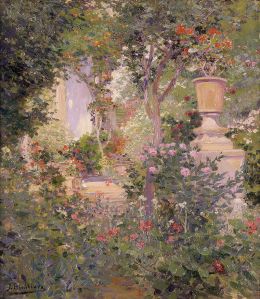
 The Garden of the Author, by José Benlliure Gil via Wikimedia Commons


The Garden of the Author, by José Benlliure Gil via Wikimedia Commons

I had an intriguing email conversation with a new acquaintance, a young man I met through PNWA at the recent conference. He was struggling in his writing group, trying to get a handle on  the showing vs. telling aspect of writing. As he writes mysteries, the setting and environment of certain scenes are quite important.

I suggested he view the scene through his protagonist’s eyes.

Every memorable element in a fictional story must be necessary to the story.  In creative writing, this concept is referred to as “Chekhov’s Gun,” as it is a principal formally attributed to the great Russian playwright, Anton Chekhov. He said this with regard to the settings for his plays, but in terms of writing, what this means is that if your characters notice a gun on the wall, someone must fire that gun, or it should be removed from the scene.

It was a neighborhood Dionte was unfamiliar with.  Just as he entered Tyrone’s gate, his phone dinged, a text from Ty. He’d had to leave for a minute, but Dionte should go on in and wait in the kitchen. Both men were on the board of the Community Action Council, but he didn’t know Tyrone well, and wondered where he’d been called off to.

What does Dionte see, and how does it register in his awareness?

He went up the walk, climbing the worn steps of the front porch. Feeling odd at entering the home of a casual acquaintance when he wasn’t there, Dionte reached for the knob and turned it. The door swung open, and entering the small sitting room, he was overwhelmed by the amount of clutter.

Tyrone had no TV that Dionte could see, but most of the furniture in the room was buried under stacks of newspapers and piles of laundry. His computer was partially hidden behind a stack of library books and a coffee cup, half full, sat atop them. A plate with a slice of toast sat beside the keyboard as if Ty had left in the middle of his breakfast.

Feeling claustrophobic, Dionte found the path to the kitchen, unsure now what sort of mess awaited him in there. To his surprise, the kitchen was immaculate.

The incongruity of the pristine kitchen contrasting with the clutter of Tyrone’s living room is all noted mentally. Each thing on our character’s path into and through Ty’s home is an image that registers in Dionte’s consciousness briefly, but is not mentioned again.

Tyrone had said there might be a serious problem, but wanted Dionte’s take on it before he brought it up at a meeting. Wondering what it could be, Dionte sat at the table, looking at the clock on the stove, seeing it was 11:15. He’d gotten the text only a few minutes before. Tyrone had to have been called to somewhere close by, as he’d left his house unlocked. He hadn’t passed Dionte in the front, so he must have left through the back.

The sound of someone coming up the back steps caught his attention, and his eyes were drawn to the screen door.

It’s a murder mystery, so who was approaching? What happened next? And why is the toast by the computer important?

Scenes require a certain amount of description. Let’s say we’re writing a short story about a grandfather fixing dinner for his grandson. He’s had to go out shopping, and now he carries his groceries home in a snowstorm, fearing he will slip and fall. This scene could be set several ways, and here are two, one less wordy than the other.

Snow fell softly. Holding a bag of groceries, he gazed at the stairs leading from the walk to the front door, fearing a layer of ice lurked beneath the pristine whiteness.

OR

He gazed at the icy stairs leading from the un-shoveled walk to the front door, his bag of groceries growing heavier.

Either way works, but personally, I would go with the second.

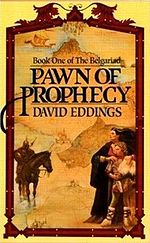
Pawn_of_Prophecy_coverIn 1982 I picked up Pawn of Prophecy by the late David Eddings. This was an amazing, eye-opening book for me, both as a reader and an author.  Eddings had the ability to convey a sense of place in a few well-chosen words. He put those words into  beautiful, poetic prose. The book opens in the kitchen of a farmhouse with Garion’s memories of playing under the table in a kitchen as a small child.

Garion’s earliest memories are of being a toddler: the sound of knives deftly dicing vegetables, his aunt keeping him corralled and happy under the table while she works, the sparkle of the gleaming pots and kettles high on the wall lulling him to nap.

“And sometimes in the late afternoon when he grew tired, he would lie in a corner and stare into one of the flickering fires that gleamed and reflected back from the hundred polished pots and knives and long-handled spoons that hung from pegs along the whitewashed walls and, all bemused, he would drift off to sleep in perfect peace and harmony with all the world around him.”

Later, when Garion has been completely uprooted, this passage becomes important, as it describes the place he thinks of as home. In that paragraph, we see the important things in the room, and we have a visual image of it. The child’s sense of contentment and safety that the kitchen represented is conveyed by the impressions of the kitchen instead of the image of it. The detail supports the story rather than impeding it.

The scenery in the narrative must be organic. It has to be purposeful and not just there to fill the space. I like books where the scenery is shown in brief impressions. We see it only when it needs to be there. Sometimes we see it through the protagonist’s eyes, and other times we see the protagonist set in the scene as described by a narrator, but everything we see must be a part of the characters’ experience.

4 Comments

Filed under writing

#amwriting: em dash; en dash; hyphen

Book- onstruction-sign copyAn em dash (—)   is a versatile punctuation mark. It is the width of an ‘m’, hence the name. An em dash serves as a comma, does the same task as parentheses, and also does the work of the colon. Used in these situations, the em dash creates a slightly less formal effect and is a useful tool in the author’s arsenal.

To insert an em dash in a Word document: type two hyphens next to each other without any space between the words or hyphens:

  • A—B (LetterHyphenHyphenLetter) Once you hit the space key after the second word, the two hyphens will form an em dash.

They can be more emphatic than a comma, and will really set apart any clause bracketed by them. In dialogue, we don’t use semicolons to join short related independent clauses. Instead, we use em dashes. Used sparingly, and not in every paragraph, they can smooth a choppy conversation and make it more normal sounding.

Unfortunately, I have a tendency to use them far too frequently, and in my hands, they lose their effectiveness. When combing a final ms for bloopers, I find them sprinkled through my work, maniacally creating run-on sentences where brevity would be a better choice.

The en dash (–) is the width of an ‘n’, hence the name. It denotes a span or range of numbers, dates, or time. Depending on the context, the en dash signifies “to” or “through.” When keying, type a space between the en dash and the adjacent material and then hit the spacebar.

To insert an en dash in a Word document: type a single hyphen between two words, with a space on either side of it:

  • 1994 – 1996 (1994SpaceHyphenSpace1996) Once you hit the space key after the second word, the hyphen will form an en dash.

Hyphens join certain compound words. Never use a hyphen in the place of an em dash or en dash.

Do not use a hyphen unless it serves a purpose. If a compound adjective is easily understood without a hyphen or its meaning is established, a hyphen is not necessary.

  • An English-speaking country
  • A time-saving device
  • A thirty-floor building

Some compounds are created on the spot to fulfill a specific need (on-the-spot creations). Permanent compounds began as improvised compounds but became so widely accepted they are now included in the dictionary as permanent compounds.

Examples of temporary compounds that have made the transition to permanent compounds are:

  • know-it-all
  • heart-stopping
  • free-for-all
  • down-at-the-heel

Context determines whether or not to hyphenate.  Ask yourself, “How will the words be interpreted by the reader if I don’t hyphenate?”

Wikipedia offers the following examples:

Man-eating shark (as opposed to man eating shark, which could be interpreted as a man eating the meat of a shark)

Wild-goose chase (as opposed to wild goose chase, which could be interpreted as a goose chase that is wild)

Long-term contract (as opposed to long term contract, which could be interpreted as a long contract about a term)

Zero-liability protection (as opposed to zero liability protection, which could be interpreted as there being no liability protection).

Overuse of em dashes and hyphens is a characteristic of lazy writing habits. We are in a hurry to get the story down, and we use the em dash to connect clauses that would be better if left to stand alone, and we hyphenate compound words that don’t require a hyphen.

I see these habits in my work and am forcing myself to be more creative. The em dash has a proper place in my work, but it can work its way into every paragraph. It is like an exclamation point. If I want my em dash to really emphasize a point, I have to only use it when nothing else will have the desired effect.

Only by seeing our work through a critical eye can we grow as authors. By writing every day and striving for growth, the quality of our work improves. Our beta readers will notice this growth and thank us for it.

11 Comments

Filed under writing

#amwriting: Two punctuation wrongs that don’t make a right

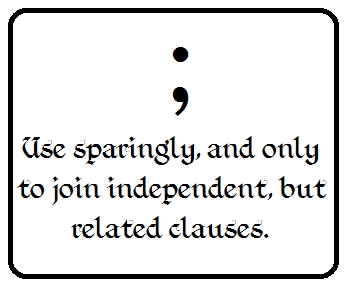
semicolon memeToday, I am revisiting independent clauses and how NOT to join them. This has been discussed at length elsewhere on this blog, so I’ll keep today’s discourse short and to the point.

You do not join independent clauses (clauses that can stand alone as separate sentences) with commas as that creates a rift in the space/time continuumthe Dreaded Comma Splice:

Comma Splice: My car is a blue Chevy Malibu and I like it, the dog likes to ride shotgun.

Same thought, written correctly: My car is a blue Chevy Malibu, and I like it. The dog likes to ride shotgun.

Would it be better if we used a semicolon? No. The dog riding shotgun is an independent clause and does not relate at all to the color of the car.

A semicolon in an untrained hand is a needle to the eye of an editor.

Remember: Semicolons join independent clauses, which are clauses that can stand alone, and your best bet is to avoid using them except under extreme duress as they can create some lo-o-o-o-ong, run-on sentences.

But what if you absolutely, positively have to use a semicolon, or your hair will fall out? Trust me, it won’t happen, but there are rules for using this type of punctuation, and the wise author will follow them:

Two clauses that are joined together with a semicolon should be

  1. complete sentences that relate to each other
  2. if they don’t relate to each other, make them separate sentences and reword them so they are not choppy.

Two separate ideas done wrong: We should go to the Dairy Queen; it’s nearly half past five.

The first sentence is one whole idea—they want to go somewhere. The second sentence is a completely different idea—it’s telling you the time.

Two separate ideas done right, assuming the mention of time is important: We should go to the Dairy Queen soon. They close at eight, and it’s nearly half past five.

If time is the issue in both clauses, and you feel like you absolutely MUST use a semicolon or you will explode, say, “The Dairy Queen is about to close; it’s nearly half past five.”

I generally try to find alternatives to semicolons, but I don’t dislike them, as some editors do. I do think they are too easily abused and misused, and should not be used if you are in doubt.

Comma splices—don’t do it. The universe will grind to halt, and everyone will die, and it will be your fault.

Semicolons—use only when two stand-alone sentences or clauses are really short and relate directly to each other.

Comma Splice Meme


7 Comments

Filed under writing

#amwriting: finding paradise

Amaranthus and Savvy at the needles by haystack rock cannon beach 2012My annual visit to the sunless Oregon Coast is upon us. For the next week I’ll be reading and gazing out the window at the ghostly rocks of Tillamook Head rising from the mist. Terrible Tilly, the most infamous lighthouse on the West Coast rises a mile out to sea, but is shrouded in fog and mist–I can’t see her today.  It is supposed to rain most of the week here–and that is what we come to this place for.

The many moods of the stormy waters, the seabirds–this place inspires me and clears my head like no other place.

I will be writing whenever the muse seizes me. Our condo is one we often stay at, and is perfect for us with a fully outfitted kitchen. I will cook many meals for my family, as being vegan, I can’t really eat in too many restaurants, although there are a few beginning to offer vegan options here.

As I write this at 06:15 a.m., the rain-slick streets are nearly empty, making this my town, my personal paradise. Despite the bad weather, people will soon be out, and it won’t be mine any more, but the hum and bustle of the streets brings a different vibe of excitement.

Walking along the beach in this sort of weather, one finds so many more things. The wave deposit sand dollars and the seabirds dine on them, leaving behind the hollowed shell for me.

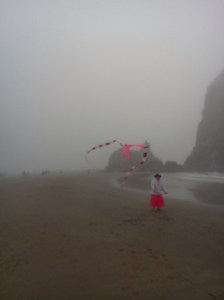
The author goes kite flying in the fog, Cannon Beach, Haystack Rock , August 2013I may not have the chance to fly my kite until later in the week, but then again, some years I find myself kite-flying in the fog. Rather like my normal life, I suppose–with so many stories whirling in my head I’m always in a fog, so to speak.

Sun or no, this is my writing and reading paradise. I have the opportunity to do both here, in undisputed peace. Today, my husband and I will stroll along the beach, or visit the small shops, or just chill on the deck, observing the sea in all her many moods.

This is my piece of Heaven. Have you found yours?


Comments Off on #amwriting: finding paradise

Filed under Adventure, writing