Tag Archives: writing

#amwriting: ensuring consistency: the stylesheet

Book- onstruction-sign copyWhen a manuscript comes across their desk, editors and publishers create a list of names, places, created words, and other things that may be repeated and that pertain only to that manuscript. This is called a stylesheet. Some editors refer to this as a “bible.”

The stylesheet can take several forms, but it is only a visual guide to print out or keep minimized until it’s needed. I copy and past every new word or name onto my list,  doing this the first time they appear in the manuscript. If I am conscientious about this, I’ll be less likely to inadvertently contradict myself later on in the tale.

Some people use a program called Scrivener which is not too expensive, but which seems to have a tricky learning curve. I downloaded the free version but couldn’t make heads or tails of it and found it quite frustrating. Nevertheless, I understand that it works well for many people, and to them, I say, “Good for you.”

For myself, I don’t want a fancy word-processing program. I just use MS Office, because I have been using the programs that come with that software since 1993, and I’ve been able to adapt to each upgrade they have made. It’s affordable, so I use Word to write and edit in, and occasionally use Excel to make small charts that are my style guides for each novel or tale I write, and also for every book I edit.

You can do this in Google Docs too, and that is free.

Regardless of how you create your stylesheet, I suggest you include these elements:

  • Word/Name
  • Page it first appears
  • Meaning

Bleakbourne Style Sheet

This is especially crucial for fantasy authors because we invent entire worlds, creating names for people, places, and creatures.

Take my own work-in-progress: it has characters with names that can be spelled several ways, and when I am in the throes of writing the first draft I fling them out any old way.

Thus, a character named Claire on page one can become Clair by page six. Dominick can become Dominic. Place names become mushy, and any word that is important or invented can evolve over the course of a manuscript.

I first learned about creating a stylesheet years ago when Huw the Bard was being edited. As she was editing my manuscript, my editor made a global search for every possible variant of the words I had created. She alerted me to these discrepancies, and I replaced the incorrect instances with the version I like best.

I have kept a Stylesheet for every work in progress since then, for short stories as well as novels.

map of Waldeyn 2015 with lettering cooper black copyPlace names evolve too, so maps are essential tools when you are building the world. Places written on a map tend to be ‘engraved in stone’ so to speak. Readers will wonder where the town of Maldon is when the only town on the map at the front of the book that comes close to that name is listed as Malton.

To prevent that from happening, double check what you have written on the map, and then do a global search for every possible variant of that name in your rough draft.

Just because you invented the world doesn’t mean you know it like the back of your hand. That world is constantly evolving in your mind. I have been writing in the world of Neveyah since 2009, and I still frequently contradict myself, which is why the stylesheet is so important.

9 Comments

Filed under writing

#ammwriting: Firing Chekhov’s gun

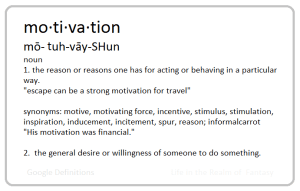
Motivation memeThis last weekend, I attended PNWA’s annual writing conference in Seattle, Washington. I garnered a great deal of advice from industry professionals and took seminars offered by well-known authors, agents, and editors.

I attend this conference every year. PNWA is where I come to learn both the craft of writing and business of publishing. Craft and business: two aspects of writing that every serious author must know whether they are going indie or taking the traditional route.

Today’s post is about identifying what motivates your characters. Well-known writing coach,  Lindsay Schopfer, gave a seminar on this, which unlocked ideas for my works in progress. That is how writers’ conferences work for me—they pry loose the ideas that have been stuck and help me verbalize them.

You have probably heard of the literary rule known as Chekhov’s Gun, which says nothing should appear in the scene that has no use. If a rifle is important enough to be shown hanging on the wall, someone had better fire it, or it should be removed from the setting.

Firing Chekhov’s gun brings us to motivation. When I was in elementary school, I was taught  “the 5 Ws” of journalism. I feel sure they still teach this, but just to remind you, they are:

  • Who
  • What
  • When
  • Where
  • Why

These five words form the core of every story. Who did what? When and where did it happen?

Why did they do it?

In some stories the author had made the what quite clear, but the why is murky. I hate it when the author is at a loss as to why their protagonist wants to do the task set before them.

If a character commits a murder, you’d better know why they were compelled to do it. Random events inserted to keep things interesting don’t advance the story.

When a character arrives at the inciting event, the things that motivate him/her should already be established. Identifying what makes your character do the things they do is the core of character development. Some characters are easy:

  • Edwin wants to save Marya.
  • Wynn wants to get back to his wife and his forge.
  • Huw wants to avoid being hanged for treason.

Some characters have motives that are more difficult to identify. Motives are driven by need, what a character desires, and what they are willing to do to attain it.

Suppose we have a protagonist who realizes her marriage is failing. We’ll call her Anna. Before we begin writing, we need to do a little brainstorming about Anna and find out who she is and what makes her tick.

She is a well-educated, professional woman, a writer of paranormal fantasy. She is married to another writer, David.

What motivates her? David is strong, charismatic and brilliant. There is nothing he doesn’t feel entitled to, and he will do anything to achieve his goals. Although she is a best-selling author of popular fiction and is the person paying the bills, Anna has made a habit of catering to his needs.

At first, she wants to keep her marriage together and presents herself as whatever she thinks David wants her to be. She feels as if she casts no shadow of her own. As the summer progresses and events unfold, she evolves, becoming an individual who no longer needs his validation. In the process, Anna finds that she is, and has always been, the strong one in the relationship.

With those paragraphs, we know the main protagonist’s desire—on the surface she has a deadline for her book and wants to save her marriage, but really she is seeking her sense of self-worth, trying to find who she is.

Now, let’s find out who the other characters are:

Anna and David rent a secluded house on the wild Washington coast for the summer. They invite 3 companions to join them for the summer, as a working retreat. All five characters have deadlines, and that is their official reason for accepting Anna’s invitation. However, the four other characters each have their own agendas. Other than Anna, they each have strong personalities, are charismatic, and are used to a certain amount of privilege. At first, although it is subtle, each of them uses and manipulates Anna for their own purposes.

Every member of the cast has a secret, including Anna. With the revelation of each secret to the reader, the motivations for subsequent actions become clear. Someone will attempt murder to ensure their secret is kept. In the end, three will die by accident, and two will be left to pick up the pieces.

With this information complete, we know the genre–this novel is a contemporary fiction, and is the story of Anna’s journey to self-knowledge. It will be slower paced than a thriller, and will be about the people and their relationships more than the events. However, the events will shape the people.

LOTR advance poster 2Unless each character’s wants and needs are clearly defined, the events won’t make any sense. Without clear motivations, it’s just a bunch of drama queens cooped up with a psychopath, in a house by the gloomy Washington North Pacific coast. Once we know their motivation, it becomes a story. And as a writer trying to flesh out characters, it becomes easy to picture these five people as individuals possessing depth and desires.

Motivation is the character’s quest to fulfill his/her deepest needs. Consider Frodo: he has seen what the ring did to Bilbo and Gollum, but more than that, he loves the Shire and does’t want it to fall to shadow. Without a real, personal motivation, there is no reason for Frodo to  agree to walk to Mordor and certain death just to toss a ring into an active volcano.


1 Comment

Filed under Literature, writing

#amreading: The Karaoke Novelist

BIF Blog Print ScreenI used to write an indie book review blog, before I got too busy to read as much as the blog required. The blog was called Best in Fantasy, and I still post reviews to it once in awhile, but only when something really rings my bells.

Sometimes I had to attempt to read six novels before I found one worth reviewing. In the process of searching Amazon for those really good fantasy reads, I’ve read a large share of badly written books. There is no  describing the agony of seeing a perfectly good idea for a plot destroyed by an author who was too eager to share their genius and rushed to publish what was clearly an excellent first draft .

You will get no snarky reviews from me—in fact I don’t review books I don’t like. I just move on to the next one in my pile and hope for the best.

Instead, I focus on the really awesome books I have enjoyed, some written by the famous, but most by the NOT so famous. Many of the great books I have enjoyed will never be best sellers because they are just one drop in an ocean of Kindle books.

It’s the wild west of indie publishing right now, and while it’s not necessarily a terrible thing, many untutored authors publish less than stellar works. These books are written and published by people who have no idea how the industry works.

Writing is like any other craft. There is a learning curve. Publishing is a separate craft, but nowadays the two go hand-in-hand.

At some point,  as indies gain the knowledge of what is involved in writing and publishing a good novel, the overall quality will  improve and level out. Those who are in it for the long haul will gain better visibility.

I have some hard-earned advice for new authors, those of you who want to leave the ranks of the Karaoke novelists, screeching their inept renditions of Wind Beneath my Wings. If you’re serious about your work, get your manuscript professionally edited.

Yes, it will cost you money, and you may get feedback you don’t want to hear. But that experience will enable you to put a book out there that you can be proud of, one that will stand up to any put out by the big publishers.

When I was writing a book review blog on a weekly basis, I often spent my week looking through five reasonably priced books only to discover they were

  1. Poorly formatted.
  2. Poorly edited.
  3. Rife with newbie errors such as beginning the book with a big info dump (been there done that).
  4. Thick, lush descriptions of “creamy blue eyes” (pardon, must barf now).
  5. Written by an author with no concept of a story arc.
  6. Boring filler conversations to fluff up the word count.
  7. Threads to nowhere,
  8. A random event that was intended as a cliff-hanger ending, but was obviously stuck there to entice the reader to get the sequel, which hadn’t been written yet and was now on my “No Way in Hell” list.

This also happens regularly with traditionally published books.  TOR can publish a novel that was poorly edited and no one will blink an eye, because they are one of the Big 5 Publishing houses.

Indies have to be better than that. Indies are scrutinized more closely and are held to a much higher standard. Flaws in our work are held up as an example of all that is wrong with the industry.

I used to curse at my Kindle when I read the first pages of books, both indie and traditionally published, that were  travesties. Many had gorgeous covers. I feel strongly the authors would be better served if they spent that money having their manuscript professionally edited.

I cringe when someone blithely tells me their friends edit for them. Most people aren’t best mates with a professional editor, and if you don’t have a degree in creative writing, you probably need a professional eye on your work.

Indies–aren’t you glad I only reviewed the books I liked? I didn’t want to be known for being a bitch, which is what I felt like when I read some of those travesties.

Thus, I say

  1. Go to writing craft seminars and conventions.
  2. Take writing classes at your local community college.
  3. Take online classes in writing.
  4. Buy and read books on the craft of writing.
  5. Write every day, even if it is only a paragraph.
  6. Hire a professional editor and consider following their suggestions.
  7. Have your manuscript proofread professionally before you publish it.

keep clam and proofreadI can’t stress this enough: before you publish that book you wrote during NaNoWriMo, please develop the craft of writing and rewrite that amazing novel.

You can join a writing group in your town and they will help you with these things. With the right group helping you grow, you will develop the skills needed to truly be a published author. And remember, if one group doesn’t really feel like a good fit, keep looking until you find a group you can work with.

2 Comments

Filed under writer, writing

#amwriting: Sturm und Drang

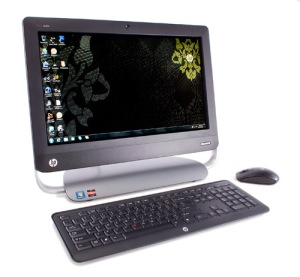
hp-touchsmart-320-1030-full-setMy main, desktop computer died on Saturday. It’s been limping along for a while. We had into the shop about six months ago, and should have known then it was terminal. The thing is, while I love Sturm und Drang in my literature, I prefer my electronic life to be stress-free.

Limping along on my ancient, half-functional laptop, I can get by well enough to write the odd blogpost or work on my own work. But the screen is too small for me to use to edit for a client. Also, I can’t do any work requiring Photoshop, as that program is on my dead dinosaur.

I have my headphones on and the laptop strategically positioned, so it blocks the 50-inch technological disaster that is our TV and which seems to take up an entire wall. It also needs replacing as a series of vertical lines obscures the view on part of the screen but I doubt that will happen this year–TV is not that important. Music is mostly my form of entertainment.

Greg’s laptop is older than this one, although he is keeping it alive. All our technology is older than dirt. So, after I finish writing this blogpost, we are going shopping and two new machines will come to our house.

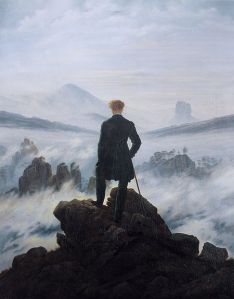
Caspar David Friedrich, Wanderer Above the Sea of Fog, 1818

Caspar David Friedrich, Wanderer Above the Sea of Fog, 1818 PD|100 via Wikimedia Commons

Let’s talk about Sturm und Drang. The English translation is literally, Storm and stress.

Google defines it as: a literary and artistic movement in Germany in the late 18th century, influenced by Jean-Jacques Rousseau and characterized by the expression of emotional unrest and a rejection of neoclassical literary norms.

What does this mean in simpler terms?

Sturm und Drang as a literary form evolved during the time of the American Revolutionary War, which a period of global unrest and great hardship, especially in Europe. The main feature is the expression of high emotions, strong reactions to events, and often, rebellion against rationalism. It is characterized by violent individualism and complex emotions. Literature and music written in this style were aimed at shocking the audience and infusing them with extremes of emotion.

Classical literature in this style began in 1772 with “Prometheus,” a poem by Johann Wolfgang von Goethe, in which the character of the mythic Prometheus addresses God (as Zeus) in misotheistic accusation and defiance. Misotheism is the hatred of God, or the Gods, in literature described as stemming from a moment in a person’s life where one feels the gods have abused and abandoned him. Misotheism requires a firm belief in a God or Gods.

Again, Wikipedia tells us this: Prometheus is the creative and rebellious spirit which, rejected by God, angrily defies him and asserts itself; Ganymede is the boyish self which is adored and seduced by God. One is the lone defiant, the other the yielding acolyte. As the humanist poet, Goethe presents both identities as aspects or forms of the human condition.

Modern genre and indie literature using this style can be found as an underlying trope in Cyberpunk.

Wikipedia defines Cyberpunk as: a subgenre of science fiction in a future setting that tends to focus on the society of the proverbial “high tech low life[1][2] featuring advanced technological and scientific achievements, such as information technology and cybernetics, juxtaposed with a degree of breakdown or radical change in the social order.[3]

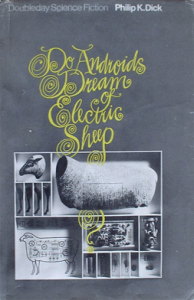
DoAndroidsDreamIt is exemplified by post-industrial dystopias that tend to feature wide divisions in the social order and extreme chaos in society. Protagonists acquire and make use of technology in ways never anticipated by its original inventors (“the street finds its own uses for things”).  Much of the genre’s atmosphere is heavily film noir, and  employs techniques and style reminiscent of detective fiction.

The difference between classical Sturm und Drang and modern Cyberpunk is Technology and Industry are the Gods whose knowledge the mortals desire, and whom they seek to replace. All aspects of Sturm und Drang can be found in Cyberpunk.

Cyberpunk began as a niche rebellion by authors like Phillip K. Dick, and is now mainstreamed and growing in popularity.

Authors writing in the early days of speculative fiction were Indies who were finding success getting short stories published in popular sci-fi magazines, and who were fortunate enough to have some farsighted editors take chances with publishing their longer work. They formed publishing companies and became giants. That opportunity will always be out there.

Indie authors have a great deal of latitude in their choice of what to write, as we can write and publish edgy work that would be deemed too chancy by traditional publishers. Authors always engage in artistic rebellion, and society always appreciates it—years afterward.

And tonight, I will continue my artistic rebellion while getting my new computing thing, whatever it shall be, up and running.

2 Comments

Filed under Fantasy, Literature, Uncategorized, writing

#FlashFictionFriday: Astorica

800px-Ladies_safety_bicycles1889Chance Jensen approached The Duck Walk Inn, aiming for the front door. It was classier than most of Astorica’s cocktail lounges, and was the third place she’d looked that afternoon. She entered, peering around to see if Jack was there.

He was, and ignoring the worried glances from the few men who were present in the otherwise empty bar, she walked toward him.

Stella, the bartender, chatted with Chuck Moore, Astorica’s lone hooker. Chuck’s clientele was comprised mostly of lonely, blue-collar laborers, women who worked in the shipyard. Stella nodded at Chance, as she lit Chuck’s cigarette.

Chuck exhaled a cloud of smoke, and glared at Chance. “You’ve been neglecting him, Chance Jensen. Don’t take your husband for granted. You’re a lucky woman to have a man like Jack. He shouldn’t be sitting in a place like this.”

“I know. I’ll do better, I promise.” She did have to smile, getting advice on her marriage from the local whore. But, she supposed, Chuck had seen plenty of marriages fail.

“Good. I don’t want to have this conversation again.” With a flounce, Chuck turned back to Stella.

The nervous-looking men at the corner table had moved their handbags to hide their cocktails, obviously regretting their decision to be so daring as to go into a cocktail lounge unaccompanied.

Jack looked out of place at the bar, dressed in his usual proper, suburban, house-husband style. He glanced up from his iced-tea. “What do you want? I’m not going back unless you’ve changed your mind.”

“Jack, we had a quarrel. I’m sorry I shouted. But, you can’t file for a divorce, as you don’t have grounds. I don’t beat you or cheat on you. You’re just angry because I can’t afford to buy you a bicycle like Loris did her husband.”

Jack straightened his sweater and crossed his trouser-clad legs. “You’re right, I am unhappy about that. I might not be able to get a divorce, but I don’t need one. I’m not interested in dating, so I have no desire to be single. But no law says I have to share your roof. If I got a job as a waiter or a housekeeper, I could support myself and buy my own bicycle. One with a good-sized basket for carrying things.”

Chance attempted to reason with him. “Jack, if you took a job outside our home what would people think? They’d think I can’t manage on my salary. I’m just starting out with this company. I don’t need that kind of image dogging me, holding me back, or I’ll never be promoted. They’re assigning me better routes now, so things will improve. I promise.”

He burst out, “I have needs too, you know. I want to go places, and do things. I’m tired of being cooped up, with nothing to do but slave away, making sure that when you come home, you find a clean house and a hot meal. Where’s the joy in that?” Jack wiped a tear, a sure sign he was really worked up. His voice, however, was calm. “It’s just, if we had a child, I would feel needed. I don’t have a purpose, Chance.” He met her eyes. “Give me a purpose, and I’ll stay.”

Chance sighed. It always came back to that. “I’d like a child too. I don’t know why we haven’t been blessed. We’re both healthy. There’s no reason we haven’t conceived.”

Jack looked around the room. “See? They’re the same as me. We’re bored stiff. Playing bridge on Tuesdays and going to Tupperware parties just doesn’t fill the void. It’s not just us. Fewer and fewer babies—something’s wrong with this world, and no one will admit it.” He stared down at his handbag. “It’s more than that. It’s everything. I get up at five to cook  breakfast and fix your lunch. The darkest corners in our house are so clean they glow in the dark! I do laundry. I wash windows. Every day, the same things.”

Chance started to agree, but Jack cut her off.

“At ten I get all dressed up and take the bus to the market, then I haul the groceries home and put them away. Once that’s done, I change and go out to work in the flower beds, because God forbid the neighbors should see an untidy yard! Once every bloody just-sprouting weed has been yanked, I prepare your dinner, and fifteen minutes before you get home I get all dolled up, just to look good while I serve you dinner. Then I have to clean the kitchen. The next day it starts all over again. My life revolves around cooking, cleaning, and what the damned neighbors might think of us.”

Hoping to calm him, Chance said,“I know it’s difficult for you, depending on public transportation. But I’m a truck driver. You knew that when you married me. Maybe I’m not as romantic or rich as the wives in your soap operas, but I do try. Don’t I give you a large enough allowance? I never ask how you spend it. I don’t care if you have lunch out with the boys, or have your hair done twice a week. I love you! I married you for keeps, and I respect the vows we took.”

“You could tell me you love me more often.” Jack sat  hunched in on himself.

“I know. I’m not good at saying how I feel.” Chance put her hand on his shoulder. “I’ll try to do better.”

Jack burst out, “I could learn to drive, but men aren’t allowed to. I could vote and help pass laws that would improve society, but no, men aren’t allowed to. We’re too emotional, too high strung to be allowed the same privileges as women.”

Desperate to head off the men’s emancipation argument, Chance said, “I know you’d be great at all those things, better than some women if I’m truthful. But it’s the way things are, and we have to live with it. And guess what—I got a raise, today.”

Jack’s eyes it up. “Really? That’s wonderful.”

Pressing her advantage, Chance said, “You know what that means? We can save up for your bicycle. If we’re careful, next month you can buy it.”

Picking up his handbag, Jack stood up. “Let’s go home. I’ll make a pie to celebrate your raise.”

Relief flooded Chance. Taking his elbow, she opened the door for Jack and guided him across the parking lot, reminding herself that men were the fairer sex, and required gentle handling. Chuck was right–she had been neglecting Jack’s emotional needs. She resolved to be more attentive.

She loved Jack , but he confused her. He had an overabundance of paternal instincts. It occurred to her that a puppy might take Jack’s mind off things. And, it just so happened Chance’s new boss, Carol, was trying to find homes for six dachshund puppies.

That was a brilliant idea. She’d gain favor with the boss and surprise Jack with a puppy, solving both problems in one swoop. Smiling, Chase opened the car door for her husband, helping him into the sedan.


“Astorica” © 2016 Connie J. Jasperson, All Rights Reserved

4 Comments

Filed under #FlashFictionFriday, Fantasy, writing

#amwriting: The Query Letter

My Writing LifeEvery author, indie or traditionally published, comes to a point in their career where they must craft a query letter. For many, avoiding having to do that is one of the reasons they went indie in the first place.
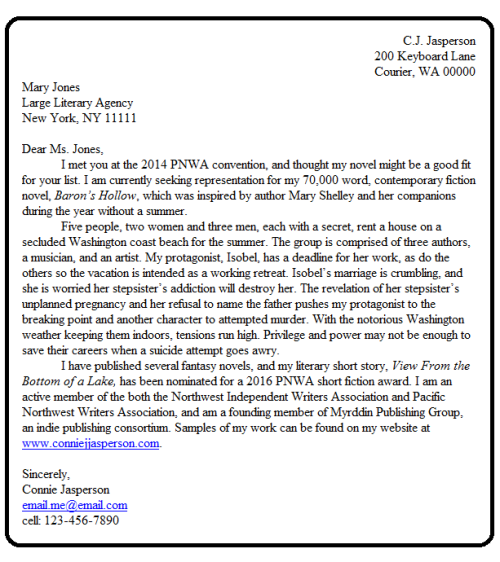
Most editors and publishers want a 1 page, 300-word description of your novel. They want the hook and the essence of that novel in 2 paragraphs, and they want to get a feel for who you are. Both aspects of this 1-page extravaganza must intrigue them. Every editor and agent has a website detailing the way they want queries submitted. In general, they want letters/emails that follow a certain pattern, and that basic format is readily available via the internet.

The www.NYBookEditors.com website has this to say about query letters: “You must walk a very fine line between selling your manuscript without coming across like the parent who knows his kid is the best player on the bench.”

That, my friends, is more complicated than it sounds. Of course, we are firm believers that what we wrote IS the best player on the bench. I’ve always known that about my children and my books!

Anyway, back to the query letter. I’ve attended several seminars on the subject and written many of them. I’ve had good results and also bad results with mine. The best place I have found with a simple description of what your query letter should look like is at the NY Book Editors website.

In essence, what they tell you is this:

  1. Format your letter this way:
  • Your address at the top of the page, right justified.
  • The agent’s address, this time left justified.
  1. Use a personalized greeting where you acknowledge the agent or editor by name.
  2. Keep the body of your query letter to three to five paragraphs.

The 1st paragraph is where you introduce yourself. If you have a connection with the agent or editor you are approaching, say you met at a convention or seminar, or you are a fan of one the authors they represent, mention that. Briefly.

If you have no previous connection, NY Editors suggest you get down to business right away with your attempt to sell your book. Their point of view on this is that you only have a few paragraphs to sell your book, so make those words count.

In the 1st paragraph are the 3 most important things to include:

  1. Title
  2. Genre
  3. Word count

The 2nd paragraph must give a brief description of the work—showcase the plot, and show why you think it is a good fit for this agent/editor. Do this in one paragraph, and don’t give it the hard sell.

The 3rd paragraph should be a quick bio of you, your published works, and whatever awards you have acquired. If samples of your work are available on your website, say so.

This is most important: don’t forget to double-check your letter for typos and spelling errors. We all make them and we don’t want them to be our legacy.

As I have said, my luck with queries has been uneven. I think query letters are like ice cream—you just have to cross your fingers and hope your query arrives on a day when the person in question is in the mood for a story exactly like what you are selling.

Query letter image

2 Comments

Filed under Publishing, writing

#amwriting: holding indies to a higher standard

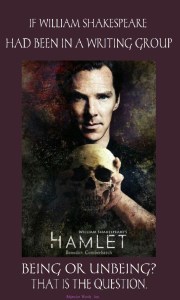
Hamlet Poster Benedict CumberbatchI haven’t been able to read as much lately as I normally do and I miss it. However, time spent editing for clients and then trying to write has seriously cut into my ability to read. When I am editing for a client, I can’t disengage my mind from that mindset, which means I have a terrible time reading for pleasure. In fact, I haven’t written a book review in months. Lately, I am lucky to read two or three pages before falling out of the book. Thus I have been reading poetry and resorting to audio books.

When I am in an editing mindset, I notice things a casual reader might not, and I can’t just enjoy the book. And I am not talking indies here—I mean books published by the Big 5 traditional publishers. I keep finding things they could have phrased more actively, or should possibly have cut. These are things an average reader will never notice, and are examples of why authors must have a thick skin.

Typos and editing mistakes are pretty much taken for granted when left in mass-market paperbacks by the Big 5 Publishers, but woe to the indie who neglects to notice a repeated ‘and’ or any other editing error. Also, the Big 5 publishers are allowed to take questionable chances with “style,” such as Alexander Chee did when writing The Queen of the Night, allowing lazy habits we indies could never get away with.

I was unable to actually read the book, as it must have been too tiring for him to use closed quotations to indicate dialogue. The reader has no idea someone is speaking until they’re halfway through a conversation, and have to re-read it. I loved what I could read of it, so I had to resort to the audio book, which was the only way I could get through it.

As an editor, it’s incomprehensible to me why an editor for a large publisher would accept a manuscript that is as annoying as that one flaw makes this otherwise remarkable book.

It is also proof that large publishers (Houghton Mifflin Harcourt in this case) are just as guilty as indies when it comes to making strange decisions that can negatively affect sales. They may have done this to elevate it to a “status” read, a must-buy literary name-dropper for those who wish to appear fashionably cultured. If so, it’s a disservice to work that is brilliant despite a flaw that would be fatal if it were to appear in an Indie author’s work.

However, though we can’t take avant garde chances with style, indies DO get to take chances with content, writing and publishing stories that traditionally published authors most likely wouldn’t be allowed to do. If a book might not sell, it won’t be published by a large publisher, because that is what they are in the business to do. However, once an indie has a best seller with a plot the Big 5 would deem sure to fail, traditional publishers will leap on it and the market will soon be glutted. (Can you say Fifty Shades of Grey?)

George R.R.Martin bormatting issue 1 via book blog page views, margaret ebySometimes the errors and flaws in the work sold by the traditional publishing houses are hilarious, as we saw in the first Kindle edition of George R.R.Martin’s A Feast For Crows. That was a formatting error, not an error on Martin’s part, so some poor intern probably got raked over the coals for it, as the book had to be pulled, reformatted, and republished as quickly as possible.

The thing is, errors do creep into even the most carefully examined texts and manuscripts. Usually, no one dies from it, but sometimes there are consequences, as in the case of the infamous Wicked Bible. The publishers paid a hefty price: Robert Barker and Martin Lucas, the royal printers in London, were fined £300 (£43,586 as of 2015) and deprived of their printing license.

Indies are held to a far more rigid code by most readers than the traditional publishers are because the internet is rife with disparaging rhetoric pointing the finger at us. And while the Big 5 traditional publishers are just as guilty of rushing-to-publish unreadable crap, the truth is, many new self-published authors haven’t yet gotten the hang of the publishing business, and often their books are rife with things they will later wish they hadn’t been so eager to publish.

Having learned my own lessons the hard way, I have made changes in how I review my own work. Besides working closely with a professional editor, I now have a solid group of friends who comb my completed manuscripts for errors and gross cut-and-paste errors. We can only hope we have caught them all. When you are an indie, it takes a village to help you get your book fit for the public to read.

Anyway—my editor’s hat is firmly on my head these days, and that means I can’t enjoy casual reading for a while more. This mindset slows my own writing output to nearly nothing because I am stupidly self-editing instead of just letting the words flow.

When I am editing I am looking for all varieties of mistakes–not just structural, grammatical, and glaring punctuation errors. I am also looking for things that will interfere with formatting the final manuscript for upload to Kindle or Smashwords, and I hope I find them all for my client, but it makes writing my own work challenging.

joyce corrections on his msAs an editor, I do my best. But, nothing is ever sure, and I won’t see the manuscript after I send my client the final suggested corrections. Mistakes can be made right up to the last minute while the client is making those adjustments, so someone else will have to proof-read her work.


Remember, you, as the author, have the responsibility for the final eye on your manuscript. So when my client has finished making revisions, she will have her posse check the manuscript over for the slings and arrows of publishing fate.

I will be done with my current editing project soon, and I plan to take a break from editing for a short while when that happens. Then I will let my mindset slide back into the joy-of-reading mode. I look forward to resting my editorial mind and over-indulging in the work of my many favorite authors.

5 Comments

Filed under Self Publishing, Uncategorized, writing

#amblogging: why authors should blog, take 3: the vegan

avacado dinner salad

my favorite avocado dinner salad

One of the things I love most about writing is this blog. I have made so many friends though this little place on the internet. Blogging offers me the opportunity to riff for several hundred words on any subject I’m interested in, without interruption. Of course, I’m usually only interested in writing-craft, but this is where I come to discuss it.

Nothing improves your writing chops more than writing every day. Deadlines can be daunting but say what you will about not being able to write under pressure—I think that is when I do my best work.

And, today I don’t feel like talking about writing. I want to discuss food! As many know, I am vegan, but my descent into veganism was (sadly) not motivated by any high moral prohibition against animal cruelty. There is a certain amount of that, but it was always there in the the way I purchased food for my family. During the 1980s, much of our meat we raised ourselves, cage free, free range chickens, and sheep raised in traditional farming methods.

However, I have developed an auto-immune variety of arthritis that is triggered by meat and dairy–all forms of it. Whenever I go off my diet (and cheese is the big draw) I pay the price. So, I stay on my vegan diet and I feel good.

I have discovered a wonderful resource for amazing, healthy, vegan food: the internet.

I know! It’s not just for Facebook and online gaming.

There is information out there, and it’s all in blogs. One of the best sites for me is called The Minimalist Baker. Today the main picture on their site is a gorgeous image of peppers stuffed with cauliflower rice. That image is eye candy. I will definitely be making some form of this recipe.

Oh my gosh! That website, and the recipes Dana and John have put together are just amazing. I use more of their recipes as the basis of my own cooking than from any other website or book.

Changing your diet is difficult, because you have to change your habits. Sometimes you have to change the flavors you love, and learn to like new ones.

And if you are just starting out and can’t afford to buy cookbooks, the internet offers an incredible wealth of free information, and much of it in the form of blogs by people like me.

I love to eat as much as I love to read, and I could easily talk for hours on either subject. If you are passionate about a particular subject, a blog is a great place to talk about it. It brings together people with similar interests, and for a writer, blogging is crucial, as it gets your name out there. Blogging shows people you can write well, and blogging regularly forces you to be creative.

If you want to know more about getting your own blog up and running, see my post of December 14, 2015, Blogging is Writing TooThis post talks about how to use the new default system here at WordPress so that you can insert pictures and make a nice looking post.

  • Keep it down to about 1000 words more or less.
  • Use the spellchecker tool to look for obvious errors.
  • Write in draft form and don’t publish it right away–come back and read it over again, and make corrections.
  • If you use information found elsewhere, quote it and credit the author
  • Use images that are either public domain, or that you have the right to use
  • Put links to other informative sites in the text
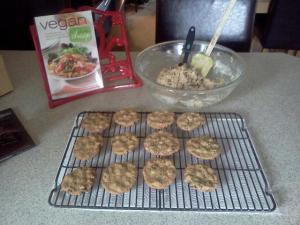
chocolate chip cookies, vegan

chocolate chip cookies, vegan and yummy

Rule number one: be consistent. I began by blogging once a week on a now defunct site—but my actual posts were more often made only once or twice a month. I dreaded it and didn’t want to do it. My blog stats were in the tank because I wasn’t applying myself to it.

It’s a commitment, and authors are procrastinators, but we can write to deadlines when we have to, and it’s good for us.  Now I am writing three posts a week on this blog, and at least one post a week for each of several other venues. I spend Sundays putting my blog posts together, which I couldn’t do if I was still raising children, but you only need to blog once a week to keep your content fresh. Writing this post took me about 45 minutes, so that is a small time commitment.

But just like a healthy diet and a walk in the fresh air, a change of writing scenery is good for you.

6 Comments

Filed under blogging, writing

#amwriting: evoking a sense of place

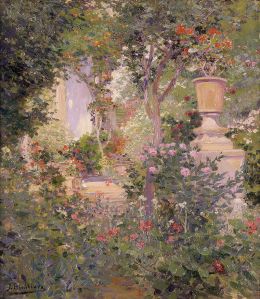
800px-El_jardí_de_l'autor,_Josep_Benlliure_Gil,_Museu_de_Belles_Arts_de_València

The Garden of the Author, by José Benlliure Gil via Wikimedia Commons

Summer has officially arrived here in the Pacific Northwest. This is a time when I can take my notepad out on the back porch, enjoying the garden and, to a certain extent, people watching. I love my back yard and my porch, feeling as if the heart of my home is there.

My work involves creating worlds and making them real to the reader. All the worlds I write about are a composite woven of my personal experiences and places that I love.

My town is a tiny place, slightly more than a village, and less than a city. Historically it is a mining town. Three things kept my town alive during hard times: the sandstone quarry, the coal mines, and timber. Now it’s a bedroom community for Olympia, the capital city of the State of Washington.

I’ve been here since 2005, and although I love my small house and garden, I don’t really fit into this community, which is probably my fault. Most of my writing groups are in Olympia, and my favorite places are in that city too. But I have a “soul-home,” which is comprised of the places that had the most profound meaning to me in my life. My soul-home is made up of three places that I have lived, which have all had a profound effect on me.

One part of that soul-home is Seattle. I lived there until I was 10, and went to West Woodland Elementary School.Our house was in Ballard, an urban community of fishermen who spent most of their time fishing in Alaska, and who were first-generation Norwegians. Everyone, including my family, was Lutheran, which was a cultural thing as well as religious. In the late 1950s to the early 1960s, Ballard was a small town within the big city, and the kids in my neighborhood were close-knit.

Seattle and the greater Puget Sound area is one component of my soul home, mainly because of the many immigrants whose cultures made it what it is today. The Pacific Northwest and Seattle, in particular, is a fusion of Asian, Norwegian, Native American, and hardy sons and daughters of the pioneers who came from all over the world seeking a better life. We are a unique mix and happy to be so.

In Seattle, music takes on a life of its own, and the world listens. Wikipedia has a page that lists all the famous musicians who came out of Seattle, and it’s pretty impressive. You can check it out here.

Music, art, and literature are celebrated in Seattle, and the influence the city has on Pacific Northwest culture is felt all up and down the Puget Sound region. I was fired to write my own books by reading the works of local area authors like Frank Herbert, Greg Bear, J.A. Jance, Terry Brooks and so many, many more Northwest authors. The Puget Sound region is a breeding ground for creativity, and Seattle is where it comes together.

Amaranthus and Savvy at the needles by haystack rock cannon beach 2012

But I am also a product of many summers spent in Cannon Beach, Oregon. I love that place so much that it is another piece of my soul-home. Terry Brooks and Ursula K. LeGuin are also fans of the North Oregon Coast, as are many famous musicians and actors. Something about it calls to the wilder side of me, and it seeps into my work.

But the primary portion of my soul-home came into my life when I was ten, and my family moved to Olympia, to a home on Black Lake. We moved from a nice, large, two-story home in a middle-class neighborhood to a tiny, rundown, ranch-style vacation house miles from civilization. It was cold and damp in the winter, and cool and pleasant in the summer. The house was barely livable, but the property was what my parents moved there for: the 350 feet of waterfront and the sandy beach, with forested land going back 5 acres to the county road. Dad was a WWII vet, and fishing was his greatest hobby.

The first thing I saw the day we moved there wasn’t the lake, although it was impressive. It was the Black Hills that dominated my view—black and forested with cedars, firs and hemlock, and rising high over the other side of the lake, they dominated the front windows. The many moods of the lake were out there for us all to see every minute of every day. You knew what going to happen by the direction the wind was coming from.

I hated it. I was torn from everything I knew, thrust into a world where I had no friends, and didn’t know my way around. Nevertheless, after the first, terribly difficult months of adjustment, I grew to love my Black Lake home, relishing the rural privacy and the deep connection to nature we formed, without our knowing it. When I left home, I carried a piece of it in my heart, and it will always be with me. My contemporary literary fiction is usually set there, with the bits and pieces I loved so much about that home forming a memory that shines, and I am able to give that place to my readers.

Just as my world, and the place I think of as my home was created by many generations of immigrants and pioneers filled with hope and the dream of a better life, so are most other cities and cultural centers.

The sense of place you instill into your work is the sure knowledge of where it is and what it represents to the protagonist. If you are crafting a world that doesn’t exist, as I have done with most of my work, you must make it real. Take some of what you love about your home, your town, and your culture, and write it into your work.

The knowledge of place is created in the reader’s mind by subtle cues, small descriptions, minor mentions over multiple scenes. A few words, little references to the background setting give the reader a framework upon which his imagination will build the rest.

Terry Brooks’ world of Shannara is real in his mind, because he lives there, just as Neveyah is real to me for the same reason. Both worlds have evolved from the reality and landscape we live in and love so much, yet they are radically different, both from each other and from the Pacific Northwest. They are composites of our imaginations, made real by our experiences.

Haystack_rock_monochromeWhen you write a novel or an essay, whether it’s fiction or non-fiction, the setting is how you create the sense of place, and must be a creation of many layers:
  • Place: where the protagonist lives, whether in the city, a village, a wandering life with no fixed address, or a farm in the countryside
  • Landscape/Terrain: mountainous, forested, high desert, seaside
  • Culture: in many stories, broad hints of what passes for political systems, the influence of religion, and the amount of respect accorded by society to music and art.

None of these layers will be overtly discussed or described at length in your work unless it is part of what creates the tension and drives the plot. But you, as the author, must know and understand these components as if they were your soul-home. That knowledge will come across in your work via small cues, and your readers will have a firm picture of the world in which your work is set.

4 Comments

Filed under writing

#amwriting: don’t gut your novel

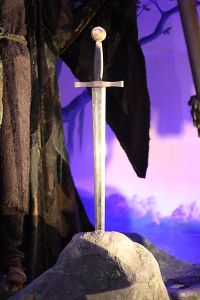
Excalibur London_Film_Museum_ via Wikipedia

This post has nothing to do with swords, but I felt one should be pictured, so here is Excalibur.

I have another novel in the editing process, one with many sections written before I embarked on my quest to discover how to write. I am now culling many unnecessary words and awkward phrases from the older sections.

If you’re a regular reader of my blog, you know the word “that” is like a keyboard tic for me. I use it a lot in my personal speech, and it falls into my work with a little too much regularity. I thought I had them pretty well under control, but one doesn’t see one’s own work with eyes of the disinterested reader.

Because of this, my editor and I are now combing each section for words I can eliminate and still retain the flow of the narrative.

Yes, I know I claim to be an editor. But I am first and foremost a writer, so I do have an editor because an unbiased eye is critical to producing a good, tight, manuscript.

When it comes to eliminating the word “that,” it’s crucial you look at each instance of how it is used.  Sometimes, “that” is the only word for a given situation. If a particular idea can’t be conveyed any other way, for the love of Tolstoy, use it. Don’t gut your prose just because some online guru tells you ‘that’ is the devil. If you remove every instance of “that” you’ll end up with a mess on your hands.

And just so you know, “that” and “which” are not interchangeable so you can’t just change every instance of “that” to “which.”

“That” is a pronoun used to identify a specific person or thing observed by the speaker, a determiner, an adverb, and a conjunction.

  1. “That’s his dog on the curb.” (Identifier)
  2. “Look at that red car.” (Determiner)
  3. “I wouldn’t go that far.” (Adverb)
  4. “She claimed that she was married.” (Conjunction)

In the case of number 4, the sentence would be stronger without it. Most of the time, prose is made stronger when the word “that” is simply cut and not replaced with anything. I say most, but not all of the time. Use common sense and if a beta reader runs amok in your manuscript telling you ax “this and that,” examine each instance of what has their undies in a twist and try to see why they are pointing it out.

There are cases where only “that” will suffice. When do we use the word “that?” We use it when we have something called a ‘Restrictive Clause’:

Quote from Grammar Girl, “A restrictive clause is just part of a sentence that you can’t get rid of because it specifically restricts some other part of the sentence.”  She goes on to give a specific example of a restrictive clause: “Gems that sparkle often elicit forgiveness.”  See?  Not just any gems elicit forgiveness in this sentence. Only gems that sparkle bring about clemency. In this sentence, forgiveness is restricted to one kind of gem.

“Which” is a pronoun asking for information. It specifies one or more people (or things) from a particular set, and it is also a determiner:

  1. “Which are the best diapers for newborns?” (Pronoun)
  2. “I’m looking at a house which is for sale on Black Lake.” (Determiner)

Go lightly with “which” and “that” but use them when they are required.

keep clam and proofreadThe same common sense approach goes for “very.” I seldom need to use it, but I do when it’s required. However, some people employ it too frequently, and it’s rarely needed in the context they  place it, fluffing up the word count. As with every word, there are times when it’s the only one that will convey an idea crucial to your story.

Mark Twain had a perfect comment regarding overusing “very.”

“Substitute ‘damn’ every time you’re inclined to write ‘very;’ your editor will delete it and the writing will be just as it should be.”

I’d love to be that editor.

6 Comments

Filed under writing