Tag Archives: 20th century landscape art

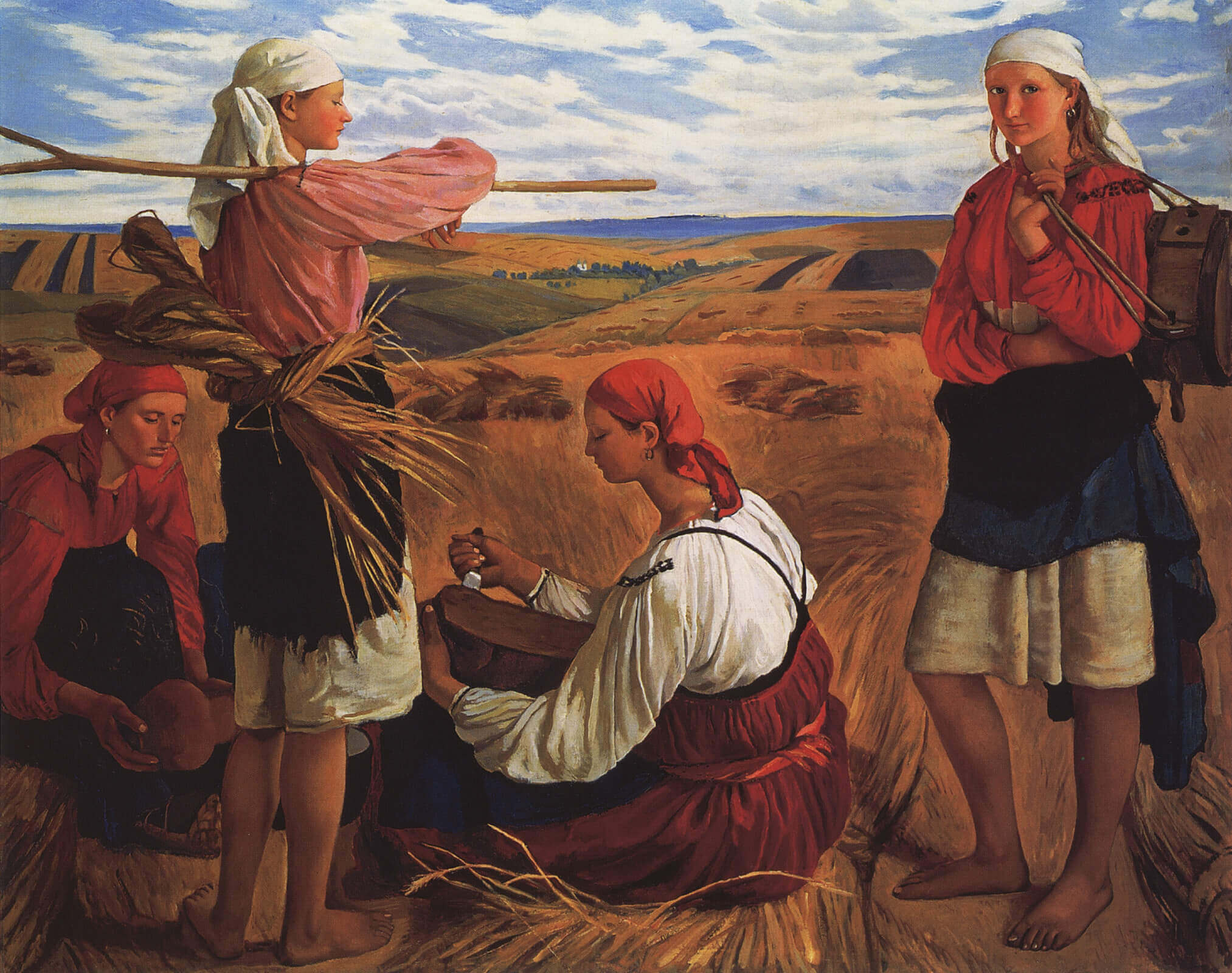
#FineArtFriday: Harvest 1915 by Zinaida Serebriakova

Artist: Zinaida Serebriakova (1884–1967)

Title: Harvest 1915

Description: English: Harvest (Français: Moisson) (Русский: Жатва)

Date: 1915

Collection: Odesa Fine Arts Museum

What I love about this painting:

I love that Zinaida Serebriakova paints women at work in the field, getting the harvest in. They are taking a midday break from raking hay. These women are barefoot, and their skirts are tied up around their waists, leaving them more able to walk easily in the fields of tall grain and field grass.

No men are there, as Russia had entered WWI a year earlier in 1914. Just like in Brittain and elsewhere, the farms were worked by the women, children, and old people.

Women managed livestock, plowed, planted, and harvested, ensuring their husbands, sons, and brothers had food on the front lines.

Their skirts are shown in shades of red, black, and brown, standing out from the field of gold. The sky overhead shows of high white clouds drifting across the afternoon sky.

Serebriakova shows us strong young women doing what women have always done: making sure that whatever needs doing gets done.

About the Artist Via Wikipedia:

Zinaida Yevgenyevna Lansere was born on 10 December [O.S. 28 November] 1884 on the estate of Neskuchnoye near Kharkov in the Russian Empire. Her father, Yevgeny Aleksandrovich Lansere (1848–1886), was a sculptor. Her mother, Yekaterina Lansere, was a painter and came from the artistic Benois family.

Serebriakova’s most famous self-portrait, At the Dressing-Table (1909, Tretyakov Gallery), was painted while she was snowed in at her family home and models from a nearby village were unable to travel there. Her brother Yevgeny encouraged Serebriakova to enter the painting in an exhibition mounted by Mir iskusstva in 1910, where it was received with enthusiasm and purchased for the Tretyakov Gallery collection.

After the outbreak of the October Revolution in 1917, Serebriakova’s life changed for the worse. In 1918, her country estate was burned to the ground. Her husband Boris was arrested, and in 1919, he died of typhus. She was left without any income, responsible for her four children and her sick mother. All the reserves of Neskuchnoye had been plundered, so the family suffered from hunger. She had to give up oil painting in favour of the less expensive techniques of charcoal and pencil. This was the time of her most tragic painting, House of Cards, which depicts their four fatherless children.

In the autumn of 1924, Serebriakova went to Paris, having received a commission for a large decorative mural. On finishing this work, she intended to return to the Soviet Union, where her mother and the four children remained. However, she was not able to return, and although she was able to bring her children, Alexandre and Catherine, to Paris in 1926 and 1928 respectively, she could not do the same for her two other children, Yevgeny and Tatiana, and did not see them again for many years.

To read more about this amazing woman’s powerful and sometimes tragic life, go to Zinaida Serebriakova – Wikipedia.


Credits and Attributions:

IMAGE: Harvest by Zinaida Serebriakova. Wikimedia Commons contributors, “File:Serebryakova Harvest 1915.jpg,” Wikimedia Commons, https://commons.wikimedia.org/w/index.php?title=File:Serebryakova_Harvest_1915.jpg&oldid=1160900234 (accessed May 9, 2026).

[1] Wikipedia contributors, “Zinaida Serebriakova,” Wikipedia, The Free Encyclopedia, https://en.wikipedia.org/w/index.php?title=Zinaida_Serebriakova&oldid=1352183665 (accessed May 9, 2026).
2 Comments

Filed under #FineArtFriday

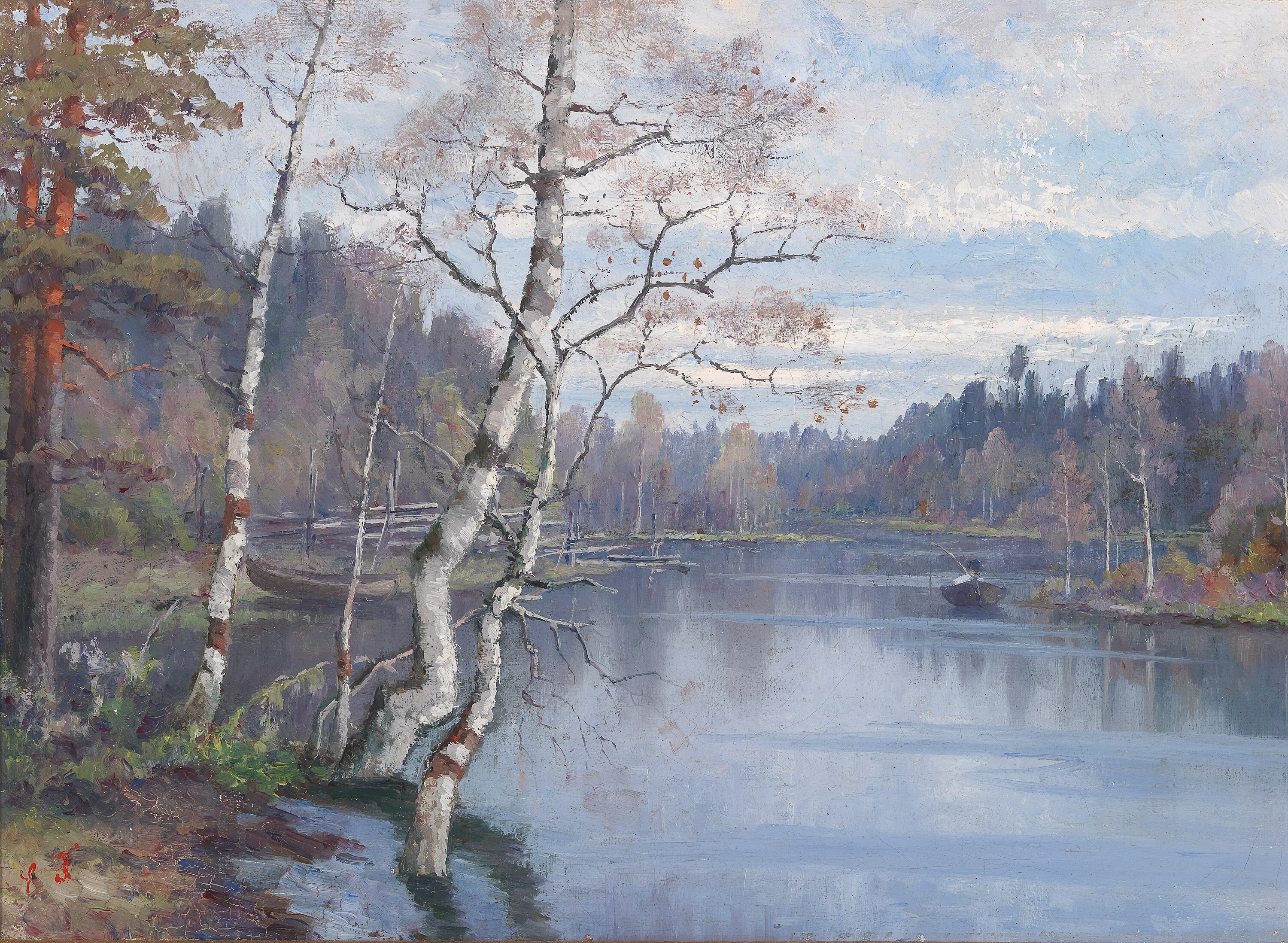
#FineArtFriday: Spring Landscape by Ellen Favorin ca 1900

Artist: Ellen Favorin (1853–1919)

Title: English: Spring Landscape (Suomi: Kevätmaisema)

Genre: landscape painting

Date: circa 1900

Dimensions: height: 20.7 cm (8.1 in)

Collection: HAM Helsinki Art Museum

What I love about this painting:

Ellen Favorin shows us a pleasant spring day beside a calm lake, with leaves on the birch trees just beginning to bud out. I especially like how she has portrayed the foliage and shrubbery along the lake shore, with the water high from the spring snowmelt, and the birch trees standing with their feet submerged.

Someone is enjoying a quiet day of fishing, and I would love to be them! What a perfect day.

I will find more paintings by this artist and feature them in the future.


About the artist, via Wikipedia:

Elsa “Ellen” Favorin (31 December 1853– 27 November 1919 was a Swedish-speaking Finnish painter.

Her parents were Anders Abraham Favorin and Lovisa Ingman. After attending the painting schools in Helsinki and Stockholm, she continued her studies in Munich, Düsseldorf and at the Académie Julian in Paris. She often painted landscapes and was one of the artists who joined Victor Westerholm in the artists’ colony at Önningeby on the island of Åland. She died together with her sister in a fire at their home in Lohja in 1919. [1]

As you can see, Wikipedia had little to say about her. However, you can find an excellent and comprehensive biography of Ellen Favorin at NiceArtGallery.com.


Credits and Attributions:

IMAGE: Wikimedia Commons contributors, “File:Ellen Favorin – Spring Landscape.jpg,” Wikimedia Commons, https://commons.wikimedia.org/w/index.php?title=File:Ellen_Favorin_-_Spring_Landscape.jpg&oldid=864051225 (accessed January 22, 2026).

[1] Wikipedia contributors, “Ellen Favorin,” Wikipedia, The Free Encyclopedia, https://en.wikipedia.org/w/index.php?title=Ellen_Favorin&oldid=1333359650 (accessed January 22, 2026).

2 Comments

Filed under #FineArtFriday

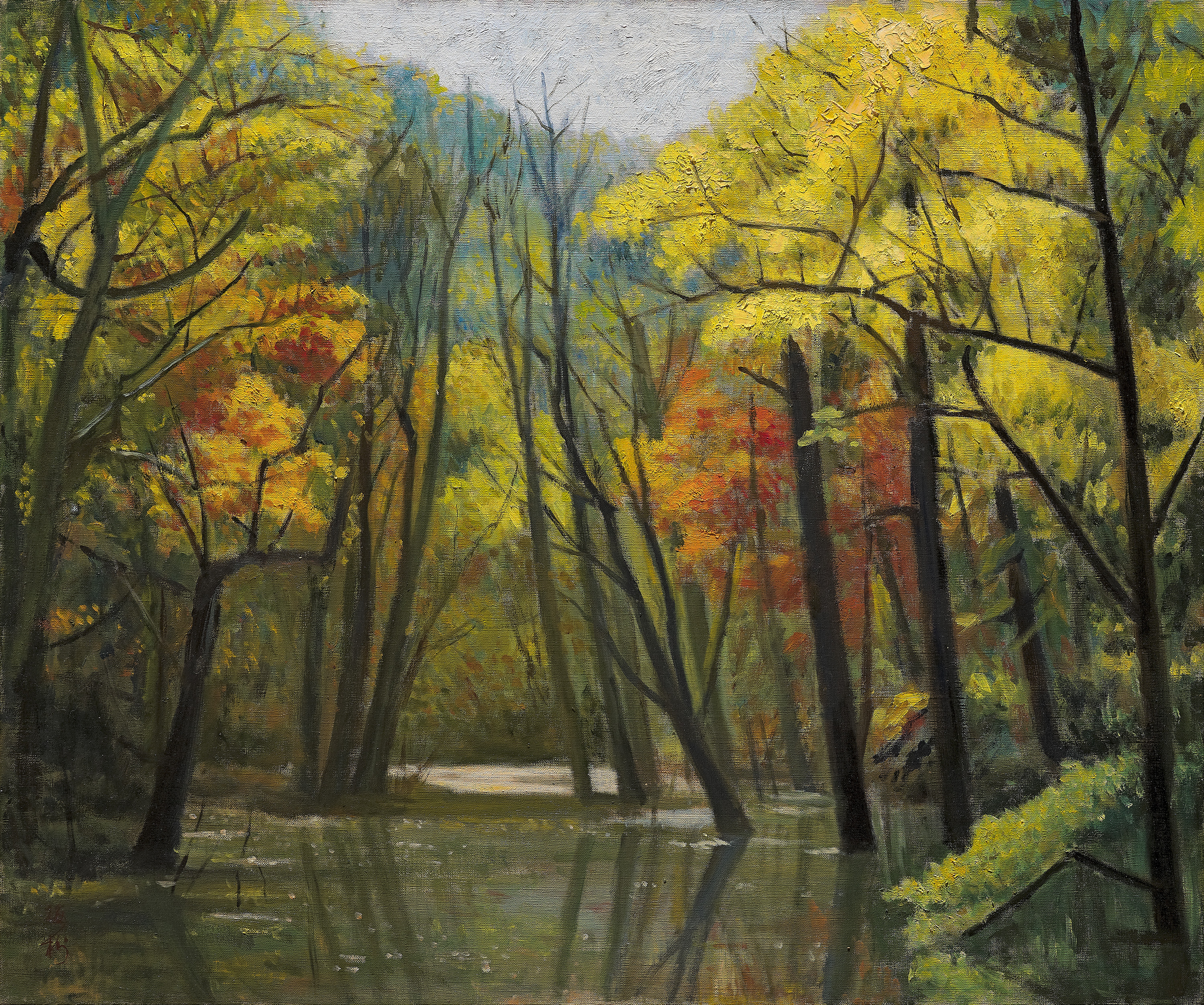
#FineArtFriday: Autumn in Towadako by Li Mei-shu

Title: Autumn in Towadako

Artist: Li Mei-shu

Date: 1978

Medium: oil on canvas.

What I love about this painting:

I love how this painting shows a pool of water at the base of the trees. I suspect the pond is dry during summer but in fall, the low area fills. The light shines through the trees and reflects on the water. It’s a scene of quiet beauty, a moment of serenity in the forest. I really like this painting.

Autum has arrived in the area where I live. The trees are beginning to turn colors, and unfortunately, the rains have come. But dryer weather is on the horizon, and we will be treated to red and gold leaves decorating the maples and other deciduous trees.

Soon, the streets and lanes in my town will be dressed in a final burst of color. It must be enjoyed while we can, as the beautiful leaves will soon turn brown and soggy, and the eternal gray of the Northwest winter will set in.

The coffee shops are all pushing their pumpkin spice blends, although I have so far resisted. However, I have pulled out a few cozy sweaters for when the weather really turns cool.

About the Artist, via Wikipedia:

Li Mei-shu (13 March 1902 – 6 February 1983) was a Taiwanese painter, sculptor, and politician. He was best known for his paintings as well as his restoration attempt of the Changfu Temple.

Li was born to an upper-class family in Sankakuyū (Pe̍h-ōe-jīSaⁿ-kak-éng), Japanese Taiwan (modern-day Sanxia DistrictNew Taipei City) on 13 March 1902. He began to demonstrate a propensity for painting in his early years. In 1918, he was accepted into the Painting Division of the Taiwan Governor-General’s National Language School. He taught himself painting after school through a copy of A Collection of Lectures, which he ordered from Japan through post. Upon graduating, he taught at Zuihō Public School (in modern-day Ruifang District). During this time, he participated in the Summer Art Seminar organized by Kinichiro Ishikawa. His works ‘Still Life and Backstreets of Sanxia’ were selected for the first and second Taiwan Art Exhibitions (Taiten), respectively. [1]

To learn more about Li Mei-shu, go to Li Mei-shu – Wikipedia.

Also, go to https://www.limeishu.org/


Credits and Attributions:

IMAGE: Wikimedia Commons contributors, “File:Autumn in Towadako, by Li Mei-shu.jpg,” Wikimedia Commons, https://commons.wikimedia.org/w/index.php?title=File:Autumn_in_Towadako,_by_Li_Mei-shu.jpg&oldid=1031830163 (accessed October 2, 2025).

[1] Wikipedia contributors, “Li Mei-shu,” Wikipedia, The Free Encyclopedia, https://en.wikipedia.org/w/index.php?title=Li_Mei-shu&oldid=1310846803 (accessed October 2, 2025).

6 Comments

Filed under #FineArtFriday