Monthly Archives: September 2019

Schadenfreude and Humor #amwriting

September is conference month for me. I just finished attending the Southwest Washington Writers’ Conference in Centralia, Washington. On Thursday the 12th of September, I will be in Seattle for four days at the Pacific Northwest Writers’ Association Conference.

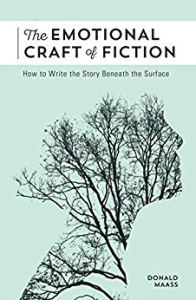
I will be attending a masters’ class offered by Donald Maass, on exploring depth with The Emotional Craft of Fiction.

Writers’ conferences are great ways to connect with agents and publishers, but they are also excellent ways to connect with other writers. A good conference offers the best education a new and beginning author can get.

This last Saturday, while in a seminar on injecting humor into the narrative, I reconnected with an old word that is making a resurgence in the English language: Schadenfreude (shah-den-froid-deh) This word from our Germanic roots describes the experience of happiness or self-satisfaction that comes from witnessing or hearing about another person’s troubles, failures, or humiliation.

I discovered this lovely (Deutsch) German word years ago while in college and had forgotten it. However, we are all familiar with it, as we experience it on a personal level quite often.

About schadenfreude, Via Wikipedia:

Schadenfreude is a complex emotion, where rather than feeling sympathy towards someone’s misfortune, schadenfreude evokes joyful feelings that take pleasure from watching someone fail. This emotion is displayed more in children than adults; however, adults also experience schadenfreude, though generally concealed.

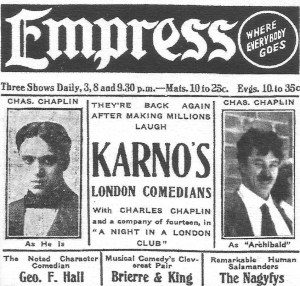
In other words, we know it’s an uncharitable emotion, and we don’t like it in others. But for many centuries, popular humor had an aspect of schadenfreude to it. Charlie Chaplin, The Three Stooges, and Jerry Lewis were all popular comedy acts of the 20th century who employed physical comedy that evoked a feeling of schadenfreude in the audience.

Since the ancient Greeks, Chinese, and Egyptians began writing plays, people have always enjoyed seeing other people’s missteps and pratfalls as long as the comedian recovers with a smile and “keeps on keepin’” on. Aristotle said that we are amused when we feel superior to others.
Dr. Adam Potthast, in his 2016 thesis on the Ethics of Slapstick Humor discussed how the recurring themes of clowns and idiots in popular slapstick comedy evoke a subtle feeling of superiority and also desensitizes us to violence. It makes bullying acceptable.

And, until recent years, dealing with bullying has been a common theme of childhood that teachers and parents, all former victims of bullying, weren’t equipped to deal with. According to Andy Luttrell in his post for Social Psych Online, psychologists believe we find something funny when it’s a “benign violation.” In other words, we are amused by things and incidents that violate the way we think things should work and which do so in a non-threatening manner.

In our current society, we don’t want to promote bullying or harassment as a positive thing in any form. But in the narrative, we do want to inspire that feeling of “payback” in the reader whenever roadblocks—instant karma—temporarily halt the Antagonist. If we can inject a little humor into a narrative, the reader feels an extra burst of endorphins and keeps turning the pages.

Exchanges of snarky dialogue (mocking irreverence and sarcasm) liven up regrouping scenes, transitions from one event to the next.

Humor and what is hilarious can vary widely from person to person. E. B. White wrote, “Humor can be dissected, as a frog can, but the thing dies in the process, and the innards are discouraging to any but the purely scientific mind.”

He was right. I can’t know what you find humorous, but I do know what makes me smile. I like snark and witty comments. I like things that surprise me, and which take a sudden detour from the expectations of normal.

Some of us have an earthy sense of humor, while others are more cerebral. For me, humor occurs when conventional rules are undercut or warped by incongruity. I have never liked slapstick as a visual comedy, but Horror authors often have it right: in the narrative, putting your characters through a little comedic disaster now and then can’t hurt.

When I was growing up, my family ran on “gallows humor” and still does, to a certain extent. We put the “fun” in dysfunctional.

That grim and ironic tendency to find humor in a desperate or hopeless situation is a fundamental human emotion.

This is why I often find myself writing gallows humor into my own work. We all need something to lighten up with now and then.

Adding a little humor can add both depth and pathos to the characters, humanizing them without your having to resort to an info dump. Each individual character’s sense of humor (or lack thereof) shows more of who they are and why the reader should care about them.

For many reasons, humor is an aspect of depth in the narrative that is impossible to fully define, but which adds a little fresh air at places where the story arc could otherwise stall.

Humor in literature occurs on an organic level, arising during the first draft before the critical mind has a chance to iron it out. Have you found yourself writing the occasional hilarity into your work? If not, why not? What holds you back from expressing this aspect of your personality in your work?
Comments Off on Schadenfreude and Humor #amwriting

Filed under writing

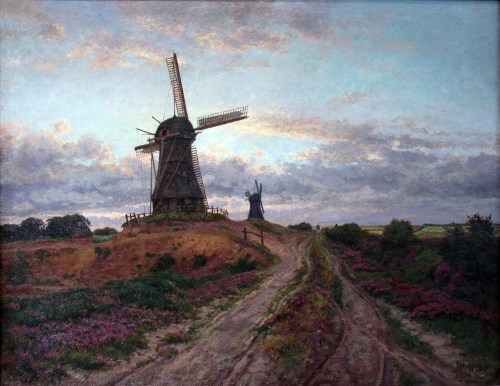
#FineArtFriday: Margaret Mill at Husum by Richard von Hagn

Margaret Mill at Husum by Richard von Hagn

What I like about this Painting:
The artist has captured the blustery feel of a fall or spring day—the sort of day where cold rain falls, interspersed with bright sunshine. His sky is perfect.

Artist: Richard von Hagn (1850–1933)
Title :English: Margaret mill Husum
Deutsch: Margaretenmühle vor Husum
Object type painting
Date: 1930
Medium: oil on canvas
Collection: NordseeMuseum Husum

About the Artist via de.Wikipedia (translated page):
“In his old age the following confession was not always easy for him, but he also showed his affection for a new topic in the spirit of the new German nationalism and the passing away of romanticism : “Yes, in my youth it always had to be Venice. Only much later did we realize that our homeland is just as beautiful, and actually much nicer for us. ” [6]


Credits and Attributions:

Wikimedia Commons contributors, “File:1930 Hagn Margaretenmühle vor Husum anagoria.JPG,” Wikimedia Commons, the free media repository, https://commons.wikimedia.org/w/index.php?title=File:1930_Hagn_Margaretenm%C3%BChle_vor_Husum_anagoria.JPG&oldid=351391992 (accessed September 6, 2019).
Page “Richard von Hagn”. In: Wikipedia, The Free Encyclopedia. Processing status: May 10, 2019, 04:04 UTC. URL: https://en.wikipedia.org/w/index.php?title=Richard_von_Hagn&oldid=188410554 (accessed: September 6, 2019, 12:46 UTC)

Comments Off on #FineArtFriday: Margaret Mill at Husum by Richard von Hagn

Filed under #FineArtFriday

Three Book Reviews—what I read this Summer #amreading

Here in the northern hemisphere, summer is winding down. The fall quarter of school begins today, and pumpkin spice lattes are suddenly available everywhere. During the summer I read several books that I would like to share with you.

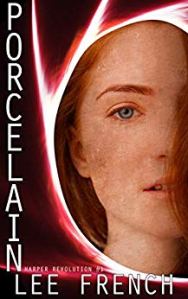
First off, I chain-read the first two books in the sci-fi Harper Revolution series by Lee French.

Publisher: Clockwork Dragon

Publication Date: June 26, 2018

The series opens with the book Porcelain. Eighteen-year-old Emma Harper is struggling. Her beloved older brother joined the Marines and has been declared missing in action. To please her emotionally distant father, she is slated to attend a college she doesn’t want, to follow in his footsteps in a field she has no affinity for—accounting. Emma is a math whiz and an inventor. She loves all things physics and science. She has a mechanical mind and can build anything. She reads and absorbs every new paper that is published in the field of physics. Unfortunately, since her brother’s disappearance, she has fallen in with a bad crowd, ‘friends’ who bully and torment her, a boyfriend who regularly forces himself on her. She has developed bulimia. She knows it’s not right but can’t seem to stop the cycle of binging and spending much of her time purging—hence the title of the book, Porcelain. One bad day, Emma is looking in a mirror when a portal opens, taking her to a mysterious living spaceship where she finds her brother and the soldiers who remain in his unit. Using the alien technology that had originally kidnapped them, her brother, Ethan, had been trying to return home but ended up transporting Emma to them. Her skills as an engineer become integral to their plan to return to Earth. This series continues with Crawlspace, which raises the stakes.

Emma is a compelling character with genuine real-world problems. I must admit—I can’t wait for the next book in this series.

***

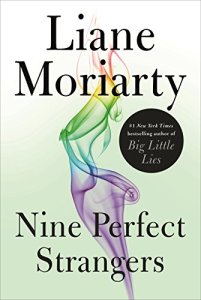
After this, I read Nine Perfect Strangers by Australian author, Liane Moriarty.

Publisher: Flatiron Books

Publication Date: November 6, 2018

The book details the experiences of nine people booked into an exclusive Australian health spa, and three members of the staff.

Moriarty introduces us to The Cast of Characters by opening with Yao and his experience as an EMT and introducing us to Masha as she suffers a heart attack.

The story picks up ten years later when nine people meet at an exceedingly remote health spa that promises to change their lives and completely transform them in ten days. The recommendations by their friends and the reviews they have read are glowing, but none explain how the transformation will be accomplished.

Each guest arrives with secrets and personal reasons for wanting to be remade into something better that what they believe they are. Masha is later revealed as the benevolent antagonist, and Yao has become her disciple.

Liane Moriarty’s characters are intensely compelling. At the outset, she establishes each as an individual and endows them with a mystery. Immediately the reader is hooked.

I hated setting the book down, wanting to know everyone’s dark secrets, curious as to what led each one to book themselves into that very unusual health spa. Structurally, it’s a bit jerky, and the ending is a series of short infodumps, but it works. By the time I reached the startling conclusion, I was looking forward to the informational epilogues just because I didn’t want to let the characters go.

***

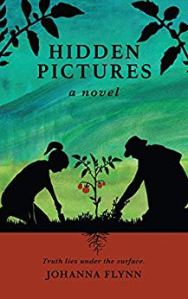
My final book of the summer, which I only just finished, was Hidden Pictures, a debut novel by Johanna Flynn.

Publisher: Palatine Press

Publication Date: August 27, 2019

This novel takes us into the shadowy places of the soul, laying bare the dark events and incidents that change our lives. The story gives you pause, exposing the moral issues we choose to ignore. Gordon Carlson is an engaging character. His strength and resilience are tested again and again, despite the bullying, as is Olivia’s.

While this book is set in the 1990s, it has a strong connection to present day issues. The cycle of abuse is explored, showing how sometimes victims become predators as a way of coping.

Themes of predatory sexual behavior and the myriad forms of violence, both mental and physical, that bullies often employ to keep control of their victims are dealt with in an open and respectful way. The wide spectrum of victim shaming is laid bare, deftly and with compassion. This is a touching story, one that stayed with me long after I finished reading it.

I highly recommend this book, and if you are looking for your next book club read, this is the book for you.

***

All in all, it was a great summer for reading as well as writing. I don’t have the chance to read as much as I used to, but I manage to fit a few books into my schedule. I have two more books on tap and will talk about them in the coming weeks. In the meantime, I highly recommend each of these books. Enjoy!

4 Comments

Filed under Book Reviews

Structure of the Word-Pond #amwriting

Today we’re winding down my summer blogpost series, The Word-Pond. We’ve explored the myriad aspects of ‘depth,’ the wide inferential layer of Story. Depth isn’t easy to categorize, nor can we point to one aspect and say, “Get this right, and you’ve got a story with depth.”

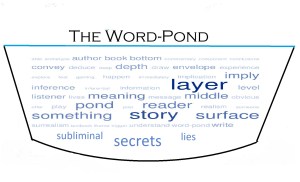
I’ve described Story as a pond filled with words and discussed the three layers:

Surface: The Literal Layer; the what-you-see-is-what-you-get layer. Characters live, and events happen. These are reflected in the surface of the story. The ways in which we play with the surface layer are by choosing either Realism or Surrealism, or a blend of the two.

Middle: The Inferential Layer, where Inference and Implication come into play. This is an area of unknown quantity filled with cause and effect: the reasons why these lives are portrayed, and why events happened. This is where emotions muddy the waters.

Bottom: The Interpretive Layer. This level is not only foundational; it contains and shapes the story:

  • Themes
  • Commentary
  • Messages
  • Symbolism
  • Archetypes

The words in this pond behave like the waters of a pond in nature. While close scrutiny reveals that the waters of a pond are separated into layers by temperature, salinity, microbial life, or by the sheer weight and pressure of the volume of water, the overall structure is one large, important thing: a hole filled with water.

Without water, a pond is a depression in the ground filled with possibilities only.

In our word pond, the one large thing containing our words is “story.” So now we want to form these layers into a coherent, meaningful story. We need a container for our words, the hole in the ground for the story to flow into.

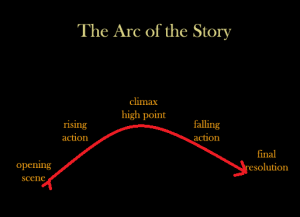
This container is the story arc.

Many people say they have a book in them, one they’d love to write. They begin, get a chapter or so into it, and lose the thread. They can’t see how to get the story from the beginning, to the crisis, to the resolution.

This is where the skills I’ve developed through my years of participating in National Novel Writing Month (NaNoWriMo) has paid off.  If you want to write a novel, it’s best to sit down and get that first draft out of you while the story is fresh in your mind. You’ll spend a year or more rewriting it, but if you don’t get the original ideas down while they’re fresh, you’ll lose them.

A story begins with an idea for a character. That character usually comes to me along with a problem. This is the seed from which the story grows.

I sit down and draft a story plan in four acts. First, I tell myself how I believe the story will go. This only takes half an hour and gives me finite plot points to write to. Once I have the four acts, I know where the turning points are, and what should happen at each. This ensures there is an arc to both the overall story and to the characters’ growth.

I’m going to use the original plot idea for a work in progress as my example. My WIP is a short story, 5000 words in length, but you can plot any length of story.

The story: Our Protagonist is a courier, transporting a valuable artifact. This artifact brings her to the attention of the Antagonist who intends to seize it, no matter the cost.

You must know what the surface of the Story looks like before you can explore the depths. A good way to discover what you are writing is to “think out loud.” Divide the story into four acts:

Act 1: the beginning: We show the setting, the protagonist, and the opening situation.

  1. Setting: a village near a crossroads.
  2. The weather is unseasonably cold.
  3. The protagonist is carrying a jewel reputed to enable a mage to control the weather.
  4. The protagonist must travel alone, as her partner was killed.
  5. Unbeknownst to her, a traitor in her employer’s court has designs on the artifact. By possessing it, the Antagonist will have the power to usurp the throne.
  6. She is wary, knowing the danger of traveling alone. She conceals the artifact by sewing it inside her shirt.

Act 2: First plot point: The inciting incident.

  1. The Antagonist’s hired thugs capture her.
  2. She is thrown into prison.
  3. A fellow prisoner has overheard that her partner was murdered to ensure she would be traveling alone.
  4. This fellow prisoner believes he has a plan to enable their escape.
  5. The protagonist isn’t sure she should trust him but refuses to let the artifact fall into the Antagonist’s hands.

Act 3.: Mid-point: We show their dire condition and how they deal with it.

  1. Seeing no other way, our Protagonist agrees to the Sidekick’s plan.
  2. He is on the verge of managing an escape but needs help with one last thing.
  3. By working together for several days, they manage to complete the escape route.
  4. Timing the rotation of their guards is critical to the success of their plan.
  5. Just as they are about to make their escape, the Antagonist makes a surprise visit to the dungeon and roughs up our Protagonist. He batters her physically and mentally, attempting to force her to tell him the whereabouts of the jewel, but she manages to keep her secret. When he leaves, her shirt is torn, but the jewel is still safe.

Act 4: Resolution:

  1. They must wait for another rotation of the guards, giving the Protagonist a chance to rest. She is injured but can still do what she must.
  2. The two make their escape but find themselves emerging near the kennels.
  3. The Sidekick gives the watchdogs the food he had saved for their journey, distracting the dogs and allowing them to escape over the walls.
  4. The Protagonist and the Sidekick manage to keep ahead of their pursuers and arrive back at court, where she delivers the artifact and reveals the identity of the traitor.
  5. The Employer is grateful, and the Protagonist and her Sidekick are all set for another adventure—perhaps a novel.

You have an idea for a story. Take a moment to analyze and plan what needs to be said by what point in the story arc. This method works for me because I’m a linear thinker.

If you know the length of a book or story you intend to write, you know how many words each act should be. Once you have the map, you can get to the nitty-gritty of turning that far-fetched tale of woe into a good story.

As you write each event and connect the dots, the plot will evolve and change. You begin to explore the deeper aspects of the story. Emotions, both expressed and unexpressed, secrets withheld, truths discovered—all these details that emerge as you write will shape how the characters react to each other. In turn, these interactions will alter the shape of the larger story.

This is why we never really know how a story will go, even if we begin with a plan. The plan serves to keep us on track with length and to ensure the action doesn’t stall.

Draft a short plan for a 50,000 word manuscript. 50,000 words is the industry standard for a novel. Write 1,667 words a day that connect those events together, and in thirty days you will have written a 50,000 word first draft of your novel.

To see more of what National Novel Writing Month is all about, go to: www.nanowrimo.org

I am dragon_fangirl there. Look me up and become a writing buddy!

3 Comments

Filed under writing