Monthly Archives: March 2020

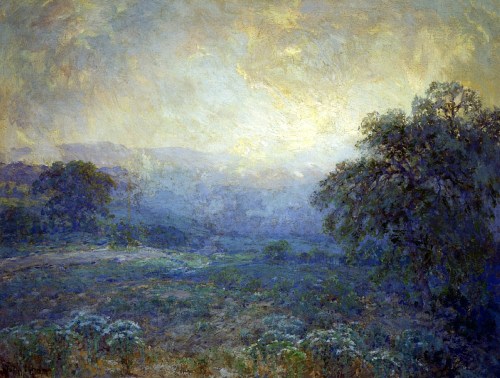
#FineArtFriday: Dawn in the Hills by Julian Onderdonk, 1922

  • Artist: Julian Onderdonk  (1882–1922)
  • Title: Dawn In The Hills
  • Date    1922
  • Medium: oil on canvas
  • Dimensions: Height: 76.2 cm (30″); Width: 101.6 cm (40″)
  • Collection: Private collection

What I love about this painting:

Onderdonk captured the surreal essence of early morning near San Antonio, Texas. The mists are rising in the hills, slowly revealing the riotous splendor of deep blue wildflowers. It is a rolling sea of bluebonnets, with the occasional white of the blackfoot or fleabane daisy mingled in.

The artist perfectly conveyed the mystical quality of that singular moment of the morning when the air is still and golden, and the day ahead is full of possibilities.

I could spend hours in this place.

About this painting:

Art historian Jeffrey Morseburg writes, “In the fall of 1922, as he was just entering his prime, Onderdonk was rushed to the hospital with an intestinal blockage. He failed to recover from the emergency surgery and died on October 27, 1922. His sudden death created an outpouring of emotion for the man who had become “The Dean of Texas Painters.” Just before he died, Onderdonk had finished a beautiful early morning view of a Texas hillside carpeted with Bluebonnets titled ‘Dawn in the Hills’ and another work, a bold fall scene titled ‘Autumn Tapestry.’” [1]

About the Artist, Via Wikipedia:

Julian Onderdonk was born in San Antonio, Texas, to Robert Jenkins Onderdonk, a painter, and Emily Gould Onderdonk. He was raised in South Texas and was an enthusiastic sketcher and painter. As a teenager Onderdonk was influenced and received some training from the prominent Texas artist Verner Moore White who also lived in San Antonio at the time. He attended the West Texas Military Academy, now the Episcopal School of Texas, graduating in 1900. His grandfather Henry Onderdonk was the Headmaster of Saint James School in Maryland, from which Julian’s father Robert graduated.

At 19, with the help of a generous neighbor, Julian left Texas in order to study with the renowned American Impressionist William Merritt Chase. Julian’s father, Robert, had also once studied with Chase. Julian spent the summer of 1901 on Long Island at Chase’s Shinnecock Hills Summer School of Art. He studied with Chase for a couple of years and then moved to New York City to attempt to make a living as an en plein air artist. While in New York he met and married Gertrude Shipman and they soon had a son.

Onderdonk returned to San Antonio in 1909, where he produced his best work. His most popular subjects were bluebonnet landscapes. Onderdonk died on October 27, 1922 in San Antonio.

President George W. Bush decorated the Oval Office with three of Onderdonk’s paintings. The Dallas Museum of Art has several rooms dedicated exclusively to Onderdonk’s work.

His art studio currently resides on the grounds of the Witte Museum.


Credits and Attributions:

[1] Julian Onderdonk, An Illustrated Biography by Jeffrey Morseburg, © 2011 https://julianonderdonk.wordpress.com/tag/julian-onderdonk-biography/  (accessed March 4, 2020).

Wikimedia Commons contributors, “File:Julian Onderdonk (1882-1922) – Dawn In The Hills (1922).jpg,” Wikimedia Commons, the free media repository, https://commons.wikimedia.org/w/index.php?title=File:Julian_Onderdonk_(1882-1922)_-_Dawn_In_The_Hills_(1922).jpg&oldid=278966540 (accessed March 4, 2020).

Wikipedia contributors, “Julian Onderdonk,” Wikipedia, The Free Encyclopedia, https://en.wikipedia.org/w/index.php?title=Julian_Onderdonk&oldid=882101452 (accessed March 4, 2020).
Comments Off on #FineArtFriday: Dawn in the Hills by Julian Onderdonk, 1922

Filed under #FineArtFriday

Self-editing: The Point of No Return #amwriting

Misfortune and struggle create opportunities for growth. We place obstacles in our protagonists’ paths that will force change on them. Crises, even small ones on the most personal of levels, are the fertile ground from which adventure springs.

In the editing process, we must ensure these opportunities are clearly defined, logical, and in the right place.

Most disasters are preceded by one or more points of no return.

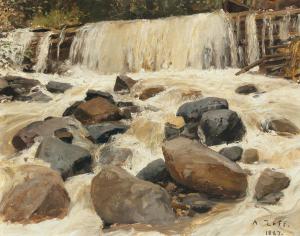
Consider the engineering that goes into building and maintaining a dam.

Wikipedia says:

Dams are considered “installations containing dangerous forces” under International humanitarian law due to the massive impact of a possible destruction on the civilian population and the environment. Dam failures are comparatively rare, but can cause immense damage and loss of life when they occur. In 1975 the failure of the Banqiao Reservoir Dam and other dams in Henan Province, China caused more casualties than any other dam failure in history. The disaster killed an estimated 171,000 people and 11 million people lost their homes. [1]

When a mistake is made in the planning or construction process of a dam, it sets a chain of events into motion.

There are usually opportunities to notice the problem and resolve it long before the dam breaks, but despite the diligence of the engineers, the construction workers, and the maintenance personnel, the flaw may go unseen, and everyone is at risk.

Once the river begins flooding, the workers and people living downstream are faced with an event from which there is no turning back.

We must identify this plot point and make it subtly clear to the reader. Knowing the flaw is there, and seeing the workers unaware of it ratchets up the tension. The moment cracks appear in the dam, you have placed the protagonist at maximum risk.

Many times, in my real life, I’ve been boxed into a corner, frantically dealing with things I could have avoided, had I noticed the cracks in the metaphoric dam. When you look at history, humanity seems hardwired to ignore the “turn back now” signs.

In every novel, a point of no return, large or small, comes into play. The protagonists are in danger of losing everything because they didn’t recognize the warning signs, and they are pushed to the final confrontation, whether they are ready for it or not.

Arcs of action drive the plot. Sometimes that action is a chain of seemingly unconnected events. The first event is a catalyst, setting in motion the small events that follow. Each incident progressively forces the protagonist and their companions to a meeting with destiny.

In the editing process, we want to make sure the events are in a logical order, and that they serve the purpose of forcing the protagonist down the path we have chosen for them. Also, we want the reader to say, “Now I see the connections.”

Points of no return aren’t always large disasters. Events can force the protagonist to a confrontation with himself.

Perhaps a family is forced to deal with long-simmering problems.

Events from which there is no turning back are the impetus of change, and that change is what the book is about.

Midpoint is often a place where a choice is made from which there is no turning back. From that point, the narrative rises to the Third Plot Point, an event that is either an actual death or a symbolic death.

This major event forces the protagonist to be greater than they believed they could be. Conversely, it can break them down to their component parts.

Either way, the protagonist is profoundly changed by this crisis.

The structure of the story must be closely examined in the process of self-editing to ensure the logic of the plot.

During the build-up to the final point of no return, we want to ensure these events develop our characters’ strengths, so they are ready to face the final crisis.

Structural editors identify both the protagonist’s goals and those of the antagonist early on. They look at the arc of the story to make sure the author shows why these goals are important and why they justify the struggle that will ensue.

  • How does the protagonist react to being thwarted in his efforts?
  • How does the antagonist currently control the situation?
  • How does the protagonist react to pressure from the antagonist?
  • How does the struggle deepen the relationships between the protagonist and their companions or romantic interest?
  • What complications arise from a lack of information regarding the conflict?
  • How will the characters acquire that necessary information?

Obstacles in the protagonist’s path to happiness make for satisfying conclusions, no matter what genre you’re writing in. Whenever the protagonist overcomes an obstruction, the reader is rewarded with a feeling of satisfaction. That reward keeps the reader turning pages.

I love books that allow us to get to know the characters, see them in their environment. An incident happens, thrusting the hero down the road to the Lonely Mountain, or trying to head off a war.

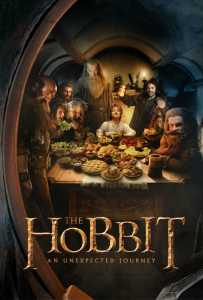
In The Hobbit, J.R.R. Tolkien set the first point of no return early. An acquaintance, Gandalf the Wizard, invited himself and twelve friends to dinner at Bilbo’s house, knowing that politeness would compel the hobbit to feed them.

The next day Bilbo found himself walking to the Misty Mountains with a group of Dwarves he only just met, leaving home with nothing but the clothes on his back.

By serving dinner to the unexpected guests, Bilbo passed the first point of no return. He heard the stories and listened to their songs. After having seen the map, even if he were to turn back and stay home, Bilbo would have been forever changed by regret for what he didn’t have the courage to do.


Credits and attributions:

[1] Wikipedia contributors, “Dam failure,” Wikipedia, The Free Encyclopedia, https://en.wikipedia.org/w/index.php?title=Dam_failure&oldid=943367090 (accessed March 3, 2020).

Wikimedia Commons contributors, “File:Alfred Zoff – A River Dam.jpg,” Wikimedia Commons, the free media repository, https://commons.wikimedia.org/w/index.php?title=File:Alfred_Zoff_-_A_River_Dam.jpg&oldid=283453136 (accessed March 3, 2020).

The Hobbit, An Unexpected Journey, Theatrical release poster, Warner Bros. 2012 (Fair Use).

3 Comments

Filed under writing

Self-editing: Action, Events, and Introspection #amwriting

If you are a member of any writers’ forum on Facebook or through a private group, you know that today’s authors are constantly prodded to emphasize the action in their narratives. For new, inexperienced authors, this can lead to an imbalance, a narrative where the characters aren’t allowed time for introspection.

An editor looks at the scenes to see how they fit into the narrative and to ensure they are in the right order and flow into each other well.

Sometimes, I see a manuscript where it seems as if a horrific event has been inserted for the sake of shock value. In the revision process, you should examine these scenes to see if they do their job.

  • Was the event foreshadowed well, or did it come out of nowhere?
  • Is the scene necessary to force change and growth on the protagonist?
  • How are her fundamental ethics and ideals challenged by this event?

A structural editor will tell you that if there is no personal cost or benefit to the protagonist or antagonist, there is no need for that scene.

Writing these blind alleys is not a waste of time. You never know when you will need those ideas, so don’t throw them away—always keep the things you cut in a separate file. The fact that an idea doesn’t work for one book doesn’t mean it won’t work in another.

For my own work, I label that file “outtakes.” Having these unused scenes ready to adapt to other uses comes in handy when I need an idea to jump-start a new story.

In the rush of writing the first draft, it can be easy to focus on setting traps and roadblocks for our protagonist and her nemesis. We forget that readers need a chance to process what we have written.

Events must force the character to grow. Creepy scenes must have a purpose. If your story absolutely must contain that scene, it must deeply affect the characters involved in it. Events must be catalysts for the character’s evolution and growth.

We may think we have written evolving characters, but they remain stagnant if you don’t allow the reader time to see that evolution and process it.

We’re all avid readers. Consider how your favorite authors in these genres connect their underlying themes with the action and growth of their protagonists, and how they allow the reader to process each event.

Political thrillers are set against the backdrop of a political power struggle. They feature political corruption, terrorism, and warfare as common themes. How the protagonist negotiates these situations and is affected by them is the story. Introspection is key to the reader’s understanding of the events and their root cause.

Romance Novels detail the developing relationship between two people and show how they overcome the roadblocks to happiness. Both the conflict and climax of the novel are directly related to the core theme of a romantic relationship with a happy conclusion. Without small chances for introspection, the reader won’t feel connected to the protagonist and their story.

Literary fiction focuses on the protagonist of the narrative. This genre features introspective, in-depth studies of complex, fully developed characters. Action and setting are not the points here, although they frame the character and provide a visual perspective. In other words, opportunities for introspection are a key feature of literary fiction.

Science Fiction details realistic speculation about possible future events. All technology should be based solidly on knowledge of real world science, both past and present. A thorough understanding of the nature and significance of the Scientific Method is crucial. Events involving science and technology must be based on known and theoretically possible physics. Morality and the wider effects of  the choices we make are a strong theme in all science fiction. Without introspection, moral choices get lost.

Fantasy is my usual genre to write in. It is often set in an alternate, medieval, or ancient world. The common themes are good vs. evil, the hero’s journey, coming of age, morality, romantic love. Some fantasy is set in urban settings with paranormal tropes, but if that is the case, the author has similar constraints to those affecting the science fiction author. In urban fantasy, the reality must be true to life and contrast with the paranormal. This contrast highlights and emphasizes the fantasy elements.

These genres look widely different, but they all have one thing in common—they have protagonists and side characters who experience life-changing events. These moments become important to the reader.

In my mind, genre and setting are a picture-frame, a backdrop against which the themes that drive the action of the story are played out.

What is the underlying theme of your story? While you were laying down the first draft, did you notice a moral concept that was woven into the story? Was it love? Was it destiny? Was it the death of hope?

In the revision and editing process, we must identify the events that strengthen that theme, and frame them with moments of reflection.

Personal growth and the hero’s journey are often the central themes in my work. Those are the stories that hooked me as a young reader, and I still gravitate to them.

The idea of the heroic journey was first introduced by Joseph Campbell, the American mythologist, writer, and lecturer, in The Hero with a Thousand Faces (published in 1949). In this ground-breaking work, he discusses the monomyth or what is called “the hero’s journey.”

He describes how this motif is historically the common pattern of humanity’s myths and legends. Each of these tales involves an unlikely hero going on an adventure. This hero, in a decisive crisis, wins a victory, then returns home changed or transformed.

I often use Tolkien’s masterpiece, The Hobbit as an example. When Bilbo Baggins faces the giant spiders, he also faces his own cowardice. Bilbo is amazed to find he has the courage to fight them.

That scene was the first step in his realization that his bravery doesn’t depend on the magic ring he found earlier. He is afraid, but he is not afraid to be courageous. This is a core concept of this book, and of the entire Lord of the Rings series.

What is important to you? When you look for a book, what catches your interest? When you look at it from a distance, what do all the stories you love best have in common?

Those are the themes you should be writing to, what your events must support. You must allow your reader the chance to consider how those events affect the protagonist, to absorb the theme and deeper personal meaning of that character’s journey.

In that way, you will hook the reader and keep them firmly in your world.

4 Comments

Filed under writing