Monthly Archives: July 2020

Need and Technology #worldbuilding #amwriting  

Need is an aspect of the world our characters inhabit.

The props we place in the setting our characters inhabit, the tools they use, the objects they must acquire – these things form a layer that grows out of need.

First, no matter what genre you are writing in, you must establish the level of technology. Whatever you do, don’t stray from it

The Romans had running water, central heating, and toilets in their homes. So did the Minoans. However modern-seeming their architectural creations were, they were low-tech.

In the environment of any genre, cups will be cups, bowls will be bowls. The materials they are made of might be different, but those items will always be needed. If you took a Minoan and transplanted them into modern-day Seattle, a bowl or cup would be instantly recognizable for what it is.

Furnishings will be similar from society to society—people need somewhere to sit or sleep, whether it is a pile of straw, cushions, or a bunk. They need a place to cook and somewhere to store preserved food:

  • A fire pit and baskets in a hut
  • A fireplace and shelves with baskets and clay jars in a cabin
  • A modern kitchen and pantry in a ranch house
  • A starship’s galley or food replicator

Settings are like Barbie clothes. The clothes of Soldier Barbie fit Corporate Barbie… and Malibu Barbie… and Star Wars Barbie. The outer garments might be changed for each genre but Barbie is still the protagonist.

We change settings to fit the genre, to create a setting with all the right tropes. Genre defines the visuals, but the characters are paper dolls we dress to fit the society we have placed them in.

You can take your protagonist and place them in one of three kinds of settings: fantasy, sci-fi, or contemporary, and they would still be who they are. In any setting, there are certain commonalities with only minor literary differences.

Take a soldier as an example. They need garments, weapons, armor, and sustenance. Those are tailored to fit your genre—sci-fi, fantasy, or contemporary military thriller. But you can also use those things to offer visual clues about your protagonist’s personality.

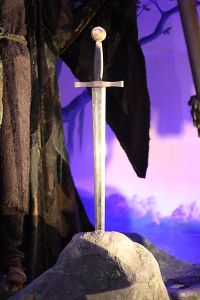
Whether the weapon is a rifle, a sword, or a phaser is dependent on the level of technology you have established.

Logic and the established level of technology determines how each need is met. In the case of weapons, you’ll find many varieties of each within each category.

Which kind of hand-held weapon your protagonist will use is dependent on their skill level and physical strength as well as what is stocked in the armory.

When it comes to weaponry, if you are writing about them, you need to research them to know what is logically possible. Within each genre, one thread remains the same: strength and skill are determining factors when it comes to weapons.

A cutlass is an efficient blade, but is shorter than a claymore. Also, a one-handed blade allows the wielder to carry a shield. In terms of firearms, a pistol weighs less than a machine-gun but isn’t as effective.

As many of you know, I’m an avid gamer. One of my all-time favorite games is Square-Enix’s 1999 Final Fantasy VIII, made for the PlayStation. It was challenging and fun to play, with entertaining side quests. I loved the music and the deep storyline. The characters were compelling and believable.
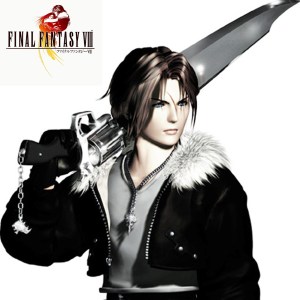
The one element that seemed illogical was Squall’s weapon, the Gunblade. Nevertheless, other fans loved it. However, while logic isn’t a thing when it comes to anime RPG weapons (witness Cloud’s Buster Sword in Final Fantasy VII), it must be considered if we want believability in our written work.

When it comes to weapons, it’s important that you research what might be most useful to your characters. Consider their strength and skills. Don’t introduce an illogical element, no matter how much you like it.

Writers of fantasy and historical fiction should do some fact checking:

Nerds on Earth’s Clave Jones says: So what would have kept a woman from wielding a longsword throughout history? Honestly, the only thing that kept more women from using swords is that they rarely got the training. It wasn’t the weight, certainly. And it wasn’t the awkwardness of the swing as swords were designed to be well-balanced and agile. [1]

Sci-fi writers, I suggest that for advanced weaponry, you should do the research into proposed future applications of lasers, sonic, and other theoretically possible weapons. Sci-fi readers know their science, so if you don’t consider the realities of physics, your work won’t appeal to the people who read in that genre.

For soldiers of any technology level, from Roman to medieval, to contemporary, to futuristic—armor will always consist of the same components: breast and backplate, shin guards, vambraces, a helmet of some sort, and maybe a shield.

These elements won’t differ much in their use. However, the materials they’re made of will vary widely from technology to technology.

For the sake of expediency and logic, garments that go under the armor must be close-fitting.

Expediency affects logic, which affects need.

The same is true for any occupation your protagonist might have–bookkeeper, lawyer, home-maker–the visual surroundings changes from genre to genre, but the fundamental requirements for each occupation remain the same.

In every aspect of a world, expediency decides what must be mentioned and how important it is.

Beneath the obvious tropes of a particular literary genre is a human being. No matter what genre you are writing or the level of technology, their actions and reactions will be recognizable and relatable to the reader.

We’ve mentioned the soldier, so let’s look more closely at their requirements.

For instance, in a battle situation, food must be extremely compact, lightweight, and must provide nutrients the soldier needs.

Nutrition bars, jerky, whatever you choose, soldiers must eat, and battles don’t pause for dinner. Think about the battle rations, how much the soldier carries, and how she carries them. Weight and the amount of space rations take up are what limits the soldier’s supply on hand.

How do you fit a soldier’s battle rations into world-building? Casually, with one sentence, a few words. She unwrapped a ration bar and ate, ignoring the sawdust-like texture.

What basic things do you need in the real-world? You need food, water, clothing, and shelter, and a means of providing those things.
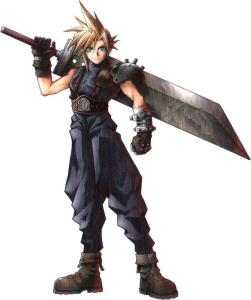
Concept art, Cloud Strife with Buster Sword

Characters need these things too, but they only come into existence at the time they are in use. Place the character in a room and call it a kitchen, and the reader will immediately imagine a kitchen. Mention the coffeemaker, and the reader’s mind will furnish the cups.

Need manifests in other, more subtle ways.

Do you require a way to communicate with others quickly? Messengers, letters, telephones, social media, or telepathy? Choose a method for long-distance communication that fits your technology and stick to it.

In world-building, how you fulfill the character’s needs shows the level of technology, the society they inhabit, and their standing within that culture.

This layer is easy to construct in many ways, but if you aren’t careful, it can be a stumbling block to the logic of your plot.


Credits and Attributions:

[1] The History Of Medieval Swords (And The Women Who Wielded Them) by Clave Jones, © 2016 Clave Jones for  Nerds on Earth (https://nerdsonearth.com/2016/02/women-and-swords/ accessed 08 July 2020).

Excalibur, Eduardo Otubo / CC BY (https://creativecommons.org/licenses/by/2.0), Wikimedia Commons contributors, “File:London Film Museum (5094934492).jpg,” Wikimedia Commons, the free media repository, https://commons.wikimedia.org/w/index.php?title=File:London_Film_Museum_(5094934492).jpg&oldid=273444520 (accessed July 7, 2020).

Squall Leonhart, Final Fantasy VIII, Square Enix ©1999 Fair Use

Cloud Strife, Final Fantasy VII, Square Enix  © 1997 Fair Use
3 Comments

Filed under writing

Plot, Politics, Religion, and the Science of Magic #worldbuilding #amwriting

It takes me about four years to take a novel from concept to completion, which is why I always have several works in progress at varying stages of development.

Much of that time is devoted to world-building, although for the first few drafts of writing, I don’t realize that is what I am doing.

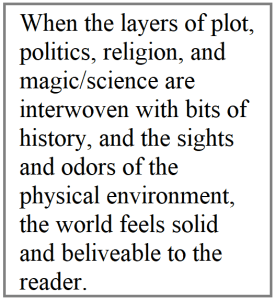
The layers of plot, politics, religion, and magic/science must be interwoven with bits of history, and the images and odors of the physical environment. Together, these layers help create the setting of any world.

I began one of my current projects with an idea for a character. I knew what the ultimate end of this story is because it is a prequel and is already canon in the Tower of Bones series.

This is the plot, the core conflict: Politics and religion shape three cultures. Two of the societies are strong enough to absorb the third, and one of them will do just that.

In that regard, neither the protagonist nor the antagonist is on the high ground morally—both consider it their right to impose their rule on the weaker society.

The first hurdle arose in the area of world-building. Because it is the origin story, I had to devise a post-apocalyptic culture. Religion was the first layer I worked on.

In the time of the Tower of Bones series, the Temple of Aeos is a finely-tuned machine that serves to distribute food and medical care to the poor, provides education to everyone, provides military protection when needed, and maintains the roads that connect the communities.

The Temple’s primary function is to find mage-gifted children before their untrained gift wreaks havoc in their communities. Untrained mages have a high chance of becoming the tool of the Bull God, Tauron.

This is bad because Tauron is the Mad God, the one who demands excessive sacrifices, often human. The word sacrifice means to surrender something of value, and the Mad God’s reign over his people is twisted. His religion is a reflection of his madness.

Thus, the Goddess Aeos’s mages are sworn to serve and protect the people of Neveyah from the depredations of Tauron, no matter the personal cost.

In the current work-in-progress, the Temple, as an institution, doesn’t exist. It is born out of the struggle between the two larger-than-life characters and the events of this book.

Both characters believe their deity has the right to rule Neveyah, and both know the Barbarian Tribes are the key to winning. At times, the line between what is moral and immoral is blurred.

Just as in real life, both men and the societies they lead are fundamentally flawed.

Both the antagonist and protagonist in this novel will do whatever it takes to achieve their goals. However, of the two, only my protagonist is burdened with regrets for the choices he makes.

Every society, fantasy, sci-fi, or real-world, must have an overarching political structure—a government of some sort. Humans are tribal. We are comfortable when we have a hierarchy of decision-makers to guide the tribe.

The politics of any society are an invisible aspect of world-building that affects the story, even when not directly addressed. This is because our characters have a place within that structure.

When you know what that place is, you write their story accordingly. In writing fiction, if you know your characters’ social caste, you know if they are rich or poor, hungry or well-fed. This will shape them throughout the story.

We know that hunger drives conflict in our modern world, so a segment of society that lives on the edge of starvation will be swayed to the side of whoever offers food first. This is a key part of the plot for my work-in-progress.

Another aspect of world-building that was crucial at the start of this series was the choice to use magic rather than science as the primary technology.

First of all, let me get this out there: Science is not magic. It is logical, rooted in the realm of real theoretical physics. The writers of true science fiction know the difference between reality and fantasy.

However, magic should be believable. The science of magic is an underlying, invisible layer that is part of my world-building process. In my stories, magic is only possible if certain conditions have been met:

  • if the number of people who can use it is limited.
  • if the ways it can be used are limited.
  • if the majority of mages are limited to one or two kinds of magic and only certain mages can use every type of magic.
  • if there are strict, inviolable rules regarding what each kind of magic can do and the conditions under which it will work.
  • if there are some conditions under which the magic will not work.
  • if the damage it can do as a weapon or the healing it can perform is limited.
  • if the mage or healer pays a physical/emotional price for the use.
  • if the mage or healer pays a hefty price for abusing it.
  • if the learning curve is steep and sometimes lethal.

This layer of world-building is where writers of science and writers of magic come together.

  • Magic and the ability to wield it confers power.
  • Superior technology does the same.

This means the enemy must have access to equal or better Science/Magic. So, if the protagonist and their enemy are not from the same “school,” you now have two systems to design for that story.

Authors must create the rules of magic or the limits of science for both the protagonist and antagonist.

Take the time to write it out and be sure the logic has no hidden flaws.

In creating science technologies and magic systems, you are creating a hidden framework that will support and advance your plot. Within either science or magic, there can be an occasional exception to a rule, but there must be a good reason for it. It must be clear to the reader why that exception is acceptable.

Having said all that, the only time the reader needs to know these systems exist is at the moment it affects the characters and their actions.

The best background information comes out naturally in conversations or in other subtle ways. By not baldly dropping it on the reader in paragraph form, the knowledge becomes a normal part of the environment rather than an info dump.

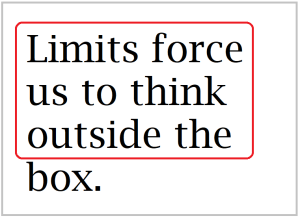
Limitations are the key to a good character arc. Roadblocks to success force ordinary people to become more than they believe they are.

That is when an ordinary person becomes a hero.

7 Comments

Filed under writing

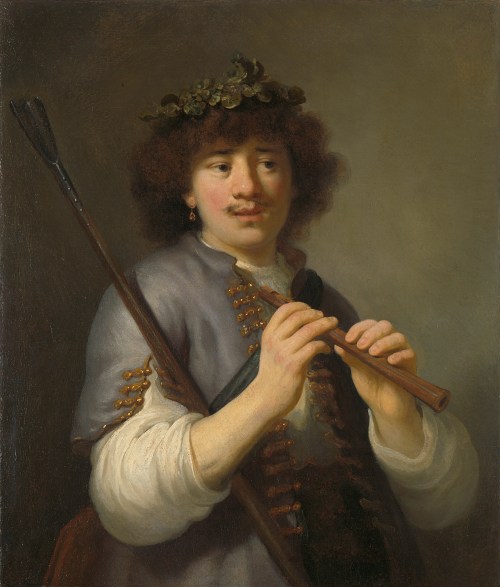
#FineArtFriday: Rembrandt as Shepherd with Staff and Flute, by Govert Flink 1636

About the artist: Born at Kleve, capital of the Duchy of Cleves, which was occupied at the time by the United Provinces, Govert Flinck was apprenticed by his father to a silk merchant, but in 1627 he was sent to Leeuwarden, where he boarded in the house of Lambert Jacobszoon. Jaobszoon was a Mennonite (one of the historic peace churches known for their commitment to pacifism). While Jacobszoon is better known as a preacher, he was a talented painter and an excellent teacher.

While studying there, Flinck met some of Jacobszoon’s neighbors, relatives of Saskia van Uylenburgh, who had married Rembrandt in 1634. That same year he began studying with Rembrandt.

Flinck is acknowledged as one of Rembrandt’s best pupils.

I really enjoy this romantic painting of Rembrandt dressed as a shepherd, holding a flute, and thinking about…what? Rembrandt’s contemplative expression seems peaceful.  The details are wonderful – from the finely worked trim on his garments down to the jewel dangling from his right ear, a gem that softly glows. The grains of the wood in both the flute and staff are subtle and real. The light falls perfectly – Flinck captured the personality of the master as a handsome young man during the happiest time of his life, and it seems as if Rembrandt himself enjoyed posing for it.

For more than a decade, Flinck’s work echoed that of Rembrandt, clearly influenced by the master’s style in the work which he executed between 1636 and 1648. As time passed, he began to desire to be a history painter, a genre in painting that  is defined by its subject matter rather than artistic style, and turned to the work of Peter Paul Rubens. In later years, Flinck had great commercial success, receiving many commissions for official and diplomatic paintings.


Credits and Attributions:

Wikimedia Commons contributors, “File:Rembrandt als herder met staf en fluit Rijksmuseum SK-A-3451.jpeg,” Wikimedia Commons, the free media repository, https://commons.wikimedia.org/w/index.php?title=File:Rembrandt_als_herder_met_staf_en_fluit_Rijksmuseum_SK-A-3451.jpeg&oldid=225225289 (accessed August 16, 2018).

Comments Off on #FineArtFriday: Rembrandt as Shepherd with Staff and Flute, by Govert Flink 1636

Filed under #FineArtFriday

Plot and Theme #amwriting

The basic premise of any story I want to write can be explained by answering eight questions. Each answer is simply one or two lines, guideposts for when I draft the outline.

A plot idea I’ve used before as an example is an idea I’ve had rolling around for a while. I hope to write it as a novella (about 12,000 words) in November. This little tale features a pair of thieves-for-hire, set in an alternate renaissance reality.

  1. Who are the players? Pip and Scuttle. Two orphaned brothers who grew up on the streets of Venetta, a medieval city, but who have a strong moral code. When the story opens, they are adults. The pair has become what is known as “Discreet Thieves,” professional retrievers-for-hire who reunite their clients with their lost or stolen valuables.
  2. Who is the POV character? Scuttle, the older brother.
  3. Where does the story open? In a pawn shop.
  4. What does the protagonist have to say about their story? Scuttle swears they aren’t thieves. They are believers in God and the laws of the Church. They only retrieve items belonging to noble clients with impeccable reputations and do it with no fuss or drama.
  5. What is the inciting incident? A highly placed Cardinal has hired them to retrieve an item, neglecting to tell them:
  • It is equipped with a curse that affects all who would steal it from the rightful owner. (Haven’t figured out what the curse is yet.)
  • It didn’t belong to the Cardinal in the first place.
  • He intends to use it to depose the true Pope and become the ruler of both the Church and Venetta.
  1. At the midpoint, what do the protagonists want and what are they willing to do to get it? They will do anything to get the curse removed from themselves and prevent the evil Cardinal from using the object against the Good Pope.
  2. What hinders them? The Cardinal has kidnapped Mari, Scuttle’s wife, and holds her in his dungeon, forcing Scuttle to do his bidding.
  3. How does the story end? Not sure. Is there more than one way this could go? Yes. I list each possible ending as they occur to me.

At the beginning of the story, what does our protagonist want that causes them to risk everything to acquire it? How badly do they want it, and why? The answer to that question must be that they want whatever it is desperately.

Question number six is an important question to consider. What ethical dilemma will the protagonist be faced with in their attempt to overcome the odds and achieve their objective?

In this story, one hard moral choice I could write would be to have Scuttle pressured to become a spy for the Cardinal.

Or, he could be pressured to sell out Pip.

How would he respond to either of these situations? I could write both and choose the one that works best. If I do that, I’ll make a note of the divergent path on my outline.

The answer to question number seven is vitally important because the story hinges on how the protagonist overcomes adversity. What hinders them? Is there an antagonist? If so, who are they, and why are they the villain of the piece?

“There has to be evil so that good can prove its purity above it.” The Buddha said it, but it’s a fundamental truth we writers of genre fantasy must consider when devising plots. J.R.R. Tolkien understood this need for a hero quite clearly.

Answering question eight is crucial if I want to have a complete novel with a beginning, middle, and end.

Endings are hard and complicated to write because I can see so many different outcomes. I write as many endings as I need to and save them in separate files.

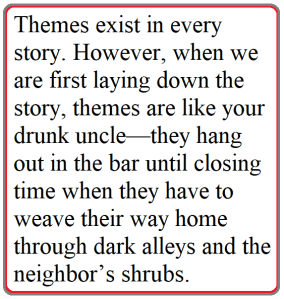
Sometimes, even if we have plotted in advance, we can’t identify the central theme of the story. Theme is what the story is about on a deeper level than what is seen on the surface. It’s the big meaning, a thread that is woven through the entire story, and sometimes it is an unstated moral for the reader to infer.

Many final objectives don’t concern issues of morality. However, if you are writing genre fiction, achieving all final objectives should have consequences and should involve a struggle.

Regardless of the theme, the struggle must be personal. Why would Frodo and Sam go to the depths of Mordor and suffer the hardships they endured in their effort to destroy the One Ring and negate the power of Sauron?

Frodo and Sam saved the world because it was the only way to save The Shire and the people they loved from Sauron, who was the embodiment of evil.

No matter how careful I am when building my outline, there is always a point where I am writing by the seat of my pants. I am usually a linear plotter, but things come along that change the direction a tale goes in.

This is where making use of scene breaks can be your friend. In the NaNoWriMo manuscript, I simply head that section (in bolded font) with the words Possible Ending 1 or 2, or however many endings I have come up with.

No matter if you are writing a NaNoWriMo novel or not, your finished novel will look vastly different from the block of stone you carved it from. Yet, it will be the core of the stone, the hidden story that was waiting for you to bring it to light.

Many times, I find myself re-evaluating a nearly complete manuscript because the story isn’t working. I go back and ask myself the same eight questions. If the story has gone in a new direction by midpoint, a different roadmap to the final scene can help you keep things logical.

However, a plot is just the frame upon which the themes of a story are supported. Knowing the main theme at the outset makes writing the first draft much easier.

When your writing mind has temporarily lost its momentum, and you are stretching the boundaries of common sense, it’s time to stop and consider the central themes. It helps to remind myself of the elements that really drive a plot.

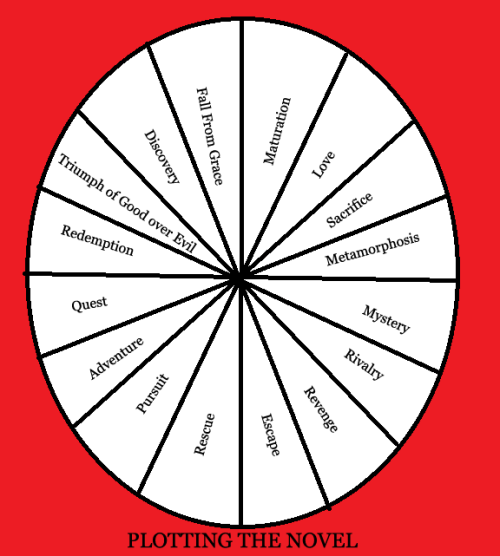
Subthemes help keep the story interesting. The image at the bottom of this post is a visual tool, a circular list of themes and subthemes that I made a few years ago.

It’s a picture that you can save (right click>save as>png or jpeg) print out and tape to your desk. Whenever you have lost your way, rather than resort to a sudden influx of something far-fetched, feel free to refer back to this picture and see if a better idea presents itself.

Hopefully, you won’t have to resort to killing anyone you might need later.

7 Comments

Filed under writing