Monthly Archives: December 2022

Pinning Down the Themes when your Characters Have Agency #amwriting

My writing mind has temporarily lost momentum in my current work. At this point, I’m unsure how to proceed with a pivotal chapter. This has me momentarily stalled on that book.
how the universe works themeFortunately, Irene is editing the final draft of a book I finished during lockdown. She sends me one or two chapters with notes for final revisions each evening. That makes me happy—it’s been a while since I published a book.

When I am stalled on a first draft, it helps to stop and consider the central themes. Theme is one of the elements that drive a plot. This novel’s central theme is redemption, which hasn’t changed.

But this novel is in the first draft stage, and things have already shifted from what was initially plotted. And now I find that some of my characters aren’t as well-planned as I thought they were.

This happens at some point in every first draft. I don’t know the themes of three important characters.

My male protagonist’s void is the death of his brother, and his theme is living through grief. I have that theme pretty well established, but the three side characters are still unclear. Their themes are mysteries at this point. I don’t know their voids as well as I thought, so it’s back to the drawing board.

This happens because the characters have agency and have taken the plot in a different direction than was planned. They are still headed toward the intended destination but are taking the plot through unfamiliar territory.

plot is the frame upon which the themes of a story are supportedAgency is an integral aspect of the craft of writing. It means allowing your characters to make decisions that don’t necessarily follow the original plot outline. This gives them a chance to become real, the way Pinocchio wanted to be a real boy and not a puppet.

A fourth personality has emerged. She’s a side character, and I like the chemistry she has with the others. But her introduction means I must revise my plot outline. Fortunately, clues are emerging.

This constant adjusting of plot and theme is why it takes me more than a year to finish a novel’s first draft. My work is character-driven, and sometimes these people are driving in a demolition derby.

Now I need to refer back to my stylesheet and look at the calendar. I will adjust events to match the timeline when a significant change happens. Adjusting my outlines is a simple process because I create them in Excel. I can delete or move events along the timeline as needed.

My story has a specific ending, but the detours have confused me. Going back to the outline and seeing where the plot took a different turn helps me find my way when I am stuck. It sometimes jars things loose, giving me a flash of inspiration about these characters.

Themes are fundamental underpinnings of the story and can be difficult to get a grip on. They’re subtle, an aspect of our work that is rarely stated in a bald fashion. And despite not being blatantly obvious, themes unify the events of a story. They are idea threads that bind the beginning to the middle and end.
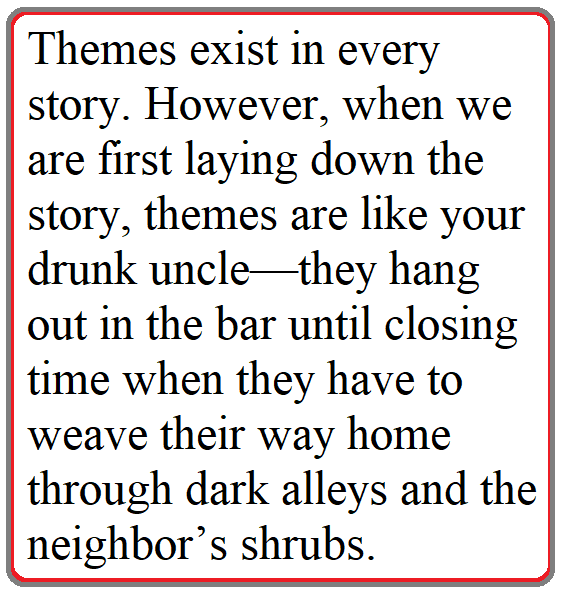
theme_meme_lirf06302020Sometimes we can visualize a complex theme but can’t explain it. If we can’t explain it, how do we show it? For me, that is the real struggle. Grief is a common theme that can play out against any backdrop, sci-fi or reality-based, where humans interact emotionally. But it is a complex theme, and people all react differently to it.

Sometimes themes emerge out of a character’s void, which is how the main theme for this story came about.

  • VOID: Each person lacks something, a void in their life. What need drives them?

Their verbs can also suggest themes.

  • VERBS: What is their action word? How does each character act and react on a gut level?
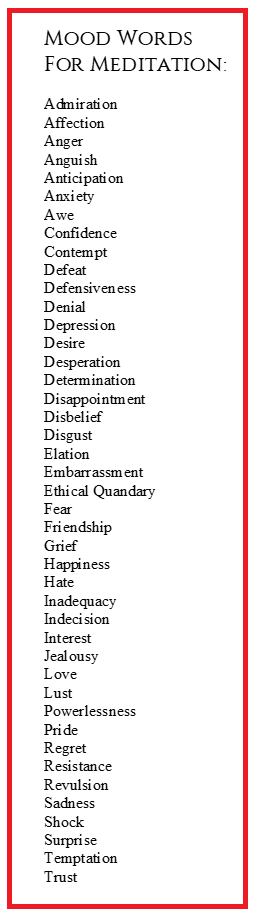
Mood words for meditationHighlighting a strong theme is challenging, even when I begin with a plan. But once I have identified these personal themes, I’ll be able to write their stories. I’ll use actions, symbolic settings/places, allegorical objects in the setting, and conversations to reinforce their personal themes. Their subthemes will support the foundational thread of redemption.

Writing requires a lot of mind-wandering on my part. I spend a lot of time playing solitaire on my computer and thinking about the plot.

When I’m stuck, it always comes back to the themes and subthemes. I have to look again at their individual voids and verbs, the aspects that define them as people. I may have to assign different verbs to them, as they aren’t reacting to each other the way I initially thought they would.

Once I know how their gut-reactions affect them, I will know their personal themes. They will become real, three-dimensional people, the way the protagonist is.

So, that is what I am working on in my current first-draft project this week. NaNoWriMo got it off to a good start, but now the real work begins.


8 Comments

Filed under writing

Finding the Words #amwriting #TheStruggleIsReal

When we sit down to write, we consciously create pictures with words. If we have done our job, the ideas they generate in the reader’s mind are infinite.

Words-And-How-We-Use-ThemWe often see memes and quotes about writing that resonate with us. Quotes often become memes because they are true and memorable and sometimes poke fun at us.

“One day I will find the right words, and they will be simple.” ― Jack Kerouac

The words we write create images in the mind of the reader. If the ideas they represent are phrased right, the complete picture will be understood. We must believe that readers will see the images we paint for them.

“The secret of being a bore is to tell everything.” – Voltaire

This is where it becomes difficult for me as a writer. I know I don’t have to spell everything out in minutia because readers are intelligent. But the insecure writer inside me fears that the reader will become confused if I don’t.

Still, I force myself to trim it down. My editor regularly points out the fluff. If I offer the reader a framework to hang their imagination on, they will see the story.

“The role of a writer is not to say what we can all say, but what we are unable to say.” – Anais Nin

I write because writing fiction helps me work my way through troubled times. When I write, I can better see how to navigate life experiences that seem too big, too scary. I face things head-on, use my incredible Office Managerial Superpowers and get things done.

I write for me, but readers may feel those emotions and sympathize with my characters’ situation. They may find a little comfort in knowing they aren’t alone.

 I’m a poet. Keeping it simple isn’t my best thing, but I’m working on it.

“My aim is to put down on paper what I see and what I feel in the best and simplest way.” – Ernest Hemingway

Hemingway gives us a truism here—don’t use “ten-dollar-words.” That’s an old-fashioned term for long words used in place of more common words. Word nerds (like me) adore those rare, bombastic morsels of linguistic delectableness.

bombasticLIRF12032022However, obscure and pretentious prose (such as I enjoyed laying down in the preceding sentence) annoys the majority of readers. I want my work to please a reader, so I don’t indulge in ostentatious phrasing except in poetry.
Right now, my editor is combing her way through the final draft of a manuscript I hope to publish this spring. She keeps me on track and points out where a reader might have to find a dictionary and look up a word.

Sometimes I leave the words in, because they are the only ones that work, and I don’t want to underestimate my readers by dumbing down my prose. Occasionally looking up a word can be fun and reading on an electronic device makes it easy.

Even though writing fiction is a solitary occupation that takes up my early morning hours, I find that writing a few paragraphs in my journal each evening helps organize my daily life. Things that happened that day become clearer once I write them out. Tasks that seem too big to accomplish are easier to resolve once I have them broken down on paper.

Writing fantasy offers me the chance to express my ideas, in a safe, non-threatening environment, without pushing them on other people. These ideas become part of the scenery, subtle hints detailing the societal framework the protagonist must live in.

All writers do this, no matter what genre or category they write in. Our personal philosophies become entwined in the book in subtle ways. Whether intentional or not, we use our words to create societies and offer ideas that challenge the status quo.

Choosing our words well is part of the job. Often, I feel a bit poetic when visualizing the world in which the story takes place. I try to tame it, but it emerges, hopefully in palatable bites. I don’t want too much—it has to be just enough to create an atmosphere.

I became a poet and songwriter because I love words, love twisting them, love rhyming them—just love them. My whole family adores words in all their glory. My parents used proper words and expected us to know and use them.

 My Dad loved words so much that he mangled them just because he liked how they sounded. He was an amputee, and sometimes he became so frustrated that he lost his words and resorted to creative cursing.

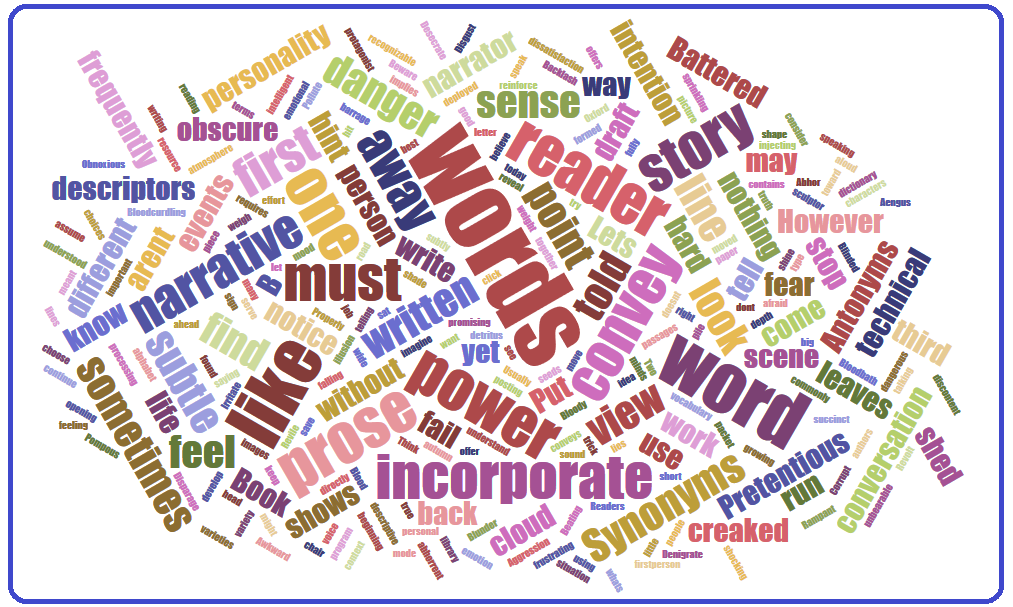
powerwordsWordCloudLIRF06192021Mama and Dad both invented words and twisted others: a screwdriver was a skeejabber. Any object can be a doo-dad, but they were often doodle-be-dads in our house. When one or the other parent was mystified, they were bumfuzzled.
Seldom-used arcane words are in my blood, so writing lean, relatable prose is an ongoing task. I’m always trying to tone it down but not flatten it. I want a little of the poet to show through and my narrative to be literate, but I also want it to be readable.

Striking the right balance is a process.

“To write well, express yourself like the common people, but think like a wise man.” – Aristotle

25 Comments

Filed under writing

#FineArtFriday: The Stonebreakers by Gustave Courbet 1849

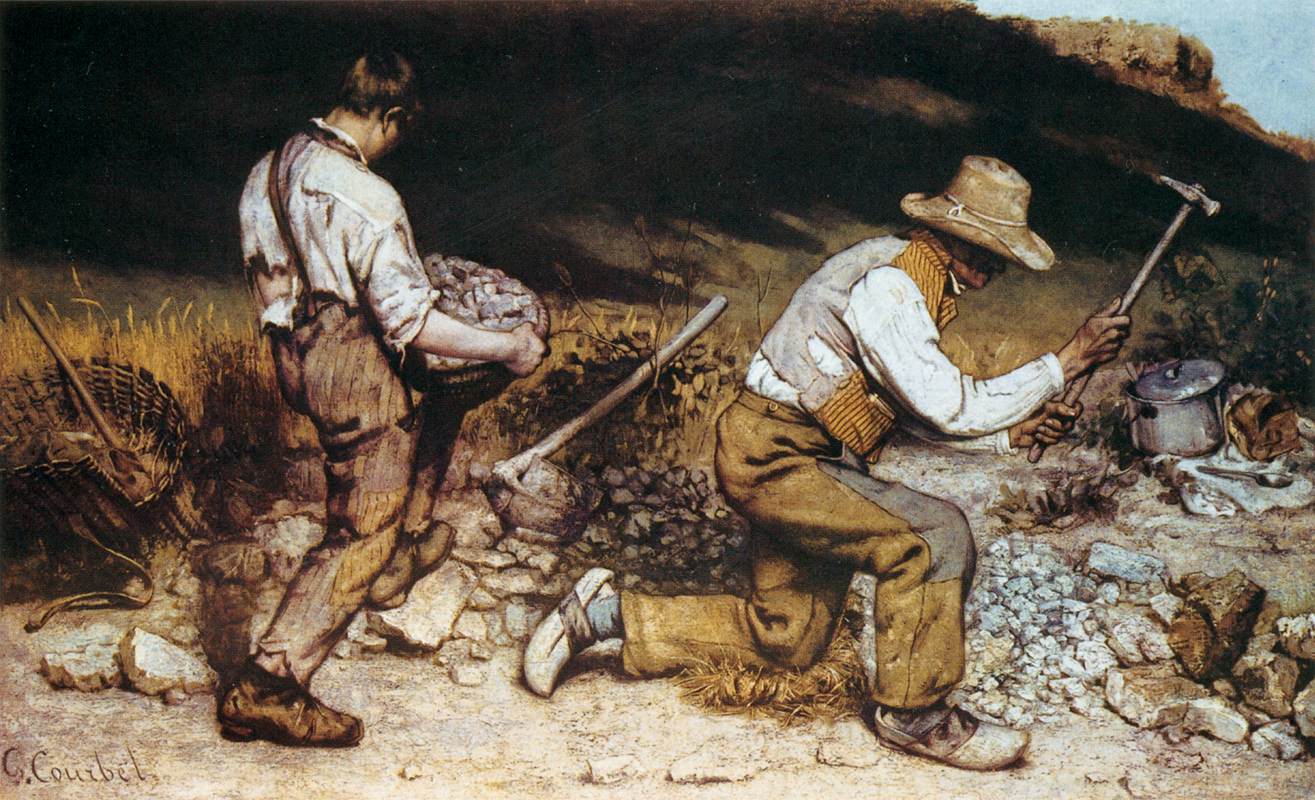
Gustave_Courbet_-_The_Stonebreakers_-_WGA05457Artist: Gustave Courbet  (1819–1877)

Title: The Stonebreakers

Date:1849

Medium: oil on canvas

Dimensions: height: 165 cm (64.9 in); width: 257 cm (101.1 in)

Current location: destroyed in fire, 1945 (Dresden, Germany)

Today’s image comes to us via the miracle of 20th century photography and modern digital photographic restoration.

The exact number of paintings and other art masterpieces that were either destroyed or are still missing since World War II is not known, but is estimated that during World War II, the Nazis looted some 600,000 paintings from Jews and Art Museums, at least 100,000 of which are still missing. Unfortunately, the original canvas of this painting was a casualty of war, destroyed in the bombing of Dresden.

About this image, via Wikipedia: Considered to be the first of Courbet’s great works, The Stone Breakers of 1849 is an example of social realism that caused a sensation when it was first exhibited at the Paris Salon in 1850. The work was based on two men, one young and one old, whom Courbet discovered engaged in backbreaking labor on the side of the road when he returned to Ornans for an eight-month visit in October 1848. On his inspiration, Courbet told his friends and art critics Francis Wey and Jules Champfleury, “It is not often that one encounters so complete an expression of poverty and so, right then and there I got the idea for a painting.”

While other artists had depicted the plight of the rural poor, Courbet’s peasants are not idealized like those in works such as Millet’s The Gleaners. [1]

Also via Wikipedia: The Stone Breakers (FrenchLes Casseurs de pierres) was an 1849 painting by the French painter Gustave Courbet. It was a work of realism, depicting two peasants, a young man and an old man, breaking rocks.

The Stone Breakers was first exhibited at the Paris Salon of 1850. As a work of realism the subject matter addressed a scene of everyday life. This painting was intended to show the hard labor that poor citizens experienced. Courbet did not show the figure’s faces, they represent the “every man” and are not meant to be specific individuals. At the same time the clothing of the figures implies some degree of individuality, the younger man’s pants are too short and the older man’s vest is striped.

The painting was destroyed during World War II, along with 154 other pictures, when a transport vehicle moving the pictures to the castle of Königstein, near Dresden, was bombed by Allied forces in February 1945. [2]

About the artist, via Wikipedia:

Jean Désiré Gustave Courbet (UK/ˈkʊərbeɪ/ KOOR-bay,[1] US/kʊərˈbeɪ/ koor-BAY,[2] French: [ɡystav kuʁbɛ]; 10 June 1819 – 31 December 1877) was a French painter who led the Realism movement in 19th-century French painting. Committed to painting only what he could see, he rejected academic convention and the Romanticism of the previous generation of visual artists. His independence set an example that was important to later artists, such as the Impressionists and the Cubists. Courbet occupies an important place in 19th-century French painting as an innovator and as an artist willing to make bold social statements through his work.

Courbet’s paintings of the late 1840s and early 1850s brought him his first recognition. They challenged convention by depicting unidealized peasants and workers, often on a grand scale traditionally reserved for paintings of religious or historical subjects. Courbet’s subsequent paintings were mostly of a less overtly political character: landscapesseascapeshunting scenesnudes, and still lifes. Courbet, a socialist, was active in the political developments of France. He was imprisoned for six months in 1871 for his involvement with the Paris Commune and lived in exile in Switzerland from 1873 until his death four years later. [1]

Credits and Attributions:

Image: Wikimedia Commons contributors, “File:Gustave Courbet – The Stonebreakers – WGA05457.jpg,” Wikimedia Commons, the free media repository, https://commons.wikimedia.org/w/index.php?title=File:Gustave_Courbet_-_The_Stonebreakers_-_WGA05457.jpg&oldid=661589775 (accessed December 1, 2022).

Wikipedia contributors, “Gustave Courbet,” Wikipedia, The Free Encyclopedia, https://en.wikipedia.org/w/index.php?title=Gustave_Courbet&oldid=1123079028 (accessed December 1, 2022). [1]

Wikipedia contributors, “The Stone Breakers,” Wikipedia, The Free Encyclopedia, https://en.wikipedia.org/w/index.php?title=The_Stone_Breakers&oldid=1070869064 (accessed December 1, 2022). [2]

4 Comments

Filed under #FineArtFriday