
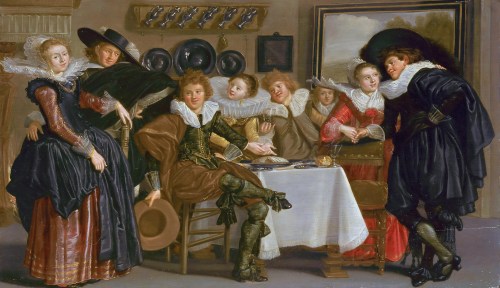
Merry company *oil on panel *30 x 51 cm *signed : D Hals 1635
Artist: Dirck Hals (1591–1656)
Title: Merry Company
Date: 1635
Medium: oil on panel
Dimensions: height: 30 cm (11.8 in); width: 51.1 cm (20.1 in)
Collection: Mauritshuis
What I love about this painting:
Perhaps we are celebrating the engagement of the young couple on the far right—a fashionably, yet modestly, dressed young woman and a gallant young man holding hands and gazing at each other.
The hostess, in the center, looks up and greets her guests who have entered to the left of us. She gestures to the food on the table, inviting them to sit. Are they the future in-laws?
The host looks directly at us, the viewer. He greets us as his guests and he too gestures to the table—join us! Sit, eat, and we’ll have an evening to remember. A single crystal wine glass shows us that wine is being served but companionship and food are what the party is really about. We are here to meet and get to know each other.
An engagement is a reason to gather and celebrate—so let us join this merry company and spend an evening with friends, partying like it’s 1635.
About the setting of this painting:
Dirck Hals has given us the image of friends partying in someone’s home. This is clearly not set in a tavern, as the walls are clean, freshly plastered and painted, and the fireplace at the far left has an ornate mantel. It is for heating the room only, not for cooking. The mantel’s aesthetics are part of the room’s decor.
The scene is set in a dining room. We see six pewter tankards proudly displayed on the wall above a sideboard, along with large pewter platters, signs that this is an intimate family room. We know they are pewter because of the dark bluish color of the metal. These are serving vessels every home needed in the 17th century, but only the wealthier middle-class could afford pewter.
And if you could afford to have a separate room just for dining, you would have your drinking vessels and platters displayed above a sideboard in the manner we see here.
In the background to the right, a fine, large landscape painting also indicates a prosperous home.
Everyone is dressed in their best clothes. The modest yet stylish dress of the guests also point to a domestic scene rather than a tavern. Their garments are made from expensive fabrics, silks and satins, and they wear the immense ruffs of crisp white lace that only the upper classes could afford. These are prosperous people, traders in cloth perhaps—but no matter what they trade, they are gathered to celebrate something, and we have been invited to join them.
Taverns and the poorer classes had either wooden tankards and bowls or fired clay mugs and platters. If they had an object made of pewter, it would be put away for safekeeping. The innkeepers and owners of public houses wouldn’t keep tankards where they could be knocked down or stolen.
About the Artist, Via Wikipedia:
Dirck Hals (19 March 1591 – 17 May 1656), born at Haarlem, was a Dutch Golden Age painter of merry company scenes, festivals and ballroom scenes. He played a role in the development of these types of genre painting. He was somewhat influenced by his elder brother Frans Hals but painted few portraits.
The Haarlem writer Samuel Ampzing mentions both brothers in his Praise of Haarlem with a poem stating that both brothers were exceptional; Frans painting his portraits “awake”, and Dirck painting his figures “purely”. [1]
About pewter, via Wikipedia:
Lidless mugs and lidded tankards may be the most familiar pewter artifacts from the late 17th and 18th centuries, although the metal was also used for many other items including porringers (shallow bowls), plates, dishes, basins, spoons, measures, flagons, communion cups, teapots, sugar bowls, beer steins (tankards), and cream jugs. In the early 19th century, changes in fashion caused a decline in the use of pewter flatware. At the same time, production increased of both cast and spun pewter tea sets, whale-oil lamps, candlesticks, and so on. Later in the century, pewter alloys were often used as a base metal for silver-plated objects. [2]
Credits and Attributions:
IMAGE: Merry Company by Dirck Hals, Public domain, via Wikimedia Commons (accessed December 29, 2022).
[1] Wikipedia contributors, “Dirck Hals,” Wikipedia, The Free Encyclopedia, Dirck Hals (accessed December 29, 2022).
[2] Wikipedia contributors, “Pewter,” Wikipedia, The Free Encyclopedia, https://en.wikipedia.org/w/index.php?title=Pewter&oldid=1129247091 (accessed December 29, 2022).
 The publishing world is a rough playground. Editors for traditional publishing companies and small presses have a landslide of work to pick from and are chronically short-staffed. They can’t accept unprofessional work regardless of how good the story is.
 Before you hire an editor, check their qualifications and references.
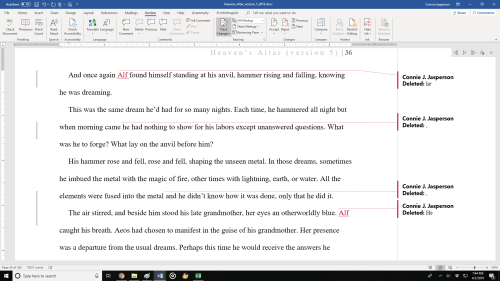
 If you’re a member of a writers’ group, you have a resource of people who will beta read for you at no cost. As a critique group member, you will read for them too.
 Clearly and consistently label each chapter. Ensure the chapter numbers are in the proper sequence, and don’t skip a number. I would label my individual chapter files this way:
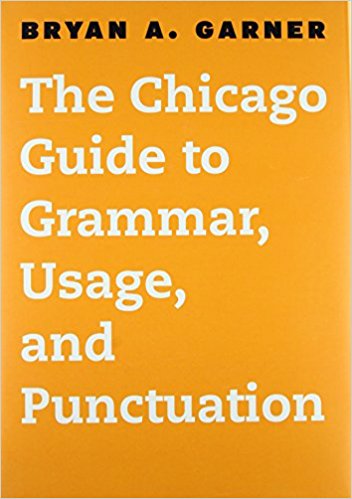
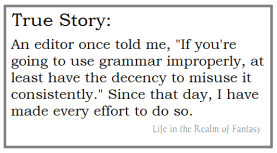 If you are writing in the US, you might consider investing in
 I have talked about this novella many times, as I think it is one of the most enduring stories in Western literature. The opening act of this tale is a masterclass in how to structure a story.
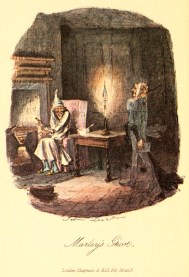 “Marley was dead, to begin with. There is no doubt whatever about that. The register of his burial was signed by the clergyman, the clerk, the undertaker, and the chief mourner. Scrooge signed it. And Scrooge’s name was good upon ‘Change for anything he chose to put his hand to. Old Marley was as dead as a doornail.”
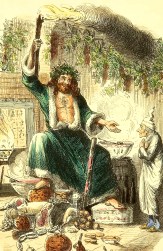 As I mentioned before, this book is only a novella. It was comprised of 66 handwritten pages. Some people think they aren’t “a real author” if they don’t write a 900-page doorstop, but Dickens says differently.
 For me, revisions begin with the second draft and sometimes involve radical changes to the storyline or character arcs. I may take a manuscript through many drafts before finally getting the story right.
 NEVER DELETE months of work. Don’t trash what could be the seeds of another novel. Save it in an outtakes file and use it later. I give the subfile a name like HA_outtakes_20Dec2022. That file name tells me the cut chapters were last changed on December 20, 2022.
 Then, I give the second draft a new file name: Heavens_Altar_version_2, which becomes the version I work on out of the main file folder.
 Either way, the characters will be profoundly changed from who they thought they were on page one, becoming who they are when the final sentence is written. The character arc is formed by their experiences.
 True inspiration is not an everlasting firehose of ideas. Sometimes there are dry spells. If you take another look at the work you have cut and saved in an outtakes file, you might see it with fresh eyes. You might see the seeds of a different story, and the fire for writing will be reignited.
 I understand that slight incompatibility has been resolved. In my opinion, both programs are good, and both have pros and cons.
 Most word processing programs have some form of spellcheck and some minor editing assists. Spellcheck is notorious for both helping and hindering you.
 You might disagree with the program’s suggestions. You, the author, have control and can disregard suggested changes if they make no sense. I regularly reject weird suggestions.
 I am wary of relying on Grammarly or ProWriting Aid for anything other than alerting you to possible problems. If you blindly obey every suggestion made by editing programs, you will turn your manuscript into a mess.
 Also, it never hurts to have a book of synonyms on hand. We all tend to inadvertently repeat ourselves, and the Read Aloud function will shed light on those crutch words. A dictionary of synonyms and antonyms can help us find good alternatives.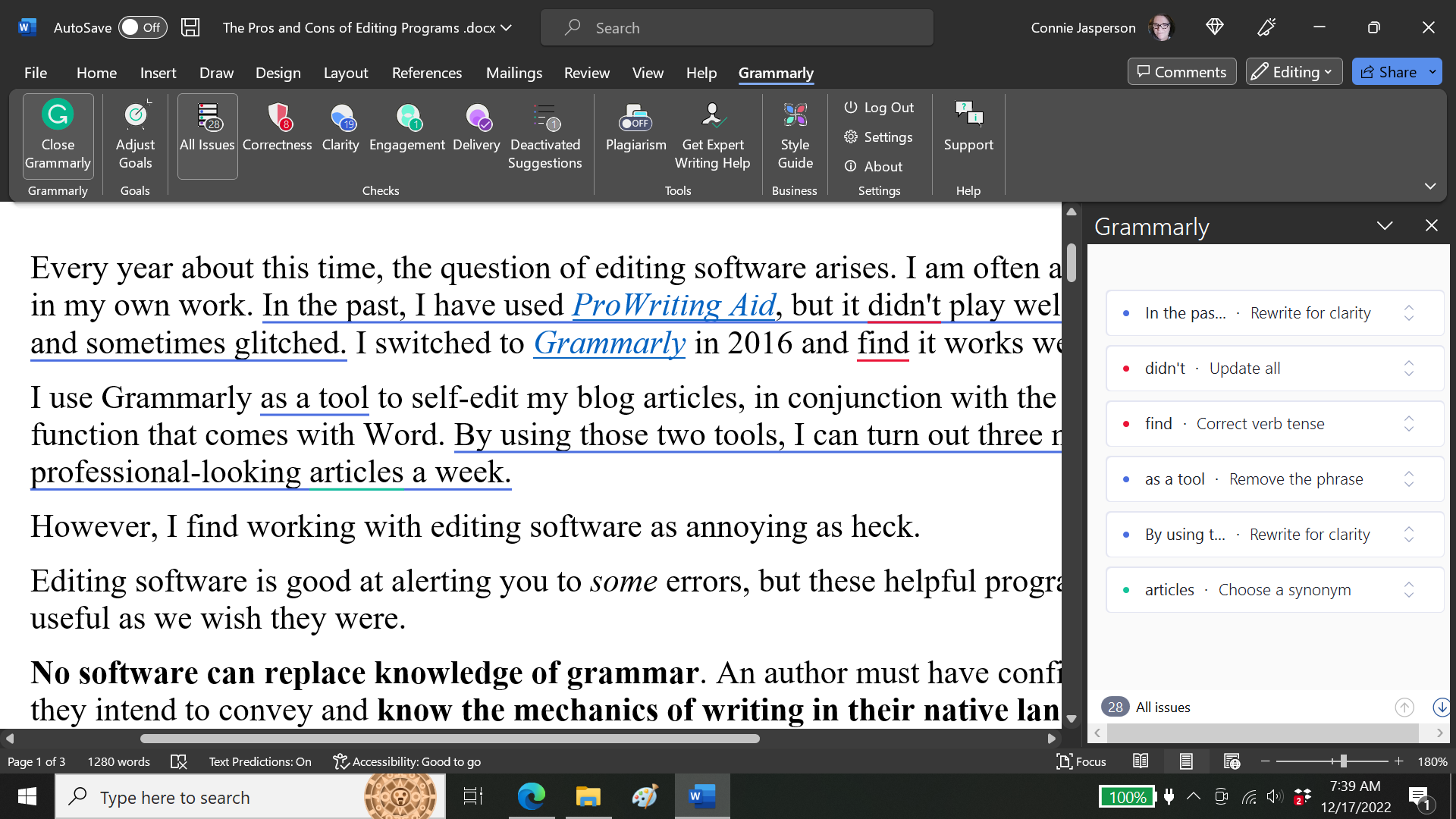
 Our universe is a mysterious, stunning place. One puzzle that has occupied scientists for decades is the observable fact that our universe has more matter and energy than it should.
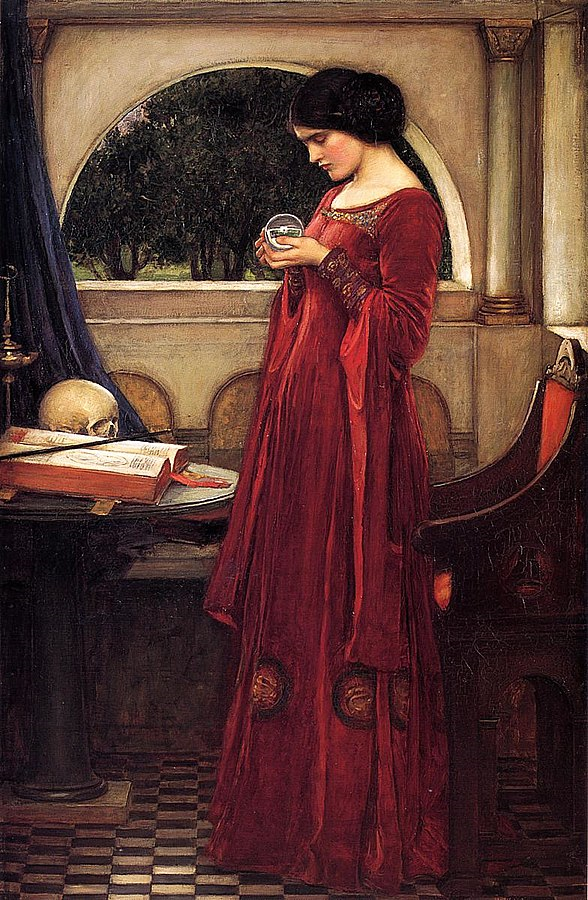 Since mainstream science still pooh-poohs its existence, telepathy and empathic abilities are whatever we who write books decide they are. I choose to see telepathy as an extension of the dark energy that scientists admit is all around us. Some people can tap into it, but others can’t.
 If a real person had the kind of power that our fictional empaths wield, we would hope they were noble, compassionate, and above all, respectful of other people’s wish for privacy. We would want them to be principled, a person who would never rummage in people’s minds uninvited.
 How will you describe it when they are healing on a cellular level? Some authors describe the act of healing as evil-looking lights changing to a healthier color. Others describe healing as angry-looking threads that must be untangled. Still other authors describe it as a feeling of evil that must be smoothed away.
 As a younger reader, I gravitated to fantasy books that feature telepathy, healing, and magic. Two series with well-designed magic and empathic systems are:
 Superpowers are both science and something that may seem like magic, but they are not. Think Spiderman. His abilities are conferred on him by a scientific experiment that goes wrong.
 Artist: Pieter Breughel the Younger (1564–1638)


 Life in the Realm of Fantasy