
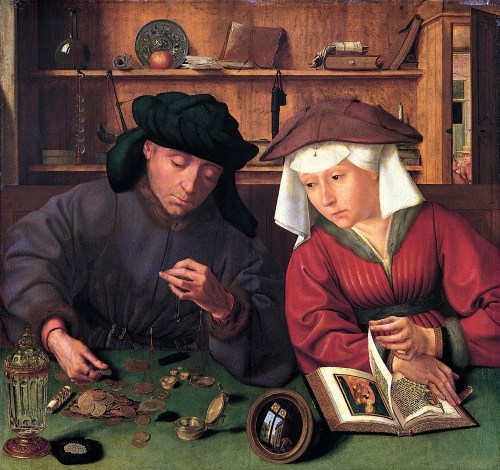
- Artist: Quentin Matsys (1456/1466–1530)
- Title: The Moneylender and his Wife
- Date: 1514
- Medium: oil on panel
- Dimensions: Height: 70.5 cm (27.7 in)
- Current location: Louvre Museum
- Inscriptions: Signature and date
The Money Changer and His Wife is a 1514 oil on panel painting by the Flemish renaissance artist Quentin Matsys.
What I love about this painting:
I first featured this painting in June of 2020. The pandemic was raging, and my husband and I spent many an hour on our back porch, sitting in the shade and watching the birds. I’d seen all the television I could stand, and so I talked Greg into helping me select a painting for that week’s Fine Art Friday post.
We sat in the shade, drinking iced tea. I had my laptop out, and together we searched though the incredible storehouse of great art available on Wikimedia Commons.
That night, we fell in love with this painting.
These two people seem happy with each other. Matsys’ shows them with rich and vivid colors, and sharp, clean lines. He included the smallest details in the prayer book, the pewter plate in the background, and the crystal jar by the man’s right hand, showing a prosperous, well-educated young couple.
In some ways, Matsys’ style and level of detail reminds me of the work of the lesser-known Flemish painter, Pieter Brueghel the Younger, who was born long after Matsys’ death. The few original works of Pieter Brueghel the Younger that have survived leaned more toward caricatures and grotesques.
About this painting, via Wikipedia:
A man, who is weighing the jewels and pieces of gold on the table in front of him, sits next to his wife who is reading a book of devotion with an illustration of the Virgin and Child. The couple is not dressed as members of nobility, but rather as well-to-do burghers of Antwerp, where the painting was made. At the time, Antwerp had grown with the influx of many southern immigrants fleeing the Spanish Inquisition. Among this international community there was a demand for money-changers and money-lenders, as international commerce was increasing in the port city.
About the Artist, via Wikipedia:
Most early accounts of Matsys’ life are composed primarily of legend, and very little contemporary accounts exist of the nature of his activities or character. According to J. Molanus’ Historiae Lovaniensium, Matsys is known to be a native of Leuven with humble beginnings as an ironsmith. One of four children, Matsys was born to Joost Matsys (d. 1483) and Catherine van Kincken sometime between 4 April and 10 September 1466. Legend states that Matsys abandoned his career as a blacksmith to woo his wife, who found painting to be a more romantic profession, though Karel van Mander claimed this to be false, and the real reason was a sickness during which he was too weak to work at the smithy and instead decorated prints for the carnival celebrations.
Matsys work is considered to contain strong religious feeling—characteristic of traditional Flemish works—and is accompanied by a realism that often favored the grotesque. Matsys’ firmness of outline, clear modelling and thorough finish of detail stem from Van de Weyden’s influence; from the Van Eycks and Memling by way of Dirck Bouts, the glowing richness of transparent pigments. Matsys’ works generally reflect earnestness in expression, minutely detailed renderings, and subdued effects in light and shade. Like most Flemish artists of the time, he paid a great deal of attention to jewelry, edging of garments, and ornamentation in general.
Credits and Attributions:
The Money Changer and His Wife by Quentin Matsys, 1514 Public domain. The work of art depicted in this image and the reproduction thereof are in the public domain worldwide. The reproduction is part of a collection of reproductions compiled by The Yorck Project. The compilation copyright is held by Zenodot Verlagsgesellschaft mbH and licensed under the GNU Free Documentation License.
Wikipedia contributors, “The Money Changer and His Wife,” Wikipedia, The Free Encyclopedia, https://en.wikipedia.org/w/index.php?title=The_Money_Changer_and_His_Wife&oldid=937629150 (accessed June 04, 2026).
Wikipedia contributors, “Quentin Matsys,” Wikipedia, The Free Encyclopedia, https://en.wikipedia.org/w/index.php?title=Quentin_Matsys&oldid=960328863 (accessed June 04, 2026).


Definitely a wonderful painting, Connie! The reflection of a window somewhere in the room is another striking detail.
LikeLiked by 1 person
Hello Audrey, I like that little touch too, and I’m glad you mentioned it. It reminds me of Jan van Eyck’s 1434 painting, “The Arnolfini Portrait,” another of my favorite paintings.
LikeLiked by 1 person
Yes, exactly! I thought of that one too.
LikeLiked by 1 person