
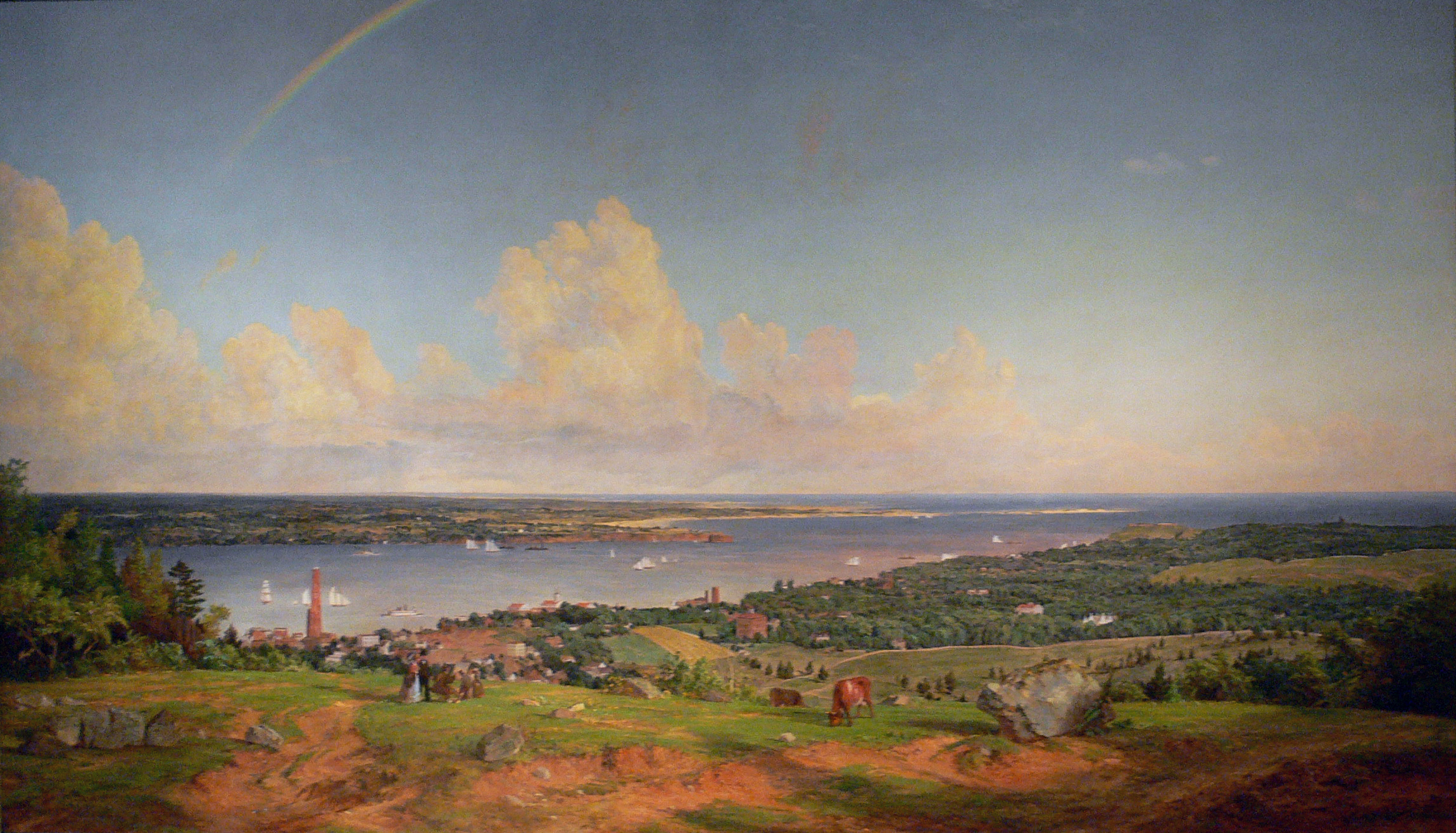
 Artist: Jasper Francis Cropsey (1823–1900)
Title: The Narrows from Staten Island
Genre: landscape painting
Date: 1868
Medium: oil on canvas
Collection: Amon Carter Museum of American Art
Why this painting makes me happy:
It’s a glorious summer’s day beneath a wide blue sky. A few wisps of the morning’s mist are drifting away, gradually giving way to the midday sun. The Narrows (a tidal strait separating the boroughs of Staten Island and Brooklyn in New York City) is alive with small sailboats. People are out enjoying the summer weather and soaking up the sun. Even the cattle seem to be enjoying themselves.
This is a painting that invites you to set aside your cares and enjoy the moment.
About the Artist:
Jasper Francis Cropsey (February 18, 1823 – June 22, 1900) was an American architect and artist. He is best known for his Hudson River School landscape paintings.
Cropsey trained as an architect under the tuition of Joseph Trench in the early 1840s, a period in which he was also trained in watercolor painting, instructed by Edward Maury, and took some life drawing courses at the National Academy of Design. He set up his own architecture office in 1843, but began exhibiting his watercolors at the National Academy of Design in 1844. A year later he was elected an associate member and turned exclusively to landscape painting; shortly after he was featured in an exhibition entitled “Italian Compositions”.[1]
To learn more about Jasper Francis Cropsey, go to Jasper Francis Cropsey – Wikipedia.
Credits and Attributions:
IMAGE: Wikimedia Commons contributors, “File:Jasper Francis Cropsey The Narrows from Staten Island Amon Carter Museum.jpg,” Wikimedia Commons, https://commons.wikimedia.org/w/index.php?title=File:Jasper_Francis_Cropsey_The_Narrows_from_Staten_Island_Amon_Carter_Museum.jpg&oldid=1123783444 (accessed August 26, 2026).
[1] Wikipedia contributors, “Jasper Francis Cropsey,” Wikipedia, The Free Encyclopedia, https://en.wikipedia.org/w/index.php?title=Jasper_Francis_Cropsey&oldid=1364518894 (accessed August 26, 2026).


