
Even if we begin with a plan, which I usually do, we never really know how a story will go. Somewhere along the line, I will deviate somewhat from the original outline. In my work, the major events usually remain as they were originally plotted, but not always.
 However, an outline keeps me on track with length. Also, an outline keeps the action moving.
SO, I have recently discovered that the reason a work-in-progress that is 40,000 words toward completion doesn’t make me happy is that I have missed a great opportunity and am trying to force the plot in a direction that no longer works.
This means that while a lot of what has already been written can be reused, a fundamental part of the character arc may have to be cut and rewritten. Also, the story’s arc will change, and if I am going to stay on track so events progress logically, I need to write a new outline.
SIDE NOTE: Everything I have written and then cut is fodder for other uses. I NEVER trash anything that was already written, although I do save it in a file labeled “Outtakes.”
Even though each manuscript starts linearly, I work “back and forth” when writing rather than in a linear fashion. When I am laying down a first draft, each section of my novel is written when I am inspired to work on that part of the tale.
I list the central plot points I currently know on the outline, then write them. That will amount to about 20,000 words in five or six sections. Then, I write connecting scenes to ‘stitch’ the sections together when the draft is complete, like assembling a quilt. That brings the manuscript to about 40,000 words.
At that point, I am looking for the ending. On rare occasions, I know how it must end, but even in those cases, writing that final 20,000 words is Literary Hell, an abyss from which it feels as if I will never emerge.
And then … into the darkness comes a ray of sunlight … the seeds of the true plot begin to sprout, and suddenly I am off to the races.
At some point I will need to open my stylesheet/storyboard and correct it to show my new timeline and order of events so everything flows, with one scene transitioning to another and no jarring “Wait … what just happened?” moments.
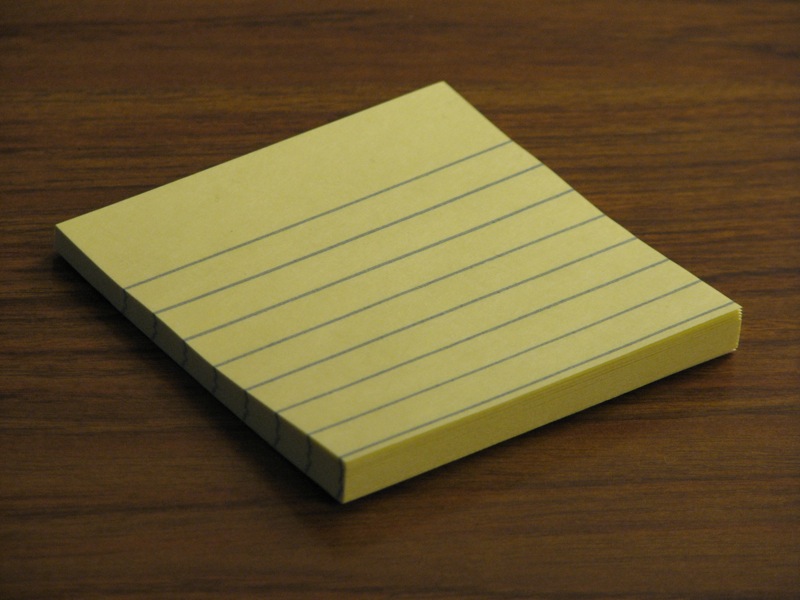 I was a bookkeeper for most of my career, and I use a program I am familiar with, Excel. But you can use Google Sheets, a whiteboard and sticky notes, or a spiral notebook. Use whatever works for you and that you can update as needed, but my storyboard works this way:
At the Top of page one: I give the piece a working title.
When I have an idea for a short story, I include the intended publication and submission deadline (not needed if it’s for a novel). I make a note of the intended word count. Having a word count limit keeps me alert for unnecessary backstory. For most publications, you must keep strictly within their word count requirements.
Page one of the workbook contains the personnel files.
Column A: Character Names. I list the essential characters by name and the critical places where the story will be set.
Column B: About: What their role is, a note about that person or place, a brief description of who and what they are.
Column C: The Problem: What is the core conflict?
Column D: What do they want? What does each character desire?
Column E: What will they do to get it? How far will they go to achieve their desire?
Page Two: I create a page for the projected story arc on page two of the workbook. I list each chapter by the events that need to be resolved at various points in the manuscript.
Page three of the workbook is the most important—the Glossary. This list of made-up words, names, and places is crucial for the finished product. The way words appear on this list is how they should occur throughout the entire story, novel, or series. This page ensures consistency and keeps the spellings from drifting as I lay down prose in the first draft.
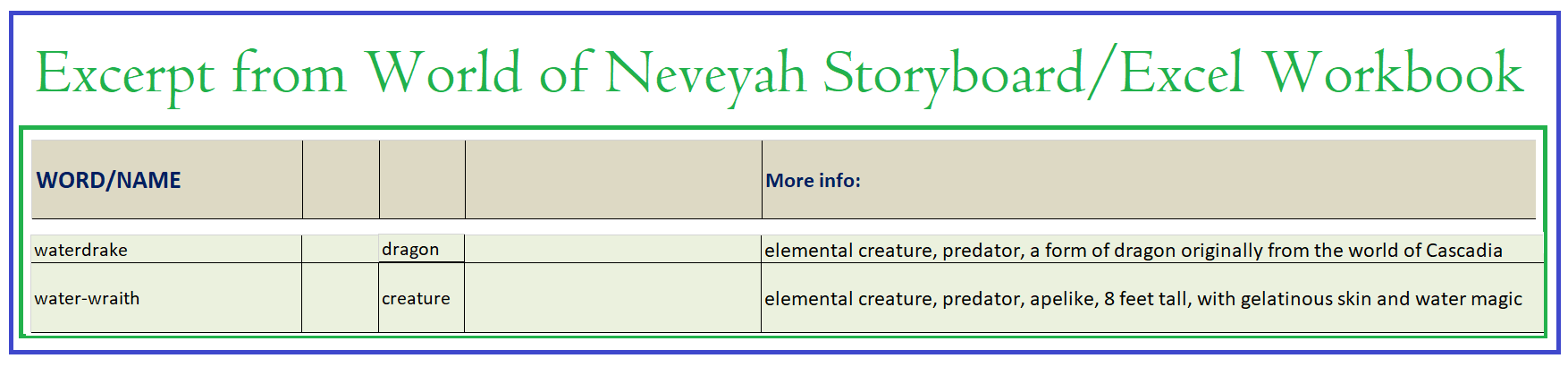 I update the glossary page whenever a word or name is added or changed. I do this even in my non-fantasy work, as it gives me a quick, easy-to-access reminder of how real-world names and places are spelled, and what story I used them in.
Page four will have maps and a calendar for that world. The calendar is a central tool that keeps events happening logically, and maps keep the traveler on the correct, previously established path.
The image below shows the page tabs for a storyboard I created in Excel for a series, and it has evolved since 2009. As you can imagine, it has grown since I took this screenshot, but it is still manageable and still useful. 
Even after five or six drafts, my editor will find things that didn’t get listed but should have been and will update the stylesheet.
Writing a novel is a process of growth and development. It doesn’t stop until you sign off on the proof copies and the book is on sale.
And even then, you will think of things you could have done better. That’s the curse of being a writer.


